Letter to the Editor: Bryan Langlois, DVM

   Time for The Industry to “Stand and Deliver” When it Comes to Accountability, Transparency, and Most Importantly, the Horse

“Ganas…all we need is Ganas.” –Jaime Escalante

Pretty simple words to say, but much harder to truly live by, and the racing industry is at the point now where it needs to truly not only say these words, but to live them.

Jerry Brown, in a letter to the editor recently published in the Thoroughbred Daily News, stated his belief that horses running in stakes races were not running true to form possibly because of not running on Lasix in those races. He pointed out that these horses may have been scoped post-race, but very often the fans, handicappers, and the public have no idea what the results of these scopes are. This issue is not related to just scoping a horse looking for bleeding, but in all facets of a horses medical care. Racing woefully fails this transparency test, a fact known for years.

One of the arguments (aside from the legal one of owners releasing records which is easily remedied with a change to an owner's license application) against providing full transparency of medical records and fatal injury data has always been that the public will not understand it, and the animal rights crowd will try to twist it to fit their narrative on things. That really is not an acceptable excuse. The industry can no longer rely on the old refrain of “you just don't understand the industry” when presented with any question or argument against racing. Take the time to explain what we all “don't understand,” but also explain it to the ones the industry has the most chance of making understand and converting to fans. It is something I have come to call the “10-80-10” rule.  Ten percent of people are always going to think racing is wrong, inhumane, and should be forever banned. They are never going to see it any differently. On the other end of the spectrum, there are 10% of people who think nothing needs to change in the racing industry at all. They will not agree to changing anything even if the data points to a need for it. Both extremes are not the area racing needs to solely focus on (even though both often shout the loudest). The focus should be on the 80% in the middle that are asking to be heard but are also willing to listen. Providing not only transparency but an explanation about that transparency in a manner that people can understand builds the trust needed to bring new blood into the game. It is not hard. It just takes “ganas.”

Finally, a constant refrain I am hearing all the time regarding the sport is, “Without the owners you have no sport,” or “Without the gamblers you have no sport.” This is all true. However, what must be remembered far more importantly is this: “Without the HORSE you have no sport”!!!

Without the HORSE you have no entity for owners to own.

Without the HORSE you have no entity for the gamblers to wager on.

Without the HORSE you have no entity for trainers to train.

Without the HORSE you have no entity for the jockeys to ride.

Without the HORSE you have no entity for vets to treat.

Without the HORSE you have no entity for the fans to root for.

As soon as we take the focus off the horse, we lose sight of what the most important thing in this sport is. The majestic animal we all fall in love with and root on to hold onto that lead or just get up at the wire is what the sport is all about. I am not trying to belittle the contributions of all the other stakeholders of this sport (and I know some will still be offended by my statement). However, NO ONE in this industry is in a position that is superior to the creature that makes it all possible. Keeping this in mind at all times is what will help re-invigorate fans and interest to the sport. Take care of the HORSE first and foremost, and the rest will follow and fall into place.

The time for just talking about change is over. We need meaningful actions to bring about that change. In some places it is happening. In others it is not. One thing remains a constant theme throughout, though. Want to bring this amazing sport to the next level and see it thrive? All it takes is “ganas.”

The post Letter to the Editor: Bryan Langlois, DVM appeared first on TDN | Thoroughbred Daily News | Horse Racing News, Results and Video | Thoroughbred Breeding and Auctions.

Source of original post

Taking Stock: Awesome Again Sires Have Puncher’s Chance

What do Hot Rod Charlie (Oxbow), Mystic Guide (Ghostzapper), and Knicks Go (Paynter) have in common?

For one, they've cumulatively won three of the four most lucrative dirt races contested in North America so far this year. Hot Rod Charlie won the $1 million Gll Louisiana Derby at Fair Grounds last weekend; Mystic Guide was first in the $600,000 Glll Razorback H. at Oaklawn Feb. 27; and Knicks Go took the $3 million Gl Pegasus World Cup Invitational S. at Gulfstream Park Jan. 23. The other big-money race was the $1 million Gll Rebel S. at Oaklawn, won by Concert Tour (Street Sense).

The trio of Hot Rod Charlie, Mystic Guide, and Knicks Go also share something else in common with one another: they are each by sons of Awesome Again (Deputy Minister). The Deputy Minister sire line isn't particularly vibrant these days, mostly flourishing within the interior of pedigrees (through daughters and granddaughters), where it is incredibly potent in that capacity. At one time, however, there were plenty of Deputy Minister sons and grandsons at stud, horses like Silver Deputy, Dehere, Graeme Hall, Salt Lake, Victory Speech, Mane Minister, French Deputy, Touch Gold, Deputy Commander, Spring At Last, Archers Bay, Forest Camp, Toccet, Posse, etc., but most of them couldn't sustain stud careers here, much less create heirs to carry the line forward. This isn't an uncommon phenomenon and it's an example of how sire lines tend to either disappear altogether or ebb and flow over time.

The Deputy Minister horse French Deputy and his son Kurofune put up an admirable fight in Japan, but the Awesome Again branch is Deputy Minister's most notably viable tail-male representative in North America and elsewhere these days, and, frankly, Ghostzapper is its main proponent despite the recent efforts of the closely related duo of Oxbow and Paynter. And not only is Ghostzapper an excellent stallion, but, true to the ethos of his grandsire, he's turning into an equally adept broodmare sire. He announced this loudly when his daughter Stage Magic produced Triple Crown winner Justify, one of three Grade l winners for Ghostzapper as a broodmare sire to date.

As a sire, Ghostzapper, who stands for $85,000 at Hill 'n' Dale, is represented by 12 Grade l winners and 83 black-type winners. He's got a great chance to add another Grade l winner to his tally when Mystic Guide starts as the probable favorite in the $12 million G1 Dubai World Cup this weekend, and it's quite amazing when you sit back and think about it that representatives of this sparsely represented sire line have been successful in some of the most valuable races this year with a chance at another, one of the biggest prizes of the season.

Certainly, it indicates that the Awesome Again sires have a puncher's chance in the big fights, particularly in races on dirt and at a distance, and frequently with older horses. It's something that defined Awesome Again's own career with such as Gl Breeders' Cup Classic winner Ghostzapper; Game On Dude, who won the Gl Santa Anita H. at seven; and Awesome Gem, winner of the Gl Hollywood Gold Cup at seven.

The Dubai World Cup is no longer the richest race in the world, that honor now belonging to the $20-million Saudi Cup. Recall that Knicks Go was one of the favorites in that race, though not successful that day after Charlatan (Speightstown) beat him to the early lead. However, the broader Deputy Minister line had success that day when the US-bred, Japanese-based 6-year-old Copano Kicking (Spring At Last) won the $1.5-million Riyadh Dirt Sprint. Copano Kicking's sire is by Silver Deputy, a son of Deputy Minister. Like Mystic Guide, Copano Kicking will be in action this weekend at Meydan, in the $1.5-million G1 Dubai Golden Shaheen.

Had Knicks Go run well at Riyadh, he'd have been in Dubai this weekend, too. At least, that's what connections had suggested before the Saudi race. His sire Paynter, who stands for $10,000 at WinStar, has 16 black-type winners to his credit and has carved out a useful career at stud through four crops, and it's possible his momentum will build as he gets more older runners in the pipeline. He was produced from a full sister to Tiznow (Cee's Tizzy), as was Oxbow.

Oxbow, like Paynter with four crops at the races through the end of last year, stands for $7,500 at Calumet, which also stands the Awesome Again horse Bravazo. The latter also happens to be from a Cee's Tizzy mare (who, in turn, is out of a granddaughter of Seattle Slew, like the dams of Oxbow and Paynter) as well.

Oxbow hasn't been as successful as Paynter, with only six black-type winners so far, but he does have a colt at Meydan in a big race this weekend with an unusual background. Bred by Calumet like Bravazo, Tuz is entered in the $750,000 G2 Godolphin Mile. He'd been sold as a Keeneland yearling for $7,000 and dispatched to Russia, a country from which horses never usually resurface. Tuz, however, was something special over there, winning his debut at the Pyatigorsk Hippodrome by 25 lengths over Polytrack in 2019 at two. He returned to win his next start by 14 lengths, then made his way to Dubai where the next year he opened some eyes by running second of 16 in the Listed Al Bastakiya over a mile and three-sixteenths in only his third start.

Tuz wasn't heard from again until this season, when he reappeared in February in a Meydan handicap over 1600 meters, running fourth of 10. Brought back in early March in a Group 3 race over the same trip, Tuz ran an improved race, finishing third of 16 to Midnight Sands, beaten less than three lengths. He's in deep this weekend, but he appears to be rounding into form and is another with a puncher's chance.

Oxbow, by the way, will also be represented by the lightly raced Calumet homebred 3-year-old filly Bow Bow Girl in the $200,000 Gll Gulfstream Park Oaks on Saturday, a race that one of the stallion's most accomplished runners, Coach Rocks–also bred by Calumet–won in 2018, so he could potentially get two new black-type winners this weekend.

Like Paynter, Oxbow, winner of the Gl Preakness, stands to grow his profile as he gets more crops of 3-year-olds and older horses at the track. He isn't a consistent stallion–and believe it or not, four of his six stakes winners earned their black type at two–but the feeling here is that he'll make his money with later-maturing runners, three and up. It's in his genes. Hot Rod Charlie is exactly that type of horse, as Knicks Go is to Paynter and Mystic Guide is to Ghostzapper

   Sid Fernando is president and CEO of Werk Thoroughbred Consultants, Inc., originator of the Werk Nick Rating and eNicks.

The post Taking Stock: Awesome Again Sires Have Puncher’s Chance appeared first on TDN | Thoroughbred Daily News | Horse Racing News, Results and Video | Thoroughbred Breeding and Auctions.

Source of original post

Notable US-Bred Runners in Japan: March 28, 2021

In this continuing series, we take a look ahead at US-bred and/or conceived runners entered for the upcoming weekend at the tracks on the Japan Racing Association circuit, with a focus on pedigree and/or performance in the sales ring. Here are the horses of interest for this Sunday running at Hanshin, Nakayama and Chukyo Racecourses, the last of which hosts the G1 Takamatsunomiya Kinen and its defending champion US-bred 6-year-old mare Mozu Superflare (Speightstown):

Sunday, March 28, 2021
3rd-CKO, ¥9,680,000 ($89k), Maiden, 3yo, 1900m
MOZU TREASURE (f, 3, California Chrome–Somethinaboutbetty, by Forestry), a $200K Keeneland September acquisition in 2019, finished well down the field in her career debut on the grass at Kyoto last October and switches to the main track here. Though her Maryland-bred dam earned her lone graded placing on the turf, she was a four-time stakes winner on the dirt and has thrown GSP Dewey Square (Bernardini) and SP Something Super (Super Saver). This is also the family of MGSW/MGISP Eskenformoney (Eskendereya). B-Siena Farms LLC (KY)

7th-HSN, ¥14,360,000 ($132k), Allowance, 4yo/up, 1600mT
LOTUS LAND (f, 4, Point of Entry–Little Miss Muffet, by Scat Daddy) has a record of 1-3-0 from five starts, but has kept some rugged company, finishing second to Takamatsunomiya Kinen entrant and future G1SW Lauda Sion (Jpn) (Real Impact {Jpn}) as a juvenile and to subsequent MGSW Babbitt (Jpn) (Orfevre {Jpn}) in allowance company last May. A comebacking second off an eight-month absence over course and distance Feb. 20, she should take a fair bit of beating here. B-Dr Aaron Sones & Winchester Farm (KY)

11th-NKY, March S.-G3, ¥68m ($623k), 4yo/up, 1800m
AMERICAN SEED (c, 4, Tapit–Sweet Talker, by Stormin Fever) looks to remain unbeaten and untested in four tries since switching to the main track in the Sunday feature at Nakayama. Bred by Courtlandt Farm, who is set to be represented by GI Curlin Florida Derby favorite Greatest Honour (Tapit), this $825K KEESEP grad, listed-placed on the turf last year, has won his three previous races by a combined 17 lengths, including a ridiculously easy drubbing of his opposition in a Jan. 24 allowance over this track and trip (see below, gate 6). Don Adam's operation acquired American Seed's Grade I-winning dam for $1.15 million at KEENOV in 2005 and she has gone on to produce SW & GSP Sweet Tapper (Tapit) and MGSP Perregaux (Distorted Humor). Sweet Talker is a half-sister to the versatile Silver Medallion (Badge of Silver). Christophe Lemaire retains the call. B-Courtlandt Farms (KY)


The post Notable US-Bred Runners in Japan: March 28, 2021 appeared first on TDN | Thoroughbred Daily News | Horse Racing News, Results and Video | Thoroughbred Breeding and Auctions.

Source of original post

`Chuck’ Puts Next Generation on Derby Trail

It's not what you would think. Not the invincible, fist-pumping, chest-bumping days. No, the real bond is forged exactly where the rest of us would least imagine—in the moments of disappointment, moments of doubt. That's where you really learn about each other.

“Honestly, thinking back, what I remember most is those bus rides back from games we lost,” says Patrick O'Neill. “And that's crazy to say. We were very competitive. Second or third, pretty much every year we played in the Ivy League. But it's those losses where you really get to know who you can trust; what people's characters are; who you can lean on when you play a bad game, or vice versa. Those are the memories that stay with you. Those were the times where I needed them, or they needed me. And we were always there for each other.”

But that kind of intensity, by definition, can't extend a lifetime. These were young men of elite accomplishment, in both intellectual and physical capacity; and they were entitled to corresponding ambition. When they left Brown University, they knew that the world would gradually have to look a little different: they would have to think about careers, courtship, maybe someday starting a family. And that implied a dread you would never want to admit to yourself, when still in your early twenties. What if life was never again to be lived in quite the same pitch?

Patrick wouldn't presume to compare what they had shared to military service. He has too much respect for veterans to do that. But maybe it's as close as you can get, outside uniform and within the law.

“Football is violent, it's aggressive, oftentimes scary out there,” he reflects. “And you grow this brotherhood. 'I got your back, you got my back.' You have that competitive spirit. You win together, you lose together. We've seen each other cry, we've seen each other get hurt, we've seen each other triumph.
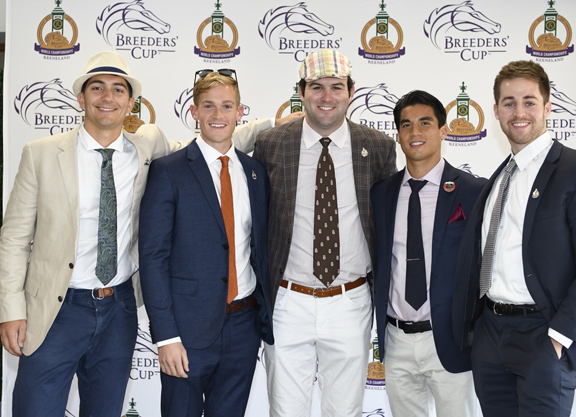
Dan Giovacchini, Eric Armagost, Alex Quoyeser, Patrick O'Neill and Reiley Higgins at the Breeders' Cup | Patrick O'Neill photo

“So we have these four amazing years where we spend literally every waking minute with each other. Woke up in the same house, went to work out together, breakfast together. Often you're in the same classes. Film studies together, football practice together. And, at the end of the day, fun together as well.

“And then you graduate, and go off into the real world. Now each one of us, we're very fortunate. We got the jobs we worked so hard for, through college and internships and all through our education. But, to some degree, there's this hole in your life.”

So they decided to form a racing partnership, just to keep those precious ties from getting too loose. It wasn't even Patrick's idea. The other guys always knew that he was mad about the ponies. During their senior year, he insisted on adding TVG to their cable package, and they knew that his uncle trained out in California. In fact, he was still in his freshman year when Doug O'Neill and his brother and assistant Dennis won the Kentucky Derby itself with I'll Have Another (Flower Alley). The year after Patrick graduated, they did it again with Nyquist (Uncle Mo). So this, his friends saw, was not just a quirky obsession; this was pretty much a family business.

Not for his dad, admittedly.  As the oldest of four brothers, Dave O'Neill had seen the other side of the coin. Their father—Patrick's grandfather, that is, for whom he is named—had an infectious enthusiasm for racing back in Detroit, but equally contagious were his wagers. One would lead to another, and the oldest of his boys learned a wariness of the track. Doug and Dennis saw only the excitement, and after graduating from high school they were immediately walking hots. But Dave felt that someone in the family should maintain an even keel. He went to the University of Michigan through a caddie scholarship, and then broke down the next door with a great job in telecommunications out west.

But life being what it is, the brothers received very different dividends for their staking plan in the gamble of life. Dave grew sick of corporate America after the telecoms sector crashed in the early 2000s and, since Patrick's mom Margie was originally from Hawaii, that's where they moved for a new start. On the flip side, Doug and Dennis went from winning $8,000 claimers at Bay Meadows to transforming Lava Man (Slew City Slew) into a triple Hollywood Gold Cup winner with a ticket to the Hall of Fame. Patrick was captivated, albeit from afar now that they had moved to islands 3,000 miles away.

Tragically, his other uncle Danny died of melanoma at just 38; and then his father was diagnosed with a similar condition in his mid-50s. They gave him maybe six months or so. Patrick was by then at Brown, literally half a world away from Hawaii, and that was a lot to deal with.

“But he ended up making it two years,” Patrick says. “And I could not be more thankful to him for making my graduation. What an amazing brother he was to my uncles, husband to my mom, and dad to myself and my sisters. Looking back, yes, there was a lot going on. But I was very blessed to have such great support around me, with the O'Neills and my mom's side as well, and then all these amazing friends. We remember him, and he's definitely on this ride with us today.”
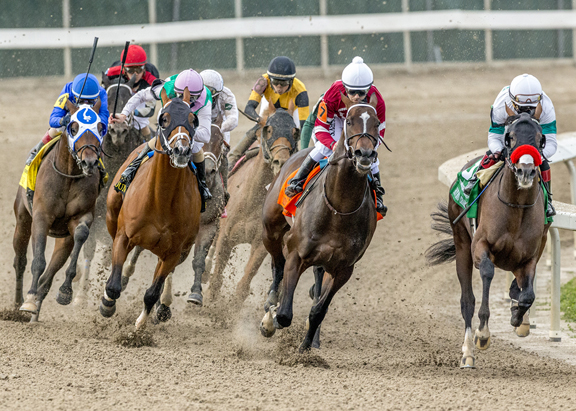
Hot Rod Charlie (#9, right) wins the $1,000,000 Grade II Louisiana Derby at the Fair Grounds | Hodges Photography

Because some ride it's turning out to be. As we've noted already, it was four of those amazing friends—Eric Armagost, Dan Giovacchini, Reiley Higgins and Alex Quoyeser—who had to talk Patrick into investing in his uncle's barn. Patrick agreed that the football brotherhood had to stick together. They had all ended up on the West Coast, but obviously they were no longer living in each other's pockets. A couple of years ago they had a reunion, and Patrick organized a backside pass at Del Mar. They had a tour of the barn, met Doug and Dennis, cheered home a winner for the team.

“And they were like, 'Wow, this sport is incredible!'” remembers Patrick. “And being smart, career-oriented guys, they said, 'Look, you kind of have an inside path in a lot of this: you know all about breeding, you have this great connection through Doug and Dennis. We should think about creating a syndicate.' And for me personally, knowing my grandpa's story, I was pretty adamant against it. But slowly they convinced me. But I said, 'Well, if we're going to do this, we're going to do it the right way. We're going to create an LLC; we're going to have an operating agreement; we're going to treat it like a diversified portfolio, and leverage Dennis at the sales, and Doug and Team O'Neill for the training.'”

They started with a share in a couple of OBS juveniles. One broke exactly even. The other “we got totally crushed on.”

“So we probably had one bullet left, in terms of continuing our business,” Patrick recalls. “And we got a call that fall from Dennis, at the Fasig-Tipton October Sale. As you know, typically Dennis doesn't buy yearlings. But he said, 'I'm looking at this colt, he's a half to Mitole (Eskendereya), and he's gorgeous. He's not just a sprinter: he's athletic, he's everything I look for in a horse.'”

There was a leg left, would the boys be interested? This was just before the Breeders' Cup, where Mitole would go on to nail down a divisional title. His sibling should have been unaffordable but—”all credit to Dennis”—they got him for $110,000. If his sire wasn't especially commercial, great: his racing career was a perfect template. Just like Oxbow, Hot Rod Charlie took four attempts to break his maiden but is now legitimately on the Classic trail.

When he sneaked into the GI Breeders' Cup Juvenile field, they looked at the pari-mutuel board and saw that “Chuck”, as they call him, was 94-1. They shrugged. What a blast, just to be there. Then they watched in astonishment as Hot Rod Charlie cruised into contention and then took over at the top of the stretch. Though ultimately just caught by Essential Quality (Tapit), he pushed the champ all the way. “We were going berserk,” says Patrick. “We were hitting each other, jumping, chairs were getting thrown.”

So who still missed the football field now? Suddenly this could even be a Kentucky Derby horse. True, “Chuck” was beaten on his return in the GIII Robert B. Lewis S. and, albeit he finished really well, the two who held him didn't do much for the form next time. But then, last Saturday, Hot Rod Charlie won the longest trial of all in the GII Louisiana Derby. The giant shadow of Midnight Bourbon (Tiznow) loomed over their frontrunner turning in, but plucky “Chuck” just kicked again and saw him off decisively. Next stop Louisville, first Saturday in May.

“In the paddock Midnight Bourbon looked incredible, as Steve Asmussen's horses usually do,” Patrick reflects. “And when he ranged up, I was like, 'Uh-oh, this is not good.' But our guy's just so tough. He doesn't care that he's a hand shorter than Midnight Bourbon. All he knows is he wants to get to that finish line first.

“Doug and his team have done such an amazing job with him. In the Lewis, at a mile and 1/16th against two really good horses, he was probably 75 percent fit after 90 days off. Then with the seven weeks to this race, he'd never been training better. He's always been a lean horse but he's finally filling out.”

One thing Patrick can't stress enough. His guys only have one leg in this horse, and would hate for their youth and enthusiasm to distract too much attention from their more seasoned partners. He knows that for Bill Strauss, and the Roadrunner syndicate of Greg Helm, a bone fide Derby contender crowns much a longer and deeper investment in the game—not just financially, but in terms of their own passion and commitment.

“They could very much have been like, 'Oh my God, who are these young rascals?'” Patrick says. “And they could not have been cooler or greater. They say, 'I love this sport. I want it promoted to the younger generation. You guys are doing that, and should do it as much as you can. Keep going.' These are two amazing individuals. And that's what happens, when you go on a ride like this. From people you didn't know at all, you end up with friends you'll have forever. Greg and Bill will be mentors to me and my friends for the rest of our lives.”

Strauss joined the youngsters and their families and girlfriends to celebrate in New Orleans last Saturday, and whatever happens in Louisville the whole group will be enjoying every second. As the Turf evangelist within his group, moreover, Patrick has loved to see the passion and the knowledge bloom among his novice buddies.

“That's my inside joke to them,” he says with a laugh. “I tell them, 'You guys are screwed for the rest of your lives.' You're going to have this ride. And then we're all going to be chasing this feeling, and this type of horse, for the next 20 years. So I'm able to tell them how lucky they are. They ask so many questions, like who is this Tapit guy who wins every race? And what are these Ragozins, and Beyers, and Thoro-Graphs? But it's great, for me personally, because I love this sport so much and having great young talent come into it is huge.

“No joke, it gives me chills, to see some of the best friends in my life so happy right there in the winner's circle. That's one of the best feelings in the world. This sport that I grew up in, that means so much to my family—and they are hooked. It shows you what a great world this is, and that if we market it properly, who knows what it could be for this next generation?”

As the one who understands the odds still to be overcome, Patrick is trying not to think too far ahead; especially with the Breeders' Cup this year returning to what is nowadays his local track. He knows to take everything one step at a time. But “Chuck” has the potential to be a precious vehicle for the whole industry. For one thing, as the final bequest of Edward A. Cox Jr., he already has a bunch of people in his corner—from his late breeder's grandchildren (well over three dozen of those, at the last count) to that old sage Bill Landes at Hermitage Farm. Bob and Sean Feld, too, will be hoping that Hot Rod Charlie can continue to magnify the skill with which they pinhooked a $17,000 short yearling. But the biggest deal of all is if young people on the outside see just how much fun these boys are having.

With such momentous stakes, then, they do well to remember the lessons learned together on the football field. To some people, sport is too frivolous to justify the emotion and money that many of us pour into it. But we only do that because it really teaches us about life, and about each other; because we know how true a mirror it holds up to the world.

“I don't even know if this whole thing is a million-to-one,” Patrick says. “It might be more like a billion-to-one. We really try to keep each other's feet on the ground. That's the input that I always received from my dad, from Doug and Dennis: about all the ups and downs in life. I respect LeBron James so much, but he's perfect physically, he's super smart and an amazing athlete. But then you also have guys like Steph Curry, who's six three. They figure it out. Those are the people that resonate because they have to get through tough experiences, tough times.

“So yes, sport is an amazing analogy for life. And if you can properly navigate college sports, it helps you to deal with other trials and tribulations. So with Hot Rod Charlie, obviously I hope he never loses another race again. But we'd be foolish to think that will be the case. There will be a time when he doesn't run to his best, and we're going to sit there and have five seconds to sulk about it. But then we're going to realize that life goes on, and that we still have each other. Just like a loss in football. You keep moving forward. Because all the amazing experiences you're going through together are never going to be

The post `Chuck’ Puts Next Generation on Derby Trail appeared first on TDN | Thoroughbred Daily News | Horse Racing News, Results and Video | Thoroughbred Breeding and Auctions.

Source of original post

Verified by MonsterInsights