Business is Booming at Norevale Farm

When Leo and Sarah Dooley announced last September that they would be starting their own boarding, quarantine and sales prep operation, they knew there would be a few factors working against them. First and foremost was the pandemic, at a time when the vaccine rollout was still months away. Plus, the couple was expecting to add a third member to their family at the end of the year.

Even so, the Dooleys decided it was the right time to step out on their own, and Norevale Farm was born.

“In the beginning, you're questioning yourself and you're thinking, 'Was this the right idea? Are we going to get enough horses? Are we going to get enough support?'” Leo said, recalling those moments of doubt. “But as we moved into the new year, it was evident that we had lots of support.”

So much, in fact, that they've already outgrown their original 110-acre property along Hume Bedford Pike near Paris and are now one month into leasing out an additional farm down the street.

“Leasing the farm across the road was definitely not expected,” Sarah admitted. “I remember when I was first setting up payroll and the payroll company asked how many employees we were going to have. I said two. They asked, 'Ever any more?' and I said, 'No, no way. We're never going to have more than two employees.' And now we have seven.”

Despite the explosion in growth, the couple still believes they're at a size where they can fulfill their initial vision of a boutique, hands-on atmosphere.

“What I love is the fact that we're not too big,” Leo said. “I can physically touch every horse, every day. We're on top of everything and with being so hands on, we know the horses inside and out and hopefully down the line that starts to show.”

“I think we both have a really great attention to detail,” Sarah added. “We talk to each other every day about everything, so our record keeping is precise and we have good control over everything that goes into the system.”

Growing up on her family's Marula Park Stud located just a few miles from what is now Norevale, Sarah learned the ins and outs of running a successful commercial operation from trailing her parents, Tony and Susan Holmes, around the fall breeding stock sales each year. After graduating from nearby Transylvania University, she traveled around the racing globe to complete the Irish National Stud and Godolphin Flying Start programs. Returning to the States, Sarah worked at Bluewater Sales, Hunter Valley Farm and Lane's End.

While serving as the sales coordinator at Hunter Valley, she met Leo Dooley.

Leo was not from a racing family, but growing up in Kilkenny, Ireland, he caught the bug early and worked for top trainer Jim Bolger as a teenager. He attended University College Dublin while also squeezing in time working at Ballylinch Stud and finding other racing-related jobs across Europe.

“I would take time off college to go and work the sales at Tattersalls and Goffs,” he admitted. “The professors weren't very happy about that, but I learned more there than I might have in the classroom.”

Before graduation, Leo made the journey overseas for a four-month internship with Gerry Dilger. The short time there was so impactful that after obtaining his degree, he came back to the States to work as the broodmare manager at Hunter Valley where he “met his lovely wife.” After four years there, he moved on to a similar position at Indian Creek Farm.

Before the duo ever became a couple, they both knew individually that their end goal would be to someday run their own operation.

“As a couple, that kind of became more realistic and was simmering in the back of our minds for a while down the road,” Sarah said. “Leo is great in terms of the hands-on aspect and I have experience in sales and the admin side of things. I think we both knew that we would work well together and so that gave us confidence to jump when this piece of land came up.”

Initially, the timing seemed a bit premature in their minds, but they took the leap anyways. Now just a few months in, their fast start is a strong indication that they made the right decision.

“We could not have done any of this without the support we've gotten from family, friends and clients,” Sarah said. “The support we've gotten has been huge.  It's hard sometimes, but it's a labor of love. We've been so incredibly busy, but every day we look at each other and we're like, 'Alright, we're doing this. We survived another day.' One hundred percent, we both know we're doing the right thing.”

To add one last variable into the equation, a three-month-old daughter keeps them on their toes, just in case they might have had a moment of spare time otherwise.

“Maeve was born in December right before foaling season,” Sarah said. “She's a huge delight. Leo is going to have a pitchfork in her hands before she can walk.”

“There was a while there where we thought we would have to use her on the farm,” Leo added.

When asked if they ever had any hesitations in taking on a business where they would be working together twenty-four seven, Leo replied, “We did think about that when we started, but it has actually worked out pretty well because I'm spending hours every day on the farm. I'm lucky if I get home for lunch.”

“I think we knew we would work well together from our time at Hunter Valley,” Sarah added. “We complement each other well, we stay out of each other's way and we respect what the other person does.”

“It gives me a lot of confidence, having been in the States for six or seven years now and having worked for three different farms, that I was able to pull bits and pieces from every operation,” Leo continued. “From Dromoland to Hunter Valley to Indian Creek, I was able to pick what I thought would fit best, from reproductive specialists to podiatrists, so it's nice to get all those bits of the puzzle together and hopefully have them all contribute to our ongoing success.”
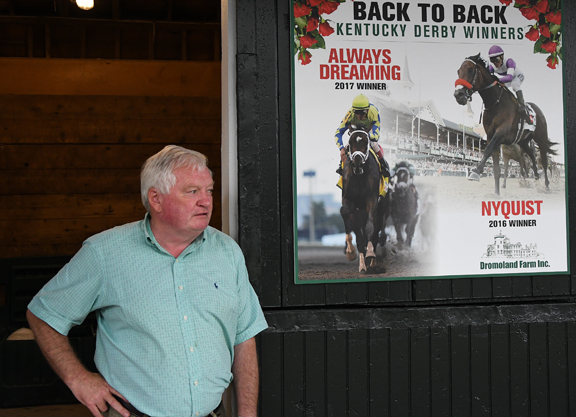
Kentucky Derby winners Always Dreaming and Nyquist both called Dilger's Dromoland Farm home as youngsters. | Fasig-Tipton

Few were more integral in molding Leo's career than Gerry Dilger. The late breeder and Dromoland Farm owner passed on in March of last year, but he still played a roll in the Dooley's decision to start up Norevale.

“I only worked for Gerry for probably four months, but they were a very impactful four months and probably changed the course of my career,” Leo explained. “I never made a single career decision without consulting Gerry. I do remember, probably three or four years ago, he said something that stuck with me. He said, 'Yeah, you know in five years, hopefully you'll be doing your own thing.' I was very surprised because I didn't think I would do my own thing for another 10, 15 or 20 years. So ultimately when we made the decision on Norevale, which was of course after Gerry's passing, I went back to that [conversation] and because I couldn't ask him, it was nice to know he had backed me all those years ago. It made the decision a lot easier.”

Soon after Norevale opened for business, a second Dilger pupil joined the team. Erin Rogers, also a native of Ireland, had worked with Leo at Ballylinch Stud years ago before traveling abroad to work for Dilger.

“Erin has been a fantastic addition to the team,” Leo said. “It's been great to sort of carry on Gerry's legacy a bit here in a way, since we both worked for him.”

Both Erin and Leo spoke on the powerful influence Dilger had on their careers.

“For me, it was really the confidence he gave me,” Erin said. “He threw me in the deep end and told me to go for it. His knowledge and demeanor made him a good mentor. Everybody just loved him for being him. I never heard anybody say one thing bad about him and it didn't matter who you were, if you were a big owner or someone just starting out, he treated everyone the exact same, which said a lot about his character.”

“He had a huge impact on my life for sure, and on countless others across the globe,” Leo echoed. “He wanted the best for everybody. I'll bet he spent so much of his time thinking about all of his pupils and what they were doing. He just genuinely cared about what was best for people.”

Last fall, an unplaced Bodemeister mare named Bodella was offered in the final days of the Keeneland November Sale as the last of Dilger's mares to go through a sales ring. When she failed to meet her reserve, her consignor Pat Costello called up the Dooleys to see if they might be interested.

“She didn't cost much and she was in foal to Mo Town, so we said sure, mostly for sentimental reasons,” Sarah recalled. “Leo brought her back to the farm and on his way back, he called Erin and told her we had a surprise for her in the back of the trailer.”
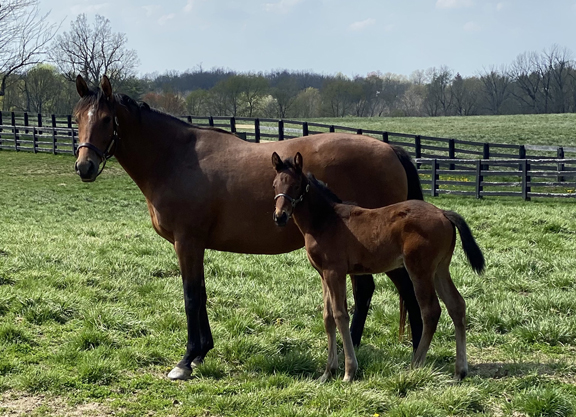
Bodella (Bodemeister) and her 2021 Mo Town filly | photo courtesy Sarah Dooley

When Erin found the mare waiting to unload, she recognized her instantly from her years spent at Dromoland. The Dooleys offered Erin a partial ownership in Bodella and Erin jumped at the chance.

“It's cool for us to all own a mare together and Erin just loves her,” Sarah said. “She absolutely adores all the horses, but Bodella is the favorite for sure.”

Bodella foaled her Mo Town filly in February this year and has since been bred back to Volatile.

“There was a rainbow one day and Bodella and a couple of mares were in a back field here, and the rainbow ended on top of Bodella,” Sarah recalled. “We were all like, 'Yeah, that's Gerry.' So hopefully he's looking out for us and we'll have a bit of luck with her.”

While both Leo and Sarah acknowledge that luck may have helped all the pieces fall into place when Norevale first got started, they now attribute the farm's ongoing success solely to the support they've received from their clients.

“We're very thankful for all the support we've gotten,” Leo said. “We've got some great clients here and we're excited to grow with them as we continue to develop the program we have here at Norevale.”

“We're always telling each other that there's no resting on laurels,” Sarah said. “We know we've got to keep putting in the groundwork, but we couldn't imagine doing anything else, even on the hard days. I've asked Leo a few times on really busy days, “So, are you glad we're doing this?' And he's like, 'Oh yes, one hundred percent.' And I feel the same way. So we know we're doing the right thing and we couldn't be happier.”

The post Business is Booming at Norevale Farm appeared first on TDN | Thoroughbred Daily News | Horse Racing News, Results and Video | Thoroughbred Breeding and Auctions.

Source of original post

Under Glare of Probing Questions, Curious Answers in Kentucky

The Week in Review by T.D. Thornton

In theory, state racing commissions are supposed to provide a layer of checks and balances by making both racetrack operators and horsemen accountable for their actions. In practice though, that often doesn't happen because regulators in many jurisdictions fail to ask probing questions of licensees during open, public meetings.

In Kentucky, for example, if you want the most concise on-the-record snapshot of what's going on with the circuit, the best source generally isn't a Kentucky Horse Racing Commission (KHRC) meeting. Instead, the proceedings of the Kentucky Thoroughbred Development Fund (KTDF) advisory committee are usually far more informative and insightful.

Bill Landes III, who chairs that committee as a representative of the Kentucky Thoroughbred Owners and Breeders Association (KTOB), is known for cutting to the chase and asking blunt, common-sense questions. Representatives of the state's five Thoroughbred tracks must update the advisory board on how each track is spending money for purses, capital improvements, marketing, and other aspects of their racing operations, and those executives are obliged to answer every query tossed at them, because the KTDF board recommends to the full commission how to allot the millions of dollars in purse supplements generated by live, simulcast and historical horse race betting.

During last week's KTDF advisory board meeting, two exchanges stood out. One put management of Turfway Park on the spot over equine safety. The other revealed surprising reluctance by a Kentucky Horsemen's Benevolent and Protective Association representative to embrace a master plan for improving the infrastructure and quality of racing at Ellis Park.

At one point during the Apr. 6 video meeting, Tom Minneci, the senior director of finance at Churchill Downs, Inc. (CDI), the gaming corporation that owns Turfway, had just finished giving a financial rundown of the track's recently-completed meet.

Landes then asked KTDF board members if there were further questions for Turfway, and Doug Hendrickson, who represents the KHRC on the KTDF advisory committee, had a one-word query: “Fatalities?”

Minneci deferred comment to Tyler Picklesimer, Turfway's director of racing and racing secretary. When Pickelsimer did not immediately respond, Minneci asked Chip Bach, the track's general manager, for help in coming up with the answer.

There was an awkward moment of silence, during which both Pickelsimer and Bach seemed to be caught off guard by the KTDF wanting to know about horse deaths.

“I've got our handle numbers in front of me. I don't have that in front of me,” Bach said. After another pause, he added, “Tyler, do you see it?”

Pickelsimer responded that he did not know the number of equine fatalities that had occurred at his track over the last three months. “I know it was a good meet, but I don't have that in front of me, no.”

Landes, who can be as diplomatic as he is direct, didn't see the need to make the Turfway execs squirm any longer over not knowing something important that they should have. He suggested to have the minutes of the meeting reflect their non-answer as a “deficiency” that needed to be addressed at the next meeting.

Bach promised to come up with the correct figure at that time. He probably should have stopped there, but felt compelled to add that, “The problem with some of the fatality numbers is horses can meet that number after they've left the track. So I just want to make sure that we've got a right number for you. Sometimes we have to go to the commission to get that number.”

This is disquieting on several levels. First, as a corporation, CDI likes to describe itself as being an industry leader in equine safety. Yet neither the GM nor the director of racing at its Turfway operation could state for the record how many fatalities occurred there over the past 90 days, or even offer a ballpark figure.

It's also circularly bizarre that a KHRC board member asked Turfway executives the fatalities question in the first place, but a Turfway official responded that he needed to check with the KHRC to obtain the correct number.

Ellis Park Twilight Zone

Later in the meeting, Jeff Inman, the general manager at Ellis Entertainment LLC, was running down a list of necessary (but generally low-level) capital improvements that Ellis Park was trying to have completed before the start of its meet June 27.

Landes politely interjected, wanting to know when Inman's company was going to come through on the big-ticket items it promised when it bought Ellis Park in 2019, like the widening of the turf course and the installation of lights, which would allow Ellis to slide into a more lucrative twilight simulcast time slot while avoiding the brutal summer heat that is detrimental to horse health and sometimes causes cancellations.

Landes termed those improvements “long overdue, and everybody knows it.”

Inman replied that the turf course widening is likely to happen first, but not until after the 2021 meet.

“If we regain capital funding, we will start work after the horses leave, [by] late October, early November,” Inman said.

J. David Richardson, who, like Landes, represents the KTOB on the KTDF advisory committee, concurred with the chairman.

“I do believe that Ellis Park has enormous potential to do much, much better with at least some opportunity to run under lights and expanded turf racing on a course that's not torn up because you have to overuse it,” Richardson said. “I really want to reiterate…how positive I think this could be for Ellis Park, for Kentucky racing, and for strengthening the whole circuit that we all are trying to do in terms of making Kentucky horses more valuable.”

Landes said he believed that Kentucky Horsemen's Benevolent and Protective Association (KHBPA) president Rick Hiles and KHBPA executive director Marty Maline “would agree with me [that] if you get twilight racing at Ellis Park and some lights there, there ain't no telling what y'all could do. And I'm not telling you something you don't know. I'm hoping Rick and Marty agree with that.”

But when Landes directly asked Hiles–who is a KTDF advisory committee member representing the KHBPA–for his opinion on the Ellis improvement plan, Hiles said he couldn't fully endorse the concept of twilight racing.

“I'm a little concerned about moving racing post times back too far, simply because of the ship-ins from Louisville and Lexington losing an hour in time zones and coming back late at night,” Hiles said. “Getting back at 12, one, two o'clock in the morning–I just don't know how [horsemen] are going to react to that.”

Landes seemed surprised by the HBPA's noncommittal stance, but he tactfully acknowledged that the concerns Hiles articulated about the late nights were valid. (Maline, who was present for the video meeting, chose not to speak on the subject.)

“Well, you have that issue to a certain extent at Turfway,” Landes reasoned, meaning late shipping after night racing. “And [at Ellis] it's either coming in at one or two o'clock in the morning or dealing with 108 or 110 degrees” during afternoon racing.

“I just don't know,” Hiles said. “School, for me, is still out on it.”

It must have been frustrating for Landes and other KTDF advisory board members to be pressing Ellis to make good on promises that could strengthen the entire circuit only to learn that the elected horsemen's representative on their board wasn't entirely supportive of the idea.

The post Under Glare of Probing Questions, Curious Answers in Kentucky appeared first on TDN | Thoroughbred Daily News | Horse Racing News, Results and Video | Thoroughbred Breeding and Auctions.

Source of original post

WindRacer A Winner For Banke And Furth

While the next crop of Thoroughbred champions are making their entrance into the world at Barbara Banke's Stonestreet Farm in Lexington, Kentucky, Banke and her friend and business partner Peggy Furth were hailing the arrival of another likely headline-maker at Keeneland on Saturday when debuting WindRacer Wines.

With some of the most notable faces in the racing industry in attendance at the track for Stonestreet Lexington day, Banke and Furth, co-founders of WindRacer, took the opportunity to share their latest project with a discerning audience. It appeared to have been met with unanimous approval.

There are six wines in the boutique WindRacer collection-two Chardonnays and four Pinot Noirs–four of which were unveiled on Saturday. The wines are crafted from grapes sourced from highly select blocks of vineyards in Mendocino County's Anderson Valley and Sonoma County's Russian River Valley. These are areas of “extreme viticulture”-high elevations, coastal winds and rocky, nutrient-poor soils mean that the growing conditions there are challenging and that grape yields are low. But those dedicated enough to nurture them are rewarded with berries that are intense, concentrated in flavour and complex.

The parallels between producing a fine wine and a Grade I racehorse would not have been lost on those in attendance on Saturday.

“There are so many similarities; the dedication, the passion and the precision that it takes to raise a Thoroughbred and to raise a grape,” said Furth. “People may not think those two are related at all, but being in both industries, there are many similarities and it does require an incredible team of people; you can't do either one of these things alone no matter what your dreams are; it takes a lot of professionalism.”

The scarcity of the grapes used for WindRacer mean that the wines are a cherished commodity-only around 200 cases of each variety has been produced. The good news for racing enthusiasts, however, is that they will be among the first to get their hands on it: in addition to being available direct to consumer, WindRacer will be rolled out around major race meetings in Kentucky, New York, California and Florida. It will not be available for purchase in retail shops; it will, however, be served this summer, for instance, at some of Saratoga's most popular restaurants.

“What they're trying to do with this is to keep it very targeted,” said Tom Gannon, advanced sommelier with The Spire Collection of elite wines. “The wines are really only available in California, Kentucky, Florida and New York and targeted at the tracks and the restaurants around the tracks and in a direct to consumer way. We'll do events at certain restaurants in Saratoga-we're already lining it up at the restaurants that Barbara and Peggy like to go to, like the Adelphi, 15 Church, Wishing Well and Village Pizzeria.”

Banke noted they have the option to expand their offerings down the road, but that mass production isn't the goal for WindRacer.

“We can, but we don't want to get big,” she said. “We want to take great little sections of the vineyards and produce wines that are really the Thoroughbreds of their class.”

WindRacer is a labour of love for Banke and Furth, who were highly successful in their individual professional pursuits before pouring their talents and resources into their family vineyards. Banke was a prominent land use and constitutional law attorney before joining forces with her late husband Jess Jackson to help grow Jackson Family Wines. Furth was the first female executive at Kellogg's as vice president of public affairs, and she founded Chalk Hill Estates and Vineyards with her late husband Fred Furth. Prior to WindRacer, Banke and Furth worked together on numerous business and philanthropic pursuits, including founding the Imagine Wine Auction (now known as Sonoma Paradiso), which raised around $6-million for local children's causes.

Horses, likewise, are pivotal in the lives of both women. Banke, of course, is a perennial breeder of Grade I-winning racehorses, while Furth is an international-level dressage rider.

“We've been neighbors in Sonoma County and we've been vintners in Sonoma County so professionally we were at a lot of events together,” said Furth. “Barbara's interest in horses is different than mine; when Jess started his interest in Thoroughbred racing they went in that direction. I'm a dressage rider so I do old and slow horses, and she does young and fast horses. It's interesting in the whole story that we are distinct personalities-we sometimes diverge in our wine tastes as well. We can argue about that and have different preferences, but over many, many years we decided it would be nice to have a wine brand together as girlfriends and have a woman-owned business, so that's how WindRacer was born.”

Banke added, “We have shared interests in horses; Peggy in dressage, and her grandkids do hunter jumper, and me in racehorses. We wanted something that had a horse on the label and we love Chardonnay and Pinot Noir, so we decided to curate some of the vineyards that I own in California and take selected pieces. I have a really good winemaker–Nikki Weerts, who is from South Africa originally–make the wines for us so it's a combination of our interests in wine and horses.”

Furth said that while she has never used Thoroughbreds in dressage, she is “very interested in the lifecycle and care of the racehorse. And I'm very respectful of the New Vocations program and what this industry does for its horses.”

It's not out of the question, either, that Furth and Banke could be enjoying another collaboration this summer, with Furth saying she may take a piece of one of Stonestreet's Royal Ascot-bound runners. Furth said she experienced a “hall of fame moment” when witnessing Lady Aurelia's G2 Queen Mary S. victory with Banke in 2016, and while in town for the WindRacer launch she visited Lady Aurelia and her first foal, a Curlin colt, at Stonestreet.

“It was a hall of fame moment in my life to be with my best friend and watch Lady Aurelia, not really understanding the significance of what it takes to do that,” Furth said. “But I'm learning.”

Banke and Furth have both, however, already worked their way to the top of the wine trade, and their collaboration with WindRacer is sure to be a winner at the major races this summer.

The post WindRacer A Winner For Banke And Furth appeared first on TDN | Thoroughbred Daily News | Horse Racing News, Results and Video | Thoroughbred Breeding and Auctions.

Source of original post

Bind Filly a Sentimental Pinhook for Granger

When lifelong owner and breeder Nathan Granger picked up a filly by his late stallion Bind, bred by his partner Jay Adcock, for just $13,000 at the ESLA September Sale, he knew right away that she was something special. So special in fact, that he gave her a name of the highest honor in the Granger family, WUPKAR, which stands for Wake Up, Pray, Kick Ass, Repeat. This was the slogan of Granger's son Ross, who was diagnosed with an astrocytoma in his brain stem shortly after his high school graduation and passed away 16 months later.

“We went through a horrible time five years ago,” Granger said. “My oldest son, Ross, the oldest of five, was diagnosed with a brain tumor right after high school graduation. He was going to go pitch in college. His mantra during the time he was ill was WUPKAR, Wake Up, Pray, Kick Ass, Repeat. He really lived by that until he passed. He spoke with youth groups, baseball teams, etc. about his faith and living every day in the fullest. He was phenomenal. He was my hero.”

Granger, who owns about 15 mares in partnership and has three horses in training, originally purchased WUPKAR with the intention of adding her to his racing stable.

“I bought her at the yearling sale very cheap because of a small issue on an x-ray,” Granger said. “It was a youth issue, nothing that would stop her from performing. She was a picture and everything you'd want in a racehorse. She was just that good. Initially the plan was to run her, but I have a lot of horses, so sometimes I have to sell a good one to pay for all the others.”

Granger entered the filly in the Texas 2-year-old Sale Wednesday, where she summoned $150,000 from Wayne Sanders and Larry Hirsch after breezing in :10 flat. After hearing the meaning behind her unusual name, WUPKAR's new owners decided to keep it.

“Al Pike told them the story and they said they would keep the name,” Granger said. “I was thrilled. I actually cried. I did intend to race her, but she was just so good. Hopefully she will win a lot of races down the line and people will ask what the name means and we can tell them about it.”

In keeping with their son's wishes, the Grangers started the Ross Granger Memorial Fund in his honor.

“Ross' illness was 16 months, so he really told us everything he wanted,” Granger said. “One of the things he wanted to do was set up a memorial fund. We had taken out a general cancer policy out on all of our kids because a buddy was selling them, so the first $20,000 of the fund was Ross' own money that he put up. We give five $2,000 scholarships every year to kids in our area and we also help other families whose children have brain tumors like Ross.”

Click here to learn more about the Ross Granger Memorial Fund.

The post Bind Filly a Sentimental Pinhook for Granger appeared first on TDN | Thoroughbred Daily News | Horse Racing News, Results and Video | Thoroughbred Breeding and Auctions.

Source of original post

Verified by MonsterInsights