Derby, Oaks Workers Out in Full Force Friday

GI Kentucky Derby and GI Kentucky Oaks workers were out in full force Friday morning at Churchill Downs. Breezers included:

  • The Todd Pletcher-trained quartet of Known Agenda (Curlin) and Sainthood (Mshawish), who were clocked in 1:01.00 (17/50) together under the Twin Spires; Dynamic One (Union Rags) who covered a half in :47.80 (1/108) alongside GSP Prime Factor (Quality Road); and GII Wood Memorial S. upsetter Bourbonic (Bernardini), who went in :49.60 (71/108). “Known Agenda is not the most aggressive work horse,” Pletcher noted. “He is not an Always Dreaming (the 2017 Derby winner) that will work in :59. He has had two good works here (1:00.40 last Friday) and I liked the way Sainthood worked with him.” Of Dynamic One, Pletcher said, “He finished full of energy with his ears pricked.” Bourbonic worked solo. “He has been pretty aggressive in his gallops so we worked him by himself today,” Pletcher explained. “It was a good steady work with a strong gallop out… It was a very good morning with excellent breezes going the way we hoped they would. That was the final piece of major work and now they will have routine gallops with some gate and paddock schooling.” Click for more from Pletcher via the Kentucky HPBA.
  • Smarty Jones S. winner Caddo River (Hard Spun), who figures to be part of the early pace, went in 1:00.60 (10/50) for Brad Cox. “He's a really solid horse and we saw that with a good [second-place] effort in the [GI] Arkansas Derby. He has a lot of speed as we've seen in his previous races,” said Cox, whose two other Derby hopefuls, unbeaten expected favorite Essential Quality (Tapit) and “wise guy” horse Mandaloun (Into Mischief), will breeze Saturday. Click for more via KY HPBA.
  • The Mark Casse-trained pair of GII Lambholm South Holy Bull S. winner Helium (Ironicus) and GI Curlin Florida Derby runner-up Soup and Sandwich (Into Mischief) were clocked in :49.80 (75/108) and :50.00 (78/108), respectively. “Very happy with both of them,” Casse's assistant David Carroll said. “I thought Helium's work was good; he's a very smooth-moving horse. He's the better work horse of the two and he went absolutely beautiful; in hand the whole way, just waiting for Julien [Leparoux] to ask him. He just stretched his legs but that's all we were looking for… Soup and Sandwich was a little rank going to the pole, but he's a horse that likes to train. We only jogged him two miles the other day so he was a little fresh. He was anxious to get going but once he broke off he was very smooth the whole way, switched leads, galloped out nicely, and came home great; you couldn't ask for anything better… These were the works we wanted for the final pieces of works. Both horses are in great shape, so hopefully we have a good week and we have a good draw.” Click for Leparoux's take on Helium's work via KY HPBA.
  • Tampa Bay Derby runner-up Hidden Stash (Constitution) worked in 1:00.60 (6/26) at Keeneland. “We decided to work this morning and beat the rain that is forecast and he worked great,” trainer Vicki Oliver said. “He is going to jog and stand in the gate tomorrow and walk Sunday. He will gallop Monday and Tuesday and ship to Churchill after he trains Tuesday morning.”
  • Cox trainees 'TDN Rising Star' Travel Column (Frosted) and Coach (Commissioner) each worked with separate company for the Oaks, but were both credited with five furlongs in 1:00.40 (5/50). “With it being both of their last works, we weren't looking for anything major,” said Cox, last year's Oaks-winning conditioner. “They both like the surface here at Churchill and got over it well. They're two quality fillies that I think will run a top effort in the Oaks.”
  • GI Central Bank Ashland S. heroine and 'Rising Star' Malathaat (Curlin) worked in :48.40 (21/108) for Pletcher under Hall of Famer John Velazquez. “She's a star,” said Pletcher. “Johnny said she handled the track well.”
  • Robertino Diodoro's Oaks representative Ava's Grace (Laoban), second in the GIII Fantasy S., went in :49.20 (51/108); while Derby bubble horse Keepmeinmind (Laoban) worked in a snappy :46.20 (1/108). “I am very happy with both of them,” said Diodoro. “He worked really good today and he loves the track here, too.”
  • Klaravich Stables' unbeaten GII Gazelle S. heroine Search Results (Flatter) breezed alongside GISW stablemate Dunbar Road (Quality Road), who's pointing for the GI La Troienne S. on the Oaks undercard. They went in 1:02.60 (44/50). “I gave her an easy work by design,” Brown said. “She's coming back in four weeks so she's very, very fit. I liked the way she went and she really seemed to get over the ground. I just wanted to get her used to the track a bit and she came back bouncing around when we untacked her. I wanted to bring her in there sound and happy and I think we're well on our way to doing that.”

The post Derby, Oaks Workers Out in Full Force Friday appeared first on TDN | Thoroughbred Daily News | Horse Racing News, Results and Video | Thoroughbred Breeding and Auctions.

Source of original post

Producers Unveil Plans for `Photo Finish’

Leon Nichols, Calvin Davis and affiliates of the Project to Preserve African-American Turf History are seeking additional backing to bring the story of the 1890 Isaac Murphy-Snapper Garrison match race aboard Salvator and Tenny at Sheepshead Bay Park. The event, held after Murphy and Salvator defeated Garrison and Tenny in the Suburban earlier in the year, was billed by press at the time as a race between “Black and white.”

PPAATH was the subject of a Katie Ritz feature in the TDN in 2020. The nonprofit's founder and co-founder, Nichols and Davis, are working on their script alongside producer James Walton, and say their film is poised to be the first in U.S. filmmaking history led by a Black production team and the first to capture the contributions made and the conflicts faced by Black jockeys beginning in the late 19th Century.

Their story traces the life of Murphy, a legendary jockey and the first-ever inductee into the National Museum of Racing Hall of Fame, and says the group, “illuminates and bridges persistent racial divides.”

African American jockeys held places of prominence across the Kentucky Derby's first 27 years, said Chris Goodlett, Dir. of Curitorial & Educational Affairs at the Kentucky Derby Museum. But by the 20th Century, he said, institutional racism and segregation had taken hold.

In June 1890, amid intense racial and political unrest, Murphy was the central figure in the match race, after the owner of Tenny demanded a rematch after his loss in the Suburban.

“With `white' and `colored' signs popping up in response to Jim Crow laws,” said a release from PPAATH, “all eyes were on Murphy and his rival, Ed `Snapper' Garrison. One sealed America's fate for generations to come in a photo-finish race that was dubbed `the greatest in the history of thoroughbred racing' by the New York Times.”

“There's a lot to unpack here,” said Walton. “In 1890, Jim Crow legislation struck a severe blow to horseracing and forced out the clear majority: Black jockeys. One after another, their obituaries then piled up. High-profile Blacks' ability to do what they loved was snatched away as mobs of emboldened whites pushed for segregated tracks. Soup Perkins, who'd won the Kentucky Derby at age 15, drank himself to death by age 31. Tommy Britton committed suicide by swallowing acid. Albert Isom publicly shot himself in the head.”

“The discrimination they faced in everyday life they also faced on the racetrack–confronted with an ideology that tore apart our nation and an entire industry,” said Nichols. “'PHOTO FINISH: The Race of the Century' celebrates one man's ability to beat the odds. Before Jordon, Ali and Owens, there was Isaac Burns Murphy. He was a hero in the eyes of Blacks and unsympathetic whites knew that. He achieved millionaire status and acclaim at a time when others feared for their safety. Yet, here we are today, in 2021…still fearful.”

PPAATH is seeking backers and tax incentives in various U.S. filmmaking hub zones in order to develop a series of films which showcase Black jockeys and pay homage to courageous acts which have gone unrecognized for more than a century. Learn more at PPAATH.org.

The post Producers Unveil Plans for `Photo Finish’ appeared first on TDN | Thoroughbred Daily News | Horse Racing News, Results and Video | Thoroughbred Breeding and Auctions.

Source of original post

It’s Margarita Time

Michael Tabor, Mrs. John Magnier and Derrick Smith's As Time Goes By (American Pharoah) has been progressing steadily since last fall and will try to collect her first black-type badge in Saturday's GII Santa Margarita S. at Santa Anita.

Third in her career debut sprinting at Del Mar last August, the daughter of MGISW Take Charge Lady (Dehere) returned to finish second to stablemate Himiko (American Pharoah) after setting the pace in the early going at Santa Anita in October. A four-length winner going six panels at Los Alamitos Dec. 13, the half-sister to 3-year-old champion colt Will Take Charge (Unbridled's Song) and GISW Take Charge Indy (A.P. Indy) galloped home an eye-catching nine-length winner stretching to a mile in a Santa Anita allowance Jan. 17. Stepping up for the Mar. 13 GI Beholder Mile, the Bob Baffert trainee found only champion Swiss Skydiver (Daredevil) too good, finishing second by 2 3/4 lengths. Mike Smith, aboard for her latest trip to post, retains the call.

Alice Bamford and Michael Tabor's Harvest Moon (Uncle Mo) reeled off four consecutive wins in 2020, including Del Mar's GIII Torrey Pines S. at a mile and the 8 1/2-furlong GII Zenyatta S. at Santa Anita. Fourth after disputing the early pace in the GI Breeders' Cup Distaff over nine furlongs at Keeneland, she resurfaced with a fourth, beaten seven lengths, in the aforementioned Beholder Mile. Regular rider Flavien Prat returns to ride the Simon Callaghan trainee Saturday.

The post It’s Margarita Time appeared first on TDN | Thoroughbred Daily News | Horse Racing News, Results and Video | Thoroughbred Breeding and Auctions.

Source of original post

This Side Up: A Super Lesson for Racing

Sure, it's a very different game from our own. On the face of it, horse racing and soccer appear to have little more in common than the same generic umbrella as sports. But then it turns out that “soccer” is itself a very different game–or a very different industry, at least–from what the British know as “football.” And if you happen to have followed an extraordinary week for its European elite, then it would be remiss not to ask whether there might actually be one or two highly pertinent lessons for the Turf.

It's hard to convey to Americans quite how the launch and overnight collapse of the European Super League saturated not just the airwaves, but ordinary conversation wherever and however it can happen these days–from families round their kitchen tables, to friends shivering in pub gardens, to colleagues on Zoom calls. Pandemic, what pandemic? Hadn't you heard, the 12 richest clubs in Europe were going to start a breakaway franchise?

If you were taken aback by the uproar, then so were the owners of “the Dirty Dozen.” They knew to expect a furious, panicked reaction from UEFA and FIFA, whose tawdry supervision of the established set-up was doubtless assumed to have so alienated fans as to disable its defense. But they were clearly not expecting to see lifelong obsessives–whose tribal loyalty is so feverish that the Italian word tifosi traces to the word for typhus–burning replica shirts outside the stadiums to which they have been longing to return. In Britain the entire political spectrum, from government to opposition, united in immediately exploring a legislative response to challenge the viability of the project. Club legends, former players and managers, gave vociferous vent to their rage and disgust; and there were even some among those lucratively contracted to serve the present squads who had the moral courage to express alarm or distaste over their employers' plans.

The key to all this, and it turns out the key to fan engagement, was jeopardy. In principle, if you marshal adequate resources on and off the field, the present structure permits a team to play its way from the bottom of the pyramid to the apex. And, critically, you can also make the reverse journey. That makes business planning difficult, but also gives meaning to what happens when you send your players, hired at staggering expense on the back of fans' television subscriptions, over those white lines.

Three of the six English Premier League clubs who formed the core of the rebellion have American owners, long familiar with franchises where membership is secured. In European leagues, however, the system is meritocratic: underperform sufficiently, and you will be replaced by those who have earned promotion. Of course, the wealth of Manchester United or Liverpool makes their squads invulnerable to relegation; but only the top four league finishers qualify for the European Champions' League, the world's most glamorous and lucrative club competition. The Super League would have relieved them of this tiresome hurdle.

So this became a vivid public exercise in how capitalism functions. The fans stood up for the free market against cartels and rentier exploitation. Whether they now sit up and take notice of the equivalent processes in the global economy, similarly built on debt and megabrands buying out all competition, must be doubted. But for those of us who had bleakly assumed that the cynical agendas of globalisation were now inexorable, it was as edifying as it was astonishing to see how quickly the whole thing was unravelled by sheer grass-roots passion.

Yes, the 12 clubs and their fundraisers and analysts (take a bow, J.P. Morgan) made a valuable contribution in their scarcely credible ineptitude, and amply deserve the damage they have done to their own brands. But I do think their crass example has done our own world an inadvertent service.

Fan engagement and passion–in many forms–are key | Horsephotos

Because we have been reminded that we are nothing without the fans. And that the day we take their engagement and passion for granted is also the day when the lifeblood of our business begins to harden in the arteries of commercialism.

“Now, wait a minute,” you might say. “That's nuts. You can't compare us with these avaricious tycoons who can already rely on fans in Thailand to keep uncertainty within manageable bounds. All we have, all day every day, is jeopardy. We're just trying to squeeze some kind of living out of the most unpredictable investment vehicle in all sport. And everything we stake depends, if ultimately on luck, first and foremost on our own skill.”

All true. Nonetheless all of us who depend on the Thoroughbred for a living must never forget the only reason we have an industry at all; must never forget that all we are doing, every day, is commercializing the passion of the fans.

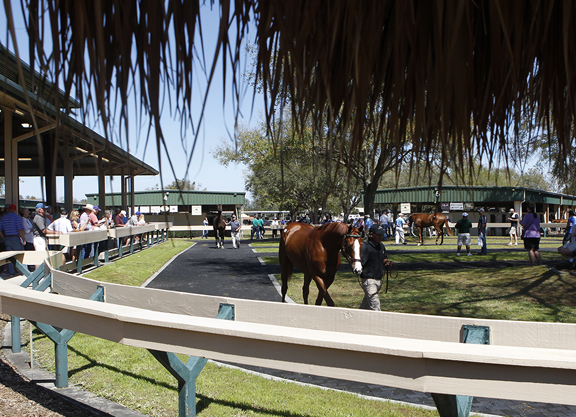
There were 1,200 juveniles catalogued at OBS this week. Yes, each one represents a precarious, flesh-and-blood project. But that doesn't alter the fact that every crop is processed on an industrial scale, so that a horse making his track debut may have changed hands four times already: sometimes in utero, and very often pinhooked twice over: weanling to yearling to breeze show.

As result, we are candidly breeding for the sales ring rather than the track. As I've often said, that is ultimately the fault of those who direct the spending of the end-user: the agents and trainers complicit with mass breeding to new stallions, most of which will soon be standing somewhere like Peru or Oklahoma. If pinhookers knew that “racehorse” stallions would get due commercial recognition at ringside, then that's exactly where they would invest.

As it is, it's not just the breed that suffers when the commercial market recycles so much genetic junk every year. How can we expect affluent people to indulge themselves with a horse in training if we are flooding the market with mediocre stock with scarcely any premium on the things they would ideally want: a naturally sound, durable animal that will last the course, will keep giving you a day out, will keep finding in the stretch? Not, in other words, one whose job is done the moment the hammer comes down.

In fairness to the American breeder, many of these assets remain more commercial than in the home of soccer. Investors in the American Thoroughbred do still aspire, above anything else, to be involved at Churchill next Saturday; they just don't support enough of the proven stallions who would improve their chances of making it there. But here, too, it is often speed that drives spending–not least on bullet breezers at OBS this week.

The OBS grounds | Photos by Z

Professionals in Ocala may have been too busy meanwhile to notice a staggering juvenile sale on the other side of the ocean. The Goffs UK Sale at Doncaster on Thursday bounced back from an excruciating spring for the sector last year to register record-breaking returns across the board. But this amazing boost to morale measured two things that are not easy to reconcile. On the one hand, this is actually an auction that prizes exactly the kind of ostensibly “commercial” precocity that is killing off those European stallions that have most to offer the breed in the long term, and racehorse owners here and now. At the same time, however, you couldn't ask for better evidence of the validity of the overall product. This amazing evidence of pent-up demand suggests that people who have survived the economic carnage of the pandemic can't wait to get back onto the racetrack and, blessed by a renewed sense that life is for living, it seems they don't even mind if the odds of reward are steeper than ever in Britain.

The type of horses we breed is just one dimension, of course. It just happens to be most relevant to our line of work. But there is much else for the sport to think about, in terms of its priorities. Because the bottom line is that owners are just fans with money. If we think about what works best for owners, we will also come up with something that will work for the fans. The success of micro-syndication confirms the personal stake of the ordinary fan in horses. Virtually all of us, after all, even if born on a horse farm, started out as fans: hooked by a particular horse or two, developing a remote but ardent bond. Maybe a Secretariat or a Kelso, but it could just as well have been some prolific old gelding who gained a cult following in claimers at your local leaky-roof.

If you're a pinhooker, you too need those fans. Apart from anything else, one of them will just have bought a pizza oven, or rented a cabin to sell a couple of used automobiles, and in 15 years' time will be wealthy enough to roll up at Saratoga or Book 1 at Keeneland.

But more fundamental are the $1 pickers of six, and the narratives that sustain their passion. That's the lesson of the European Super League. It's not a question of how fast is the fastest buck we can make, but how we keep those turnstiles clicking. That's our real bank vault, the true foundation of our sport. If we only remember that, then everything else will fall into place.

The post This Side Up: A Super Lesson for Racing appeared first on TDN | Thoroughbred Daily News | Horse Racing News, Results and Video | Thoroughbred Breeding and Auctions.

Source of original post

Verified by MonsterInsights