Dave Johnson: What a Performance!

Maybe our sport is still capable of bringing together four such people round a dinner table. But you have to doubt it.

“They were comparing the theaters that they had played on the Vaudeville circuit,” Dave Johnson recalls. “Which had the best backstage dressing rooms? Which had the best eating places, that you could walk to still with your costume and makeup on?”

These memories were being shared between Johnson's mother and Fred Astaire. Moreover, both of those who were listening on, fascinated, had remarkable stories of their own: Astaire's wife, the former jockey Robyn Smith, and Johnson himself-the man whose call, for those present at the 1973 Belmont S., will forever be synonymous with one of the greatest performances in the story of the breed.

Whether or not the world has moved on, it has certainly turned plenty since. Next Saturday, indeed, is the 50th anniversary of Secretariat's final start. And this dinner itself took place over 40 years ago, in Los Angeles, during Johnson's tenure as the caller at Santa Anita.

“Afterwards Fred sent my mother an autographed picture,” Johnson recalls. “I think things like that helped keep her alive. My dad died early, he was only 52. But my mother passed away at 93. I have a picture of her as a dancer in 1930, when she was nine or so, with the whole McLeod Troupe on the Orpheum Circuit: my grandfather, my grandmother, their oldest son who was an attorney, then a daughter who was in the chorus, and then my mother, and then baby Jackie, who was about four or five.”

It was a different world, clearly. His grandparents, indeed, were blackface comedians. But the timeless dividend, for Johnson, was to be raised on the stories of a nomadic community, full of incident and character; and, moreover, with a genetic flair of his own. Because it was performance, of course, that united all four of those gathered round the table at the Palm that night.
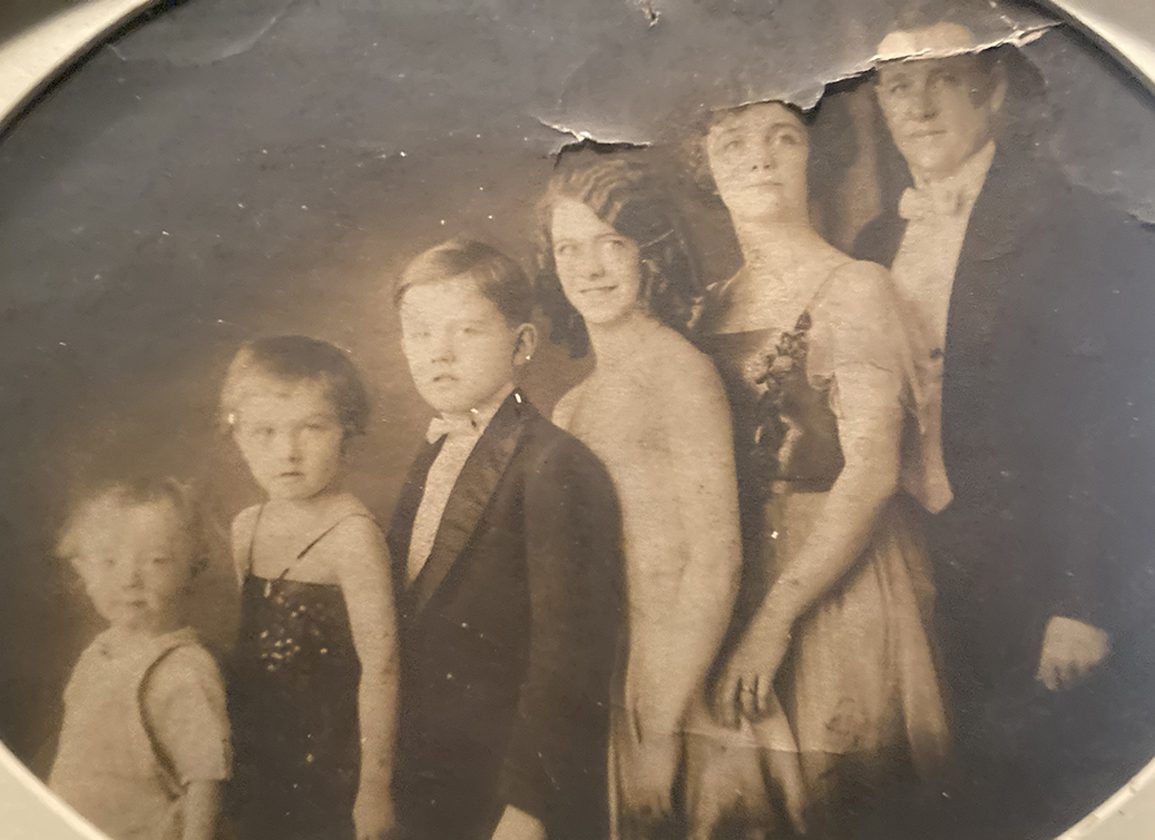
McLeod Troupe on the Orpheum Circuit: Johnson's mother is second from the left next to brother Jackie | Dave Johnson

“Robyn was much younger than Fred, but each was equally dependent on the other,” Johnson recalls. “Robyn's a wonder. She was a terrific rider, but a great person. Still is. And of course Fred was just a hell of a guy. Loved the game. He would get emotional about his horses. If one got claimed, just like Burt Bacharach, he would buy it back.

“At one point during that dinner Fred leaned across the table to me, just so serious, and I thought, 'Oh gosh, what's coming now?' And he said, 'Dave, I really have an important question to ask you.'” Johnson pauses and chuckles. “'Dave,' he said. 'How do you win the Pick Six?'”

Now here we are, on the opposite coast, in the Manhattan apartment that Johnson even then called home. (He bought it 51 years ago.) And we're wondering what has happened to our game since; how to retrieve the glamor of those days, when the golden age of the silver screen retained at least a copper glow; when Marje Everett ran Hollywood Park and made sure that friends like Elizabeth Taylor would show up for the inaugural Breeders' Cup.

Johnson knows that horseracing today is a very different world from when his mother taught him, aged just four or five, how to read the Racing Form: they were on the train from St. Louis to New Orleans, in the last months of the war, visiting his father's military posting.

“The arc of what has happened, in racing, seems so evident to me,” Johnson says. “I first started to go to the races as a very young guy. My family was never in the game as owners, trainers, anything. But we all loved to go to Fairmount Park, over the river from St. Louis, and it was always a wonderful holiday.

“In 2023, racing is a television production. There's no longer people at the track, or only very few. For the Derby, Oaks, the Breeders' Cup, Royal Ascot, a destination like Saratoga or Keeneland: yes. But on a day-to-day basis, year round, it's a television production. So what we have now, with some racing executives, is people making decisions about television without knowing anything about broadcasting. Of course, some are terrific. I've worked for good and bad; and it's no different on the TV side, some know their racing, some don't.”

At 82, naturally enough, Johnson doesn't find it quite so easy to get around. But he remains fully engaged, and feels due gratitude for precisely the reach of all the broadcasting platforms that are available today. Shortly before welcoming TDN, indeed, he had already been watching British racing on his phone over a morning coffee. But breadth of access does not equate to breadth of engagement.
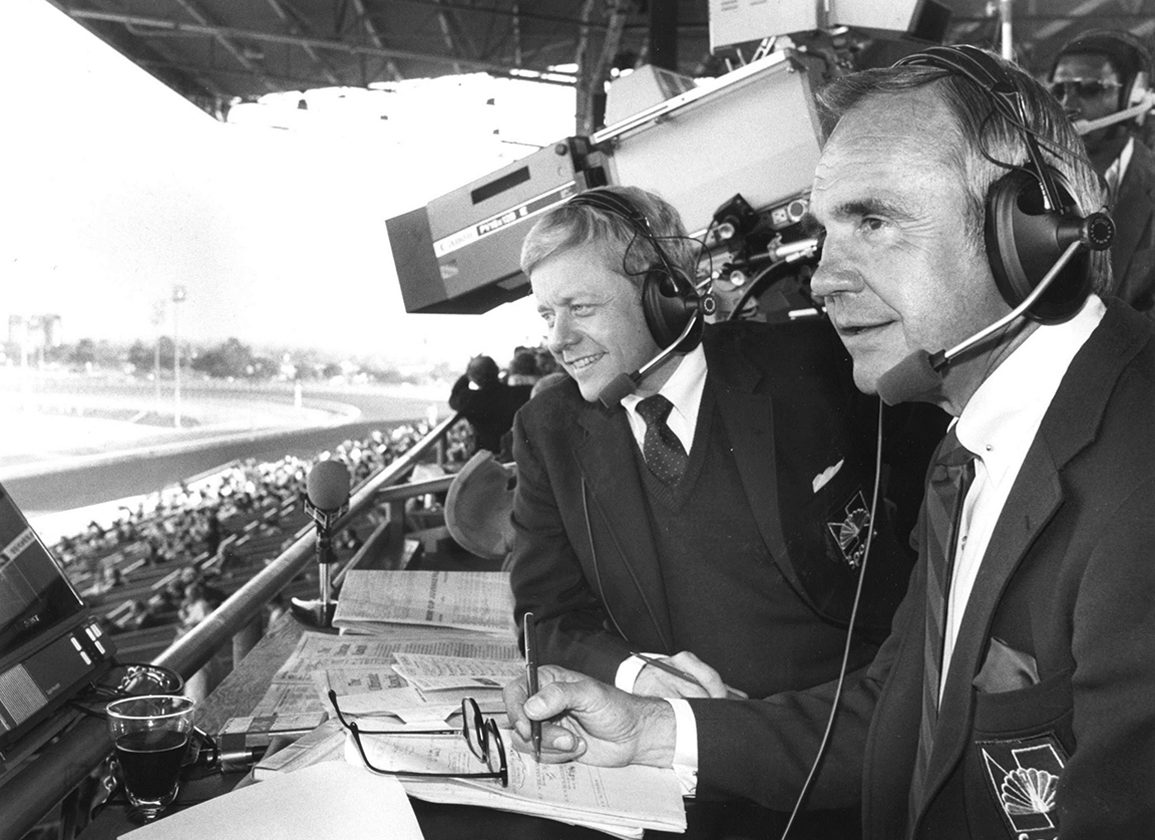
Dick Enberg and Dave Johnson at the 1984 Breeders' Cup | NBC Sports

One of the things that sustained the sport's popular heyday, he feels, was simply the way horses were bred or trained (or both). Johnson wonders whether longer intervals between races have partly become standard because of medication levels; less speculatively, he deplores the sensitivity of trainers to their win percentages, above all now that so many potential runners are concentrated in so few hands. Johnson remembers when even someone like Woody Stephens would have no more than 40 horses.

“I knew Woody very well, and his assistants Sandy Bruno and David Donk,” Johnson recalls. “I knew that whole barn. Wonderful people. And Lucille, Woody's wife. That was before  the age of flying horses around, which was really started by Wayne Lukas. I mean, how would you begin to know 200 horses? I don't know how they do it.

“Woody was very funny. And very self-centered! 'Let's see what time it is. Oh, by the way, did I tell you that Laurel gave me this watch for winning five Selimas?' But he was a hell of a horse trainer, wasn't he? I mean, a real hardboot. Hardworking, old school. A throwback. Owners had some input, too, but the trainers ran their horses where they thought. I mean, Woody is a perfect example: winning the Met Mile with Conquistador Cielo Monday, and winning the Belmont on Saturday. I think there are some traditions which should stay, including the Triple Crown. To move the Met Mile to the Belmont undercard, that hurt me. Maybe I'm old school too.”

But maybe that's just what we're missing-the sense of participation that spreads down from the barns to the public. Horses weren't just financial or career devices, whether for breeders or trainers: they put on a show.

After all, Johnson himself would never have got started without an innate sense of theater.

“I called my first race in '65 at Cahokia Downs,” he recalls. “And it's like the script of a B movie. I was 24, working for a law firm. I'd do wills, I'd go out and take pictures of where an accident happened, I'd go and talk to a guy in prison. Anyway we had a box at the track, for the clients, and that evening I'd gone over there to wheel a horse in the double. And the announcer, Todd Creed, became ill. A stretcher went by, behind the box, and an announcement was made: 'Ladies and gentlemen, there'll be no more announcing tonight. Please watch the tote board. Thank you, and good night.'

“Now, I knew the general manager, Ann Detchemendy. She was an Ethel Merman type: a brash, wonderful lady. She'd say to me, 'Hey sweetheart, you want to split a double with me?' 'Oh yes, Miss Ann, I'd love to.' Her office was right behind, so I went in and said, 'Miss Ann, I could call the races for you. I can memorize the 10 points of the Yalta Agreement, so I can certainly manage the seven horses in this race.'”

Miss Ann picked up the phone, there was some back and forth, and she hung up. “Thanks, Dave, but the announcer's son is going to fill in.”

“That was Todd's son, Mike,” Johnson recalls. “So he's in there with the engineer, and the 'musician' who would put the stylus on the record to play the bugle. (They had to have a member of the Music Union do that for every race!) And so the three of them stood there as the horses broke out of the gate.”

“That's number five going to the lead,” says Mike.

“I don't think it's the five,” interjects the engineer.

Then a third voice: “I think it's Blue Boy.”

“And you heard the three of them argue for five furlongs,” Johnson says. “It was hilarious. Immediately after the race, Miss Ann came into the box. 'You're next!'” Johnson pauses and smiles. “I'd told my friend Tony Marino that I was going over to the track, but he was going to have some dinner first and drive over later. So he parks his car, and as he's coming through the parking lot he hears the fourth or fifth race being called. And he said, 'Geez, that sounds like Dave.'” Johnson shakes his head and chuckles. “And that was it. And here we are, almost 60 years later.”

Johnson did other stuff around the track, too: booked group parties, wrote stories, did selections for both the local newspapers. (They had to be different!) He carried on working during the day and called races at night. Meanwhile he was still reading history at Southern Illinois University, albeit graduation had to be squeezed in between the fourth and fifth races one night. “And the people, I loved the people,” he stresses. “That's what is so wonderful about working at the track. They're like family. Because you spend more time with them than you do at home.”

Calling a race just came naturally: that performance gene coming through. Having provided cover on other, less extempore occasions, Johnson took over at Cahokia and Fairmount when Creed went to Ak-Sar-Ben. Then, in 1970, he got the NYRA gig on the retirement of Fred Capossela. Secretariat was foaled that year, and so the wheel of destiny turned.
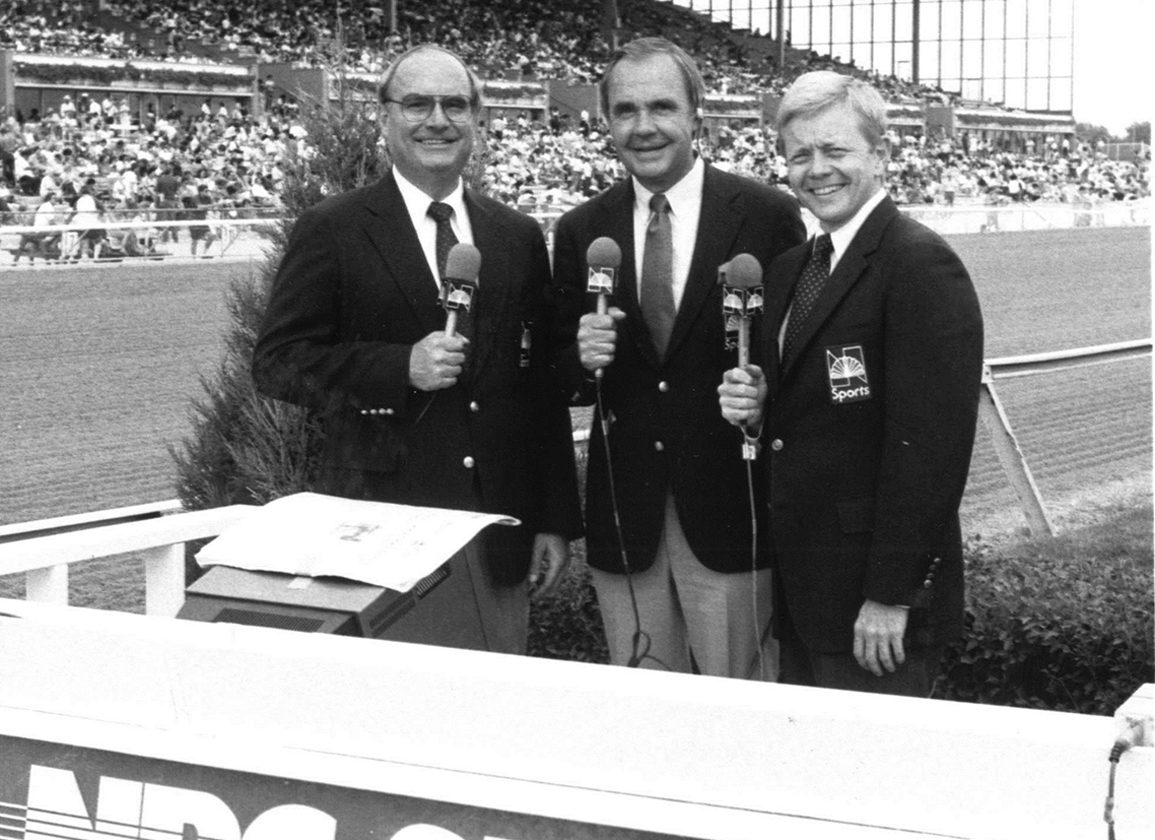
Pete Axthelm, Dick Enberg and Dave Johnson in 1984   | NBC Sports

With time, Johnson's trademark call (“And down the stretch they come…”) became literally that: he was able to charge its unauthorized use to charity. But however entertaining his style, he always felt that his first priority was to inform.

“Say what you see,” he says. “That was my only job. All the extraneous B.S. of the announcer coming on, and telling who they like, that's somebody else's job.”

That said, even the informing was constrained in the old days. “At the track, you had to shut the microphone off at the 16th pole,” he recalls. “That was because of a federal law called the Wire Act. They didn't want the result to get outside the confines of the racetrack, for fear that illegal bookmakers would churn the money. Prior to the first race, the string of payphones at Belmont Park would be locked up-and they'd only unlocked after the ninth.”

There was one time, admittedly, when Johnson finished the call too early even for the strictures of the Wire Act-in a race at Cahokia that he called as a sprint when it was really a route. (“I saw these jocks with the brakes on,” he recalls. “And I thought, 'Oh my God, it's a fixed race!' They went around the clubhouse turn, I hung up the microphone off, and the engineer said to me, 'Dave, they go around again!'”)

Not all change is for the worse, plainly.

“No, that's true,” Johnson acknowledges. “One time Angel Cordero was going for his fourth win of the day. And early in the stretch I said, 'And Cordero moves to the front.' And then at the 16th pole I said who was in front, who was second, shut it off. [Next day] my boss Pat Lynch called me in and said, 'I got a memorandum. From a board member. “Please inform Mr. Johnson, it's horse racing-not jockey racing!” The mentality… I mean, see how much it's changed?

“But if you listen to Fred Capossela-a  wonderful man, just a great human being-his calls were never jockey-, or trainer-related. But it was all very good. And that's our job: to identify, and give the margins, and who's moving. And from the top of the stretch, maybe only concentrate on the horses in contention.”

One way or another, however, Johnson showed that inherited flair for performance. And, in time, that actually extended as far

as playing roles on stage and screen.

Back in St. Louis, for instance, he performed in musicals like My Fair Lady, Can-Can and Unsinkable Molly Brown in front of 12,000 at the outdoor theater in Forest Park. Above all, however, Johnson has adapted his racetrack nose for a wager to investment in Broadway productions.

“That also came from a St. Louis connection,” he says. “Rocco Landesman, who I knew from the racetrack 20, 25 years ago. Owned six theaters here in New York, called the Jujamcyn Theaters. We had always talked about The Producers, which was one of my favorite films, with Zero Mostel. So when he said there was a chance he might do it as a stage play, I said, 'Count me in.'”

Johnson had already backed a theatrical winner in London, a city he would get to know very well through attending 24 consecutive Royal Ascots. In 1983 he saw the West End debut of Michael Frayn's Noises Off, and virtually camped on the producers' doorstep.

“I begged them to take my money!” he says. “And it was a big success, mainly because they sold the film rights for $5 million. But I didn't invest in another show until The Producers, nearly 20 years later. Rocco came up to me at the memorial service for David Merrick and said, 'I think we've got Matthew Broderick.' And that was it. Biggest bet I ever made. But it paid very well.”

The show opened at the St. James Theater on 19 April 2001, and ran for 2,502 performances, harvesting a record 12 Tony Awards. And Johnson remains immersed in that cosmopolitan community, still telephoning and corresponding with folks from behind and in front of the footlights. Asked what draws him to their world, his answer is succinct and emphatic.

“Talent, and honesty,” Johnson declares. “I have a lot of friends whose talent I really admire. They give it all. But it's not just the performing, it's everything that goes into making any of these things: a television show, a commercial, a stage show, a movie. Because, really, can't you see through people that are phony? I can, at least I think I can. So it's not just talent, it's also the honesty: people, like Rocco, who always do the right thing. I don't want anything to do with anybody who isn't above board, who's shady, who cuts corners.”

But come on, Dave, how does that account for where you spent the rest of your time? You must have seen a few phonies on the racetrack.

“Oh, yeah!” he says with a chuckle. “And in the management of racetracks, too.”

This, in fact, is one of his pet vexations: track executives who didn't come up through the game; people who would never go to the races on their day off. But the beauty of Johnson's own story is the way he has straddled the margins between these two cosmopolitan, theatrical worlds: the stage and the Turf.

“There's only one job at the racetrack that is a performer,” he reflects. “As announcers, we are performers. If you're doing it on television, you're not doing it for the crowd. Yeah. Isn't that funny? Only one job.

“And it's a once-in-a-lifetime thing. In anything, like a movie, that's going to be on videotape or film, you can change it. You can do take two, whatever. At the racetrack, you get one shot, and it'll never be the same. Ever. Run the same horses, your call is never going to be the same.”

What luck, then, that he took his cue that night back in 1965: an unscheduled audition for the rest of his life.

“There's a little article in The New York Times called Tiny Love Stories,” Johnson says. “It has to be 100 words or less. And so many times it's about people who met their mate in a cab, or on a corner, or in a rainstorm. I love those stories. It's the same kind of thing. What if I hadn't gone to the track that evening? Who knows? How lucky was I? And then I get to see Secretariat, Ruffian, Affirmed. I really have been lucky. I have no regrets. I've had a great career, and a wonderful life. I love the line in the movie Braveheart, where Mel Gibson says: 'Every man dies. But not every man lives.' And boy, have I lived.”

The post Dave Johnson: What a Performance! appeared first on TDN | Thoroughbred Daily News | Horse Racing News, Results and Video | Thoroughbred Breeding and Auctions.
Source of original post

Catching Up with 2010 Breeders’ Cup Ladies’ Classic Winner Unrivaled Belle

A homebred for Gary Seidler and Peter Vegso, Unrivaled Belle's Breeders' Cup win came at the expense of the following year's Horse of the Year Havre de Grace, who finished third. The two mares would eventually share common ownership, both being purchased by Mandy Pope's Whisper Hill Farm, and live together at Timber Town before Havre de Grace's passing earlier this year.

The crown jewel among Unrivaled Belle's foals to date is two-time champion Unique Bella. Unrivaled Belle has a 2-year-old full-sister to Unique Bella named Tap My Belle, as well as yearling and weanling colts by Into Mischief. She was bred to Flightline for next term.

“Our time with Unrivaled Belle was amazing and super fun,” said Vegso, best known outside of racing as publisher of the “Chicken Soup for the Soul” series. “She was a wonderful horse and loved racing. Bill Mott did a super job with her; he's a special soul as is 'the Belle.' It's always so special when a horse we foal does so super well; makes having a farm and mares and mating–and the Mother Nature surrounding that comes with it–magical.”

Unrivaled Belle (2006 gray or roan mare, Unbridled's Song–Queenie Belle, by Bertrando)

Lifetime record: GISW, 14-6-6-1, $1,854,706

Breeders' Cup connections: B/O-Gary Seidler & Peter Vegso (KY); T-Bill Mott; J-Kent Desormeaux.

Current location: Timber Town Stable, Lexington, Ky.

The post Catching Up with 2010 Breeders’ Cup Ladies’ Classic Winner Unrivaled Belle appeared first on TDN | Thoroughbred Daily News | Horse Racing News, Results and Video | Thoroughbred Breeding and Auctions.
Source of original post

A Pair of Queens for King’s Equine

ARCADIA, CA – As the unbeaten Tamara (Bolt d'Oro) looks to emulate her legendary dam Beholder (Henny Hughes) with a win in the GI Breeders' Cup Juvenile Fillies, the duo have something else in common that you won't be able to find in Friday's program at Santa Anita.

Before heading out to join Hall of Fame trainer Richard Mandella in Southern California, they were both broken and trained on behalf of Spendthrift Farm at Raul and Martha Reyes's King's Equine in Ocala, Florida.

Like mother, like daughter?

“Actually, Tamara was a little different as a yearling than Beholder was,” Raul Reyes said. “Tamara was a little bit more of a rebel. She was a little harder to break for a couple of weeks–she had her own mind. Then, she changed and became a regular filly. On the other side, Beholder was very pleasant all the time. She never gave you any trouble.”

Reyes continued, “Beholder was a little more stocky and had more muscle. Tamara has really filled out since Mandella has had her.”

Tamara is the fourth foal produced by the four-time champion and three-time Breeders' Cup winner. Beholder's first two offspring–Q B One (g, 5, by Uncle Mo) and Karin With an I (f, 4, by Curlin)–failed to find the winner's circle and were a combined 0-for-6 at the races. Tamara's 3-year-old half-sister Teena Ella (War Front), winner of this spring's grassy GIII Senorita S. at Santa Anita, became Beholder's first winner as a broodmare in February.

Beholder's yearling colt by Curlin, meanwhile, brought a sale-topping $4 million from Zedan Racing at Fasig-Tipton's Saratoga Sale this summer. Barren for 2023, Beholder was covered by Jackie's Warrior for next season.

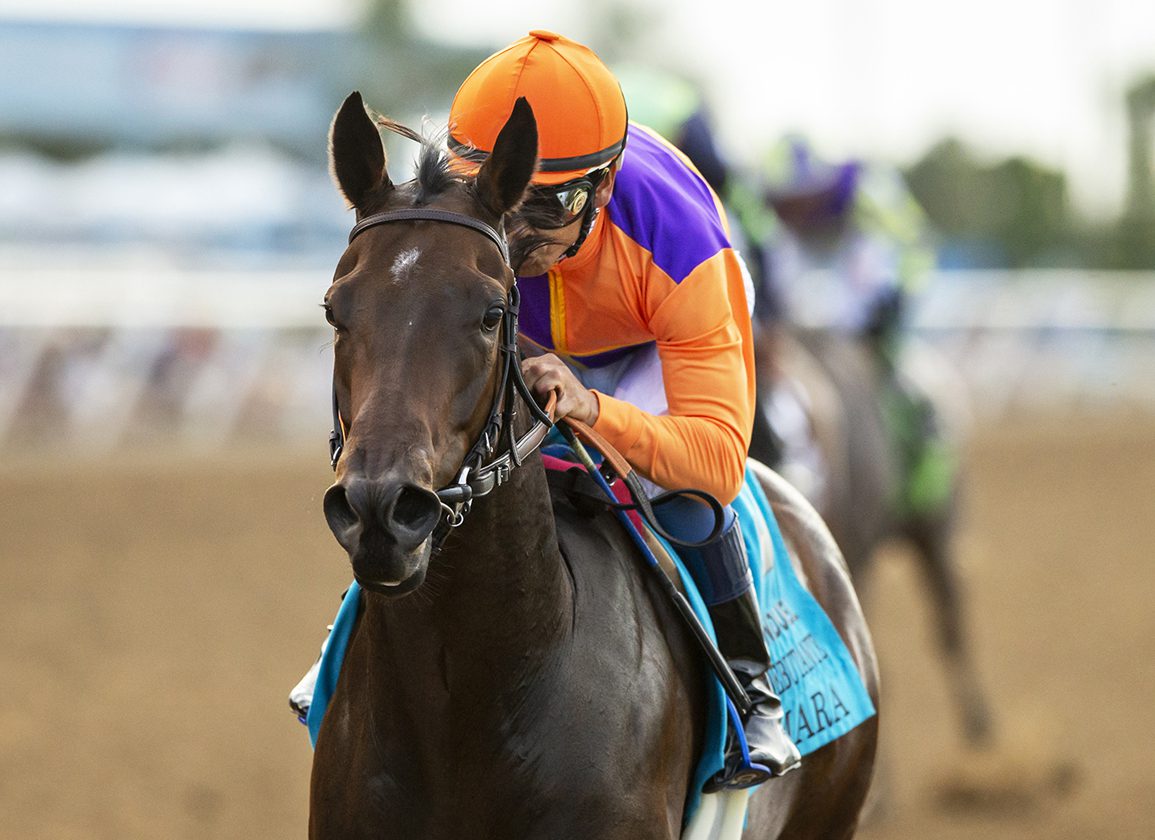
Tamara, ears up, toying with the competition in the GI Del Mar Debutante S. | Benoit

Reyes and Mandella would often chat about and compare notes on Beholder's offspring during Mandella's visits to King's Equine, Reyes said. Mandella has trained all of Beholder's progeny to date.

“I told him that I didn't know how good this filly (Tamara) was going to be, but she sure was better than her siblings,” Reyes said. “I broke all of Beholder's (offspring) and Tamara looked more racey. She breezed way better than all of them–way way better. She used to outrun the company when I used to breeze her here. The filly before her (Teena Ella) won a Grade III and she was O.K. But Tamara was exceptional. We didn't know that she'd go on and win these races like that. But she was the best one of the siblings by far.”

Carrying the namesake of B. Wayne Hughes's daughter–sounds like the folks at Spendthrift concurred with Reyes's assessment–Tamara overcame a stumble at the start from her rail draw to launch her career in style with a 'TDN Rising Star' performance at Del Mar Aug. 19.

Tamara ran to the billing as the 6-5 favorite and then some with a 6 3/4-length tour de force over 11 rivals in the GI FanDuel Racing Del Mar Debutante S. Sept. 9, good for a 91 Beyer Speed Figure. Tamara will be heavily favored as she tries two turns for the first time in the Juvenile Fillies. She has been installed as the 4-5 morning-line favorite.

“The way she runs, she makes you think that she's gonna be alright,” Reyes said.

Beholder seeks to become the fifth Breeders' Cup winner to also produce a winner at the two-day Championships.

Living the American Dream…

Growing up a mile from the racetrack in his native Tijuana, Mexico, Reyes wanted to follow in the footsteps of his older brother, a quarter horse jockey in Texas. Reyes began working on the backstretch at the tender age of 10 back in 1975–yes, you read that correctly–and just six years later, began to pursue his career in the saddle in California.

“I came to the United States and worked for a couple of good trainers, but I was too big to be a jockey,” Reyes said. “I had to quit riding when I was like 20. It was hard for me because I couldn't speak English very well. Can you imagine? It's hard enough for an American kid to make it here.”

King's Equine's Raul Reyes | Fasig-Tipton

Reyes subsequently relocated to Florida to begin training and caught his big break while working the yearling sales for Taylor Made in Kentucky. Everything began to fall into place from there.

“They gave me the opportunity of a lifetime,” Reyes said. “That opened my eyes. I learned how to sell horses and how to deal with people. I must say, my friend (Taylor Made's Vice President of Sales) Frank Taylor, he's the one who really made it happen for me. He introduced me to all these good people–the biggest clients in the world all come to Taylor Made. And then I met Wayne. That's really how I got started.”

Wayne, of course, is B. Wayne Hughes, the late founder of Spendthrift Farm who passed away in 2021.

“We became pretty good friends,” Reyes said. “And we've had pretty good success together. They are great people to work with.”

Reyes typically trains approximately 100 head at his 84-acre training center and is also a leading consignor at the 2-year-old-in-training sales. Spendthrift Farm has been a client of his for nearly two decades now.

“We try to keep it simple,” Reyes said. “It can get very complicated if you start looking for ways to do it differently. People have been doing this for a 100 years. They say the good things don't change.”

In addition to Beholder and Tamara, other King's Equine training graduates include: champion Letruska (Super Saver); MGISW Miss Temple City (Temple City); GI Breeders' Cup Sprint winner Silver Train (Old Trieste); and GISWs Jimmy Creed (Distorted Humor) and Hit the Road (More Than Ready).

King's Equine's 2-year-old sale alumni include: GISW Beyond Brilliant (Twirling Candy) ($200,000 2yo '20 EASMAY); MGSW millionaire Stanford (Malibu Moon) ($550,000 2yo '14 BARMAR); MGSW Kanthaka (Jimmy Creed) ($140,000 2yo '17 BARMAR); and GSW and GI Breeders' Cup Sprint runner-up Shancelot (Shanghai Bobby) ($245,000 2yo '18 OBSMAR).

“I've been in Ocala for 25 years already,” Reyes said. “This is a place that's been very good to me. That's a lot of good seasons that I've had here now.”

Reyes's 2023 season is about to get even better at 2:40 p.m. PT on Friday afternoon.

The post A Pair of Queens for King’s Equine appeared first on TDN | Thoroughbred Daily News | Horse Racing News, Results and Video | Thoroughbred Breeding and Auctions.

Source of original post

Clay’s Debut Consignment Features a Powerhouse Pair

It was almost a year ago that Case Clay stepped away from his position at Three Chimneys Farm to focus full-time on his company, Case Clay Thoroughbred Management. With services including bloodstock auction and private purchases, portfolio management and equine insurance, he has stayed busy since going solo.

Clay was in Australia for the Inglis Easter Sale this spring to oversee a successful auction for his clients offering yearlings there. They celebrated several lucrative sales, including a Dundeel (NZ) colt out of Kevikki (Aus) (Smart Missile {Aus})–a mare that Clay had purchased privately for the breeding partnership–that sold for A$500,000 out of the Arrowfield consignment to Katsumi Yoshida.

He maintains his longstanding relationship with Three Chimneys by working to expand Gun Runner's international presence. In April he took a trip to Japan, visiting farms there to recruit mares for the emerging supersire.

Of course he was recently on hand for the domestic yearlings sales as well, representing clients both buying and selling. During Book 1 of Keeneland September, Case Clay Thoroughbred Management purchased a Kingman (GB) filly from the family of Uncle Mo for $625,000.

“It's going well,” Clay shared. “I'm really enjoying it and having a lot of fun. The goal is to try and do well for my clients, whether that is advising or buying or selling for them. I feel lucky to be working with some great people and what I'm really liking is the variety of work. It's never the same job from one day to the next.”

Clay's next undertaking is one that he admits was never really in the cards for his business until now. At the Keeneland November Sale, he will launch his first consignment. The two-horse lineup features Puca (Big Brown–Boat's Ghost, by Silver Ghost), the dam of GI Kentucky Derby winner Mage (Good Magic), and Grade I-winning millionaire Dalika (Ger) (Pastorius {Ger}–Drawn to Run {Ire}), by Hurricane Run {Ire}).

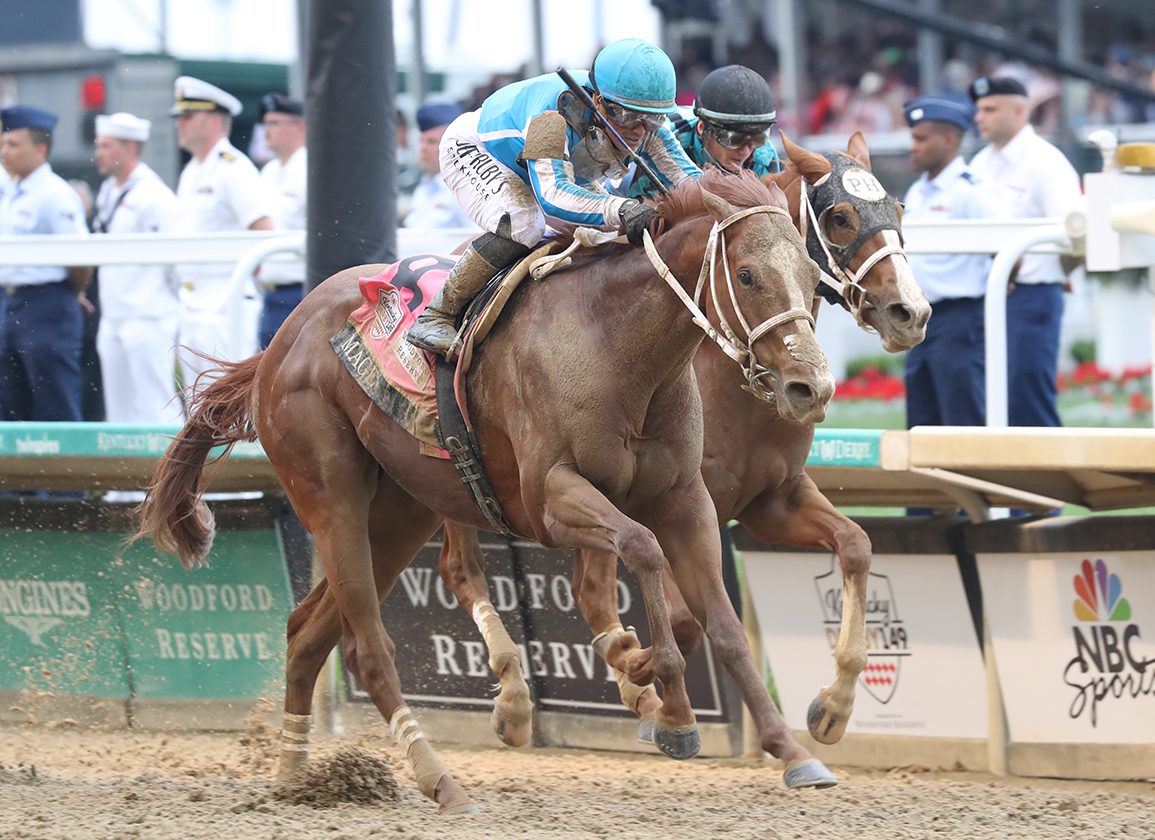
Mage gets the win in the GI Kentucky Derby | Horsephotos

“This was not really in the plans, but when these two mares came along and did well, it became part of the plan,” Clay explained. “I'm lucky to have clients and relationships that have confidence in me to take them to a sale. They were very much a part of this decision and very much a part of me being fortunate enough to sell them.”

Clay's father Robert Clay launched Grandview Equine not long after selling Three Chimneys in 2013. When the partnership bought several shares in Good Magic, they purchased Puca, a stakes-winning half-sister to GISW Finnegans Wake (Powerscourt {GB}), for $475,000. After producing her first foal by Gun Runner the following spring, Puca was sent to Good Magic in his first year at stud.

The resulting foal was Mage, who Grandview sold as a yearling for $235,000. Although he won't make it to the Breeders' Cup this weekend due to a fever, the Kentucky Derby winner has stamped himself as a top 3-year-old this year as he collected additional Grade I placings in the Florida Derby, Preakness S. and Haskell S. and he will now point to the GI Pegasus World Cup in 2024.

“My dad has been floating around since May,” Clay said with a laugh. “It's very exciting for my parents and the partners in Grandview.”

At 11 years old, Puca's produce record extends past Mage. That first Gun Runner foal, a filly named Gunning, was retained by Grandview and is twice stakes placed. Her 2-year-old Dornoch, a full-brother to Mage, was second in the Sapling S. in August and just broke his maiden at Keeneland by six and a half lengths for trainer Danny Gargan. Puca's yearling colt by McKinzie sold to Mayberry Farm for $1.2 million at the Keeneland September Sale.

“She's three for three with producing blacktype and now has sold a $1.2 million yearling as well,” said Clay. “Her foals are all a little bit different, but one consistency is that they're good-looking horses. They're all commercially-appealing physicals. She's a big, beautiful mare and she's from a good-producing family.”

Puca will be offered at Keeneland November in foal to Good Magic.

“Who knows what her potential is with what she has already produced?” said Clay. “I can't think of another Derby producer that sold in the same year with this kind of produce record from only three foals to race.”

The other mare in the consignment, the German-bred Dalika, represents the scope of Clay's international network.

A winner at two in her native country for her breeder Gestüt Ammerland, Dalika caught the eye of Bal Mar Equine's Paul Varga.

“Paul and I had talked a lot about buying fillies in Europe and racing them here,” explained Clay. “By good luck, I am friends with Ammerland. He used to board his horses at Three Chimneys back in the day. Crispin de Moubray is a good friend and he managed for Ammerland for many years. I called him and we were able to buy Dalika privately.”

Dalika quickly emerged as a turf force on American soil and she was a presence in the Al Stall barn for four years as she amassed four career graded stakes wins highlighted by the 2022 GI Beverly D. S. at Churchill Downs.

“She won at seven distances, from five and a half to 11 furlongs,” said Clay. “A track record setter at Churchill Downs and Kentucky Downs, she had 32 starts and retired sounds. She was kind of the dream filly. Al Stall did an amazing job training her. It's one of those things where it was such a lucky circumstance that such a durable mare ended up in Stall's hands.”

Dalika is Stall's highest-earning filly with over $1.4 million in earnings.

“She is very unique to what we are training in America,” said Stall. “When she was traveling well close to the front end, she was a tough horse to get by. She outlasted the competition and she brought it most of the time. That was the best thing about her. Every time she ran we would just assume that she would come out of the race fine and usually she did. There's a lot to like about this mare with her soundness, heart and reliability.”

Dalika wins the 2022 GI Beverly D. | Horsephotos

Retired from racing at the start of the year, Dalika is now carrying her first foal by 2022 Horse of the Year Flightline.

Clay said he believes the 7-year-old's pedigree will offer breeders ample opportunity for success.

“You've got breedability with her,” he said. “She's pretty much an outcross anywhere. These German mares are durable and they have produced winners of a lot of races around the world–the Arc, the Melbourne Cup, the King George and Queen Elizabeth, the French Derby and Epsom Derby. For anyone around the world who wants to win a major Classic, the more you look into it, these German mares produce those types.”

Clay said he doesn't plan to set expectations for his consignment until the mares are on site. Until then, he will finalize last-minute preparations, take a quick trip to the Breeders' Cup on Friday and then return to Lexington to ship in for the weekend.

“Once you get to the sale you can get a feel for things, so I've left all that until later,” he said. “I plan to treat my customers and the people I deal with right and hopefully the rest takes care of itself.”

Clay is quick to say that while he is looking forward to this latest endeavor, he has no plans of expanding his consignment into yearling sales.

“Selling mares that are in my camp is vertical integration, so it makes sense,” he said. “Mares are much more straightforward, whether you're buying or selling them. That's what I like about it.”

After a 20-year tenure at Three Chimneys, Clay has had a hand in offering many top-selling broodmares and broodmare prospects to the marketplace. One of his most memorable Keeneland November Sales was back in 2004, when MGISW Take Charge Lady (Dehere) was consigned by Three Chimneys and sold for $4.2 million.

Clay said he hopes his past experiences serve him well going forward.

“I was super lucky to be working for Three Chimneys when there were a lot of these million-dollar plus mares going through,” he said. “Take Charge Lady was a really memorable one, as well as Mizdirection (Mizzen Mast), Composure (Touch Gold) and Life at Ten (Malibu Moon). It's nice to have that experience to pull from and I'm looking forward to getting back in the saddle with these two mares.”

The post Clay’s Debut Consignment Features a Powerhouse Pair appeared first on TDN | Thoroughbred Daily News | Horse Racing News, Results and Video | Thoroughbred Breeding and Auctions.

Source of original post

Verified by MonsterInsights