Super Trainers in California: The Story in Numbers

Over the years, the rise of the so-called super trainer has prompted many a clutched pearl by virtue of a perceived monopoly on the sport.

Anecdotally, it can certainly appear as though the same few names wield an outsized impact. But what does the data say?

The TDN has crunched the numbers in California from 2007 onward. This is far from a comprehensive overview of the situation, and what emerges is a picture that can be viewed from multiple angles.

On the one hand, the numbers suggest that the biggest stables in the state have indeed consolidated their positions at the top during a long period of market contraction. Yet at the same time, other indicators afford tentative encouragement for the smaller players.

One statistic that should make industry leaders sit up and take notice, however, is how in just 14 years, the number of trainers making at least one start in California has nearly halved. As a market shrinks, the impact from any dominant force is going to be more keenly felt.

Super trainers

One common narrative in California is that the 80/20 rule–the notion that 80% of prize money funnels into the pockets of 20% of the trainers–has long been a defining feature of the industry.

How accurate is this?

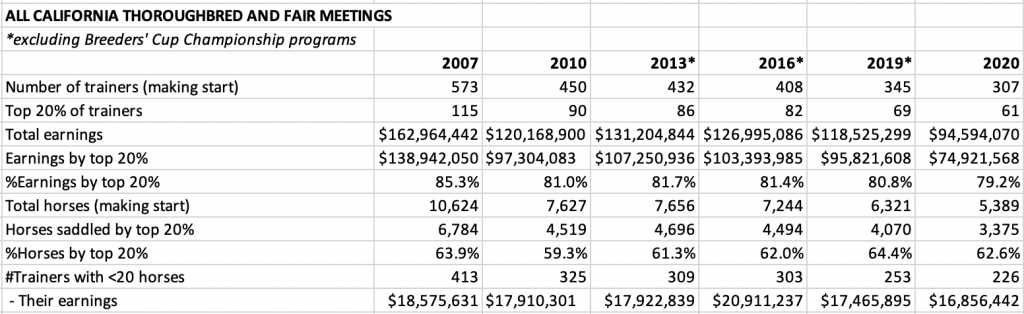
The 80/20 rule has fluctuated a little over the last 14 years, with the top 20% of trainers in the state typically winning more then 80% of available purses. Indeed, back in 2007, they won more than 85% of all available prize money.

Between 2007 and 2018, the closest California came to the 80/20 benchmark was 2015, when the top 20% trainers won 80.7% of all prize money. But the last two years have seen a very slight shift in that trend.

In 2019, the top 20% of trainers won 80.8% of prize money. Last year, it fell to 79.2%–the first time it dipped below 80% in at least 14 years.

There doesn't appear any one clear explanation. These past two years in California have been far from typical, with 2019's welfare issues followed by a global pandemic. It's unclear, however, exactly why those events should begin to iron out prize money distribution disparities.

Another factor to take into consideration is purse distribution between stakes and overnight races. Then there's the shrinking opportunities out West–has that led to the bigger barns stabling more horses elsewhere?

Arguably more consequential was the expulsion in June of 2019 of trainer Jerry Hollendorfer from The Stronach Group's California facilities (Santa Anita and Golden Gate Fields).

Prior to that, Hollendorfer had been the dominant numerical force in California racing for many years. In 2018, for example, his runners made up 3.6% of all starts in the state. As recently as 2015, they had made up 4.1% of all starts in the state.

Nevertheless, without a clear understanding of where Hollendorfer's horses went, it's difficult to accurately diagnose. And as we shall see farther down, when the data is restricted to stables with 100+ horses making a start per year, their dominance appears as strong as ever.

Trainer data

Between 2007 and 2020, California has witnessed a 46.4% decrease in the number of individual trainers making at least one start: from 573 in 2007 to 307 in 2020.

At the same time, the number of trainers making up the 20% highest earners has decreased by nearly 47%–from 115 in 2007 to 61 last year–putting it in line with the overall drop in trainers.

The top 20% of trainers have consistently had an outsized impact when it comes to the apportioning of horses.

For the past 14 years, these top 20% trainers have started between 58.6% and nearly 65% of horses that have made at least one start in the state.

There are other indicators illustrating how, while the industry has shrunk, the big players have consolidated their position at the top.

One hundred-plus horses

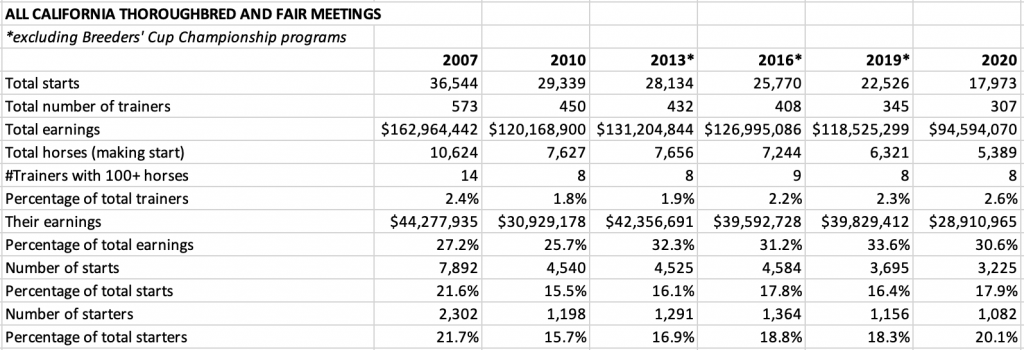
Back in 2007, the number of trainers with 100 or more horses making at least one start per year was 14–the highest over the last 14 years.

Since then, however, the number of trainers with 100 or more horses making at least one start has fluctuated between eight and 12.

This means that while the number of active trainers in California has almost halved, the number of trainers with 100+ horses making starts has stayed fairly constant.

Not surprisingly, these large stables have long wielded tremendous sway in terms of prize money won and number of starts made.

In 2007, the 14 stables with 100 or more horses making at least one start annexed roughly 27% of all prize money and 21.6% of all starts. These 14 stables represent 2.4% of all trainers with at least one start in the state.

In 2020, the eight stables with 100 or more horses making at least one start (Isidro, Glatt, Sadler, Wong, O'Neill, Baltas, Miller and Baffert) represented 2.6% of all trainers with at least one start in the state. All in all, they annexed nearly 31% of all prize money and roughly 18% of all starts.
Lower end

There are, however, some angles to the data which appear to show glimmers of encouragement for the smaller stables barely scratching out a living.

As the number of active trainers in California has shrunk, the average earnings per trainer have trended upward.

Comparing 2007 to 2020, the average earnings per trainer for the bottom 80% had increased nearly 53% (from roughly $52,000 in 2007 to roughly $80,000 last year).

In comparison, the average earnings per trainer for the top 20% had increased only 0.6% during that same period (from roughly $1.212 million in 2007 to roughly $1.220 million last year).

Comparing 2007 figures to last year's, the bottom 80% of trainers have also significantly outpaced their top 20% cousins in terms of growth in both earnings per horse and earnings per starter.

Nevertheless, when the data is adjusted for the relative purchasing power of the dollar, the picture looks less rosy. When overall earnings per trainer are adjusted for inflation, for example, we see a more than 13% decrease from 2007 to last year.

To reinforce just how important the smaller stables are to the racing ecosystem, over 70% of trainers start fewer than 20 individual horses a year, but last year their horses accounted for about one-quarter of the entire horse inventory (1,392 of 5,389) and about one-quarter of all starts (4,321 of 17,973).
If the health of a racing product is defined in good part by fielding races with a varied breadth of competitor, therefore, this certainly leaves much food for thought, especially when the broken business model widely used throughout the industry disproportionately impacts the smaller trainer struggling to stay afloat.

And if the smaller stables find themselves unable to survive in an increasingly lopsided marketplace, what kind of product can the bettor expect?

Note: The data is derived from Daily Racing Form chart text files.

The post Super Trainers in California: The Story in Numbers appeared first on TDN | Thoroughbred Daily News | Horse Racing News, Results and Video | Thoroughbred Breeding and Auctions.


Source of original post

April U.S. Wagering Tops $1 Billion

As the Triple Crown trail came to an end, with many tracks hosting important Kentucky Derby preps, and with Keeneland staging its Spring meet in its regular spot on the calendar, wagering on U.S. races exceeded $1.1 billion, according to statistics released Wednesday by Equibase.

Year-over-year comparisons are largely irrelevant, as the effects of the coronavirus really made their presence felt in April 2020. Keeneland was left no choice but to postpone its meet to July, racing at Santa Anita was dark into late May and in New York, it remained shut down into early June.

However, a side-by-side analysis considering pre-pandemic numbers reveals some encouraging trends. The handle on U.S. racing in April 2019 was $850 million, meaning that this year's figure represents an impressive gain of 30.4% as compared to two years ago. While the raw number of live racing dates compared to April 2019 declined by 10.29$ and the average number of races (-7.16%) and starts (-8.56%) were also down, average daily wagering last month was $3,953,797, an improvement of 45.35% over 2019, while the average purses per race day of $321,005 represented a gain of 16.2%.

Year-to-date wagering of $3.87 billion is better by 14.44% over 2019, with average daily wagering ($3,702,589) increasing by 26.49% over 2019. Average purses per day were ahead by 7.54% at $291,446.

The post April U.S. Wagering Tops $1 Billion appeared first on TDN | Thoroughbred Daily News | Horse Racing News, Results and Video | Thoroughbred Breeding and Auctions.

Source of original post

Thursday’s Insights: Pricey Quality Road Filly Debuts at Belmont

2nd-BEL, $90K, Msw, 3yo/up, f, 6f, 3:38p.m.
Shug McGaughey debuts 3-year-old BIG CITY MOMMA (Quality Road) for Courtlandt Farms. The $700,000 KEESEP graduate is out of stakes placed New York-bred Easy Living (Big Brown). The filly posted a pair of recent four-panel works at Belmont, including the most recent going :48 4/5 Apr. 24. Jose Ortiz gets the call. TJCIS PPs

The post Thursday’s Insights: Pricey Quality Road Filly Debuts at Belmont appeared first on TDN | Thoroughbred Daily News | Horse Racing News, Results and Video | Thoroughbred Breeding and Auctions.

Source of original post

Landmark 1-2 Flies the Flag for Speightstown

The day that will forever be remembered for a Cinderella story also contained a valuable corrective. Nobody, after all, will suddenly decide that the best route to the GI Kentucky Derby is simply to buy every $1,000 yearling that comes onto the market; nor does it now follow that every seven-figure yearling will necessarily prove a waste of money. Our industry will only remain viable so long as we all feel we have a puncher's chance, whatever our weight division. And if Medina Spirit (Protonico) sustained the longshot dreamer, then last Saturday also provided fresh vindication for a much bigger investment, made at much shorter odds.
The GI Churchill Downs S., a race opened up by the defection of one son of Speightstown, Charlatan, was instead decided by the head separating two others, Flagstaff and Lexitonian. It was the runner-up's second near-miss at this level, having failed by a nose to nail the Bing Crosby S. last summer. That's how close Speightstown came to five individual Grade I winners in 2020; as it was, he earned a fee hike back up to $90,000 from $70,000. In doing so, he not only resisted the fee cuts made across nearly every roster this spring but also an insidious prejudice against ageing stallions.

For here is one prolonging his pomp in a fashion that will leave a lasting impact on the breed. That's exactly the kind of thing he was bought to do, as a $2 million yearling. And now, 22 years later, it is hard to think of many living American Thoroughbreds as deserving of the adjective “venerable.” Flagstaff is Speightstown's 20th individual Grade I winner in the Northern Hemisphere. As such, it feels right to celebrate his latest distinction as one that might-between his prolific record, and the contrasting narrative that dominated the day-be too easily taken for granted.

The fact is that Speightstown is one of the most proven, gilt-edged influences available to breeders today. And, while the expert WinStar team has been maintaining his libido and fertility to very solid levels, it behooves us all to take a step back and remind ourselves what it is that we should most be prizing in Speightstown, while we still have the chance.

It must be said that Flagstaff and Lexitonian are a couple of apples that did not fall far from the tree. At seven and five respectively, they resemble their sire in thriving with maturity round a single turn. By now breeders know not to expect precocity from Speightstown: Tamarkuz, for instance, crowned an ongoing bloom by winning the GI Breeders' Cup Mile at seven. That said, only the pandemic last year prevented Charlatan redressing his sire's notorious failure, hitherto, even to muster a starter in the any U.S. Classic, instead being obliged to settle for a division of the GI Arkansas Derby on the first Saturday in May. (Maddeningly, of course, he was sidelined by the time a Kentucky Derby was salvaged in September.)

But we should always be wary of making rules about any Thoroughbred. Speightstown has sired Grade I scorers at two, notably Sharing at the Breeders' Cup. In terms of distance, moreover, he has given us two-turn winners as prestigious as Golden Ticket in the Travers S. and Haynesfield in the Jockey Club Gold Cup. Last year he even had a Group 2 winner in France over 15 furlongs!

As should always be the case, when planning a mating, you should first think about how best to complement Speightstown's knockout, pugilistic build. Certainly it would be too simplistic to say that he merely needs a Classic-bred mare to stretch out his stock. Saturday's protagonists, Flagstaff and Lexitonian, are respectively out of mares by A.P. Indy and Tapit. His most accomplished performer in Europe, Lord Shanakill, similarly won a Group 2 over six furlongs at two even though he was out of a Theatrical (Ire) mare.

Speightstown at WinStar | Louise Reinagel

On the track, Speightstown's own trademark was the kind of speed we recognize in Nashville and Echo Town, two of the fastest sophomores of 2020. Unsurprising, then, to find Speightstown himself preceding Flagstaff on the roll of honor for what remained a Grade II handicap in 2004. By that stage, he had begun to complete the template: having twice endured prolonged injury lay-offs, he was now on a roll that would include a 1:08.04 track record at Saratoga and an Eclipse Award sealed in the GI Breeders' Cup Sprint. Mind you, the raw talent had already been transparent when running City Zip to a length in the GII Amsterdam S.-one of the more resonant races of the decade, in terms of assets showcased to breeders.

Speightstown bowed out at the Lone Star Breeders' Cup, and if that seems a long time ago, well, they still had a July Sale at Keeneland when Eugene Melnyk made that $2 million play. It's the page Speightstown brought to that auction I feel we need to revisit, because the key to his success may be something we very seldom consider now-and that's the way he can connect young mares to some storied but attenuating influences on the breed.

Speightstown's first three dams are by Storm Cat; Bold Ruler's second crop son Chieftain; and Buckpasser. If you accept Chieftain as a proxy for Bold Ruler, you could scarcely have come up with a more resonant branding at each stage.

A hard-knocking campaigner for Frank Whiteley Jr., Chieftain set a dirt track record over seven at Arlington but was also effective round two turns on turf. While he failed to establish a branch of the Bold Ruler line, he filtered some potent blood into Speightstown's family as a half-brother to Tom Rolfe (Ribot {GB}) and to the dam of Alzao (Lyphard). Their mother Pocahontas (Roman), duly decorated as Broodmare of the Year, was one of just three foals out of 1961 Kentucky Oaks winner How, who raced for Boone Hall Stable.

How was by Princequillo, momentously claimed for $2,500 during the partnership of that most colorful of stables and Horatio Luro. And the golden strands of Princequillo and Bold Ruler are further entwined in Speightstown's pedigree by the top-and-bottom replication of the mighty Secretariat (who of course combined them far more closely, as a son of Bold Ruler out of a Princequillo mare). For two of the three greatest achievements of Secretariat, as a broodmare sire, are represented in Speightstown through his sire Gone West and damsire Storm Cat.

Let's hear it for Flagstaff, by the way, as he introduces the third in his damsire A.P. Indy. What a pity he was gelded! I wouldn't mind keeping a filly by a sire that draws together the great stallion sons of Weekend Surprise, Terlingua and Secrettame… Especially as A.P. Indy himself obviously extends the Bold Ruler line; while his granddam Lassie Dear brings in Buckpasser, sire (as noted) of Speightstown's third dam. As it is, in the top half of Speightstown's pedigree we instead get a nice mirror of Buckpasser's sire Tom Fool, Gone West's second dam Tamerett being a daughter of Tom Fool's son Tim Tam.

If that is all starting to feel a little dense, then the key point couldn't be simpler. You can call Speightstown “a Mr Prospector line sire” if you like, but to me his most precious genetic payload comes through these packed seams of old gold. It's pretty rare, nowadays, to be able to breed a stallion who will give you Bold Ruler 4 x 5 x 4. (What Mr. Prospector does introduce, incidentally, is an extra line of Bold Ruler's sire Nasrullah: Mr. P.'s dam Gold Digger being by Nasrullah's son Nashua.)

So much for the overall seeding. The bottom line itself is also truly aristocratic, tracing to the matriarch Hildene who produced several elite runners and/or producers headed by 1950 Horse of the Year Hill Prince-as it happens, the first signpost to the greatness of Princequillo, as a graduate of his debut crop conceived in Virginia at $250.

Speightstown is out of Silken Cat, whose spectacular first season-three wins by an aggregate 25 ½ lengths-qualified her as Canada's champion juvenile filly and for private acquisition by Aaron and Marie Jones. She lost her only start in their ownership, but made amends with that $2 million dividend on what was her very first foal. Despite four other seven-figure yearlings, Silken Cat produced a series of duds until her very last foal, the ill-fated Irap (Tiznow), won the GII Blue Grass S.

The branch of the Hildene dynasty leading to Silken Cat goes through her granddaughter Copper Canyon, second dam of three Grade I winners: Crusader Sword (Hopeful S.), Cherokee Colony (Flamingo S.) and Turk Passer (Turf Classic Invitational). The latter was by Turkoman out of Buckpasser's unraced daughter Insilca, whose mating with Chieftain produced the stakes-winning dam of Silken Cat.

Quality in the seedbed, then; and quality in the seeding. So far as we must associate Speightstown with a sire-line, moreover, we must gratefully recall the diversity of the Gone West influence (itself so typical of Mr. Prospector)-notably on turf, from milers like Da Hoss to stayers like Johar. Sons Elusive Quality and Mr Greeley proved similarly versatile.

Speightstown's damsire Storm Cat, of course, straddled the ocean like few modern stallions; and, in the process, elaborated the cosmopolitan repertoire of his grandsire Northern Dancer. It seems unlikely, then, that Speightstown as a sire of sires will limit himself to mere speed through the likes of Munnings, Central Banker, Jersey Town, Poseidon's Warrior and Country Day, and now Speightster and Tamarkuz. And we'll soon see, moreover, whether Vekoma (Candy Ride {Arg}) and Laoban (Uncle Mo) can also extend his legacy as a broodmare sire.

At 15, Munnings seems to have been a buzz stallion forever and, oversubscribed at an ever-rising fee, has been given every opportunity to make that final break into the elite. As it happens, he never did match five other members of Speightstown's debut crop by winning a Grade I, but he has steadily been catching up with his reputation and last month Kimari's Madison S. cracked his first such prize in nearly four years, and his third in all.

His sire, as noted, has now reached a landmark 20 Northern Hemisphere Grade I wins. That represents 1.67 percent of named foals, a stellar ratio surpassed only by Tapit (narrowly) and War Front (a law unto himself, with those conservative books). Speightstown's 120 black-type winners, meanwhile, represent almost precisely one in ten of his named foals, which beats all bar War Front (11.3 percent).

In this era of industrial output, these yields evoke the days when quality stallions were reserved for quality mares. To me, that must reflect his compression of so many copper-bottomed influences, in terms of both genetic proximity and density.

It would be invidious to compare Speightstown's indices with any particular stallion among those commanding even bigger fees, but we've mentioned the only pair who can measure up consistently and it's an elementary exercise to discover which others do so only in one or two categories, or none. As such, there's a case for arguing that Speightstown still represents value, at this rarefied level, even now that his fee has reverted towards the $100,000 he charged through 2016-18.

Those credulous enough to believe that stallions deteriorate with age are welcome to send their mares elsewhere. This is a self-fulfilling prejudice, further nourished by affordable and commercially fashionable sons entering competition. Obviously Speightstown can't be expected to remain as sprightly as Galileo (Ire), say, who has all the advantages of youth in having been delivered as many as eight weeks later in 1998! But value is relative. At one end of the market, people have been shown to give the likes of Protonico a chance. But for those who can afford to operate at the other extreme, Speightstown was value as a $2 million yearling–and he's value as a $90,000 cover, too.

The post Landmark 1-2 Flies the Flag for Speightstown appeared first on TDN | Thoroughbred Daily News | Horse Racing News, Results and Video | Thoroughbred Breeding and Auctions.

Source of original post

Verified by MonsterInsights