Taking Stock: Coolmore Investment In Scat Daddy Sons Paying Off

No matter how ugly racing can get over here on our dirt tracks, most recently highlighted by the Gl Kentucky Derby betamethasone positive of the Bob Baffert-trained Medina Spirit (Protonico), North American pedigrees have to be reckoned with wherever racing is conducted at the highest levels, and that includes on turf in Japan (Sunday Silence) and Australasia (Danehill) in addition to Europe (Sadler's Wells). No one knows this better than the Coolmore partners, headed by maestro John Magnier, who learned this lesson decades ago on American buying sprees as the then-junior partner of Robert Sangster and Magnier's father-in-law Vincent O'Brien. The Irish group made a killing buying and breeding offspring of GI Kentucky Derby and GI Preakness S. winner Northern Dancer, a colt who, by the way, raced on Lasix in the Derby when no one had a clue as to what that drug was. He sired–among many other icons–the great Coolmore stallion Sadler's Wells, in turn the sire of Coolmore's more recent giants Galileo (Ire) and the late Montjeu (Ire).

Coolmore is the ultimate stallion maker, and it is invested to this day in various lines of Northern Dancer aside from Sadler's Wells that have far-reaching influence. Protonico, the sire of Medina Spirit, is by Coolmore's late Giant's Causeway, the best racing son of Storm Cat. Bred in Kentucky by Coolmore partners, Giant's Causeway began his stud career in Ireland and was later transferred to its Kentucky satellite at Ashford Stud. Giant's Causeway is also the sire of Cowboy Cal, the broodmare sire of last weekend's Preakness S. winner Rombauer (Twirling Candy), and his influence is particularly profound through his Kentucky-bred son Shamardal, who has a boatload of promising young sons at stud in Europe, particularly for Godolphin.

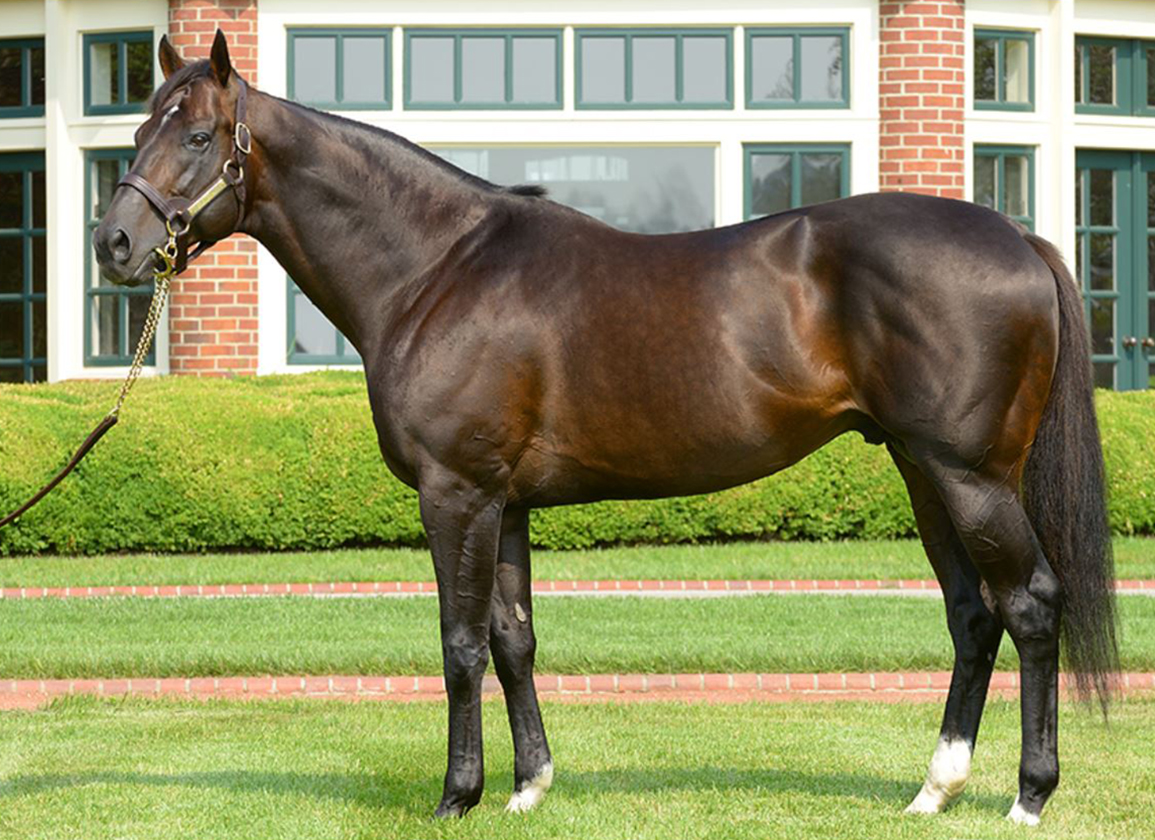
The Irish-headquartered operation is back at it again with another Storm Cat-line horse in Caravaggio (Scat Daddy), a young American-bred freshman stallion based this year at Coolmore America. So far through a young juvenile season, Caravaggio is making a loud noise in Europe with six winners to his credit, suggesting that he could have a mammoth year at the rate he's clicking, and his start at stud is reminiscent of No Nay Never, another son of Scat Daddy. A Group 1 winner in Europe, No Nay Never began his racing career at Keeneland (yes, on Lasix, unlike in his European wins) and is now one of the most exciting young sires in Europe, standing in Ireland for €125,000 after starting out for €20,000 in 2015 and reaching a reported €175,000 in 2020.

Hours before Rombauer won the first Lasix-free Preakness in decades, Caravaggio got his fifth winner, The Entertainer (Ire), a colt trained by Aidan O'Brien for the Coolmore partners, and the day after the Baltimore Classic, the muscular grey stallion got his sixth winner when Andreas Vesalius (Ire) and Silver Surfer (GB) ran one-two in a Naas maiden race for trainers Joseph and Donnacha O'Brien, respectively. He's the young horse everyone is talking about in Europe the same way they did of No Nay Never, and he's available this year for $25,000 to American breeders after three seasons in Ireland, where he entered stud for €35,000 (the equivalent of about $40,000 at the time) in 2018.


To say that Coolmore is heavily invested in the Scat Daddy line, both here and in Ireland, is an understatement. Aside from Caravaggio, Coolmore also stands Scat Daddy's sons Justify and Mendelssohn at Ashford. The latter, a Grade l winner who was campaigned in England, Ireland, Dubai, and the U.S., was purchased by Coolmore for a sale-topping $3 million at Keeneland September in 2016, while the 2018 Triple Crown winner was purchased from WinStar and partners for a reported valuation of $75 million.

In Ireland, Coolmore stands the aforementioned No Nay Never, a Group 1 winner at two, and the Kentucky-bred 2-year-old Group 1 winner Sioux Nation (Scat Daddy). Also standing there are No Nay Never's sons Ten Sovereigns (Ire), a Group 1 winner at two and three; and Arizona (Ire), a Group 2 winner who was twice Group 1-placed–all at two. Coolmore obviously moved Caravaggio from Ireland to Kentucky to give him new life for his fourth year at stud and to make way for Ten Sovereigns, because the two are essentially the same type: Caravaggio was also a Group 1 winner at two and three and a specialist sprinter like Ten Sovereigns.

The best European-raced offspring of Scat Daddy tended to be, like the aforementioned horses, 2-year-old Group winners and/or fast sprinters–think of G1 King's Stand S. and Prix Morny winner Lady Aurelia, too–and this is very much a sire-line trait for this branch of Northern Dancer that started with Storm Bird. In fact, each stallion in the sequence to Caravaggio that goes from Storm Bird/Storm Cat/Hennessy/Johannesburg/Scat Daddy was a Group 1 or Grade l winner at two.

Note also in this sire-line sequence that every horse from Storm Bird to Caravaggio stood at Ashford except for Overbrook's Storm Cat, but he was one that Coolmore identified early as a breed-shaper and jumped on board to use. One of his last remaining sons at stud, Tale of the Cat, still stands at Ashford.

In contrast to Europe, the best Scat Daddys in North America stayed farther, and Justify is obviously the supreme example. He also was unraced at two, and his forte was dirt; therefore, Coolmore now has all the racing aptitudes covered in Kentucky with the Scat Daddy sires Justify (Triple Crown winner, dirt); Mendelssohn (Grade l winner on turf at two at a mile, Grade ll winner and multiple Grade l-placed on dirt at three at up to a mile and a quarter); and Caravaggio (Group 1 winner on turf at two and three in sprints).

Caravaggio's return to Kentucky was something of a homecoming because he was bred by Coolmore America director of sales Charlie O'Connor (Petaluma Bloodstock) in partnership with his father-in-law's Windmill Manor Farms. The specialist sprinter was produced from the Holy Bull black-type winner Mekko Hotke and has a thoroughly American pedigree on the dam's side, but he was campaigned by the Coolmore partners on the turf in Europe, where he won seven of 10 starts and was undefeated in four starts at two for Aidan O'Brien at Ballydoyle.

His early promise now, coupled with the rise of No Nay Never, bodes well for the other sons and grandsons of Scat Daddy that Coolmore has in the pipeline. Coolmore lost Scat Daddy, a dirt horse who raced on Lasix, in December of 2015 at age 11, a few months before the stallion was to cover mares at a career-high fee of $100,000. He'd entered stud for $30,000 in 2008 and had dropped to a low of $10,000 in his fourth year at stud before his first crop took off, and in hindsight his loss has been massive for Coolmore, which has double-downed on his sons. And the gamble appears to paying off.

The global operation dominates the European Classics with its Galileos but is one European-based entity that has a healthy dose of respect for American-raced horses, even the ones that campaigned on race-day medication. Scat Daddy, for example, had no issues siring high-quality runners that raced without medication in Europe, and Coolmore has never thumbed its nose at dirt performers. Magnier's son M.V. Magnier put it unequivocally a few years back when he said, “My grandfather M. V. O'Brien built Ballydoyle off the backs of some brilliant American Classic horses. In Justify and American Pharoah we now have two all-time greats, so we couldn't be more optimistic about the future.”

Perhaps this is the reason that Coolmore is the leading racing stable and stud operation in Europe and, arguably, the world.

Sid Fernando is president and CEO of Werk Thoroughbred Consultants, Inc., originator of the Werk Nick Rating and eNicks.

The post Taking Stock: Coolmore Investment In Scat Daddy Sons Paying Off appeared first on TDN | Thoroughbred Daily News | Horse Racing News, Results and Video | Thoroughbred Breeding and Auctions.
Source of original post

Notable US-Bred & Sired Runners In Japan: May 22-23, 2021

In this continuing series, we take a look ahead at US-bred and/or conceived runners entered for the upcoming weekend at the tracks on the Japan Racing Association circuit, with a focus on pedigree and/or performance in the sales ring. Here are the horses of interest for this weekend running at Chukyo and Tokyo Racecourses. This week's Group 1 feature is the Yushun Himba (Japanese Oaks), in which the popular white filly Sodashi (Jpn) (Kurofune) will attempt to protect her perfect five-for-five record while attempting the 2400-meter trip for the first time:

Saturday, May 22, 2021
3rd-TOK, ¥9,680,000 ($89k), Maiden, 3yo, 1600m
DAYTON TESORO (f, 3, Violence–Chelan Echo, by Lion Heart) outran odds of 20-1 to finish a respectable fourth on local debut over 1400 meters in a single juvenile appearance last November and is a candidate to improve with maturity and a bit more distance here. A $130K Keeneland September purchase, the chestnut is out of a half-sister to MSW Notoriously (Cherokee Run), SW Cherokee Echo (Cherokee Run) and GISP Smarty's Echo (Smarty Jones). B-Woods Edge Farm LLC (KY)

11th-CKO, Heian S.-G3, ¥68,000,000 ($625k), 4yo/up, 1900m
AMERICAN SEED (c, 4, Tapit–Sweet Talker, by Stormin Fever) made giant strides once switched to the dirt last fall, winning three starts by a combined 17 lengths, but he stubbed his toe when a distant 14th as the 2-5 favorite in the G3 March S. at Nakayama. The $825K KEESEP yearling, whose dam was a Grade I winner on the turf in 2005 before fetching $1.15 million at KEENOV, was rumored to have lost a shoe in the running and he gets Christophe Lemaire back in the saddle Saturday. American Seed is a full-brother to SW & GSP Sweet Tapper; and to the dam of recent GII Edgewood S. runner-up Barista (Medaglia d'Oro); and a half to GSP Perregaux (Distorted Humor). Sweet Talker is a half-sister to the versatile MGSW Silver Medallion (Badge of Silver). B-Courtlandt Farm (KY)


Sunday, May 23, 2021
11th-CKO, ¥34,620,000 ($318k), Allowance, 4yo/up, 1200m
QUEEN'S V V (JPN) (f, 4, Honor Code–V V Goodnight, by Midnight Lute), a $360K in utero purchase at KEENOV in 2016, has punched well above her weight in Japan, with three wins from nine runs, including a half-length success over this track and trip when last seen Mar. 14 (see below, gate 15). Her Grade III-placed dam is a half-sister to GSW Gleam of Hope (City Zip) and to SW Forest Princess (Hansel). B-Kosho Bokujo


The post Notable US-Bred & Sired Runners In Japan: May 22-23, 2021 appeared first on TDN | Thoroughbred Daily News | Horse Racing News, Results and Video | Thoroughbred Breeding and Auctions.
Source of original post

GFS Roundtable Discussion – Part 4

The 2020-2022 Godolphin Flying Start trainees have been tasked to use their knowledge and creativity to come up with proposals for a new look U.S. Graded Stakes Program for 3-year-olds.

These round table discussions have been published in TDN on May 15, 17, and 19. Click here for video.

In the final installment we have the American trio of Samantha Bussanich, Devon Dougherty and Erin McLaughlin who will be providing an overall perspective.

Please send feedback and suggestions to the trainees via Kate Hardy at khardy@godolphinflyingstart.com.

All feedback will be correlated and responded to by the trainees in the TDN next week.

The post GFS Roundtable Discussion – Part 4 appeared first on TDN | Thoroughbred Daily News | Horse Racing News, Results and Video | Thoroughbred Breeding and Auctions.
Source of original post

An ‘Ultra’ Compliment to Twirling Candy

Curious how we can always explain what makes a pedigree work once a horse has shown he can actually run. They call it “ex post rationalization” or sometimes “hindsight bias”. Working backward from a high-functioning racehorse, you isolate whatever elements of the page flatter your prejudices and methodology, and triumphantly announce that you have found the key to the genetic engine. You could, of course, perform pretty much the same exercise with countless slow horses whose antecedents contain equally plausible elements. Funnily enough, however, we don't bother doing that quite so often.

It feels very wholesome, then, when horses come along “to keep us honest”. And certainly that tendency to self-validation has been challenged by the first two legs of the Triple Crown, respectively won by a $1,000 yearling by Protonico and now a colt whose first four dams are by Cowboy Cal, Afleet, Vigors and Knightly Manner.

We are familiar, of course, with Classic winners whose families have arcane seeding–try American Pharoah (Pioneerof the Nile), whose equivalent parade comprises Yankee Gentlemen, Ecliptical, Tri Jet and Crozier–and I do think we should gratefully embrace the vigour sometimes latent when stagnant reaches of the gene pool are stirred. That principle aside, however, the material otherwise available to Rombauer (Twirling Candy) surely adds fresh luster to two names in his background whose merit has already been established at this kind of level.

One of these is his granddam, Ultrafleet, who must now be saluted as a truly remarkable mare. Her fame has hitherto hinged on two foals by Avenue of Flags: the millionaire sprinter California Flag, and the “Queen of the Hill”, Cambiocorsa, whose branch of the dynasty has since given us the tragic European champion Roaring Lion (Kitten's Joy). But now Ultrafleet's unraced daughter by Cowboy Cal has given us a GI Preakness S. winner, a feat that clearly demands a fresh look at bloodlines so unpromising that John Fradkin had to pay only $10,500 for the future matriarch as a yearling.

First, however, let's congratulate Rombauer's sire Twirling Candy on this vital consolidation of his candidature as principal heir to Candy Ride (Arg), a contest lately heated by the likes of Gun Runner, Mastery and Unified.

Twirling Candy | Lane's End

At 14, Twirling Candy has reached a stage where he is no longer trying to get established but aspiring toward the elite echelons largely populated by older stallions. Since joining his sire at Lane's End, he has barely missed a beat. Yes, he had the standard bump in the road, required to negotiate a couple of smaller books pending the advent of his first runners in 2015. With 25 winners from 45 juvenile starters, however, his freshman success secured him 159 mares when restored the following year to his opening fee of $15,000 (had dipped to $10,000).

That first crop, with GII San Felipe S. winner Danzing Candy as pathfinder, ultimately yielded two Grade I scorers who sketched out what has meanwhile become his calling card: a remarkable versatility. One was the sprinter Finley'sluckycharm; the other, the five-season, two-turn scrapper Gift Box.

Rombauer's breakout means that Twirling Candy–about to launch his seventh wave of juveniles–has consecutively mustered Grade I winners from his 2016, 2017 and 2018 crops, following Concrete Rose (the prolific turf router sold for $1.95 million at Keeneland last November) and Collusion Illusion (who, as a dirt dasher, confirmed their sire's range in the GI Bing Crosby S. a couple of months previously). Even before that pair raised the bar, Twirling Candy had covered 171 mares at $40,000 last spring–which, by the commendably restrained standards of his farm, basically amounts to oversubscription. Sure enough, he was one of few Kentucky stallions to maintain his fee in the pandemic economy.

The diversity seen in his stock, in both surface and discipline, was amply advertised in Twirling Candy's own career. He won the GII Del Mar Derby on grass before breaking the track record in the GI Malibu S.; and later switched to synthetics to win the GII Californian S. before stretching out for narrow defeats at 10 furlongs back in Grade I company.

That was all consistent with his roots: Candy Ride himself funnels plenty of chlorophyll, from both Argentina and France, while Twirling Candy's damsire is Toussaud's GI Arlington Million winner Chester House. His granddam brings into play one who transcended all environments, in Danzig, but then the next dam knots together three undiluted dirt icons: by Seattle Slew out of an Alydar half-sister to Affirmed. As such, the 2021 Triple Crown trail has yielded a touching postscript to the epic 1978 series, through her owners' decision to console Alydar with Won't Tell You, the dam of his nemesis.

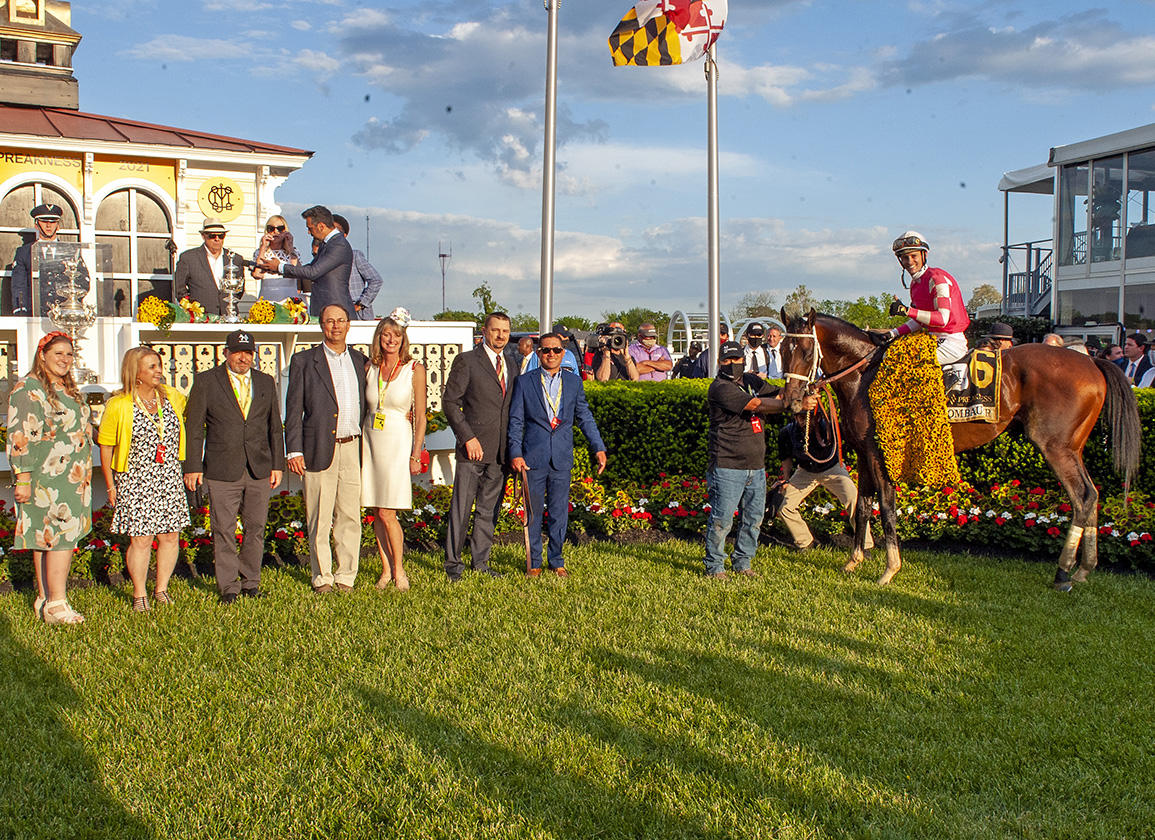
The Fradkins (fourth and fifth from left) join Rombauer in the winner's circle |MJC photo

We'll never know whether Rombauer might himself have had a Triple Crown on the line, if only trainer Michael McCarthy had managed to persuade owner-breeder Fradkin and his wife Diane to run in the GI Kentucky Derby. That race didn't really set up in a way that would have played to Rombauer's strengths, but it's poignant to reflect that all these damaging headlines might conceivably have been confined to a Derby runner-up!

Be that as it may, Rombauer is a spectacular new bloom on the Ultrafleet family tree. Fradkin bought her with the spoils of his very first dabble in ownership, a 7-year-old gelding claimed after finishing last, with a swollen ankle, at Hollywood Park in 1993. Freshened up by Ron Ellis, the old boy resurfaced at Del Mar two months later. They didn't see which way he went, and his owner was hooked.

Just days afterward, Fradkin could be found at the Keeneland September Sale. He assumes that his bid was the only one that took a roan filly by Afleet, bred by William A. Purdey, past a $10,000 reserve.

Making no show in a handful of maiden claimers, Ultrafleet looked like becoming a painful lesson to her novice owner. Instead Fradkin decided on a fresh experiment: breeding. Through 25 years since, he has just maintained a couple of mares, one typically at Old English Rancho in California and another at Woodstock Farm in Kentucky. As commercial programs go, it could scarcely be more modest. And, as has by now been well chronicled, only happenstance caused Rombauer to join those few graduates to have been sporadically retained.

Jan Vandebos Naify with Cambiocorsa (left) and Vionnet (right) | Courtesy of Jan Vandebos Naify

One that did sell, early on, was Ultrafleet's 2002 daughter by Avenue of Flags, a $90,000 Barretts juvenile. As Cambiocorsa, she gained rather a cult following at Santa Anita, crowning a six-race streak out of the downhill turf chute with the first of two graded stakes wins. Cambiocorsa, in the loving hands of Jan Vandebos and her late usband Bob Naify, has subsequently done better still in her second career: she has produced two Grade II winners on turf, Moulin de Mougin (Curlin) and Schiaparelli (Ghostzapper), and three other stakes scorers including Grade I-placed Vionnet (Street Sense). Sadly Vandebos lost Vionnet in 2018, even as her first foal was evolving into a champion in Europe; and subsequently, of course, fate would permit Roaring Lion himself only a single season to recycle what had now come to seem royal genes.

Cambiocorsa's brother California Flag (in whom Fradkin retained a stake) was another prolific turf sprinter whose three wins in the GIII Morvich H. incorporated a track record; while Ultrafleet has also produced Shadow Raider, a graded stakes-placed, ten-time winner by Memo (Chi). But her penultimate foal, an unsold, unraced Cowboy Cal filly named Cashmere, appeared to be a dud.

Cowboy Cal! He was exported to South Korea for 2017, having mustered 125 winners from five crops of racing age. He could take with him a millionaire resumé on turf/synthetics, plus kinship to the top-class Behrens (Pleasant Colony), his dam's half-brother. On the whole, however, it surely reflects lavishly on Ultrafleet that a daughter of Cowboy Cal should now have delivered a Preakness winner.

Cashmere's first three foals are all multiple winners and one, Treasure Trove (Tapizar), was actually beaten only a length though last of five in the GIII Ben Ali S. at Keeneland last month. But if their hallmark has hitherto been toughness sooner than class, then the entry into the equation of Twirling Candy has changed all that.

True to the variegation of his genes, Rombauer started out on grass before McCarthy alertly proposed an opportunist crack at the GI American Pharoah S. His big move that day, circling the field to close down an always-handy winner, was made with such style that some of us played Rombauer at giddy odds for the GI Breeders' Cup Juvenile. He ran creditably, without ever laying a glove on the winner, but reiterated that Twirling Candy adaptability when pouncing for the El Camino Real Derby on synthetics on his resumption. In hindsight, it was too easy for him to track the front pair in the GII Blue Grass S., a race that didn't really draw adequately on the stamina that tends to underpin acceleration off a stronger pace.

The popular California Flag (front), one of several overachieving members of this family | Sarah Andrew

But there we go again, rationalizing “ex post”! In which spirit, let's go back to the package that held so little market appeal, that fateful day when Ultrafleet entered the ring. We've noted the left-field names seeding Rombauer's family. But if the first four dams are by sires lacking clout, at least each one funnels some truly resonant blood: Cowboy Cal is by Giant's Causeway, and Ultrafleet's sire Afleet by Mr. Prospector; while the next two dams are by sons of Grey Dawn (Fr) and Round Table.

Canadian Horse of the Year Afleet established one of the more precarious branches of the Mr. P. empire (via Northern Afleet/Afleet Alex) and left for Japan soon after siring Ultrafleet. Looking at her pedigree as it appeared at the time, can we honestly rebuke the lack of interest? Sure, the family had a light sprinkling of stakes performers. But only when you get back to Ultrafleet's fourth dam, Albany Isle (GB), does something begin to stir.

And even that line has been through a couple of wastelands. Albany Isle did ultimately trace to one of the most potent tap-root mares in the story of the breed, but that was way back in Victorian times and her family had lately done very little (outside steeplechasing) to warrant her export from Ireland in the 1950s. Yet today she pegs down the pedigrees of such high achievers as Country House (Lookin At Lucky) and Rock Your World (Candy Ride {Arg}).

It was the GI Santa Anita Derby winner–himself, of course, a son of Twirling Candy's sire–whose switch from the Californian turf was supposed to have a seismic impact on the Classics this year. In the event, that trick has instead been played by Rombauer.

Perhaps we can see echoes of Ultrafleet's damsire Vigors, whose flamboyant charge won some of California's marquee dirt races, in the turn of foot that might otherwise be credited to Rombauer's grassy influences. It's also worth mentioning that Vigors was by a notable distaff influence in Grey Dawn, whose own sire Herbager moreover resurfaces in the top half of Rombauer's pedigree: Twirling Candy's grandsire Ride the Rails is out of a Herbager mare.

But really it's edifying to admit to ourselves that there was no obvious reason why Ultrafleet should have cost more than she did, and that little she has achieved since can be easily reduced to repeatable formulae.

What we do have is a nice mix of West Coast dash and hardiness, combined with plenty of turf flair out of South America and Europe. We have a stallion whose brushes work on any palette. And don't forget that Rombauer is still only an adolescent, really, after seven starts; that he was raised on the same small farm, Woodstock, as Derby third Hot Rod Charlie (Oxbow); and that he has been expertly trained since. To be fair, that all makes some kind of sense–and maybe as much as we should ever hope to find.

The post An ‘Ultra’ Compliment to Twirling Candy appeared first on TDN | Thoroughbred Daily News | Horse Racing News, Results and Video | Thoroughbred Breeding and Auctions.

Source of original post

Verified by MonsterInsights