PHBA Honors 2020 Champions

The Pennsylvania Horse Breeders Association honored its 2020 champions during a virtual celebration of the 42nd annual Iroquois Awards last Friday. Multiple stakes-winning Caravel (Mizzen Mast), bred, owned and trained by Elizabeth Merryman, was named Horse of the Year and champion 3-year-old filly.

Other champions announced Friday were: 2yo Filly: Plane Drunk (Stay Thirsty); 2yo Male: Fire's Finale (Jump Start); 3yo Male: Dreams Untold (Smarty Jones); Older, Turf and Sprinter Female: Jakarata (Bustin Stones); Older Male: Wait for It (Uptowncharlybrown); Turf and Sprinter Male: The Critical Way (Tizway).

PA-Preferred Female and Male were Its a Journey (Jump Start) and Wait for It, respectively. Avani Force (Forestry) was named broodmare of the year. Leading Breeder Award Recipients were Blackstone Farm and Glenn E. Brok LLC.

Patricia Chapman was given the lifetime achievement award and Pastures of Point Lookout was honored with the award of merit.

The post PHBA Honors 2020 Champions appeared first on TDN | Thoroughbred Daily News | Horse Racing News, Results and Video | Thoroughbred Breeding and Auctions.

Source of original post

The Week in Review: Breeding & Selling the Million-Dollar Racehorse That Doesn’t Exist

There's an adage in poker playing that says if you take a look around the card table and can't tell who the sucker in the game is, it's you.

There's also an old saw about never investing in any business transaction you don't fully understand or can't explain to someone else (or yourself) in fewer than 30 seconds.

Nevertheless, the cryptocurrency-styled racehorse trading spree rages on at Zed Run, the online global marketplace that went live in 2018 and has since sold 11,000 “Thoroughbreds” that exist only as digital assets on the Ethereum blockchain as non-fungible tokens (NFTs).

According to a May 12 New York Times article by Taylor Lorenz, one trader reportedly flipped a single “horse” that initially cost $16,000 on Zed Run for $125,000. Another sold an entire stable for $252,000 when demand skyrocketed for that particular collection of “limited drop” offspring. A third touted the thrill of being able to churn a “crazy return on investment,” and predicted that prices on individual digital equine assets could soon surge into the million-dollar range, matching–and at times far exceeding–the auction prices of real-life Thoroughbreds.

“This is either going to be the smartest or stupidest thing I've ever done,” one Miami-based Zed Run enthusiast who has amassed 48 horses told the Times. “I'll either buy a house with the money I make from it or never show my face for a year.”

The Australia-founded Zed Run has been thriving in recent weeks. Or it at least has the appearance of thriving, because, as with any rapidly emerging market–crypto, traditional, or otherwise–you never truly know who is driving or profiting from the stampede. This is especially true when highly hyped trading is based on assets that have no tangible underlying value outside of their specific marketplace.

I spent a good chunk of the weekend trying to get my head around Zed Run's core concept (“to create an ecosystem where collectible digital assets hold value and have use in an exciting and ever-evolving gaming and wagering environment”). I read through the company's work-in-progress website and absorbed varying outside opinions on it that ranged from “next big thing” to warnings about the platform being a pyramid-styled investment vehicle that could be rewarding early adopters at the expense of late-to-the-party participants who might have to bear the costs of any collapse.

My opinion? Although there are enough waving red flags surrounding Zed Run to keep my digital wallet fully sealed, I must admit to being drawn in by how the platform is completely unlike any other digital horse racing endeavor to date. Even though Zed Run conducts virtual races 24/7, it is not so much focused on the actual racing, per se. It doesn't even have a pick-the-winners or betting component (yet).

Rather, its entire structure is based on trying to replicate–and capitalize from–an ever-changing, real-time digital bloodstock marketplace.

Assets that take the form of NFTs have been popping up in the news with increasing frequency. On May 20, David Stevenson of the Financial Times in London described the complicated concept of an NFT as “a certificate of authenticity held on the blockchain, a digital ledger of transactions that cannot be hacked. These tokens may refer both to an actual item, such as an artwork, as well as its authentication. Cut through the jargon and they are just a piece of code with specific functionality and a unique identifier.”

In essence, the buying and selling of NFTs is closely linked to our society's infatuation with ownership and property rights. On Apr. 29, Sophie Haigney described that idea in the New York Times, detailing how someone recently paid more than $69 million at auction to “own” an NFT-derived JPG image that anyone else could freely download on the internet. Someone else bought a “digital house” that can be owned, but not actually lived in for $500,000. A conceptual artist created a specific shade of blue, stored it digitally, then sold it for $800.

Yet another New York Times story on May 13 described how National Basketball Association players are investing in and trading proprietary, NFT-backed video highlight collections. Some players have become so obsessed with the concept that on-court trash talk now involves barbs about how much spectacular dunks and blocks will be worth as crypto-collectible clips.

Earlier this month, The Stronach Group launched an NFT series of GI Preakness S. souvenirs that David Wilson, the company's chief marketing officer, said would “offer our consumers some really rare value.” The collection consisted of 18 different Preakness-related NFTs, 14 of which were video recordings of past races, plus four “special edition” NFT offerings that were paired with real physical assets and experiences, like VIP tickets to next year's Preakness or a replica of the Woodlawn Vase.

Zed Run pushes beyond the memorabilia mindset, but the company underscores on its site that “Zed is NOT a cryptocurrency. Zeds are digital racehorses which can be viewed as a digital asset on the Ethereum blockchain using ERC-721 NFTs.”

That description of a digital racehorse might seem fairly dry and sterile, so Zed Run attempts to infuse some life into the idea of NFT ownership wherever it can by pointing out that you can “nurture your racehorse and create an everlasting legacy” within what is repeatedly termed as the “ecosystem” on the Zed Run platform. “We are hellbent on creating an emotional connection with your digital asset,” a note from the founders explains.

Zed Run also refers to its digital racehorses as “breathing” NFTs, which is meant to refer to the fact that you can actually do something with the investment, like race the non-existent equines for purses and prestige that will purportedly add to their digital breeding value. The race outcomes are derived from algorithms, as are the results of the NFT matings. But nowhere on the Zed Run site could I find an explanation of exactly who or what controls those algorithms, and nothing in the documentation suggests that these blockchain transactions are being monitored or overseen by any regulatory agency here in the United States.

Zed Run's site states that the firm takes a 10% cut of all transactions on the platform, “which may vary from time to time without notice as per Zed's Terms.” It also charges a “small” (exact amount not disclosed) “gas fee,” which Zed Run explains is the standard blockchain term for processing and executing the “smart contracts” that underpin each transaction.

Supply and demand drive any marketplace, and in this respect Zed Run is no different. There are four primary “bloodlines” that exist within the Zed universe, and they can be thought of as the digital equivalent of our three real-life Thoroughbred foundation sires. As the site explains, “each bloodline contains differing levels of rarity and characteristics unique to that racehorse.”

Zed Run plans to initially make available, via periodic releases, a total supply of 38,000 “Genesis racehorses.” Think of this as the first foal crop. You can either buy individual horses via the platform when they “drop” as a batch (in previous drops, some of these could initially be had for under $100), or purchase them on a secondary marketplace, quite likely at a higher price.

“However, players can choose to breed their racehorses, thereby creating more unique racehorses,” the site explains, laying the groundwork for what Zed Run hopes will be many future generations of digital Thoroughbreds. But as of the writing of this column Sunday, the breeding section of the site was down for maintenance.

“There are two main criteria to look for when purchasing a racehorse in Zed; bloodline and genotype,” the site continues. “The rarer your bloodline is and the closer your racehorse is to its ancestors, the more desirable it will be for breeding and the better it will perform on the racetrack…”

Once enough races are in the database, past performances will be a key factor, and there are already virtual bloodstock analysts popping up within the Zed community to offer assessments on the value of horses. These digital horses are also prized for the unique names owners bestow upon them, and as the site explains, “color plays an important aspect in terms of the collectability nature of racehorses in Zed.”

In fact, the coat color of a Zed Run horse–they appear in races as riderless, luminescent, computer-generated equines running on an elevated straightaway against the futuristic nighttime backdrop of a city skyline–is a main driver of digital breeding considerations. The Holy Grail is to produce what is termed as a “super rare” coat color in an offspring that could translate to big bucks in resale value.

Unless you happen to be holding that horse of a different color in your digital stable just when the bottom drops out of the Zed Run market.

“A Zed racehorse belongs to the user, just like your house, car or boat belongs to you,” the platform's tutorial explains. “No one can take it away from you. And just like in real life, the value of your Zed racehorses is determined by the market and what other people or users are willing to pay for it.”

The post The Week in Review: Breeding & Selling the Million-Dollar Racehorse That Doesn’t Exist appeared first on TDN | Thoroughbred Daily News | Horse Racing News, Results and Video | Thoroughbred Breeding and Auctions.

Source of original post

Happy Saver Returns Friday at Belmont

Wertheimer and Frere's unbeaten Happy Saver (Super Saver), last seen winning the GI Jockey Club Gold Cup last October, will make his 4-year-old debut in an allowance at Belmont Park Friday.

“I'm happy to get his season under way,” said trainer Todd Pletcher. “Hopefully, we've done enough with him to have him ready, but I'm looking forward to getting him going.”

Following some down time at WinStar Farm, Happy Saver began working regularly at Palm Beach Downs in early April before shipping to Pletcher's division in Saratoga. His most recent breeze was a five-furlong work in 1:01.70 (3/13) May 21 over the Saratoga main track.

Happy Saver will put his four-for-four record on the line in the third race–a one-mile optional claiming event–at Belmont Friday. The field also includes stakes-placed Three Technique (Mr Speaker) and recent allowance winner Locally Owned (Distorted Humor).

Pletcher has added Red Oak Stable and Madaket Stables' multiple Grade I winner Mind Control (Stay Thirsty) to his stable. The 2018 GI Hopeful S. and 2019 GI H. Allen Jerkens S. winner, previously trained by Greg Sacco, is being pointed towards the July 4 GII John A Nerud S. at Belmont Park.

Mind Control, who opened 2021 with a runner-up effort in the Apr. 3 GI Carter H., was seventh last time out in the May 1 GI Churchill Downs S. He worked a half-mile in :48.30 (11/91) Saturday on the Belmont dirt training track.

“The John Nerud is what we're targeting at the moment,” Pletcher said. “He came to me in great shape and he's a very straightforward and good-training horse. He looks good.”

The post Happy Saver Returns Friday at Belmont appeared first on TDN | Thoroughbred Daily News | Horse Racing News, Results and Video | Thoroughbred Breeding and Auctions.

Source of original post

Trainer Liz Merryman Has High Hopes for Homebred Filly

It's a rare feat to get to the winner's circle on one of the biggest weekends in racing with a horse bred, owned and trained by the same connection, but Elizabeth Merryman did just that when her speedy filly Caravel (Mizzen Mast) gave a gutsy performance at Pimlico to take The Very One S. by a nose on Preakness weekend.

Many would consider the juggling act between the foaling barn and the training center to be an impossibility, but Liz Merryman says for her, it's the best way to produce a racehorse.

“I love working with a horse that has no mystery to what happened before I got them,” she said. “You know everything about them, you know why they do what they do and it's really rewarding. It's my favorite way to train a horse.”

Did last Friday's victory mark Caravel as the most successful homebred Merryman has brought up?

“Definitely,” the Fair Hill-based trainer said.

And for the cherry on top, Merryman picked up Caravel's dam for free.

Zeezee Zoomzoom (Congrats), a $135,000 2-year-old purchase out of a dual stakes winner, broke her maiden on the Saratoga turf as a 3-year-old in 2015. After she dropped to the claiming ranks the next year, a bowed tendon ended her racing career.

A friend of Merryman's heard the filly was up for grabs.

“I was looking for another broodmare and my friend called me from Florida,” Merryman recalled. “She said the owners were just looking for a good home for her, either as a riding horse or a broodmare, but she told me she thought the filly would make me a nice broodmare. I looked her up and she had a weird page. There were very few horses on it, but the ones there could really run. All the way down, there were nice, strong broodmare types.”

So Merryman agreed to take the filly and shipped her from Florida to Kentucky, for a date with Juddmonte's Mizzen Mast, and then on to her farm in Pennsylvania.

“I never saw her until she was pregnant with Caravel,” Merryman noted with a laugh.

Zeezee Zoomzoom's first foal immediately showed promise.

“She was the only foal I had that year since my other mare wasn't in foal, so she was kind of raised as an only child,” Merryman said. “She always had a great personality and was really nice-looking and correct. I thought she was special from day one, I just didn't know she would be this special.”
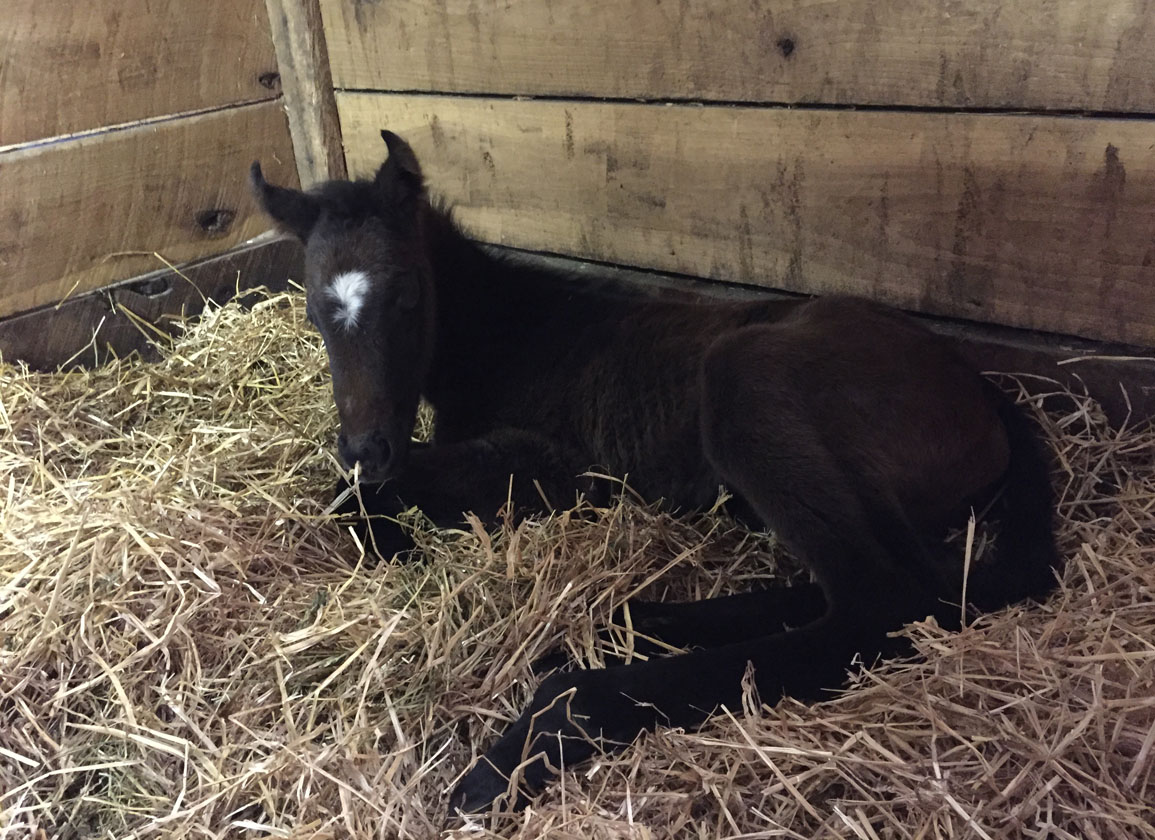
A young Caravel taking a snooze. | Elizabeth Merryman

While Merryman said she will occasionally put a foal through a sale, she never considered it with Caravel.

“I really believe if you're going to make a mare, you should keep the first foal and campaign it yourself to make sure it gets every possible chance to prove itself and the family. She was also bred for the grass and she started cribbing early on. I thought she was a fantastic-looking baby, so I didn't want her to be discounted for being a cribbing turf horse.”

Merryman's hopes for the gray filly grew once she started putting in her first works at Fair Hill.

“One day I told her rider to kind of cruise through the lane and two-minute lick the last eighth to see how she goes. I clocked her at 11 flat and I thought, 'You know what? I think I have a runner.'”

Caravel broke her maiden on debut, going last to first over five furlongs of turf at Penn National. She then took an allowance at the same track before claiming her first stakes win in the Lady Erie S. at Presque Isle Downs.

At that point, the Pennsylvania-bred was getting some attention. After a third-place effort in the Hilltop S., Merryman put her in the Wanamaker's October Online Auction.

“I had a lot of people calling me and I thought I should probably cash in on her,” Merryman said. “I set her reserve at $350,000 and she didn't get to it. I wasn't very sorry. She won a stakes a week later.”

Caravel wrapped up her 3-year-old season with a win in the Malvern Rose S. back at Presque Isle Downs.

From the start of her campaign this year, Merryman was shooting to bring Caravel to Pimlico for The Very One S.

“I knew she was going to need a prep race, but everything kept getting backed up at Laurel and there was no allowance for her in New York really, so I thought I would run her in the License Fee S. and that would be a nice prep for her being three weeks out,” Merryman explained.

When bad weather pushed the race back a week, Merryman decided to keep her filly entered, planning to opt out of a trip to Pimlico on Preakness weekend two weeks later and instead wait until Monmouth opened.

But after Caravel's third-place finish in the License Fee, Merryman wavered in her decision.

“When she came out of that race, she seemed like she had really moved forward,” Merryman said. “She didn't come out tired or stiff and she was training happy, so I thought alright, maybe two weeks is going to be fine.”

Merryman grew more confident in the days leading up to the race.

“The week before, I was so confident in her, and I'm never confident,” she said. “I always second guess myself, but I'd never had a horse come into a race like such a monster.”

Caravel settled along the rail for the five-furlong contest and waited for a hole coming down the stretch. It seemed as though she would have no way to get up and would have to fight to get in the money, but in the final strides before the wire, she slipped through to surge forward and get the bob in a nail-biting three-way photo finish.

“I thought she had finished third when she crossed the wire,” her trainer admitted.
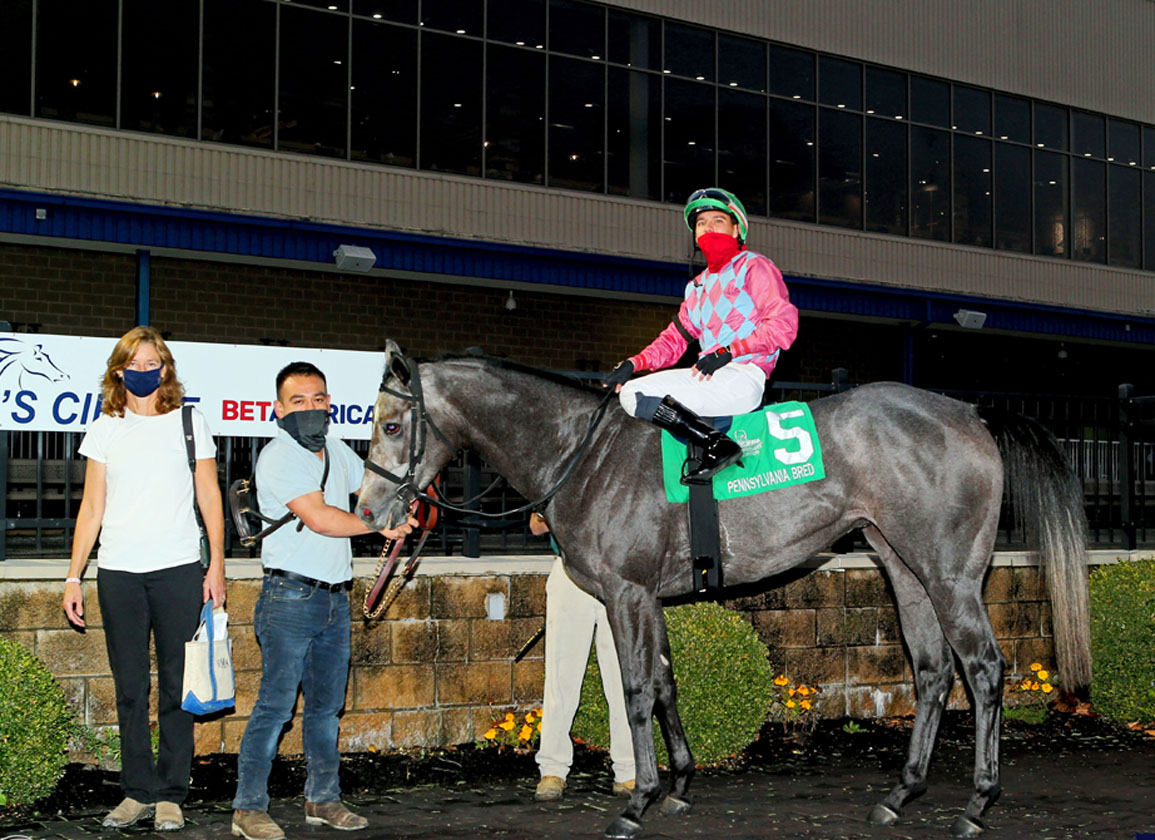
Merryman joins her homebred in the winner's circle for the Malvern Rose S. | Coady

For Merryman, who was born into a prominent racing family and has now passed on the trade to her children, the victory was cause for celebration.

“I had a lot of family there- both my kids, my husband, my sister and her family, and quite a few friends. It was really special and a lot of fun.”

Merryman reports that Caravel came out of the race with flying colors. She doesn't have any set plans for the filly's next start, but is considering options at Woodbine and Belmont.

Caravel's 3-year-old sister Tipsy Chatter (Bourbon Courage) is now in training with Merryman and looking to break her maiden, entered on May 26 at Delaware Park. Their dam also has a juvenile son of Great Notion named Witty, a yearling colt by Holy Boss, and was most recently bred back to Great Notion.

While Merryman admits that Caravel and her siblings are foaled out at another farm, they are back in her hands at three days old. Caravel has not left her owner's care since she first arrived at Merryman's Pennsylvania farm in the spring of 2017.

“We broke her ourselves,” she said. “She's been with us for everything. I love raising them. It's obviously a slow process. Everything goes wrong, there's always sleepless nights, but being able to work with a clean slate, with a horse you know everything about, there's no mystery.”

Merryman said she starts her day later than most at Fair Hill so she can care for her mares and foals before heading to the training center. It makes for hectic days, but it's a process that she has found serves her best.

“I just like to work with horses,” she said. “It's thrilling. A lot of people's lives are pretty mundane and boring. Mine certainly isn't. There's a lot of hard work and drudgery, but there's always something that's going to get your blood up.”

The post Trainer Liz Merryman Has High Hopes for Homebred Filly appeared first on TDN | Thoroughbred Daily News | Horse Racing News, Results and Video | Thoroughbred Breeding and Auctions.

Source of original post

Verified by MonsterInsights