RRP’s Makeover Marketplace Expands to Include Prospects

The Retired Racehorse Project (RRP) has expanded the American Society for the Prevention of Cruelty to Animals (ASPCA) Makeover Marketplace catalogue to include adoptable Thoroughbred Makeover prospects eligible for the 2022 competition. The catalogue also will continue to feature sport horse prospects who are offered for sale by their trainers at the conclusion of the Makeover process.

The expanded catalog is expected to include hundreds of transitioned and restarted Thoroughbreds, most of which will compete at the 2020-21 Thoroughbred Makeover this October at the Kentucky Horse Park. Up to 100 off-track prospects from non-profit organizations will be listed as well, all of which will be 2022 Makeover-eligible.

“The ASPCA Makeover Marketplace is a premier horse shopping and adoption opportunity for equestrians looking for well-started sport horse prospects,” said executive director Jen Roytz. “The Makeover provides the ultimate venue to browse multiple prospects listed in the catalog, watch them perform in competition, ride prospects, and have horses vetted on-site.”

Makeover graduates have traditionally undergone extensive preparation for the event, with former graduates having gone on to successful careers in eventing, hunter/jumper, field hunter, western performance, pleasure, and trail riding.

The catalogue will be printed as an insert in the fall issue of the RRP's Off-Track Thoroughbred Magazine, with a digital catalogue available at TBMakeover.org after August 15. Listing organizations must pre-register by July 10; horse registration will open July 15.

The post RRP’s Makeover Marketplace Expands to Include Prospects appeared first on TDN | Thoroughbred Daily News | Horse Racing News, Results and Video | Thoroughbred Breeding and Auctions.

Source of original post

Meah Adding Horsepower to Chrome Finish

She's still only 28, and it isn't three years since she started training. Yet a first graded stakes success for Anna Meah last weekend was welcomed with a depth of perspective extending both forward and back.

On the one hand, she has always been a woman in a hurry: however crammed the automobile she drove south from Washington in December 2012, her heart set on finding a backstretch job in California, the years since have been no less packed with experience. Indeed, the veteran trainer of a small string at Hollywood Park who hired Meah as assistant the following April also launched another career that very same month: a Cal-bred chestnut by Lucky Pulpit, name of California Chrome.

Even since starting to train, however, Meah has been through enough–a terrifying trackwork smash, for one thing, not to mention a barn reboot in Kentucky on the very eve of a global pandemic–to view the success of Abby Hatcher (Ire) (Acclamation {GB}) in the GIII Chicago S. at Arlington as a boost to the morale of her small, dedicated team, but otherwise only as a first milestone on what remains a long and challenging road ahead.

“When I started training, I had some funny luck,” she says. “I don't want to say bad luck, because I know things can always be worse. But, yeah, funny luck. I thought I had my first winner in a stakes race at Del Mar. What a fairytale that would have been! But he was disqualified. It was one of those that could have gone either way, depending who you asked, but they took him down.

“Between starting out that October, and the end of the year, I had 16 runners. Eight finished second. I was thinking, 'Man, this horse-training business is not all I was hoping… Am I ever going to win a race?' That was a humbling experience–but it's also how this whole game is. So, yes, winning my first graded stakes felt amazing, and nothing will take that away. But at the same time, it's a reminder to stay humble. There's still so much to be done, so many goals to accomplish.”

As such, Meah has found nearly as much satisfaction in the less conspicuous breakthroughs that assure her, in quiet increments, that she's heading the right way.
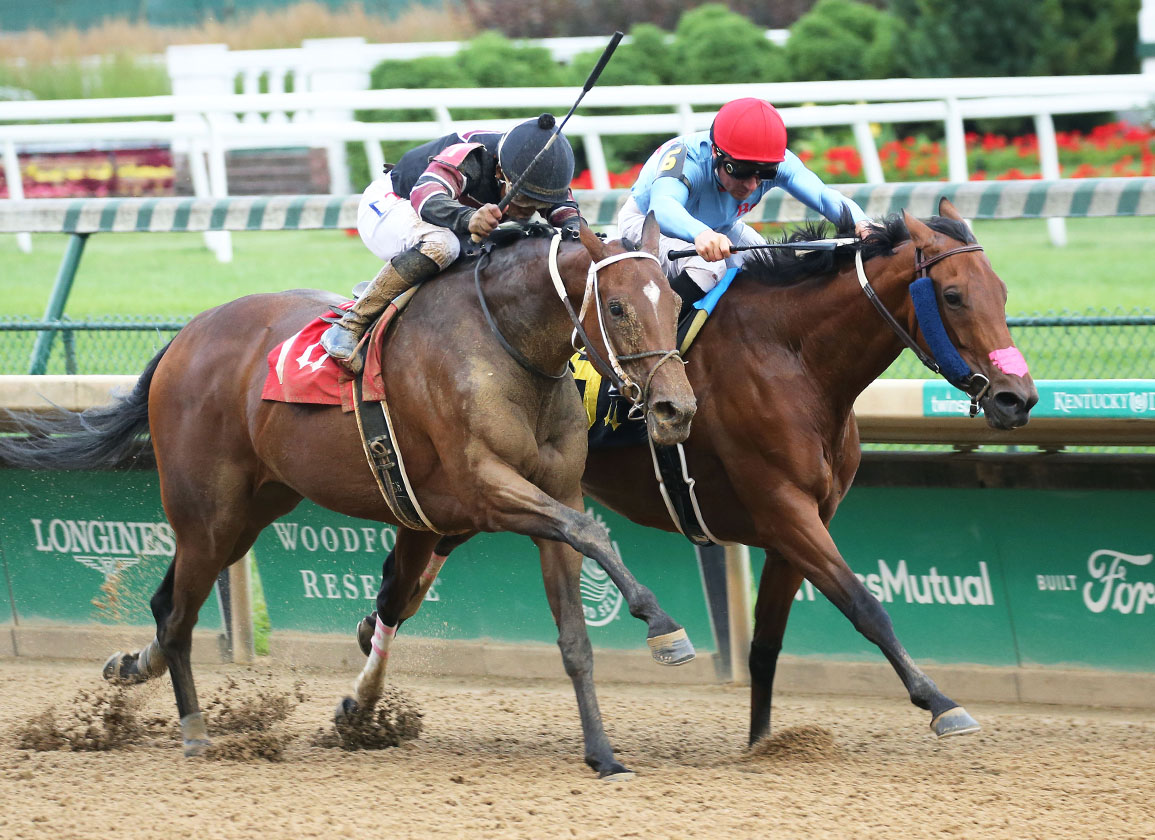
Jungle Juice (right) winning at Churchill last week | Coady

“I don't know what it was about June, but we hit a ton of milestones,” she notes. “We finally won first time off a claim, having bumped up from $30,000 claimer to maiden special weight; then the following week we won with a first-time starter, also for the first time; and I believe Jungle Juice (Ire) (Bungle Inthejungle {GB}) [a Churchill optional allowance winner last week] is the first to win three times for me. And then of course the graded stakes. So we had a huge month. We're not a huge crew but the staff work so hard, some of them traveled across the country to stay with me, and I'm so thankful to them. It's been really rewarding for everyone.”

That migration from California, early last year, was a huge decision so early in Meah's training career. Logically, there was no point bringing her Cal-breds. Leaving them behind, however, reduced the string to 11. But she now has 27 in the barn, and was able to build up support even after the shock that awaited her in Lexington.

“I have a lot of clients along the East Coast that were very supportive of the idea,” she explains. “California was undergoing a bit of scrutiny at the time, and not many people wanted to send horses there. That was sad to see, I'd had a great run out there, but for a young trainer getting started, it was really hard to give it an honest go. You could enter a horse and if the race didn't fill you might be looking at another month. We have so many more options here.

“But yes, it was a bit alarming to move our stable from Santa Anita to Keeneland and be told, after our first day training, that they were cancelling the meet. 'What have I done?' I said. 'I've shipped my horses all this way for one day of training!' Obviously I soon saw that this wasn't a Kentucky problem but a global one. And we made do with what we had. We shipped over to Oklahoma and won a race, for instance. But even during the pandemic I was given a chance by a lot of new people, which just goes to show how Kentucky has helped my business thrive.”

That Oklahoma winner, at Will Rogers Downs, was very dear to Meah. For it was Vallestina (Leroidesanimaux {Brz}) she was riding round Santa Anita one morning in June 2019 when the pair of them were badly lacerated in a freak accident. The vets candidly doubted whether Vallestina would make it.
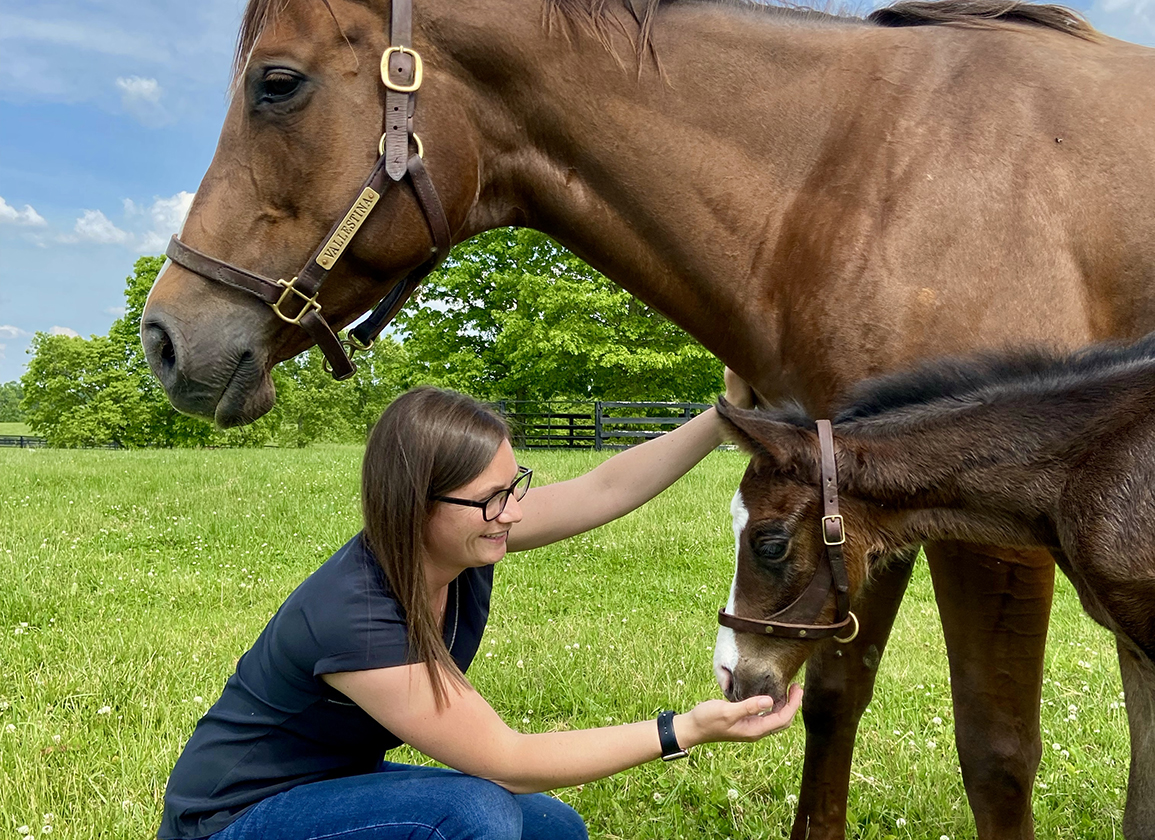
Meah with Vallestina and her Midnight Storm foal | Courtesy David Meah

“But long story short, she ended up pulling through,” Meah says. “And she not only came back and won at Santa Anita but also became the first to win for me after we moved out here. It's been a bit of a fairy tale–she has just had her first foal by Midnight Storm, and the plan would be to bring him into training someday–so let's hope it keeps panning out that way.”

After that horrible drama, Meah reluctantly acknowledged that it was neither sensible nor necessary to continue riding trackwork herself. So began a new chapter in her relationship with the horse, which had first evolved in a backwater of Thoroughbred racing–Meah was born in Oregon and raised in Washington–and initially devoted her to rodeos. Her ultimate vocation would only gradually come into focus.

In adolescence, she began shadowing Dr. Solomon Benneroch, the veterinarian who tended her rodeo mounts but also had clients with a Quarter Horse barn. “I begged them for a job for two years,” Meah recalls. “I just bugged them until they finally called and said, okay, this summer.” She went on to study Animal Science at Montana State but her real education would come in grooming and exercising at places like Portland Meadows, Emerald Downs and Grants Pass. A world away from Keeneland–her current base, though she's excited to be moving back into a renovated barn at Kentucky's Thoroughbred Center in October–but a perfect environment to learn the nuances of equine care.

“Working at those smaller racetracks, you learned a lot about what you can and can't do with horses,” she says. “It was exciting to be a part of it, and I'm glad I was. You could really build a foundation that way, and I feel that's so important for everything in life.”

The graduation ceremony awaited in the new, life-changing journey Meah began in tandem with California Chrome. Her four years with Art Sherman would span two Horse of the Year campaigns.

“Honestly, I have been so blessed,” she reflects. “Coming into this game, and landing that job with Art, and becoming part of Chrome's entire career. The Shermans are still like family to me, to this day. They were the first people to really take me under their wing. And Art is one special horseman. Chrome wasn't a difficult horse–very sound, great mind–but Art is such a wonderful person, and loves his horses so much, I know he did everything right by that horse and gave him the very best opportunity to succeed. Maybe in some bigger barns, little things may have been overlooked. Every small detail needs to come together to make big things happen.”
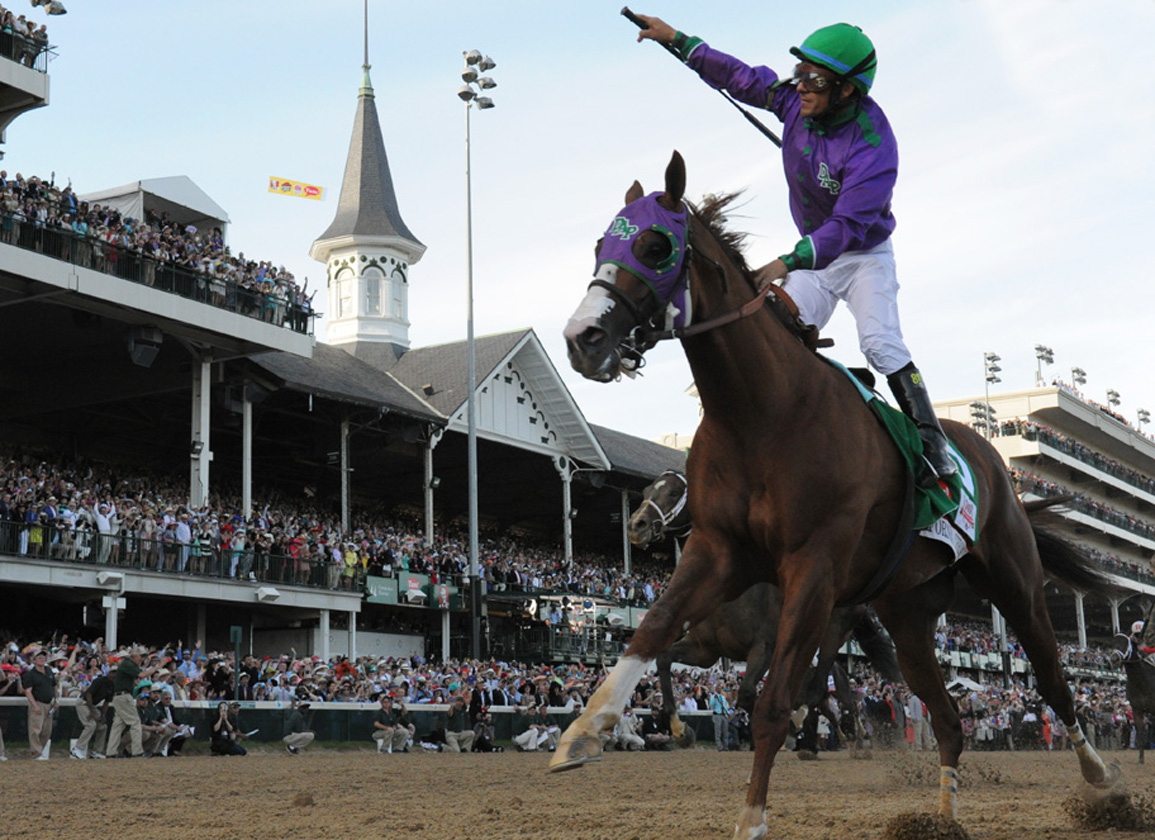
California Chrome | Horsephotos

Just as when she had first cut her teeth on the racetrack, however, Meah feels that she learned as much from the lesser horses.

“Art trusted me to run the barn when he wasn't there,” she explains. “At the time, I felt I was missing out on the fun a little, like when Chrome went out to Dubai for three months. But with a 12-hour time difference I couldn't call about every little issue. I had to figure things out.”

Nonetheless Meah was also privileged to have a regular, hands-on connection with the champion.

“I breezed Chrome all the way into most of his races, unless of course Victor [Espinoza] was out for it,” she says. “That was quite an adrenaline rush. It's not anything I could put into words. I just let him do his thing, he knew what he needed to do and how to do it, but the way he traveled, the way he covered the ground, he just had so much class about him. And it's not like his pedigree was outstanding: he just had such a big heart.”

That elusive grail, so hard to identify, remains ever in mind when stocking her own barn from limited resources. Likewise for husband David, as a bloodstock agent whose transatlantic partnership with Jamie Lloyd often targets horses off the track in Ireland or his native Britain. David has also had a fertile association with Richard Baltas, with whom Meah rounded off her apprenticeship after the retirement of California Chrome.

“Baltas probably had over 100 horses,” she recalls. “So it was a totally different experience, and more demanding, both physically and in terms of time. More runners, more problems. Again, he trusted me, for instance to travel east with horses like Gas Station Sushi (Into Mischief). She was such a star to deal with, and that was also how I really fell in love with Kentucky as Horse Country.”
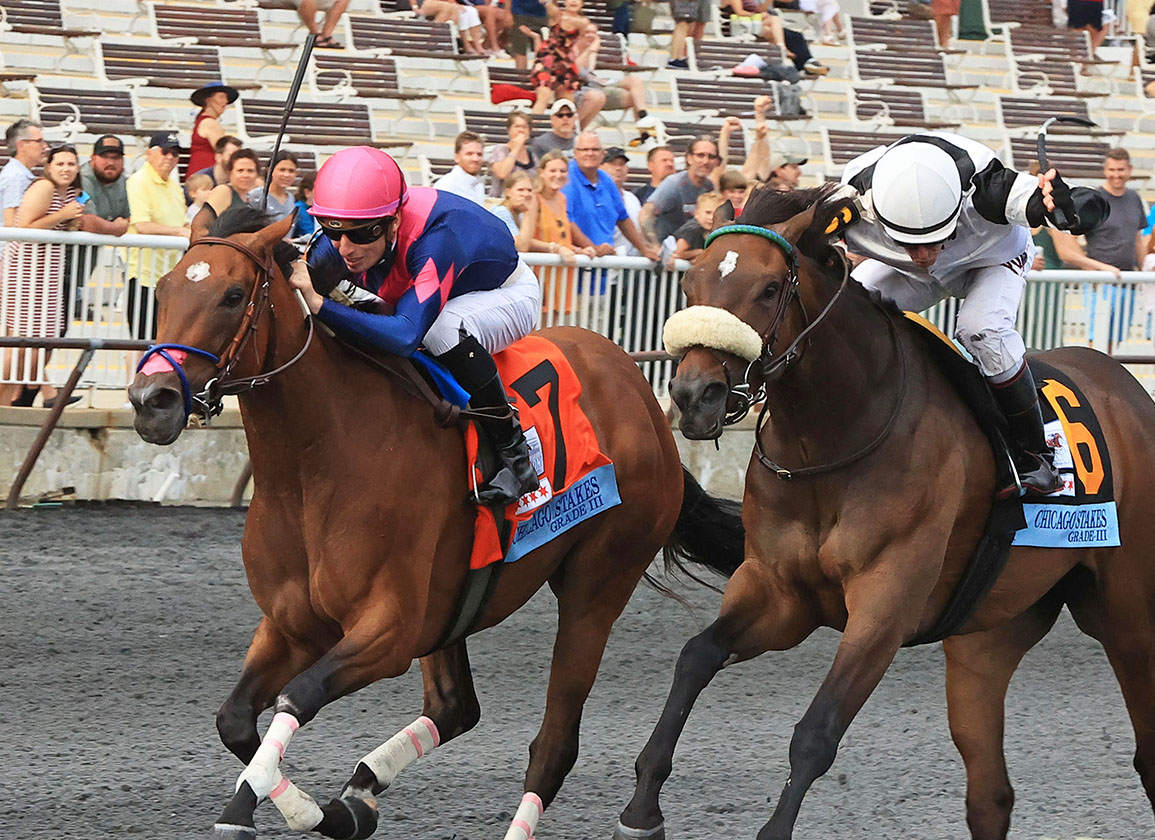
Abby Hatcher, winner of the June 26 GIII Chicago S. | Coady

David–who bought that filly, winner of the GIII Beaumont S., as a 2-year-old–can these days sometimes encourage clientele toward his wife's barn and indeed heads up the partnership that races Abby Hatcher, herself an Irish import.

“We'd actually been eyeing that race for a long time,” Meah says. “As you know, in horseracing things rarely go to plan, but for once everything worked out. We thought we'd be happy just to get her some black type, but to actually go up there and win was unbelievable. When she first came over here, I put some works into her and knew she had ability. But then I turned her out, gave her a bit of time to adjust and be a horse for a while. And that has really paid off. David has provided me with a bunch of horses from Europe that I've had success with, so it's really nice to have his support and his eye.”

Her first debt, however, remains to parents with zero horse connection who nonetheless indulged their daughter's obsession. “Rodeo was obviously very different, though maybe suggested that I have a very strong competitive edge!” Meah says. “It was every weekend, so I'm very thankful that I was sometimes allowed out of school early, or to miss a day for traveling. I always knew I wanted to spend the rest of my life with horses. But I didn't come into this business with the mentality that I wanted to be trainer. It's just how the stepping stones laid out until it became a no-brainer not to give it a try.

“I did try to make sure I had that foundation before branching out. I didn't want to start out with two or three horses, with me as owner, and piece things together as I went along. I had people ready to give me a chance. I don't run into too many young trainers, male or female, and I feel there are plenty of people out there who want a trainer that's young and hungry. I have put in a ton of work, but a lot of people do the same without having a graded success so early in their career. So when all that work pays off like this, I do feel very blessed.”

The post Meah Adding Horsepower to Chrome Finish appeared first on TDN | Thoroughbred Daily News | Horse Racing News, Results and Video | Thoroughbred Breeding and Auctions.

Source of original post

Maryland Overnight Purses Increase

A 15% across-the-board increase for overnight purses in Maryland has been instituted for the rest of 2021 after a Maryland Thoroughbred Horsemen's Association (MTHA) Board of Directors meeting June 29. The increase goes into effect at Pimlico July 2, the next date of live racing in the state.

Overnight purse distribution levels will also be restored. First place will be 60% (an increase from 57%); second place is 20% (a decrease from 21%); third place is 10% (down from 11%); and fourth place will be 5% (down from 6%). Fifth place will be 3% (plus 1% for the fifth-through-last place bonus) and sixth place will be 2% (plus 2% for the fifth-through-last place bonus). The 4% bonus remains in place for horses that finish seventh through last.

The post Maryland Overnight Purses Increase appeared first on TDN | Thoroughbred Daily News | Horse Racing News, Results and Video | Thoroughbred Breeding and Auctions.

Source of original post
A Mighty Day for Woodbine Fans

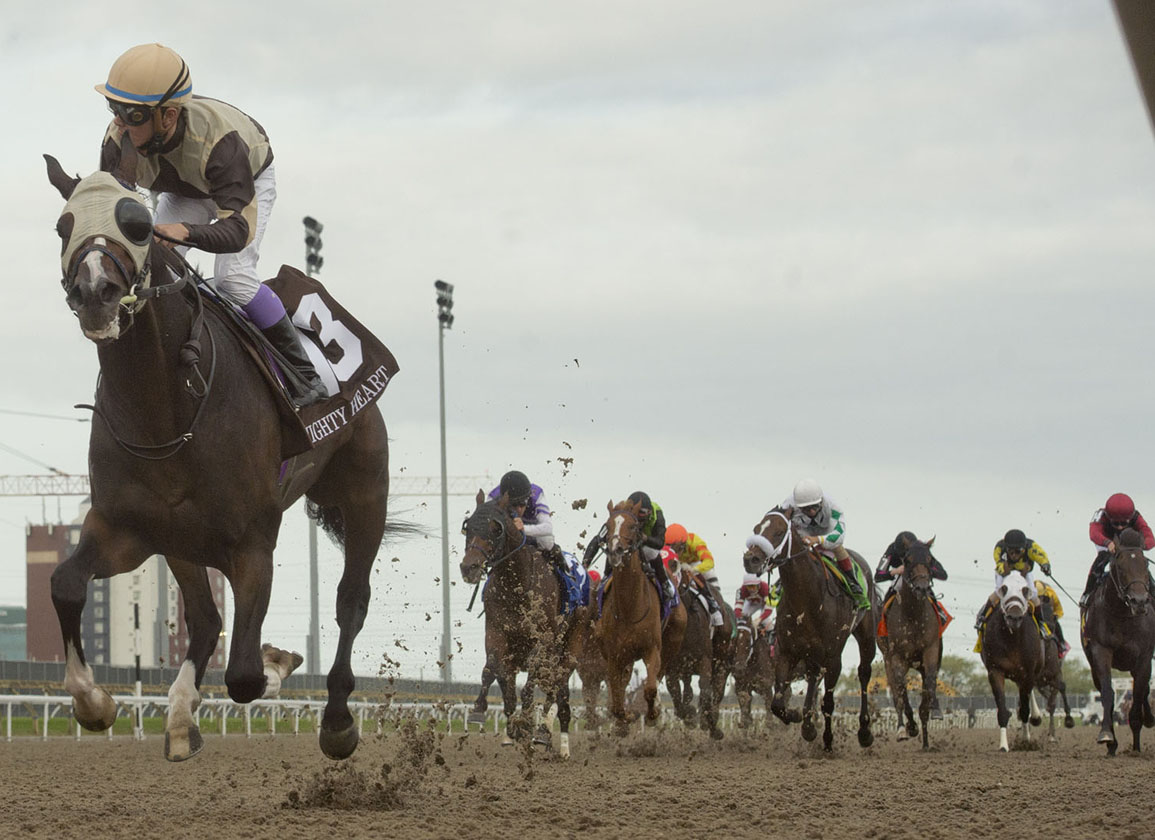
What a singular coincidence, and literally so, that two of the best horses recently bred in Canada–and that has never been a negligible distinction–should both have only one eye. True, the origins of Hard Not to Love (Hard Spun) and Mighty Heart (Dramedy) could scarcely be more diverse. The 2019 GI La Brea S. winner, who was retired a few weeks ago, graduated from one of the most admired breeding programs in North America, which routinely sends yearlings to Keeneland as coveted as any making a shorter trip from the storied Bluegrass farms. Much like the pioneering E.P. Taylor, indeed, Anderson Farms rebukes any condescending misapprehensions about raising top-class Thoroughbreds in “ice and tundra”. The way Mighty Heart has defied their shared adversity, in contrast, confounds the odds in a fashion–out of the only mare then in his breeder's ownership, by a sire since exported from Oklahoma to Saudi Arabia, and named for the eyedropper-fed runt of a Sphnyx cat litter–that nourishes hope for smaller operations everywhere, from Ontario to Ocala.

After a promising spring south of the border, Canada's Horse of the Year resumes his domestic career Thursday in the most auspicious of contexts. He not only lines up for the GIII Dominion Day S., but does so on a Canada Day when fans are finally restored to the Woodbine stands after a second lockdown trauma that brought the local racing community to its knees. Mighty Heart's return to the scene of his runaway success in the Queen's Plate last September, then, serves as the perfect tonic. Even before the pandemic, after all, the Ontario industry had been through years of crisis following the abrupt loss of slots. For all those who have been striving to rally investment, and all those who have resisted fresh despair during the past year, the big heart of this one-eyed wonder has become an inspiration.

“I find it so funny that he got the name he did, before all this,” says his trainer Josie Carroll. “Because it just sums up this horse. Like in his last race, at the head of the lane, I thought: 'Okay, he's going to run a good race.' But he just dug in. He's just a scrappy little horse.”

That was in the Blame S. at Churchill last month, where Mighty Heart refused to be denied in a three-way photo finish. Having previously made a promising return at Keeneland, he has laid a solid foundation for his second campaign after exploding onto the scene last year, winning the first two legs of the Canadian Triple Crown. Carroll had always planned to get him rolling again in the U.S., but his peregrinations from Florida to Kentucky obtained a melancholy background as the news from the home front became ever more frustrating.

Woodbine finally reopened for business on June 12, albeit behind closed doors, with a jackpot carryover that had been gathering dust ever since Nov. 22. That was when the meet came to a premature end, despite an exemplary record of functioning within COVID protocols in 2020, while a resumption scheduled for Apr. 17 had then been thwarted by government orders that permitted training but not racing. The ensuing limbo became an excruciating new test for the demoralised backside community and its patrons.

Josie Carroll with Mighty Heart | Michael Burns

“You know, I have such a great appreciation for our owners,” says Carroll. “They stuck it out. They had the opportunity to race elsewhere, every other major track was open, but they left their horses here to race. We're all very appreciative, and it makes me so happy to see them coming back to the races, and back to the backside. Some of them haven't even seen their horses for a year and a half, yet they've been hanging in there.”

As Carroll acknowledges, that can represent the entire span of a horse's evolution into a measurable talent. There will certainly have been many a Woodbine project that has run its course in the meantime. And the excitement for many owners, as such, will often be the journey sooner than the destination. “For the majority of owners, half the fun is in the participation,” Carroll confirms. “That's what makes the relationship between the people and the horses.”

But it's a parallel relationship that has been under no less painful strain: the one connecting the morning toil of backstretch workers with the fulfilment available in the afternoons.

“It's been very hard for them, to keep their spirits up,” Carroll says. “Because the fun part, when you have put all that work into your horse, is going over there and seeing them run a big race. That's when you see the excitement on all your people's faces. So just to sit for months and months, without getting the opportunity to run, was very tough on them. And we all know that your basic pay rate, for backside help, is not that strong. They supplement their income with their percentages, from the horses' earnings, so it's a dent in their income too.”

Mighty Heart's Queen's Plate | Michael Burns

Fortunately times of trial will draw the best out in people, too, and fortify a sense of community. “I tell you, everybody in this industry has been great,” Carroll says. “I think we were all shocked when we got shut down at the end of November. Everybody had done such a great job, I think we had two cases out of the thousands of people back here. The same people that were working with these horses in the mornings were also handling them in the afternoons, so it didn't really make a lot of sense. It just felt like we got grouped with a whole lot of other sports and activities, without being looked at individually.

“Since then, everybody has worked so hard together. To get everyone on the backside vaccinated, for instance, so that when we presented to the government we could show them that the majority of people had had their shots. Woodbine did pop-up clinics, for people who live here and don't have a lot of access to transport, so that when Ontario began to open it would have been very hard to deny us, when we could show such a rate of coverage.”

For trainers, of course, the uncertainty created a particular challenge: how do you train up to a target, if the target keeps moving? After all, judging that fever pitch for race day is perhaps the key to their whole profession. But Carroll showed just why she was inducted into the Canadian Hall of Fame in 2019 when priming Boardroom (Commissioner) to win the first graded stakes of the Woodbine calendar, the GIII Whimsical S., after a seven-month absence.

“It's been a very challenging year for all the Woodbine trainers,” she says. “Every other jurisdiction was open. We were aiming for an April start, and getting horses ready for that. But it's very difficult when you haven't got an exact date, and things keep moving, and you're trying to keep horses ready to peak: you don't want to go over the top but you don't want to back off them too much, either.”

Mighty Heart himself was always going to have to regroup, regardless, having disappointed behind barnmate Belichick (Lemon Drop Kid) in the final leg of the Triple Crown before running fourth in the GIII Ontario Derby. Belichick, second that day, will again be in opposition Thursday after an excellent comeback run of his own when beaten a nose in a Churchill allowance.

Michael Burns

“Mighty Heart is not a big horse but he's well put together, very athletic-looking, and he's definitely rounded out into a much more mature shape than he had last year,” Carroll reports. “Mentally, he's always been pretty uncomplicated–for a one-eyed horse! He's got a few little quirks, but if you can deal with those, he will just soldier on.

“I had always intended one start before we got up here, and initially we were going to do that at Gulfstream. But a race didn't come up when he was ready, so we had our one start at Keeneland. The intention then was to come home but when things got delayed, and he was doing so well down there, I just said that now is not the time to backtrack.

“Belichick I sent back down to Kentucky when racing didn't reopen, and he ran a nice race. We're looking at the Niagara S. on the grass [July 25] but he's been 50 days without a run, he needs a race and he's good enough to run in this one.”

Even at 25% of capacity, the return of fans on such a resonant occasion will represent another psychological breakthrough as Woodbine horsefolk seek to put a nightmare year behind them. “We've gotten so used to it being quiet over there!” Carroll says. “But yes, the energy of the fans is part of what makes any sport.”

It feels only fitting, then, for this particular race, on this particular day, to be dignified by the participation–besides three runners trained by another great ambassador for Woodbine, Mark Casse, who this summer receives his postponed induction to the Hall of Fame in Saratoga–of a horse who so captured the hearts of the Canadian horseracing public. Nobody could have predicted what lay ahead after Mighty Heart lost his left eye in a paddock accident when just two weeks old. Carrying the silks of breeder Larry Cordes, he won the Queen's Plate by 7 1/2 lengths in the second-fastest time since the race arrived at the new Woodbine racetrack–the opening of which in 1956 was, of course, one of the many benedictions to the Canadian sport owed to the drive of E.P. Taylor–before following up in the Prince of Wales S. on dirt at Fort Erie.

With so many skilled Canadian horsemen doing their utmost to build on Taylor's legacy, they could have no better model for the underdog spirit than Mighty Heart.

“Our breeding numbers are down but if you look at racing in North America, for the foal crop we have, a lot of very good horses come out of Canada,” Carroll says. “I just hope things pick up and our industry starts to grow, because we breed such nice horses here. I think that's what made me really proud, going down there with Mighty Heart as our Horse of the Year. He showed he could really do it on the North American stage, and I just hope that helped showcase Canadian racing, and the quality of the breeders we have.”

The post A Mighty Day for Woodbine Fans appeared first on TDN | Thoroughbred Daily News | Horse Racing News, Results and Video | Thoroughbred Breeding and Auctions.

Source of original post
Verified by MonsterInsights
