‘Stormy’ Forecast at Kentucky Downs

After annexing her second career win in the GI Fourstardave H. at Saratoga this summer, Got Stormy (Get Stormy) will take on males once again in Saturday's 'Win and You're In' GIII Fanduel Turf Sprint S. going six furlongs at Kentucky Downs.

A winner of the GIII Kentucky Downs Ladies Sprint S. at an additional half of a furlong here last term, Got Stormy narrowly captured the GIII Honey Fox S. at Gulfstream Feb. 27 before rolling a pair of fives in the GII Longines Churchill Distaff Turf Mile S. May 1 and GI Jackpocket Jaipur S. at Belmont June 5.

Casa Creed (Jimmy Creed) was given the nod on the morning-line at odds of 7-2 in this wide-open affair. A flashy come-from-behind upset winner in the Jaipur on the GI Belmont S. undercard two back, he rallied for third in the Fourstardave last time.

Last year's narrow Turf Sprint winner Imprimis (Broken Vow), drawn widest of all in post 12, and dead-heat second-place finishers Bombard (War Front) and Front Run the Fed (Fed Biz) will renew acquaintances again here.

Save a disappointing sixth in the Jaipur, Fast Boat (City Zip) has won three out of his last four, led by a sharp win in Saratoga's GIII Troy S. last time Aug. 6.

Saturday's loaded program at Kentucky Downs also features: the 'Win and You're In' GII Calumet Turf Cup; the GII Franklin-Simpson S., led by GI Bruce D. winner Point Me By (Point of Entry); the GIII Mint Ladies Sprint S., featuring the speedy Venetian Harbor (Munnings); and the GIII Kentucky Downs Ladies Turf S.

The post ‘Stormy’ Forecast at Kentucky Downs appeared first on TDN | Thoroughbred Daily News | Horse Racing News, Results and Video | Thoroughbred Breeding and Auctions.

Source of original post

A Look Back: New York Racing and 9-11

For New York-based trainer Pat Reynolds, it was supposed to be a quiet day, as quiet as it gets at the New York racetracks. September 11, 2001 was a Tuesday, a dark day in New York, and Reynolds was hoping that he could cut his day short after working one of his better horses at the time, Peeping Tom, that morning at Belmont Park. Instead, he was soon heading head first into a nightmare.

Just a few minutes after the first plane had struck the World Trade Center, someone called Reynolds into his office and told him to turn on the news. He sensed immediately that the buildings were under attack, a terrible feeling and one that hit home. Reynolds's wife, Laura, worked in the North Tower, the first one struck by an airplane.

“I went nuts,” Reynolds said. “It's one thing when you read about something like this in the paper, something happening to somebody else. This was a personal disaster.”

The usually punctual Laura Reynolds was running a few minutes late to work that morning and never reached her office. It was not until about 3 p.m. that afternoon that she was able to find a working phone to call her husband and tell him that she was safe. Still later that afternoon, she finished the long walk from lower Manhattan to the couple's home in Flushing, Queens, and fell into her husband's arms.

It is just one of the stories that emerged that day from the New York racetracks and Belmont Park, which is about a dozen miles from what was the World Trade Center. The whole country, and New York in particular, was shaken to its core that awful day, and the New York tracks didn't escape the horror and heartache. Everyone has their story, where they were when the planes hit, who they knew that was killed, how they dealt with the shock and grief.

For New York racing, it was a time to mourn and to hit the pause button, but it was also a time to look ahead. In less than seven weeks, the Breeders' Cup was set to be run at Belmont and no one wanted to give in and cancel or postpone the event. Everywhere, there was a sense that the proper response was to put your head down and get through this.

It didn't exactly start out that way.

With no racing scheduled for that afternoon, jockey Richard Migliore thought he was going to have an easy day. He started off the morning working a few horses at the track and then got in his car to head home. As he was pulling into his driveway, he got a call from a friend telling him what was going on. He went inside his home and began watching the coverage and then decided he wanted to take a look for himself. Along with trainer Dennis Brida, he drove back to Belmont and went up on the roof to get a clear view of what was happening. Migliore and Brida had the entire roof to themselves.

“You could see the smoke and everything else that was going on,” he said. “It appeared to me that one of the towers fell. I said to Dennis that the tower just fell. He said, 'No, I think something just blew up.' As the smoke and dust started to settle, you knew that a tower had fallen. It was surreal. It was madness. I'll never forget being on the roof at Belmont when the first tower fell.”

Among the handful of tracks scheduled to run that Tuesday, all canceled. Belmont was scheduled to resume racing on Wednesday, Sept. 12. Migliore heard rumors that NYRA was going to rush back into action. In what now seems like a tone-deaf move, four U.S. racetracks actually ran on Sept. 12 and 26 were in operation on the Friday after the attacks.

“There was talk there was going to be racing immediately because people thought we had to get back to some sense of normalcy,” said Migliore, whose wife, Carmela, lost a cousin, Charles Lucania, in the attacks. “Then, of course, smarter heads prevailed. It was decided that we had to take a step back.”

In the executive offices, NYRA President Terry Meyocks knew that some important decisions had to be made and made quickly.

“We discussed with the trustees and with our management team what was the right thing to do,” he said. “We knew we needed to take some time off. At the same time, we knew that the Breeders' Cup was coming up and that we had to move forward.”

Belmont resumed racing on Sept. 19, eight days after the attacks. The day began with a moment of silence before Sam Grossman played a rendition of “America” on his bugle. There were 5,436 fans in the massive stands and many seemed to have their minds elsewhere.

“I remember having mixed emotions that day,” said Migliore, who won the day's third race. “The jockey's room has always been my comfort zone. Everything else could be going wrong in my life and I could walk into the jockey's room and just escape. I could have a huge argument with my wife and when I walk into that room, it's the furthest thing from my mind. There was a sense of relief that I was going to get back to what I do. Yet, it still didn't quite feel right. It almost seemed trivial. Big deal. I got to ride in a few horse races. There was something a hell of a lot more important going on, and only a few miles away from where we lived.”

Two nights later, the Mets entertained the Atlanta Braves and the sporting world as a whole began to return to normal. But the Breeders' Cup remained a concern. With horse coming in from all over the country and the world, there were so many moving parts and so many concerns.

“We had a good rapport with local, New York City and state police,” Meyocks said. “We worked with them as to how to proceed and whether or not we could have a Breeders' Cup. We felt it was prudent to go ahead and run the Breeders' Cup. We felt confident we could do it. Basically at the end of day, we felt it was the right thing to do.”

Forty-six days had elapsed since the attacks on the World Trade Center, but reminders were everywhere when horsemen, jockeys, track management and fans started to file into the track.

“I remember going into the infield before the races,” said Jerry Bailey, who would win the GI Breeders' Cup Sprint that day aboard Squirtle Squirt. “All the jockeys gathered and they took pictures of us holding American flags. I looked up at top of the grandstand at Belmont and remember seeing snipers up there with their rifles. I thought to myself, is this the way it is going to be from now on? It struck me how different things had become.”

“The Breeders' Cup was crazy because of all the security,” Migliore recalled. “You look up on the roof and there's snipers everywhere. Everywhere you went, there were bomb sniffing dogs. They put up those big cinder block buffers so someone couldn't drive a car into the lobby.”

The day went off without a problem and it finished up with a win by the American-based Tiznow by a nose in the GI Breeders' Cup Classic over European shipper Sakhee. As he so often did, announcer Tom Durkin captured the moment perfectly, calling out “Tiznow wins it for America!”

“We all took a lot of pride in how well the Breeders' Cup worked,” Meyocks said.

As for Reynolds, he's been training ever since that fateful day. The first trainer of Big Brown, he's had some good years, but also some slow years. He's learned to deal with it.

“This is a wonderful sport and something I've spent my whole life doing,” he said. “But when it comes down to human life, everything else is secondary. That day, it put everything else into perspective.”

The post A Look Back: New York Racing and 9-11 appeared first on TDN | Thoroughbred Daily News | Horse Racing News, Results and Video | Thoroughbred Breeding and Auctions.

Source of original post
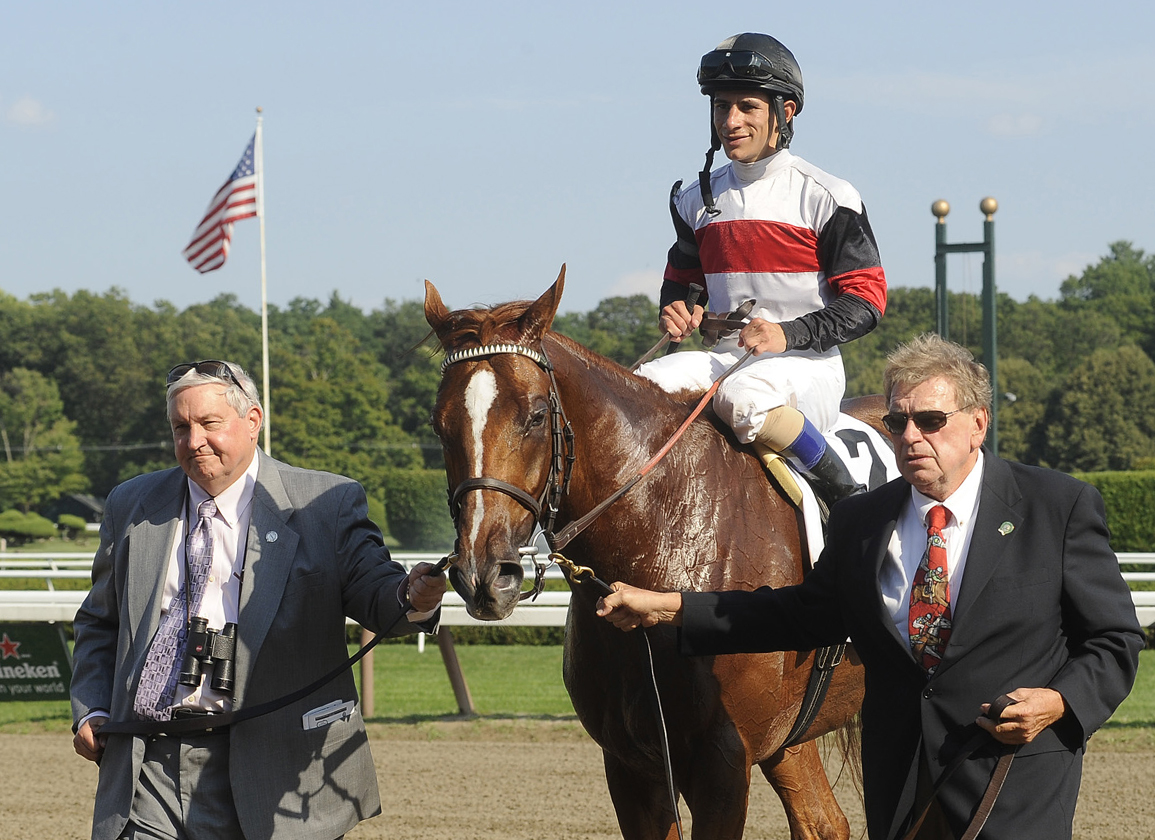
Kentucky Downs Turf Pick of the Day for Sept. 11

Steve Sherack and Brian DiDonato give their best bet for each day of racing during the FanDuel Meet at Kentucky Downs. $100 Win/Place format; highest bankroll at the end wins.

Steve Sherack: Thursday's Results – Couple of late gate scratches completely killed my price (went from 6-1 to 5-2), but still great to finally get on the board with Red Danger after a steady diet of no-shows with logical horses to start this thing off. Bankroll: $550.

Race 8 – A full field of turf sprinters are signed on for this seven-figure payday and the lightly raced 8yo gelding Bombard may find himself all alone on the lead if the AE doesn't draw in. He came within a neck of pulling off a 19-1, front-running upset over soft ground in this race last year and he appears to be in even better form this time around off a win in Santa Anita's GIII Daytona S. in late May. Selection: #3 Bombard (10-1).

Brian DiDonato: Thursday's ResultsJungle Juice (Ire) finished sixth. Bankroll: $0.

Race 10 – What. A. Card. My head was admittedly spinning trying to decide who to play, and I ultimately landed on Annex in the GII Franklin-Simpson S. The 'TDN Rising Star' showed an impressive turn of foot to take his first three starts, but has been a bit disappointing since then, albeit with some excuses along the way (though he was flattered by Public Sector last Saturday). I'm thinking the cut back to 6 1/2 furlongs and one turn might wake him up. His quick burst should be aided by this configuration, and the make-up of the field is not such that I'm too worried about him getting run off his feet early. Selection: #7 Annex (9-2). 

The post Kentucky Downs Turf Pick of the Day for Sept. 11 appeared first on TDN | Thoroughbred Daily News | Horse Racing News, Results and Video | Thoroughbred Breeding and Auctions.

Source of original post
This Side Up: ‘Doc’ Was a Tonic to Us All

Three years ago this week, at the September Sale, I was privileged by as powerful a reminder as I'd enjoyed in a long time as to why this is such a great business. Not in the sale ring itself, watching the billionaires puffing out and locking antlers, but just sitting in the pavilion lobby with a guy who had been born in a one-room house to teenage parents–and had spent the intervening seven decades accumulating the kind of riches, being contingent on a mighty intellect and noble heart, that would forever elude most of those flaunting their wealth just a few yards away.

It was supposed to be a quick chat over a coffee, but as each hour ran into the next, the talk became ever more wide-ranging and fascinating. And, of course, he kept being interrupted: every other face that came through the door would light up, “Hey Doc!”, another handshake, often a murmured exchange on the well-being of some relative or neighbor or colleague, and often too, in parting, a warm expression of thanks for everything he had done.

And now, correspondingly, a whole community finds itself reeling at the loss of one who represented us so flatteringly in a wider, less frivolous world.

Dr. J. David Richardson is irreplaceable enough, purely in terms of a contribution formally measurable in his generous service on so many industry bodies over the years. But even that void does not begin to compare with the abrupt effacement from our midst of a friend to all ranks, from hotwalkers to tycoons.

As one of the most decorated surgeons in the land, Doc was always an amateur on the Turf. But he was no dilettante. He took great pride in the way he had honed his eye, wearing out his soles around the barns, of course mentored by none other than Woody Stephens (his “uncle”, actually his father's cousin). Richardson recommended Danzig as a yearling; and a shortlist of four put together for James Mills in 1985 included Gone West, who was purchased, and Alysheba, who was not.

Richardson, left, with longtime racing partner Dr. Hiram Polk | Horsephotos

But “Doc” also knew that the Thoroughbred is primarily a vehicle of humility. That day at Keeneland he derided the agents who would be going round telling clients that such-and-such a yearling “ticked all the boxes”. Because every year at Saratoga he would see horses that had cost a million bucks running down the field, when the winner cost $22,000, and the second $9,000. “And I wonder if they ticked all the boxes, too!” he said with a grin. “But that's what makes it fun.”

As a man of science, equally, he deplored the shortcuts sold to those of sufficient credulity. Data might be legible across the horse population, but individual capacities depended on too many intangibles. Cardiac physiology, for instance, was not a question of heart size but of function and efficiency. And even that, terribly complex as it was, remained only one element in a huge equation of attributes that had to cohere unreadably to meet the pressures of race day.

One apt memorial to Richardson, then, would be for prospectors returning to Keeneland this week to respect the lore and instinct that always governed stockmanship–and Richardson, typically, had been receptive to lessons learned with a friend who bred Hereford cattle–and to reject the “snake oil” or the software programs where it is often found today.

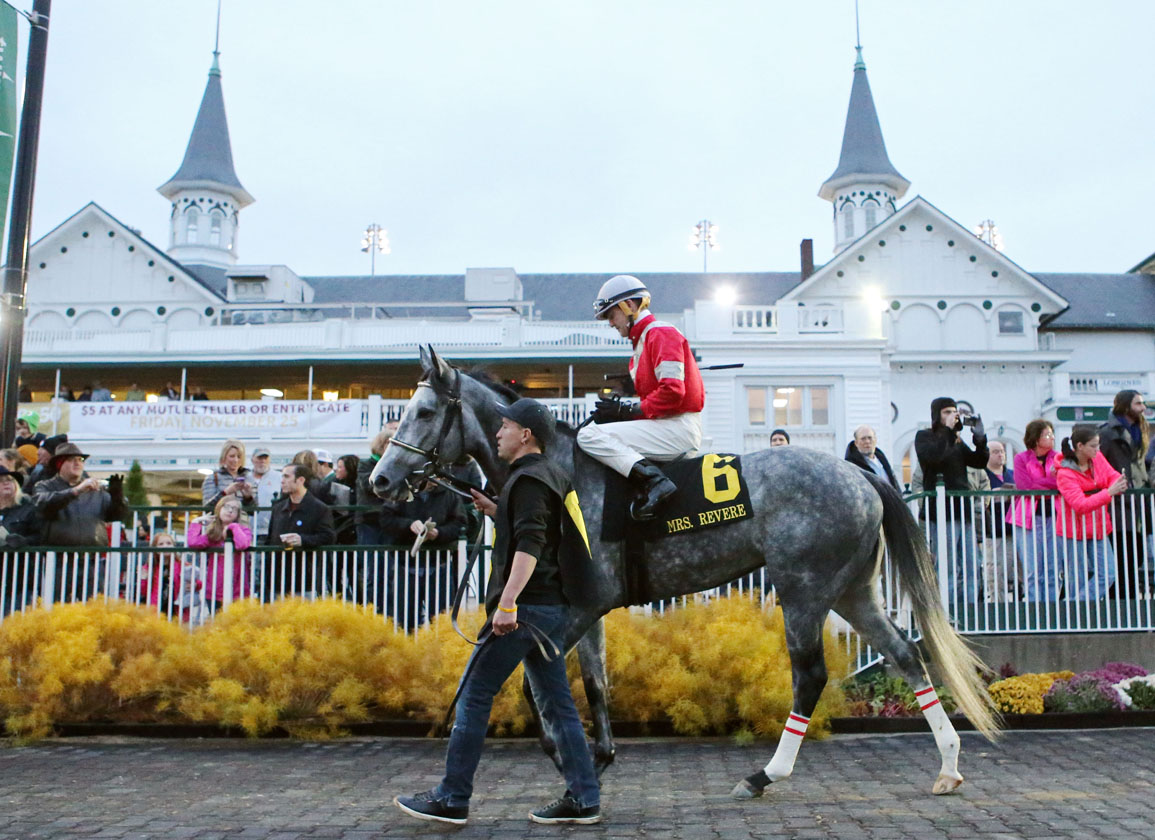
He remembered going out to Hermitage in 1982 with longtime racing partner Dr. Hiram Polk, to see a yearling filly they had entered for a sale. She was probably the smallest of maybe 20 fillies, but they all got out of her way when she wanted the feed tub. Who would perceive this alpha female in such a diminutive filly at the sales? They scratched her, and in their silks Mrs. Revere was a Grade I-placed, 12-time winner, since honored by a Grade II at Churchill.

If hardly any among us can begin to emulate Richardson in terms of professional achievement, then that should not stop us at least aspiring to his example in our family lives, or as donors of time, energy and experience to our community. Because he valued none of his cerebral gifts above the compassion available to the least of us.

The GII Mrs. Revere S. is still run at Churchill in the fall | Coady

Doc always told students that a little bit of you will die with every patient you lose. But their purpose in life was to help people through traumatic situations as best they could; to be confident–not arrogant, but definitely confident–in their skills; and to accept that some unpredictability of the human organism is unalterable. “I think if you are a compassionate person, it never gets easy,” he said. “If it does, then I worry about you. But if you do something out of love, then you never do the wrong thing.”

It is not as though a man who salvaged so many lives from the brink had failed to contemplate his own mortality. A few years ago he had survived a health crisis that allowed him to nurse his wife through her final days; and then, happily, to be consoled by new love and remarriage. But now that unpredictable human organism has pulled a vicious shock on us all, with grief rippling out in widening circles from what has always been a very close family.

Our society has few enough men of this stamp, never mind the narrow walk of sporting life we tread. Doc's passion for Thoroughbreds dignified our whole business. He made you feel that if such a sage and accomplished human being could be equally enthused, then ours could not just be some trivial, dumbass obsession. So if we borrowed something of his human luster, while blessed by his living example, let's now try to honor Doc by preserving it as our own–in how we engage with this business, and with each other.

The post This Side Up: ‘Doc’ Was a Tonic to Us All appeared first on TDN | Thoroughbred Daily News | Horse Racing News, Results and Video | Thoroughbred Breeding and Auctions.

Source of original post

Verified by MonsterInsights