Detecting a Possible Future for Shoeing?

In Fair Hill, Md., the recent site of a large international equestrian event, several farriers gathered, not necessarily an unusual occurrence where events that involve horses are concerned. However, this day lacked the usual sights and sounds that horse people have become accustomed to when considering farriers: no ringing anvils, no screeching grinders or sounds of clinches being blocked. The assembled farriers did not unpack toolboxes from their rigs or unload any horseshoes; nonetheless, the group descended upon the Fair Hill show grounds only armed with cameras, measuring devices, laptops, sensors, and a desire to push their skill into the 21st century. A nearby sign encouraging participation in the study simply read, “Farriery and Gait Assessment…Free Analysis!” The pot was sweetened for the skeptical, reluctant, and resistant, with a $1,000 raffle for participants, including other inducements donated by Dover Saddlery and the American Farriers Journal.

The gathering of farriers moonlighting as researchers and data collectors turned out to be a mini reunion of sorts, with the majority being recent graduates of the Royal Veterinary College's (RVC) Equine Locomotor Research (ELR) program, some traveling great distances to attend. Overheard conversations included a recount of the last resident weekend for the course (hosted in February 2020) on the eve of some new coronavirus outbreak elsewhere on the globe and the resulting effects on travel, while another member of the group was heard expressing their disappointment with failed attempts to encourage some rider/horse combinations participation, attributing resistance to cynicism or a possible jog mishap on the eve of a major competition.

In attendance, farrier Doug Anderson of Mount Airy, Md., informed onlookers and potential partakers that in the field of hoof-related research, which includes approximately 159 studies examining the hoof and shoeing, only five were authored by farriers. He explained that the RVC's ELR program was created with the goal of providing the tools and knowledge to facilitate changing this narrative.

The Fair Hill study, the brainchild of Pat Reilly, another RVC graduate and Chief of Farrier Services at University of Pennsylvania's New Bolton Center since 2006, explores potential correlations of symmetry and performance using a sensor-based gait analysis (EquiGait). The New England native, who has a life-long family connection to horses and their business which retrained off-track Thoroughbreds for eventing, segued into shoeing after a four- or five-day stint as an exercise rider and a trainer's recommendation to seek out another line of work. Explaining the origin of the U.S. version of the ELR Program, Reilly shared that his plans to attend the UK program were derailed by Brexit and visa restrictions, resulting in his lobbying hard the program's creators (Dr.'s Renate Weller and Thilo Pfau) to implement a satellite program in the U.S.

Reilly analyzes the data | Jude Florio

“All farriers have different ways to shoe, and in the absence of facts everyone has an opinion. [Farriers] don't have to prove it,” Reilly said, explain the need for improving farrier education and increasing evidence-based shoeing through research.

In choosing the Fair Hill venue to perform his study, Reilly explained that it offered a “good opportunity” to measure top performance horses, while seeking possible correlations of hoof morphologies, symmetry of movement, and any resulting effects on performance. Ensuing observations, images, and simple measurements were recorded (i.e.: hoof angles, toe lengths), as were the types of shoes, including any possible additional interventions (pads, glue-ons, pour-in materials).

The study's primary focuses are based on the results of measurements using the EquiGait system, an inertial measurement unit (IMU) sensor-based technology developed by Pfau. EquiGait is similar to existing devices commonly known as “lameness locators.” However, Pfau, who was recently appointed Professor to the University of Calgary's Departments of Veterinary Medicine and Kinesiology, explained his system goes one step further than the lameness locator, which uses sensors placed on the pole and sacrum to detect asymmetry. In comparison, EquiGait additionally incorporates the withers, offering the ability to pinpoint asymmetries occurring in front or behind. Pfau added that these systems' main characteristic seek to identify asymmetry of motion, a possible sign of lameness. Measurements of the upper body, movement, and the interaction between the sensors capture function of the legs, including weight bearing, pushing off, and indirect conclusions about force distribution between limbs.

An example of some of the sensor-based technology data | Jude Florio

When asked about the usefulness relating to Thoroughbred racing, Pfau referred to knowledge gained from studies and routine use of this technology by Dr. Bronte Forbes, previously based in Singapore and presently in Hong Kong. He noted Singapore's use of sensor technology as an objective assessment of lameness and confirmation after a veterinary check results in a visual detection. The technology's use has been widely accepted as a trusted veterinary tool. Pfau explained racing's biggest challenge is the reality of horses being pushed to their limits, and asymmetries connected to potential issues are never quite the same, with huge variations in measurements and data. However, both Pfau and Reilly believe using sensor technology in racing may quantify farrier interventions and its measured effect, while identifying existing asymmetries and quantifying why one may enhance performance and another may precipitate a breakdown. Additionally, they agree that farriers do play a huge role in affecting horse's movement and symmetry and the use of this type of technology can only be beneficial.

Pfau asserted, “Shoeing is the most powerful thing that we can do; it has huge consequences.” He underscores shoeing adjustments can be directly quantified, as well as having the potential to redistribute forces highlighted by ongoing examinations of upper-level dressage horses. The study investigates the effects of shoeing on multiple surfaces and attempts to distribute forces symmetrically which without intervention may have longer-term implications with negative ramifications. According to Pfau, for now, sensors are a great resource for veterinarians, assisting in the detection of potential causes of lameness and identifying an area of concern. He also believes the continued collection of data is necessary and imperative, as there is a likelihood that long-term goals will have future sensors used as a preventative measure with an ability of early detection.

Whatever the outcome of Reilly's study, Pfau adds, it's good the conversation continues, forcing the art of shoeing closer to the science of shoeing, and is a great start in providing more facts and fewer opinions. Reilly stressed that he was extremely proud that out of the 10 or 12  graduates, seven or eight took time out of their busy schedules to participate and assist. Of the 40,000 farriers in North America, there are presently 10 or 12 with research training.

“Imagine if we had 10,000 or 12,000, 1,000 or 1,200 even… We have an incredible ability to help our horses and become better at what we do by using evidence and changing how we teach,” said Reilly.

As a lifelong horseperson, rider, farrier, I am unsure of the logic–nor do I understand–the resistance or objections to exploring and unearthing potential issues with the use of noninvasive sensor technology, which objectively measures and assesses gait(s), perhaps detecting a need for an adjustment in shoeing and/or training. The resulting data could potentially enhance or improve performance or, more importantly, detect and derail a potentially catastrophic issue before it's too late.

At the end of the day, what do I know? I hold an inverted unnatural position for hours on end bending metal for a living.

Jude Florio, who has served as a professional farrier for over 20 years, earned a graduate diploma from the University of London's Royal Veterinary College in Applied Equine Locomotor Research. He is among the current MSc Equine Science cohorts studying at the University of Edinburgh, Royal 'Dick' School of Veterinary Studies (June 2023).


The post Detecting a Possible Future for Shoeing? appeared first on TDN | Thoroughbred Daily News | Horse Racing News, Results and Video | Thoroughbred Breeding and Auctions.

Source of original post

Taking Stock: The Kingmans in America

Juddmonte's European-based Kingman (GB) (Invincible Spirit {Ire}) is one of the best young stallions in the world. Through four crops of racing age, Kingman is represented to date by 42 black-type winners, 22 of them group or graded winners, four at the highest level. Moreover, he sires black-type winners at a rate of 9% from foals. In these days of big books, that's an excellent ratio. For comparison, Juddmonte's outstanding sire Frankel (GB) (Galileo {Ire}) gets 10% black-type winners from foals, while Frankel's legendary sire got 11%.

Kingman is keeping heady company, and he caught the attention of some American owners early, most notably from Seth Klarman's Klaravich Stable and Peter Brant. Chad Brown trains for both owners and is behind a number of Kingmans that have won or placed in graded races over the last three weeks, reminding us once again that Kingman is that rare European stallion with a particularly sharp record over American turf tracks.

On Saturday, Klaravich's 3-year-old colt Public Sector (GB) (Kingman {GB}) won the Gll Hill Prince S. at nine furlongs over the inner turf course at Belmont–his third consecutive graded score, following wins in the Glll Saranac S. over a mile and a sixteenth on the inner turf at Saratoga and the Gll National Museum of Racing Hall of Fame S. over a mile on the same course. Altogether, Public Sector has won five of nine starts with three second-place finishes and has earned almost $600,000.

The weekend before, Klaravich's 3-year-old filly Technical Analysis (Ire) was second to runaway winner Shantisara (Ire) (Coulsty {Ire})–also trained by Brown–in the Gl Queen Elizabeth ll Challenge Cup S. Presented by Dixiana at Keeneland over nine furlongs on turf. Prior to the Queen Elizabeth, Technical Analysis had won the Gll Lake Placid S. over a mile and a sixteenth on the inner turf course at Saratoga and the Glll Lake George S. at a mile on the same course. Technical Analysis has a record of four wins from seven starts with two placings and has earned almost $400,000.

The weekend before that, Peter Brant's 5-year-old Serve the King (GB), a member of Kingman's first crop, was second to the Brown-trained Rockemperor (Ire) (Holy Roman Emperor {Ire}) in the Gl Joe Hirsch Turf Classic over 12 furlongs on turf at Belmont. A listed winner, Serve the King has won four of 10 starts with three placings and earned almost $300,000, and it looks as if he's on the verge of landing a graded race sometime soon.

Brown also trains Klaravich's 4-year-old Kingman gelding Domestic Spending (GB), the best of them all. Most recently he was second as the heavy favorite in the Gl Mr. D. over 10 furlongs on turf at Arlington in August, but before that had won three consecutive Grade l races on grass: the Hollywood Derby over nine furlongs at Del Mar; the nine-furlong Old Forester Bourbon Turf Classic at Churchill; and the 10-furlong Resorts World Casino Manhattan S. over the inner course at Belmont. All told, Domestic Spending has won six of eight starts and earned $1.4 million.

Brown also trained the stakes winner and Grade lll-placed She's Got You (GB) (Kingman {GB}), a 5-year-old homebred mare for John and Tanya Gunther, plus several other stakes-placed, allowance, and maiden Kingman winners, mostly for Klaravich and Brant, who sourced these horses mostly from the Tattersalls October yearling sale's Book 1.

Brown obviously knows how to prepare the Kingmans for U.S. racing, as they fall into his wheelhouse as a master of turf horses, but that they succeed regularly here under American training conditions and on harder surfaces than in Europe is a testament to their adaptability–no small feat. One other thing about them: they consistently exhibit acceleration and “try,” always fighting to the finish, and those are the precious attributes that make a world-class sire.

The Kingmans tend to excel from a mile to a mile and a quarter both in Europe and the U.S., and this season the stallion is represented in Europe by the outstanding 4-year-old miler Palace Pier (GB), who'd won three consecutive Group 1 races before going down by a neck to Baaeed (GB) (Sea the Stars {Ire}) in the G1 Queen Elizabeth ll S. at Ascot Oct. 16. Palace Pier is a winner of nine races from 11 starts and has earned the equivalent of $2.4 million. He'll enter stud next year at Darley.

Kingman, a son of Invincible Spirit (Ire) and very much a Danzig-line horse by type and aptitude, was himself an outstanding miler for Khalid Abdullah, winning seven of eight starts. His lone loss, as the 6/4 favorite in the G1 2000 Guineas, was a shocker when he was nipped in the dying stages of the race by 40-1 Night of Thunder (Ire) (Dubawi {Ire}), but he went on to win four consecutive Group 1 races after that: the Irish 2000 Guineas, the St. James's Palace (from Night of Thunder); the Sussex; and the Prix Jacques le Marois.

He entered stud at Juddmonte's Banstead Manor in 2015 as the highest-rated horse of 2014 on Timeform and covered mares in his first year at a fee of £55,000. This year, it was  £150,000. There's nothing like success to bolster demand, and Kingman was a hit off the bat with a first-crop Classic-winning miler, Persian King (Ire), who served his first mares this year at Haras d'Etreham in France.


Klaravich

Kingman's first yearlings were offered at auction in 2017, and that year Klaravich purchased one colt by the stallion for the equivalent of $167,290 among the six yearlings the stable took home from Tattersalls October Book 1 for a total of $1.8 million.

The stars of that group were Grade l winners Newspaperofrecord (Ire) (Lope de Vega {Ire}) and Digital Age (Ire) (Invincible Spirit) and listed winner Value Proposition (GB) (Dansili {GB}), but the Kingman colt Good Governance (GB), a $167,290 purchase, was talented if not sound. He'd won his first start by a nose at three in a maiden special at Saratoga and was then thrown into stakes company in his next start, the Glll Saranac at Saratoga. Good Governance made a fight of it, finishing second by a neck, but he wasn't seen again until the following year. At four, he won an allowance at Belmont on his season debut, then ran third in the Gll Bernard Baruch before going on the shelf again. He's made one start this year, a fourth-place finish in an Aqueduct AOC in April, and hasn't raced since, but his early class, plus the top-level race the stable won with Digital Age, a horse by Kingman's sire, no doubt made the stable return to the well the following year.

In 2018 at the same venue, Klaravich bought 10 yearlings for $2.9 million by such sires as Lope de Vega, Sea the Stars (Ire), Dansili, Gleneagles (Ire) and Australia (GB), but the best of the lot and the only Grade l winner among the group was Kingman's Domestic Spending, a $413,973 buy. The only other Kingman from this group, the colt Principled Stand (GB), a $288,701 purchase, is a winner of two of three starts and looks like he's got a future.

In 2019 at Tattersalls October Book 1, Klaravich bought 15 yearlings for $3.8 million, and included among this group that featured colts and fillies by such as Lope de Vega, Shamardal, Invincible Spirit, and Dubawi were four Kingmans. Two of them are the aforementioned Grade ll winners Technical Analysis, who cost $258,109, and Public Sector, a $217,822 buy, and they are the only black-type winners from this group so far.

With this type of record with Kingman, it's only a matter of time before other American owners start copying the Klaravich formula, and why not?

Sid Fernando is president and CEO of Werk Thoroughbred Consultants, Inc., originator of the Werk Nick Rating and eNicks.

The post Taking Stock: The Kingmans in America appeared first on TDN | Thoroughbred Daily News | Horse Racing News, Results and Video | Thoroughbred Breeding and Auctions.

Source of original post

Dayoutoftheoffice’s Career One to Remember at Siena Farm

Nacho Patino had high hopes for Dayoutoftheoffice before she had even hit the ground at Siena Farm.

Her dam, Gottahaveadream (Indian Charlie), was a relatively large mare and had consistently thrown size and scope in her first three foals, so the Siena team had decided to pair her with Into Mischief. The resulting foal, Patino said, was better than what they had imagined.

“I loved the filly when she was born,” Siena Farm's General Manager explained. “She was a big, strong filly with the size and scope we were hoping for. I remember calling Anthony [Manganaro, Siena Farm Chairman] and telling him the mare got a beautiful Into Mischief filly.”

As spring turned to summer, Dayoutoftheoffice looked to be the prized weanling of her foal crop at Siena. But one foggy morning in September, the trajectory of her career changed entirely.

Manganaro was in town and told Patino he wanted to take a look at Gottahaveadream's filly.

“It was very foggy and the guys were bringing the weanlings closer to the gate,” Patino recalled. “We were driving up to the barn when we heard all this commotion. The horses had spooked and they took off running in the field. When the guys finally brought them into the barn, that's when we saw Dayoutoftheoffice had run into a fence. Her knee looked like somebody had taken a sledgehammer and hit her.”

Patino immediately sprang into action, loading the injured weanling onto the van and calling the clinic as soon as they were on the road.

“When one of these things happens, you pretty much know that as far as this horse becoming a racehorse, it's probably not going to happen,” he said.

But at the clinic, they discovered that there was minimal damage to the bone or the ligaments. The filly returned to the farm a few days later and for weeks, Patino diligently changed her bandage daily.'

“After three weeks, the knee looked great,” he remembered. “There was a lot of swelling, but the wound had closed. The problem was that for everything to heal, the skin had become stiff and there was no flexion in the knee.”

Dayoutoftheoffice and her dam Gottahaveadream at Siena Farm | Siena Farm

Patino and his team worked with the filly daily to get some flexibility back in the joint, using the cold-water spa and trying out other forms of therapy. When it came time for sales prep to begin, Patino decided to keep her on the same track as the other sales yearlings.

“You could see that the knee was never going to be normal, but running around in the field, she looked fine,” he said. “I think the knee was probably bothering me more than it was bothering her. I was kind of hesitant to put her on the walker or exercise her like the other yearlings, but we started sales prepping and it was a completely different horse. Everything she was doing was very easy for her and she just loved it. You didn't have to make her work, she did it on her own.”

Even as the filly flourished in her training, the veterinarians told Patino she had a 50-50 shot of seeing the racetrack. He knew she would be overlooked at any sale.

“People would take one look at the knee and turn around,” he said.

Patino and Manganaro, along with Siena's President David Pope, decided to send her to Tim Hamm, a conditioner they had shared success with in 2016 with My Dear S. winner Velvet Mood (Lonhro {Aus}).

“Tim has a program that he will work out a deal with us and for 50% equity, he will train them at no expense to us,” Pope explained. “So it was a win-win. Dayoutoftheoffice was in a group of three or four horses that we sent him and we thought she was probably the least likely [to race] because of her injury.”

But Patino said that when Hamm first saw the young filly, his eyes lit up.

“I don't think it took him two seconds to look at the filly,” he recalled. “He loved her size and the physical was there, just looking at the knee you didn't know if she would make it. I remember going to visit her in February and you could see she loved going on the track and she looked normal galloping.”

It wasn't long before Hamm was asking for a name for their juvenile. Pope and Patino discussed options back in the office at Siena.

“Her dam's name is Gottahaveadream,” Patino had reminded Pope.

“Nacho, my dream is to have a day at the beach,” Pope had replied.

They looked up the name Day at the Beach, but it was already taken.

“Well my dream is to have a day out of the office,” Patino suggested.

They tried again with Dayoutoftheoffice, and the name was available.

“We didn't even tell Anthony, we just gave her the name,” Pope recalled with a laugh. “Next thing we know, Anthony is calling us up and he hated the name. But after she won the Schuylerville, he called us and said, 'You know what? I love that name.'”

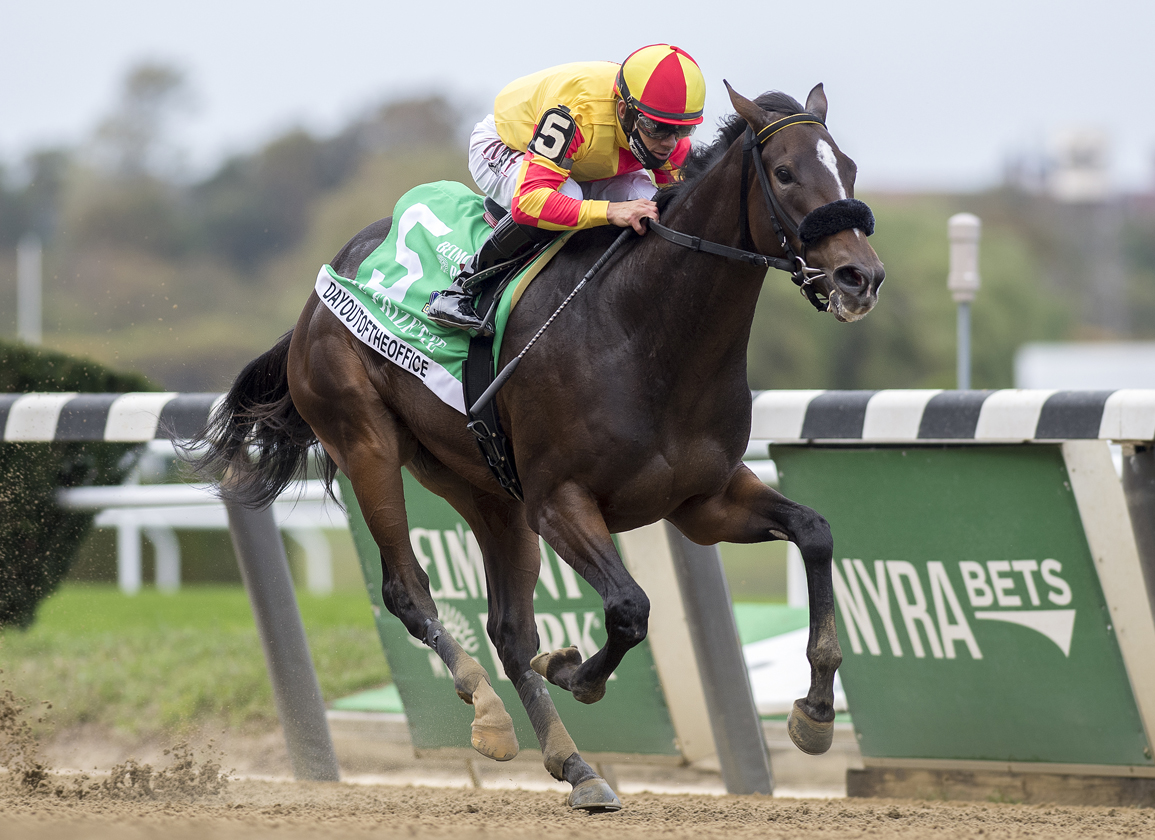
Dayoutoftheoffice made a winning debut at Gulfstream in May last year, flashing through a speedy opening quarter of :21.89 to win the 4 1/2-furlong contest by 4 3/4 lengths. She was dismissed at long odds in her next start in the GIII Schuylerville S., but bested the rest of the field by six lengths.

“I loved the fact that she was 20-1 because we made a little bit of money on that bet,” Pope said with a grin. “We were running against the big boys and it's nice when you're the underdog and you win. She made us proud. You look at the field that day and you see the top outfits in the country that we were racing against. It wasn't even a close race; she dominated.”

Dayoutoftheoffice returned several months later to remain undefeated in the GI Frizette S., besting GI Spinaway S. winner and eventual GI Breeders' Cup Juvenile Fillies champion Vequist (Nyquist) by two lengths at Belmont with over 10 lengths back to the third. She earned a 95 Beyer Speed Figure in the mile-long contest.

Meanwhile, Patino proudly watched these dazzling performances back at Siena with the rest of his team, a group that was undoubtably responsible for getting the filly to the racetrack in the first place by helping her overcome her early setback.

“It kind of validates what we're trying to do here, for the guys more than anything, because every day we were trying new things with the filly and after a while, I think they probably thought we were just wasting our time,” Patino said.” We didn't know if it was going to work out or not, but we kept working with her and now she's a Grade I winner. Now they believe that any horse we're working on could be the next one.”

Patino said that for each of their star filly's races, all of “the guys” at the farm would congregate at the office to watch.

“They like to bet so of course they're betting on our filly,” he recalled. “When they would go back to work, you could see that they really enjoyed it because this horse just won a big race and now they know they're doing something special. For me, she was special because of overcoming her injury and for all the work that we had to put in to get her there.”

Dayoutoftheoffice scores a 95 Beyer in the GI Frizette S. | Sarah Andrew

Dayoutoftheoffice gave a gutsy performance to finish second to Vequist at the Breeders' Cup to cap off her juvenile season, defeating the likes of Grade I winners Simply Ravishing (Laoban) and Princess Noor (Not This Time).

She returned at three this year with a runner-up performance in the GII Eight Belles S. and a fourth-place finish in the GI Acorn S. While recording works at Thistledowns over the summer, she sustained an injury and was retired soon after.

Much thought was put into what to do with the Grade I winner, but it was ultimately decided that she would go to the Fasig-Tipton November Sale.

“I come from the business side of it and I see an opportunity that we could take any funds we generate from that sale and reinvest to get multiple mares to grow our broodmare band to do bigger and better things,” Pope explained. “With her being our third Grade I winner, it's been very special and while we do approach it as a business, we also get emotionally attached to these horses. So we'll always be a fan of hers.”

Dayoutoftheoffice will sell as Hip 156 at the 'Night of the Stars' on Nov. 9 with the ELiTE consignment.

“We're excited to have Dayoutoftheoffice at the sale,” Fasig-Tipton's Boyd Browning said. “It's unusual to have the opportunity to sell a Grade I winner at two by Into Mischief. It's a pretty unbeatable combination from a sales perspective and it's a pretty unbeatable combination from a breeding perspective. I think what made Dayoutoftheoffice special on the racetrack was the ease in which she won. When you watch the replays, she's pretty much winning in-hand against the best in New York in some very key races. I think when you look back at that group of 2-year-olds last year, we're going to say it was a really deep group and a very talented group of horses.”

Dayoutoftheoffice's pedigree is another factor that Browning said will attract buyers at the upcoming auction.

“One of things I really love about Dayoutoftheoffice is the influence on the broodmare side of things. I think we're going to look up in 15 or 20 years from now and say Indian Charlie was a remarkable broodmare sire. He's already off to a great start, being the broodmare sire of some horses like Mitole (Eskendereya) and Hot Rod Charlie (Oxbow).”

Gottahaveadream is a half-sister to GI Forego S. winner Here Comes Ben (Street Cry {Ire}). Her granddam, GISW Race the Wild Wind (Sunny's Halo), produced G1SW and sprint champion King Charlemagne (Nureyev) as well as Chasethewildwind (Forty Niner), the dam of successful young sire Daredevil and GISW Albertus Maximus (Albert the Great).

“Indian Charlie is one of the top broodmare sires out there and her pedigree has got graded stakes horses all over the page,” Pope said. “She is something that you're looking for in a broodmare. I think you'll see a lot of people in the industry focusing on Into Mischief as the next top broodmare sire, so this is a great opportunity for people. How many opportunities do you get with a Grade I-winning filly by Into Mischief coming to the marketplace?”

Take a look at our full 'Spotlight on the Night of the Stars' series here.

The post Dayoutoftheoffice’s Career One to Remember at Siena Farm appeared first on TDN | Thoroughbred Daily News | Horse Racing News, Results and Video | Thoroughbred Breeding and Auctions.

Source of original post

Bradley Thoroughbreds’ True to Retire

Vicky True, Bradley Thoroughbreds' longest tenured employee, will retire at the end of October, according to the bloodstock agency.

“Just over 22 years ago, Vicky joined the Bradley Thoroughbreds team as the office administrator and has been a steadfast team member ever since,” said the release. “She has managed all Bradley Thoroughbreds stallion season contracts and worked in conjunction with all major farms in the area to ensure our business runs smoothly. Always the first to greet a visitor in the office or answer the phone, Vicky has been the first line of defense at Bradley Thoroughbreds for more than two decades.”

True is a graduate of the University of Kentucky and prior to joining the Bradley Thoroughbreds team, worked at some of the most prestigious farms in Central Kentucky, including Spendthrift, Gainesway, Hill 'n' Dale, and Darby Dan.

“Bradley Thoroughbreds is proud to have counted Vicky as a member of our team for so many years and we wish her a wonderful and well-deserved retirement,” the agency said.

The post Bradley Thoroughbreds’ True to Retire appeared first on TDN | Thoroughbred Daily News | Horse Racing News, Results and Video | Thoroughbred Breeding and Auctions.

Source of original post

Verified by MonsterInsights