The Week in Review: Charisma Edges Out Chaos in ’21 Breeders’ Cup

This year's Breeders' Cup revealed itself as a microcosm of the current state of North American racing: An inability to dodge off-track dysfunction (Friday) paired with sensational on-track action (Saturday).

Luckily, the corking performances unleashed over the course of the two-day thrill show were emphatic enough to spark more than a few exhilarating expectations for 2022.

That will make it a touch easier to endure an entire winter of wincing at the oft-repeated social media meme “for purse money only” while simultaneously wondering if the presumed juvenile champ will even be allowed to compete in next year's GI Kentucky Derby.

Other topical industry subplots also surfaced over the course of the 14-stakes lineup at Del Mar Thoroughbred Club. Among them were the continued globalization of high-end racing, the phasing-out of Lasix, and recently reformed whip rules.

The first of those three was a welcome development, with two horses bred and campaigned by Japanese connections breaking through in the world championships for the first time.

The latter two regulatory transitions proved only to be bit players in the overall performance, with neither triggering the levels of harm and alarm that have long been prognosticated by opponents of change.

And how's this for a masterful culmination of a season-long story arc? It took until the final furlong of the 1 1/4-miles GI Classic to answer the two burning handicapping questions that had percolated all year: Could Knicks Go (Paynter) really win a Grade I race beyond nine furlongs? And could his chief tactical weapon of flat-out speed stand up to a pace-centric younger cast of challengers that included the 1-3-4 finishers from the Derby six months ago?

The answers were yes and yes–although the high-torque gray did appear to be cracking under pressure while drifting out three-sixteenths of a mile from the wire with Medina Spirit (Protonico), 'TDN Rising Star' Essential Quality (Tapit) and Hot Rod Charlie (Oxbow) all bearing down relentlessly.

Yet Knicks Go somehow managed to kick again, reaching for and finding an overdrive gear that none of his foes could match. It translated into a 112 Beyer Speed Figure and the certainty of Horse of the Year honors. The Maryland-bred has now competed in three Breeders' Cups, wiring both the '21 Classic and '20 GI Dirt Mile by open lengths, and finishing second at 40-1 in the '18 GI Juvenile.

The only regret lingering after the Classic came in the form of a “What if?” bit of speculation: Wouldn't you have loved to see 'TDN Rising Star' Life Is Good (Into Mischief) slugging it out on the front end with Knicks Go over 10 furlongs after witnessing the odds-on dismantling that Life Is Good unleashed upon the Dirt Mile field earlier in the afternoon? That win, earned under the duress of blitzing splits, rated as the most dominant victory of this year's championships.

A sophomore did manage to turn the tables against elders in the GI Turf, with Yibir (GB) rallying with gusto from 13th to score by half a length. The victory marked the third Breeders' Cup winner of the weekend for the team of owner/breeder Godolphin, trainer Charlie Appleby, jockey William Buick, and the sire Dubawi. Those same connections all partnered to bring home Space Blues (Ire) in the GI Mile and Modern Games (Ire) in the GI Juvenile Turf.

Yibir has now won four of five stakes since being gelded May 27, which also means there's no risk of this tour-de-force deep stayer being whisked off to stud duty for '22.

The truly global aspect of the Breeders' Cup will now be accentuated a bit more meaningfully thanks to the landmark twin scores by Japanese connections on Saturday. The 4-1 Loves Only You (Jpn) (Deep Impact {Jpn}) stormed home with an inside surge to win the GI Filly and Mare Turf. The mare who was essentially her travelling companion, the 45-1 Marche Lorraine (Jpn) (Orfevre {Jpn}), got her nose down first in the pace meltdown known as this year's GI Distaff.

Both Japanese victresses were bred by Northern Farm and were trained for separate owners by Yoshito Yahagi. On a larger scale, those two wins represent several decades worth of continued effort by Japanese interests to make an impact in top-tier North American racing. Northern Farm and Godolphin were the only two breeders at this year's Cup to be represented by more than one winner.

Six Breeders' Cup races were decided by a length or less. But the nod for tightest finish goes to Aloha West (Hard Spun), who gamely nailed Dr. Schivel (Violence) by a nostril in the GI Sprint.

As for the most sublime winning ride, that would be Pizza Bianca (Fastnet Rock {Aus}) looking hopelessly adrift in 14th turning for home before Jose Ortiz seamlessly sliced and diced through traffic to snatch a half-length victory from the jaws of defeat in the GI Juvenile Fillies Turf.

Trainer Wesley Ward supplied the winners of the two grass dashes, with the 'TDN Rising Star' filly Twilight Gleaming (Ire) (National Defense {GB}) besting mixed company in the GII Juvenile Sprint. Stablemate Golden Pal (Uncle Mo), who won the '20 Juvenile Sprint, delivered a lesson in equine propulsion straight from the gate to make every call a winning one in the GI Turf Sprint.

The Juvenile Turf Sprint also provided the only penalty related to California's recently enacted strict whipping standards. Jockey E. T. Baird, who rode ninth-place finisher One Timer (Trappe Shot), was fined $5,000 on Sunday morning for using his riding crop more than six times in the race.

But if overzealous use of the whip was a relative non-issue, so too was the first Breeders' Cup prohibition of Lasix in all races.

In last year's championships, only the juvenile races were mandated Lasix-free. The older Breeders' Cup horses were allowed Lasix, and European-based trainees swept all four of the '20 Saturday grass stakes with first-time-Lasix (FTL) users.

Three of those four FTL winners were back to defend their titles at Del Mar. Running without Lasix, Glass Slippers (GB) (Dream Ahead) was eighth in the Turf Sprint. Audarya (Fr) (Wootton Bassett {GB}) ran fifth in the Filly and Mare Turf. Tarnawa (Ire) (Shamardal) finished 11th as the beaten favorite in the Turf. They are now a collective 1-for-13 since winning their respective Breeders' Cup races on Lasix.

Declining field sizes are a problem at all levels of North American racing, and this year the Breeders' Cup was no exception.

Only six could be lured into the GI Juvenile Fillies, with five of them eating the dust of Echo Zulu (Gun Runner).

Just five faced the starter in the GI Filly and Mare Sprint, won in off-the-pace fashion by Ce Ce (Elusive Quality).

But the true dysfunction alluded to at the top of this article concerns Friday's featured 2-year-old Breeders' Cup races for males.

'TDN Rising Star' Corniche (Quality Road) benefitted from the vet scratch of morning-line favorite and fellow 'Rising Star' Jack Christopher (Munnings) earlier in the week, plus being able to outbreak the field from post 11 to remain undefeated at 3-for-3 in the Juvenile.

The Bob Baffert-trained bay is now the presumptive 2-year-old champion, and under normal circumstances he'd be the early and enthusiastic favorite to win the Kentucky Derby.

But unless you've been hiding under a rock for the past six months, you know that Baffert has been barred by Churchill Downs, Inc. (CDI), from competing at its corporate collection of racetracks for the next two years over his repeated equine drug violations and a pending possible penalty for a betamethasone overage in the '21 Derby with Medina Spirit.

Horses trained by Baffert aren't allowed to accrue points in the Road to the Derby qualifying series, setting up an array of distracting outcomes that range from Corniche being transferred to another trainer and/or Baffert and CDI engaging in a high-stakes game of “chicken” that could involve litigation as the Derby draws nearer.

The name Corniche means a road cut into edge of cliff, and it's disquietingly appropriate as the crop's top colt awaits a dicey Derby fate that has absolutely nothing to do with his talent or ability.

And then, of course, there was the fiasco about Modern Games (Ire) (Dubawi {Ire}) having to race for purse money only in the Juvenile Turf because of a series of miscommunications that played out over an excruciating  12-minute span that involved the Del Mar stewards, the veterinary team at the gate, and the track's mutuels department.

You can read the full-blown explanation here for all of the cringe-worthy details regarding Modern Games twice being removed from the wagering pools. The error was costly in terms of lost betting handle, customer ill will, needless confusion, and the erosion of confidence in the officials responsible for overseeing and regulating the Breeders' Cup races at Del Mar.

On-track patrons let loose a chorus of boos as Modern Games crossed the finish wire first, but rest assured no one was deriding the horse.

And if you think that was a bad optic, just imagine the predicament the sport would have been in had the Del Mar stewards scratched/unscratched Modern Games and the colt ended up suffering an injury during the running of the race

The post The Week in Review: Charisma Edges Out Chaos in ’21 Breeders’ Cup appeared first on TDN | Thoroughbred Daily News | Horse Racing News, Results and Video | Thoroughbred Breeding and Auctions.

Source of original post

Life Was Good, Very Good

There is talk that Breeders' Cup winners Knicks Go (Paynter) and Life Is Good (Into Mischief) will meet in the Jan. 29 GI Pegasus S. at Gulfstream. I'll take Life Is Good. He was that good Saturday in the GI Big Ass Fans Breeders' Cup Dirt Mile.

Nothing against Knicks Go or any of the other winners over the weekend at Del Mar, but the best horse over the 14 races that make up the Breeders' Cup was Life Is Good. He put in a sensational performance in the Dirt Mile in an effort that suggested that, if he stays healthy, he is on the verge of becoming one of the brightest stars this sport has seen in a while. I can't wait for his 4-year-old year.

It's not that he snuck up on anyone. In March, he won the GII San Felipe S. at Santa Anita by eight lengths over Medina Spirit (Protonico) and was so dominant that it was easy to see him winning the GI Kentucky Derby. Maybe even the Triple Crown. Then his luck turned. He suffered a slight injury to a hind leg and had to have ankle surgery to remove a chip. The Triple Crown races were out.

Things got even more complicated when his trainer, Bob Baffert, got into hot water. The owners, WinStar Farm and the China Horse Club, pulled him out of the Baffert barn and sent him to Todd Pletcher in New York.

The result was that they had to hit the reset button. He was ready to go again, but the plan was to bring Life Is Good along slowly and start off sprinting. He ran a huge race in defeat when second behind star sprinter Jackie's Warrior (Maclean's Music) in the GI H. Allen Jerkens Memorial and then beat a couple of tomato cans in the GII Kelso H.

Still not ready for a mile-and-a-quarter, Life Is Good went into the Dirt Mile instead of the GI Breeders' Cup Classic. On paper, he was easily the best horse, but he still had to prove it.

It turned into one of those races where it wasn't that he won, it was how he won. Unlike in the Classic, where no one went after Knicks Go early, Life Is Good never got a breather. Chased by the Baffert-trained Eight Rings (Empire Maker) and the Japanese entrant, Jasper Prince (Violence), Life Is Good sizzled through an opening quarter-mile in :21.88. They kept applying the pressure through a half-mile in :44.94 and six furlongs in 1:08.76. On the same day where pace pressure did in favorites Gamine (Into Mischief), Jackie's Warrior and Letruska (Super Saver), Life Is Good had every right to give up after being pushed so hard so early. Instead, he put it in another gear and drew off to win by 5 3/4 lengths. The final time for the mile was 1:34.12, good for a Beyer figure109. (Knicks Go got a 112).

“It was just an amazing race,” said WinStar President and CEO Elliott Walden. “I feel like he was one of the better horses I've ever been around. Because his season had gotten broken up, he hadn't been able to put races together back to back to back. Yesterday, to see him put it all together like that was just amazing.”

“I was a little worried,” Walden said of the fast early pace. “I was worried when Ginobili (Munnings) made a little move to him at the two-and-a-half. I knew that Ginobli loved Del Mar and he is a good horse in very good form. But then he didn't get to him and when Life Is Good spurted away I felt very good about it.”

Perhaps the only knock on Life Is Good is that he's never gone beyond a mile-and-a-sixteenth, but there's nothing to suggest that nine, and even 10, furlongs will be beyond his reach.

Walden confirmed that the Pegasus is next on Life Is Good's schedule and added that the G1 Saudi Cup is a possibility. That could be the start of a very good 4-year-old year.

In the meantime, it's tempting to look back at what might have been. This horse obviously has the talent it takes to win a Kentucky Derby. After all, he beat Medina Spirit twice, in the GIII Sham S. before thrashing him in the San Felipe. Since then, Medina Spirit won the Derby and the GI Awesome Again S. and finished second in the Classic.

Nonetheless, Walden would rather look ahead than in the rear view mirror.

“Yes, I think he is the best 3-year-old in the country and I think he showed that yesterday,” he said. “It's unfortunate that he couldn't show that in the Derby and some of the other big races we're always trying to win. But, at the same time, you take what the horse gives you. And you have to be grateful for that. He's such an athlete that we're just lucky to have him. I always felt like if you take care of the horse they will take care of you.”

Considering that he is a 3-year-old Grade I winner with a stellar pedigree, it's a relief that WinStar and the China Horse Club are going to bring Life Is Good back next year. Then again, why retire a horse when it seems like his career is just getting started? After a terrific win in the Breeders' Cup, the best is surely yet to come.

The post Life Was Good, Very Good appeared first on TDN | Thoroughbred Daily News | Horse Racing News, Results and Video | Thoroughbred Breeding and Auctions.
Source of original post

Much to Love with Grade I-Winning Fasig-Tipton Offering

Whatever Hard Not to Love (Hard Spun – Loving Vindication, by Vindication) may have lost with the absence of one eye, she gained with the loyal following that developed over her career as she won the hearts of racing fans and earned the respect of the racing community.

“She was special because she dealt with a problem that I knew she was thinking about and I knew was on her mind, but she had the class and the style and the substance to fight through the issue,” said Terry Finley, whose West Point Thoroughbreds campaigned the filly along with Mercedes Stables, Scott Dilworth, David and Dorothy Ingordo and Steve Mooney. “She was very special to all the racing fans and all the people in the business out on the West Coast and especially to John Shirreffs and his barn. There was a lot of goodness around her career and I think she really drove home the things that cause us all to love this great business.”

After a three-year campaign marked by wins in the GI La Brea S. and GII Santa Monica S. and placings in four additional graded stakes races at Santa Anita, Hard Not to Love will be offered this week at the Fasig-Tipton November Sale.

“She's sure appropriately-named,” said Fasig-Tipton's Boyd Browning. “Everybody cheered for her and you wanted to see her get to the winner's circle. To watch her grow and develop and to see her accomplishments on the racetrack was pretty remarkable and I would say that her offspring are going to be hard not to love also. She combines all the elements of what you look for in a brilliant broodmare prospect and she provides a world of opportunities.”

Bred by Anderson Farms, Hard Not to Love was picked out by David Ingordo at the 2017 Keeneland September Sale.

“She came out and was just a queen-looking physical,” Ingordo recalled of the moment he first saw the daughter of Hard Spun. “She was very correct in front and was a very strong filly behind.”

On the day of her $400,000 purchase, the filly's pedigree listed just one stakes-winning half-brother as offspring of her Saratoga allowance-winning dam Loving Vindication (Vindication). But later that afternoon, the yearling's 2-year-old half-sister placed in a Grade I. The filly, named Wonder Gadot (Medaglia d'Oro), would become a multiple graded stakes winner and 2018 Horse of the Year in Canada.

“Since then, there have been other different family members that have popped up, so the family just became explosive and all at Grade I levels,” Ingordo said.

Hard Not to Love as a yearling at the Keeneland September Sale. | Louise Reinagel

Hard Not to Love was sent to McKathan Brothers Training in Ocala and had just turned two when Ingordo received a call about a paddock accident. The filly's eye had to be removed surgically.

“She was broken into training, from saddling to breezing, without ever having the benefit of that eye,” Ingordo said.”But we had a group of six fillies in the partnership and she was the star from day one.”

“You get really excited when [you have a horse with] John Shirreffs and you can start to hear it in his voice,” Finley said. “He said, 'It will probably take me a little while to get this filly to the races, but she's a good one.' So everybody was really excited and John was right on with this filly; she was a runner from the start.”

Early in her 3-year-old season, Hard Not to Love debuted with a front-running, three-length win at Santa Anita to earn the 'TDN Rising Star' nod.

After two more trips to the winner's circle over allowance company, she stepped up to Grade I company in the GI La Brea S. Up against a quality field that included MGSW Bellafina (Quality Road) and GIISW Bell's the One (Majesticperfection), Hard Not to Love rallied from the back of the field to win be over two lengths and earn a 102 Beyer Speed Figure.

“It was a good group of fillies, but I thought from the feel I got around the barn that she was sitting on a big effort,” Finley recalled. “I knew going into the far turn that they were going to have a difficult time trying to contain her. She ran by a couple of fillies that turned out to be exceptional and she did it with style and grace and with a flourish. I think that's been her calling card is the ability to finish with a flourish.”

The accomplished bay kicked off her 4-year-old campaign with a 3 1/2-length winning performance in the GII Santa Monica S. and then ran second in her next two starts against top company in the GI Beholder Mile S. and the GII Santa Maria S.

“Hard Not to Love was certainly at the top of her game posting those back-to-back graded stakes wins,” Browning said. “They were quality races against quality competition. She was also very, very consistent. An eight-time graded stakes performer, very versatile in terms of the distances she ran and was a fun filly to watch because sometimes she would be on the lead and other times she would close.”

Hard Not to Love wins by 2 1/4 lengths in the 2019 GI La Brea S. | Benoit

After placing in two more graded stakes in California, Hard Not to Love was retired this year with five wins in 12 career starts, placing in all but two.

“Hard Not to Love's hallmark for me, and it's something I look for in any horse, is when they're consistently competing at a high level,” Ingordo said. “She showed up every race, competed against the best of her generation and left it all on the track each time.”

Ingordo said he strongly believes that if it were not for the dedication of John Shirreffs, the talented filly never would have had the chance to show off her ability.

“There's no doubt in my mind that if Hard Not to Love was in a mega-trainer's barn, they would have sent her home,” he said. “She was a talented filly and she had a great mind, but you had to teach her and work through some things. John's process was well thought out and was for the filly's best interest. Having Hard Not to Love with John Shirreffs is like being in private school versus public school, and we got a valedictorian.”

The 5-year-old will begin her new career as a broodmare after selling as Hip 184 on the 'Night of the Stars.'

“Hard Not to Love will be a successful broodmare because she had style, class and elegance and she was able to put all those together and perform on the racetrack,” Finley said. “She always had that sparkle in her eye and I think people that know the business can see those special ones.”

Along with the success of her half-sister Wonder Gadot, who sold for $2 million at the 2019 Fasig-Tipton November Sale, Hard Not to Love's pedigree received another Grade I  boost since her yearling purchase with the success of GI Beholder Mile S. victress Secret Spice (Discreet Cat).

“She has a fantastic depth of pedigree,” Browning explained. “She also offers a lot of breeding opportunities being by Hard Spun and out of a Vindication mare. From a sire-line perspective, she can be bred to a lot of different stallions that stand all over the world. She combines race record, pedigree and physical looks and presents a fabulous scenario for someone looking to have the opportunity to fulfill their dreams come November the 9th.”

For Ingordo, Hard Not to Love offers everything that he seeks out in a broodmare prospect.

“They have to have some speed and Hard Not to Love is a very fast horse,” he said. “They have to have a good physical presence and I feel like Hard Not to Love is one of the better-looking horses that will walk through any sales ring this year, next year or two years from now. Then when you take into account her race record and pedigree, those are all the things that you need to have a blue hen, foundation-type mare.”

The post Much to Love with Grade I-Winning Fasig-Tipton Offering appeared first on TDN | Thoroughbred Daily News | Horse Racing News, Results and Video | Thoroughbred Breeding and Auctions.
Source of original post

This Side Up: A Showcase for Horses Born to Run

Now this, we can all agree, is just what a GI Longines Breeders' Cup Classic should look like. Three of the first four in the Derby, albeit not the one that may ultimately be credited as winner. And besides resolving the questions left open by that processional race at Churchill, they must also pick up the gauntlet thrown down by an older horse whose plain running style should leave no stone of merit unturned. A race, in other words, commensurate with the biggest prize of the American Turf, with the laurels of Horse of the Year very possibly on the line, too.

To connections of the nine involved, then, congratulations. Even in getting to the gate, you've basically achieved everything that drives the perennial investment of billions into the improvement and nurture of the breed. That being so, however, the composition of the field asks some pretty challenging questions of the bloodstock industry.

Sure, it can point to a functioning paradigm in Essential Quality: a son of the elite stallion Tapit, bred by the biggest investor in Turf history from the daughter of a mare bought for $3 million. But the rest of the field does not support perceived commercial values anything like so sturdily.

Favorite Knicks Go has brought Paynter back from brink, his current juveniles having graduated from a book of 34 covers in 2018, but he is still only $7,500–at which fee Hot Rod Charlie's sire Oxbow received just 28 mares this year. Medina Spirit, son of an even cheaper sire in Protonico, famously changed hands for $1,000 as a yearling. Max Player's sire Honor Code, shockingly, barely surpassed even Oxbow's book this spring despite also producing from his first crop the only colt ever to beat the 2021 Horse of the Year.

Art Collector is by one of the most precocious broodmare sires in history, but the yearling market had become so disenchanted with Bernardini that the last crop sold before his death, conceived at $85,000, achieved a median of $38,500. Tripoli is a dirt outlier for Kitten's Joy, whose lack of commercial recognition has long been symptomatic of the witless treatment of turf stallions in Kentucky. Stilleto Boy is by Shackleford, exiled to Korea last year. That leaves Express Train as the only runner, bar Essential Quality, by a stallion with any claim to making sense of the market's operation: Union Rags had a book of 164 last year, though it must be acknowledged that he presumably only maintained that traffic by having his fee halved to $30,000.

If this is our idea of a horse race, then, it vividly rebukes the familiar, dismal disjunction between sales ring and racetrack. Logically, there should be nothing more commercial than breeding winners. But most matings are planned with only one moment in mind: not post time for the Breeders' Cup Classic, but the fall of a gavel.

You can't blame commercial breeders, really. It's a tough business, and a lot of things can go wrong with these delicate young animals. The fault rests with those directing investment, the agents and advisors who would rather urge their wealthy patrons to buy a yearling by the latest unproven rookie than one by an Oxbow or a Paynter.

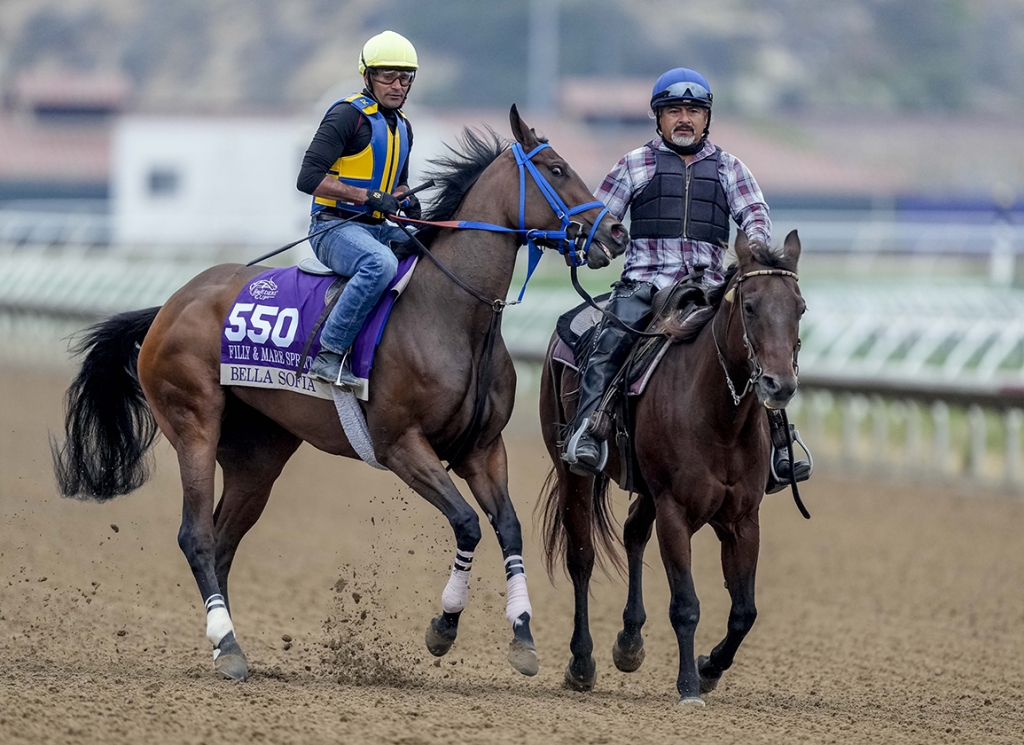
Filly & Mare Sprint entrant Bella Sofia is by the same sire family as Hot Rod Charlie and Knicks Go | Breeders' Cup/Eclipse Sportswire

Oxbow and Paynter! If you want “run”, well, it runs in the family. These sires are both by Awesome Again out of daughters of the freakish Cee's Song (Seattle Song), also mother of the dual Breeders' Cup Classic winner Tiznow (plus two other Grade II winners) from her serial trysts with Cee's Tizzy. And don't forget that Oxbow's brother Awesome Patriot gave us Bella Sofia, the principal rival to Gamine (Into Mischief) in the GI Filly and Mare Sprint. So here we have three stallions from the same dynasty, all perceived as lacking commercial allure, all with Grade I winners eligible to win on the day that best measures the endeavors of a multi-billion-dollar industry.

Awesome Patriot admittedly earned his chance at stud sooner by pedigree than performance, but the same is true of Outflanker, the Maryland stalwart (by Danzig out of a half-sister to Weekend Surprise) who contested 10 maidens without success–and who surfaces as damsire of Knicks Go.

Bella Sofia was found for just $20,000 at OBS last summer. Knicks Go was co-bred by Sabrina Moore and her mother Angie when they had a total of three mares. And Hot Rod Charlie, as we've often celebrated, was the very last horse sold by the peerless Bill Landes of Hermitage Farm from the families cultivated by his late patron Edward A. Cox, Jr.

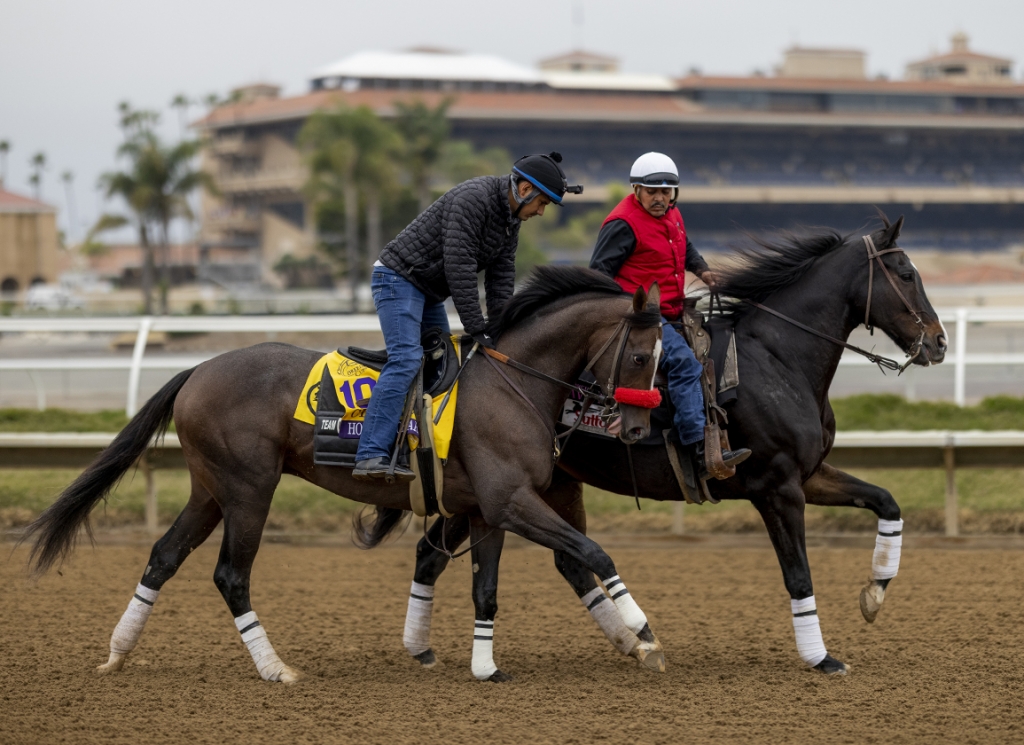
Having made just $17,000 as a short yearling, Hot Rod Charlie could not reward his shrewd pinhookers past $110,000 despite the subsequent rise of half-brother Mitole (Eskendereya). That's a measure of the commercial renunciation of Oxbow, but at least it allowed his son to fall within reach of a multi-generational partnership, united by ageless enthusiasm, including a bunch of Brown University football alumni headed by the nephew of trainer Doug O'Neill. Some of these boys live and work in San Diego and to bring “Chuck” to their local track, a year after his insolent 94-1 challenge to Essential Quality in the GI Juvenile, offers just the kind of tale our sport could do with telling the outside world right now.

Hot Rod Charlie training at Del Mar | Breeders' Cup/Eclipse Sportswire

But success for Hot Rod Charlie would have no less redemptive potential within the business, too. Son of an exemplary speed-carrying scrapper, he is author of the fastest opening in GI Belmont S. history (and a half eclipsed only by Secretariat) while still locking horns so obstinately in the stretch that it was 11 lengths back to the Preakness winner in third. So bravo to Gainesway for investing in such granite. Apart from anything else, Tapit mares will be a fun match: Cee's Tizzy was by Relaunch, full-brother to Tapit's third dam.

Oxbow, for his part, had plenty of quantity in his early books but not so much quality. Sure, Calumet marches to its own drum, and a lot of commercial breeders will never fall in step. But at least this farm is setting a premium on those assets most eroded by the corner-cutting vices of our industry: constitution, durability, staying power. Because we need to start raising and racing horses that do not depend for their competitive ardor and longevity on medication, but on their genetic inheritance.

It's called the Breeders' Cup, remember. Not the Vendors' Cup. And its climax this year reminds us what we're supposed to be trying to breed. Milton famously ended a sonnet by observing: “They also serve who only stand and wait.” But that's all many horses today are bred to do: to stand on that dais and wait for board to light up. Okay, they have to walk nicely too. But run? A bonus, apparently.

So go get 'em, Chuck!

The post This Side Up: A Showcase for Horses Born to Run appeared first on TDN | Thoroughbred Daily News | Horse Racing News, Results and Video | Thoroughbred Breeding and Auctions.

Source of original post

Verified by MonsterInsights