Voting Underway for Vox Populi Award

Online voting is officially open for the 12th annual Secretariat 'Vox Populi' Award. Won by Horse of the Year Authentic (Into Mischief) last year, the Vox Populi was created by Secretariat's late owner Penny Chenery and recognizes the racehorse whose popularity and racing excellence best resounded with the public and gained recognition for the sport during the previous year.

Fans can vote on one of six nominees selected by the award's committee or choose a write-in option. This year's nominees, along with their most recent winning race, are: GI NetJets Breeders' Cup Juvenile Fillies winner Echo Zulu (Gun Runner); GI Travers S. champ Essential Quality (Tapit); GI Pennsylvania Derby winner Hot Rod Charlie (Oxbow); GI Breeders' Cup Classic winner Knicks Go (Paynter); GI Spinster S. victress Letruska (Super Saver); and GI Big Ass Fans Breeders' Cup Dirt Mile scorer Life Is Good (Into Mischief).

“Our nominees this year represent some of the brightest moments for the sport in 2021,” said Chenery's daughter, Kate Chenery Tweedy. “We look forward to the fans celebrating their favorites by voting for the horses who thrilled them, who inspired them, and who provided them the most joy during another challenging year.”

In addition to 2020's Authentic, previous Vox Populi winners have included inaugural 2010 winner Zenyatta (Street Cry {Ire}), Ben's Cat (Parker's Storm Cat), and two-time honoree California Chrome (Lucky Pulpit).

For more information about the Vox Populi Award, visit Secretariat.com. Voting will be open through Nov. 30 and the winner will be announced in December.

The post Voting Underway for Vox Populi Award appeared first on TDN | Thoroughbred Daily News | Horse Racing News, Results and Video | Thoroughbred Breeding and Auctions.

Source of original post

The Week in Review: Tygart, USADA Out to Clean Up the Game

We heard from the United States Anti-Doping Agency (USADA), its CEO Travis Tygart and the Director of Equine Science Dr. Tessa Muir last week when USADA released its anti-doping guidelines, rules and protocols. Once again, we saw that these are no-nonsense, dedicated people with a track record of cleaning up other sports. The release of the guidelines was an important step toward what will be a welcome change for racing–competent, dedicated policing from an outside entity replacing the current system, which just doesn't work.

(Quotes from this story were taken from Tygart and Muir's appearance on the TDN Writers' Room podcast and from Dan Ross's coverage in the TDN and his Q&A with Tygart and Muir.)

With Thursday's release of the details, there was a lot to digest. Here's what resonated with me:

(*) USADA is not going to rely solely on drug testing, which has been proven to be a woefully inadequate way of catching cheaters. There are always a number of potent drugs out there that can't be detected by standard drug tests. USADA may not have all the tools, including wiretaps, that the FBI had when it took down Jason Servis, Jorge Navarro and others, but Tygart made it clear that there are more ways to catch cheaters than just through drug tests.

“Can you bring a case if you don't have a positive test?” Tygart said. “In some states today, I don't think that's even possible under the rules. But if you look at Article Two of the rules, it identifies about 12 different types of violations. Only one or two of those includes a positive test. So possession, trafficking, complicity, attempted administration, retaliation against a whistleblower, those are things that can be anti-doping rule violations.”

He said that scientific evidence will be combined with “buckets of evidence”, much like what you see each week on shows like Law and Order and NCIS.

Tygart said they will also rely on a tip line that is already receiving calls. All of which is a step in the right direction. Neither Navarro nor Servis had any serious violations on their records that were the result of testing, which just goes to show that a lot more beyond testing needs to be done.

(*) USADA appears to understand the importance of going after more than just the trainers. It stands to reason that in most cases where performance-enhancing drugs are used, a veterinarian is involved. And what about the owners? It's hard to imagine they don't know what's going on when their trainer is wining at 30% and 50% off the claim. They should have to pay the price when their trainer is caught.

“When the horse is in training, the owner, the veterinarian, anyone else involved with the horse, they can be held accountable if they're complicit and part of a doping or a medication issue,” Tygart said. “The strict liability of the positive test doesn't apply to them. So there will be a slightly different way that this is prosecuted, but they absolutely can be held accountable under these rules.”

He added: “It's not just the trainer training the horse that has responsibility for this culture of a clean sport. Everybody within the sport should have a responsibility to ensure that it's being done the right way.”

(*) One thing that was not addressed last week was the obvious problem of having a trainer turn the stable over to an assistant once they are suspended. Life goes on largely uninterrupted for that stable with the head trainer getting what amounts to a vacation. There's not nearly enough of a deterrent here. At least with the more serious violations, the stable should be penalized along with a guilty trainer.

(*) USADA is going to rely heavily on out-of-competition testing and trainers must let USADA know at all times where a horse is located. He also said that out-of-competition tests won't be done on a random basis. For obvious reasons, the focus will be on trainers whose results suggest they might be using something to get an edge.

“It's what we call intelligent testing,” Tygart said. “It's not random. Some call it smart testing. Some call it target testing. We will use data.”

(*) You might want to call this one the “Baffert Rule.” While USADA will distinguish between violations that involve performance-enhancing drugs and overages of therapeutic medications, Tygart believes that there is a point where enough is enough when it comes to overages. Four minor infractions or therapeutic overages within five years could result in a sanction of up to two years.

(*) Just because a horse passes post-race urine and blood tests doesn't mean that they can't be caught later on. If someone uses something illegal and a new test for that substance comes around after the fact, they could get nailed. This is another welcome development.

“We will have the ability to do what is called retrospective testing,” Tygart said. “Samples will be put into storage. And then when you develop new tests in the future, we're going to be able to bring those samples out of storage and actually then analyze them with the new methodology for those prohibited old-time substances. That's also a great deterrent to people using things where they say you can't detect it. But in the future, when those technologies and the capabilities are enhanced and changed, then we can go back and you will still be subject to sanction (for a positive test).”

(*) More than six months after the race, the Kentucky Horse Racing Commission has still not acted when it comes to this year's GI Kentucky Derby and the reported betamethasone positive on winner Medina Spirit (Protonico). That, Tygart said, will not happen after USADA takes over.

“I was pretty stunned to hear that (Medina Spirit's) Kentucky Derby case hasn't been resolved yet,” Tygart said. “That's not going to happen on our watch. I mean, it's crazy that it's taken that long to get to a final resolution, particularly when someone is competing the entire time.”

Lawsuits have been filed by horsemen's groups and six states to shoot down the Horseracing Safety and Integrity Act (HISA), which is what created the need for a new method of policing the sport, and USADA has yet to sign a contract with the Horseracing Integrity and Safety Authority. Both factors could mean that the projected start date for HISA, July 1, 2022 will not be met.

But if and when HISA goes into effect, USADA will be ready. Tygart called the new rules a “gold standard program for the industry.” He's got that right. It's time for a new era.

The post The Week in Review: Tygart, USADA Out to Clean Up the Game appeared first on TDN | Thoroughbred Daily News | Horse Racing News, Results and Video | Thoroughbred Breeding and Auctions.

Source of original post

Op/Ed: Corniche Connections Should Consider Dennis Diaz Wisdom

In 1985, owner Dennis Diaz had a decision to make after his runner, Spend a Buck, won the GI Kentucky Derby.

Under ordinary circumstances it would be on to the GI Preakness S. two weeks later.

But, as Lee Corso would say: “Not so fast.”

In this particular year, before the Triple Crown prep season had begun, Garden State Park owner Robert Brennan offered a $2-million bonus to any horse who won the track's two preps plus the Kentucky Derby and GIII Jersey Derby.

Diaz and trainer Cam Gambolati sent Spend a Buck to the New Jersey racetrack, where he won the Apr. 6 Cherry Hill Mile S. and Apr. 20 Garden State S. prior to his run in the Kentucky Derby.

So, after Spend a Buck, under jockey Angel Cordero, Jr., beat Stephan's Odyssey by 5 3/4 lengths in a sharp 2:00 1/5, Diaz had a decision to make.

It didn't take him long to make it.

Though Pimlico, home of the Preakness, had upped its purse from $250,000 to $350,000-added, Diaz opted for Brennan's offer. The Preakness was won by Tank's Prospect, who earned $423,200 for his owner, Gene Klein.

Spend a Buck won the May 27 Jersey Derby with Laffit Pincay, Jr. aboard, Cordero having a previous engagement. With the purse and bonus, Diaz pocketed $2.6 million, at the time the largest purse in the world.

(Who did Spend a Buck defeat in the Jersey Derby by a neck but Creme Fraiche, who would go on to take the GI Belmont S.)

Because of the bonus Brennan had offered, and the fact Diaz had spurned a run at the Triple Crown to chase the money instead, Triple Crown Productions was formed and the three tracks (Churchill Downs, Pimilco and the New York Racing Association's Belmont Park) began offering a $5-million bonus to any horse that swept the series.

Now, with the purses of the Triple Crown races larger and the long-dropped bonus sponsorship (first by Chrysler, later by VISA), the bonus, which was never paid, has been dropped.
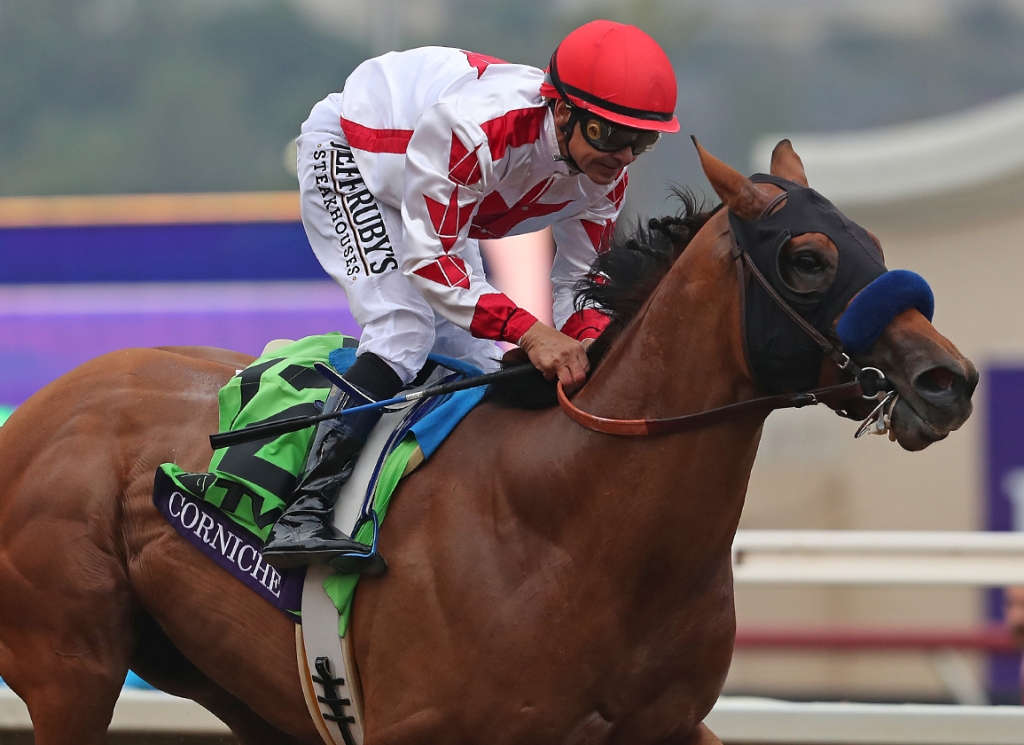
Breeders' Cup Juvenile winner Corniche | Breeders' Cup/Eclipse Sportswire

What does all of this have to do with today?

Well, today Peter Fluor and K.C. Weiner have a decision to make. The men, who race as Speedway Stables, own Corniche (Quality Road), winner over the weekend of the GI Breeders' Cup Juvenile.

With his decisive victory, and a perfect three-for-three season, Corniche will be named champion juvenile colt. And with that, the expectation of being the winter-book favorite for the 2022 Kentucky Derby.

Where is Corso when you need him, because again, “not so fast.”

Corniche is trained by Bob Baffert, who trained this year's Derby winner Medina Spirit (Protonico). However, after Medina Spirit tested positive for the presence of betamethasone, Churchill Downs Inc. suspended Baffert from saddling horses at its tracks for two years.

Yes, a different set of circumstances altogether than what faced Diaz, who owned a modestly bred horse bought inexpensively and trained by someone few had previously heard of.

Corniche was an expensive purchase ($1.5-million OBS April sale topper) with a nice pedigree, bred and racing in an age where there are a multitude of farms and partnerships desperately competing to make future stallions.

If they are hell-bent on taking a run down the Triple Crown trail, Fluor and Weiner have two options. They can transfer their colt to a new trainer or they can pursue litigation against Churchill to allow Baffert-trained runners to earn points in prep races and compete in the Derby.

Or, they could take a page from Diaz and instead of being hell-bent, they could say to hell with tradition, the Derby, and Churchill.

There are, after all, many other racetracks and many other races with big purses. And, surely, some clever racetrack promotion team could put together a bonus as cleverly as Brennan did.

Another thing for Fluor and Weiner to consider: Corniche's sire, Quality Road, did not win the Derby. Neither did Tapit, Into Mischief, Ghostzapper, Curlin, Medaglia d'Oro, Uncle Mo

Want to go back a bit further in history? Though Northern Dancer won the Derby and established a dominant sire line, Mr. Prospector, who also began a superior sire line, did not.

Yes, the Derby will always be the Derby. To this Kentucky-bred, there is no more wonderful race than the Derby. Never will be.

But winning the Derby should not be the ultimate goal for Fluor and Weiner. If they believe in their horse, and in their trainer, there are many other races in which to run.

And, make no mistake about it, breeding farms will still want to stand their horse and breeders will still want to send mares to him.

Another thing for the residents of Houston to think about. Spend a Buck was voted the 1985 Horse of the Year and champion 3-year-old colt.

Tradition is great. It provides us a way of linking the past to the present and perhaps one day, to the future.

But for Peter Fluor and K.C. Weiner, there is also the wisdom of Dennis Diaz to consider.

The post Op/Ed: Corniche Connections Should Consider Dennis Diaz Wisdom appeared first on TDN | Thoroughbred Daily News | Horse Racing News, Results and Video | Thoroughbred Breeding and Auctions.

Source of original post

Sunday’s Insights: Expensive Colt Looks To Maintain Sire’s Momentum

Sponsored by Alex Nichols Agency
3rd-DMR, $70k, Msw, 2yo, 5fT, post tme: 4:30 p.m. ET
Spendthrift Farm's Gormley (Malibu Moon) has gotten off to a flyer at stud, with 18 first-crop winners to his credit, and B DAWK will look to add to that total Sunday 'where the turf meeets the surf. A half-brother to SP Nicky Scissors, the May 21 foal was a $77,000 short yearling at Keeneland January last year before improving into a $140,000 KEESEP purchase. Joseph Besecker signed the ticket on the chestnut at $425,000 at this year's Fasig-Tipton Midlantic Sale (see below) and West Point Thoroughbreds, among the underbidders, struck a deal to partner on the colt. The hammer price was the second-priciest of his sire's 45 juveniles (52 ring) reported as sold this year. TJCIS PPs


The post Sunday’s Insights: Expensive Colt Looks To Maintain Sire’s Momentum appeared first on TDN | Thoroughbred Daily News | Horse Racing News, Results and Video | Thoroughbred Breeding and Auctions.

Source of original post

Verified by MonsterInsights