Lexington’s Thoroughbred Community Makes Town Branch Park a Reality

Urban parks are well-loved destinations in America's most developed and highly-populated cities. Of course Central Park is the first that comes to mind, as well as perhaps Lincoln Park in Chicago or Golden Gate Park in San Francisco. These beautifully-designed pieces of landscape architecture serve as gathering places for the city's community and are often stopping points  for those visiting a bustling metropolis.

In a few years Lexington, Kentucky, with a population of less than 400,000, will get a state-of-the-art park of its own in the heart of downtown. Ground is set to break next year to transform over nine acres of asphalt parking lot adjacent to Lexington's Convention Center into a green oasis that will be called Town Branch Park.

The idea for the park was born 10 years ago as Lexington was in the midst of a major downtown revitalization project within the hospitality sector. Town Branch Park would be unique in that it would be privately funded by the community. While the city had raised $10 million or even $15 million for projects before, this one would require over $30 million in funding.

It was a lofty goal, but today the fundraising target is already well on its way to being met thanks in large part to Lexington's equine community.

Kip Cornett is the Vice President for External Affairs for the Town Branch Park project and is also on the executive community. He explained how Lexington's signature industry has stepped up to turn the park vision into a reality.

“At this point, 26% of all the dollars that we have raised have come from the equine industry and it's really been in an unprecedented way,” he said. “The industry has always been benevolent both within the industry and locally, but this is taking it to another level. It's a really good cross section of farms, individuals and organizations with donations that range from $10,000 to $3 million. We've had people who are willing to step up because they see the vision the same way that we do.”

When plans for the park were first  laid out, a key goal was to focus on bringing the Bluegrass countryside into downtown. That concept resonated with Spendthrift's Eric Gustavson, who has been a prominent supporter of the project.
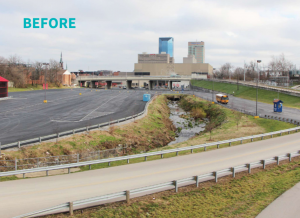
“One of the things we were drawn to is the beautiful nature aspect of it in the middle of downtown–a big, sprawling park,”

Gustavson explained. “We were also drawn to the ability for our team at Spendthrift to be proud of being a part of the amazing project. I think it's going to be a crown jewel for the city. For tourists, the bourbon industry and Thoroughbred industry are big draws, but I think someday on their itineraries, you'll see people wanting to visit Town Branch Park.”
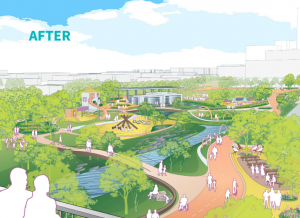
Imagery courtesy Town Branch Park

Spendthrift Farm has already committed to sponsoring the Great Lawn, a sprawling green space in the middle of the park that will resemble the rolling topography of Bluegrass horse pastures.

“Sponsoring the Great Lawn made sense to us,” Gustavson said. “With our racing and breeding industry being so related to the turf, we thought there was no better way to make that connection than to sponsor the Great Lawn.”

The Great Lawn, which will seat over 5,000 people, will be located next to the largest amphitheater in Central Kentucky called The Stage, which will be designed to host everything from local art organization and after-school programs to national touring acts.

“We wanted to make sure the park was very active and not just something that's pretty and is there for people to look at,” Cornett said. “There will be a reading room where folks can enjoy some quiet time as well as a café, a large children's playground and a dog park. It will be a highly-active nine and a half acres that we'll be able to do a lot of things with.”

Programs will include Zumba and yoga classes, author readings and book clubs, acapella groups and dancing lessons, movie nights and trivia nights, cooking classes, farmers' markets and more.

“We wanted the park to be very inclusive,” Cornett explained. “We see families, college students and senior citizens visiting. The overwhelming majority of the programming will be low cost or no cost. We want to make sure that there is a lot of different options for everybody. The folks behind the park have done a really good job of talking to people to make it their park. This is not 10 people who have gone into a room and said this is what it should look like. We've gotten a tremendous amount of feedback so people can tell us what they want to see.”

Lane's End's Bill Farish is a member of the Board of Directors for the park and said he is looking forward to the positive effects the project will have on the entire Lexington community.

“I've always been aware of private parks that have been built in other cities and how successful they've been at keeping them a lot cleaner and better policed than [public] parks,” Farish said. “What's great about it is that we have a blueprint from other cities that have done the same thing and we're able to find out what has worked and what hasn't. It's something that has had tremendously-positive effects on real estate values around other parks, which lifts everything up.”

To ensure that the park is welcoming to all community members, the Town Branch Board formed the Town Branch Park Partners, a diverse group of 29 community leaders that would reflect the greater Lexington community through their roles with universities, neighborhood groups, transit, urban design, safety and more to ensure that the park was safe and accessible for all.

“We want to make sure that the park is first class in how it's built, but also in how it's maintained,” Cornett said. “Once we've raised the money to build the park, we will set up a significant endowment and multi-year operating budget because we want this park to be looked on in five years exactly how it looks when we welcome the first visitors. ”

The park's name originates from the historic Town Branch stream, which was once integral to the founding of the city. The waterway will be cleaned and exposed and will run through the heart of the park along the amphitheater.

Upon completion, Town Branch Park will serve as the trailhead between the Town Branch Trail and the Legacy Trail, connecting over 22 miles of protected bike and pedestrian trails throughout downtown and into the countryside and ultimately leading to the Kentucky Horse Park.

“The Town Branch Park was really the last piece of the puzzle,” Cornett said. “We think it will be enjoyable for people whether they're here every day or they're visiting. A lot of visitors stay downtown and now they're going to have a world-class park in their backyard.”

He continued, “With our fundraising, we're not finished. But without the Thoroughbred industry we would be so far from our goal that it might be difficult to reach. I think it's a very positive sign that numerous farm owners are not just people who have lived here all their lives, but people who have only lived here a few years. They've said, 'This is my city and we're a very important industry within it so we need to step up and do this.'”

“My wife and I moved to Lexington four years ago and we're proud of our new town,” Gustavson said. “We love living on the farm and we thought there was no better way to show our support for our new city than to get involved with the Town Branch project. I'm so thankful for the people who have been so committed to making this a part of our city.”

“The whole revitalization of downtown that has happened over the last 20 years has been remarkable,” Farish added. “This project would just give it so much more momentum and would be such a positive thing for downtown. Lane's End is interested in anything that's a positive for the local community. We think it will enhance everyone's appreciation for downtown and for Lexington so we're very happy to be able to throw our support behind it. It's obviously taking a lot of support from a lot of people so we're very happy to do anything we can to help further the idea. It's a community-wide effort that I think benefits everybody.”
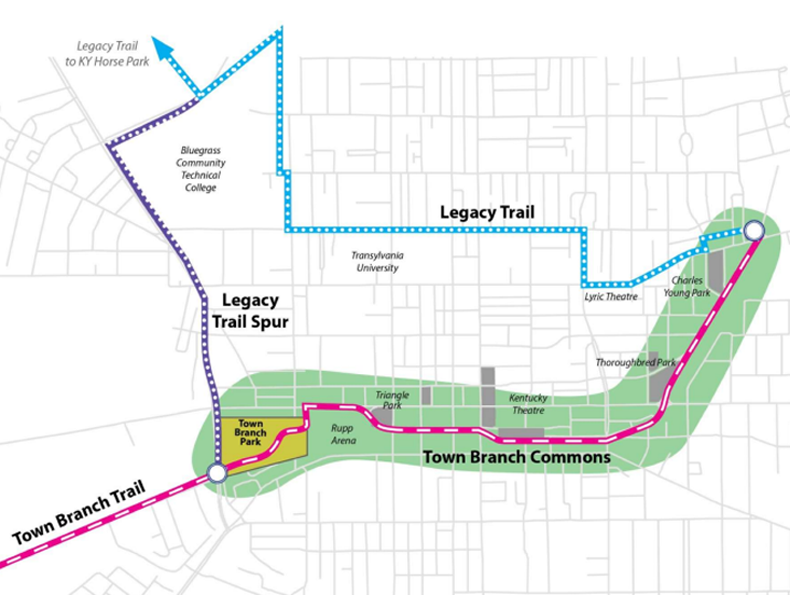
Town Branch Commons, composed of Town Branch Park and Town Branch Trail, connects with the Legacy Trail to provide over 22 miles of uninterrupted bike and pedestrian trails. | courtesy Town Branch Park

As funds continue to pour in, the team behind the Town Branch Park aims to welcome the first visitors by the end of 2024. Cornett said that, along with Spendthrift and Lane's End, over 20 Thoroughbred organizations have already shown their support for the project including Godolphin U.S.A President Jimmy Bell, who is also a Town Branch board member.

“It's wonderful to see so many in our industry step up to support this project, whether it's to help honor Mr. [Ted] Bassett or to ensure that this wonderful park becomes a reality for the community,” he said. “Many in our industry either come from or visit cities where parks like Town Branch already exist. I think they recognize the impact those parks have there and they want to provide Lexington the same opportunity through Town Branch. Anticipating the hundreds of programs and special events to be offered yearly to our community truly adds to the vibrant atmosphere this park will provide for one and all to enjoy. This Park will be transformational for Lexington and I'm very honored to be involved.”

“There's no question that sometimes people don't fully recognize what an economic engine the equine industry is in Central Kentucky,” Cornett said. “It's really the brand of the city. For the Thoroughbred industry to step up with a project of this magnitude is a great story.  I think [their support] is two-fold. They see the vision of bringing the countryside into downtown and they see it as an opportunity for Lexington to continue on its path of becoming an even greater city.”

Over $7.7 million has been raised by the equine community alone, including the following donors:

Spendthrift Farm

Mt. Brilliant Family Foundation

Coolmore

Keeneland

Bill Justice – Equine Realty

Mary K. Oxley Foundation (Jack and Debbie Oxley)

Everett and Jeanetta Dobson

Ann Bakhaus

Orrin Ingram

Bill Farish/William Stamps Farish Fund

Headley and Nancy Bell

Mandy Pope

Frank and Rita Penn

Unanimous Donor

John and Beth Phillips

James  G. “Jimmy” Bell

Helen Alexander

Sarah Stipanowich

Robert Clay

The Duke and Duchess of Devonshire

Reilly McDonald

D.G. Van Clief

Craig Bandoroff


For more information, contact Allison Lankford (Allison@townbranchpark.org) or Ben Shaffar (Ben@townbranchpark.org) or visit https://www.townbranchpark.org.


The post Lexington’s Thoroughbred Community Makes Town Branch Park a Reality appeared first on TDN | Thoroughbred Daily News | Horse Racing News, Results and Video | Thoroughbred Breeding and Auctions.

Source of original post

Keeneland Art Auction Grosses $1.9 Million

The ninth annual Sporting Art Auction, a collaboration between Keeneland and Cross Gate Gallery of Lexington held Sunday afternoon at the Keeneland Sales Pavilion, grossed $1,908,015.

Topping the auction was Andre Pater's War and Peace, a pair of signed and dated pastels, sold for $115,000, including buyer premium.

Fishing on the Elkhorn, a signed oil by Kentucky artist Paul Sawyier, brought the second-highest price of $100,050.

Keeneland's portion of the auction proceeds will benefit its non-profit initiatives.

The post Keeneland Art Auction Grosses $1.9 Million appeared first on TDN | Thoroughbred Daily News | Horse Racing News, Results and Video | Thoroughbred Breeding and Auctions.

Source of original post

The Week in Review: Feds: Even Those Sold It Did Not Know Contents of SGF-1000

This past summer, Michael Kegley Jr. and Kristian Rhein both pled guilty to felony drug adulteration and misbranding charges in the alleged international Thoroughbred doping conspiracy case. That means they'll avoid trials prior to their sentencings. But it doesn't mean that the voluminous cache of evidence that prosecutors would have used against them won't ever see the light of day.

In fact, just last week, the feds disclosed intriguing documentation about SGF-1000, the adulterated and misbranded purportedly performance-enhancing drug (PED) that was an elixir of choice for now-barred trainer Jorge Navarro, who admitted to injecting it into his horses when he pled guilty in August to one felony drug count. SGF-1000 allegedly also served as “juice” for fellow ruled-off conditioner Jason Servis, but he's still fighting his felony doping charges, even after being implicated by other defendants and allegedly being caught on intercepted phone calls discussing his wide-ranging use of PEDs.

The new intel about SGF-1000 arrived Nov. 15 in the form of a sentencing report for Kegley submitted by the government in advance of his Jan. 6 appearance in United States District Court (Southern District of New York), when he will learn his potential prison fate.

Both Kegley and Rhein are facing maximum three-year terms of incarceration. Rhein's sentencing is Jan. 5, and his report from the government is due Nov. 24.

Kegley is the former sales director for MediVet Equine, the Kentucky-based company that marketed and sold SGF-1000. Rhein is a now-suspended veterinarian formerly based at Belmont Park who has admitted that he and Servis were “leaders and organizers” of a network of associates who performed criminal actions related to doping. The feds also allegedly have Rhein taped on an intercepted phone call bragging that he sold “assloads” of SGF-1000 to racetrackers.

Soon after the arrests of 27 defendants on Mar. 9, 2020, we learned about Servis's alleged conversations with Rhein from June 2019 in which the trainer expressed fears that his purportedly doped MGISW Maximum Security would trigger a positive for SGF-1000. Rhein assured him Max wouldn't, because “they don't even have a test for it in America.”

And this past September, when prosecutors released a separate trove of wiretapped evidence, it was further disclosed that MediVet later in 2019 allegedly attempted to trick the Racing Medication and Testing Consortium (RMTC) into delisting SGF-1000 as a prohibited substance.

The government's sentencing submission from Nov. 15 fills in some previously unknown blanks about how SGF-1000 was marketed, pitched, and positioned during this time frame to maximize sales and avoid scrutiny.

$200 a bottle…but it worked

By the time SGF-1000 had landed in the crosshairs of federal prosecutors in early 2019, MediVet had already “reaped millions of dollars in revenue,” the court document stated. Part of the reason the company was able to rake in enormous profits had to do with bypassing the costs of the rigorous drug approval and registration process required by the Food and Drug Administration (FDA).

“Unlike legitimate drug manufacturers, MediVet spent no funds on studies to demonstrate to the FDA the safety and efficacy of SGF-1000,” the submission stated.

Working in tandem, Kegley and Rhein “both extolled the performance-enhancing benefits of the drug to racehorse trainers.”

Up until the spring of 2019, marketing material for SGF-1000 was routinely provided to purchasers and was readily available on MediVet's website. According to the government, its sellers emphasized “the potent effects of SGF-1000,” which were supposedly derived from “an innovative formulation consisting of Regenerative Proteins, Cytokines, Peptides, potent Growth Factors and Signaling Molecules derived from Ovine Placental Extract.”

The submission further stated that SGF-1000 was explained to trainers as being similar to a vasodilator that would “increase stamina, performance, and overall health.” The materials even listed the growth factors that were purportedly found in SGF-1000, including fibroblast growth factor and hepatocyte growth factor.

“Of course, many jurisdictions prohibited the use of such growth factors on racehorses, particularly where the growth factors are component parts of drugs that are not approved by the FDA, and administered solely to improve a horse's recovery and race performance,” the submission stated.

“Despite the advertised effects of, and ingredients in SGF-1000, the drug's appeal was rooted in the fact that it was undetectable in a horse's system through standard drug screens used in the racing industry, which Rhein repeatedly touted when discussing the drug,” the document continued.

The feds also alleged that despite what Kegley, Rhein, and other MediVet representatives claimed when they were parroting the company's marketing materials, no one pushing the product really had any accurate idea of what was in it.

“Notably, Kegley and his coconspirators did not know the precise contents of SGF-1000 until at least in or about August 2019–years after MediVet had started marketing and selling the drug,” the submission stated. “But [they] believed that no matter the component parts of the drug, it would enhance a horse's performance.”

So too, apparently did trainers. That's why they shelled out $200 a bottle for SGF-1000.

After Servis phoned Rhein on June 5, 2019, to allegedly tell him that Maximum Security had received a dose of SGF-1000 right before an unannounced drug test, “Rhein grew concerned regarding the potential for regulatory scrutiny of SGF-1000, and shared this concern with others at MediVet,” the sentencing submission stated.

The filing continued: “A few weeks later, on July 9, 2019,  Rhein and others affiliated with MediVet convened a conference call in which they discussed the potential for increased scrutiny of the drug. During that call, a participant mentioned that the federal government had prosecuted a racehorse trainer, Murray Rojas, for doping horses, citing it as an example of a case where drug use on racehorses had been pursued by governmental authorities beyond state racing commissions.

“Following the drumbeat of events indicating heightened suspicion of SGF-1000, Rhein and Kegley strategized regarding the best way to divert people's attention away from SGF-1000.

Rather than cease their sales of that drug, Kegley and Rhein instead discussed how they could tweak the labeling of SGF-1000, so as to make it appear innocuous,” the sentencing submission stated.

“You're right, it might help to re-brand it,” the feds allegedly recorded Kegley saying on a wiretap. “We won't mention the word 'growth factor' in any way shape or form…. We can even put on the box, you know, 'dietary supplement for equine.' That way it's not–no one even has to question if it's FDA-approved or not. It's strictly a supplement.”

RMTC Trickery

By the summer of 2019, the push was on at MediVet to try and convince the RMTC that this “supplement” was so harmless that it should be delisted as a banned substance.

“On August 8, 2019, a MediVet representative received a report from Industrial Laboratories reflecting a negative finding (at that time) for certain growth factors,” the court document stated.

Yet that same test did detect, among other prohibited substances, “low levels of acepromazine, levamisole, detomidine, pyrilamine, lidocaine, MEGX, xylazine, and caffeine.”

MediVet's reaction to this disturbing news?

According to the sentencing submission, it was “to request that the negative and positive findings be split into two separate reports. On Sept. 10, 2019, MediVet, through counsel, conveyed the negative findings to the RMTC, while withholding the positive findings.”

Around the same time, MediVet was feeling heat from regulators in New York who were zeroing in on SGF-1000 as an allegedly abused PED.

“In September 2019, MediVet's sales of SGF-1000 hit a significant hurdle,” the sentencing submission stated. “The New York Gaming Commission issued a notice in which it reiterated its longstanding prohibition against the use of growth factors and growth hormones on racehorses, but also specifically named SGF-1000 as a prohibited drug of the type that contained growth hormone or growth factors.”

Yet still, the court document explained, “Kegley and Rhein continued to market and sell SGF-1000” while MediVet “altered the promotional material for SGF-1000 to divert attention and mislead anyone who was unfamiliar with the prior marketing materials description of SGF-1000.”

So whereas the packaging and label for SGF-1000 in July 2019 described it as consisting of “regenerative placental proteins” and being “made in Australia,” by October the drug's description “had been altered to remove any reference to Australia, and was instead described as a 'homeopathic placental extract.'”

Yet by Oct. 14, 2019, MediVet had already learned “that a subsequent test of SGF-1000 did result in findings reflecting the presence of a specific growth factor,” the document stated.

And by the time Kegley and Rhein were arrested five months later, “the website for SGF-1000 had been scrubbed clean, removing any reference to growth factors, and much of the description regarding SGF-1000” itself.

“In short, even after Kegley and others at MediVet had reason to pause and take stock of the illegality of SGF-1000, they nonetheless continued to sell the drug,” the submission stated.

“With full knowledge that SGF-1000 was banned in New York, that a racehorse trainer had been criminally charged for doping, and that law enforcement was beginning to scrutinize the use of SGF-1000 specifically…Kegley and Rhein worked together and with others to deceptively label that drug, and to continue to sell the drug to those in the racehorse industry seeking a competitive advantage,” the document stated.

“Given the proliferation of websites that offer potent PEDs to those in the racehorse industry, similar to that operated by MediVet, a significant sentence is warranted to send a strong signal to others thinking of engaging in such criminality that there will be consequences for their crimes.

“Many actors in the racehorse industry have grown indifferent to, and dismissive of, the notion of obtaining illegal drugs to dope racehorses for profit, and assume that no serious ramifications will follow if they are ever caught,” the submission summed up.

The post The Week in Review: Feds: Even Those Sold It Did Not Know Contents of SGF-1000 appeared first on TDN | Thoroughbred Daily News | Horse Racing News, Results and Video | Thoroughbred Breeding and Auctions.

Source of original post

Classic Causeway on Track for Kentucky Jockey Club

Kentucky West Racing and Clark Cooper's Classic Causeway (Giant's Causeway) is on target for the Nov. 27 GII Kentucky Jockey Club S. at Churchill Downs following a five-furlong work in :59.40 (2/59) in Louisville Saturday. The chestnut colt, an eye-catching 6 1/2-length debut winner at Saratoga in September, set the pace before finishing third as the favorite in the Oct. 9 GI Claiborne Breeders' Futurity at Keeneland last time out.

“He's always been a horse that breaks sharp from the gate,” trainer Brian Lynch said. “We knew that going into the debut, so it didn't really surprise us he broke on top like he did, but it's always a pleasant surprise to see them win that impressively.”

Lynch continued, “Last out in the Breeders' Futurity, he was hung wide from the gate and he battled pretty hard on the lead through fast fractions. I thought he gamely held on for third after the field closed in on him.”

Lynch is looking for Classic Causeway to be less on the muscle early next Saturday.

“Going into this start, I've been trying to get him to relax a little bit in his training,” Lynch said. “I've worked him behind horses and in company, so he doesn't have to be on the engine.”

The Kentucky Jockey Club will offer the top four finishers points (10-4-2-1) on the Road to the Kentucky Derby. The field will be drawn Wednesday.

The post Classic Causeway on Track for Kentucky Jockey Club appeared first on TDN | Thoroughbred Daily News | Horse Racing News, Results and Video | Thoroughbred Breeding and Auctions.

Source of original post

Verified by MonsterInsights