WTBOA Stallion Season Auction On Now

The Washington Thoroughbred Breeders and Owners Association's annual online stallion season auction began Dec. 15 and runs through Dec. 22. In addition to stallion premiums, this year the WTBOA has added a chance for bidders to receive a bonus. All winning bidders will now be eligible for one of two bonus level amounts, as they will be entered into a drawing to receive a credit of up to $1,000 or the actual bid amount, whichever is less, on their stallion season purchase. The second drawing will be for a $400 bonus.

In addition, it is expected that a $7,500 or greater bonus will be available for all progeny of stallions whose seasons sold for the 2022 breeding season. The bonuses will be part of two 3-year-old stakes to be run at Emerald Downs during their 2026 racing season.

Over 90 seasons will be offered for the 2022 breeding season for stallions such as American Freedom, Army Mule, Country House, Cross Traffic, Keen Ice, Karakontie (Jpn), Lea, Speightster, Tapiture and Tapwrit.

The post WTBOA Stallion Season Auction On Now appeared first on TDN | Thoroughbred Daily News | Horse Racing News, Results and Video | Thoroughbred Breeding and Auctions.

Source of original post

Are you Maximizing Your Tax Deductions and Minimizing Your Taxes?

By Len Green, CPA and John Wollenberg, CPA

In horse racing, the contest is not over until the horse crosses the finish line. The same is true with maximizing your tax deductions and minimizing your taxes. For those who think it is too late to save on your 2021 taxes, we are here to tell you, it is not!

With over 40 years' experience saving our clients taxes along with our knowledge of the new tax laws, we are confident the following information will help you as you approach the 2021 home stretch and allow you to hit the wire a winner.

Impact of Recent Tax Acts on The Horse Industry

Recent tax acts contain favorable developments for depreciating and expensing yearlings, breeding stock, farm equipment and other property.

  • Bonus Depreciation: An increase in bonus depreciation allows a write-off to increase from 50% to 100%. Accordingly, you are now permitted to fully expense purchases in the first year for yearlings, breeding stock and farm equipment. Used property can now also qualify.

A few weeks still remain for 2021 asset additions with the potential benefit of a full tax write-off.

  • IRC §179 Deduction: The maximum amount that may be expensed has been increased from $500,000 to $1,050,000. The phase-out threshold has been increased from $2 million to $2.6 million.
  • Farm Equipment: The useful life has been reduced from seven years to five years and the 200% declining balance method can now be used.
  • Racehorses: Certain thoroughbreds can still be depreciated as 3-year property. Even if business equipment (or horses) are purchased before year-end, they still qualify for tax benefits.

2021 Year-End Tax Planning Strategies

Due to the new administration in our nation's capital and the uncertainty of whether or not proposed tax law changes will be forthcoming, year-end tax planning for 2021 is more important than ever.

Steps Available for Individual Taxpayers

  1. Capital Gains: President Biden is proposing, for future years, an increase from 20% to 39.6% on capital gains for taxpayers with income above $1 million. Accordingly, if you are contemplating a sale of horses or real estate, you should consider accelerating the transaction into 2021 rather than waiting until 2022.

Even for taxpayers with income below the $1-million threshold, if you have realized capital gains in 2021, along with unrealized losses, you might want to trigger those losses before year-end to offset your gains, thereby reducing your tax liability.

On the flip side, if you have realized losses, consider taking some gains, as the deduction for capital losses is limited to $3,000 in any given year.

  1. Retirement Plan Alerts: First, required minimum distributions are reinstated for Year 2021.  Please be sure to have sufficient taxes withheld.

Second, plan participants who turn 70 1/2 in 2021 or later, do not need to take required distributions until the year in which they turn 72.

Third, you are now permitted to contribute to a traditional IRA after age 70 1/2 as long as you have earned income.

Fourth, contributions to a Keogh Plan or a one-person 401(k) Plan can be significant and save you substantial 2021 tax dollars if set up before Dec. 31, 2021.

A SEP-IRA is another flexible alternative. A SEP can be set up before the filing date of your 2021 tax return, yet still provide you with a 2021 deduction.

  1. Avoid the Underpayment of Estimated Tax Penalty: If you have not prepared a 2021 income tax projection, you should have your advisor do so. If your 2021 projection shows a balance due, request that a disproportionate amount of withholding be taken from your December paychecks, year-end bonus or retirement plan distribution, rather than paying a comparable significant amount with a fourth quarter estimated tax voucher.

This withholding approach is more favorable than writing a check because taxes that are withheld in December are deemed to be “thrown back” and treated as evenly spread through the calendar year. This enables you to catch up on any shortfall and still avoid a penalty for the first three quarters.

  1. Business Losses: Of great importance, 2021 business losses are capped at $262,500 for single taxpayers and $524,000 for joint returns. Please take these loss limitations into consideration when preparing your 2021 income tax projections.
  2. Maximize the Pass-Through Business Income Deduction: This tax saving deduction allows certain taxpayers to deduct 20% of their qualified business income. To maximize the deduction, you should take action steps to qualify your taxable income so it is below this new provisions' phase-out thresholds.
  3. Charitable Contributions: Non-itemizing married couples filing jointly can now deduct up to $600 of cash charity for 2021.

Steps Available for Business Taxpayers

  1. Maximize Available Depreciation: Businesses should consider making expenditures that qualify for 100% first year bonus depreciation. Generally, both new and used depreciable assets are eligible. The full first year write-off is allowed even if the asset is purchased late in the year and even if the deduction gives rise to a taxable loss.

Also, make sure you are taking bonus depreciation on all assets that are eligible. Many times assets are missed as to leasehold improvements on horses purchased in overseas sales or horses put into training but not yet raced.

An alternative is IRC §179 depreciation, where for 2021 the expense limit has been raised to $1,050,000 if the investment purchases do not exceed $2,600,000. Keep in mind that §179 expensing cannot give rise to a loss.

  1. Qualified Business Income Deduction (QBID): Certain business owners may be entitled to a deduction of up to 20% of their qualified business income. You should take whatever steps are possible to keep your taxable income below the phase-out thresholds. The rules are complex, so contact your tax advisor so they can help you maximize the use of the QBID.
  2. Active Business Requirements:
  3. Operate your horse activities in a business-like manner. We go so far as to recommend that you form a Limited Liability Company (LLC) before year end and definitely have a separate checkbook. Keep a record of your horse business activities.
  4. Consult with someone knowledgeable in the horse business to ascertain if you meet some of the nine tests “to qualify” as “active” and therefore put yourself in the position to take “full advantage” of any tax losses you may incur.

Possible Tax Law Changes Proposed by the Biden Administration

The best way to sum up President Joe Biden's tax plan would be to say he wants to raise taxes on “high-income” households and corporations.

  • Increase the corporate tax rate – The existing tax plan lowered the corporate rate from 35% to 21%. While Biden's camp generally agrees 35% was too high, the 21% rate will soon be raised, possibly to 26.5%.
  • Increase taxes on high earners – Biden would restore the 39.6% top marginal tax rate that was in effect prior to the 2018 tax year.
  • Phase out the pass-through deduction – Biden would phase out the 20% QBI deduction for taxpayers earning $400,000 or more.
  • Increase capital gains tax on high earners – Currently capital gains get lower tax rates than ordinary income, but Biden would change this for taxpayers earning more than $1 million.
  • Increase Social Security taxes – Biden would increase revenue to Social Security by imposing the 12.4% payroll tax (half of which is paid by the taxpayer) on all income above $400,000 in addition to the current structure of the tax.
  • Changes in Estate Planning – This portion of the proposed plan is less “straightforward.” One the one hand, you have the estate tax exemption of $11.7 million being reduced by 50%. On the other hand, there is less clarity regarding important items such as step-up in basis, business asset exemptions, capital gains, etc.

Clearly there will be changes, adjustments and alterations during the “negotiation period” prior to any changes being implemented. Also note that it is highly unlikely that any new laws will be made retroactively to 2021. Our best advice is to keep an open line of communication with your tax and financial advisors prior to making any updates to your estate planning.

The Green Group welcomes the opportunity to discuss your 2021 year-end tax savings strategies with you by phone at (732) 634-5100 and ask for Len Green, CPA, John Wollenberg, CPA, Ava Agbulos, CPA, Jeff Greene, CPA or Tracy Zhang, CPA.

In the meantime, stay well.

The post Are you Maximizing Your Tax Deductions and Minimizing Your Taxes? appeared first on TDN | Thoroughbred Daily News | Horse Racing News, Results and Video | Thoroughbred Breeding and Auctions.

Source of original post

Value Sires, Part V: First Sophomores in 2022

So finally we come to a group of stallions that has at least offered some initial indication of their competence actually to produce a runner. Not that the market tends to enjoy this process! Its nervousness about sires at this stage of their career makes it easy to see why so much investment is instead concentrated in that period of grace when they haven't yet been exposed in such heartless fashion.

Yes, the one or two that are prompt to seize their chance are instantly on their way: their second crop soars at the sales, their fees are hiked, and their next books are oversubscribed. Those that miss out on early headlines, in contrast, find themselves in danger of being discarded almost as hastily. Never mind that some of them could never have been sensibly expected to come up with precocious stock and never mind that a game-changing difference can be made by a single high achiever, wildly distorting an essential parity in underlying ratios. (As such, moreover, it can come down to sheer luck whether or not a particular sire's best prospect happens to get across that highwire of health and soundness.)

In fairness, there's a corollary to the complaint that the monster books herded by so many rookie sires are excessive. Because so long as that remains the case, then actually it's pretty reasonable to reach a few conclusions according to the fortunes of their debut crops. New sires are given so much opportunity that it really can't be very auspicious if they draw a complete blank.

A single juvenile campaign is not enough, obviously, to make judgements of that kind. In the meantime, however, I'm always happy to share the interest of the rest of the community when a stallion appears to make a valid statement with his first runners. It's perfectly coherent to believe, on the one hand, that way too many mares are sent to unproven sires and that those stallions who capitalize are nonetheless legitimately deserving of attention.

And, besides, it's also fitting to celebrate their success simply because it's so very tough, for these farms, to get any young stallion established in such an impatient, neurotic environment.

So hats off to Gun Runner (Candy Ride {Arg}) for confounding assumptions about the amount of time his stock might need. In the process, however, he has catapulted his fee to $125,000 from $50,000, and rewarded those who stuck with him after he had opened at $70,000.

The only stallion in this group to have started higher (at $75,000) had been the tragic Arrogate (Unbridled's Song), whose posthumous fortunes show how very differently things can unfold for horses with similar eligibility on paper. Himself a late developer, Arrogate has so far been represented by a pretty timid bunch: no winners before September, and zero black-type. There's no reason at all, of course, why his maturing stock shouldn't still prove worthy of his legacy. In the meantime, however, their contrasting fortunes show how precarious is the quest for value. We have to compromise between those sires that retain our faith even if, like Arrogate, they haven't produced overnight dividends and those that can at least comfort us with some viable momentum, pending any breakthrough.

Cupid (Tapit), for instance, must ride out a bump in his road after plummeting from 223 mares to 53 in his second book. Both figures were equally extreme, but maybe he can continue to eke sufficient credit from his debut crop to make a sustainable revival at what is now a basement fee. Such are the volatilities challenging these stallions. By the same token, the rewards for catching a rising tide now–when many are available at dwindling fees–will be proportionately greater. Here, as subjective as ever, is the choice of one bystander.

Bubbling under: There's a case for arguing that Practical Joke (Into Mischief) remains value even at his new fee of $35,000, up from $22,500. If the “pipeline” counts for anything, he's in business, having actually corralled his biggest book yet at Ashford last spring despite serving 608 mares through his first three seasons. And that was before his first crop put him behind only Gun Runner in the earnings table. The action duly continued at the sales, where his second crop (sold 84 of 92) hit it out of the park at an average $162,472–up from $120,243 with his first crop, a rare distinction.

Strictly on the racetrack, however, he has been matched stride for stride by Connect (Curlin). Each has 24 winners, from virtually the same number of starters (68 and 65), including five black-type performers apiece. Practical Joke has four winners at that level, compared with just two for Connect–but both of those are graded stakes scorers, including Classic prospect Rattle N Roll (GI Claiborne Breeders' Futurity). Albeit Connect can't yet match Practical Joke in the sales ring, he has earned a hike to $25,000 from $15,000 at Lane's End.

No denying that Mastery (Candy Ride {Arg}) has yet to find his stride. We thought him attractively priced, starting out, at $25,000–and sure enough, he processed his first yearlings at a handsome $129,421. He has had 11 winners so far, and no black-type, but I remain confident he will come good with maturing stock. In the meantime, Claiborne's extremely generous fee cut, to just $10,000, gives breeders every incentive to keep the faith.

A word, too, for Astern (Aus) (Medaglia d'Oro). His exotic profile has evidently defeated some imaginations, at the sales, but he has made a very purposeful start where it counts–as many as five black-type performers, in fact, from his dozen winners to date. If he can build on that, hopefully he will start getting due recognition on $10,000 at Darley.

Bronze: CLASSIC EMPIRE (Pioneerof The Nile—Sambuca Classica by Cat Thief), $17,500, Ashford

Perhaps this wouldn't be the most obvious of the four Coolmore sires in the top seven of the freshman's table. His fee has halved since starting out, and he mustered not even half the fourth book of Practical Joke. But he has actually made a pretty solid start out on the track and, with a pedigree that entitles his stock to keep developing, this might be an opportune moment to take a roll of the dice.

His first crop, standing fourth by earnings, has matched Practical Joke and Connect with five black-type performers (including a GII Adirondack S. runner-up), only from fewer runners. His 19 winners from 57 starters meanwhile represents a similar base ratio, leaving Classic Empire deficient only in the kind of headline acts that so often make or break a young stallion's career. But he might well have found one of those in Rocket Dawg, who started repaying his $375,000 yearling tag when impressing on debut for Brad Cox at Churchill last month. A couple of days later the $550,000 2-year-old, Classy Edition, extended her unbeaten start for Todd Pletcher with a second stakes win.

Those were just a couple of late-season straws in the wind. Having excelled both in the ring and on the track, however, they represent a sample of the kind of stock that could quickly turn round the four consecutive fee cuts suffered by their sire.

Over the years, the yearling market has acclaimed eventual duds as routinely as it has underrated sires of real potency. And if Classic Empire has so far achieved only a modest commercial yield, then his sliding fee has at least maintained sufficient traffic (321 mares across the last three seasons) to keep him in the game as he starts to draw out some exemplary old-school flavors in his pedigree.

Remember how Classic Empire unseated his rider leaving the gate in the GI Hopeful S.? The opening was gratefully seized by his future studmate Practical Joke, but it was Classic Empire who regrouped to be champ. Maybe he could yet do something similar now.

Silver: UNIFIED (Candy Ride {Arg}–Union City by Dixie Union), $10,000, Lane's End

The other steps on the podium go to a couple that could heat up a slightly tepid commercial reception for their yearlings, now that they are beginning to offer a more meaningful gauge of their ability to recycle their excellence. Unified, in contrast, has achieved an absolutely unmissable momentum at auction.

Sure, his first crop has performed with ample credit on the track. His 15 winners from 41 starters include three who scored at black-type level. These include two-for-two Behave Virginia, winner of the Debutante S. at Churchill, and three-for-three Unified Result, a $33,000 yearling who has bossed the Louisiana-bred scene.

And that was consistent with the dash Unified had shown in his own career, despite never making the track himself at two. He landed running with a 99 Beyer, clocked 1:47.14 in the GII Peter Pan, and missed the GI Carter H. by just a neck. And he has the physique and pedigree for his first sophomores to stretch that speed, too.

But the really staggering advance made by Unified since this time last year is the performance of his second crop at the yearling sales. He sold 39 out of 40 into the ring, an unbelievable ratio, for an average $66,846–dizzily multiplying a fee that has, unusually enough, remained constant throughout. Remember that stallions are typically flattered by sales statistics, in that their averages “reward” them for failing to sell their least attractive stock. (Sure, you also have to factor in the occasional ambitious reserve for better models–but the principle stands.) Remember also that almost all stallions absorb considerable erosion in yearling values between their first and second crops, yet Unified elevated his by almost exactly half from $43,390.

In the meantime, he had already turned round the slide so familiar in a young stallion's books. After shrinking from 152 mares in his debut year (basically oversubscribed, by the commendably restrained standards of this farm) to 102 and then 68, he was right back up to 144 last spring.

It's extremely unusual for a stallion at this stage of his career to be accelerating like this, without the kind of racetrack breakout we've seen from Gun Runner. All this buzz about Unified can hardly be attributed to ninth in the freshman's championship, and zero graded stakes action to date. People are plainly loving what they are seeing, in flesh and blood. If his first crop can build on a promising start, then, and his second can run anything like they must look, this fee will be one of many things left in the rear-view mirror.

Gold: GORMLEY (Malibu Moon–Race to Urga by Bernstein), $7,500, Spendthrift

Pretty unusual for a commercial farm like this actually to increase the fee of a freshman lurking only 10th in the earnings table. But there are general and specific reasons to think that Gormley represents a value play right now.

He was, of course, among 15 of 21 stallions on this roster to receive business-like cuts this time last year. If that has residually given Spendthrift a consistent presence in this series, so be it.

But let's not pretend that cutting Gormley again to $5,000 (from $7,500; opened at $10,000) was purely a Covid concession. He had processed the yearlings from a hefty debut book of 180 at a disappointing yield–a median of only $20,000 was pretty disastrous against their conception fee–and traffic had begun to erode, albeit a total 199 covers across years two and three keeps him amply in the game.

There has been a definite turn in the tide since. True, Gormley again rather struggled for traction at the yearling sales, but pinhookers should have remembered some of the punches he landed in the 2-year-old market (where his maturing stock doubled their yearling average). But his fourth book rallied to 158 mares, significantly bucking the trend. That will really help him to consolidate, should his opening crops start to outrun their yearling profile out on the track. And that is exactly what I think could happen, judging from the fact that only class leader Gun Runner and Caravaggio (Scat Daddy), who has bombarded the hectic European juvenile sprint program with no fewer than 78 starters, can beat Gormley with a fourth graded/group performer.

Gormley's trio include GII Saratoga Special romper High Oak, who disappeared (reportedly with injury) after what felt like a disappointing fourth in the GI Hopeful S. and is evidently still considered a Derby prospect. The others finished runner-up in the GIII Sanford S. (this was the $550,000 juvenile, Headline Report, the top colt by a freshman at OBS March) and GIII Pocahontas S. respectively.

In other words, his first wave was featuring prominently in the kind of races that start shaking down the leading summer juveniles. And it's not just the fact that Gormley himself added the GI Santa Anita Derby to a juvenile Grade I success that encourages one to think that his 20 winners to date, from 57 starters, will keep progressing.

Because if the turf elements in Gormley's pedigree contributed to commercial wariness, then their sheer class is going to shine through his stock with maturity and, in some cases, maybe distance too. His family is inlaid with both toughness and flair, ideal to carry speed through the kind of races we all covet most.

In fact, I'm not sure too many in this group are more eligible to sire a Classic type. Okay, Gun Runner. But you can now get 17 Gormleys for the price of one of those. Admittedly Malibu Moon left one critical gap in his legacy, thanks to a preponderance of females and geldings among his best performers. Here, in the nick of time, could yet be the heir he deserved.

The post Value Sires, Part V: First Sophomores in 2022 appeared first on TDN | Thoroughbred Daily News | Horse Racing News, Results and Video | Thoroughbred Breeding and Auctions.

Source of original post
Smaller, But Still Super: Eddie Kenneally

The concept of the super trainer is by no means a new phenomenon in horse racing, but the huge stables run by super trainers have undoubtedly changed the landscape of the sport in many ways, from the backside to the racing entries. Are super trainers bad for the sport?  Are there any benefits for an owner in using a “smaller” trainer? We asked these questions and more to a few trainers who may not be considered super trainers in terms of their stall numbers, but they have made the most of the horses they're given to build competitive racing stable over their careers. 

Growing up in Ireland, Eddie Kenneally's favorite day of the week was when his father would take him to visit their local steeplechase track. Now a multiple Grade I-winning trainer, Kenneally looks back and pinpoints those days at the track as defining moments in his life when he developed his love for the horse at a young age. After nearly 30 years of running his own operation, the Kentucky-based trainer has developed two million-dollar earners–2007 G1 Dubai Golden Shaheen winner Kelly's Landing (Patton) and 2016 GI Stephen Foster H. victor Bradester (Lion Heart). This year, he earned his 1,000th career victory and was represented by GI Bruce D. S. winner Point Me By (Point of Entry).


KP: How did you first get involved in horse racing?

EK: I grew up in Waterford in Ireland and my dad was a big fan of steeplechase racing. He would take us to the local races at least once a week. That's when I first got a liking for horses and racing. We grew up on a dairy farm and we always had some horses there that my dad would break and train, so I grew up riding from a very young age.

I was fortunate enough to get my first real job in the industry working for one of the leading pinhookers in Europe with Tim Hyde at Camas Park Stud. He has a great reputation and I spent a few years doing yearling prep and breaking for him. He was connected with Pegasus Stud Farm in Lexington so I was able to come here for a work experience program in 1987. I loved the Lexington area and decided that I wanted to stay. I worked at Pegasus for a year and then galloped horses for Rusty Arnold at Keeneland.

After I spent a year with Rusty, I had an opportunity to become an assistant for Tom Skiffington, who was one of the leading trainers in New York at the time. It was a great education and I learned a lot from him. Through the exposure I got as an assistant, I decided to start training on my own in 1993.

For the first few years, we started out pretty small. It took a while to get established. I was spending my summers in Kentucky and winters in New Orleans and we were holding at about 12 to 15 horses for the first six or eight years. The business wasn't growing as big as I had hoped and the success hadn't really happened as much as I had hoped.

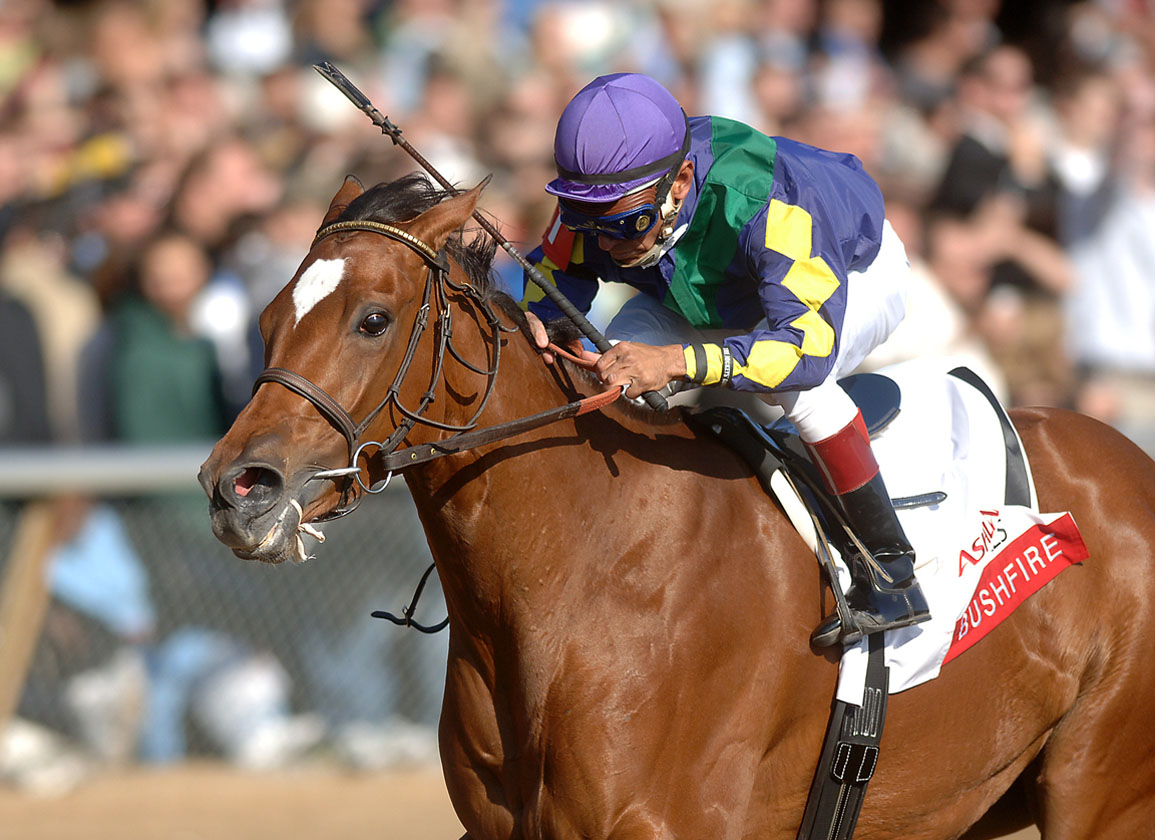
Eventually we had an opportunity to start working for Jack Lally of Summerplace Farm, who had a really nice horse named Kelly's Landing (Patton). That horse helped propel my business to the next level. At around the same time we started to train for Ron and Ricki Rashinski of Homewrecker Racing. They had a filly named Bushfire (Louis Quatorze) who won three Grade I races for us and was an Eclipse finalist as a 3-year-old. We still train for both of those clients today and they really helped get my career off the ground along with longtime client Joe Sutton, who had Grade I winner Bradester (Lion Heart) with us a few years ago.

KP: How many horses are normally in your stable?

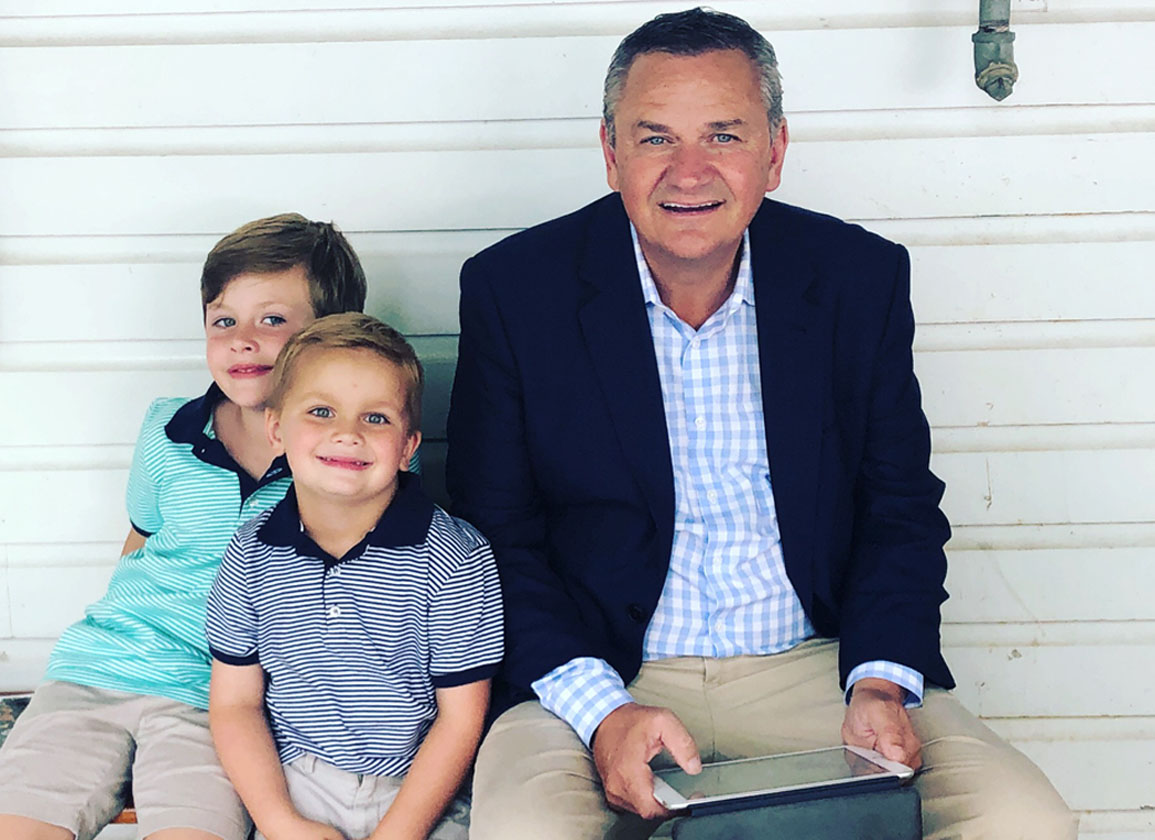
Eddie and Catherine Kenneally have two sons, Vincent and Liam | photo courtesy Eddie Kenneally

EK: We're at a comfortable number now because I am spending a lot of time with my two young kids. They play a lot of baseball so I have a lot going on with family. Our stable has been at about 50 head for the past few years. We have about 20 at Keeneland and 30 at Churchill Downs, so we have two divisions and two assistant trainers, Kelly Wheeler and Kevin Glodowski, who are a huge part of our operation.

Six or eight years ago, we would have had closer to 70 horses, but 50 is a good number for where I'm at right now. About five years ago, I decided to discontinue my New York division. I've scaled back a little bit and we don't spend nearly as much time in New York, partly because we decided to stay closer to home and also because the purses have increased dramatically in Kentucky. I probably could have more horses if I wanted to, but this number works for me.

KP: What do you believe makes your stable unique?

EK: I'm very hands on. I'm on the road a lot between Louisville and Lexington all year and I like to be at the barn every day. I look forward to going out every morning, but it's hard work and I think a person needs to stay on it. You can't get complacent and you need to be willing to put in the time to maintain it.

We've had some good people work for us in the past who have gone on to have their own success. Tom Morley is in New York now and Brendan Walsh spent a few years with us as well. I take pride in the fact that we've had some good people who have come through and go on to do very well.

KP: What do you believe are the benefits for an owner in using a “smaller” trainer?

EK: Obviously, the smaller trainers aren't going to win as many races because they don't run as many horses. So you aren't going to get as much exposure as with a guy who has 10 times more horses than I do. But I don't envy any of [the larger outfits].  I say good for them for having 300 or 400 horses. 50 works well for me and we have some great clients who appreciate what we do and we certainly appreciate them.

I think that the clients of super trainers might not get the same opportunities because for every condition, their trainer may have several horses and will probably only end up running one of them. For instance, if you have a turf maiden filly, the trainer might have 20 of those when the race comes up but they're only going to run one or two. The owners of the other horses will have to just wait for their turn. So it wouldn't work for me. I think we can give better customer service with a smaller operation like ours.

KP: Do you think super trainers are bad for the sport?

EK: A lot of the stuff that goes on in this game is out of our control. This is out of my control so it doesn't matter what my opinion is about it. If some guys have a lot of horses, then good for them.

KP: What do you enjoy most about your job?

EK: I enjoy waking up every morning and being hands-on with every horse in my barn, getting to know them and develop them. Being self-employed and having my own business allows me to have flexibility where I can spend time with my kids and my wife. Sure, I have to get up in the middle of the night to go to work, but I've been doing that a long time and I've adapted to it.

KP: What is the most frustrating aspect of your job?

One of the most frustrating things with the state of racing in this country at the moment is how penalties are not equal for violations of the same sort in different states. Violations and penalties are not implemented in the same way and the testing and rules are different in every state.

When we get under uniform rules, I'm hopeful that will take away some of the frustration and maybe establish a more level playing field because I do think it's not quite as fair as it could be. The penalties are not harsh enough for the people who can't abide by the rules and it's frustrating for someone like me who has never had a suspension to run against people who are multiple offenders and continue to bend the rules when there's no real incentive for them to stop.

Bushfire wins the 2006 GI Ashland S. and later goes on to claim the GI Acorn S. and GI Mother Goose S. | Horsephotos

KP: Do you think the Horseracing Integrity and Safety Act (HISA) would help achieve the uniformity you mentioned?

EK: I think uniformity would be great if it could be implemented, but I think it's going to be a tough process going from where we are right now to where that is up and running and achieving what it is set out to accomplish. In theory, it sounds good and hopefully we'll be able to get there, but it won't be easy.

KP: Earlier you talked about when you first set out on your own and your stable was very small. What advice would you have for younger trainers who are just getting started and hope to establish a stable like yours someday?

EK: The advice I would give to younger people who want to train is that the key is to try to get around someone who is successful that they look up to and admire. Spend the time working as an assistant for long enough that they can get enough contacts and experience before they begin to train. The game has changed a lot and I think communication is vital. For young people starting out, I would recommend to travel and go to another country to work in racing and see as much as you can before you start training on your own. Put in the time beforehand and it will benefit you down the road.

KP: What horse do you look back on as one you will always remember for having one of the biggest personalities? 

EK: The first horse that comes to mind is a filly called Girls Know Best (Caleb's Posse). I claimed her in partnership, which is something I do with a large portion of my stable, with Brian Chenvert. She won over half a million in purses after we claimed her, winning three stakes and placing in about seven others. She was just a filly who was rock solid and tried hard every time. She was around the barn for quite some time and was often on her toes. She was just a really fun filly to be around.

Another horse would definitely by Kelly's Landing. He was such a dude. He was very particular and definitely wasn't nice to everyone, but we go along great and he eventually became my stable pony when he retired from racing.

To nominate a trainer for this ongoing series, email katiepetrunyak@thetdn.com. General criteria: Multiple graded stakes-winning trainer, fewer than 300 starts this year, has trained for over 20 years and accumulated no more than approximately $50 million in career earnings. 

The post Smaller, But Still Super: Eddie Kenneally appeared first on TDN | Thoroughbred Daily News | Horse Racing News, Results and Video | Thoroughbred Breeding and Auctions.

Source of original post
Verified by MonsterInsights
