The Week in Review: USADA-HISA Must Settle Their Differences

The announcement that came last week that the United States Anti-Doping Agency (USADA) has bowed out and will not become the enforcement agency for the Horseracing Integrity and Safety Authority couldn't have been worse news for the sport. It was a lump of coal in the stocking at Christmastime. Thanks to the passage of the Horseracing Integrity and Safety Act (HISA) racing finally seemed ready to clean up a game where cheating trainers and the use of performance-enhancing drugs is a serious problem. USADA was not only the best choice to take over the policing of the sport. It was the only choice. There is no one else.

With USADA's announcement, HISA is in shambles and picking up the pieces will be a daunting, if not impossible, task. USADA's involvement was the reason so many people were so enthusiastic about HISA's passage. USADA and its CEO Travis Tygart are the gold standard when it comes to anti-doping and they get results. Just ask Lance Armstrong. While it's true that HISA covers other areas and issues, none seem that important at the moment. This was always about bringing in USADA and letting them accomplish what the sport is incapable of doing on its own.

Now what?

The Horseracing Integrity and Safety Authority, the group overseeing the implementation of HISA, said, in a press release last week, that it is evaluating options for engagement with other leading independent enforcement agencies. I suppose that's what they had to say, but the statement does not address the realities of the predicament they are in. The statement indicates they will simply move on to Plan B. Except there is no Plan B, no alternative to USADA. And if they somehow do come up with another agency to handle drug testing and enforcement, it's not going to be an entity that has anywhere near the bona fides that USADA does.

There's only one way to solve this mess, and that's a reconciliation between USADA and the Authority.

In their respective press releases, neither USDA nor the Authority gave any indication as to what exactly was the problem that caused a divorce before the two were officially married.

“After months of negotiations, we have been unable to enter an agreement in line with the requirements of the Act, and one which would have given us a reasonable chance to put in place a credible and effective program,” Tygart said in USADA's statement, not exactly answering any of the questions so many now have.

The most likely reasons USADA and the Authority could not come to terms?

It could be about money. It was never going to be cheap to have USADA come in and provide the manpower and expertise needed to police an entire sport, one that has far more competitors and moving parts than even the Olympics. And it was never made clear where the money to pay for USADA was supposed to come from. Tygart might have asked for more than the Authority was willing to pay.

There may have also been a disagreement regarding rules and regulations, what USADA could and could not do. It's easy to see Tygart walking away if there were roadblocks put in his way that he could not accept.

Or it could be something else.

Whatever the reason may have been, Authority Chairman Charles Scheeler and his crew and Tygart and his team need to lock themselves in a room with the understanding that no one can come out until they have reached an agreement that will bring USADA back into the fold. That may mean that it will be the Authority that has to blink first, that it will have to find a way to give Taggart whatever it is that he is looking for. Horse racing needs USADA a lot more than USADA needs racing.

Maybe the relationship between the two is beyond repair and nothing can be done to salvage it, but racing has to try. The alternative is that everything goes back to the status quo and that, without USADA, the bad guys continue to run amok. HISA, without USADA's involvement, becomes so irrelevant that the act might as well be repealed. That depressing possibility should be considered unacceptable by the Authority, The Jockey Club and everyone else who has been trying so hard to bring meaningful change to a sport that needs just that.

There has to be a way. Make it happen.

The post The Week in Review: USADA-HISA Must Settle Their Differences appeared first on TDN | Thoroughbred Daily News | Horse Racing News, Results and Video | Thoroughbred Breeding and Auctions.
Source of original post

No Injuries in Fair Hill Barn Fire

A Christmas Eve fire completely destroyed a barn at Fair Hill Training Center. The barn houses an outpatient veterinary clinic operated by Dr. Kathleen Anderson and is used part of the year by trainer Michael Matz, but was empty at the time of the fire.

“We appear to have lost everything, but fortunately no horses or people were involved,” Anderson told Paulick Report. “There was a lot of diagnostic equipment: X-rays, ultrasound, the pharmacy, plus medical records.”

Also suffering a barn fire over the holiday weekend was Glencrest Farm. The farm's stallion barn was completely destroyed Christmas morning, according to Paulick Report. While the farm no longer stands stallions, the barn was home to three show horses who perished in the fire.

“Nothing survived,” John Greathouse, Jr. told Paulick Report. “The barn is gone and sadly the horses.”

The barn was leased by Lorna Matthews and Melanie Fransen. Andrea Greathouse established a GoFundMe page to collect donations for the mother and daughter.

“We are asking for help in raising funds towards everything that was lost,” Andrea Greathouse tweeted. “Our thoughts and prayers go out to the three incredible horses that lost their lives and to Lorna and Melanie who have lost so much.”

The cause of both fires is still under investigation.

The post No Injuries in Fair Hill Barn Fire appeared first on TDN | Thoroughbred Daily News | Horse Racing News, Results and Video | Thoroughbred Breeding and Auctions.

Source of original post

After Challenging Year, Vargas Looks to Bounce Back in 2022

Last week, Puerto Rican jockey Jorge A. Vargas, Jr. won one of the biggest races of his young career aboard Geno (Big Brown) in the $500,000 NYSSS Great White Way S. at Aqueduct. The victory, more than happiness and a nice check, brought relief and a breath of fresh air going into a new year after a tough 2021.

“I was a little down because I was working hard, I'm riding almost every day and you want to see the results and nothing was happening,” said Vargas during a recent holiday trip to Puerto Rico to catch up with his family. “Thank God this week was good. I won every day, which is one of my purposes, to win at least one each day. On top of that, we won the stakes, which helps us not only with money, but for people to see us and know that we can do it and that we are here because we have the skills.”

After two straight successful seasons in 2018 and 2019, where he won more than 100 races each year and obtained his first riding title at Laurel's Park Winter Meet, Vargas's pace was slowed down by the pandemic in 2020. He came back hungrier than ever in 2021, but his progress was once again short-lived as he hit the ground hard Mar. 20 when his mount fell during a race at Monmouth Park. Vargas fractured his lumbar and was sidelined for another four months.

“I'm not going to lie and it isn't a secret that it was hard,” Vargas said of his 2021 mid-year crisis. “You're coming from a pandemic that kept you from what you love for three to four months. You try to get back on track, get a little steam, and fall again, another three to four months out.”

Represented by Jimmy Riccio, Vargas has opted to stay on the NYRA circuit for the last three years even with the steep competition of one of the most elite jockeys colonies in the nation. It's a calculated risk for the 26-year-old, who says he always wants to push himself against the best.

“New York is the Big Leagues, it's where everybody wants to prove themselves,” Vargas said. “You have to really work and know if you belong. I like the challenge and that's what moves me. I've accepted the challenge and I always work hard and keep afloat.”

Vargas, who started riding in 2013, has been an underdog for his whole career. People doubted he could become a professional jockey and he did. People doubted he could ride in the United States and he shone on the Pennsylvania circuit. People doubted he could win a meet and he was a champion in Maryland in 2018. Now, the always smiling Vargas wants to do the same in New York and he just needs a little bit of luck and trust.

“I just want to have a healthy year,” Vargas said about his expectations for 2022. “For it to be a year where I can ride and show what I know how to do. It's always challenging. In the United States at this moment there are so many jockeys that winning races is complicated. I would like to keep over 100 wins every year.”

The post After Challenging Year, Vargas Looks to Bounce Back in 2022 appeared first on TDN | Thoroughbred Daily News | Horse Racing News, Results and Video | Thoroughbred Breeding and Auctions.

Source of original post

20 Years Celebrating the Legendary Tiznow

As the calendar turns to 2022, the final crop of foals from legendary racehorse and sire Tiznow will become yearlings. Soon-turning 25, Tiznow has sired over 80 blacktype winners including 14 Grade I/Group 1 winners after nearly two decades as a cornerstone stallion at WinStar Farm.

This year, the successful sire enjoyed his first full year of retirement. WinStar Stallion Manager Larry McGinnis said that Tiznow still shares a similar routine to the other stallions in the stud barn.

“He does get a bit more leeway because he's a teacher's favorite,” McGinnis admitted. “If there's a day where he wants to stay out in his paddock, we'll feed him outside. I think he has developed a little bit of a bravado as he's gotten older. He does try to intimidate the young boys as they go through. He does what he wants, when he wants and it will be like that for the rest of his life.”

Such a lifestyle is nothing new for Tiznow, who was well documented on the racetrack for doing most everything on his own terms. McGinnis said that attitude never wavered throughout the blaze-faced bay's career at stud.

“Tiznow is the smartest horse I've ever been around. When we first got him, I noticed that. He looks a lot and nothing fazes him. One time we had him on a tour and a girl got stung by a bee right next to him. She screamed bloody murder and he just stood there. He has never shown that he's afraid of anything.”

Tiznow and McGinnis have developed a special bond as they've shared the past two decades together at WinStar. Before Tiznow's arrival, McGinnis was the assistant manager at Prestonwood Farm as the property transitioned into WinStar Farm.

“They told me that we had a stallion coming in and asked if I wanted to be stallion manager,” he explained. “I didn't realize that the horse coming in was Tiznow.”

Tiznow was no shoo-in to become a successful Kentucky stallion when he first arrived at WinStar, but the grit and determination the California-bred son of Cee's Tizzy showed during his illustrious career on the racetrack was soon reflected in his offspring.

He was the leading freshman sire of his crop after producing 2005 GI Breeders' Cup Juvenile Fillies winner Folklore and 2009 GI Dubai World Cup winner Well Armed. His success continued throughout his career with the likes of 2008 GI Travers S. hero Colonel John, 2008 GI Belmont S. winner Da' Tara and 2016 GI Breeders' Cup Mile victor and now WinStar sire Tourist.

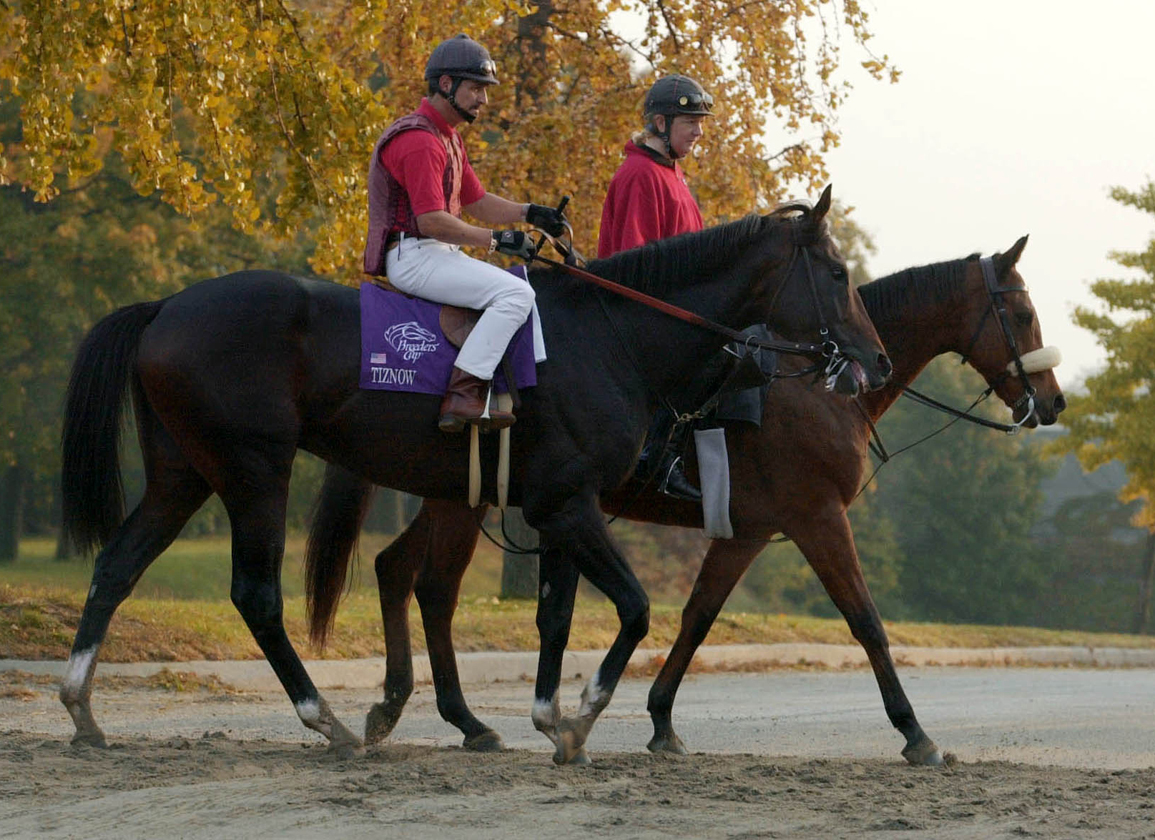
Tiznow prepares for the 2001 Breeders' Cup Classic | Horsephotos

Tourist is pretty much like his dad-even-keeled,” McGinnis explained. “Nothing much gets him wound up. I've rarely seen one of Tiznow's progeny that didn't have composure and know how to handle things without getting excited about it.”

Tourist and Crestwood Farm's Tizdejavu are the only sons of Tiznow standing in Kentucky today, with several more at stud in regional markets. If his top performer this year in GSW Midnight Bourbon someday joins a stallion program, the colt could be the last of Tiznow's sons to begin a career at stud.

And yet, Tiznow still has his last few crops waiting to show their worth on the racetrack. Fittingly, his final crop that arrived this year came 20 years after the unforgettable day at Belmont Park when Tiznow won his second straight GI Breeders' Cup Classic.

Owned by Cees Racing Stable and campaigned to a champion 3-year-old and Horse of the Year season in 2000 by trainer Jay Robbins, Tiznow returned to the Breeders' Cup in 2001 to defend his Classic title with only one win to his resume as a 4-year-old.

Even his regular rider, Hall of Fame jockey Chris McCarron, couldn't be certain of Tiznow's true ability as they approached the starting gate.

“There was always some question in your mind of if he peaked as a 3-year-old,” McCarron said. “But the way he trained, I knew there was more. It was just a question of which Tiznow was going to come to the party. Fortunately, he rose to the occasion on the most important day of his life in the 2001 Breeders' Cup Classic.”

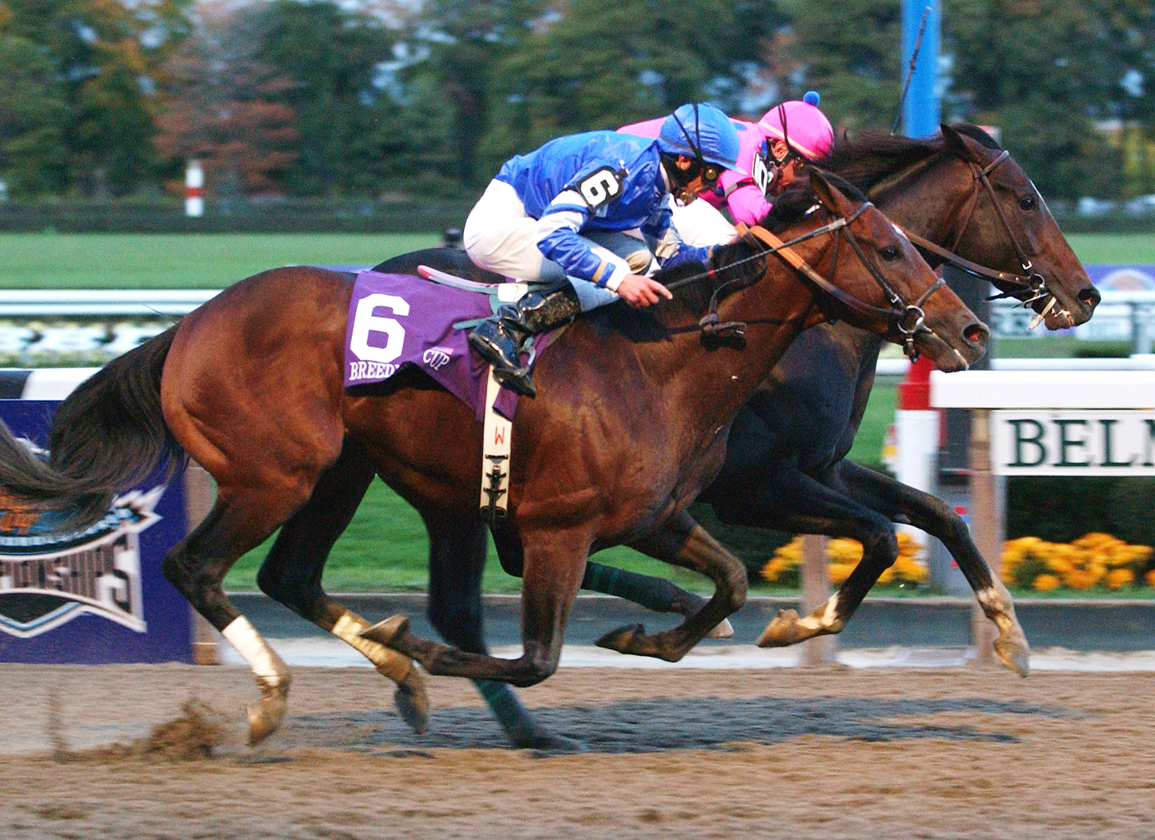
Sent off as a 7-1 gamble behind the top pick in Juddmonte homebred Aptitude as well as European invaders Galileo (Ire) and Sakhee, Tiznow stalked in third position for most of the trip until McCarron looked out of the corner of his eye to see Sakhee coming to their outside. The pair fought neck and neck down the stretch and as the wire grew closer, Sakhee bobbed his head in front.

“I had it in my mind that I was not going to hit him with the stick,” McCarron explained. “I wanted to let him be the boss. When Sakhee went by me by a neck I thought, 'Well, I've got nothing to lose. I might as well see if he'll respond from a little tap.' So I tapped him once left-handed and I felt him accelerate. He went back on and overtook Sakhee right in the shadow of the wire.”

The roar of the crowd swelled as race caller Tom Durkin exclaimed a line that will forever be held in racing's history book, pronouncing that Tiznow had won it for America.

Tiznow towers over rival Sakhee as he edges past the wire first in the 2001 Breeders' Cup Classic | Horsephotos

“I don't really know if in my notes previous to that if I was going to say that Tiznow wins it for America,” reflected Durkin. “I don't know, but it was in my subconscious somewhere. Some would argue that it was a rather jingoistic thing to say, but that was the story. Tiznow was carrying an American banner and he was trying to beat a foreign horse, so that was a big story there.”

The 2001 Breeders' Cup was the first international sporting event following the Sept. 11 terrorist attacks six weeks earlier. SWAT teams lining the rooftops and security check-ins made for a very abnormal day at Belmont Park.

“When Tom Durkin screamed Tiznow wins it for America, that was a really happy day,” McCarron recalled. “With the devastation and the tragedy of 9/11, people were really longing for something to make them happy. It just so happened that the Yankees won the World Series that year and then when Tiznow wins it for America, that was kind of the icing on the cake.”

Tiznow retired after earning the title of the first and only horse in history to claim back-to-back Breeders' Cup Classics, leaving cherished memories in the hearts of racing fans as well as those who knew him best.

Today, McCarron looks back fondly on Tiznow's days in training when the opinionated and super-sized colt protested from being led into a stall and had to be turned around and backed in, as well as his most memorable antic during his final workout ahead of the 2001 Breeders' Cup when he refused to move forward on the racetrack, standing stoically for 35 minutes before finally moving ahead and putting in a blazing mile-long work.

“He had a very strong will and didn't do anything unless he was ready to do it,” McCarron said. “He was quirky, but what I learned from him was tremendous. He taught me a lot about the relationship between a person and a horse. Once I learned, I tried to figure out what made him tick and just let him be the boss. That's what he wanted, so I just followed his lead and fortunately, we had a lot of success together.”

These days, as both Tiznow and his rider enjoy the laid-back life of retirement in the Kentucky Bluegrass, it isn't uncommon for McCarron to stop in at WinStar. Along with visits from his old friend, Tiznow is still a fan favorite during the tours at WinStar and of course, he is happily looked after by McGinnis and the rest of the WinStar stallion team.

“He's just been kind of a rock,” McGinnis said, reflecting on his two decades with the stallion. “He helped my career out as much as Distorted Humor and Speightstown did. If it wasn't for them, I'd just kind of be a regular Joe. Tiznow was a good, useful sire that was a California-bred and really, if you think of it, shouldn't have been a stallion, but he made himself one by winning two Breeders' Cup Classics. I'm not sure if anybody is ever going to do that again.”

The post 20 Years Celebrating the Legendary Tiznow appeared first on TDN | Thoroughbred Daily News | Horse Racing News, Results and Video | Thoroughbred Breeding and Auctions.

Source of original post

Verified by MonsterInsights