Notable US-Breds in Japan: Wednesday, Jan. 5, 2022

In this continuing series, we take a look ahead at US-bred and/or conceived runners entered for the upcoming weekend at the tracks on the Japan Racing Association circuit, with a focus on pedigree and/or performance in the sales ring. Here are the horses of interest for Wednesday's first JRA meetings of 2022 at Chukyo and Nakayama Racecourses:

Wednesday, January 5, 2022
4th-NKY, ¥11,400,000 ($99k), Newcomers, 3yo, 1800m
WONDERFUL HEAVEN (f, 3, Hard Spun–Couture Cat, by Storm Cat), a half-sister to SP High Fashion Diva (Girolamo), is out of a winning daughter of GSW & MGISP Runway Model (Petionville), the dam of four-time Grade I winner, 'TDN Rising Star' and current Gainesway stallion McKinzie (Street Sense). A $52K purchase at Keeneland November in 2019, the late January foal matured into a $180K KEESEP yearling the following fall. Wonderful Heaven is bred on the same Hard Spun cross over Storm Cat responsible for MGISW Hard Not to Like. B-Kenneth & Sarah Ramsey (KY)

12th-CKO, ¥21,110,000 ($183k), Allowance, 4yo/up, 1400m
LEMON POP (c, 4, Lemon Drop Kid–Unreachable, by Giant's Causeway) won the first two starts of his career, including the Cattleya S. (allowance) in November 2020, and most recently returned from a 13-month layoff to finish a strong second going this distance at Hanshin Dec. 12. A $70K KEENOV acquisition by Paca Paca Farm on behalf of Godolphin in 2018, the chestnut is a maternal grandson of MGSW Harpia (Danzig), a full-sister to the legendary Danehill as well as MGSW Eagle Eyed and GSW Shibboleth. B-Mr & Mrs Oliver S Tait (KY)

The post Notable US-Breds in Japan: Wednesday, Jan. 5, 2022 appeared first on TDN | Thoroughbred Daily News | Horse Racing News, Results and Video | Thoroughbred Breeding and Auctions.

Source of original post

Derby Prep Season is Upon Us; Get Tied On for Litigation

The Week in Review by T.D. Thornton

Oaklawn Park readjusted its series of prep races for the GI Kentucky Derby this year by moving back the date of its premier stakes, the GI Arkansas Derby, so it now sits five weeks out from the first Saturday in May instead of the traditional three. That changed the overall complexion of the prep-race picture so that the final three nine-furlong stakes that award 100 coveted Derby qualifying points to the winner will all take place Apr. 9.

This means that for the first time, there will now be a full four-week gap between the last significant prep races and the May 7 Derby.

The Apr. 16 GIII Lexington S. at Keeneland will technically be the final Derby qualifying race. But with only 20 points to the winner, that 1 1/16-mile stakes historically lures few A-list sophomores.

Taking the longer view, it's hard to believe we are only 40 years removed from when Churchill Downs used to card the Derby Trial S. on the Tuesday (four days!) before the Derby itself, and it served as a legitimate prep race.

Although the new four-week minimum spacing is in line with the current less-is-more approach to racing top-level contenders, the nearly full month without any meaningful (to the general public) events in the lead-up to America's most important horse race could prove problematic.

In theory, that gap should be filled with even more beauty shots of Thoroughbreds being bathed, and trainers will be increasingly challenged to come up with newly creative ways to say “I'm just trying to keep this colt happy and healthy” when repeatedly asked about the minutiae of their training methodologies.

But in all likelihood, there won't be any vacuum in the news cycle. That's because this spring, it's a solid bet that any expected void will be overtaken by litigation headlines related to whether or not Bob Baffert's trainees will truly end up excluded from the Derby.

Back in June, Churchill Downs, Inc. (CDI), barred the seven-time Derby-winning trainer from its portfolio of racetracks in the wake of now-deceased Medina Spirit testing positive for a betamethasone overage while winning the 2021 Derby.

Citing private property rights and Baffert's “repeated failures” regarding equine drug infractions (four other Baffert trainees also tested positive for medication overages roughly within the previous year of the ban, two of them in Grade I stakes), CDI said the Hall of Famer wouldn't be eligible to race in the 2022 or '23 Derbies; nor would his trainees be allowed to accrue qualifying points.

The purpose of this column isn't to debate whether or not Baffert's ban should be lifted or not. Rather, the intent is to provide a heads up about the barrage of non-horse-related court news that is odds-on to overshadow most pre-Derby talk about the equine athletes themselves.

Baffert currently trains 'TDN Rising Star' Corniche (Quality Road), the presumptive 2-year-old champion, plus his usual stacked stable includes a handful of other 'Rising Star' sophomores and graded stakes-winning colts. Had those horses been allowed to collect Derby points for their wins and placings so far, Baffert would be in his customary top-heavy position of dominance on the qualifying totem pole.

There appear to be three paths to Baffert-trained horses being allowed to run in the Derby: 1) CDI relents; 2) Owners of Derby aspirants currently conditioned by Baffert start sending those horses to other trainers, and 3) The issue winds up in court, taking the form of lawsuits in which obtaining a temporary restraining order (TRO) to allow participation in the Derby is more important than winning the overall case.

CDI relenting is the least likely outcome. Why would it? Its position seems legally defendable from the private property perspective, and the ban had to have been implemented only after the gaming corporation's layers of attorneys crafted, tweaked, and signed off on it.

The second option–essentially a high-stakes game of chicken–is a more likely outcome, but it too is not etched in stone. As the reality of a once-in-a-lifetime chance to own a Derby winner comes more clearly into focus and qualifying points grow more imperative, it remains to be seen how many of Baffert's clients reframe their reasoning from “we're loyal to Bob” to “circumstances have forced our hand.”

Litigation permeates all aspects of society and our sport is no different, so having Baffert's banishment hashed out in front of a judge seems like the most inevitable outcome.

In a separate case just last week, a federal court dismissed an anti-trust and anti-competition lawsuit filed by eight Standardbred owners who faced private-property exclusions from tracks in New Jersey and New York because of their ties with a banned trainer. But even though that case got tossed, the judge dismissed it “without prejudice,” signaling that those plaintiffs could initiate a subsequent suit with re-filed charges or take the matter to another court.

So along the same lines, just because CDI appears to have a strong case, that doesn't preclude anyone who perceives they're being harmed by that ruling from challenging it. Courts in our country are generally reluctant to stand by and do nothing when “my livelihood is being yanked away from me” types of arguments are presented, and when corporate entities try to assert broad control over individuals, judges are usually receptive to at least hearing out the so-called little guy.

Given that framework, you can understand why Baffert has yet to challenge CDI's banishment in court. Why try to litigate relatively early in the process when it would be to Baffert's advantage to wait until we're right on the cusp of the Derby, when he could claim that the alleged harm from the ban is at its most imminent? Again, he doesn't even have to argue well enough to win the overall case–just well enough to convince some judge somewhere to grant a TRO that puts CDI's exclusion on hold while the parties duke out a final verdict.

Conceivably, that application for a TRO could even include a request for the judge to order CDI to retroactively tally up the non-awarded qualifying points as if Baffert's horses had earned them all along. The argument could be made that such an order would cost CDI nothing in terms of money–they're just qualifying points after all. There's no hard-and-fast legal rule of what a petitioner can and cannot ask for in a TRO.

Then again, that angle might open yet another Pandora's Box. What if Baffert has three colts who suddenly get ruled eligible to run in the Derby based on a recalculation of points, but other owners whose horses get nudged out of the starting gate separately sue because they were deprived of Derby berths by the very same order? The waiting during that four-week period in April and May will be tough enough on the connections of Derby horses without a constantly simmering debate over which horses legally “deserve” to start.

Right now, most of the discussion on this topic tends to focus on whether Baffert takes the matter to court. But he might not have to. If the individual owners of Derby-worthy colts ask for TROs on their own instead of having their trainer do so, it leaves the door open for them to try an angle of persuasion along the lines of, “Hey, we're just collateral victims caught in the legal crossfire between Baffert and CDI, and we're being robbed of our one and only opportunity to run in the Derby with our otherwise-eligible horse.” That might end up being more of a convincing tactic than forcing a judge to side with either Baffert or CDI.

The looming wild card in this entire scenario has to do with the inaction so far by the Kentucky Horse Racing Commission (KHRC) in issuing any sort of ruling pertaining to the event that triggered CDI's ban.

Medina Spirit's betamethasone positive has long since been confirmed by two KHRC accredited labs, and we're now nearly 250 days out from the race date when the alleged infraction occurred. No hearing has taken place (at least none that has been publicly disclosed), and in the months-long interim, the KHRC has already tested for, held hearings, and ruled upon other drug positives that have subsequently occurred at other race meets in the state.

Remember back in 2019, when Maximum Security got disqualified from winning the Derby for in-race interference? At that time, KHRC representatives repeatedly underscored how they officiate the Derby just like any other race. Clearly, based on how long the process has been stalled and dragged out, that is not what's happening with Medina Spirit's in-limbo drug positive.

It's not out of the realm of possibility that the 2021 Derby won't get fully adjudicated before the 2022 Derby is run. And that lack of a KHRC ruling could factor in favor of Baffert or any ownership entity that decides to challenge CDI's Derby exclusion in court.

The post Derby Prep Season is Upon Us; Get Tied On for Litigation appeared first on TDN | Thoroughbred Daily News | Horse Racing News, Results and Video | Thoroughbred Breeding and Auctions.

Source of original post

Owner Hits Jackpot With First Horse

The sport is not supposed to be that easy, even if some people make it look that way sometimes.

Pat Kearney is 83, admits he doesn't know much about racing, has a fairly modest budget and had never owned a horse when he showed up last year at the OBS April 2-year-old sale. Fast forward some eight months later and Kearney is the owner of Kathleen O. (Upstart), one of the more promising 3-year-old fillies in racing right now. Making her second career start Saturday at Gulfstream, Kathleen O. won the Cash Run S. by 8 1/2 lengths in an impressive effort despite hesitating at the start. The victory came after she broke her maiden in her debut in November at Aqueduct.

“It has been an amazing, exciting, energizing experience,” said Kearney, who races under the name of Winngate Stables.

Prior to getting involved in ownership. Kearney was a casual racing fan who started going to the track at Arlington Park with his father as a child.

“I'm not a good handicapper,” he said. “I don't know much about breeding or pedigrees. What I did was take my $50, spend a day at the track and make some bets. It's good entertainment. I always really liked the horses.”

Kearney, who is retired after working in the securities industry in Chicago and as a lawyer, and Hall of Fame trainer Shug McGaughey have known each other for about 20 years and often play golf together. Somewhat out of the blue, Kearney one day asked McGaughey what he thought about his buying some horses.

“I talked to Shug and I asked him if he would work with me and buy some horses,” Kearney said. “I asked him what to do and he said I should buy two horses, a filly and a colt, get them at auction and buy them at a 2-year-old sale. He explained the costs and explained that you don't get into this sport to make money but for the satisfaction and the fun of the game.

“I wanted to find something I was interested in that I could do and didn't have to make a huge commitment. Not so much financially, but more so time and effort. I didn't want to have a lot of obligations.”

Having gotten off to a successful start in the game, Kearney only wishes he started earlier.

“I don't know why I didn't do it earlier,” he said. “About a year ago I just decided I wanted to get involved in something new. Do I wish I did it 10 years earlier? Absolutely. It had just never come up. The one question I had was whether I was too old to get started in the business. Fortunately, I am in good health.”

Kearney bought Kathleen O. for $275,000. He named the filly after his wife, whose maiden name is Kathleen O'Boyle. His other purchase, Cloudy (Noble Mission {GB)}, was bought three days later at the same sale for $130,000. He is winless in two starts.

Buying horses at the sales is somewhat new territory for McGaughey, whose longtime main client, the Phipps family, races primarily homebreds.

“I enjoy going to the sales,” McGaughey said. “I worked the yearling sales pretty good last fall and we bought some nice yearlings. We also looked at some 2-year-olds last winter. It's been fun and interesting.”

It was apparent early on that McGaughey had picked out a filly with talent. Sent off at 3-1 in her first start in her debut, Kathleen O. was next to last and 6 1/2 lengths behind with a furlong remaining, but still found a way to get up in time to win by a head.

“I think we've got a lot to look forward to,” McGaughey said after the Cash Run. “I'm very pleased with the way she's come along and the way she ran today, and her maturity level. I was just saying to [my wife] Alison, think of what she's going to look like in a year from now. She's always been tall and she's still filling out.”

He may still be learning about the sport, but Kearney knows enough to know that the GI Kentucky Oaks could be part of the filly's future.

“I know that she's a very talented horse and I know there is a race called the Kentucky Oaks, but I have no idea if she will qualify for that or not,” Kearney said. “So far, it's been like hitting the lottery. I'm flabbergasted.”

The post Owner Hits Jackpot With First Horse appeared first on TDN | Thoroughbred Daily News | Horse Racing News, Results and Video | Thoroughbred Breeding and Auctions.

Source of original post

It’s All about Sole

“It's all about soul…Yes, it is.” The title and line from Billy Joel's 1993 hit refers to unmeasured essence of our being, and the same may be said also about another kind of sole, the hoof's sole, which is an often-overlooked, under-studied insensitive structure of the hoof that fails to get much attention until there is a problem. The failure to care for the sole's well-being, like its homophone cousin (soul), may have deeper implications and longer-lasting consequences for the soundness of the horse that it is attached to.

The sole is a keratinized structure similar to the wall, growing at the same rate as the horn and designed to resist wear with a primary function of protecting the bottom of the coffin bone. The sole's flexibility and thickness vary, often effected by environmental conditions (wet or dry), hoof morphology, pathology, and a host of other factors (breed, size, stabling, turnout, etc.), all which may affect its makeup. The sole's design is to flake away or exfoliate over time, however, flaking or exfoliation is again dependent upon a number of factors including those previously listed, all affecting its composition. Horses can have thick, thin, or false soles. The ability to identify the type of sole, and how much can be removed, requires experience.

To properly 'read' a foot for trimming, balancing, or shoeing, farriers with their hoof knife in hand remove varying amounts of sole and the practice differs within the industry. The amount of sole and from where it is pared is an often-argued conversation amongst farriers, old and new, in journals and trade publications. Everyone has a theory and everyone has an opinion.

Is there a point where sole paring goes too far?

Many years ago, in seemingly another lifetime, I had the good fortune to meet and apprentice for the late James Cahill of Lamberville, N.J. Cahill, a Vietnam veteran returned from his service, trained Thoroughbreds for his then-father-in-law in the New England area. Cahill recounted to me how he was fascinated by shoeing and somehow the need arose for him to learn how to shoe, most likely a need to tack a shoe [this story is sounding familiar to me, as I had a similar experience]. He would always laughingly describe how he remembered paying his plater to teach him and at some point, later while still in the midst of learning, recognized that he was still paying his plater to watch him while he shod his own horses. Cahill later transitioned from training to shoeing full time which segued to shoeing riding horses.

The horseman's style was to repeatedly pare the sole; his knife was always unbelievably sharp. I recall him pressing with his thumb, paring, and pressing again while sometimes going a little too far and finding what farriers refer to as 'bottom'–or even farther with the infrequent droplet of blood. Obviously, being a good apprentice and direction follower, I copied my teacher with his sole paring style. I later learned when I went on to work for legendary USET and Hall of Fame farrier Seamus Brady that this practice of sole paring was not going to fly with him. I recall on my first day when I started paring out the sole of the horse that I was working on, Brady apoplectic, bellowing in his Irish accent, “Whoa, whoa, whoa, what the hell are you doing? We don't do that in this world.” He later explained after I was stopped in my frenzied sole-removing tracks, that the horse needs as much protection as it can get and removing the sole was essentially removing protection, an argument supported by Dr. Scott Morrison, partner and founder of the Podiatry Center at Rood & Riddle Equine Hospital in Lexington.
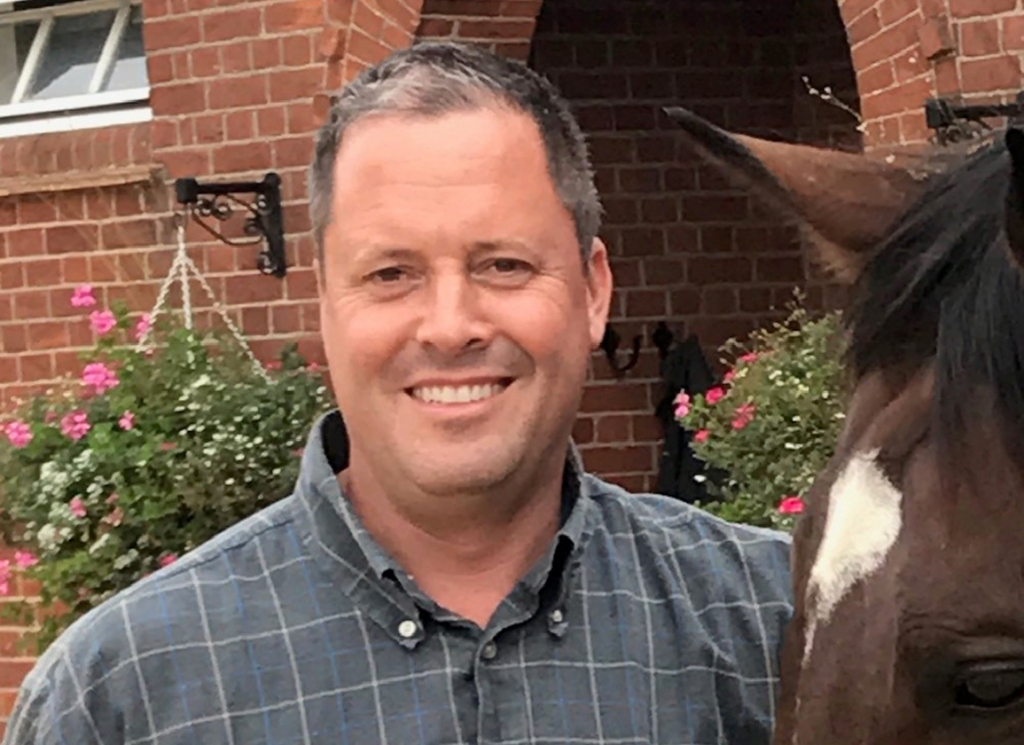
Dr. Scott Morrison, DVM | Courtesy Rood & Riddle

I was grateful to catch a moment with Morrison in between his in-demand, reported seven-day-a-week schedule as he agreed to share his thoughts on this topic. As with all things sole (soul) related, the conversation pivoted and delved deeper into some issues the industry continues to face.

Having had some overlap with Morrison over the years, I recently worked closely with him on a new account that I was enlisted to take over and he was recruited by the owner to consult. Humble is an understatement describing Morrison. In an industry where ego and chest beating are the drivers, humility and a willingness to share knowledge is refreshing. Brady exhibited similar traits. Morrison's demeanor, approach, and professionalism is almost surprising considering his influence in the industry, following other veterinary podiatrists, who Morrison labels 'pioneers,' like Dr.'s Ric Redden and Steve O'Grady.

Ninety percent of Morrison's practice consists of the podiatric care of Thoroughbreds, from corrective work on foals, to racing athletes, to the geriatric horses found at breeding facilities. The complaints range from knee deviations in foals commonly known as carpus valgus or varus, to thin soles, chronic heel pain, negative palmar angles, and–normally found in geriatric breeding mares and stallions–chronic low-grade laminitis.

When asked specifically about the sole and the varying farrier practices in the amount of sole that is pared out, Morrison shared that he, as well as other members of Rood & Riddle's practice, “leave as much sole as they can.”

“It still is commonly done, perhaps a little too much,” Morrison added in reference to the common practice of paring significant amounts of sole at the track. I was always under the impression that what may be considered extreme paring was an effort to create a 'cup' for traction, or to achieve the 'shortest' foot possible to relieve sole pressure under the shoe. However, Morrison thinks there may be other simpler motivations at work.

“People [farriers] like seeing a nice, cleanly pared-out foot. It looks nice. However, carving out the sole propagates flares, thinner soles, and this compromises the foot. The sole holds the foot together and a natural arch exists, a natural cup. The arch is really strong, we see it in design and architecture. [Farriers] continually weaken that dome causing the soles to collapse by removing some thickness, which changes the contours of the foot, creates flares, and the common issue: flat feet, where the arch is lost at the back half of the foot. The sole and lack of it in the back half of the foot is a very common complaint.”
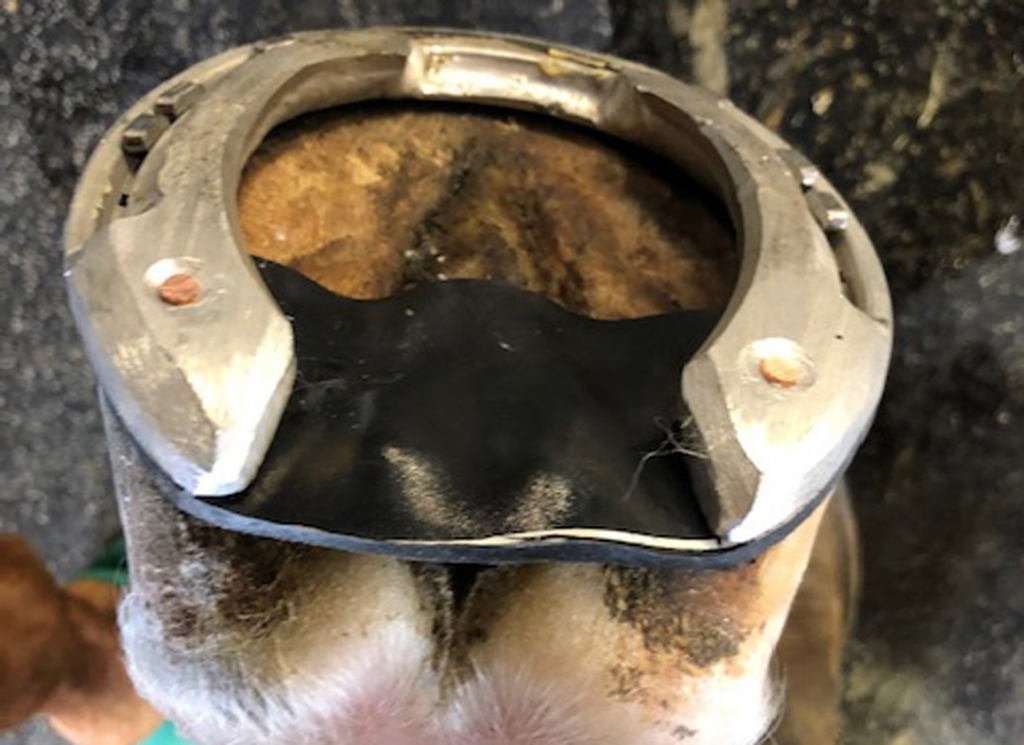
An example of Morrison's frog support | Courtesy Dr. Scott Morrison

Morrison underscored that much of his time is spent restoring that natural arch and trying 'fix' its collapse by “leaving in the bars” [in certain instances dependent upon the foot] and as much sole as possible. He shoes with as much support as necessary, always trying to “mimic the barefoot condition” with the use of heartbar shoe, pads, and frog support while recognizing the realities of the horse's tolerances relating to frog and sole pressure. He also stressed there is a right and wrong way to apply these interventions as “not all bar shoes are equal.” However, Morrison highlighting some of the issues may lie with trainers and their tendency to want to see a 'normal' shoe even when “heels are crushed and the frog is dropping out of the bottom.” Morrison labeled it at times as a “battle” to get frog support or in other instances when a farrier must “do what is needed for the horse.”

Asked if this resistance by some trainers to see a properly applied shoe with frog and/or heel support may be the result of a perceived negative effect on performance he said, “I don't think so. You can train him in a bar shoe, or heartbar, and pull it off for race day,” when opting for regular shoes.

While not entirely buying into the argument that breeding may perpetuate some of these foot issues in Thoroughbreds, he did not completely discount breeding's role, however, he admitted that he has witnessed things turn around in horses where the feet “became pretty good.”

Effectively, the greater issues that Morrison highlights are the realities of continuous training.

“There is no time off,” he said. “Pulling shoes is so important because feet need to be let down. The result, to some degree [the feet] will normalize.”

It's All About Sole…and Then Some…

So where is the industry going? Where should it go? Will things ever become standardized?

Morrison, who was likely driving to his next appointment while facing the barrage of questions that I lobbed at him like hand grenades, chuckled a few times at some of my more loaded questions. I knew the answers would be good.

“There are different camps of thought [relating to industry practices]. I don't really see things changing in the near future,” he admitted.

Firmly believing that the current reality perpetuates good farriers continuing to acquire top clients, Morrison explained that their good methods will most likely be passed along to future apprentices and helpers, as has always been the tradition.

“Some disciplines may trend to doing things more uniformly,” he said.

Morrison segued into some failures on the part of the Thoroughbred industry to promote continuing education for farriers at racetracks which he labels a “big need.” He highlighted farriers in other disciplines [riding horses] tending to actively read trade magazines and attend conferences, while “platers are less represented.”

He added, “It would be nice to see a big shoe company or big owner” sponsor and promote some continuing education programs for farriers at the racetracks.

I agree.

Jude Florio, who has served as a professional farrier for over 20 years, earned a graduate diploma from the University of London's Royal Veterinary College in Applied Equine Locomotor Research. He is among the current MSc Equine Science cohorts studying at the University of Edinburgh, Royal 'Dick' School of Veterinary Studies (June 2023).

The post It’s All about Sole appeared first on TDN | Thoroughbred Daily News | Horse Racing News, Results and Video | Thoroughbred Breeding and Auctions.

Source of original post

Verified by MonsterInsights