Navigating the ‘High Heel/Low Heel’ Conundrum

Sporadically, I have had trainers, owners and random onlookers approach me while I'm working on a horse with a remark that the horse's feet (specifically the front) 'sort of look different.' This normally only occurs when I find myself working on horses with extreme examples of mismatched feet, where one foot presents a longer-looking toe with a low or no heel, and the other, a shorter toe with a higher heel. My normal response usually includes a look (of disgust); however, their observations would be (somewhat) correct (on the surface), but–with the quick retrieval of my calipers–disproven with a measurement indicating the toe length, both right and left, are the same. (Yes, I ALWAYS check). The reaction is invariably a collective response of, 'huh, interesting,' which is usually followed by, 'so, why is that?'

Like humans, left-handed or right, horses favor one leg versus the other, with related studies approximating 75-80% of horses are right forelimb dominant. Forelimb dominance and how a horse supports itself are all factors with implications on hoof symmetry and morphology. If you observe a horse eating in a stall or grazing in the field, one foot is always pointed out in front of the other. This position is commonly referred to as the grazing stance, with the preferred foot varying among horses but likely remaining the same throughout a horse's life. I am not aware of any examples of ambidextrous horses or one's ability to change a horse's preference, however, we must consider that a horse normally grazes, whether in the field or stall, for approximately 22 hours a day and that reality has some consequences and effects on the hoof's morphology.

Using an example of a horse that points the left foot, leaving the right back, we then must start to ponder the other factors which may further affect the horse's ability to comfortably graze, such as the neck, poll, shoulders and their additional effects on the hoof, its confirmation and presentation. Typically, horses with extremes in conformation (head, poll, neck) will likely produce some level of inability to comfortably graze. Typically, this results in great visual differences in the feet and this will also include similar effects on the diagonal pair of the hind feet (i.e.: left front, right hind). Continuing to consider the above grazing stance preference, the right hind tends to be a slightly 'longer' toe with a 'lower' heel. However, achieving equilibrium in the hind feet tends to be easier due to the decreased amount of weight bearing. Many old timers, especially those in the Standardbred world, often say you can do a lot more to the hinds attempting to correct things than you can to the fronts with a decreased potential for soreness or lameness. That has also been my experience.

So, what then occurs when bearing in mind the grazing stance and effects on hoof presentation?

Continuing to use our example, characteristically, the left foot is always (visually) the 'longer' toe with a lower heel; this reality has varying degrees of extremes which are again dependent upon the horse's ability or inability to comfortably graze. With the force and pressure of the horse's weight leaning on the left heel, most experts agree, the foot grows away from pressure. Theoretically, this pressure impacts heel growth, likely impeding blood flow, which in turn impacts the foot's ability to grow 'up,' prompting interventions to change or correct the foot's presentation and alignment. These realities, if left unaddressed, probably will have greater consequences on soundness and biomechanics, including the potential for possible injury to soft tissue (DDFT and suspensory).

Radiographic image of club foot and toe's dish. The arrows highlight the dish and the changing relationship of outer wall and coffin bone. Breakover is highlighted with the red arrow beneath the shoe and the yellow arrow indicates arguably where the foot 'wants' to breakover. Additionally, the blue arrows emphasize the farrier's likely need to trim the heel in an effort to correctly align the bony column and reduce possible strain on soft tissue aspects of the forelimb affected. The successful farrier is always forced to balance the possible limitations of the foot's presentation for trimming and shoe application. | Jude R. Florio

Conversely, the foot that remains back usually presents a more upright appearance, the result of greater pressure being placed in the toe with pressure alleviated in the heel. Again, the extent or severity of that appearance varies and can be quantified with hoof angle measurements. As an example, Arabians (in my experience), always tend to have one club foot, the probable result of the breed tendency to have an upright head and high neck set, creating the need for the affected animal to contort itself to comfortably graze. Differently than the pointed foot, the back foot heel growth is dependent upon how much pressure is put in the toe. Having witnessed some extreme examples of the back foot being 'tipped' forward on the toe, this includes possibilities of the toe “dishing,” this visible change normally occurring when the relationship of the toe of the outer wall deviates from the position of the pedal bone and the toe extends past the breakover. All of these factors will dictate how each foot should be trimmed and how shoes should be applied.

Moreover, the realities of handling, exercise, training and veterinary/chiropractic treatment cannot be discounted when seeking balance and equilibrium. The types of exercise and training will also have direct effects on the foot's confirmation and presentation, evident in noticeable observations of shoe wear or the way a horse goes, where adjustments are possible.

I recently discovered that my iPhone has a slow-motion video option. (I know; welcome to the 22nd century, but I'm in a 2,000- to 3,000-year-old industry. I'm told the second oldest.) This slow-motion option has been great to detect gait anomalies, loading, unloading, landing and take-off. I highly recommend its use at the lower speed gaits as a tool to detect potential issues, which one can extrapolate may be exaggerated at higher speeds.

So, what is the farrier's role in all of this?

A farrier/podiatrist has a lot to consider when addressing these issues and their level of experience will dictate how much they do or how far they go. When I consider these differences, I always work from the space of the bony column's alignment and what I can do to improve it when necessary and within reason. There are some occasions where a horse will grow enough toe that can be trimmed down on the low, pointing foot, which may include pulling the foot forward and trimming the toe back. In extreme examples, sometimes there is not enough foot to be taken down and doing so may result in soreness. I have never experienced a horse being sore by taking the toe back. Subsequent to static balance, dynamics is key and setting the shoe back aims to decrease the duration of breakover, a result of the caudal shift of the fulcrum point, commonly referred to as 'backing the toe.'
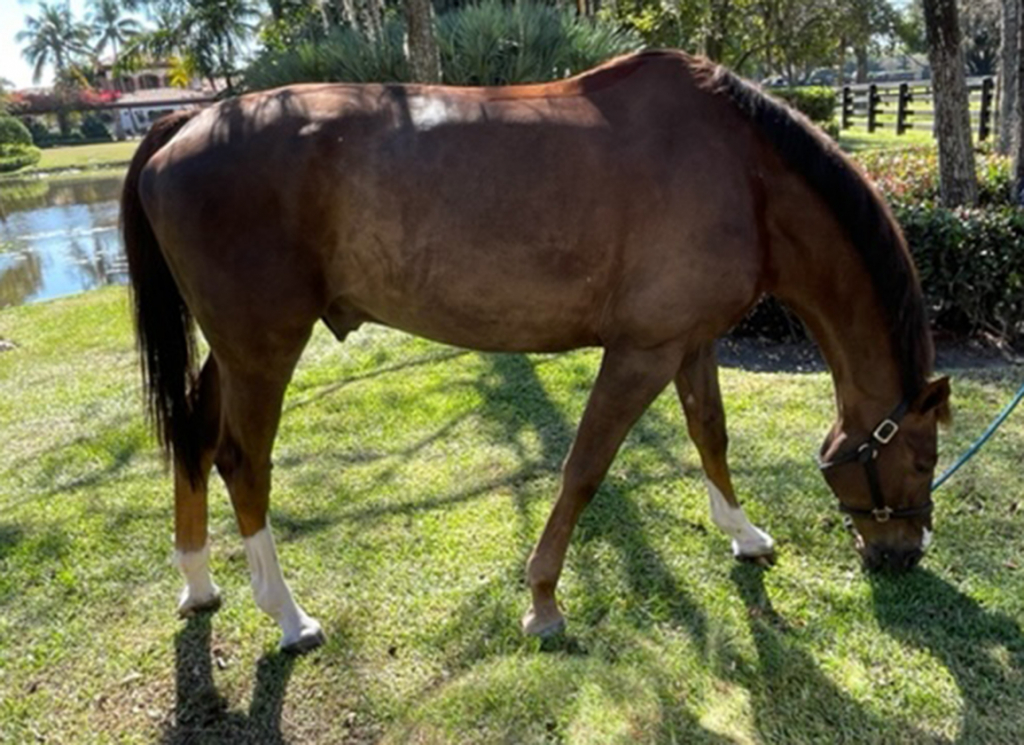
The grazing stance | Jude R. Florio

Equally, the other front foot, upright and remaining back during grazing, is addressed slightly differently. Experience will dictate how much heel can be trimmed including a measure of the horse's comfort, frequency of shoeing and the degrees of change, with significant changes to the hoof's angle possibly negatively affecting the soft tissue. Some horses require greater amounts of heel trim. I often use the frog as a guide in assisting in decision making: the higher heel's frog seeking pressure (pumping mechanism, vascular function) distorts and, when trimmed, gives a greater ability for one to determine how much heel can come off. Of course, as highlighted in the article linked above, the use of radiography is an additional resource for guidance.

Having gained experience from past work on foals and younger horses, I have found positive changes are possible and realistic. Routine trimming requires minimal adjustments achieving noticeable changes and correction of differences in the feet with positive outcomes. Perhaps this is because of the foal's or weanling/yearling's size and the realities of initially suckling, as well as the future ease and ability to graze, which may decrease extremes and the effects on the feet. However, this will quickly change with time and growth and may include other circumstances throughout a horse's life including injuries and their potential for effects on hoof growth.

In the end, farriers have multiple tools at their disposal which should facilitate their ability to make sound decisions when attempting to address differences. Using fixed reference points, measurements which quantify toe length and angles can all be recorded for future reference assisting in achieving the goal of static balance and equilibrium. As in all things, there are no hard and fast rules. In certain instances extreme or otherwise, achieving balance and equilibrium may not be possible, therefore requiring veterinary examination and any number of interventions (pads, frog support, etc) in the hope of alleviating potential stress, decreasing strain and pressure with the expectation of facilitating improvements, especially in performance. However, it is wholly possible with time. By including the correct interventions, positive improvements are possible as redistribution pressure and forces theoretically can improve blood flow, which likely results in healthy hoof growth.

Jude Florio, who has served as a professional farrier for over 20 years, earned a graduate diploma from the University of London's Royal Veterinary College in Applied Equine Locomotor Research. He is among the current MSc Equine Science cohorts studying at the University of Edinburgh, Royal 'Dick' School of Veterinary Studies (June 2023).

The post Navigating the ‘High Heel/Low Heel’ Conundrum appeared first on TDN | Thoroughbred Daily News | Horse Racing News, Results and Video | Thoroughbred Breeding and Auctions.

Source of original post

First Captain First, Triple Tap Third in Returns

A pair of highly touted sophomores returned to make their 4-year-old debuts with mixed results Sunday. First Captain (Curlin), sent off the 4-5 favorite in a seven-furlong allowance at Gulfstream Sunday, looked to have left himself too much to do before making a furious late rally to win by a head in his first start since finishing third in the Curlin S. last summer. The 'TDN Rising Star' and $1.5-million Fasig-Tipton Saratoga yearling won last year's GIII Dwyer S. for West Point Thoroughbreds, Siena Farm, Bobby Flay and Woodford Racing and trainer Shug McGaughey.

Less successful on return was Summer Wind Equine's homebred Triple Tap (Tapit), a half-brother to Triple Crown winner American Pharoah who was making his first start since finishing fourth in the Dec. 26 GI Malibu S. in a seven-furlong optional claimer at Santa Anita. The 1-5 favorite, facing just three rivals, chased pacesetting Fore Left (Twirling Candy), but was hemmed in by Dark Vadar (Tale of Ekati) for much of the stretch. Finally finding clear sailing, Triple Tap made late progress, but could do no better than third as Dark Vadar nipped Fore Left for the win.

Triple Tap, tabbed a 'TDN Rising Star' following his debut win at Santa Anita last March, added a Nov. 5 optional claimer at Del Mar before suffering his first loss when well-beaten behind Flightline (Tapit) in the Malibu.

The post First Captain First, Triple Tap Third in Returns appeared first on TDN | Thoroughbred Daily News | Horse Racing News, Results and Video | Thoroughbred Breeding and Auctions.

Source of original post

‘Oath’ No Secret, But Measuring Her Talent a Pleasant Conundrum

The Week in Review by T.D. Thornton

Secret Oath (Arrogate)'s big winning move despite trip trouble in Saturday's GIII Honeybee S. at Oaklawn Park launched the 3-year-old filly to the forefront of conversation just at the precise time the sport needs a little diversion from anything having to do with lawsuits, trainer banishments, and the GI Kentucky Derby.

There is no question that the D. Wayne Lukas trainee looms large atop the leaderboard for the GI Kentucky Oaks and that her 86-year-old conditioner isn't crazy for at least considering running her against males next time out in the GI Arkansas Derby.

But if you want to drill down for a more precise prognostication as to where Secret Oath truly ranks in the always-intriguing fillies vs. colts debate and if she might be good enough to run in the Derby instead of the Oaks, you're going to have to come up with a measuring stick that doesn't appear to be available at the moment.

Comparing her 7 1/4-length Honeybee romp against the performance of males in the GII Rebel S. three hours later on the same Oaklawn card is a non-starter. The Rebel rates as the “chaos race” of the season so far among Derby preps because the 4-5 favorite was a no-show in an otherwise so-so field, and the slowly-run race was won by an improbable one-eyed gelding who paid $152.80.

Likening Secret Oath to Althea, the champion filly for Lukas four decades ago who also raced at Oaklawn (and beat the boys in the Arkansas Derby) should also be a no-go, at least for the time being. Obviously, Althea is from a much different generation. But even then, she was such an anomaly that her past-performance block reads like that of a racehorse from an entirely different planet when you consider how often Lukas raced her and how early in her career she lined up in the starting gate against males.

We'll have to let the next few weeks be the chief determinant in how Secret Oath's story arc plays out, knowing that whichever path Lukas sends her down, her next start is going to have a “circle the date” aura surrounding it.

Secret Oath entered the Honeybee with a 3-for-5 record, having won a Dec. 31 allowance race and the Jan. 29 Martha Washington S., both at Oaklawn, by a combined 15 1/2 lengths. She got pounded to 3-10 favoritism Saturday and appeared content to be last away in the Honeybee, given her natural running style as a stalker/closer.

Jockey Luis Contreras allowed the Briland Farm homebred to creep closer down the backstretch through opening quarters of :23.15 and :23.92, a brisk pace that seemed to be working to Secret Oath's off-the-pace advantage. But by the far turn, Contreras's patience contributed to his filly getting pocketed behind the two caving speedsters while an advancing rival to the outside kept the favorite locked and blocked, forcing Contreras to snatch up the reins in a ride-the-brakes type of maneuver.

Five sixteenths out, Contreras realized he had no choice but to dive inside of the tiring leaders. And when Secret Oath saw a glimmer of daylight through that narrow gap, she kicked on like a pro at the head of the lane. Never seriously threatened through the stretch, she won while kept to task but never fully extended.

Secret Oath's final time of 1:44.74 for 1 1/16 miles translated to a Beyer Speed Figure of 92, one point shy of her career-best effort. It's worth noting she carried five pounds more than the second- and third-place fillies.

Lukas indicated post-race that Secret Oath is nominated to both the Arkansas and Kentucky Derbies. The GIII Fantasy S. on the Apr. 2 Arkansas Derby undercard would be the conservative against-fillies option if he opts not to take on the boys.

Advocates for running in the Arkansas Derby will point out that Secret Oath's clocking and speed number trumped what was to follow six races later in the companion stakes for 3-year-old males. Oaklawn's third race in its quartet of Kentucky Derby points-earning preps is usually a pretty intriguing affair. But this year it might go down as the aberrational “Rebel without a cause,” which is why it's best to hold off on any claims that Secret Oath would have crushed that field had she been entered in that spot instead.

Rain had moved into Hot Springs by the time the feature race arrived, and although the track was still listed as “fast” for the Rebel, it would soon require sealing and a downgrade to “sloppy” for the final race. The un-California-like conditions would be eventually cited as a possible excuse for trainer Bob Baffert's ship-in fave Newgrange (Violence), who appeared primed to pounce after a trouble-free stalking trip but instead retreated to sixth.

The 75-1 Un Ojo (Laoban) saved ground every step of the way, rallied briefly at the quarter pole, then appeared to regress. But Un Ojo re-awakened late with an out-of-nowhere spurt of energy to snatch victory from the 15-1 Ethereal Road (Quality Road), who had been ambitiously entered by Lukas off a 19-1 maiden win in career start number four. The final time was 1:45.69, nearly a full second slower than Secret Oath's clocking; the Beyer (84) was also eight points lower.

Ethereal Road gave up serious real estate while hooked four wide on both turns, yet led from the quarter pole until 50 yards from the wire. He certainly punched his ticket to the Arkansas Derby, leaving Lukas to ponder over the next month whether he wants both his top filly and top colt aiming for the same race.

In the meantime, expect those comparisons to Althea to percolate–even if they're still off the mark.

Althea broke her maiden on June 22, 1983 at Hollywood Park. She ran second 17 days later in the GII Landaluce S., then wheeled back two weeks after that, beating the boys by 10 lengths in the GII Hollywood Juvenile Championship. When the racing switched to Del Mar, Lukas continued the pattern of aiming Althea against both fillies and colts, and she responded by winning both the GII Del Mar Debutante (by 15 lengths) and the GII Del Mar Futurity, just 10 days apart.

After a mix of firsts and seconds against fillies at Santa Anita in the fall, Althea closed out her 2-year-old season by attempting the mixed-sex Grade I double of the Hollywood Starlet (first) and Juvenile (sixth). Althea started 1984 with Santa Anita stakes victories against fillies, then shipped to Oaklawn for the Fantasy, where she finished a fast second despite encountering significant trip trouble.

Back then, the Fantasy was run the week before the Arkansas Derby. Lukas spent most of that week saying he wouldn't enter Althea against the boys. He did anyway.

Althea toyed with the Arkansas Derby field, drawing off to win by seven lengths while equaling the track record at the time. Afterward, Lukas admitted he had planned all week to run his star filly in that spot, but that he had chosen not to tell anyone until the day the race was drawn.

Thirty-eight years later, on the day after Secret Oath's win, Lukas remained uncommitted to a plan beyond saying he'd take it one race at a time.

Sunday, Lukas at first told the Oaklawn notes team that “I don't know what we're going to do,” before later adding, “Right now, she would be in the Fantasy and Ethereal Road would be in the [Arkansas] Derby.”

But you never know. The man is entitled to change his mind.

The post ‘Oath’ No Secret, But Measuring Her Talent a Pleasant Conundrum appeared first on TDN | Thoroughbred Daily News | Horse Racing News, Results and Video | Thoroughbred Breeding and Auctions.

Source of original post

The Day Chick Lang and Cab Calloway Integrated the Turf Club at Hialeah

Racial segregation is one of the dark chapters in American history. Until the 1950s and 60s, Blacks had limited access to housing, facilities, schools, transportation and other opportunities. While we have plenty of racial problems today, it's almost hard to believe that there was a systematic separation of people in daily life. To right this terrible wrong, millions of Americans began to protest in the 50s and the situation began to change. The Supreme Court ruled that school segregation was unconstitutional, Rosa Parks declined to sit in the back of the bus and highly visible demonstrations began in earnest, led by leaders such as Dr. Martin Luther King, Jr.

While there was a public outpouring of opposition to segregation, it took thousands and thousands of simple, unpublicized acts to dismantle this institution which had remained in society since the Jim Crow laws of the 1800s. Horse racing was no different than the rest of society, especially in the South. So, in recognition of Black History Month, here's a little-known story.

Let's start with some background. Most people in horse racing recognize Charles John “Chick” Lang as Mr. Preakness. Through hard work and determination, Lang took the Preakness from a weak sister to the Kentucky Derby and Belmont to the “Middle Jewel” of the Triple Crown. During his decades-long stint with Pimlico, he set the Preakness on course to become one of America's great races. It is annually the top sporting event for Maryland and the city of Baltimore, with more than 100,000 fans in attendance and millions watching it on television.

As a former hotwalker, groom and jockey's agent, Lang was a true racetracker. He never forgot the importance of each individual who played a role in Thoroughbred racing. Lang believed the backstretch worker deserved the same amount of respect as the wealthy owner. He was a tireless advocate for the rights of the less fortunate.

Early in Lang's horse racing career, he was the jockey agent for Hall of Famer Bill Hartack. From 1954 to early 1960, Lang and Hartack had a great run. Lang was representing a jockey who was considered one of the most successful and highest-paid professional athletes in the world. In 1958, Hartack was on the cover of Time Magazine. From 1953 to 1957, Hartack averaged 355 wins a year. During that run he had tremendous success at Hialeah, which offered the greatest racing in America at that time of the year. Hartack, who would go on to win five Kentucky Derbies, was the most recognizable athlete in Thoroughbred racing.

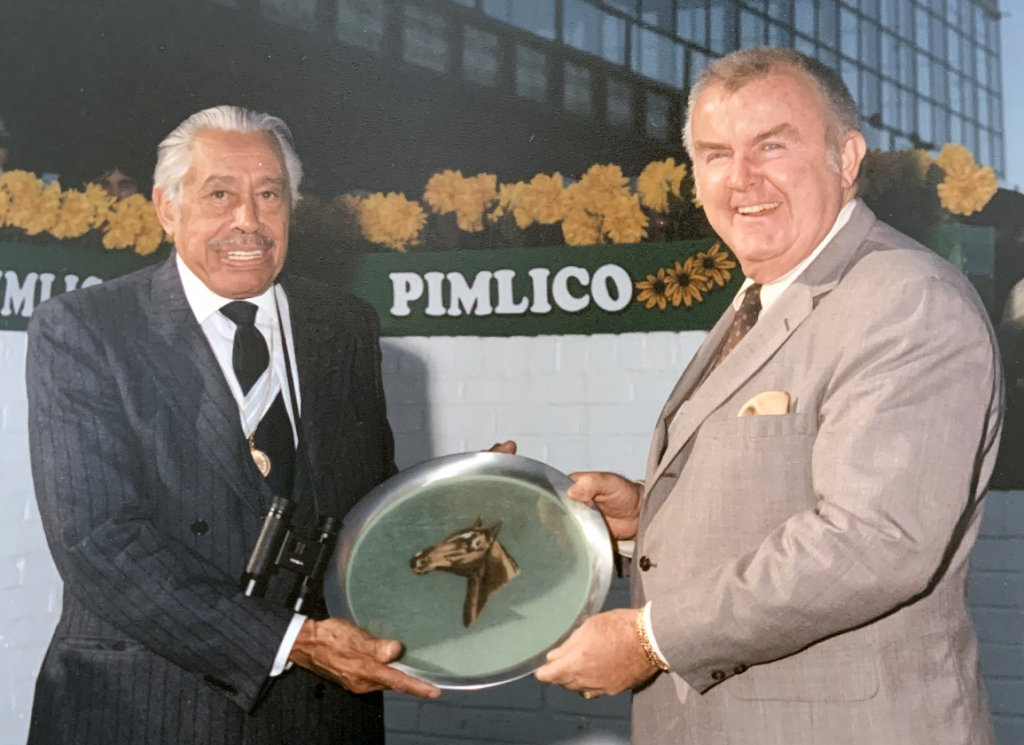
Cab Calloway and Chick Lang | Courtesy Lang Family

The second character in the story is Cab Calloway, the Black entertainer who was a singer, dancer, bandleader and actor. His best-known song today is Minnie the Moocher (Hi-De-Ho!). He recorded one of the first music videos (and maybe the best). Calloway loved horse racing. Whenever possible, he would visit his local racetrack. Of course, when he went to Hialeah, he always looked up Lang, who marked his program with plenty of winners delivered by his jockey, Hartack. On one crowded day, Calloway mentioned that his normal seats were already taken and asked if Lang could help. While in the midst of closing entries, Lang gave Calloway his Turf Club pin without hesitation. He directed him to go see the maitre d' and have him seated at Lang's table.

A few minutes later, a dejected Calloway returned and told Lang that they wouldn't let him in the Turf Club because he was a Negro. The Turf Club was for whites only. Those who knew Lang and his famous jockey can guess what happened next. Lang went to a nearby phone and called the track manager, and there was a one-sided conversation that followed.

“If Cab Calloway is not good enough to sit in the Turf Club at this track, then my jock will never ride here again, starting today!”

Calloway returned to the Turf Club, got his table and the color barrier was broken at Hialeah.

Those who knew Lang understood he was a man of principle. There was no gray area in a matter like this. He also knew where his jockey stood on this issue. Hartack had numerous Black friends, many of them entertainers. Throughout his career, Hartack never wavered in important principles. I am sure Lang informed him of the incident that night after the races, and I am confident Hartack affirmed the importance of his actions.

Lang went to work as a racing official at Pimlico in 1960. He never wavered in his distaste for segregation. No flip-flopping on important issues. It was either right or wrong, no matter what personal consequences one might face. For example, in his first year at Pimlico, he did something that was not in his job description or within his level of authority. When he came upon the “White” and “Colored” signs on the drinking fountains at Pimlico, he took them down and they never came back.

Lang and Calloway showed us all on that day–at the races at Hialeah in the 1950s–that change is accomplished with courage and commitment, one step at a time.

The post The Day Chick Lang and Cab Calloway Integrated the Turf Club at Hialeah appeared first on TDN | Thoroughbred Daily News | Horse Racing News, Results and Video | Thoroughbred Breeding and Auctions.

Source of original post

Verified by MonsterInsights