Greathouse Schemes for Action All the Way

His friend Spider Duignan knew that the stakes were high. When the horse coasted past the wire in the GII Saratoga Special, Duignan turned and said, “You needed that bad, didn't you?”

Deuce Greathouse was candid in his reply. “It was not an option,” he said, “for that not to happen.”

Raised the way he was, Greathouse knows that there are never any guarantees with horses. Since taking his cue that day, indeed, Rhyme Schemes (Ghostzapper) has himself demonstrated as much by coming up with an ankle issue shortly before the GI Hopeful S. There will be no Derby trail for him, then, though he appears highly eligible to pick up the Triple Crown pieces as a fresh horse in the summer.

And at least he did what was required, that crucial day at Saratoga.

“It did not cross my mind,” he says of the idea that Rhyme Schemes might not follow up his stunning maiden success at Ellis Park. “I would not allow myself to imagine how bad a spot I was going to be in, if that horse didn't win the Saratoga Special. Because that's just the way we play, that's the way we're in the game.”

Rhyme Schemes is a flagship for Pura Vida, a partnership Greathouse has put together over the past three years or so. As we'll hear, it's definitely a program tailored to the modern marketplace. At the same time, however, it adapts a precious legacy–and not just the horsemanship inherited by the whole clan, long associated with Glencrest Farm.

Greathouse remembers Rusty Arnold saying that his father David, lost at just 63 in 2013, was the only person who still “did everything.” He raced horses, gambled, bred and consigned, sold shares and seasons. In other words, it was action all the way; and it was all about the action.

“A lot of the older guys have told me that I'm kind of the last of a dying breed, as far as the real gambling side of the racing,” Greathouse remarks. “Now a lot of my good friends are pinhookers, and they've got their farms and everything. But you don't really see the guys that just live gambling, just buying and trading horses like we used to.”

And that's why he suspected that there might be a niche for something like Pura Vida. Too many partnerships, he felt, were too woolly and discouraging in their aspirations. He wanted players who would tease out the odds: hedge here, roll the dice there, try to offset the investment as they went along.

“It's like all these people that are getting in are basically being told, 'Hey, you got to love the game so much that you're willing to burn $50,000, or whatever,'” Greathouse says. “And I just thought that was B.S. I mean, most of us that make a living in the horse business never start racing partnerships. You'll see a good guy try it once in a while, buy a few with a couple of buddies. They either have luck or they don't. But I grew up with gamblers. I mean, real gamblers. And a lot of the horses that we did well with, and sold, it was like I said: not doing well was not an option. Because if they didn't pan out, I was gone.”

That approach is bound to bring the odd bump in the road, but it also meant that Greathouse could fire up his resume with early involvement in names as illustrious as Tepin (Bernstein) and Shedaresthedevil (Daredevil).

In a way it was picking out the latter, when she failed to sell at Keeneland September, that satisfied Greathouse that he could and should make something like Pura Vida happen.

“I knew that the reserve was $20,000,” he explains. “So I stood next to WinStar and made sure nobody was going to bid that, let them haw and hem, and tried to get her for $15,000. But they wouldn't, so I took the $20,000. I was just trying to be cheap! But I was not going to leave without the filly. And when she broke her maiden, we sold [a majority share] based on $600,000.”

As a GI Kentucky Oaks winner, of course, she would bring $5 million at Fasig-Tipton on her retirement and Greathouse had, by then, long sold his remaining stake.

“But I'd do it again,” he insists. “I'd do it five times in a row. I had to, to make a living. And listen, I was proud to have done so. Of course, it would have been cool, to have still owned a piece of an Oaks winner. But when someone asked whether that was a little bittersweet, I could truthfully say no. What it did do, was make me decide that I needed to raise more money, and do this properly, if I wanted my partners to be able to keep pieces of their great horses.

“And that's what it's all about. You sell. I'm always going to sell, to prove to those guys we can keep it going. But now I can sell a minority piece instead. When I was doing it myself, I always had to lose any control. You make your money, but then you might have to watch horses railroaded by the wrong people, in how they handle them.”

Shedaresthedevil was trained to break her maiden by Norm Casse, who also handles Rhyme Schemes as Pura Vida's principal trainer. (Also on the roster are Mike Maker and Bruce Levine.) Greathouse and Casse got to know each other in the slipstream of Tepin, trained by Casse's father Mark. When Casse went solo, Greathouse promised him support–albeit he now questions quite how helpful he was being.

“I think Norm had 20 horses in training, and 10 were mine,” he says. “But I was trying to survive, and he had to deal with horses that I tended to have only because they didn't sell. They usually had some vet things, and you knew they'd be limited before they ever got going. So it was a tough job for him, starting out.

“I had tried to buy way too cheap: most were 10 to 20 grand. And that really helped change my opinion on exactly how to do it. You still have to be very sharp about what you pay, but you don't want to force yourself to buy at too low a level. It can work, but it's not going to work every year. And, to keep going, this needed to come up with a good horse every year.”

They now seem to be managing just that. Bankrolled initially by Brett Setzer, Cindy Hutson and Greathouse, with some back-up from Tom Romano and Alan Usher, the budget was upgraded to around $370,000 on seven horses. In the buyer's market of the pandemic year, Greathouse “was really just looking for nice fillies in the back ring and letting it all kind of fall together.”

Ontheonesandtwos (Jimmy Creed) was one of those, sent to Casse as a $37,000 Keeneland September yearling.

“She was out of a Malibu Moon mare that could run some but didn't have a lot of page,” Greathouse recalls. “After she broke her maiden, we sold a third for $200,000. We had another filly that ran second at Saratoga on debut. We'd paid $42,000 for her, and sold a quarter for $75,000. So they kind of got it going, showed people what could be done if somebody's picking them out that knows what they're doing.”

To secure which advantage, partners in Pura Vida commit to leaving decision-making to its founder.

“It's for their own protection,” Greathouse explains. “I still talk to everybody, see what they're thinking, and try to make decisions–when I can–based on what the group wants. But it protects them from me making a mistake, and letting somebody into the partnership that proves a real pain in the ass! I grew it very slow on purpose, because I knew the group really enjoyed each other. Obviously that helps you strengthen and build. If I tried to build too quick, let a bunch of people in, it could ruin the whole culture.”

Greathouse and his father had always been amazed by the presumption of successful people who enter this arcane and challenging environment expecting to nail it overnight.

“My dad always used to laugh about these guys,” Greathouse says. “They come in and they have a plan. And they know nothing. Men and women who made a fortune doing other things on sound business principles, they get into this, they get in front of the lights and throw everything out the window. And then a few years down the road they're bitching about bills, and wanting to blame you!”

Both funding and discipline were in place, then, by the time Greathouse came across a Ghostzapper colt in the Paramount Sales consignment at last year's Keeneland September Sale.

“I believe he was the very end of Book 2,” he recalls. “That's kind of where my price range started in that sale: everything I bought came between there and Book 3. This time round, it took until the very end of Book 3 to buy one or two, and then we bought everything in Book 4! So you just have to deal with what the market gives you.

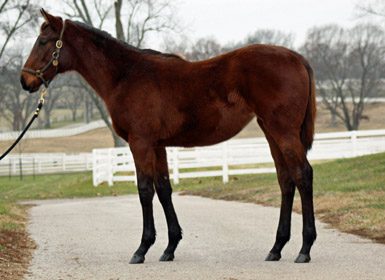
“Anyway he's a gorgeous horse. In all my years, pinhooking and everything else, somehow I don't think I've ever owned a Ghostzapper. And, as I said, our focus is always on fillies. But I had a little more money to spend, so wanted to add a couple colts. You never know, you might come up with a Derby horse in the package without trying to buy 10 colts a year on a feast-or-famine deal.

“He was my kind of horse: medium-sized, pretty head, extremely well balanced. That hind leg, which I learned from Ciaran and Amy Dunne, that we all look for when buying for the 2-year-old sales. And not too heavy. I've stopped trying to buy heavier colts. They just don't hold up. You trick yourself into these big, gorgeous colts–but they're just not sound. Certainly they can't have a heavy neck because, to me, that's just all weight on the knees. I mean, $210,000 was a lot of money for me, so he had everything I liked in a horse.”

As usual, Geoff Mulcahy was entrusted with the colt's education.

“As far as I'm concerned, the earliest any of them will ever run is April or May,” Greathouse declares. “So I don't want to pay to ship them all to Florida and ship them all back here. Geoff does a great job. I'm out there three or four mornings a week in the winter watching them train. That allows me to see how they're doing–which need to be turned out, which we go on with, which trainer might suit them best.”

The Ghostzapper colt was always obliging, equal to anything he was asked.

“Didn't matter if you breezed him with a really good horse, or a mediocre one,” Greathouse says. “He never let them get ahead of him. At the same time, he never blew you away. He did everything evenly. With Geoff, we do a lot of two-minute licks, a lot of slow three-eighths. We just build them up and then let them gallop out. So you build a lot of stamina in the babies.”

Sitting down with Casse in the spring, they agreed that a horse of this kind of cost and profile shouldn't be cranked up to explode into the shop window on debut. So Rhyme Schemes was left space to learn from his first experience at Churchill in May.

“He was fit enough to run, but by no means sharp,” Greathouse recalls. “And when he didn't break, and that stuff hit him in the face for the first time, he just kind of ran around there. You didn't necessarily know what to make of it. But he came back a little stronger, we put blinkers on him. And I will say that Ricardo [Santana Jr., jockey], when he breezed him after that first race, said that nobody was going to beat him next time.”

They went to the windows, sure enough, but nobody was expecting to see something quite so electric.

“He just flapped the reins on his neck, and all of a sudden he's gone,” Greathouse marvels.

And it was exactly the same at Saratoga, when even the winning margin was identical: 9 1/2 lengths.

To recuperate from his setback, Rhyme Schemes has gone “home” to Duignan's Springhouse Farm. (Duignan not only helped to consign the horse as a yearling but is nowadays a syndicate partner). The team was never going to take risks simply for the sake of a little Derby fever.

“We're going to go take our time with him and hopefully have a good 3-year-old,” Greathouse promises. “Knock wood, he's been a great patient. He has an incredible mind, and that has been so helpful. When they're high-strung and stupid, they just hurt themselves again.”

In the meantime, there's much else to keep the Pura Vida team excited.

“We've four or five fillies we really like that haven't run yet,” Greathouse says. “There'll always be a couple that won't work out. But that's kind of the point. My job is not to have any pride, to identify those that need to come off the payroll so that the good ones aren't covering them.”

Whatever happens, a runaway Saratoga Special winner is quite a find among no more than 10 recruits.

“I don't analyze the crosses so much,” Greathouse says of his catalogue work. “We should all know, just from doing it our whole lives, which ones work. Really I just try to look at a pedigree and say, 'Would it shock me if this page produced a racehorse?' Whether there's two dams there that are basically blank, but it's an incredible family below; or whether a family is pretty weak on the bottom, but the mare could really run herself.

“My dad also always told me that a mare can make her own pedigree. A stallion can't. You don't see stallions with no page making it. But he said, 'You see fillies all the time that were just freaky racehorses, out of nowhere, and that's basically the bottom of the family tree.'”

The one thing any Greathouse will always have, of course, is a great pedigree of his own.

“Dad's friends would tell you that it was almost weird how close he and I were,” this one recalls. “I mean, we were together 24/7. So in the amount of time I had with him, I guess I absorbed everything I could. I'll never have his personality. I'm more of an introvert. But yeah, everything about the horsemanship side, and dealing with people, I learned from Dad. He was a legend, and his word was good. It's now 10 years since he passed away and even today, anywhere I am, I have people coming up to me saying, 'I still miss your father.'”

His Uncle John was a significant mentor, too, especially in the selection of young stock.

Overall Greathouse's orientation was always towards the racetrack, meaning that it worked out ideally when his cousin, the younger John, found himself drawn to farm life.

“So I kind of branched away [from Glencrest],” Greathouse explains. “John had gone to the Irish National Stud, he'd really learned a lot in a short period, and he loved foaling, which I never did. What I loved was getting them from weaning, prepping them for the sales, and then breaking them: just anything going towards the racetrack.”

The Pura Vida brand, which borrows Costa Rica's catch-all salutation, was chosen for its upbeat vibe. Because this is a program that likes to get on the front foot, trying to force gaps in the market.

“You're constantly having to buy new horses with money you make,” Greathouse says. “And the expenses that come with them are getting more and more insurmountable. But from the time I was little, you don't buy racehorses to win a maiden race. You're trying to hit a home run. And there's got to be something about that horse, whether you buy it for $20,000 or $500,000, that makes you really believe; that makes you feel there's a something in there that could turn out to be a little bit special.”

The post Greathouse Schemes for Action All the Way appeared first on TDN | Thoroughbred Daily News | Horse Racing News, Results and Video | Thoroughbred Breeding and Auctions.

Source of original post

New Recruits in Demand at Spendthrift

The TDN team barely had time to stop in at Spendthrift Farm to visit Forte this past November before the champion was booked full for 2024. Here's our video feature on the son of Violence. But Forte is just one of the four in-demand newcomers at Spendthrift, where the breeding shed is sure to be busy as ever this year as Into Mischief continues his reign as the leading sire in North America and the top four freshman sires of 2023 take on their fifth season at stud. To learn more about the other new kids on the block at Spendthrift, we sat down with Mark Toothaker.

TAIBA (5, Gun Runner – Needmore Flatter, by Flatter)

   Standing for an introductory fee of $35,000, this son of Gun Runner trained by Bob Baffert and campaigned by Zedan Racing Stables was a leading 3-year-old in 2022 with three Grade I victories on his resume.

KP: A seven-figure 2-year-old and a TDN Rising Star in his debut, it's fair to say that expectations were high for Taiba from the start. How did he rise to those?

MT: Taiba certainly got the whole racing world on edge when he brought $1.7 million at the 2-year-old sales. Being by Gun Runner out of a Flatter mare, he is a gorgeous horse. He probably has more bone and body than any Gun Runner that I've seen.

Taiba got off to such a start as a TDN Rising Star. It was just one of those races that gives you chill bumps. He won so effortlessly and so easily that day and then to come back in start two in the GI Santa Anita Derby, doing something he'd never done before going a mile and an eighth, and be able to win the way he did just lets you know right off the bat that this horse is as talented as maybe anything we've seen in a while.

From there, he would go on to win the GI Pennsylvania Derby in impressive fashion and he closed out his 3-year-old year with a win in the GI Malibu S. He was a very talented horse to be able to do what he did early on, but still be good late in the year. It was asking a lot of him, but it tells you how mentally tough that horse was.

KP: You said he stands out from other progeny of Gun Runner physically. How so?

MT: I think it's just his body. He's got a great way of moving, but he's got a lot of bone and a lot of muscle. I've had many people out here tell me that they've not seen another Gun Runner with a body like that.

His dam was in the Night of the Stars Sale. She was a mare that had tons of bone and tons of substance to her. Anybody out there that got a chance to peek at her can see what Taiba got.

KP: Last year you added dual Grade I winner Cyberknife to your roster and now this year you have Taiba. What has the demand been like in offering two new sons of Gun Runner to breeders within two years?

MT: Well we say around here that you can't have too much Into Mischief blood, but you also can't have too much Gun Runner blood.

When we had a chance to go get these two horses, we bought them both during the same year. We knew they wanted to run Taiba again as a 4-year-old and so that fit our program fine with them doing that. We were able to get Cyberknife 223 mares last year. He was a great breeder, a very fertile horse. Now we have Taiba standing for $35,000 and he sold out in about an hour. It was crazy, the demand for him. We've got him at 180 mares. We'll get to mid-April and see how he's breeding and if it's going well, we'll slide some more in.


Arabian Lion will stand for $30,000 in 2024 | Sarah Andrew

ARABIAN LION (4, Justify – Unbound, by Distorted Humor)

   This speedy son of Justify was his sire's first Grade I winner when he edged away to win the 2023 GI Woody Stephens. Another TDN Rising Star for Bob Baffert and Zedan Racing Stables, Arabian Lion will stand for $30,000 in his debut season.

KR: Speaking of red hot stallions, this year you have the first son of Justify to retire in Kentucky.

MT: We were so excited to be able to get Arabian Lion because of him being a son of Justify. We have Bolt d'Oro here that was in a great battle with Justify and Good Magic for leading freshman sire in 2022. We were thrilled that Bolt wound up coming out on top and then in 2023, it was all just Justify, Justify, Justify. So you tip your hat to that horse on the year that he's had that culminated with what he did out at the Breeders' Cup.

For us to be able to go out and get a Grade I-winning son of one of the hottest stallions here in North America–plus the success he's had in Europe and Australia–it's a very cool thing. But what makes him even more special is that his female family is all a Phipps family. His mother is a Distorted Humor mare that was stakes placed. His third dam is the great Personal Ensign. So when you back up that this horse ran a 109 Beyer when he won the Woody Stephens and he's by Justify and out of a Phipps family that's as deep as you could ever hope for, it gives you a lot of hope that five years down the road, what could he be standing for? We've seen what Justify started out at and where he's at now and we're hopeful to have a son that can go follow in his footsteps. We were overwhelmed with interest in him and he sold out extremely quickly.

KR: That 109 Beyer Speed Figure was one of the best numbers on the year in 2023. How does that speak to Arabian Lion's talent?

MT: He was always one that Bob had at the top of his list as a horse with tremendous talent. He ran a very good race at Keeneland when he was second in the GIII Lexington S. and Bob decided to go the conservative route and run him in the Sir Barton S. on Preakness day. He came out of that weekend with the fastest Beyer of anything that ran that weekend [103]. Bob said he probably should have run him in the Preakness and I think if they would have, he would have been a tough customer in there. To bounce out of that race and come back three weeks later on Belmont Day in the GI Woody Stephens, the horse just left there running and was in a great spot all the way around. When he made the lead, he was gone.

KR: This guy is built a bit differently than his sire. What type of horse do you expect him to throw?

MT: What's funny about Arabian Lion is that he looks very much like a Distorted Humor. He looks like his mother's side of the family. We have Jimmy Creed, who is a Distorted Humor, and Arabian Lion reminds me a little bit like Jimmy with the really good body and great hip. He looks like he would throw a precocious, fast, early horse–just like he was.

It'll be interesting to see what he throws when we start seeing the foals on the ground. We'll have to see when that chapter comes up in his career, but we're trying to breed mares to him with a little bit more stretch. I think that will suit him.


GI Blue Grass S. winner Zandon at Spendthrift | Sarah Andrew

ZANDON (5, Upstart – Memories Prevail, by Creative Cause)

About as consistent as they come, this Brereton C. Jones-bred placed in all but two of his 14 lifetime starts for trainer Chad Brown and owner Jeffrey Drown. Zandon was a leader on the Kentucky Derby trail as the winner of the 2022 GI Blue Grass S. and this year at four, he claimed the GII Woodward S. The $2.2 million earner will stand for $12,500.

KR: Zandon always caught my eye in the mornings, whether it was at Churchill Downs ahead of the Derby or this summer up in Saratoga. How have his looks factored into his resume as he launches his stud career?

MT: Well Zandon is Black Beauty. From the first time we saw him, he was a big, scopey, stretchy horse. He's an Upstart out of a Creative Cause mare. Mike Ryan, one of the best eyes of anybody in the horse business, bought him as a yearling out of the Airdrie consignment. It's an Airdrie family that Governor Jones and his son Brett have really cultivated for many generations. We're excited that they are doing the Share The Upside on the horse with us and so it's fun to have them involved.

I think he's at a price point at $12,500 where he fits a lot of breeders' programs. He gives them what they're looking for and hopefully will get them a gorgeous sale weanling or yearling.

KR: When you look back on his career, what do you think of as his best race?

MT: I think his best race was probably when he won the GI Blue Grass. He worked his way through horses in the stretch and when he finally found daylight, he was gone. I thought he showed a great turn of foot that day and it was an impressive trip to be able to work it out the way he did. Any time you win a Grade I right here in front of all the breeders at our home track, that gets your attention.

KR: He was on the board in 12 of 14 starts–all of those were graded after his debut win and half of his placings came in Grade I contests. For him to be so consistent at the top of the game at two, three and four, what does that indicate about his potential ability as a sire?

MT: Zandon was a very good 2-year-old and he had a great 3-year-old year–not only winning the GI Blue Grass S., but he ran a very good third in the GI Kentucky Derby. He's a horse that danced all the dances–on the board in the GI Travers and the GI Pennsylvania Derby. He's had a very good 4-year-old year. He was second in the GI Met Mile and the GI Whitney. He won the GII Woodward. We had big hopes for him out on Breeders' Cup weekend and unfortunately we didn't get the Cinderella ending we were hoping for. It was a tough track to close ground on out there on both days, but he ran hard. He always tries hard and so we were very proud of the horse to make $2.2 million. He was an extremely consistent horse that always gave his all. That's something that you can hang your hat on as a breeder. You know the horse had a lot of try in him and he was always going to come out there and compete as hard as he could.

The post New Recruits in Demand at Spendthrift appeared first on TDN | Thoroughbred Daily News | Horse Racing News, Results and Video | Thoroughbred Breeding and Auctions.
Source of original post

Mating Plans, presented by Spendthrift: Dixiana Farms

The TDN's popular annual series 'Mating Plans, presented by Spendthrift,' continues today in a conversation with Robert Tillyer, farm manager of William and Donna Shively's Dixiana Farm.

AMERICA'S TALE (9, Gio Ponti – America's Friend, by Unusual Heat) to be bred to Taiba

She's in foal to Jackie's Warrior and she's a Grade II winner. We thought Taiba was good value. He's a very attractive son of Gun Runner that won three Grade I races.

DIAMOND WOW (5, Lookin At Lucky – Patriotic Diamond, by Hat Trick {Jpn}) to be bred to Forte

A new mare to the broodmare band and one of four going to champion 2-year-old Forte. She's a multiple stakes winner and is graded stakes placed.

GRAND AVE GIRL (6, Runhappy – One More, by Holy Bull) to be bred to Jackie's Warrior

This multiple stakes winner is carrying her first foal by Jack Christopher.

LADY BRIELLE (6, Tapit – Tabarin, by El Prado {Ire}) to be bred to Gunite

This daughter of Tapit is in foal to Cyberknife. She had a nice update in the family with her half-sister producing the GII Golden Rod winner Intricate (Gun Runner). We are breeding her on the same cross.

LAYLA (10, Union Rags – I'm a Flake, by Mineshaft) to be bred to Constitution

Layla had a mention last year [See those 2023 mating plans here]. She's the full-sister to GISW Express Train. Her first foal, Gran Orca (Liam's Map), has now had two impressive wins in Japan. He was the highest-priced Liam's Map in 2022, selling for $625,000. She is due to have a Flightline foal at the end of February.

Sold It's filly by Quality Road | Dixiana Farm

SACRED LUNA (12, Maliby Moon – Sacred Feather, by Carson City) to be bred to Uncle Mo

This half-sister to MGSW Taareef (Kitten's Joy) produced an Oscar Performance colt that sold last September Keeneland for $310,000.

SOLD IT (8, The Factor – -Charade, by Maliby Moon) to be bred to Cody's Wish

The farm has a very nice Quality Road yearling filly out of this stakes-winning mare. She's in foal to Not This Time.

TRAIN TO ARTEMUS (6, Tapizar- Pay Day Kitten, by Kitten's Joy) to be bred to Into Mischief

Another new mare for the farm, purchased in November. She is a multiple stakes winner and is graded stakes placed.  She is a beautiful mare that will really compliment the Dixiana broodmare band.

The post Mating Plans, presented by Spendthrift: Dixiana Farms appeared first on TDN | Thoroughbred Daily News | Horse Racing News, Results and Video | Thoroughbred Breeding and Auctions.

Source of original post

The Week in Review: In the Good News Department, 2024 is Off to a Good Start

The year 2023 was a pretty rough one for the sport of horse racing, and there was little to suggest that this year would be any different. The sport seems to be caught in a downward spiral as we move from one crisis to another and are left to wonder “what next?”

So far this year, the answer to that question is that maybe things will be better in 2024 than we might have thought. There have been several recent positive developments for the sport, many of them having to do with state governments investing in the game's future.

We learned last week that the New Jersey Senate joined the state's Assembly in passing a bill that would extended a $10-million annual purse subsidy through 2029. Governor Phil Murphy is expected to sign the bill. New Jersey is one of only a handful of states where the racing industry does not receive revenue from gaming. Without the $10 million, Monmouth's purses wouldn't be large enough to compete with tracks in neighboring states. According to the Daily Racing Form, Monmouth distributed $31 million in purses over 56 live racing days, for an average of $553,000 a day, the highest in its history, with one-third of that money coming from the subsidy.

It wasn't that long ago that Monmouth was operated by the state and then Governor Chris Christie threatened to shut the track down. In 2011, he said that Monmouth would “disappear” if private management wasn't put in place at the state-owned facility.

The news out of New Jersey was just the latest example of a state government showing that it believes in the future of the sport. In Maryland, Governor Wes Moore endorsed a plan authored by the Maryland Thoroughbred Operating Authority that will overhaul racing in Maryland. The proposal, which is dubbed “Pimlico Plus,” would mean a re-envisioned Pimlico site, with a new clubhouse, stables for 700 horses, a 1,000-seat event space, 2,000-car parking garage, veterinary facilities, a possible hotel and other new amenities. Laurel will close once the new Pimlico is ready to open for business and a new training facility will be built at a site that has yet to be determined.

Pimlico Plus has a hefty price tag. According to the Baltimore Banner, the new Pimlico will cost between $274 million and $284 million, while the new training facility would cost about $113 million. In 2020, the Maryland General Assembly approved the sale of $375 million in bonds for capital improvements for Pimlico and Laurel. The projects that were on the table at the time stalled, but the $375 million is still available and, with legislative approval, can be used to rebuild Pimlico.

The deal would require 1/ST Racing and Gaming, which owns Pimlico Race Course and Laurel Park, to transfer ownership of Pimlico to the state, and for 1/ST Racing to cede control of its day-to-day Thoroughbred operations to a non-profit entity as of Jan. 1, 2025. The non-profit entity would be structured so that it is similar to the New York Racing Association. 1/ST Racing will retain the rights to the GI Preakness S. and the GII Black-Eyed Susan S., which it would license to the non-profit operating authority.

The Maryland deal was announced about eight months after New York Governor Kathy Hochul's budget included a $455- million loan to NYRA that it will use to build a new Belmont Park, which is expected to open in 2026. Hochul did so despite fierce criticism from some advocacy groups, including PETA, that questioned the move. Victor Matheson, a Holy Cross College professor and expert on sports economics told the New York Post, “Basically it looks like with this project, you're kind of hitching your wagon to an industry that is in long-term decline.”

Belmont was last refurbished in the sixties and is a mammoth structure built during an era when 35,000 people might show up to the track on a Saturday afternoon. It is also not winterized, the primary reason why the Breeders' Cup has not been run at Belmont since 2005. New York racing needed a new Belmont and needed to consolidate so that there was just one downstate track. Thanks to Hochul, it's going to happen.

In October, Keeneland announced a major capital investment project highlighted by the construction of a permanent paddock building. Once again, a state government came forward to help with the costs. Keeneland is working with state and local government to secure incentive funds to support the project, which is expected to cost nearly $93 million. Already, upon the recommendation of the Tourism, Arts and Heritage Cabinet, Keeneland received preliminary approval from the Kentucky Tourism Development Finance Authority for incentives to support the project totaling up to $23.2 million.

“Keeneland is a historic destination for our local families and travelers, and this exciting investment will create more opportunities for everyone to enjoy, while boosting our signature horse racing industry and Kentucky's $12.9 billion tourism industry,” said Gov. Andy Beshear. “The horse racing industry is as indispensable to our economy as it is to our culture, and after a record-breaking year for tourism in 2022, leaders like Keeneland are going to help ensure Kentucky's success continues for years to come.”

Last week, we also learned that the purse for the Kentucky Derby has been raised to $5 million. It was $3 million. In addition, the 2024 spring meet at Churchill will offer purses totaling more than $25 million or a 25% increase over 2023.

This happened because Kentucky racing has never been healthier. Revenue from Historical Horse Racing Machines has created huge purses in the state. Maiden special weight races at Churchill Downs went for $120,000 and allowance races were worth $141,000 last fall.

“These record purse increases are a symbol of the health of horse racing in Kentucky,” Bill Carstanjen, CEO of Churchill Downs Incorporated said when announcing the Derby purse increase. “Churchill Downs Incorporated's over $1-billion investment into live and historical horse racing in Kentucky over the last five years has meaningfully strengthened the entire Kentucky Derby Week and year-round racing program. It's important to acknowledge the state legislature for its commitment to working closely with private enterprise in a truly collaborative partnership to support the continued growth of Kentucky's signature industry.”

None of this means that 2024 will be perfect or that we shouldn't brace ourselves for the next set of problems. But this sport is resilient, as the recent developments have shown. Let's hope for more of the same in 2024.

Triple Crown Purses

Churchill Downs was not the only track to raise the purse for its Triple Crown event. The purse for the GI Belmont S. has been increased to $2 million from $1.5 million. That's a step in the right direction, but it's not enough. Along with the Breeders' Cup, the Triple Crown races are supposed to be the sport's most important events. Their purses should reflect that. All three races should have purses of $5 million. As of now, there is a gap between the Derby and the $1.5-million Preakness and the Belmont, which isn't good for the Triple Crown. There should be enough money out there to have three $5-million races.

The post The Week in Review: In the Good News Department, 2024 is Off to a Good Start appeared first on TDN | Thoroughbred Daily News | Horse Racing News, Results and Video | Thoroughbred Breeding and Auctions.

Source of original post

Verified by MonsterInsights