Kirk and Judy Robison's Jackie's Warrior (Maclean's Music) will make his 4-year-old debut and first start since being named 2021's champion male sprinter at the Eclipse Awards as the highweight in Saturday's GIII Count Fleet H. at Oaklawn.
Starting his career perfect in four starts, including convincing wins in the GI Runhappy Hopeful S. and GI Champagne S., the $95,000 Keeneland September buy suffered his first two losses in his only two-turn attempts to date, running fourth at 9-10 in the GI TVG Breeders' Cup Juvenile and third in last February's local GIII Southwest S. The Steve Asmussen trainee has been kept around one turn since then, going four-for-six the rest of 2021, rattling off consecutive dazzling scores in the GII Amsterdam S., GI Woody Stephens S. and GII Gallant Bob S. That was enough to make him the biggest favorite of Breeders' Cup weekend at 1-2 in the Qatar Racing Sprint, but the bay was burned up on a quick pace and weakened in the final furlong to finish a disappointing sixth.
Jackie's Warrior returns with a sharp-looking worktab at Fair Ground and over this track, most notably going a bullet five furlongs from the gate at Oaklawn in :59 2/5 (1/45) Apr. 3.
The champ will likely have his hands full with an emerging Hot Springs talent, however, particularly if the fractions are swift. Michael and Patricia Feeney and Jennifer Grayson Taylor's Bob's Edge (Competitive Edge) won four of his first 11 starts from ages two to three, but failed to threaten in three stakes tries before having the proverbial lightbulb go on this winter. Debuting as a 4-year-old in the King Cotton S. here Jan. 29, the gelding blew to the front all the way from seventh just inside the quarter pole and kicked clear to a 2 3/4-length success, earning a career-best 97 Beyer. The Larry Jones pupil showed that was no fluke when passing every rival to repeat in the GIII Whitmore S. Mar. 19.
(Listen to this story by clicking the play button below.)
We live in a world where change is routinely mistaken for progress, draped in the cheap frills of “modernization”–a word that needs treating with extreme suspicion, implying as it does that any who challenge innovation are obstructing our species in some otherwise inexorable journey to fulfilment.
Nobody can sensibly deny that a great deal of change has indeed been for the better. Few who honor her memory at Keeneland on Saturday, I'm sure, would like to have been with Jenny Wiley in her pioneer cabin, that bloody day in 1789. But nor should we ever be vapidly impulsive in our stewardship of the Thoroughbred, that beautiful time capsule for generations of toil and reflection by stockmen whose lore has long faded from all other record.
In my homeland of England, they actually have ended up having to use heritage as a substitute for decent purses. Even in that environment, however, vigilance is constantly required against well-intentioned but crass unstitching of the pageant.
On both sides of the water, admittedly, we must tolerate such pragmatic change as will preserve what has become known as “the social license” to persist in our way of life, in an era when a largely urban world can grossly amplify its misapprehensions on social media.
That's a context we can't afford to neglect in any of the scandals, actual or perceived, that undermine our claims to scrupulous regard for equine welfare. At one end of the spectrum, you may this week have glimpsed some nightmarish images from the Quarter Horse world. Be in no doubt, however: we absolutely invite outsiders to place us on the same continuum even in what too many people in our community consider our marginal complicities–when indulging the alchemy apparently practised in certain barns, for instance, or arguably when harnessing ideological lobbies to litigate against meaningful regulation.
And I do feel that some of the decisions we make as breeders show inadequate consideration for the breed's long-term welfare. Everyone talks a good game about turf stallions, for instance, but they won't actually give them commercial oxygen. And the odds are stacked even against dirt stallions if perceived as “slow burners”, whether in terms of maturity or stamina.
With far too many horses brought into the world to walk, not run, I recently took the tragic cue of Get Stormy's loss to celebrate the exemplary approach of Crestwood, where the roster majors in competitive longevity, often combined with turf acceleration and/or an aristocratic maternal line. But the suspicion must be that a family farm, with relatively limited resources, can only have created this heroic niche in the Bluegrass because of market contempt for precisely those assets that would best sustain the breed.
Thankfully Crestwood is not alone in understanding how the viability of our sport depends on the physical competence of the model we hand over to the next generation. Few grasp this more ardently than Airdrie–where Divisidero, for instance, built five campaigns on a maternal line extending to Cosmah herself; and Preservationist, who pairs up the King Ranch icons Courtly Dee and Too Chic, must somehow get people to see past the fact that he was six when he broke two minutes in the GII Suburban.
That pair will need a lot of far-sighted support to emulate the breakout of their buddy Upstart, who–multiple Grade I-placed at two, three and four, and tracing to a Federico Tesio champion–has genuine prospects, with only his second crop, of a first Kentucky Derby-Oaks double since Native Dancer.
Whatever happens at Churchill, Upstart has done something pretty phenomenal just to put himself in this position as a $10,000 start-up. Remember this is the 50th anniversary of Airdrie's foundation; and also that Zandon's first three dams were all mated in support of resident stallions. Typically of this farm, moreover, the family traces to a great matriarch in Boudoir II (GB), whose foals included the dam of Flower Bowl, granddam of Majestic Prince and sire of Kelso. Any neutral whose Derby pick will be determined by a due sense of heritage and class, then, will have had goosebumps watching Zandon put it all together in his hometown trial last weekend.
Now it's true that Zandon has himself participated in radical change; in a process, indeed, that many trainers would doubtless hail as “modernization”. Having been so lightly campaigned, by the standards of the past, last week he needed things to go right just to reserve himself a Derby gate.
It's a world away from 1941, when Whirlaway (seven-for-16 at two) was beaten in a Blue Grass nine days before the Derby, and again in the Churchill Derby Trial five days later, only to convert that sharpening into an eight-length win in the first leg of his Triple Crown. On its nine-day turnaround the Blue Grass produced the Derby winner nine times in 14 runnings from 1959. In 1990, however, it was pushed back to three weeks before the Derby, and in 2015 to four. That leaves the GIII Stonestreet Lexington S. as the last chance saloon for those still needing gate points and, despite its relative proximity to the Derby, as the ultimate example of how trials have become treated principally as a means to get into the race, rather than actually to win it.
Lexington contender Ethereal Road with D. Wayne Lukas | Coady
Except that maybe D. Wayne Lukas is trying to do both, in backing up Ethereal Road (Quality Road) a week after the Blue Grass–where patience seems finally to have been exhausted with his jockey, now replaced both here and on Secret Oath (Arrogate) in the Oaks.
Remember how Lukas brought a son of Summer Squall to this race in 1999, a couple of weeks after he'd made some late ground into fourth of eight as an outsider in the GI Santa Anita Derby? Charismatic had needed six attempts to win a maiden, and both his wins had come under a tag, but all that groundwork suddenly came together in the Lexington. And 13 days later he went into the Derby–with 12 more races under his belt than will Taiba (Gun Runner)!
The only rule, with Thoroughbreds, is that there are no rules. If Taiba can win off that prep, then I will have to acknowledge myself not just a traditionalist but a culpable reactionary. Actually, as we've indicated already, there is one immutable rule: that whatever we do with these horses, their welfare comes first. But if they are not being “proved”, the way they once were, then I don't know that anyone gains.
If trainers don't trust the resilience of the genetic material they're being given, then that's a poor reflection on the breeders of today. And equally it's no help to the breeders of tomorrow if stock perfectly equal to a tougher schedule never gets a chance to demonstrate those wares. So, no, not all change is good–any more than all change is bad.
As has been well-documented, Japanese interests have–over the course of many years–accumulated some of the best bloodstock from all corners of the globe, and as evidenced in Riyadh and Dubai in the last couple of months, the Japanese are breeding horses that can compete anywhere at any level.
Classics season in the island nation kicked off last weekend with the running of the G1 Oka Sho (Japanese 1000 Guineas), with the colts' equivalent–the G1 Satsuki Sho (Japanese 2000 Guineas)–set for this weekend at Nakayama Racecourse. The 3-year-old offspring of some mares whose names will ring familiar dot the field of 18, with each of the four colts something of a winning chance.
Do Deuce (Jpn) (Heart's Cry {Jpn}) is a son of MGSW Dust and Diamonds (Vindication), who was purchased by Katsumi Yoshida for an even $1 million in foal to the late Pioneerof the Nile at Keeneland November in 2016, having been sold to Borges Torrealba Holdings for $900,000 at the same venue just days after her runner-up effort to Groupie Doll (Bowman's Band) in the 2012 GI Breeders' Cup Filly & Mare Sprint. A half-brother to MGSP Much Better (Pioneerof the Nile), Do Deuce capped an undefeated championship season in last years' G1 Asahi Hai Futurity and was the near-miss runner-up in the G2 Deep Impact Kinen on seasonal debut Mar. 6.
Danon Beluga (Jpn) (Heart's Cry {Jpn}) is the first foal from his dam Coasted (Tizway), winner of the P.G. Johnson S. and second in the GI Breeders' Cup Juvenile Fillies Turf in 2016, who was knocked down to Yoshida for $1.3 million at the Fasig-Tipton November Sale in 2017. Just five months after his foaling date of Feb. 7, 2019, Danon Beluga was sent through the ring at the JRHA Select Foal Sale, hammering for $1.472 million, and is perfect in two tries, including a win at Group 2 level Feb. 13. Yuga Kawada, who was aboard the victorious Loves Only You (Jpn) (Deep Impact {Jpn}) in last year's GI Filly & Mare Turf, has the ride from gate one.
Yoshida was striking while the iron was hot at FTKNOV when acquiring then 8-year-old Palace Rumor (Royal Anthem) for $1.1 million in foal to Mineshaft a handful of months after the mare's produce of 2010, a Curlin colt named Palace Malice, took out the GI Belmont S. A half-brother to the MGSP stayer Iron Barows (Jpn) (Orfevre {Jpn}), Justin Palace (Jpn) (Deep Impact {Jpn}) also starred at the JRHA Sales, fetching nearly $1.8 million as a yearling in 2020. The dark bay colt won each of his first two starts over 10 furlongs and was last seen finishing runner-up in the G1 Hopeful S. over Sunday's course and distance when last seen Dec. 28.
The winner of the latter event was Killer Ability (Jpn) (Deep Impact {Jpn}), a son of 2011 GI Hollywood Starlet S. heroine Killer Graces (Congaree), who realized $850,000 from Yoshida at FTKNOV back in 2012. The late January foal was capping a four-race preparation in the Hopeful, having won his maiden by seven lengths at second asking at the end of August before just missing in listed company in October. Killer Ability is the mount of the up-and-coming Takeshi Yokoyama, the regular rider of last year's Satsuki Sho winner, champion 3-year-old and Horse of the Year Efforia (Jpn) (Epiphaneia {Jpn}).
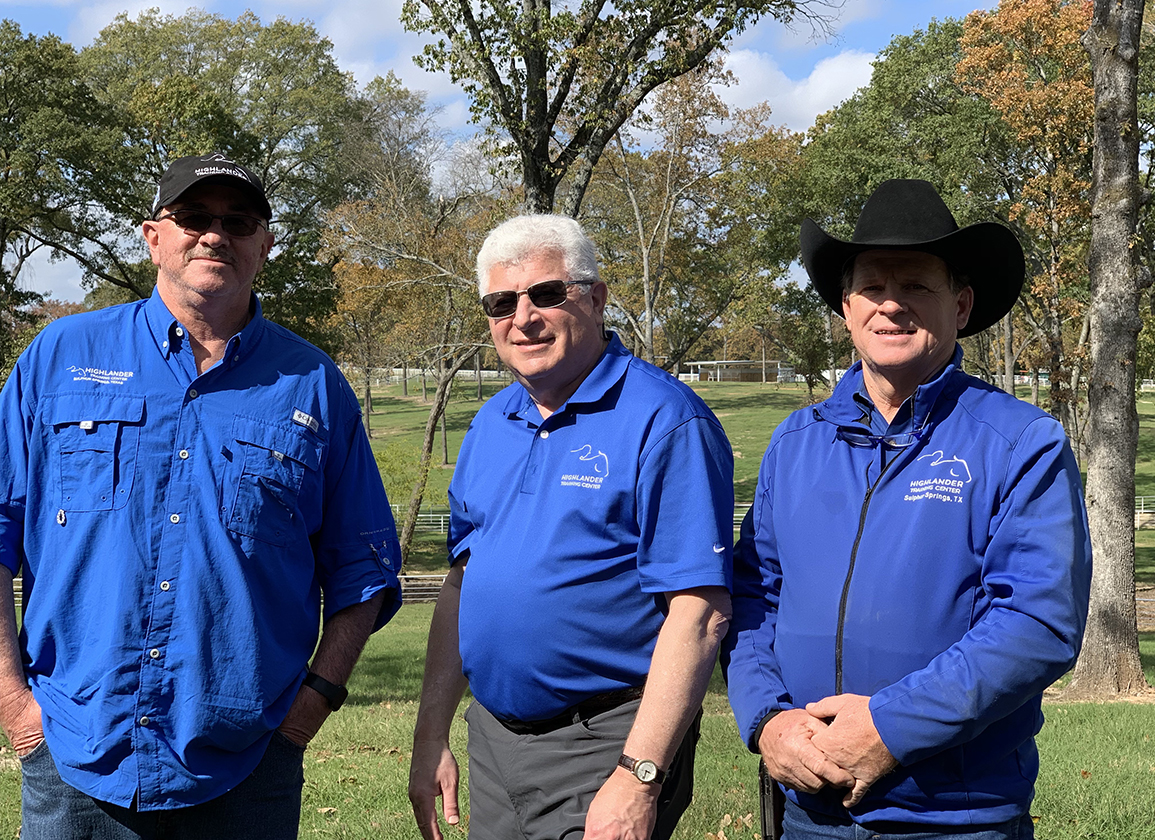
SULPHUR SPRINGS, Texas — The head trainer is the guy who prepared 2009 Horse of the Year Rachel Alexandra to be a racehorse. He and his two assistant trainers combine for more than 100 years of experience and the development of more than 300 stakes horses.
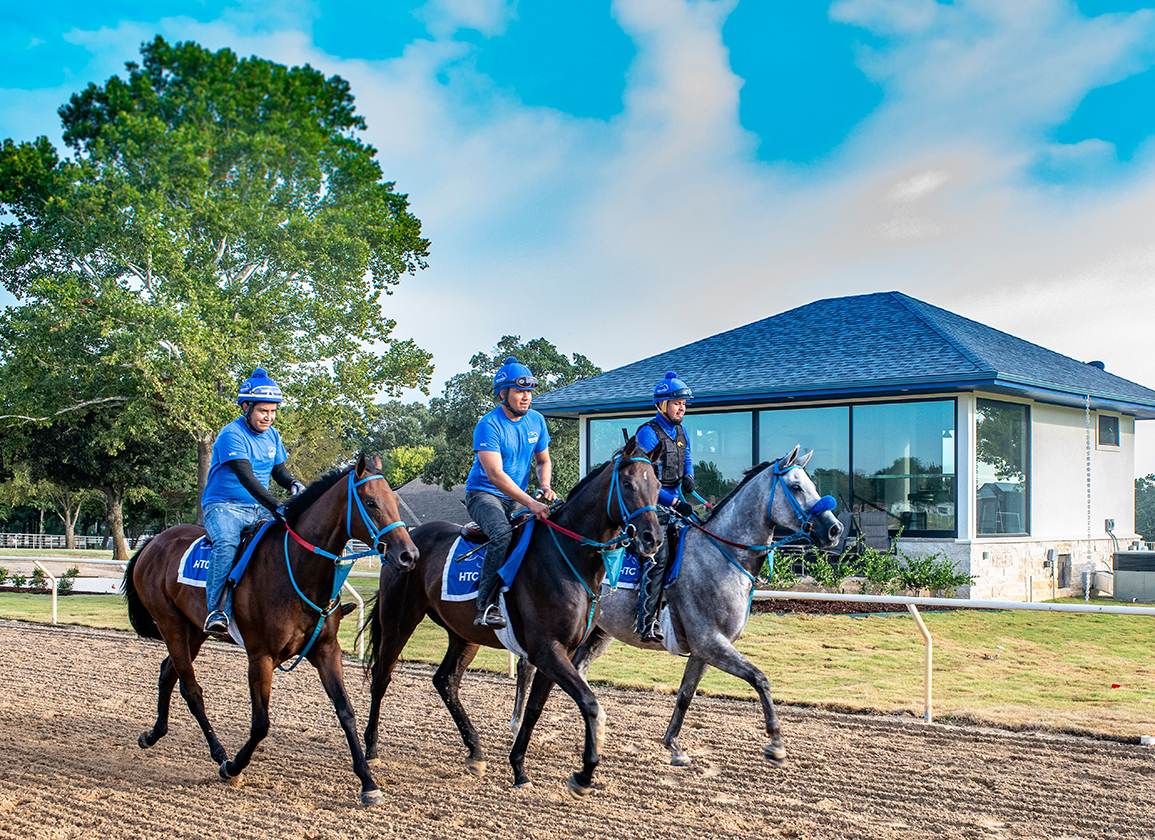
Yearlings and weanlings romp in undulating pastures. Two-year-olds learning the fundamentals and older horses coming off layoffs gallop and work over a traditional training track as well as lope up a 1 3/8-mile turf gallop.
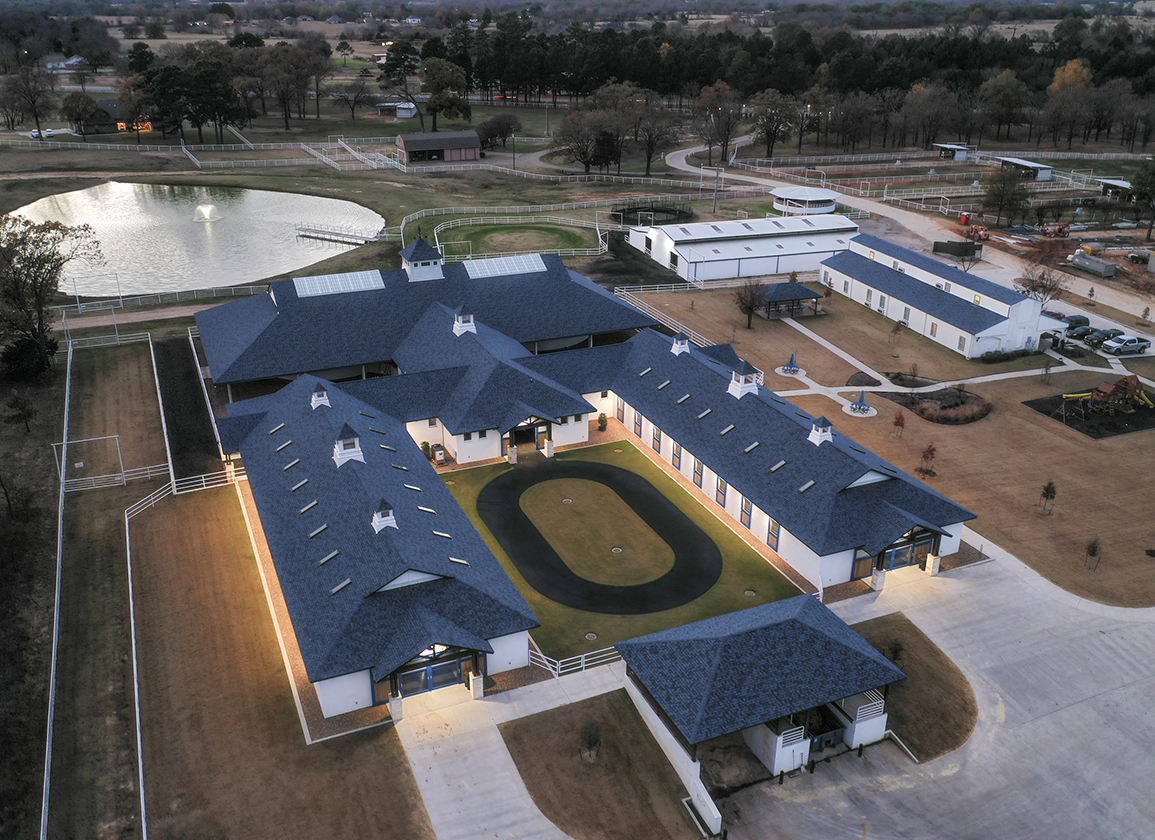
The spacious barns have vaulted ceilings featuring skylights that can open and close via remote control but are programmed to automatically shut when rain starts. The 12′ X 12′ stalls with springy flooring underneath the bedding provide horses maximum comfort. Think of it as box springs for equines.
A therapy center opened a year ago in the facility owner's quest to make long racing careers the norm and to keep small problems from becoming big problems. Depending on horses' needs, they could head to the above-ground cold saltwater spa where 35 degree water churns around their legs, in-ground and above-ground aqua treadmills or two stalls with full vibration-plate floors. They might be treated with a regenerative laser or wear an electro-magnetic blanket. Or any combination of the above.
“You'd think you just drove into Lexington, not Sulphur Springs, Texas,” said trainer Lon Wiggins. “It's a hidden gem right now, but it's not going to be for long.”
No, it's not Central Kentucky; rather, Highlander Training Center an hour east of Dallas. Sulphur Springs, population 16,000, is home to the Southwest Dairy Museum and Education Center, which chronicles the town's roots as Texas's one-time dairy capital. The region is populated with cattle farms interspersed with horses of various breeds.
“I know of only one other facility similar to this, which would be WinStar,” said Dr. Ali Broyles, the veterinarian and equine surgeon who oversees Highlander's equine medical care.
“For this kind of weanling-throughout-racing timeline, in addition to these therapy modalities, there are not very many facilities of this scope in the country,” said Broyles, whose post-vet school training was at Lexington's world-famous Rood and Riddle Equine Hospital. “It's a relatively new facility, but I know they have already seen a lot of growth and acceptance from the Thoroughbred community on a national level.”
For years, horse owner Larry Hirsch trusted his yearlings, 2-year-olds and layups to the father-son team of Ed and Scooter Dodwell at their Diamond D Ranch in Lone Oak, Texas. After Ed died and the ranch was put up for sale, Hirsch opted to establish his own training center rather than relocating to an existing facility. He told Scooter Dodwell, who headed Diamond D for 13 years after his dad's retirement, to “find us” a property.
After looking statewide, Dodwell, now Highlander's president in addition to head trainer, found the ideal property a mere 12 miles away from the location of the Diamond D. But it was hardly turn-key. The old Rafter L Ranch had been vacant for years, its main barn in disrepair, the training track overgrown. Trees had taken over the fields.
“But you could see it had 'good bones,'” Hirsch said of the land. “It's beautiful property, great topography–as opposed to flat ground in Texas. It had rolling grounds that came down, which means that water and rain–which we have a lot of in east Texas– would roll off the property. It was treed, which meant we have shade for our horses. It had a wonderful track that hadn't been used for 20 or 25 years. But the soils, everybody we showed them to said they're extraordinarily good for preserving the health and training of horses. It wasn't hard to come to the conclusion that this was the right place to be.”
Since he couldn't have his horses at Diamond D, Hirsch brought the ranch to the new venue, with much of the Diamond D crew relocating with Dodwell. That included Jon Newbold, the assistant trainer and general manager tasked with getting the Sulphur Springs land to where building could begin and be ready for horses to return.
Newbold estimates that he and his crew cleared out 300 trees. He personally trimmed up those remaining. Almost all of the fencing was replaced and an area where broken and rusty machinery had been stashed was cleared and cleaned up. The existing barn went through an extensive makeover and new barns were constructed.
“The front pasture by the main road, we took out 70 trees to make it usable. I mean, it was wilderness,” Newbold said. “It was really beautiful, but it was a challenge to get it fenced to where we could make it functional. To see all of the progress and the transformation, there has been so much done every single day to get it to where it is now.”
Trainer Bret Calhoun–whose main divisions are in Kentucky, Louisiana and Texas and whose clients include Hirsch–calls Highlander “just a great facility anywhere it would be in the country. But for the Midwest and South, the facility is badly needed: a complete facility, a breaking and training operation with a great rehab facility as well. They have spared no expenses and made it top notch.”
Hirsch named Highlander Training Center after his Dallas-based global private equity firm Highlander Partners.
It is clear that Hirsch has used the same principles that have worked so well with his firm at the training center. Highlander Partners invests only their own money, are big on flexibility and loathe to bureaucracy. Strategies emphasize having no limits, restrictions or artificial deadlines while playing the long game and investing in a broad range of industries and entrepreneurial endeavors. While an involved boss, Hirsch's management style is to get the right people in the right spots and let them do their job, giving them the tools they need for success.
When he bought the property in 2017, Texas racing and breeding industries had been pummeled, the heady days when Lone Star Park hosted the 2004 Breeders' Cup long gone. The reality was bleak.
Texas tracks could not compete with the slots-enriched purses offered in neighboring Louisiana, Oklahoma and Arkansas. Texas purses in 2017 totaled $14.5 million–less than half the $32 million paid out to horse owners 15 years earlier. The foal crop of Texas-born horses plunged from more than 2,000 to 407 five years ago and was destined to shrink more.
Gee, what better time to invest in a training center?
But Hirsch saw the investment as sending a powerful message to the Texas legislature and the state's elected leadership. Highlander Training Center showed the promise of Texas racing, which produced legendary horses such as Triple Crown winner Assault, Kentucky Derby and Belmont winner Middleground and champion Stymie–all while pari-mutuel horse racing was banned in the state.
“We definitely had a vision for creating something special for the state of Texas,” Hirsch said last month. “While we didn't know for sure the legislation would be passed to help our industry, we knew that the industry, the people, the owners, the trainers, etc., would come back to Texas if we could create something unique, at least for our area of the country. That was the vision, the thesis behind the training center. I think if you look at it today, it's been fully realized, and we're not done yet.”
In 2019, Texas passed legislation directing half of the funds from the sales tax on horse feed, tack and other equine products into the money horsemen race for at the state's tracks. The returns were almost immediate, with dramatically enhanced purses totaling $26.5 million last year, a resurgence at the Texas Thoroughbred auctions and an atmosphere of optimism.
However, Hirsch doesn't see Highlander as serving only Texas and the Southwest.
“We think the quality of care, the quality of what we're doing, the therapy center we've created, the commitment to excellence is attracting owners already from Kentucky, from Minnesota, Louisiana,” he said. “So it is a national operation in Texas, as opposed to a Texas-only operation.”
Hirsch brought aboard Highlander CEO Jeff Hooper in 2019. Hooper is one of Texas's most respected executives, having worked on both the racetrack (Lone Star Park) and horsemen's (Texas Thoroughbred Association) side. Jose “Cuco” Mendez, assistant trainer and co-general manager, was hired to work alongside Dodwell and Newbold after 28 years working as an exercise rider, assistant and trainer. Office manager Dee O'Brien, from a horse-racing family and with extensive experience on the equine auction side, heads up administrative functions, including client relations and new project initiatives.
“We think horsemanship is the key and foundation of what we do here,” Hooper said. “We want to bring each horse to the best of their abilities, whatever that may be. We're fortunate to have experienced and highly professional people in all of our leadership roles here. But we always want to learn from others, too, and blend old-school horsemanship with the cutting edge technologies available. Racing can be a game of inches. So, anything we can do to help these horses achieve what they're capable of, we want to have those tools at our disposal.”
That included last year's opening of 11,000-square foot Highlander Fitness and Therapy Center, the on-sight operation overseen by former jockey, trainer and highly respected horsewoman Shannon Ritter, who held a similar position at WinStar Farm. Soft-tissue injuries that once would have forced a horse's retirement are treated with such tools as the ground-breaking RLT Vet Regenerative Laser Therapy. Diagnostic equipment on hand include a portable digital X-ray machine, ultrasound and dynamic endoscopy (examining the upper airway to detect abnormalities that may only be found during high-speed exercise).
“Everything is state of the art,” Ritter said. “It's a facility that could be in Lexington, with everything it has. But Larry Hirsch has built it here, a beautiful facility in Texas.”
The therapy center was a critical part of Hirsch's game plan.
“What is going to make you different from competition from Ocala, Kentucky, Louisiana etc.?” Hirsch said. “Those of us who believe we want to have horses that run at four and five years old, and retain them in a healthy manner throughout their lives, know the importance of having some place to lay up horses, some place to improve them, some place to get over injuries. That was the concept: Differentiation with quality, with creating something special here.
“High-level owners, premium owners, people who are creating the stakes-winners of the future know quality. They've bought quality, and they want quality to prepare, train and care for them.”
The Highlander crew, which includes six full-time riders and 14 full-time grooms, works as a team on all facets of training, handling yearlings, 2-year-olds and older horses alike. An integral part of the Highlander philosophy is to keep young horses outside as much as possible to romp and play.
“We raise them outside, so they build more bone,” Dodwell said. “We feel we can raise good, sound, horses here with high-quality feed, hay and management, while still letting the horses be horses.”
Many of Dodwell's Diamond D clients are also strong believers in this approach, and have followed him to Highlander.
“They do an outstanding job with the horses,” said owner Fred Walden. “The horses get everything they need. If I do it myself, I might say, 'Well, I'm going to skimp on worming' or something, or I might not get the farrier at home to trim them when I should. But at Highlander they don't miss a beat.
“After the babies come off the mares at six months, I just leave them right there (at Highlander) and let them grow up with their buddies. I was down there the other day, was going to pick up a colt–thought I'd save some money. My yearling was out there with his buddies, running around and they're just building themselves up, growing into maturity and doing really well. I said, 'Well, I might save some money if I take him home, but I might have to pay more in the long run if he's not out there with his buddies growing up like he is now.'
“Now you've got a place where you can take them when they're six months old and let them grow up and Highlander take care of them and put them on the track,” Walden said. “You can go and enjoy them at the track, or you can visit them any time at Highlander. I have two broodmares and 15 acres. I rely on them really heavy at Highlander to take care of what I do and don't know.”