Don’t Forget the Other Name on the Ticket

Most of us have voted early, and voted often, when it comes to the biggest impact recently made by a new stallion–and now, it seems, we've celebrated his official inauguration. Because a Classic winner for Gun Runner rounds out the narrative that so excited everybody last year, when his first juveniles showed such startling speed and precocity relative to his own Horse of the Year campaign, around two turns as a 4-year-old.

Sure, Gun Runner himself managed to win his first two (of three) juvenile starts, and then added the two big Fair Grounds trials before making the GI Kentucky Derby podium. But it was only in maturity that he reached his full potential, streaking through five Grade Is by an aggregate 27 1/2 lengths. Given the many Classic influences in his pedigree, then, he was surely only getting started when a GI Hopeful winner and champion 2-year-old filly contributed to a first-crop earnings record of $4.3 million. Sure enough, this spring Gun Runner had already followed through with winners of the GI Arkansas Derby and GI Santa Anita Derby, and now Early Voting has sealed the deal in the GI Preakness S.

We know that a ruthless price is exacted from young stallions if failing to capitalize on the one opportunity they tend to be given by commercial breeders, and even Gun Runner–despite having absolutely lived up to his billing at the yearling sales–was trimmed by Three Chimneys last year from $70,000 to $50,000, just to keep him in the game pending the launch of his first runners. But while many peers have meanwhile begun the usual, inexorable slide, he had already been hoisted to $125,000 for this spring and has been quick to reassure investors that his advent among the elite will be as lasting as it has been unmistakable.

By this stage, then, nobody still needs to be told that Gun Runner is a landslide success. But let's not forget the second name on the ticket. Because the other half of his genetic equation is certainly going to assist Early Voting, as and when he gets the chance to open up the next frontier for Gun Runner–as a sire of sires.

Pitch it short or drive it long, Early Voting's maternal family will sit very prettily in a stallion brochure. His dam is a Tiznow half-sister to an outstanding stallion in Speightstown; and full sister to a highly accomplished runner in the tragic Irap. And the quality of this dynasty–which eventually unspools, as seventh dam, to the Virginia matriarch Hildene–can be judged by reminding ourselves that Speightstown, though a first foal, brought $2 million as a yearling.

The line admittedly tapers pretty thinly by the time it reaches Hildene, foaled in 1938 and a foundation mare at Christopher T. Chenery's Meadow Farm, eventually famed for the nativity of Secretariat. Though Hildene (like her first two dams) was mediocre on the track, and apparently a bleeder, her five stakes winners included Hill Prince, Horse of the Year in 1950; and First Landing, champion juvenile of 1958.

First Flush was one of Hildene's less distinguished foals, unplaced in a light career. But if that seemed unsurprising in view of her paternity–her sire had won steeplechases in France–the fact is that she went on to prove a fertile source of stakes performers and/or producers. These included Copper Canyon, whose sire Bryan G. had been selected after coming up with triple champion Cicada from one of First Flush's half-sisters. Three of Copper Canyon's daughters would go on to produce Grade I winners, including an unraced daughter of the great Buckpasser named Insilca who delivered GI Turf Classic Inv. scorer Turk Passer (Turkoman).

Insilca's daughter by Bold Ruler's son Chieftain, Silken Doll, ran up a sequence of four as a sophomore (crowned with a stakes win) before in turn becoming quite a useful producer. Her foals included a Group 1-placed juvenile (admittedly regressive after) in Britain by Silver Hawk; the dam of GII Indiana Derby winner/GI King's Bishop runner-up Star Dabbler (Saint Ballado); and a Storm Cat filly named Silken Cat, whose three processional wins round Woodbine qualified her as Canada's leading 2-year-old filly of 1995.

Silken Cat, who had been bred in Quebec by Ferme Du Bois-Vert and sold to Sam-Son Farm as a yearling, was at this point acquired by Aaron and Marie Jones but had to be retired after a single sophomore start (and first defeat) in California. Any disappointment was soon assuaged, however, when her first yearling colt, by Gone West, brought that $2 million from Eugene Melnyk. Though Speightstown took his time to repay his investment, at one stage surfacing only twice in 30 months, he put it all together as champion sprinter at six, bowing out in style at the Lone Star Breeders' Cup.

On the face of it, Silken Cat then appeared to produce a series of costly duds. There was a winner in Malaysia, but that was it. Three never even made the starting gate: a $1.5 million sister to Speightstown; a $1.75 million Tiznow filly; and a colt by Unbridled's Song, plainly unraceable, discarded for just $8,000 as a 2-year-old at the Keeneland November Sale. By the time the very difficult delivery of a Tiznow colt caused her retirement, 16 years after she had produced Speightstown, Silken Cat had burned enough fingers for her final son to fail to reach his yearling reserve at $140,000.

Pinhooker Bobby Dodd did a deal, however, and managed to advance the colt's value to $300,000 at OBS the following March. The very same day, Silken Cat lay down peacefully in her paddock at Taylor Made and died. Her work, albeit protracted and fitful, was done: 11 yearlings sold for over $8.5 million.

Her final bequest, this Tiznow colt, was always campaigned like a talented horse by Doug O'Neill and a shock success in the GII Blue Grass S. showed why. Irap later added the GIII Ohio Derby and GIII Indiana Derby before making the podium in the GI Travers, only to succumb to laminitis that fall.

In the meantime, two of those ostensible “dud” siblings have enhanced their dam's legacy in astounding fashion. The Unbridled's Song colt written off for $8,000 was bought by John McKee, who offered him to West Virginia breeders at Beau Ridge Farm as a half-brother to Speightstown. Fiber Sonde has since accumulated 21 black-type winners, two at graded stakes level, including the 15-for-27 millionaire and Charles Town stalwart Runnin'toluvya.

And then there was that very expensive Tiznow filly, named Amour d'Ete, unraced after her acquisition as a yearling by incoming Three Chimneys chairman Goncalo Borges Torrealba at the 2013 September Sale. Evidently a stunning physical, she apparently suffered a fungal infection in training that nearly cost her an eye. The Three Chimneys team did try to cash her in, with a Super Saver cover at the November Sale of 2016, but in the end held their nerve and retained her at $725,000.

That has turned out to be an inspired gamble. True, her daughter by Super Saver was sold as a yearling for barely a tenth of that sum, at $75,000, and only won a maiden claimer. But how Ten Strike Racing must be congratulating themselves after claiming this filly for $50,000 at Churchill in November! Because she now finds herself half-sister to a Preakness winner.

Things had started to turn round for Amour d'Ete immediately after she was retained at the November Sale, her full brother Irap coming good the following spring. And fortunately her 2019 foal by the farm's rookie stallion Gun Runner (apparently still immature when making $200,000 at the Keeneland September Sale, to join Klaravich Stables) was striking enough for her to be bred straight back.

As a result, Three Chimneys find themselves not only with both the sire and dam of a Preakness winner, but also a full sister–along with several other new shoots on this long-flourishing family tree, Amour d'Ete having otherwise produced only fillies. Her first foal, by Distorted Humor, required patience but did break her maiden stylishly at four; after Early Voting's sister, now two, came a yearling by another recent breakout sire in Constitution; while just last month the farm welcomed a filly by Volatile.

So let's now just take a step back and consider the mating that produced a Preakness winner. Apart from sheer quality of blood–both Gun Runner and Amour d'Ete, after all, are real aristocrats–the first thing that stands out is a nice echo behind Silken Cat, blue hen as she has unmistakably become, and Gun Runner's great damsire Giant's Causeway. Because Early Voting's second dam, as noted, is by Storm Cat out of Chieftain's daughter Silken Doll; and Giant's Causeway, also by Storm Cat, was out of a granddaughter of a Chieftain mare.

While his contribution to the package is plainly limited, Chieftain is a wholesome kind of brand to find top and bottom. Though he never established his own branch of the Bold Ruler line, he was a conduit not just for speed and durability but for some regal genes: he was a half-brother to Tom Rolfe, while their dam was out of How, the Kentucky Oaks winner whose sister delivered Sham.

How sire Princequillo tends to recur in almost any worthwhile American pedigree and this one is no exception. For instance, he also helps to lace together the very familiar pedigree of Quiet Dance, whose mating with Giant's Causeway produced the dam of Gun Runner. (Quiet Dance, of course, also gave us Saint Liam by Saint Ballado.) Quiet Dance's second dam was by a son of Princequillo, while the famously close inbreeding to Dr. Fager in her sire Quiet American was in each case via daughters of Princequillo's prolific producer Cequillo.

Turning to those opposing strands of Storm Cat, his damsire Secretariat–besides being another son of Bold Ruler–introduces more Princequillo through his dam Somethingroyal. For the little it may be worth, moreover, Tiznow's damsire Seattle Song combines a Bold Ruler line with a mare by a son of Princequillo.

Doubtless these are fairly random tints to pick from a complex palette. In broader brushstrokes, however, we can say that Early Voting's prestigious family has had the benefit of commensurate seeding throughout–first four dams by Tiznow, Storm Cat, Chieftain and Buckpasser–and that there won't be a chink in his genetic armor when he goes to stud. His four grandparents are a developing sire of sires in Candy Ride (Arg); a half-sister to Saint Liam; a broodmare sire now up to 29 graded stakes winners, following We the People (Constitution) only the previous weekend; and the dam of Speightstown, Irap and Fiber Sonde.

To me, that's what makes a copper-bottomed pedigree: when all genetic contributors have established their worth through horses other than those who actually put them on the page in front of you.

Gun Runner's first crop has already drawn alongside that of Speightstown, which eventually mustered five Grade I winners. These largely proved typical of Speightstown's stock overall, however, in tending to need time to mature. For his half-sister by another fairly slow burner in Tiznow to have produced a Classic winner, then, certainly attests to the striking dynamism we're seeing in Gun Runner.

But let's not get ahead of ourselves. The previous Preakness winner in Early Voting's maternal line, Hill Prince, was also from his sire's debut crop. As we've just seen in this pedigree, that was the start of a road that led to one of the commanding summits of the modern breed. If Gun Runner can go on and become even half as influential as Princequillo, then he will indeed be looking at greatness.

The post Don’t Forget the Other Name on the Ticket appeared first on TDN | Thoroughbred Daily News | Horse Racing News, Results and Video | Thoroughbred Breeding and Auctions.

Source of original post

Honoring 50 Years of Vigilance Against Equine Disease

It must have become rather irritating for virologists, over the past couple of years, to hear so many of us appointing ourselves overnight experts on the best ways to tackle a pandemic. But that was a familiar enough experience for Dr. Peter Timoney, thinking back 20 years to the harrowing time when the Bluegrass was gripped by panic over Mare Reproductive Loss Syndrome (MRLS).

At the very time when his skills were most precious, as a world authority on equine virology based right there at the University of Kentucky, so his toil became most literally thankless.

“Oh yes, you feel like you're in the stocks,” he recalls. “And of course the expectation is that you should have had 20-20 hindsight. 'Why didn't you do this, why didn't you do that?' It all became very fast and furious, human nature being what it is…”

He permits himself one of the wry chuckles seldom far away in conversation with this immaculate figure, dapper and courteous, whose true standing in our community can be more accurately judged by the Lifetime Contribution Award he has just received from the Kentucky Thoroughbred Association/Kentucky Thoroughbred Owners and Breeders. As their citation declared: “There is no one more respected or admired on the topic of infectious diseases, either locally or internationally, than Dr. Peter J. Timoney, MVB, MS, PhD, FRCVS, professor and Frederick Van Lennep Chair at the Gluck Equine Research Center.”

But the alphabet soup and formal distinctions, which could be infinitely extended, feel almost incidental to the still greater status implied by the first half of that sentence—nourished, as it is, by a tireless spirit of inquiry and service. In the words of one of Kentucky's leading farm managers, Timoney is “on speed-dial for any equine laboratory in the world where they stumble across something that makes them uneasy.”
While grateful that his community had sought to ease the wrench of retirement, Timoney reflects on his award with resolute modesty.

“It was very thoughtful of them and I was deeply honored in that I didn't deserve it, frankly,” he says. “Not that I haven't been involved in the industry, on both sides of the Atlantic, for a very significant number of years. In fact, it's 50 years since I became species-specialized. But for me there was no greater pleasure or distinction to the day than the presence of Mr. Bassett.”

A significant span even of Ted Bassett's years measures their friendship. They recently shared a meal in the Keeneland track kitchen. John Williams was sitting on the adjacent table and the next thing Timoney knew the pair had broken into song. “Oh, it was choice!” he exclaims—an expression that quaintly captures the Irish lilt, light and precise, he retains after all these years.

And suddenly, no less typically, you realize that we're no longer talking about the latest of Timoney's many awards.

It turns out that he prefers to discuss his own limitations, and those of his field. These latter, of course, diminish all the time–which goes a long way to explaining Timoney's reluctance to take things easier now. But like a general who learns to read the mind of his opponent, through a long siege, he will never lose his awe for the way Nature, in her most aggressive garb, is always one step ahead.

“How many viruses have we truly eradicated?” he asks. “Two, smallpox and rinderpest. That's it. It would be counter-productive for a virus to eliminate the host species it infects. You take African Horse Sickness. In Equus caballus, the domesticated horse, certain forms of the disease can kill 90 to 95 percent of infected individuals within a week of exposure. What about mules? Yes, they become sick but the mortality rate is less, maybe 50%. As for donkeys, it depends on the type under discussion: in European donkeys, the virus can kill 40 to 50%. But this doesn't occur in the case of African donkeys that survive the infection. They've been around for a considerable period of time. Given time, agents and their hosts learn to adapt.

“Nature is amazing. Take bats, the single largest class of Mammalia: an estimated 6,000 different species. Sources of rabies, SARS-1, SARS-CoV-2 viruses: none of which clinically affect them. But by golly, look what they're capable of causing in humans.”

Timoney will always cherish insights obtained as a graduate student in the 1960s, when privileged to sit in on meetings between then prominent pioneers in arbovirology (i.e. studying arthopod vectors like mosquitoes). “Endowed by instinct and very strong observational skills, they had worked out how certain viruses spread to humans and persisted in nature,” he says. “A forerunner to what was subsequently expanded upon in the era of molecular diagnostics. I'll never forgetting listening to Karl Johnson describing what he had discovered in relation to Bolivian hemorrhagic fever, caused by Machupo virus which can give rise to fatal infections in humans. At the time there was no idea how people became exposed to the virus. He investigated a range of species of rodents and found that one, a small mouse, Calomys callosus, was susceptible to the virus and became persistently infected with it–but that the virus didn't kill it. The virus localised in the kidneys and was shed in the urine. Individuals unfortunate to come in contact with contaminated food or any fomite [material carrying infection] ran the risk of being exposed to the virus and many developed the disease.”

One of Timoney's early mentors was “one of the true virus hunters”, a Texan who had spent many years working in Africa and South America and identified a number of arboviruses; and had previously worked under Dr. Kenneth Smithburn, who discovered West Nile virus in Uganda in 1937. Timoney embraces that sense of the baton being passed, from one generation to the next; the perseverance and accretion of science. In that vein, he urges graduate students today to go back and see how remarkable was some of the deductive work published in 19th Century medical journals, when laboratory diagnostics was still in its infancy.

“Some of those papers are tremendous introductions,” he says. “I think our powers of observation and reasoning are not perhaps as finely tuned as they were in early investigators. We're spoilt today by the wealth of advanced diagnostics available to us.”

Now that technology has made deep sequencing far more affordable and rapid than even five years ago, it is possible to identify additional agents that have never been recognised or that used to be described as “orphans” because they couldn't be linked to a specific disease.
Such efficiencies are critical whenever science finds itself in a race against the clock to trace the cause of new disease. It's hard to imagine the sinking feeling that Timoney must have experienced when MRLS hit. While hindsight, as he has already remarked, is all very well, he reflects wistfully on the time, a couple of decades previously, when one of the biggest breeding farms in Kentucky sent expelled foetuses for analysis that could well have represented cases of MRLS.

“A species of streptococcus was being isolated that we felt at the time wasn't the cause of the problem,” he recalls. “But what we didn't know was there was a background surge that year in the population of tent caterpillars. In 2001, the latter were everywhere, they were to be found in the suburbs of Lexington. One couldn't walk outside without scrunching them underfoot. The horses were ingesting them in the course of grazing, and the setae on the integument of the caterpillars were piercing the wall of the small intestine. Bacteria from the alimentary tract were carried via the bloodstream to the pregnant uterus. It was terrible, upwards of a third of all pregnancies being lost that breeding season. A terrible consequence for the industry to bear.”

By the following year, farms were adapting. They cut down cherry trees, and either kept mares indoors or muzzled them at pasture. Timoney's vocation certainly calls for a thick skin. He remembers, as a young vet in rural England seconded to the British Ministry of Agriculture to assist in an outbreak of foot and mouth disease in the late 1960s, how the associated depression in some instances led farmers to take their own lives.

“The first cases I saw of this dreaded disease involved the No. 3 Ayrshire herd in England,'” Timoney recalls. “And all I could do was share in the misery and grief of the farmers affected. The images of the resulting desolation never leave you.”

Timoney had actually been drawn into the horse world in the slipstream of another crisis. He was still working with cattle and sheep diseases when a number of prominent Thoroughbred studs in the south of Ireland were struck by the neurologic form of Equine Herpesvirus 1 in 1972. That prompted the Department of Agriculture to re-assign him to head up a new equine diseases section at the Central Veterinary Research Laboratory.

After an extensive training period in the U.S. and Canada, he established and headed up the new section for six years until in 1979 accepting an associate professorship in virology at Cornell, where he supervised a high volume multi-species diagnostic service. After a couple of years or so, he returned to Ireland to assist in planning and developing an Irish Equine Centre before in 1983 taking a full-time research position in the University of Kentucky Department of Veterinary Science. He served as department chair from 1989 to 2008, and director of the Maxwell H. Gluck Equine Research Center from 1989 to 2006.

Those years encompassed immense changes in racing and breeding, above all in the frequency and range of international horse travel. The challenge today is to facilitate that movement while mitigating the risk of disease transfer to an acceptable level. Timoney is confident that it's possible to achieve this goal using the High Health, High Performance framework and, when indicated, the Equine Disease-Free Zone concept.

“While I'm a very strong proponent of the facilitation of international horse movement, my greatest worry is the risk of introducing a disease into the U.S. that might have catastrophic repercussions,” he says. “At the end of the day, containment of risk is dependent on the actions, or lack thereof, of human beings. The greatest consequences for the equine industry in the U.S. would be if either African horse sickness or Venezuelan equine encephalitis were introduced or re-introduced into the country. Were even one case to occur, it would result in a trade embargo on all horse exports for a minimum of two years. We all know what this industry is worth, not least as one of the few labor-intensive ones that remain. Sometimes one has to err on the side of conservatism. What's at stake is too great.”

First and foremost, Timoney remains animated by a deep respect for the species that has captivated him for decades. After all, there is no more privileged insight into the inner spirit of the Thoroughbred than the relationship of physician and patient. While he has a pragmatic wariness of their unpredictability on occasion, having taken the odd kick in his time, he marvels at their beauty, spirit and performance potential. “The intensely competitive spirit they can have is unequalled among domestic species,” he says. “Horses are such noble creatures. It's easy to see how over millennia, the horse has been the subject of magnificent masterpieces of art and sculpture.”

That this mystique has drawn five decades of diligence and inspiration from Dr. Peter J. Timoney is a profound benediction to our community, though typically he sees it the other way round. “I feel very fortunate,” he stresses. “Both to have been given the opportunity to work in the field I found myself in for the past 50 years, and with an animal species that is a continuing source of wonderment, and an industry that has been so supportive over the years.”

The post Honoring 50 Years of Vigilance Against Equine Disease appeared first on TDN | Thoroughbred Daily News | Horse Racing News, Results and Video | Thoroughbred Breeding and Auctions.

Source of original post

Midway University Equine Program on the Rise

Tiani Ibbotson is looking forward to her senior year at Midway University as she prepares to launch her career in the Thoroughbred industry.

Three years ago, she moved from the Channel Island of Jersey to join the equine program at the private university located outside of Lexington, Kentucky. While she considered many different colleges around the world, this one stuck out because of the unique program tailored to her career goals. After graduating next year with a degree in Equine Studies with a focus on Equine Rehabilitation, Ibbotson hopes to take what she has learned at college to her career in the racing world.

“Midway University was perfect for me because the classes you have in the equine program are very specific in targeting different areas of education,” she said. “Not only do you have the basic anatomy classes, but you also have classes like Eastern Medicine, which is really interesting to learn different things like traditional Chinese medicine. These are classes that a lot of other colleges don't include in their equine program. It's really interesting to get an overall view of the entire equine world and learn how different people do different things.”

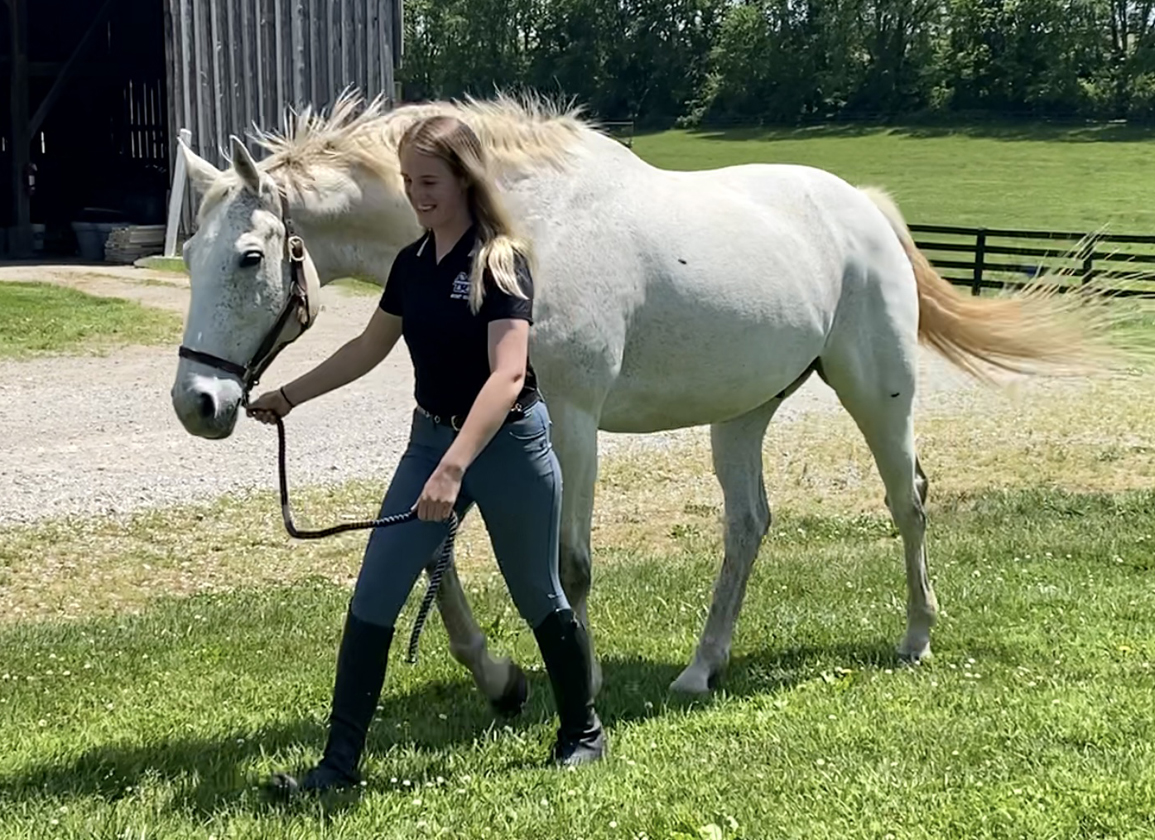
Located in the heart of horse country within walking distance to the small-town community of Midway, the equine program at Midway University is one of just a few in the nation to house an on-campus, working horse farm. With 160 acres and over 30 horses to tend to, students are in the barns each morning and afternoon, including on weekends and holidays, to complete daily chores.

With an emphasis on hands-on learning, most of the program's classes are held outside of the traditional classroom space. This fall, they will be opening a new, 18-stall barn with a built-in, 40-by-60 foot equine classroom to provide even more opportunity for practical experiences for their students.

Midway University's Dean of the School of Business, Equine and Sport Studies Mark Gill said the real-life situations their students go through daily have led to an increasing demand for their graduates as employees.

“In the last several years, we have had 100% of our students fully employed in the equine industry upon graduation,” Gill said. “One of the reasons why our students are so sought after is that they have a great deal of experience by the time they leave our farm. We're able to bring horses into the equine classroom and have hands-on activities as part of the instruction. Students learn how to drive tractors. They can back up horse trailers. They're taking horses to and from lessons throughout the day. They're involved in every aspect of running our farm.”

“One of the things that is really important in the equine industry is work ethic,” he continued. “We impart that on our freshman and our students quickly learn that they're willing to work at the level expected in the equine industry.”

Asked what applicable skills she has learned during her time at Midway, Ibbotson rattled off a lengthy list.

“Anything from wrapping and bandaging legs, giving IV and IM [injections], knowing when to deworm, knowing which medications are used for what, the anatomy of a horse, rehabilitation modalities and a whole load of other things that really help someone going into that career.”

Students are required to complete an internship during their four years in the program to gain additional experience and make connections in their specific area of interest. Last year, Ibbotson interned at Margaux Farm and spent time working in their rehabilitation program.

The basis of Midway University's growing equine program is their on-campus, in-person program, which currently has about 120 students and includes three different pathways: equine science, equine management and equine rehabilitation. In addition, their MBA program with a concentration in equine management is geared toward professionals in the equine industry moving into managerial roles. This fall, they are also launching a new, fully-online Bachelor of Science degree in Equine Business and Sales.

While the university in its entirety has seen record growth in recent years, it wasn't long ago that the college was facing millions of dollars in debt and serious enrollment decline.

Students gain hands-on experience working with the 37-horse herd at Midway University | Katie Petrunyak

John Marsden, Ph.D., stepped on as President in 2013. He implemented several major changes, the first being a transition to co-education. Prior to 2015, the school was the only women's college remaining in Kentucky. Since the transition, total enrollment has nearly doubled from under 1,000 students to over 1,800 last year. The name of the school was also changed from Midway College to Midway University to reflect expanding graduate programs.

With the increase in enrollment, Marsden turned his attention to campus improvements. One of the institution's oldest buildings from the mid-19th century was converted into a third residence hall. The campus also benefitted from the addition of an athletic field house, an admissions welcome center, a baseball stadium and tennis courts.

“All of this was done without incurring any debt,” Marsden said. “Rising debt levels and decreasing enrollment are two of the biggest challenges among private colleges in the United States, but we have been paying down our debt. We've paid it down 38%.”

Marsden added that despite the improvements, Midway University remains financially accessible to prospective students.

“We are one of the most affordable institutions in the state,” he said. “Our graduate programs are the most affordable in Central Kentucky and of the 18 private colleges in the state, our traditional daytime program is the fifth most affordable.”

This year, Midway University is celebrating its 175th anniversary at their annual Spotlight Awards on Thursday, May 26. The funds from this event support ongoing academic programing and student scholarships.  With this year's theme of 'Making History,' they will be honoring two equine industry leaders.

“As part our Spotlight Awards, we honor two individuals,” Marsden explained. “The first award that we give out is called the Pinkerton Vision Award. This year it will be given to Shannon Arvin, who is making history as the first female president of Keeneland. The second individual we are honoring with the Legacy Award, which goes to someone who has made a difference with time, talent and treasure at Midway University. That will be awarded to former trustee and horseman Tracy Farmer.”

John Stuart, founder of Bluegrass Thoroughbred Services, is a current member of the Board of Trustees at Midway University and is looking forward to the institution's bright future.

“I've learned what a truly impressive job President Marsden and his team have done in the past six years to make this school a university that is going places,” Stuart said. “Our horse community probably is not aware of the quality of the equine program at Midway. If we are going to produce enough foals to fill future race cards, we need equine-educated young people to employ in the local community.”

Members of the equine community in and around Lexington have been an essential piece of the equation in Midway University's recent success. Gill said that the experiences and access students in the equine program receive are some of the most influential factors for prospective students.

“Thoroughbred farms have graciously given our students unparalleled access, whether they're coming to campus to speak or inviting students to go to their farms and observe how their operation works,” he said. “We really look at Midway University as a partner with the Thoroughbred industry, and we're proud of the fact that this is really the Thoroughbred capital of the world. We want to help provide the workforce that will continue the Thoroughbred industry's growth in this area.”

The post Midway University Equine Program on the Rise appeared first on TDN | Thoroughbred Daily News | Horse Racing News, Results and Video | Thoroughbred Breeding and Auctions.

Source of original post

TDN Snippets: Week of May 16 – 22

It was certainly a busy week of action on both sides of the Atlantic. Here's a sample of what went on, and what should be on your radar.

Headline Maker…
With Early Voting's Classic win at Pimlico Saturday, the colt became Gun Runner's fifth Grade I winner. It's a remarkable stat for any stallion, especially one so early in his stud career. It looks likely the Three Chimneys stallion will vie with the mighty Into Mischief for the honor of being America's most expensive sire over the next few years.

Ferguson/Natalma Making Waves…
Natalma has been appearing on buyers' sheets here and in the U.K. since 2021 with the investment portfolio, spearheaded by John Ferguson, having purchased 21 fillies and mares at public auction for an aggregate of $4.6 million during that time. Three of these purchases were at Tattersalls July, three at Fasig-Tipton November, 11 at Keeneland November and four at Tattersalls December. Natalma are also active in the private market. Ferguson is currently at Magic Millions selling three mares, via the Arrowfield consignment, all in foal to Frankel. Watch this space…

Wellman The Explorer…
Following the theme of international expansion, Eclipse Thoroughbred Partners' Aron Wellman recently plucked a filly out of Europe, with the guidance of Mike Levy/Jamie Lloyd, and she's now Royal Ascot-bound. Manhattan Jungle (Bungle Inthejungle), trained by the talented Amy Murphy, won a listed race at Vichy (video), France Friday and looks to have a bright future.

Wellman summed it up nicely, “The world is getting so small, particularly in our industry, and it's wonderful to have an Irish-bred filly, who is three-for-three in France and now destined for Royal Ascot in England and will be supported by a strong contingent of American owners. Very cool stuff!”

First (U.S.) Starter, First Winner…
Social media was buzzing Sunday after Tahoma became Justify's first winner, from his first American runner. Craig Bernick's Aspen Grove had run a promising fifth at the Curragh earlier in the day, in what appeared to be a strong maiden.

Tahoma, a $160,000 Keeneland September yearling purchase by Dennis O'Neill, is a half-brother to graded stakes winner Legends of War (Scat Daddy). Legends of War, who won the 2019 GIII Franklin-Simpson S. at Kentucky Downs for brother Doug, was actually named a TDN Rising Star May 23, 2018 at Yarmouth under the tutelage of John Gosden. Legends of War is now back in England standing at March Hare Stud for £4,000.

Appleby Can Do No Wrong…
Native Trail (Oasis Dream)'s win in the G1 Tattersalls Irish 2000 Guineas gave Charlie Appleby/Godolphin its third 2000 Guineas win of the year. What's even more staggering is that they did it with three different horses; Coroebus (English 1000 Guineas), Modern Games (Poule d'Essai des Poulains aka French 2000 Guineas) and now Native Trail. Aidan O'Brien won the three races back in 2002 but with two different horses; Rock Of Gibraltar (England & Ireland) and Landseer (France).

The team at Dalham Hall/Kildangan Stud in Europe better start building new stallion boxes to accommodate the array of stallion prospects Appleby is churning out.

The post TDN Snippets: Week of May 16 – 22 appeared first on TDN | Thoroughbred Daily News | Horse Racing News, Results and Video | Thoroughbred Breeding and Auctions.

Source of original post

Verified by MonsterInsights