This Side Up: A Long Fellow, And The Longest Reign

The bit that most concerns us, naturally, is that the race is not to the swift–albeit ours is a business that will also disclose, fairly reliably, that nor is the battle to the strong; bread to the wise; riches to men of understanding; or favor to those of skill. “Time and chance happen to them all.”

So, yes, we all know that before anything else we require a little luck. But the whole point of Epsom, as the definitive measure of the Thoroughbred, is that while your horse must certainly be swift and strong, he also requires agility and, above all, endurance. And that latter element certainly sets the tone for the 243rd running of what remains, with all due respect to the even older St Leger, the most venerable horserace on the planet.

Because on Saturday, by some poignant alignment of the stars, the Derby will have a far broader reach than has lately been the case in Britain, thanks to two single spans of human life that have indelibly shaped even an institution that has doughtily survived empires, wars and, of course, plagues.

The race is being run in memory of Lester Piggott, the only jockey to win it nine times, whose epic tale drew to a close last Sunday. And it will also be a centerpiece of a four-day national holiday for the unprecedented 70th anniversary of the Queen's accession to the throne.

For a long time, the monarch had hoped to insist that one perennial ritual would retain its place in the Jubilee pageant, but even her indefatigability has its limits, at 96, and she has reluctantly accepted that she will not make it to the royal box at Epsom. Until last year, when social distancing intervened, she had missed only three Derbies since the Second World War.

Though she has won the other four Classics, she has never got closer to the Derby itself than immediately after her coronation, when Pinza had the effrontery to deny the young Queen's runner by four lengths. But that does not alter the fact that her passion for the Thoroughbred, and its proud English heritage, has proved a priceless boon to the sport through a reign that has measured a profound demographic alienation from to its roots in rural life.

The year after Pinza beat Aureole, the teenaged Piggott made his precocious Epsom breakthrough on Never Say Die, who had started life on Jonabell Farm and so became the first Kentucky-foaled Derby winner. Never Say Die! An apt enough maxim, for a man who would serve a prison sentence before coming out of retirement at 54 and winning the GI Breeders' Cup Mile 10 days later. That was such an outlandish tale that we tend to overlook what a last-ditch gamble was Royal Academy, as a yearling, for a trainer with whom Piggott had shared four Derbies in their mutual heyday–all with North American-breds.

In Vincent O'Brien no less than Piggott, then, we see how competitive longevity discloses an element of stubbornness, nearly of obduracy, as the vital spark of all achievement. And we also see it in Frankie Dettori, the only jockey since Piggott to find a niche in British popular culture, though still seven Derbies behind him at the age of 51.

Dettori rides Piz Badile (Ire) (Ulysses {Ire}) for Donnacha O'Brien, who is less than half his age. The Niarchos family must be pretty excited by the possibility of the ultimate dividend from such a bold mating, both sire and dam being out of daughters of Lingerie (GB). That mare herself condenses much the same kind of transatlantic cross-pollination as was integral to O'Brien and Piggott's golden age: her sire was an Epsom Derby winner, by another Epsom Derby winner foaled in Virginia; and her dam, Arc runner-up Northern Trick, was by Northern Dancer from an American family. And while both the parents of Ulysses won Epsom Classics, from top to bottom Piz Badile's pedigree is basically held together by loop after loop of Mr Prospector and Northern Dancer.
So while an Englishman is this week asking you to indulge a parochial theme, it does contain one or two more universal strands. For one thing, all breeders build their families with that same competitive perseverance: a willingness to ride out the inevitable ebb tides and, if you want to breed a Classic winner, a degree of obstinacy in favoring blood that hasn't been diluted by fast-buck fads.

That, as I am always reminding people, is actually a far bigger problem among British and Irish breeders than it is in Kentucky, where they do still want speed to be carried through two turns on the first Saturday in May. The Epsom Derby has paid a price for that, over recent years, but it feels as though we are slowly witnessing a turn of the dial and 17 runners should certainly assure the Queen a fitting cavalcade. One ongoing factor is the emergence of so many promising sons of Galileo (Ire) to contest the succession, many of them relatively affordable. The late king retains his customary footprint in this field, but it tells you everything that his son Nathaniel (Ire)–sire of warm favorite Desert Crown (GB)–is still standing at just £15,000 despite coming up with champion Enable (GB) among five Group 1 winners in his first three crops.
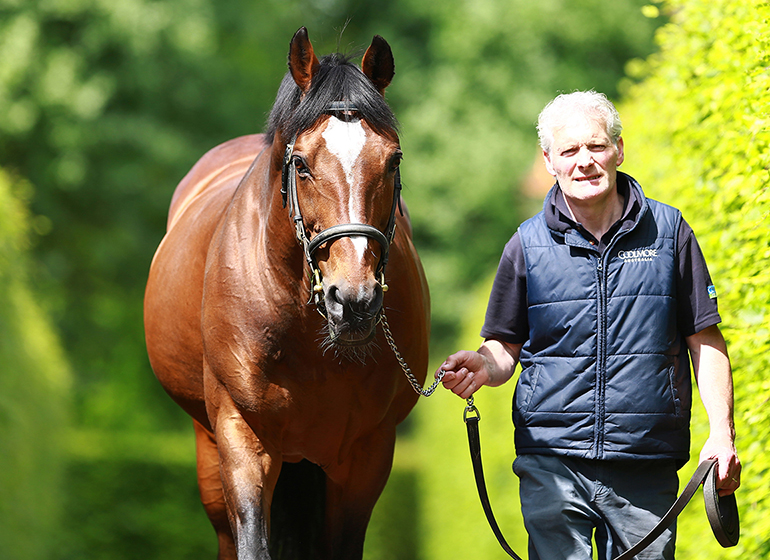
The late Galileo | Coolmore photo


But never say die. Aside from Galileo, Desert Crown's three other grandparents were foaled in North America. In the next generation, the ratio reads one from Britain, seven from America; and the next offers one from Britain, and 15 from America. In its puerile addiction to precocity and dash, and its disdain for stallions like Nathaniel, the European commercial market will eventually drive far-sighted and ambitious breeders back over the water to mine those speed-carrying reserves in Kentucky.

Like all his predecessors, the 243rd Derby winner will be a living, breathing register of selective breeding across eras defined by emperors of the breed like Galileo and Northern Dancer. But even as long a game as breeding is sustained by daily commitment, by the accretion of small decisions over the years. That's not so different from the indomitability we celebrated in Piggott, and the same steadfast adherence to standards being saluted in a Queen born just before Bubbling Over won what was only the 52nd running of the Kentucky Derby.

He became the sire of Hildene, dam of one Preakness winner in Hill Prince and now seventh dam of another, in Early Voting. A long game, then, and a “Long Fellow” too. That was what they used to call Lester, on account of his unwonted height; so let's make one last cultural transfer, and invoke the words of Henry Wadsworth Longfellow. For the same poem that urged us to leave “footsteps on the sands of time”–albeit few of us will leave an imprint quite like those we trace, back through the decades, at Epsom on Saturday–concludes with these lines:

Let us, then, be up and doing,
With a heart for any fate;
Still achieving, still pursuing,
Learn to labor and to wait.

The post This Side Up: A Long Fellow, And The Longest Reign appeared first on TDN | Thoroughbred Daily News | Horse Racing News, Results and Video | Thoroughbred Breeding and Auctions.

Source of original post

Notable US-Bred and -Sired Runners in Japan: June 4-5, 2022

In this continuing series, we take a look ahead at US-bred and/or conceived runners entered for the upcoming weekend at the tracks on the Japan Racing Association circuit, with a focus on pedigree and/or performance in the sales ring. Here are the horses of interest for this weekend running at Chukyo Racecourse. The penultimate Group 1 event of the spring racing calendar is set for Sunday at Tokyo, which hosts the G1 Yasuda Kinen. Two-time G1 February S. hero Cafe Pharoah (American Pharoah) tries the grass for just the second time in his career, while the bonny mare Lotus Land (Point of Entry) tries to improve on her cracking runner-up effort when last seen in the G1 Takamatsunomiya Kinen in late March. Elsewhere in Japan over the weekend are the first foals to race by the expatriated Beach Patrol and Mind Your Biscuits, among other Japanese stallions:

Saturday, June 4, 2022
5th-CKO, ¥13,400,000 ($103k), Newcomers, 2yo, 1600mT
SATONO MISCHIEF (JPN) (c, 2, Into Mischief–Play Pretty, by Indian Charlie) is out of a daughter of Broodmare of the Year Oatsee (Unbridled), whose notable produce include treble Grade I winner Shackleford (Forestry); GISW Lady Joanne (Orientate); MGSWs Baghdaria (Royal Academy) and Afleeting Lady (Afleet Alex); and SW/MGSP Stephanoatsee (A.P. Indy). Shadai Farm acquired dam Play Pretty for $750K with this colt in utero at the 2019 Fasig-Tipton November Sale. Satono Mischief is bred on the same cross as Grade I-winning juvenile filly Dayoutoftheoffice. B-Shadai Farm


Sunday, June 5, 2022
5th-CKO, ¥13,400,000 ($103k), Newcomers, 2yo, 1400mT
MANIBHADRA (c, 2, Speightstown–Trini Brewnette, by Milwaukee Brew) is the first foal from his dam, a two-time Ontario-bred stakes winner and daughter of Sovereign Award winner Dancing Allstar (Millennium Allstar), herself the dam of Canadian champion female sprinter Summer Sunday (Silent Name {Jpn}). Corser Thoroughbreds purchased Trini Brewnette for $195K at Keeneland November in 2019 and this colt paid most of that bill when hammering to Hideyuki Mori for $225K at KEESEP last fall. Speightstown's 35 winner from 43 Japanese starts includes G1SW Mozu Superflare and GSW Matera Sky. B-Corser Thoroughbreds (KY)


The post Notable US-Bred and -Sired Runners in Japan: June 4-5, 2022 appeared first on TDN | Thoroughbred Daily News | Horse Racing News, Results and Video | Thoroughbred Breeding and Auctions.

Source of original post

There Goes Harvard the Latest Grade I-Winning Homebred for Michael Cannon

Owner Michael Cannon woke up on Memorial Day with a gut feeling. Cannon Thoroughbreds was going to win a Grade I that day.

His inkling didn't come without good reason. The stable's leading earner Smooth Like Strait (Midnight Lute) would be attempting to defend his title in the GI Shoemaker Mile and was slated as the 4-5 morning-line favorite.

Of course as anyone in this business can attest, favoritism doesn't secure a trip to the winner's circle no matter how small the odds. So while Smooth Like Strait had to settle for second in the Shoemaker, it was Cannon's other entry at Santa Anita–the one they considered scratching hours before the race–who made his Grade I premonition come to fruition.

The second-longest shot in a field of five in the GI Hollywood Gold Cup S., There Goes Harvard (Will Take Charge) pulled the upset to win by a length, making him Cannon Thoroughbreds' second Grade I-winning homebred and giving trainer Michael McCarthy his first Gold Cup score.

“I'm shocked that he won,” Cannon admitted as he relived the victory. “I was hoping for third. Until about nine o'clock that morning, we weren't sure if we were even going to run him. It was only a two-week break from his last race and we usually give them three to four weeks, but he looked like he was ready to go.”

Coming off a seven-month layoff this spring, There Goes Harvard ran second in his 4-year-old debut at Santa Anita. He dead-heated for a win in April and scored in a turf allowance on May 14 before stepping up to Grade I company on Memorial Day. Cannon credits jockey Irad Ortiz, Jr. for his hand in the colt's accomplishment.

“Irad was a gamechanger,” he said. “He did a great job. There were some serious horses in there and it was not an easy win. I'm still in shock, to be honest.”

Now that There Goes Harvard is making top headlines, Cannon is constantly asked about the story behind the colt's name.

“Everybody asks me and I feel like a bad parent every time I answer,” he said with a laugh. “When my kids say something dumb, I always joke with them and say, 'there goes Harvard.'”

Based about two hours north of Las Vegas, Cannon has been involved in racing for decades. He started purchasing and syndicating racehorses after graduating college, but soon decided to get “a real job.” He made a career in entertainment lighting and is now the President and CEO of Cannon Nevada, a venture capital firm.

Michael Cannon | photo courtesy Michael Cannon

When Cannon decided to re-enter the Thoroughbred business, he committed to a new business plan. He would purchase broodmares and establish a breed-to-race operation. One of his very first broodmare purchases, Beautiful Lil (Aptitude), is now the granddam of his stable's top performer Smooth Like Strait.

Several years after launching his new operation and with the assistance of bloodstock agent Kathy Berkey, Cannon purchased There Goes Harvard's dam Soul Crusader (Fusaichi Pegasus) for $75,000 at the 2016 Keeneland January Sale. While There Goes Harvard was somewhat of a standout as a foal a few years later, Cannon said that Soul Crusader tended to throw small foals and did not live up to expectations as a producer. He sold the mare two years ago.

“There Goes Harvard was a little different than her other foals, but there was really nothing special about him in the first year,” Cannon admitted. “He was definitely bigger than the rest, but I didn't think he would ever be a Grade I winner, that's for sure.”

Even after There Goes Harvard was sent to trainer Michael McCarthy, it took some time for him to show his true potential.

“He was actually a bit of a handful,” Cannon explained. “Smooth Like Strait was always a real professional and did everything right, but when this colt first got to Michael, he was doing everything wrong. He was difficult to manage and Michael really had to work with him to get him turned around.”

It took six tries for There Goes Harvard to break his maiden, finally getting the win in his first attempt on turf. When he ran second two starts later in the 2021 Runhappy Ellis Park Derby, Cannon said they got a feel for the homebred's true potential. He dealt with a chip soon after and sat on the sidelines for the remainder of the 2021 season, but has improved steadily in his return this year.

“What's great about this horse is that he's probably better on the turf than the dirt,” Cannon said. “It's nice to have a horse that we know can do both.”

Asked where There Goes Harvard could end up next, Cannon replied slyly, “The one thing I know about Michael [McCarthy] is that you don't discuss that until a couple weeks down the road.”

Cannon acknowledged that he was disappointed with Smooth Like Strait's runner-up effort on Monday, given that the 5-year-old has now finished second or third in his last six starts, but he said that their end goal for this year is still a return to the Breeders' Cup, where Smooth Like Strait ran second in last year's GI FanDuel Breeders' Cup Mile.

“He tries so hard every time and you feel bad that he hasn't gotten it done in the last few races,” Cannon said. “He's in great shape and he just got caught up in a fast pace [in the Shoemaker]. We will probably follow the same races with him as we did last year at Del Mar.”

Cannon won't get too down on one string of bad luck. After all, it was just a few years ago that his stable had no graded stakes winners, which wasn't for lack of trying.

“Before these last two years, I had very limited success,” he said. “I don't take anything for granted now because I know how quickly you can go backwards.”

Cannon plans to stick with his breeding-to-race operation. He said he tried giving the commercial market a chance, but quickly learned that it wasn't what he wanted to focus on. He forces himself to keep a broodmare roster of just six members and currently has a collection of 14 racehorses and future racehorses, including the 2-year-old full-brother to Smooth Like Strait in training with Michael McCarthy. At his cattle ranch at home in Nevada, one pasture is set aside for his stable's retired racehorses and is now up to eight residents.

As Cannon told TDN in a story on Smooth Like Strait last year, half of the earnings from his racing stable are set aside for The Special Operations Care Fund, a non-profit organization that provides support to soldiers who have served in special operations forces. While those earnings may have seemed insignificant to Cannon when he was first starting out, with two colts performing at the top of their divisions this year–and both coming in the money, appropriately, on Memorial Day–those funds are quickly adding up.

Asked about his secret to building a program that can produce two Grade I winners within a year, Cannon replied with a laugh and said, “I wish I knew the secret because it has taken me a long time to figure this out. Honestly, the secret is patience, staying in your lane in terms of developing a program and sticking with it, and hiring good people and listening to their advice. Then you just hope it all works out.”

The post There Goes Harvard the Latest Grade I-Winning Homebred for Michael Cannon appeared first on TDN | Thoroughbred Daily News | Horse Racing News, Results and Video | Thoroughbred Breeding and Auctions.

Source of original post

Thursday’s Insights: Full to Good Magic Debuts at Belmont

4th-BEL, $90K, Msw, 3yo, 6f, 4:40 p.m.
FOR GOOD (Curlin) gets his start for Chad Brown and e Five Racing Thoroughbreds. The $800,000 KEESEP yearling purchase, who is out of MSW and GSP Glinda the Good (Hard Spun), comes from the same Stonestreet Thoroughbreds pipeline that produced juvenile champion Good Magic, who was also campaigned by this colt's connections. Purchased for $1-million at the 2016 KEESEP sale, Good Magic went on to take the GI Breeders' Cup Juvenile and GI Haskell Invitation in addition to finishing runner-up in the GI Kentucky Derby and GI Champagne S. TJCIS PPs

The post Thursday’s Insights: Full to Good Magic Debuts at Belmont appeared first on TDN | Thoroughbred Daily News | Horse Racing News, Results and Video | Thoroughbred Breeding and Auctions.

Source of original post

Verified by MonsterInsights