First-Crop Yearling Previews: Maximus Mischief

The 2022 class of first-crop yearling sires features a diverse batch of Kentucky-based young stallions, including a pair of Breeders' Cup champions, two sons of reigning top sire Into Mischief, five graded stakes winners at two and five Grade I winners on turf. Throughout the course of the yearling sales season, we will feature a series of freshman sires as their first crop points toward the sales ring. Check out the first few editions of our series here.

Buyers will have plenty of opportunity to get a good look at the first crop from Maximus Mischief (Into Mischief – Reina Maria, by Songandaprayer) at next week's Fasig-Tipton July Sale. With a dozen yearlings currently slated to go through the ring for Maximus Mischief, Spendthrift's Mark Toothaker said the young sire is generating quite the commercial buzz.

“I think he's going to have as much hype as any stallion out there,” he explained. “We knew there was a lot of excitement with this horse and we felt like, as the Fasig-Tipton team was doing their inspections, they were going to find a lot of these that they liked. He's a horse that gets the right type of physical. ”

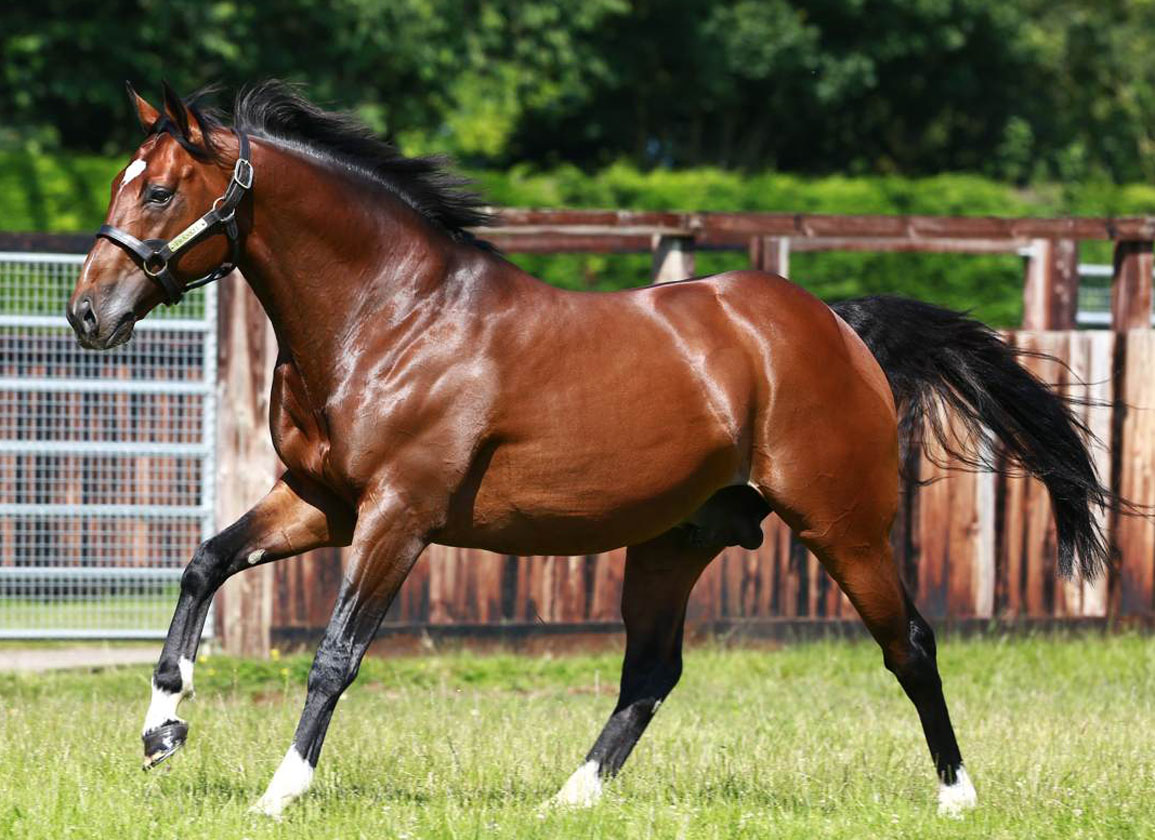
While Maximus Mischief's major selling point for breeders has been the fact that he is by Into Mischief, this son of the remarkable leading stallion offers a different physical than most other sons of Into Mischief at stud. Toothaker said the speedy 'TDN Rising Star'-turned-Grade II winner has continued to fill out since settling in at Spendthrift and now, as a 6-year-old, stands at 17 hands.

“He is my biggest horse,” he said. “For him to win his first three starts, including the GII Remsen S., he was amazing with his speed for a horse that big. But to be an Into Mischief and be that big is even more amazing because normally that's something we don't see a lot. For him to be this massive, stretchy horse, breeders are loving it.”

Toothaker explained that as a unique representation of the Into Mischief line, Maximus Mischief is producing offspring with both the body and the leg that the commercial market demands.

“Breeders are putting something out there that the market wants. You get that great hip and really good Into Mischief body, but also with plenty of leg.”

With a $7,500 stud fee in his first three years at stud, Maximus Mischief has been held to an average of 180 mares each year. It's a book size that Toothaker said fits the stallion and what they hope to accomplish with him.

“I feel like we hit the bull's-eye with him because he's at a price that anybody can afford,” he noted. “It has caused a dilemma because we sell him out, which is a great problem to have, but it's exciting for breeders to be able to get a horse of his quality for that price. Who wouldn't want to breed to a son of Into Mischief?”

Out of a half-sister to Grade I winner Secret Compass (Discreet Compass) and campaigned by Cash is King LLC and LC Racing, Maximus Mischief romped in his first two starts as a juvenile at Parx, winning the first by almost nine lengths under wraps and the second in a similar style with a 98 Beyer Speed Figure. He remained undefeated in the GII Remsen S., but incurred an injury shortly after placing in the GII Holy Bull S. and was forced off the Kentucky Derby trail and eventually into retirement.

“We were pretty determined to land him here at Spendthrift,” Toothaker noted.”We were very fortunate that Chuck Zacney and Glenn Bennett were willing to do a deal with us to insure bringing him here. They've been very, very supportive of Max each year. They've sent mares to him and have been active at the sales buying some.”

At the fall and winter breeding stock sales, Maximus Mischief's progeny averaged $42,777 with 45 of 52 sold. At the Keeneland January Sale, his filly out of Sheza Sweet Lemon (Lemon Drop Kid) sold for $145,000 to Cash Is King and Commonwealth New Era Racing.

Bloodstock agent and pinhooker Renee Dailey said she went into the weanling sales with the goal of coming out with several Maximus Mischief pinhooking prospects.

“We had seen and heard about how their appearance was so much like the Into Mischiefs,” she recalled. “They were very athletic-looking foals that had great walks and strong shoulders and hips. When they were pulled out of the barn, you would not have known it wasn't an Into Mischief.”

Hip 123, Maximus Mischief colt out of Lucy Buckner | Amy Lanigan

Dailey couldn't get her hands on a Maximus Mischief until late in the Keeneland November Sale, but found another prospect in January. Partnering with John Greathouse of Glencrest Farm, she signed the ticket on a colt out of Lucy Buckner (Stormy Atlantic), a full-sister to GISW Stormy Lucy, for $55,000.

“When John and I got him at that price, we looked at each other and high-fived,” she recounted. “We were thrilled. He is a very strong colt. He has a huge hip and shoulder. With Storm Cat on the bottom and Into Mischief on the top, he is bred to be fast and it's a similar cross to GISW Going to Vegas (Goldencents).”

The colt is now preparing to go through the ring as Hip 123 at the Fasig-Tipton July Sale with Four Star Sales.

“I'm just thrilled with how he has come along through sales prep,” Dailey said. “He's a forward, tenacious colt and an extremely athletic physical. I've had him since he was purchased and he just hasn't had a bad day.”

Toothaker said he believes that Maximus Mischief's sales prospects at Fasig-Tipton July will serve as a harbinger for more to come for their sire as the yearling auctions continue.

“Everyone you talk to is saying that they've got a good one,” he said. “They're going to be horses that people can buy right and give them a real chance at the track or back at the 2-year-old sales.”

The post First-Crop Yearling Previews: Maximus Mischief appeared first on TDN | Thoroughbred Daily News | Horse Racing News, Results and Video | Thoroughbred Breeding and Auctions.

Source of original post

This Side Up: Renewal Starts at Grass Roots

If this is seeing the future, then maybe it really will work. Among all these tiny, straggling groups negotiating the arid wastes of the dirt stakes program, we finally reach a true oasis in the GI Caesars Belmont Derby Inv. Here is a field that matches quality with quantity: a win for the owners, and a win for the bettors.

It is also, lest we forget, staged on a benign surface. As such, it is also a win for a whole community that needs to present its way of life to the wider world with absolute confidence. To a degree, you could almost say that the rapid maturity of the elite turf schedule devised by NYRA has become one way for the East Coast to complement the fantastic recent work, celebrated here a couple of weeks ago, on the dirt tracks of California.

In fact, you could even argue that it also dovetails with the progressive aspirations that have just inaugurated the HISA era. We know that some people will cling stubbornly to the wreckage, fiercely opposing federal interference with their constitutional right to treat the training of Thoroughbreds as a branch of pharmacology. But it's good to see so many industry stakeholders beginning to see the bigger picture; to recognize the trouble we've been inviting for ourselves, and to do something about it.


Click the play button below to listen to this week's edition of This Side Up.


And that's heartening, because right now we only have to look around to realize what a special product we have to share, if only we get our act together.

Look at last weekend, and look what's coming down the tracks, and shout it from the rooftops: we have a great game here. Provided we care for them as they deserve–and that includes the provision of scrupulously maintained dirt tracks, and a properly respected turf/synthetics division–we could have no more captivating advocate than these noble horses of ours.

So long as we have Saratoga, we still have a chance. Much as can again be said of Santa Anita, here's a sanctuary from the cares of life to win over even the most surly and snarling of sceptics. And the meet looks more exciting than ever after Olympiad (Speightstown) and Life Is Good (Into Mischief) threw down the gauntlet for the GI Whitney S.

The one pity is that they've dropped all talk of Flightline (Tapit) shipping back across for that race, too. Connections would evidently rather stay in his backyard, this time, even at the cost of a more abrupt step up in distance. We won't reprise our irritation that this huge talent should have become such an extreme example of the modern horseman's dread of actually racing a racehorse. But we all know that while life may indeed be good, it seldom contrives its very best possibilities. And experience sadly tells us that the idea of all three of these horses converging on the same race at the Breeders' Cup, in the same form as now, is a fanciful one.

What we do know is that right here, right now, we could put on one of the great races of our time. Nobody can be complacent about that happening in November, especially if their respective fortunes in the meantime happen to make the Dirt Mile more tempting than the Classic. Of course, we can't expect individual horsemen to base their gameplan on sheer altruism, when they need to redeem such heavy stakes already committed to the industry. But it does just seem a shame that when people start comparing horses to greats of the past, very often they don't see them measured even against the best of their contemporaries.

That became a familiar charge against Frankel (GB), albeit without eroding his status as one of the undisputed giants of the breed. The relentless style trademarked by his stock, in what is proving a no less brilliant stud career, has only heightened regret that he spurned both the Arc and the Breeders' Cup Classic.

Frankel / Juddmonte

But we have long become bleakly familiar with the schism nowadays dividing the industries either side of the pond. The only real trafficking between them today is about plugging the gaps in American grass racing. Frankel's two daughters in the GI Belmont Oaks show that this can be done by participation or trade: one, homebred by Godolphin, mounts a raid from Newmarket; the other was imported from that same town as a yearling. A third way is elaborated, however, by the presence in the colts' race of Stone Age (Ire), a White Birch-bred son of Galileo (Ire) shared by farm owner Peter Brant with partners from Coolmore. It's a massive tribute to the impresarios behind the Turf Triple that once again, as with last year's winner Bolshoi Ballet (Ire) (Galileo {Ire}), this race has been chosen as the next target for Ballydoyle's principal candidate in the Epsom Derby itself.

Yet while the import market for European horses-in-training and yearlings grows ever stronger, it somehow remains impossible even for highly eligible European stallions to achieve commercial traction in Kentucky. Flintshire (GB) (Dansili {GB}) was retired as the highest earner in the history of the Juddmonte program, and supplanted only by a member of his own family in Enable (GB) (Nathaniel {Ire}). Yet during his final spring in the Bluegrass–when his first crop had just turned three, one of its members flying into fifth of 19 in the G1 Prix du Jockey-Club–he was outrageously reduced to just eight mares.

American horsemen increasingly talk a good game about turf, but in practice most of them are no less culpable than Europeans about dirt blood. I know this is a drum I have long since banged to a pulp, but it's worth reflecting that all four of Stone Age's grandparents were bred in Kentucky: the icons Sadler's Wells and Urban Sea obviously stand behind Galileo, while his dam is by Danzig's son Anabaa out of an Alysheba mare. Stone Age's maternal line actually tapers to none other than La Troienne (Fr), but as eighth dam she is also the first not to have been conceived with Kentucky seed.

For sure, some horses are more versatile than others. Tiz The Bomb (Hit It A Bomb), for instance, was plainly born for chlorophyll. His connections were originally talking about a tilt at the Classics in Britain, only to be seduced to Churchill–understandably enough–when he found himself with those coveted starting points. Look closer, however, and you'll see that this horse, too, cautions against a prescriptive view of surfaces: his first two dams are by avowed dirt influences, in Tiznow and A.P. Indy, yet both ended up on turf.

His trainer also saddles recent recruit Classic Causeway (Giant's Causeway), famously one of three colts from the final crop of one of the last of the old school, a crossover force in both careers. As befits a son of the Iron Horse, he is being turned round just two weeks after his debut for the barn. That kind of thing makes Kenny McPeek a real outlier, in this day and age. And that's why, when I see the future, actually I don't see it working at all.

Not, that is, until breeders start renewing the kind of cross-pollination that previously opened such dynamic cycles in the evolution of the Thoroughbred, from Nasrullah going one way to all those sons of Northern Dancer going the other. In those days, we bred robust horses by the constant, mutual invigoration of the gene pool, either side of the water. If cynical, in-and-out, fast-buck trading in the freshman window is producing horses that can only run every couple of months, that's actually a welfare issue. So while we have found one welcome oasis, we must navigate with care if our final destination is not to prove a mirage.

The post This Side Up: Renewal Starts at Grass Roots appeared first on TDN | Thoroughbred Daily News | Horse Racing News, Results and Video | Thoroughbred Breeding and Auctions.

Source of original post

The Funny Farm Comes to Fasig-Tipton

With over three decades of experience in the horse world, breeder Meg Dumaine will record a first when she brings her own consignment to the Fasig-Tipton July Sale of Selected Yearlings. Dumaine will offer three homebred yearlings under her The Funny Farm banner during the one-day auction.

“I have done all phases of this industry and I have run consignments for other people, but I've never sold my own horses,” Dumaine said. “It's just sort of coming full circle, from planning the mating, being there for the breeding, foaling the foal and raising it and prepping it. It's the last step in the cycle if you're not going to go any further and race them.”

Dumaine, who grew up just outside Boston, loved horses right from the start.

“My mother says my first words were, 'I want a horse,” Dumaine recalled. “That's the story I grew up being told. And I fought desperately to have a horse, against lots of parental opposition. As soon as I was old enough to buy one and support it myself, I did. I did U.S. Pony Club until I aged out of that and I am still active with the local Pony Clubs here working with younger kids. I just always wanted to do something with horses.”

Dumaine left New England for warmer climes in the late 1970s and has been living in the Bluegrass of Kentucky ever since.

“I didn't want to stay in New England where the winters were so long and the riding season was so short,” she said. “Especially for somebody who loves to ride outdoors. I moved here in 1979 when I attended UK. I never left.

“But I never finished UK, either,” she added with a chuckle.

Dumaine began breeding horses over 30 years ago, but determined to take a break from the pursuit until she could do it right.

“I was breeding years ago while I was galloping and breaking horses for a living and foaling mares,” Dumaine said. “They were cheap junk. And when I quit doing cheap junk, I swore I would never do it again until I could afford to do something that, at least on paper, looked like it might be worth something.

“I came into a little money when my parents died and stock certificates were really boring, so I decided to play with a little bit of it.”

She made her first move at the 2017 Keeneland November sale, where she acquired the dams of all three of her July offerings. She purchased the unraced Picardia (Stormy Atlantic), a half-sister to Grade I winners Lear's Princess (Lear Fan) and Pretty City Dancer (Tapit), for $350,000; stakes winner and multiple graded-placed You Bought Her (Graeme Hall) for $250,000; and stakes-placed Conquest Superstep (Super Saver), a full-sister to graded winner Inside Straight and half to graded winner Dance Daily (Five Star Day), for $150,000.

“I decided if I was going to do it, it had to be a team effort made up of people a lot smarter than me,” Dumaine said of that trip to Keeneland five years ago. “I reached out to an old friend, Dan Rosenberg, and he helped me with a long list coming down to a short list as we walked around at Keeneland. And these are the ones that the hammer fell on.”

The Uncle Mo colt Picardia was carrying in November 2017 sold for $410,000 at the 2019 Fasig-Tipton October sale, while You Bought Her's colt by Distorted Humor sold for $270,000 at the 2020 October sale.

Dumaine currently has a broodmare band of five Thoroughbreds at her The Funny Farm in Bourbon County and while she sees the most potential for making money within Kentucky's Thoroughbred industry, she is by no means breed exclusive.

“My interest is in horses,” Dumaine said. “I've bred sports horses, I've done driving horses, I've done dressage horses, I like draft horses. I have a field full of American miniatures. It doesn't matter to me. I'm not a breed snob.

“I love the birth process with the mare,” she continued. “I love being there for the foaling. I love getting my hands on foals. And going through those phases of 'I'm scared, I'm scared. You're a predator' and then building that confidence with them. The shaping of that young mind, that process. That's not specific to the Thoroughbred, but in this part of the country, it's the thing to do. It is where there is an industry and the potential for making some money.”

The Funny Farm's July consignment kicks off with a filly by Munnings out of Picardia (hip 154) and continues with a colt by Street Sense out of You Bought Her (hip 228). The trio is rounded out by a filly by Ghostzapper out of Conquest Superstep (hip 280).

“I am confident in them,” Dumaine said of the group. “I don't think anybody knows which one is going to be a racehorse until they get head to head with another horse and you see if they are going to dig in and go. But I know these horses are sound. I know they are clean and their X-rays are good and their scopes are good. They've never had horrible mishaps and they have been handled well. They are straightforward horses with good, athletic walks. They are the kind of horses I would want to buy if I was going to buy a racehorse prospect.”

As for her first attempt at consigning her own horses, Dumaine said, “I know I can do it on a small scale in the right venue. I don't feel like I could take my horses to Keeneland in September and sell them myself and be successful. I feel like, unless you  have that one horse who is the superstar that everyone is talking about, it's too easy to get lost among 3,000 horses. The buyers have to take horses off their lists somehow and not knowing who the consignor is could be enough.”

The Fasig-Tipton July sale will be held at the company's Newtown Paddocks next Tuesday with bidding beginning at 10 a.m. Next Monday, Fasig-Tipton will host its July Selected Horses of All Ages Sale. Bidding for that auction begins at 3 p.m.

The post The Funny Farm Comes to Fasig-Tipton appeared first on TDN | Thoroughbred Daily News | Horse Racing News, Results and Video | Thoroughbred Breeding and Auctions.

Source of original post

Charge It to Granddam’s Account

This whole industry, as I've often remarked, turns on a delicate pivot. We need pedigree to hold up sufficiently for the big investors to stay in the game, and incidentally to keep the rest of us in business; but we also need a sufficient number of unaccountable aberrations for the little guy to feel he always has some kind of chance, as well. If the top lot at Keeneland September Book I won the GI Kentucky Derby every year, then almost the whole pyramid beneath would collapse. But nor can we afford a Rich Strike (Keen Ice) to turn everything on its head too often, either.

This is why, when it comes to blue hens, we need two types of Lady in our lives. We need Leslie's Lady (Tricky Creek), the $8,000 daughter of a mare once claimed for $5,000 and a stallion who ended up in New Mexico. And we also need Take Charge Lady (Dehere), who was sold for $4.2 million after an elite racetrack career and has proved worth every cent.

In hailing yet another stellar talent under Take Charge Lady in her grandson Charge It (Tapit), we must remember that there is no more cherished tool in pedigree analysis than hindsight. Since we tend only to study the backgrounds of horses that excel sufficiently to claim our attention, it's difficult to avoid post-rationalization. Sure enough, I have often enjoyed demonstrating how Leslie's Lady was actually saturated with genetic quality a couple of generations down.

Given the mosaic of influences behind every Thoroughbred, we hardly ever find ourselves looking at the pedigree of an elite animal and discovering absolutely nowhere to hang our hat. Conversely, however, we seldom consider the countless duds to ask just what went wrong, when their pages often offer far more obvious hooks for quality.

There's an implicit assumption that the fulfilment of genetic potential has been thwarted by the fallibility of our own intervention, which can unravel a Thoroughbred's development at so many stages: foaling, raising, feeding, breaking, training.

Personally, however, I suspect that we're better off admitting that much of what we do will always be contingent on mystery. Of course, you're welcome to pay for a software program that claims to reconcile an infinite number of imponderables into some kind of system. It's your money, and we'll see you on the racetrack. But anyone who has met my charming, cultured and handsome brother will confirm what every Thoroughbred breeder knows, that even full siblings won't necessarily have the slightest thing in common.

It is now a couple of decades since William Schettine banked exactly the same sum for consecutive yearling fillies out of an unraced Rubiano mare he had bought for $42,000 at the 1998 Keeneland November Sale. The first had arrived with the mare, in utero, and was sold to Kenny McPeek for $175,000 at Fasig-Tipton's July Sale. Schettine had obviously liked her, because he had sent the mare straight back to Dehere. This time, the resulting daughter went to Keeneland September where, again offered through Bluewater Sales, she realized the same price from G. Watts Humphrey Jr.

Though named Uplifting, she fell rather flat as a runner, failing to break her maiden in a dozen attempts. Nonetheless her owner was able to cash out for a nice profit, for $450,000 to Glen Hill Farm at the 2004 Keeneland November Sale. Her sister with McPeek having meanwhile turned out to be none other than Take Charge Lady, winner of 11 of 22 starts (including three Grade Is) and nearly $2.5 million for Select Stable.

The more illustrious sister had actually been sold just minutes before in the same ring with a Seeking The Gold cover. As we've already noted, she realized nearly 10 times as much.

Now the only rule in this game is that there are no rules. Just because an identical pedigree had functioned so much better in Take Charge Lady, on the racetrack, it remained perfectly feasible that Uplifting could parlay their genes more effectively in their second career. In the event, however, this has proved one of those occasions when the market's assumptions, about the replication of ability, would be thoroughly vindicated.

Uplifting had been in foal to Came Home when she changed hands. The resulting filly was unraced before making little impact as a producer, and likewise the Smarty Jones filly Uplifting delivered next, who was discarded for $3,200. The mare was then given a chance with Medaglia d'Oro and their gelded son, while he did win a couple of times, ultimately descended to mediocre claiming company. By that stage Uplifting had been culled for $50,000, soon after delivering what unfortunately proved to be her final foal, a minor winner by Rock Hard Ten.

For all concerned, then, Uplifting proved a thoroughly deflating experience. In the meantime, her sister has founded one of the great dynasties of our time.

The most obvious point of departure is that Take Charge Lady was routinely given opportunity commensurate with the cost of her acquisition by Eaton Sales. Okay, so her first date after delivering her Seeking The Gold filly was with Fusaichi Pegasus (then still a six-figure cover); but her remaining eight named foals were by Storm Cat, A.P. Indy, Unbridled's Song, Indian Charlie, War Front (three times) and American Pharoah.

Three of these emulated their dam as Grade I winners: Will Take Charge (Unbridled's Song) in the Travers and Clark H.; Take Charge Indy (A.P. Indy) in the Florida Derby; and As Time Goes By (American Pharoah) in the Beholder Mile earlier this year. Meanwhile that first foal by Seeking The Gold, Charming, not only instantly recouped $3.2 million as a yearling but then contributed lavishly to her dam's legacy despite curtailed careers both on and off the track. Just five named foals included two elite performers in Omaha Beach (War Front) and Take Charge Brandi (Giant's Causeway), herself since dam of this year's Jerome S. winner Courvoisier (another Tapit).

By the time Take Charge Lady's daughter from the final crop of Indian Charlie arrived at the 2013 September Sale, her page was already decorated by Will Take Charge and Take Charge Indy. With residual value duly guaranteed, the filly was recruited for $2.2 million by Mandy Pope of Whisper Hill Farm, who named her I'll Take Charge. Confined to five starts, she showed fair ability (won a Belmont maiden) before commencing her second career and has wasted little time in coming up with a colt eligible to recover her cost in Charge It, her second foal. (The other is a daughter of Medaglia d'Oro, also retained by her breeder. She has required patience, now four, but has suggested the ability to win a race, again placed at Monmouth only last week).

The imposing gray Charge It could obviously have made good money as a yearling, but he looks like repaying the gamble of his retention for Pope's racing division. Unraced at two, thanks partly to an eye infection, he progressed quickly enough to run second in the GI Curlin Florida Derby, but remained pretty raw on the first Saturday in May. He apparently displaced his soft palate anyway, but was sensibly given an easy time once his chance had gone and, regrouping for the GIII Dwyer S. last Saturday, outclassed a short field by a jaw-dropping 23 lengths. He's clearly going to be a force in what is promising, after a messy Triple Crown series, to prove a dynamic second half of the year among the sophomores. Indeed, his 111 Beyer at Belmont is the top of the crop to date.

In the current context, it requires some effort to take a step back and see what lurks beyond the neon presence of his granddam in Charge It's pedigree. On doing so, however, you notice at once the branding of a second mighty mare. For Tapit's dam Tap Your Heels (Unbridled) is, of course, out of the celebrated Ruby Slippers (Nijinsky)–whose son Rubiano (by Unbridled's sire Fappiano) gave us Take Charge Lady's dam Felicita.

Through a double dose of Rubiano, interestingly, Ruby Slippers also has a top-and-bottom footprint in Omaha Beach, arguably the most brilliant member of this clan: in counterweight to Felicita (third dam, as with Charge It), his sire War Front is out of a Rubiano mare.

Tapit, meanwhile, already has a monster talent out of an Indian Charlie mare in Flightline. (Pope and her team wisely bred I'll Take Charge back to the Gainesway phenomenon after she delivered an Into Mischief colt this spring). Indian Charlie's record as a broodmare sire has also been lately enhanced by siblings Mitole (Eskendereya) and Hot Rod Charlie (Oxbow). In terms of distaff influence, however, few modern stallions have been more abundantly qualified than the sire of Take Charge Lady herself. Dehere is by one outstanding broodmare sire in Deputy Minister, out of the daughter of another in Secretariat.

Take Charge Lady's dam Felicita, as noted, was unraced but her siblings included a couple of bright streaks of green, in a Group 1-placed juvenile in Europe plus the dam of GII Breeders' Cup Turf Sprint winner Chamberlain Bridge (War Chant). That figures, their mother being by Blushing Groom (Fr)–himself, of course, another killer broodmare sire.

Besides Take Charge Lady, Felicita gave us a couple of minor graded stakes operators–one of whom (by Lear Fan) became a triple black-type producer, notably with Grade II winner/Grade I runner-up Straight Story (Giant's Causeway), also on turf. But some excellent covers, for instance by A.P. Indy twice and Deputy Minister, proved less productive. And, as we've already elaborated, repeat matings with Dehere could not have yielded more contrasting results.

Take Charge Lady, sadly lost to foaling complications in 2018, has founded a dynasty that only continues to proliferate. Omaha Beach, having received all the support he has been priced to tempt, surely has a massive chance in his new career, having exceptionally spanned his Grade I success across six and nine furlongs in the same season. And Charge It, if he can build from here, will similarly bring one of the best families around into the competition to succeed an ageing sire.

Yet how perplexing, to witness all this, for those who invested in her sister. Even our old standby, hindsight, can't really help them this time.

The post Charge It to Granddam’s Account appeared first on TDN | Thoroughbred Daily News | Horse Racing News, Results and Video | Thoroughbred Breeding and Auctions.

Source of original post

Verified by MonsterInsights