Patience is Key as Tessa Bisha Develops Next Class of Cox Stable Stars

Impressive GIII Sanford S. victor Mo Strike was the first Brad Cox-trained 2-year-old to make it to the winner's circle at Saratoga this year, but the son of Uncle Mo probably won't be the last. At last year's meet, Cox saddled five juveniles winners at the Spa, including the future multiple stakes-winning filly Bubble Rock (More Than Ready).

In recent years, the Cox barn's arsenal of talented 2-year-olds has rapidly developed in terms of both quality and quantity. While many of the stable's runners have reached future success alongside their back-to-back Eclipse Award-winning trainer, nearly all of them received their early schooling at Keeneland under Cox's assistant trainer Tessa Bisha.

Mo Strike was one of the first juveniles to arrive at the Brad Cox barn at Keeneland this spring, putting in three recorded works in May. When the colt showed early talent, he was among the first group that Bisha sent on to Churchill Downs. A few weeks later, he broke his maiden there on debut and is now pointing toward the GI Hopeful S.

Bisha is passionate about training 2-year-olds. While she enjoys overseeing the older horses, she said that they usually have a good handle on their job already. With 2-year-olds, however, she has the opportunity to teach them and get their racing career off on the right foot.

“I'd say judging the two-year-olds is the biggest part of my job–making sure that they get on the right pathway for success for whatever life has in store for them as far as racing goes and I feel like beyond that as well,” Bisha said. “What I look for is I want them to be comfortable with what we're asking them to do. They need to come in with an open mind and a good attitude, and we try to help them get there if they're not when they come in. We go back to the gate early and often and we make it a laid-back and calming experience. We really focus on making everything a good experience for them.”

Every year after the Keeneland Spring Meet has wrapped up, Bisha's incoming class of 2-year-olds starts to arrive. During her busiest months of May and June, she will have up to 85 juveniles under her care. The most precocious among the group will head to the Churchill Downs race meet and later, other promising youngsters will ship to Saratoga. When training at Keeneland concludes for the summer, the remaining pupils will stay under Bisha's care either at Ellis Park or Turfway Park.
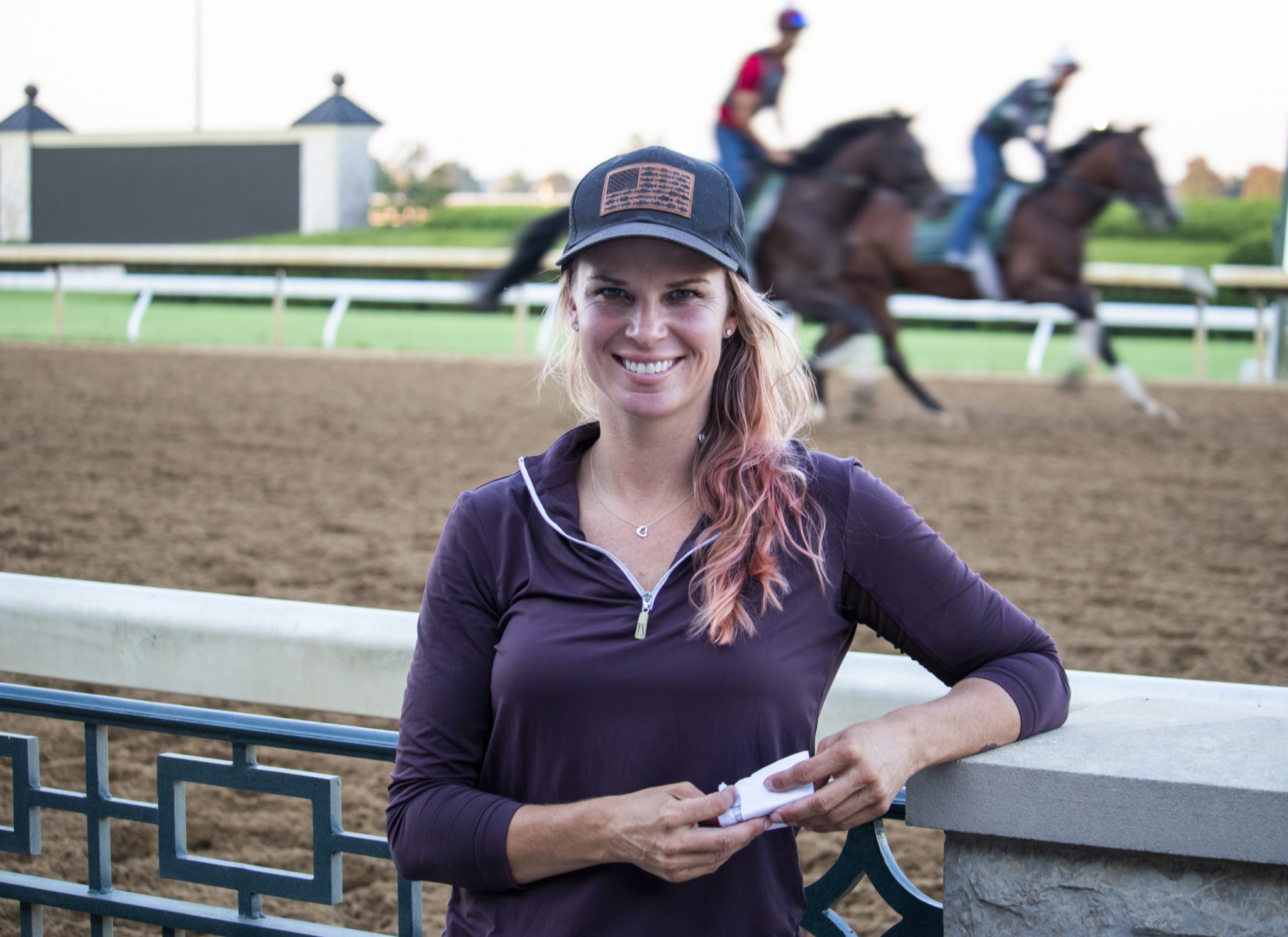
Tessa Bisha oversees a morning of training at Keeneland | Sara Gordon

“It's a bit of a revolving door in that sense,” she said. “We really try to watch them breeze every week without trying to say if this horse is going to win the Derby or if it's going to be an absolute bust because they can grow and develop so much. They love proving you wrong and showing you how little you know, so we try to make sure that they all have the opportunity to basically become the best individual they can be with whatever talent and heart they bring to the table.”

With that mindset, Bisha said she aims to keep an open mind when a horse joins her stable, regardless of any reputation that might precede them.

“You have to create an environment where they know what's expected of them,” she said. “With the babies, you have an opportunity to develop them into being an individual that's not too tough on the track, not silly in the gate and not fractious in the barn. If you can get them to act right, they're usually kinder on themselves and handle their job better.”

Bisha first began working for Cox in 2016 as an exercise rider before taking on the role of assistant trainer. In her first year overseeing the incoming 2-year-olds, she estimates that she had about 30 or 40 juveniles in her care. When stable star Monomoy Girl (Tapizar) came onto the scene, the influx of new trainees began soon after.

With the growth of their program, Bisha said that she has had to evolve her managerial role. She finds herself spending more time in the office checking and rechecking registration papers and set lists, going over charts with Cox, and putting in notes from blacksmith visits or for vaccination schedules.

“We have a staff that helps with all that, but I always feel better if I have a hand in it too,” she admitted. “The more people that can check the boxes, the more you know it's thoroughly done.”

Countless top-level horses have been under Bisha's care since Monomoy Girl's outstanding career. Essential Quality (Tapit) will always be one that stands out to Bisha. The four-time Grade I winner spent his early days at Keeneland and returned to Lexington to race several times during his juvenile and sophomore campaigns.

“He came in here and was just head and shoulders above everybody else,” Bisha said. “Things with him were really streamlined, so there was no guesswork. He followed his own mind and liked to do his thing, but for the most part he never missed a work, he went straight to the races, and that was just him.”

Asked which horses she is most proud to have had a hand in bringing up, Bisha named off a few trainees that required a bit more legwork. One recent favorite is GIII Ohio Derby winner Tawny Port (Pioneerof the Nile), who was in her care almost all of last year as a juvenile.
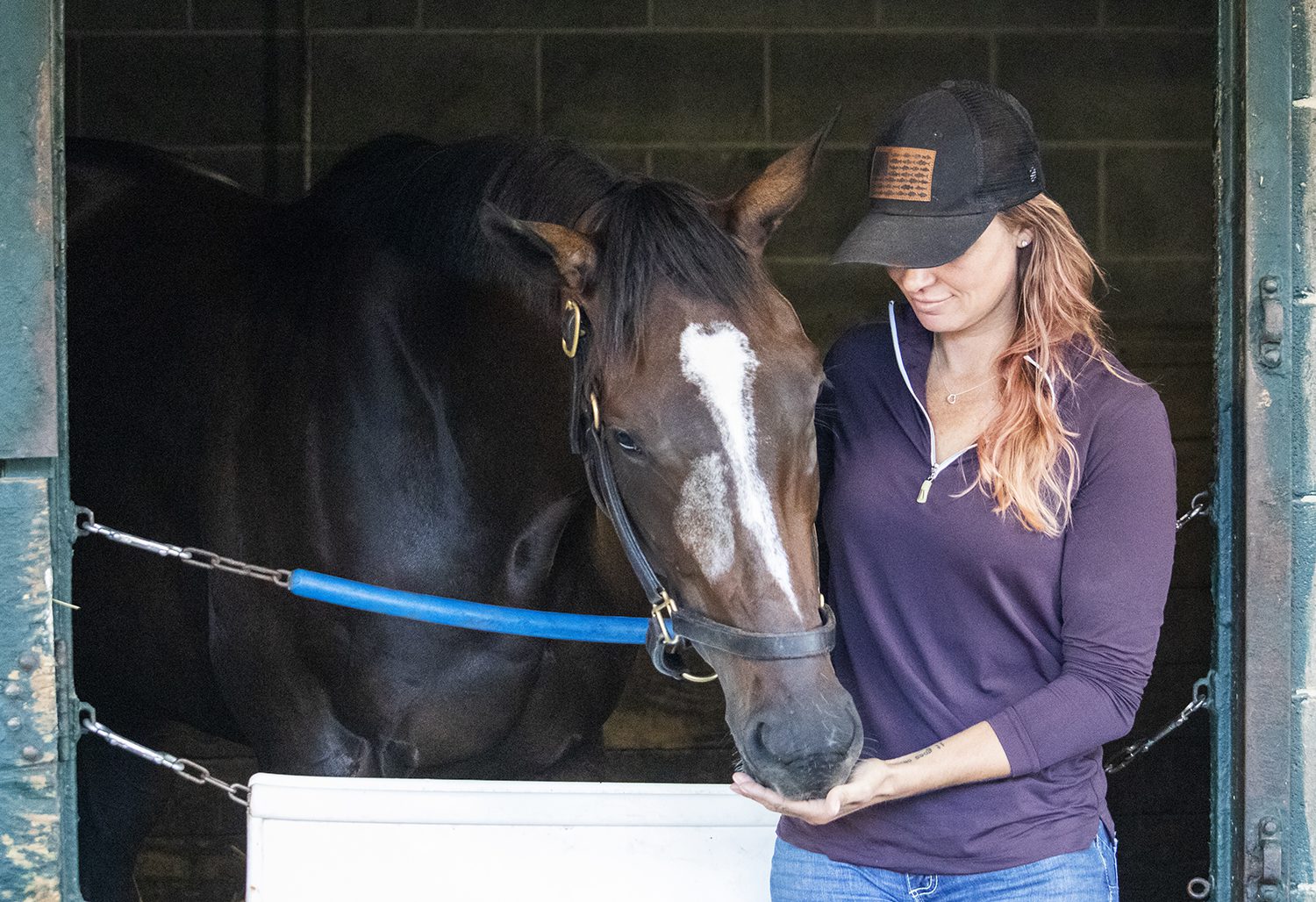
Tessa and Grade III stakes winner Bubble Rock (More Than Ready) | Sara Gordon

“He actually broke his maiden at Turfway over the winter,” she recalled. “I think those types of horses are really rewarding because they have more of, I guess a long-shot feel in our barn. To know that you helped develop them and you let them go on their schedule, that can be very hard, but it's a big success when it works out.”

Bisha said that as their program has continued to develop, one thing she believes they do best is keeping an open mind when it comes to helping their trainees progress.

“When we launched into this 2-year-old program and it started to really take off and get the numbers behind it, Brad and I would have heated discussions over how it was working out and what we were seeing,” she said. “After horses showing us how wrong we were and us eating crow a few times, I think we kind of learned that you really just have to let the horse develop and show you who they want to be.”

Bisha explained that every year, they make an effort to try something new or use a certain tool more frequently–maybe putting blinkers on more readily for a workout, warming up without the pony with a first-time starter, or going back to the starting gate one extra time before breezing.

“It might just be something small, but we try to stay open minded and focus on improving all the time and not just using our ego or what we think we know to get in the way of improving the program,” she noted.

Last year, Bisha was a finalist for the TIEA Dedication to Racing Award. Prior to her time with Brad Cox, the Washington native worked at tracks in Southern California and all along the East Coast. These days, as her former pupils are making headlines at high-profile racetracks like Saratoga, she prefers to stay back home in Lexington training up the next class of future stars.

“I've been to a lot of different tracks so I feel like I've seen enough and done enough to where I'm pretty content just staying here and doing this,” she said. “I don't mind traveling, but I find myself most fulfilled by training the 2-year-olds, so I don't feel any need to stray away from that.”

The post Patience is Key as Tessa Bisha Develops Next Class of Cox Stable Stars appeared first on TDN | Thoroughbred Daily News | Horse Racing News, Results and Video | Thoroughbred Breeding and Auctions.

Source of original post

The Week in Review: Penny Breakage a Welcome Change, but Not a ‘First’

When the .69-to-1 favorite returned $3.38 to win at Ellis Park in the first race on July 15, the to-the-penny payoffs represented a massively positive paradigm shift for horseplayers. Under a new Kentucky law that eliminates dime breakage at the state's tracks, bettors will no longer be subject to the disadvantageous, industry-wide practice of down-rounding that, in the above instance, would have sliced the return on that winning $2 wager to $3.20.

Yes, penny breakage looks a bit odd to the eye. But getting used to the concept will be worth it.

The Thoroughbred Idea Foundation (TIF), which spent four years championing this cause and advocating for any industry entity to make the change, estimates breakage at roughly 0.45% of the nation's total handle.

“That suggests breakage totals at least $50 million per year,” a 2018 TIF study reported, explaining that instead of being retained by tracks, states, or purse accounts, the rightful return of that money to bettors has the potential to generate additional wagering. “We estimate the betting churn from breakage to total at least an additional $200 million in annual handle.”

Those increases could nudge even higher if place and show betting suddenly become more attractive (because the returns on those bets will be greater, percentage-wise). In America's competitive wagering landscape, you'd think that other racing jurisdictions would be quick to follow Kentucky's lead.

There's only one misconception about Kentucky's laudable move to penny breakage: It's not a “first” as has been widely publicized.

In fact, Kentucky itself was among a handful of states that mandated penny breakage nearly a century ago, when pari-mutuels first began replacing on-track bookmakers.

In 1927, Kentucky and Maryland were the two only states with legalized pari-mutuels. The takeout rate for both states (in an era when only win-place-show betting existed) was 5%, with dime breakage.

Pari-mutuel machines were in use in other states despite not being explicitly sanctioned. In such cases, the public had zero knowledge of how much takeout and breakage were being raked out of the pools.

“In other states the amount of the percentage depends entirely on the greed of the pari-mutuel officials,” wrote nationally syndicated newspaper columnist Frank G. Menke in 1927. “How much was deducted in Florida last winter by each of the tracks is not publicly known. [One track] is purported to have apportioned 20% for itself, [another] 25%.”

Such aggressive pool-scraping, Menke further reported, was exacerbated by the all-too-common practice of track officials literally grabbing money out of the tills and pocketing it before it showed up in the mutuel calculations. At one Canadian track, he wrote, mutuels officials made a $10,000 error one afternoon by overpaying bettors. It simply made up the difference the very next day by upping the takeout and liberally rounding down the breakage.

“If such an act is not deliberate theft, then what is theft?” Menke asked rhetorically.

When Illinois codified its new mutuels law that went into effect July 1, 1927, it tweaked the percentages that were standard in Kentucky and Maryland. It set the takeout higher (6.5%), but mandated penny instead of dime breakage.

Half a year later, the Louisiana Jockey Club also saw merit in abandoning dime breakage, and the issue was a big enough deal that the New York Times reported on it. Starting Jan. 2, 1928, the Fair Grounds swapped out a 4% takeout and dime breakage and replaced it with a 6.5% take and penny breakage.

Louisiana officials calculated that bettors would receive “the same net return” under the penny breakage system. But their belief was that the betting pools would be more secure because the change “would render impossible any charge or insinuation that the mutuel calculations have been juggled via the amount of the breakage to return on winning certificates a smaller amount than would otherwise have been the case.”

It didn't take long after that for Kentucky to revisit how its tracks calculated breakage.

A front-page story in the Mar. 17, 1928, edition of the Lexington Herald proclaimed that, “The penny promises to come to prominence on Kentucky race courses during the coming season. At the meeting of the state racing commission here yesterday, a rule was introduced whereby breakage in the pari-mutuels shall be to the penny.”

At that time, Kentucky staggered its takeouts based on a two-tiered system that took into account the population base around each track. Churchill Downs and Latonia (now Turfway Park) in the more populated parts of the state went from a 5% takeout to 6.5%. The more rurally located tracks at Lexington, Raceland, and Dade Park (now Ellis Park) went from 7% takeouts to 10%.

“The new rule favors the players slightly,” the Herald reported.

Yet penny breakage remained the norm in those three states for only a relatively brief window of time. The Great Depression was a major factor in quashing the concept.

As finances became tighter, some tracks in the penny- breakage states went out of business entirely. Others pleaded with state regulators for permission to start chipping away at the winnings of horseplayers by raising takeout rates and restoring dime breakage so tracks could retain more rounded-down money. When new states began embracing pari-mutuels as a form of “sin taxes” to raise revenues, they wrote laws stipulating dime breakage, which once again became established as an industry standard.

Barely three months after the huge stock market crash of 1929, the Fair Grounds did away with penny breakage to start its 1930 winter meet. In 1934, Kentucky went to a 10% statewide takeout and back to dime breakage at the request of its track operators. Illinois also abandoned penny breakage.

It's interesting to note that when penny breakage first came into vogue in 1927 and '28, the idea made national headlines. When breakage reverted to dimes, newspapers rarely reported on it.

Writing in 1937 about Fairmount Park, the St. Louis Post-Dispatch reported that, “When the [1927] mutuel bill went into effect, the property immediately became a dead loss. It will be different now,” the article said, with takeout set at 9% and dime breakage once again a windfall for the track.

In 1938, penny breakage briefly resurfaced at Rockingham Park as the result of an oddball standoff between the New Hampshire racing commission and “Uncle” Lou Smith, the track's owner.

The New Hampshire attorney general had ruled that, unlike mutuels calculations in other states, Rock could not deduct its dime breakage until it had multiplied a bettor's winnings on a dollar by the number of dollars wagered.

Smith told the New York Times that such a rule “discriminated against the $2 bettors” who comprised 84% of Rockingham's patronage and provided 55% of the handle.

“We are faced with the alternative of closing our track or giving up the entire breakage to avoid discrimination against the $2 bettor,” Smith said. “We voluntarily choose to give up the breakage,” relying on revenue solely from the track's cut of the 10% takeout.

This required the Rock money room to have 220,000 pennies on hand each day to make exact change. The stalemate was resolved in time for the 1939 summer meet, which opened with a takeout hike to 11% and breakage reverting back to a dime.

New York's racing commissioners advocated for penny breakage when legalizing mutuels there in 1940, but they had to settle for nickel breakage (still a significant improvement over a dime). “The general public pays little attention to breakage,” the New York Times dismissively reported when briefly mentioning the concept in its annual recap of the racing season.

Penny breakage then went into a long, long slumber. History is just now repeating itself.

This time around, here's hoping the bettor-friendly “Keep the change!” mentality takes root and grows.

The post The Week in Review: Penny Breakage a Welcome Change, but Not a ‘First’ appeared first on TDN | Thoroughbred Daily News | Horse Racing News, Results and Video | Thoroughbred Breeding and Auctions.

Source of original post

Imports a Key Pillar of Phil D’Amato’s Winning Strategy

Plenty of imports into the clogged Southern California shipping terminals of Los Angeles and Long Beach have been left idle these past few months, collateral damage in a supply-side bottle-neck.

Imports into the Southern California stable of Phil D'Amato, on the other hand, have been far more effectively commandeered.

“It's a really good strategy for owners to help them make money and have fun in the process,” says D'Amato, caught mid-morning between scrutinizing his trainees jog a dusty Santa Anita horse-path under a blazing hot sun and a scouting trip to Del Mar in preparation for the annual coastal caravan south.

D'Amato's “strategy” is a reference to his equine pipeline from Europe which, unlike the Nord Stream twins out of Russia, doesn't appear at risk of any imminent shut-off–not if recent results are any guide.

D'Amato's record-setting 67 victories this past Winter-Spring meet at Santa Anita–57 of them on the turf and 16 of them in stakes–included the ex-Euro winners of the GII Royal Heroine S. in Going Global (Ire) (Mehmas {Ire}), the GIII Senorita S. in Island of Love (Ire) (Kodiac {GB}), and GIII American S. in Hong Kong Harry (Ire) (Es Que Love {Ire}).

A glance through some of D'Amato's less starry winners these past six months illuminates another intriguing pattern–that a good number of those purloined from Ireland come with report cards largely empty, save the odd check mark or two at some of that country's more pastoral venues.

“It's trying to get those diamonds in the rough at the right time for the right price and Dundalk seems to be the right venue to do that,” says D'Amato.

Such rare mineral scavenging has unearthed the recent winners Rhea Moon (Ire) (Starspangledbanner {Aus}) and Ma France (Ire) (Caravaggio), both placed at the East Irish track before their relocation Stateside, as well as Gold Phoenix (Ire) (Belardo {Ire}) a winner at Dundalk last year before finishing runner-up in the GII Charles Whittingham S. in April.

Why the smaller Irish tracks? Thrift, for one.

“It's just an easier venue to buy out of,” explains D'Amato. “You can buy a horse on the upswing, one that's going the right way, versus if they've run at the Curragh or Newmarket or Ascot, what they're going to be asking for it.”

That, and with fewer tracks to review, “you have a better line on the form,” he added.

The way D'Amato describes it, he and his fellow Transatlantic bargain hunters–bloodstock agents Niall Dalton, Michael Donohoe and Craig Rounsefell–have honed their operation into something of a well-oiled machine.

Think the East India Tea Company, only with none of that, how shall we call it–colonial baggage.

“It's everyone kind of working together to keep the wheel moving–us buying them, then developing them and getting rewarded for that,” he says, without hesitating to spill the tea on any trade secrets. “It's all of us watching these races every day and trying to find the horses that we think have talent.

“Niall and Michael have great relationships over there with the trainers and know which horses they think would be appropriate to buy. The right kind of style to fit in California,” he adds.

And what style is that?

“Really, most of these Europeans are small, so, you've got to kind of put that in the back of your mind, that you're not going to find these imposing 16-hand tall horses. You're going to find these smaller athletes. But at the same time, usually, these lighter made horses, if they can take to the surface here, they're easier on themselves,” he says, adding, “I can't emphasize enough that I think the more time you give them to acclimate usually the better rewarded you are when you run them.”

Right now, says D'Amato, with prizemoney in Ireland and England especially in such palliative care, the overseas market is ripe for plunder, many smaller outfits, in particular, relying more and more on the selling of their young stock to keep the bloodhounds from snapping at their heels.

“For most of them, this is what they do for a living. Most of them are traders with the way the purse structure is there,” D'Amato says. “Those are the people that are in it really to buy yearlings at a cheaper price and develop them and potentially sell them for a nice profit at two and three.

“And yeah, we're definitely not looking to buy off the Aidan and Joseph O'Briens of the world there because number one, they're not sellers. And two, their stock is–they're just very well-bred expensive horses, so that just doesn't fit what we're looking for.”

Mention of the O'Briens gives rise to recent news of the prodigal son setting up a small satellite operation at Saratoga this summer.

What if the young O'Brien–or some comparable European stable–decided to set up a small hypothetical camp in Southern California, maybe even Santa Anita next winter? Would D'Amato welcome such a challenge on his home turf?

“Well, I mean, hey, so long as you can welcome the competition and it helps the races fill, I don't have a problem with it. I mean, the same goes if I were to ship horses to Saratoga or try to win a race elsewhere. We're all doing what we can do to try to win races.

“But yeah, Joseph O'Brien, I've definitely watched him from afar. And you can tell he's the kind of person that could definitely supersede what his father's done, just by how young he is and what he's accomplished already.”

The parallels between the scion of the O'Brien clan and D'Amato's emergence as a trainer in his own standing, fully out from under the shadow cast by his long-time mentor, Mike Mitchell, are too obvious to leave undrawn.

Indeed, in a little more than eight years, D'Amato has almost doubled the graded stakes haul of Mitchell's, thoroughly eclipsing his former boss' Grade I total already. And he's done it with minimal window-dressing.

Whereas many trainers proudly wear their grouchy irascibility like a colorful tunic at Mardi Gras, or court the press with quote-ready aphorisms designed for the next day's headlines, D'Amato's approach is a contradiction, no-nonsense and business-like, pleasant and personable.

Little old ladies looking for a helping hand across Santa Anita's Baldwin Avenue swoon when they see D'Amato approach.

Given what he's achieved already in the sorts of big races populated by names like Whittingham, McAnally, Frankel, Mandella and Drysdale, where does he see his burgeoning record when placed alongside those history makers?

“I guess in a sense, with the bar set where it is, we just want to continue to keep building on that and doing what we've done the previous meet. So, I definitely take it as a challenge. But those are the situations I thrive on. Yeah, I like the challenge of it.”

He adds, however, “When I start a meet, I never look at statistics and how I'm going to start the meeting and how many wins I expect. I always look at it from the perspective of putting the horses in the right spots and also giving them their best chances to develop.”

Such an approach helps to avoid being pigeon-holed as a trainer–the ultimate bete noir of the rookie looking to expand and grow a competitive barn.

For every young import in the D'Amato stable, green as the emerald grass they grew up on, there's an older American-bred as hard as a walnut husk with as many miles in their wheels as an old Ford Model T.

The Red Kings (English Channel) of the world, they love and they thrive on running,” D'Amato says of his Kentucky-bred 8-year-old, still competitive in graded stakes even with more than 40 runs under his belt.

“I've got great owners and an operation where we can take our time and run them when they're ready to run,” he adds, in explanation. “We don't have to force them to run in spots just because this spot or that spot comes up in three weeks.”

Notably, D'Amato has achieved his upward trajectory at a time when getting a horse to the races in California has rarely been harder, given the suite of welfare measures implemented in recent years–measures, it needs to be said, that have helped situate California at the head of the nation in equine safety.

“I mean, it's definitely been a learning experience for every trainer,” says D'Amato. “But I think it just makes us focus on giving these horses breaks when they need time off. All my owners are in favor of that and I think it just helps the horse's longevity at the end of the day.

“It's always been one of my things, to give horses two, three months off after they've had their run for the year,” he adds. “But I think it really, I wouldn't say forces, but makes all these trainers realize it's probably a better way of doing things in order to keep these horses around longer, happier and healthier.”

With Del Mar just around the corner, D'Amato shared running plans for some of his stable stars and emerging lights.

Count Again (Awesome Again): “We're freshening him up. He likes a lot of spacing in between his races and he's doing well. But we'll run him in the [Sept. 3] GII Del Mar Mile and then maybe just wait until the Breeders' Cup Mile.”

Desert Dawn (Cupid): “Desert Dawn is going to take on older horses in the [Aug. 6] GI Clement Hirsch S. on the dirt.”

Leggs Galore (Bayern): “She is going to run in the [July 29] Daisycutter H. sprint.”

Going Global (Ire) (Mehmas {Ire}): “She will run in the [Aug. 13] Yellow Ribbon H.”

Going to Vegas (Goldencents): “Going to Vegas will probably wait to run in the [Sept. 10] GII John C. Mabee S. and then hopefully the GI Rodeo Drive S. at back at San Anita. That's our two-way plan.”

Bellabel (Ire) (Belardo {Ire}): “She's going to run opening weekend in the [July 23] GII San Clemente S. She's doing really well. She's this big, for a European, big gangly filly. [After her win in the Blue Norther S.] we put that race under her and just kind of gave her a little time, freshened her up. Now, hopefully, we can knock out some of these 3-year-old stakes, try to win the [Aug. 20] GI Del Mar Oaks with her down the road. That's kind of our master plan. But we've got to run in the San Clemente first.”

Cathkin Peak (Ire) (Alhebayeb {Ire}): “He's doing very well. He's going to run in the [July 31] GII Eddie Read S.”

Says D'Amato of his Del Mar squad, “This year, knock on wood, I'm pretty deep in those [big] races. We've kind of freshened up, ready to go.”

The post Imports a Key Pillar of Phil D’Amato’s Winning Strategy appeared first on TDN | Thoroughbred Daily News | Horse Racing News, Results and Video | Thoroughbred Breeding and Auctions.

Source of original post

Behind the Lens: Two Million Photographs, One Passionate Historian

Two summers ago, when six-time Eclipse Award-winning photographer Barbara D. Livingston acquired the entire five-decade archive of noted 20th Century racetrack photographer Jim Raftery, she thought the hard part would be getting the 300 oversized boxes from Florida to New York in the middle of a pandemic.

Turns out Livingston was wrong. After two years of sifting through the massive collection, she said the truly “impossible task” ended up being having to select some 60 images out of more than two million for a just-opened exhibit titled “Jim Raftery: A Turfotos Retrospective” at the National Museum of Racing and Hall of Fame.

James Joseph Raftery (1915-1994) won his first race as a jockey at age 20 at the Marshfield Fair in Massachusetts. He grew out of that profession and took work as a hot dog vendor at East Coast tracks. As an amateur photographer with only a cheap camera, Raftery caught a break one afternoon when a customer left behind an expensive camera at his Tropical Park stand. According to the bio that accompanies his Hall of Fame exhibit, Raftery brought that camera to the lost and found booth. When it went unclaimed, he was allowed to keep it.

That stroke of fortune started Raftery's half-century run as a track photographer. After fighting overseas in the Army during World War II, he parlayed an assistant's job at Hialeah into eventually operating the winner's circle and publicity photo businesses at all the major tracks in Florida and New Jersey, plus numerous smaller meets up and down the Eastern seaboard.

During the sport's glory decades, his venture, Turfotos, fed the insatiable appetite of the nation's newspapers, whose readers were hungry for images of Thoroughbred action and celebrities who attended the races. Raftery's archives are not only replete with equine and human stars, but are brimming with hidden-gem portraits of unheralded backstretch workers from a bygone era.

Livingston, when not shooting as Daily Racing Form's chief photographer, has evolved into racing's most passionate curator of historic images. In a conversation on the eve of the exhibit's June 14 opening, she spoke about the Raftery collection as part of TDN's occasional series on equine photography. An edited and condensed transcript follows:

TDN: I had assumed you knew Raftery pretty well long before you acquired his staggering trove of work. But-somewhat humorously-that's not the case, right?

BDL: At the time, every photographer knew who Jim Raftery was. And he could be a little scary. He was always dressed in a suit jacket, and he was very serious about his work. Even though he apparently had a fantastic sense of humor and everybody loved him, for somebody like me, who was young and getting started, I was too scared to talk to him.

Around 1990, I went to Hialeah with my boyfriend at the time, also a photographer. We got credentialed for the day, but my boyfriend had dressed very casually. We showed up at the track, and the only thing I remember was Jim Raftery verbally dressing us down for how my boyfriend had literally dressed down. Jim basically told us your attire needs to reflect respect for photography and respect for the sport. And that was the only conversation I ever had with him!

It's funny, because last year I spoke with my then-boyfriend, and he said, “Barbara, I learned from that!” And I did too! I might wear blue jeans on the backstretch in the morning. But if I'm caught like that at the track in the afternoon, I'd be horrified. So 32 years later, that's the one personal impact Jim had on me. I was scared of him and it wasn't his fault. He was right.

TDN: So fill in the blanks, then. How did you eventually connect with Raftery's photographs?

BDL: I've been collecting horse racing photographers' negatives since the late 1990s. A gentleman by the name of Jim Sames had the last image ever shot of Man O' War. He only photographed horse racing for maybe a decade, but had some remarkable images. I went and met him because I wanted to buy a print. And he ended up selling me his negative collection, which was something I had never even thought of. He didn't have any children to leave the collection to. I didn't want it to end up in a dumpster. So I drove home with three boxes full of negatives of Whirlaway, Man O' War and Citation. It felt like I had history in my front seat.

Since then, I've acquired maybe four or five photographers' collections, but nothing of the scale of Raftery's work. Jim's family had kept the collection safe after his death. A couple of years ago I was speaking with his granddaughter-I don't remember quite why, but I'm sure it was because someone was looking for a historic image that I thought the family might have. I learned they were at the point where they knew they'd done all they could with the collection as far as getting it out to the world. But they wanted to get Jim's name seen again, and wanted to make sure his collection carried on. So we worked out details, and I acquired it because they were ready for it to go to the next place.

TDN: You live near Saratoga and the collection was down near Miami. Transporting it must have been no small task, especially in the middle of a pandemic.

BDL: I rented a huge U-Haul. Three of Raftery's family members helped with loading some 300 boxes onto it, and I also recruited four racetrackers to help. One of them was Walter Blum Jr., and his father, the retired Hall-of-Fame jockey, had been very dear friends with Jim Raftery. Many of the very boxes he was moving had images of his dad in them! So that was a fun aspect of racing history that was involved. The U-Haul ended up not being big enough, so I also rented an SUV and filled that up, and then another carload.

TDN: What state of organization were the archives in, and give us an idea of the scope and size.

BDL: It made me realize how badly my own collection is organized! I came up with a rough count of somewhere between 2.5 and 3 million negatives. But it will take you just a minute to find, say, Never Bow's 1970 Widener H. win. You can go right to the date of the race, and there they are: Six or eight images of that race that were shot by a 4-by-5-inch camera, and the negatives are 4-by-5-inch. And by the 1970s, Jim had 35 millimeter cameras involved, so you could easily have 25 or 30 negatives per race.

There's also boxes like “1958, Waterford Park” that had the whole season's programs, rubber-banded, in date order, with the order of finish and results handwritten for each race. He also kept hand-written notebooks that cross-referenced the dates when individual horses won races so he could look them up if somebody wanted a print in the future. His handwriting is so precious, so beautiful.

I think 1949 was the first full box. Some of the earlier stuff seems to have been lost, which is a terrible shame. But believe me, 1949 to 1994 is enough to deal with.

TDN: What's your process for sifting through it all?

BDL: For the first week or two, I just grabbed a box that I thought, “This is going to be loaded with good stuff! Like, 1964 at Hialeah-this is going to have good treasure!” And there's no doubt that was true. But then I started feeling guilty for the 1958 Waterford boxes. And those horses, even though I had never heard of them, their histories became all-encompassing. So I went through every single one of the boxes-it didn't take that long because I was so obsessed with it.

As I did this, I changed them over from the cardboard boxes they were in and I put them in plastic boxes so they would be better protected. I've been scanning them in my spare time. I've scanned somewhere between 16,000 and 18,000 of them so far. The eventual goal is to have all of these be seen online.

TDN: Although the general public would probably want boxes full of prints, I'll bet as a photographer, you must have been thrilled to find original-source negatives.

BDL: Some people might say, “What are you going to do with these things? It's an envelope with a strip of film that says Nashua or Bold Ruler. What's the point?” And obviously, to me, the point is just to preserve the history, and hope that someone someday will take that time to turn them into pictures again. They're like cocoons, and they're waiting to get changed back to butterflies.”

TDN: Have people contacted you in search of long-lost images?

BDL: A really neat example just happened a week ago. A young woman sent me an email that said, “My father was a jockey in the 1980s, and I didn't know if you happened to have any images of him, because I really have nothing.” So I looked him up and he only raced for a decade, but mostly in New Jersey. I found the shot of his first win, and his first handicap race win. He seems to have won only about 250 races, but I'm guessing by the dates that I have about 150 of them. So now she's going to have some photos of her dad as a jockey.

TDN: Which images in the collection stand out for you?

BDL: I'm extra-fascinated by things that took setup. Jim liked to set up shots because back then the news agencies would pick up these pictures and run them all over the place, and I would think there would be incredible inspiration in knowing that would happen. But later in his career, newspapers were not publishing racing images so much.

So possibly my favorite is Nashua and Swaps being posed together [presumably prior to their 1955 match race]. You don't see pictures of them together, other than racing. So that kind of picture–Carry Back touching noses with Kelso. Moccasin and Thong–two fillies who ended up being among the greatest producers we've had. They're full sisters. Moccasin was a champion. Thong was not a champion. So to have a picture of those two together, that kind of picture to me is absolutely doubly fascinating and fun, because it's something we just wouldn't do now these days. When Mr. Raftery was shooting, horse photography was a different thing.

TDN: How so?

   BDL: I mean, Raftery shot everything. He shot social changes. There's an image in the exhibit of jockeys sitting in the jockeys' room watching the moon landing on television in in 1969. By the 1960s, his photo IDs say things like “patrons in hot pants” or “women in pantsuits.” It's sort of hilarious-sad and wonderful-to see the changes. He said female jockeys were the best thing that ever happened, and the negative files are often identified as “jockette” or “girl jockeys.”

TDN: Can you spot fundamental changes in the way photographers worked, too?

BDL: At one point, Raftery said, “I will not shoot a winner's circle picture of anyone obscuring a horse. The horse did it; the horse is a beautiful thing.” And that was a later-career quote, because in the early days, you only had the groom in the shot. Possibly the owner. And if you had the valet, they were way off on the side trying not to be in the photo. And now, sometimes you barely see the horse's head, because there are 200 people surrounding the horse. Jim would not have taken kindly to that.

TDN: What do you think Raftery's reaction to having an exhibit in the Hall of Fame would be?

BDL: I read a magazine profile of Jim from the 1950s or '60s, and he said something to the effect of, “I'll never be in the Hall of Fame, but my horse pictures might end up on the wall of a sick child's room.” I don't remember the exact quote, but what he said was very thoughtful and kind and empathetic to humanity. He really loved people, and he loved what he did.

I don't have words to explain how great this man was. And I don't think there's any American racing photographer who had nearly his scope of work, basically a half century covering six racetracks where he was a full-time photographer. So the breadth of his work, and the debt that racing owes him-it's more than we could repay. I'm just really grateful he was in the world, and that I could help protect this collection and see it on to its next destination, wherever that may be

The post Behind the Lens: Two Million Photographs, One Passionate Historian appeared first on TDN | Thoroughbred Daily News | Horse Racing News, Results and Video | Thoroughbred Breeding and Auctions.

Source of original post

Verified by MonsterInsights