First-Crop Yearling Previews: Omaha Beach

The 2022 class of first-crop yearling sires features a diverse batch of Kentucky-based young stallions including a pair of Breeders' Cup champions, two sons of reigning top sire Into Mischief, five graded stakes winners at two and five Grade I winners on turf. Throughout the course of the yearling sales season, we will feature a series of freshman sires as their first crop points toward the sales ring. Check out past editions of our series here.  

Omaha Beach (War Front–Charming, by Seeking the Gold) set the bar high for this year's class of first-crop yearlings stallions at the Fasig-Tipton July Sale, where five of his progeny sold and averaged $236,000. His top lot, a Spendthrift-bred daughter of Grade III winner Gas Station Sushi (Into Mischief), brought $410,000 and was the highest-priced filly by any sire at the one-day auction.

“When we went out to Fasig July, we were extremely happy with what we were seeing,” Spendthrift Farm's Mark Toothaker reported. “It was fun for us to watch them. They were nice-sized horses–not overly big, but very correct with good bodies.”

Toothaker explained how he thinks of Omaha Beach as the first horse Spendthrift took a big swing for when they began seeking out some of the most in-demand stallion prospects in recent years. He remembers visiting the Fox Hill Farms-campaigned colt in the days between his nine-length maiden-breaking score and his victory over juvenile champion Game Winner in the GII Rebel S.

“When Richard Mandella told me that Omaha Beach was the best horse he'd ever had in his barn, it didn't take long to get back here and say that we needed to figure out a way to get this thing done,” Toothaker recalled. “With the amount of ability that this horse had to go along with his great looks and pedigree, Omaha Beach was just the entire package.”

The winner of the GI Arkansas Derby and morning-line favorite for the 2019 Kentucky Derby was sidelined before his Derby bid due to an entrapped epiglottis, but returned later in his sophomore season to defeat Shancelot (Shanghai Bobby) in the GI Santa Anita Sprint Championship S., run second in the GI Breeders' Cup Dirt Mile and cap off his career with an easy victory in the GI Malibu S.

Launched at a stud fee of $45,000, Omaha Beach bred 215 mares in each of his first two seasons at stud. Toothaker said that the initial demand for the regally-bred son of War Front was unprecedented in Spendthrift's history.

Mill Ridge Farm's Saratoga-bound Omaha Beach colt out of Savannah Sky | Sara Gordon

“We've never had a horse have 600 requests for seasons in his first year,” Toothaker explained. “I don't know that we've ever had a horse get that kind of book to get them started. With the type of mares that he got in his first year, there's no telling what this first crop can do because the potential is crazy.”

Omaha Beach's first crop was in demand as weanlings, with 19 of 24 selling to average $112,736 and stamp their sire as the number one freshman stallion by weanling average. His top-selling weanling, a colt out of stakes producer North Freeway (Jump Start), sold for $200,000.

At next week's Fasig-Tipton Saratoga Sale, Omaha Beach will be represented by six yearlings. The first to go through the ring will be Hip 36, a filly out of Peter Blum's stakes-placed homebred Night Time Lady (Midnight Lute).

“She was a late foal, but she still has lots of size,” agent Bridie Harrison said of the late April-foaled yearling. “She has great bone, great substance and a really good walk. We like her a lot.”

Harrison reported that Blum has been a strong supporter of Omaha Beach throughout the stallion's first years at stud.

“Peter fell in love with Omaha Beach when he saw him in Richard Mandella's barn in California,” she said. “He thought he was a big, strong, beautiful horse with a great temperament. We bred a few mares to Omaha Beach and I like all the foals. Omaha Beach added a lot of size to our mares. Every one of our Omaha Beach foals are taller than most of the mares' other foals. They have lots of substance and bone and they're strong, rangy-type horses.”

Also during the first session of the Saratoga Sale, Mill Ridge Farm will send Hip 67 through the ring. The Omaha Beach colt out of the winning Sky Mesa mare Savannah Sky was a $140,000 weanling purchase at the Keeneland November Sale.

“We liked this colt from the get-go,” Mill Ridge's Headley Bell explained. “His presence and athleticism was really everything that you look for in a horse. We couldn't be more pleased with him. We've always been big fans of Omaha Beach. Two years ago, we bred 12 mares to the horse with our clients.”

Other yearlings by Omaha Beach at the same sale include Hip 41, a half-brother to GSW & MGISP Pappacap (Gun Runner); Hip 93, a New York-bred half-sister to MGSW Highway Star (Girolamo) and MSW Captain Bombastic (Forty Tales); Hip 196, also a New York-bred and a half-sister to MSW Espresso Shot (Mission Impazible) and current stakes performer Venti Valentine (Firing Line); and Hip 205, a filly out of  Hot Water (Medaglia d'Oro), the dam of this year's GIII Ben Ali S. and GIII Michelob Ultra Challenger S. winner Scalding (Nyquist).

Omaha Beach will have four additional yearlings sell at the Fasig-Tipton New York-bred sale.

As the young stallion's first crop begin to make their way to the track next year, Toothaker said he looks for Omaha Beach's progeny to show speed right out of the gate as juveniles.

“With his speed, he was able to win a Grade I going six furlongs and also lay very close in all of his two-turn races. With his pedigree, your hope is that he turns out to be a Classic sire, but that he's also going to be able to throw horses with enough speed that I think you'll see plenty of them be well received at the 2-year-old sales.”

Hailing from one of the most influential dirt families in recent years, Omaha Beach is a half-brother to champion Take Charge Brandi (Giant's Causeway). His second dam, 2013 Broodmare of the Year and MGISW Take Charge Lady (Dehere), has now produced three Grade I winners while her daughter I'll Take Charge (Indian Charlie) is the dam of recent GIII Dwyer S. winner Charge It (Tapit).

“It's one of those female families that is just going to keep getting bigger and better,” Toothaker said. “It's as good as there is in the stallion book. Omaha Beach was a really good dirt horse out of a really good dirt female family, but he's by one of the best sprinters and now turf sires out there. It's an interesting combination and we look forward to seeing what they do on the track.”

The post First-Crop Yearling Previews: Omaha Beach appeared first on TDN | Thoroughbred Daily News | Horse Racing News, Results and Video | Thoroughbred Breeding and Auctions.

Source of original post

One Life in a Box: Richard Hazelton

For nearly three years, a frayed cardboard box has hidden in the corner of a small apartment in the Westside of Los Angeles, buried from view by wooly blankets, a tennis racket with broken strings, worn clothes long earmarked for the thrift store and an old jacket with a broken zipper and patched leather sleeves.

The box is filled mostly with creaky photo albums stuffed full of old newspaper clippings pasted onto faded paper, laminated win pictures–the plastic as brittle as sheet-ice–and handwritten letters. There are magazines and an old DVD and family photographs taken when Kodak shops weren't just a punchline for Millennials.

The box has remained undisturbed for years–since its subject, trainer Richard Pierce Hazelton, passed away–only to be unearthed during a spring clean, quite by chance, near the anniversary of his passing in 2019 when he was 88.

“King Richard” lies 10th on America's all-time winning-most trainer list, 4,745 victories officially to his name. Between Hawthorne, Arlington and Sportsman's Park alone, he held 36 individual training titles. For those counting, add another 15 from Turf Paradise.

But like many such boxes–dusty treasure troves stuffed into corner or closet and brought out only occasionally–its narrow scope, a few scattered years among decades, holds something of a frustrating paradox.

While offering up much so more than just its contents, the box still feels an unsatisfying relic, the memories hidden within telling only fragments, leaving one to wonder at what else has already slipped entirely away.

“If Hazelton trains 'em… he's a runner…”

On May 21, 1971, Ellyn Shaunahoff sat down to what one imagines was a desk overlooking a pretty primrose garden and put pen to paper–in florid cursive baby-blue ballpoint–to ask Hazelton for any information on Maxwell G., then a prolific winner in less than prolific contests.

Maxwell G. had been Shaunahoff's favorite horse since attending her first race meet at Hollywood Park on April 19, 1969.

“I have followed him ever since and have cheered his stretch runs many a time,” she writes. “I've been to Del Mar, Santa Anita and even Turf Paradise to see him race.”

At that point in time, Ellyn assumed the then-10-year-old had retired, saying he had “about reached the age limit for racing.” As it turned out, Shaunahoff was a little premature in relegating the old veteran to pipe and slipper.

“There must be a fountain of youth hidden somewhere in Chicago,” wrote the Illinois scribe, Neil Milbert, about the 11-year-old, who had just scored his third victory in a row at Arlington Park just one year later. Even then, AARP was forced to hold fire on sending their magazine to the horse fans called “Maxie.”

Indeed, it wasn't until five years later, in 1977, that Maxwell G. ran his last race when the “grizzled gelding,” as one writer put it, was but a supple 16-year-old.
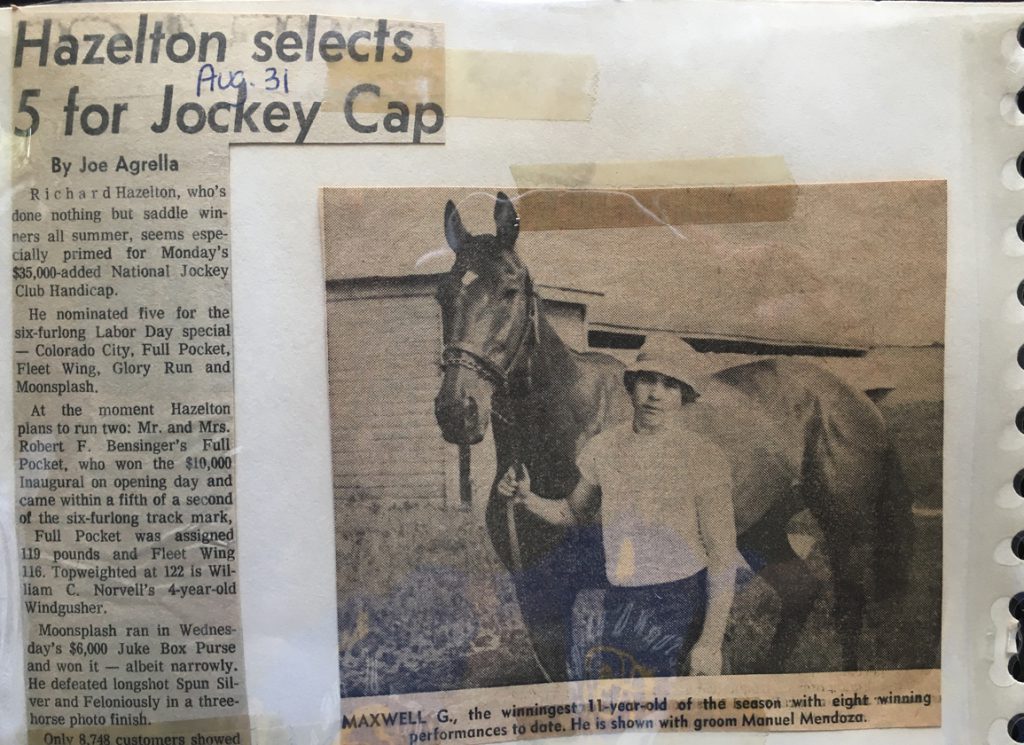
Maxwell G. in a clipping found in Hazelton's box of memories | Courtesy of Dan Ross

“Grizzled” really doesn't do the horse justice. A picture from 1972 shows Maxie–tall, raw-boned, yet handsome in elder statesman fashion–standing serenely beside his groom, large ears pinned forward as though gathering radio signals.

By the time of his swan song, Maxwell G. had won 47 out of a staggering 233 career starts, not all for Hazelton, who had claimed him for $1,000 at Yakima Meadows, in Washington, in May of 1965 (another story has it that Hazelton claimed him for $6,200 in 1968 at the Los Angeles County Fair).

It was Hazelton's touch, however, that gave this lowly claimer the veneer of a celluloid star.

The Chicago Sun-Times claimed that Maxwell G., at the height of his fame, brought thousands of fans to the track, lured by his Houdini-like theatrics, when he would race far off the pace before making “a bold bid to win,” as one writer prosaically put it.

Another scribe describes this last gasp maneuver with a tad more relish: “Typically, he will start a race slowly, plodding along behind the field until about the quarter-mile from the finish. Then he will swing wide and make a mad dash for the wire.”

By the time Hazelton had turned 80, memories of his own life were hazy or as terse as Hemingway's prose.

“My dad was involved in horse racing,” he told the poor writer of a Hawthorne Racecourse program, one obviously hoping for Horatio Alger. “I went to live with him when I was seven or eight years old. He had horses. I started galloping them and then I started riding them when I was 14.”

Not exactly edge of the seat stuff.

Hazelton's stint as an apprentice rider can hardly be deemed a bust, not when, south of the border, fans referred to him as “El Ricardo.” But here's his own take on that brief spell, 65 years later.

“I first rode in Phoenix. That's where I was born and raised. I was the leading rider at Caliente in Mexico in 1945. I went to work for the Klein Cattle Company after my stint as a jockey.”
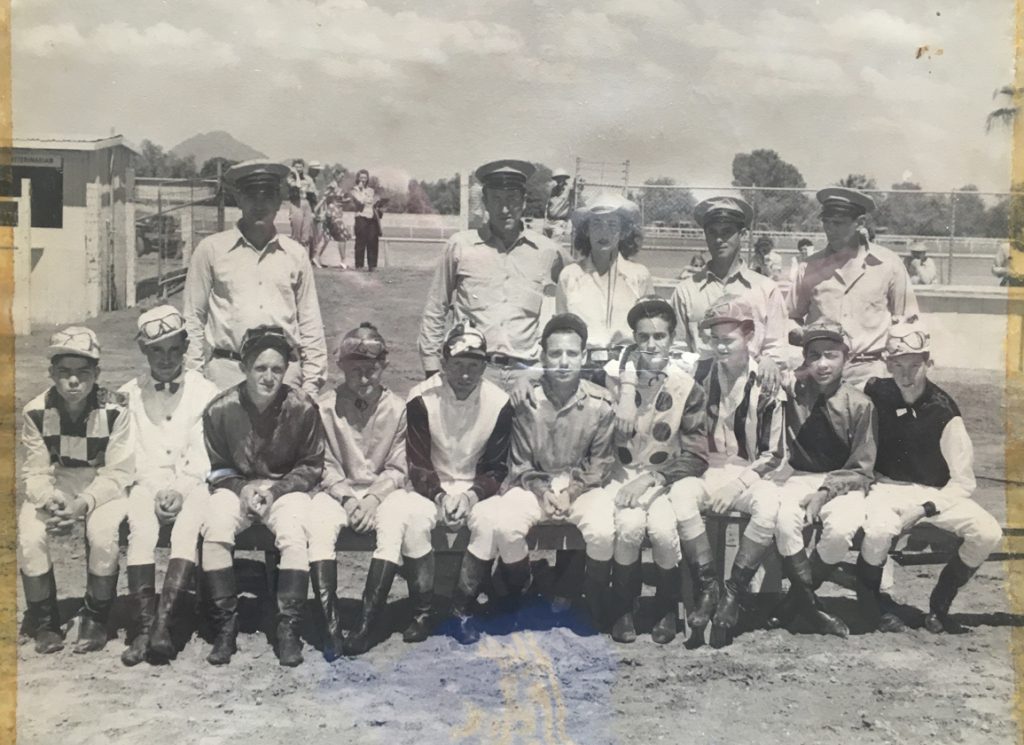
A baby-faced Hazelton (far left, seated) | Courtesy of Dan Ross

When it came to his horses, however, Hazelton's mind suddenly illuminated, as though a bolt of lightning had passed through it.

“I lost him three or four times but I always claimed him back,” Hazelton remembered, of Maxwell G. “He was a favorite of announcer Phil Georgeff. I remember they took him to the paddock in front of the grandstand and gave him two bushel baskets full of apples. They even named a race for him at Sportsman's and ran it for a few years.”

Hazelton added, proudly: “He was the only horse that was ever on the front page of the Wall Street Journal.”

The 1974 front page Wall Street Journal story in question wouldn't pass editorial muster by today's standards.

“If ever a racehorse was a candidate for the glue factory, it was Maxwell G.,” the story begins, in Dickensian fashion, explaining how poor Maxie, at the age of five, suffered a badly injured left foot, snagged in barbed wire while out punching cattle.

Hazelton would manage the problem appendage with a special shoe that eased the pressure on it. Maxwell G. would repay this favor through what's described in the Journal as “calm affection” and a willingness to “nuzzle strangers.”

As Hazelton put it, “He wouldn't give a nickel for an earthquake.”

Stable hands, the Journal notes, adored the horse.

“When another owner bought Maxwell G. in a claiming race two years ago, one stable hand came to Mr. Hazelton in tears, threatening to quit if he didn't buy back Maxwell G.,” writes the Journal. Hazelton did what was demanded of him.

“What's really amazing is that he's done it the hard way, a nickel and dime at a time,” Hazelton said of the horse's career–an assessment seemingly apropos of the trainer himself and so many of his trainees.

Take Full Pocket, a horse a Sportsman's Park program writer described as one of the “finest” Hazelton ever trained. He was certainly one of the nation's finest and fastest handicap sprinters during that era. In 1973, he won more than $200,000 and was second in the Eclipse Award balloting to champion Shecky Greene for Sprinter of the Year.

Special mention goes to Full Pocket's 3-year-old “reign of terror at Sportsman's.”

This included the “dandy young star's” imperious victory in the $38,400 National Jockey Club Handicap, before a Labor Day crowd of nearly 24,000, when he led home stablemate Moonsplash for “Cowboy Richard,” as one contemporary reporter coined the trainer.

Postage stamp Full Pocket was hardly a Colossus of Rhodes, “something breeders will hold against him,” one miser once noted. But that didn't stop breeders from trying anyway.

By the time the horse retired to stud at Hurstland Farm, in Kentucky–a good outcross to mares with Nearco blood, noted the 1974 Stallion Directory and Farm Register–Full Pocket had won 27 of his 47 lifetime starts and placed in 14 others. He also won 17 stakes and was placed in 11 more.

Again, Hazelton's 80-year-old mind came alive at the horse's memory. “He was one of the reasons I came to Chicago,” said the native of Arizona. “I brought him from the yearling sale for Mr. Bensinger, of the Brunswick Corporation. He named all of his horses. We paid $18,000. That was a lot of money back then. He was never a great sire, but he certainly was a runner.”

Dates and details, places and people–the box is something of a scramble of puzzle pieces sharing oftentimes conflicting information, giving the trainer a shape-shifting quality that somehow only sweetens the myth.

Part of the reason appears to be the man's aversion to the press. As one scribe put it, “I tried to interview him for years but Mr. Hazelton didn't like to talk about himself–or to me.”

One such seemingly slippery fact surrounds his age.

“Jockey records in 1945 list him as having been born in 1929,” wrote longtime Sportsman's Park fixture Don Grisham, of Hazelton's Icarus-like career in the saddle for his father, George. “As a supposed 16-year-old in '45, he finished among top apprentice riders in North America.”

Grisham's “supposed” does a lot of heavy lifting, for the minimum age for apprentices back then was 16.

“However, in those days, it was possible for an underage youngster to get by stewards and begin riding before turning 16. There is reason to believe Hazleton might have fallen into in this category. It is a matter of record he emerged a riding star at Arizona tracks and Caliente. One nine-race card at Caliente, he rode six winners, two seconds, and a third during a single afternoon.”

The melting sun to Hazleton's Icarus dream was biological. “Increasing weight soon terminated his saddle career,” Grisham noted, with blunt assessment.
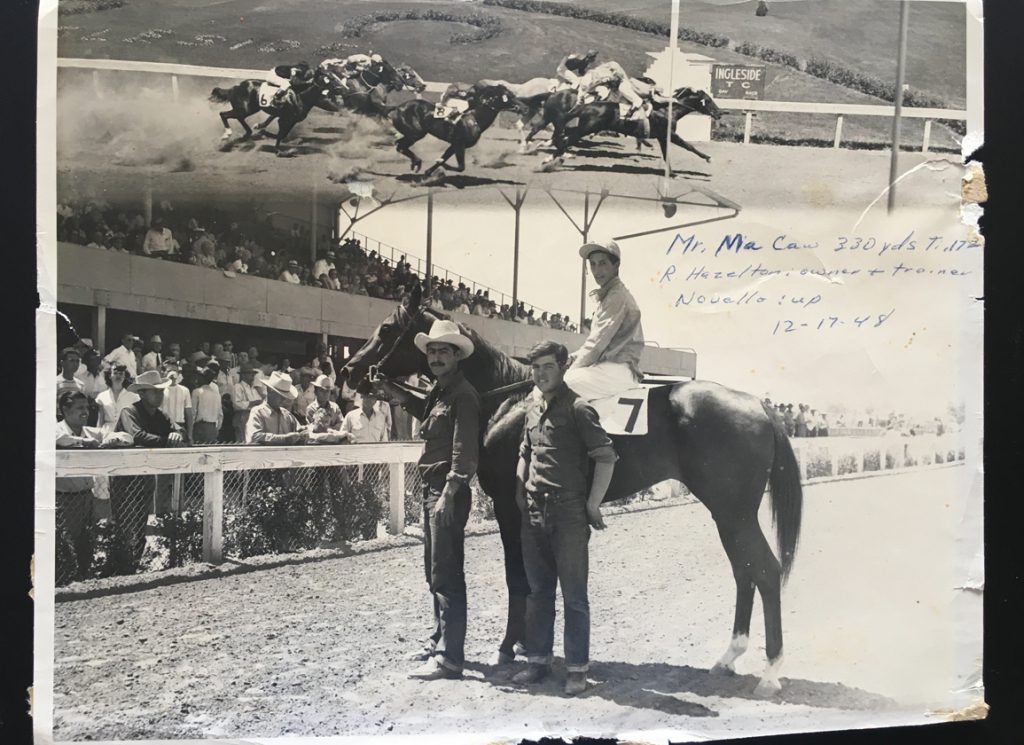
The handwritten win photo date with Hazelton aside the horse is 1948 | Courtesy of Dan Ross

What happened then depends upon the bard.

One version is that Hazelton returned to his studies in Phoenix, where the natural athlete became a prep school football star. Another is that he became a mainstay of the Southwestern rodeo circuit. Either way, it wasn't long before the Stetson-loving Arizonan turned his hand to training. Some reports pin the date as late as 1957. A tattered win picture from 1948 lists Hazelton as the trainer.

“After struggling for a while to saddle his first winner, the day finally came in Silver City, New Mexico. But Richard would have to wait until he was 26-years-old for his first 'bread-'n-butter' horse, a $500 claimer named Foxation,” one profiler made of Hazelton's early years with a license.

The box yields precious little of Foxation but considerably more of Zip Pocket, whom Hazelton saddled in 1967 to a 5 1/2-furlong world record of :55 1/2. The following year, Zip Pocket set a world record of 1:07 1/5 for three-quarters of a mile.

“Was it because of the biochemicals sprayed on the track or is Zip Pocket really that fast?” asked writer Pete Peters, after the horse's winning appearance at Turf Paradise.

Peters, a brylcreemed pipe-smoking staff writer for the Gazette, had the full-faced appearance of someone with limited athletic inclination. This is in stark contrast to the typical Hazelton runner, jettisoned into racing folklore as though shot from a cannon.

“If Hazelton trains 'em… he's a runner…” one observer described it. An early example was the Rudy Krize-owned “speed-geared grey colt” Wandering Boy, who came out on top in a $3,500 winner-takes-all duel at Turf Paradise against the Quarter Horse, Arizonan.

The clippings bear no date, but given how weathered is the tissue-thin newspaper, the late 1960s seem a safe bet. The following decade the trainer stepped it up another gear, with much of his success hinged upon bringing an army of horses West to East before commandeering the Chicago claiming circuit to make room for fresh legs.

“Contrary to rumors, Richard Hazelton did not suggest this dinner. Hal has claimed 11 horses off Richard this year and won only one race with the sum total,” said trainer Bill Resseguet, at a dinner–which sounds more like a roast–organized by the Chicago chapter of the Horsemen's Benevolent and Protective Association in honor of trainer Hal Bishop.

“I realize Richard is most appreciative of unloading those 11 horses,” Resseguet deadpanned.

The observation, though couched in jest, provides a useful entry point into the subject's character.

On the one hand, Hazelton is made as inscrutable as an IRS inspector.

“Husky,” one scribe calls him. Another, “a man of few words.” “Taciturn.” A “dark-browed horseman who prefers boots and Stetson.” And a “modest wonder man from Arizona” with “his ever-present cowboy hat and slow Western drawl.”

Yet ambition doesn't run on empty fumes alone.
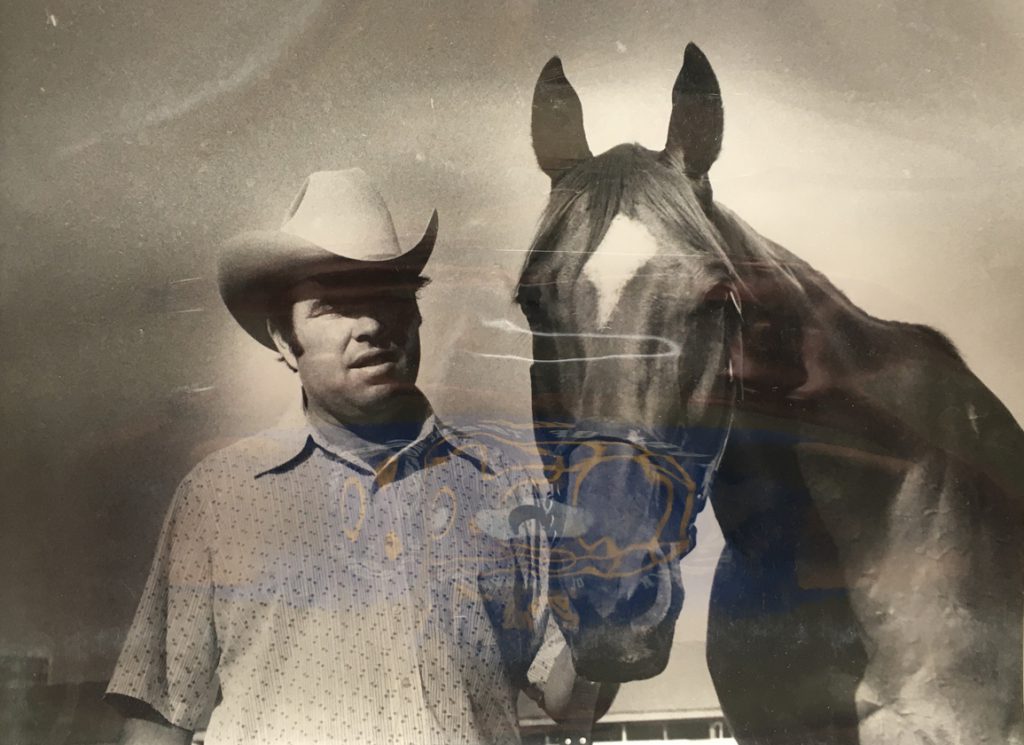
Richard Hazelton | Courtesy of Dan Ross

To the Chicago Sun-Times, Hazelton let slip the mask. “It's been a difficult job,” Hazelton said of plans to reach 5,000 wins, “but I have been averaging approximately 134 winners a year so maybe in the year 2001 I can brag of what I did in less than 40 years.”

The pipe-puffing Pete Peters managed to elicit from Hazelton another rare peek through the same slim aperture. “I finally landed him,” crowed Hazelton about the wealthy businessman, Harold Florsheim, who Hazelton lured to his owners' ranks for the 1966-67 Turf Paradise racing season.

“I've been after him for a long time but I couldn't convince him to come West with his horses,” Hazelton added. “He finally consented. He's got some good stock.”

Modeling the trainer's work ethic, Don Grisham at Sportsman's Park turned to a quote of Hemingway's: “You got to learn something: Never confuse movement for action.”

As Grisham put it, “There is always tote action on Hazelton-trained horses. As for the movement, Hazelton was in Kentucky Friday to inspect yearlings with Harold Florsheim, the shoe magnate. He jetted back in time to saddle two winners on Saturday's card, including Glory Run in the $22,425 Crete Handicap.”

In her husband, Marge Hazelton–a champion calf roper and an integral part of the story–saw an “uncanny ability to remember all the horses on the grounds and what they have done in each of their races. His memory helps him put our horses in races in which they have a good chance of winning.”

With her husband's ego evidently in mind, Marge added: “He can't remember anything else, of course.”

Then comes Dr. Richard Radke, the former orthodontist and a key patron of Hazelton's over decades.

Radke believed his trainer of having “one of the highest IQs of anyone I've ever met, but not many people are aware of that because he's so modest and quiet,” or so he told John McEvoy of the Daily Racing Form.

Hazelton's parsimonious approach to shared connection had some unintended side effects.

“There have been a few times that we didn't have the best communication,” Radke added, warmly. “Times like when I'd call up Richard and ask about one of my horses, and Richard would say, 'Oh, I sold him for you. I guess I didn't call you about that.'”

Given how often the search for a father's approval launches the hero's journey–or so says Joseph Campbell–perhaps the most telling insight is from Hazelton's own tongue, shared on the back of a Sportsman's Park program in a potted bio in which we also learn the trainer's favorite food (steak) and favorite movie (“Shawshank Redemption”).

“I'm very proud of my father, George. He was a real 'man's man',” Hazelton said. “He had that rare ability, I think we call it charisma, to draw people to him.”
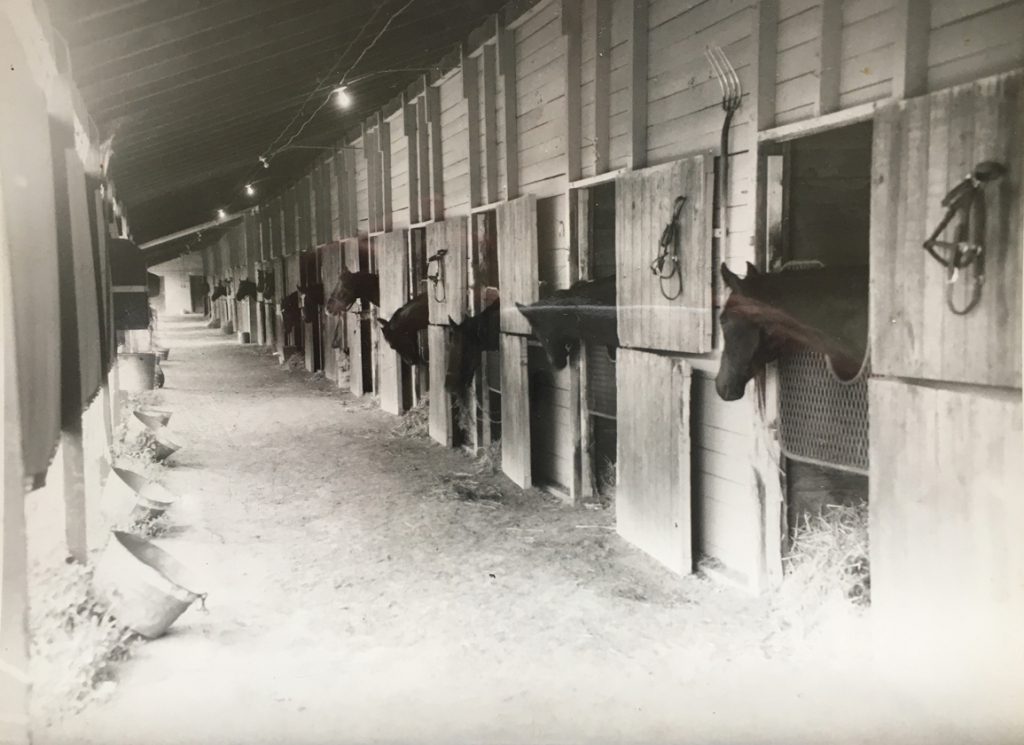
Believed to be a Hazelton shedrow | Courtesy of Dan Ross

“Arlington builds a great deal right around you”

Where naval gazing has now become all but a national occupation, Hazelton offers a refreshing alternative, one very much of its time, when exterior interests held almost exclusively one's private inward-lit gaze.

The box is a sobering reminder of this at a time when it can feel as though the coattails of horse racing have snagged on some fast-moving bullet train, dragging it forward to goodness knows where, bumping and somersaulting, never able to quite get its footing. For it is not lost how Hazelton's favorite playgrounds are now an aberration of his memory–Arlington a tumbleweed ghost town and Turf Paradise a derelict disgrace.

So, why not turn to the architects of this collection of halcyon summers for advice on where indeed to tread now–people like Richard Duchossois, then Arlington's chairman when in May of 2011 he wrote to Hazelton the sort of letter one imagines rarely escapes today's sterile racetrack boardrooms.

“We are delighted you have returned to Arlington,” Duchossois wrote, when the trainer had all but stored away for good the stable's shingle. “You are one of the staples of Arlington and Arlington builds a great deal right around you.”

He wasn't wrong–a good deal right was built around Hazelton. And so, after all, maybe it's okay if the box contains only a sliver of the great arc that constitutes a life greatly lived, just as long as every now and then such memoirs are unearthed, rediscovered anew, spread out across the floor in the evening lamplight by the kneeling archeologist with a lump in their throat.

The post One Life in a Box: Richard Hazelton appeared first on TDN | Thoroughbred Daily News | Horse Racing News, Results and Video | Thoroughbred Breeding and Auctions.

Source of original post

The Week in Review: For Epicenter, the More Things Stay the Same…

To twist an old saying so it best describes rock-steady GII Jim Dandy S. winner Epicenter (Not This Time), “The more things stay the same, the more they change.”

This is annually the time of the season when we start hearing from trainers of Triple Crown contenders how markedly their sophomores have improved and matured over the past couple of months. So it was a bit of a surprise when Steve Asmussen told DRF.com last week that he hasn't seen much change in the colt who ran second as the beaten favorite in both the GI Kentucky Derby and GI Preakness S.

“What difference do I see? Nothing, which is perfect,” Asmussen said, noting Epicenter's ultra-consistency in training, which has now powered a 5-3-0 record from nine lifetime starts. “His numbers were faster than any 3-year-old I had going into the Derby, so incremental improvement will be harder to sustain because of how fast he was going early.”

We can bemoan the short-field graded stakes that have been served up at Saratoga so far this meet, but the Dandy's four-horse offering was as intriguing as it gets for handicapping races in which you can count the number of entrants on one hand.

Epicenter and Zandon (Upstart) were both kicking for home strongly and each had a blanket of roses within their grasp before they got blindsided by impossible longshot Rich Strike (Keen Ice) in the Derby, finishing two-three across the wire. While Zandon got rested to await Saratoga, Epicenter marched on to Baltimore, where he chased home the fresh, speed-centric Early Voting (Gun Runner) in the Preakness. Now 2 1/2 months later, those three lined up to headline the Dandy, with wild-card underdog Tawny Port (Pioneerof the Nile) making it a foursome after his Kentucky Derby seventh (beaten only 4 3/4 lengths at 80-1) and a favored win in the GIII Ohio Derby.

Early Voting loomed on paper as the obvious pacemaker, but the issue of who might force the issue was up for grabs. Zandon generally takes a while to unwind and Tawny Port has off-the-pace tendencies. Epicenter, who primarily relied on applying up-tempo pace pressure through his first six races, had switched to coming from farther back in both the Derby and the Preakness. But it was unclear if making one sustained run was really his preferred running style.

Epicenter got bet down to 6-5, again bearing the burden of favoritism he couldn't carry to victory in the first two legs of the Triple Crown. He came away last at the break under Joel Rosario, and briefly ran up into a tight spot on the heels of Tawny Port, who had crossed over and claimed the rail in third. Early Voting assumed command with ease, and his uncoupled stablemate, Zandon, seemed a touch out of his element in having to adopt the stalker's role by default–he'd only been 1 1/2 lengths off the lead down the backstretch once in five career races.

Early Voting cranked out opening quarters in :24.22 and :24.06, and the cadence seemed sustainable. Zandon and Tawny Port maintained their positions right behind the leader, while Epicenter, still last, was into the bit and edging up incrementally.

Jose Ortiz looked over his left shoulder a half mile from home and again over his right shoulder a furlong later, perhaps wondering why the favorite wasn't closer on both occasions. He began riding with greater urgency five-sixteenths from the finish, which is when Rosario, barely nudging his mount for guidance, swooped out to the five path, giving up ground in exchange for  unimpeded passage while the front three converged under full-out drives down near the inside in upper stretch.

The quartet lined up four across the track at the eighth pole after third and fourth quarters in :23.98 and:24.29. But Epicenter clearly had superior momentum, and he came over the top with only a brisk hand ride for encouragement through a final eighth in :12.44 before being wrapped up under the wire to win by 1 1/2 lengths in 1:48.99 for nine furlongs.

That translates to a 102 Beyer Speed Figure. Underscoring Epicenter's reliability, that's the third time he's replicated that exact same number in his last four stats.

Exterminator would like a word with you…

Hats off to the record established by Jackie's Warrior (Maclean's Music) for winning Grade I stakes in three straight seasons at Saratoga with his romp in the GI Vanderbilt H. Saturday.

No disrespect to the accomplishment, but when I first heard that news, I was surprised no other horse from a bygone era had accomplished that feat, considering the Spa's history goes all the way back to 1864.

But keep in mind the graded stakes system in America dates to only 1974. That leaves 110 years of great horses out of the mix.

A racing historian who goes by the nostalgically clever Twitter handle @rileygrannan alerted TDN to the fact that, “'Grade 1' is the key distinction here. Busanda won Alabama in 1950 & Saratoga Cup in 1951 & 1952. Exterminator won four straight Saratoga Cups from 1919 to 1922. All before graded stakes system went into effect.”

Surely those stakes would have been considered Grade I equivalents back in the day.

Speaking of obscure records…

Quick: Can you name the only horse to earn over a million dollars while starting 29 times and never once going off as the favorite?

That would be Long Range Toddy (Take Charge Indy), who brought up the rear behind Jackie's Warrior in the public workout known as the Vanderbilt H.

I don't know if that's really a record. But it's a safe enough guess I'd bet a beer on it (corrections welcomed from actual database researchers).

The other oddball item within Long Range Toddy's past performance block is that despite a lifetime bankroll of $1,107,572, he hasn't won a race in more than three years, since before his notorious brush with fate coming off the far turn of the 2019 Kentucky Derby.

That was the Derby in which first-across-the-wire Maximum Security shifted outward while on the lead just prior to the five-sixteenths pole. Long Range Toddy was already spent from pressing the pace, but he had to check sharply as the result of chain-reaction crowding.

Long Range Toddy crossed the wire 17th but was elevated one position when the stewards disqualified Max for fouling him after an agonizingly long 22-minute review in front of a global audience.

It's debatable whether the incident was a true momentum-stopper for Long Range Toddy (next-out Preakness winner War of Will actually took the worst of it). But as far as history is concerned–the DQ was even litigated in federal court by Max's owners but the result stood–Long Range Toddy was judged the aggrieved party.

He's been an asterisk to infamy ever since. Still, there are worse ways to earn seven figures.

Since his score in the 2019 GII Rebel S., Long Range Toddy is 0-for-22, with a career mark of 4-4-4. The 6-year-old transitioned to sprinting after switching from Asmussen's barn to Dallas Stewart's for owner/breeder Willis Horton, and new owner Zenith Racing acquired him just prior to a 45-1 second in the GIII Commonwealth S. at Keeneland this past April.

In no-nonsense workmanlike fashion, Long Range Toddy continues to pick up black-type stakes checks and makes occasional forays into the graded ranks. A diet of six-figure allowance opportunities at Churchill and Oaklawn has also been good for his financial health.

Long Range Toddy isn't even the only remaining active participant out of what would come to be known as the first in a spate of “Dysfunctional Derbies” (we've since had a pandemic-necessitated September running, a drug DQ of the winner, and an 80-1 shocker by a colt who drew in off the also-eligible list).

In fact, four of the last five horses across the finish in that '19 Derby are still active. The other three are:

Tax (Arch), who ran 14th in the Derby, and recently returned off a nearly 1 1/2-year layoff to win the $100,000 Battery Park S. at Delaware July 9.

Roadster (Quality Road), 15th, who, like Long Range Toddy, has also not won a race since prior to the '19 Derby. The GI Santa Anita Derby victor is now training in the mid-Atlantic (scratched from a Colonial turf allowance July 19).

Gray Magician (Graydar), 19th in the Derby, subsequently won the Ellis Park Derby and a Keeneland allowance that season, but has been winless since. He ran fourth in a $16,000 claimer at Del Mar on opening day.

The post The Week in Review: For Epicenter, the More Things Stay the Same… appeared first on TDN | Thoroughbred Daily News | Horse Racing News, Results and Video | Thoroughbred Breeding and Auctions.

Source of original post

July 31 Insights: Half to Mo Donegal Debuts at the Spa

by Christie DeBernardis & Patrycja Szpyra
Sponsored by Alex Nichols Agency

6th-SAR, $105K, Msw, 2yo, f, 5 1/2f, 3:49 p.m. EDT
GI Belmont S. winner Mo Donegal (Uncle Mo) may be missing his appearance at the Spa this summer, but his little sister PRANK (Into Mischief) will be stepping up to the post for the first time Sunday. Out of a daughter of GISW Island Sand (Tabasco Cat), the $500,000 KEESEP buy also hails from the Todd Pletcher barn. Steve Asmussen unveils Courtlandt Farm's High Class (Into Mischief), purchased for $575,000 out of the same sale. She is a daughter of GSP Euroboss (Street Boss). TJCIS PPs

2nd-SAR, $105k, Msw, f, 2yo, 1 1/16mT, 1:37p.m. ET
MILIEU (Empire Maker), half-sister to Champion female sprinter and GI Breeders' Cup Filly and Mare Sprint shocker Shamrock Rose (First Dude), debuts in this turf maiden route for Bill Mott and Mike Rutherford. Costing $230,000 as an October yearling at Fasig-Tipton Kentucky, there is high-level success in her pedigree on the grass, namely MGSW Slew the Red (Red Ransom) under the second dam, who annexed two French Group contests before being imported for a State-side campaign. TJCIS PPs

1st-DMR, $80k, Msw, 2yo, 5 1/2f, 5:00p.m. ET
Sent to the blocks here by his powerhouse connections of SF Racing, Starlight Racing, Madaket Stables, Robert Masterson, Stonestreet Stables, Jay Schoenfarber, Waves Edge Capital LLC, and Catherine Donovan, MASSIMO (Uncle Mo) will debut under the tutelage of Bob Baffert. The colt rides back-to-back five furlong bullets into the race, a July 14 move in :59.80 at Santa Anita (1/46) and a July 22 work over this track in :58.40 (1/82). A Winstar-bred graduate of the Fasig-Tipton Saratoga Select Sale, his connections paid $575,000 for the half-brother to GSP Hozier (Pioneerof the Nile) out of MGSW Merry Meadow (Henny Hughes). Through third dam Cruella (Tyrant), this is the family of MGISW Diazo (Jade Hunter). TJCIS PPs

8th-DMR, $80k, Msw, f, 2yo, 5 1/2f, 8:37p.m. ET
Debuting against a well-bred field here, JUSTIQUE (Justify) stands tall as the half-sister to GI Hollywood Derby winner Mo Town (Uncle Mo). Out of MGISP Molto Vita (Carson City), herself half to GSP Jaguar Paw (Giant's Causeway) and MGSP Venetian Mask (Pulpit), the filly's $725,000 price tag befit her pedigree; hailing from the breeding program of John Gunther & Eurowest Bloodstock. John Shirreffs will send Justique to post. Breaking to that one's inside in the colors of Mrs. Doreen Tabor is Fourth Street (Street Sense), the fleet-footed filly blazed :9.4 at OBSAPR, bringing $600,000 from M. V. Magnier to secure her. Out of a young broodmare, her second dam is MGSW Salty Strike (Smart Strike). Tea N Conversation (Candy Ride {Arg}) will carry the Spendthrift Farm colors on unveiling here, a $400,000 KEESEP half-sister to GI Runhappy Del Mar Futurity winner Nucky (Ghostzapper).  TJCIS PPs

6th-MTH, $55k, Msw, 3yo/up, 1 1/16mT, 2:40p.m. ET
Breaking from the rail, MANASSAS (Frankel {GB}) debuts here for Todd Pletcher. Dam Avenge (War Front) was the two-time winner of the GI Rodeo Drive S. and finished third in both the GI Breeders' Cup Filly and Mare Turf and the Gamely S. at Saratoga. His dam's half-sister Lira (Giant's Causeway) was graded stakes-placed, and was herself the dam of a stakes winner. This is the family of GISP Grasshopper (Dixie Union) and of the globetrotting MG1SW Mashaallah (Nijinsky II). TJCIS PPs

The post July 31 Insights: Half to Mo Donegal Debuts at the Spa appeared first on TDN | Thoroughbred Daily News | Horse Racing News, Results and Video | Thoroughbred Breeding and Auctions.

Source of original post

Verified by MonsterInsights