September Snapshot of Stallion Scene

by Chris McGrath & Stefanie Grimm

It's all the trees I feel guilty about. That, and the postman's lumbago. But while many people nowadays complacently compress the world's biggest yearling auction onto a digital device, a stubborn few of us will always prefer scribbling notes on the dog-eared pages of a paper catalog.

Whichever your preference, of course, you will do well to avoid wearing out the soles of your shoes during the Keeneland September Sale–not to mention other reserves, in morale or finances. Before you start appraising individual hips, however, it might be worth attempting a wider panorama of the sale.

Because their relative representation, across what is unarguably the most comprehensive of all marketplaces, provides an interesting measure of the current balance of power among Kentucky stallions.

We've divided the sale into three sectors: Book 1, for the elite tier; Books 2 and 3, for a version of that elusive “middle market”; and Books 4, 5 and 6. Pretty crude, clearly. Many horses in Book 2 will have far more in common with their Book 1 peers than with anything in Book 3; and some in Book 4, equally, will be different class from Book 6. But, look, it's just one snapshot; a picture drawn in clumsy brushstrokes, not a draughtsman's pencil. We'll just demarcate stallion representation across the two weeks, and see what–if anything–turns up.

The first thing to remember is that catalog distribution is never a simple, scrupulously neutral assessment of merit. The sales company has to work with consignors, and consignors with their clients. The freshman, for instance, needs to be given his now-or-never platform. Same with the proven elite: bury a six-figure cover in Book 6, and you might as well send the creature in towing a plow.

There are some consignors, equally, who remain adamant that a certain type of yearling will do better if relegated to stand out from the crowd at a lower level. Whether or not that strategy is justified, it obviously backfires in an exercise like this one.

Besides, the market will nearly always end up more or less obeying the cover fee. That's certainly true of spending, especially on new sires, no matter how loudly agents claim simply to be assessing the flesh and blood in front of them. Much the same can be expected, then, when inspectors and consignors try to anticipate the market. Even so, perhaps we can find one or two stallions that deserve an extra rosette.

Quality Tells in Book 1

There's an immediate caveat here, in that some of the best yearlings of the crop have already gone under the hammer at Saratoga. As we've already stressed, however, this is just one moment in time and by no means definitive. It was tempting, indeed, to combine Book 1 with Fasig-Tipton's Select catalog. But Book I does at least give an undiluted elite flavor.

The table below is ranked according to the percentage of stallions' September entries to have gained admission to Book 1, down to a ratio of one-in-10.
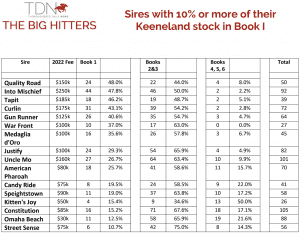
There's an unsurprising correlation between Book 1 footprint and fee. But the six-figure club has internal competition all of its own and, while the proportion of his Book I stock is only a scintilla higher than that of Into Mischief, there's no mistaking the statement made here by Quality Road.

Because this is a very important stage in the career of a stallion now in his prime at 16. This crop was conceived during his single season at $200,000, in 2020, a second consecutive hike after he had been catapulted from $70,000 to $150,000 the previous year. City Of Light had driven the initial rise before joining his sire at Lane's End in 2019, his swansong success in the Pegasus being promptly followed that year by other Grade I scores for Dunbar Road, Roadster and Bellafina.

Their sire has since reverted to $150,000, but it's obviously a great sign that he has managed to get very nearly half his September stock into the two showcase sessions. His first six-figure covers, in 2018, resulted in a spectacular juvenile, Corniche, and if that colt has since proved a source only of frustration, then the gap was helpfully filled this summer by a graduate of the previous crop, Bleecker Street, in the GI New York S. at Belmont.

Quality Road has already sold a $1.8-million filly this summer at Saratoga, where his four other hips reached $700,000, $350,000, $205,000 and $575,000 (RNA). Having worked his way up from a base of $25,000, it was vitally important for Quality Road to match his billing once promoted to the top echelon. So far as the Keeneland inspectorate and the consignors are concerned, at any rate, that seems to be pretty much what he's doing.

Nowadays, of course, Into Mischief stands alone in terms of his fee and, having exponentially advanced his record with the quality of his books, he accommodates no fewer than 90 of his 92 September entries in the first three of the six books. Tapit and Curlin, long established at this level, also house over 40 percent of their September stock in Book 1, and the phenomenal young sire Gun Runner has now also tipped that mark.

Having had 11 in Book 1 last year, the Three Chimneys champion is now up to 26. He has, moreover, already sold a couple of standouts from his third crop at Saratoga: a colt bought by White Birch Farm and M.V. Magnier topped the whole sale, at $2.3 million, while the latter gentleman also signed for another at $1.4 million. And remember that Gun Runner was only elevated to the six-figure bracket this spring.

The star of the next intake, Justify, has also consolidated well; while we should remember that Constitution remained no more than $40,000 when conceiving the 16 yearlings (of a whopping 105 in the catalog) that have made the elite book.

Beach Making Waves on Debut

Among the debutants at the sale, Omaha Beach stands apart with an impressive Book 1 ratio of one-in-eight. With two-in-three then surfacing in Books 2 and 3, moreover, he looks well positioned to maintain his early momentum as top rookie.

He dominates the table below which is restricted to Kentucky rookies with more than 15 yearlings in the September Sale.

Having processed 10 of 13 so far offered at other auctions, at an average $268,882, Omaha Beach has jumped pretty flamboyantly through every hoop so far. Even on the top fee of the intake, he looked fair value at his introductory fee and Spendthrift have meanwhile been characteristically aggressive in keeping him in the game.

Audible managed to get four into Book I, having already sent seven yearlings to Saratoga. He has punched weight with a significantly bigger proportion in Books 2 and 3 than all bar Omaha Beach.

The only other newcomers to break into Book I, with one apiece, are Catholic Boy, Vino Rosso and Preservationist. I'm a huge fan of the latter, who was launched against a fairly steep commercial slope, so he deserves congratulation for getting hip 179 into the premier book off a $10,000 cover. This colt must be pretty special, in the circumstances, so y'all get down to Barn 12 and take a look! The dam is a half-sister to a Grade II winner/Grade I runner-up and has already contrived graded stakes winners by Creative Cause and, wait for it, Haynesfield.

Don't be alarmed by how many of these freshmen will be doing the bulk of their trade in the second half of the sale. That's pretty standard for many established sires, and we all know how vital sheer volume is to the launch of these fellows. And it can't be reiterated enough that this is just one fleeting glimpse of one market, however big. Budget stallion Flameaway, for instance, hit one out of the park at Saratoga at $425,000.

All these horses have to do now is run.

Grass is Greener

One real paradox is the deference the U.S. market will show to turf stallions based in Europe, while giving so little commercial oxygen even to the most eligible imports to Kentucky.

A number of European stallions surface in this catalog, mostly with a single shot. Given American activity at the breeding stock sales in recent times, most of these yearlings were presumably imported in utero with their dams. And, curiously, they have all been given a ticker-tape reception.

Galileo (Ire), Frankel (GB) and Kingman (GB) unsurprisingly get the Book 1 limelight for their respective samples. No Nay Never, as a thriving son of Scat Daddy, fields four–one in Book 1, the rest in Book 2. But even stallions that maybe aren't so well known in Lexington get full respect: Bated Breath (GB), Calyx (GB), Study Of Man (Ire) and Wootton Bassett (GB) all field their solitary offerings in Book 2. Caravaggio, himself since imported to Kentucky, has been followed over the water by four from his last European crop and all but one are accommodated in Book 2.

Stoking the Embers

When a stallion is pensioned, or sold abroad, or lost prematurely, vendors always anxious about his residual stock being ruthlessly abandoned to fend for themselves. With the marketing teams no longer putting their shoulders to the wheel, these hapless animals tend to be left to fend for themselves. It's a tribute to pure quality, then, if they retain prominence in the catalog–as, for instance, when Arrogate sells three-in-four of his final crop in the first half of the sale.

They are all collector's items, after all, but the same is true of just three yearlings salvaged here from the final crop of Tiznow. Surely it would be rash to leave town on Friday without at least checking out this trio of colts. Hip 1195 is out of a mare whose son by Tiz Wonderful won a Belmont maiden and the GIII Sanford S. on his only two starts; and the second dam is half to a French Classic winner. Hip 2011 demands a look regardless, simply because you must never miss a visit to Crestwood's consignment. And hip 2090 is out of a Storm Cat mare (herself daughter of a Grade I winner) that has previously produced a multiple graded stakes-placed Listed winner by Tonalist.

Noble Mission (GB), meanwhile, sadly proved too well named, having failed to prise open the eyes of myopic Kentucky breeders before the Japanese cannily rehomed Frankel's brother. Predictably enough, 10 yearlings from his final Kentucky crop have been dumped towards the end of the second week, but I shouldn't be at all surprised if there was a gem or two lurking there.

Among those sires still persevering against neglect, you'll find some chastening names with a bare handful coming under the hammer. Several haven't been given anything like an adequate chance, but they're in trouble enough as it is and we won't make things worse by drawing attention to specific examples.

But it's too poignant to pass over the fact that the pair responsible for the first and third past the post in last year's Kentucky Derby, Protonico and Oxbow, can, respectively, muster just two yearlings and one. Let's hope both earned some renewed attention this spring, and might yet return from the brink.

Oxbow must obviously share the plaudits for Hot Rod Charlie with the dam of that heart-warming racehorse: Indian Miss, after all, had already produced Mitole by Eskendereya. Yet Oxbow would surely be amazed to learn that even $1.6 million was insufficient to get her latest colt, by Into Mischief, to his reserve at Saratoga!

Hats off the Middle Men

Here's a club you can be proud to join; one that shows you have done what it takes to achieve a viable niche in Kentucky.

The table below probes the very marrow of the market. It excludes the absolute elite, which for present purposes we'll define as those (featured in Table A) whose Book 1 footprint represents 10% or better of their September stock. It also leaves out the freshmen, who are a case apart and duly treated as such in Table B. And it cuts off at 40% representation in Books 2 and 3. Believe me, that's a true badge of distinction.

You may well think it depressing that even some of these rock-solid operators must sell half their September stock in the second half of the sale. But all you have to do is think of your favorite stallion that might be eligible for this table, only he's nowhere to be seen. A quick, back-of-the-catalog calculation on his distribution will teach you due respect for these guys.

And, above all, for Ghostzapper. What an unbelievable shape we find to the distribution of his yearlings in this sale: just three in Book 1, but just four in Books 4, 5 and 6. And 33 crammed into Books 2 and 3! That is what I call a stallion you can set your clock by.

There are quite a few other veterans in this group, the odd pensioner, and indeed sadly a couple that have left us altogether. Conversely there are also one or two younger guns, notably Not This Time, who are laying strong foundations for the leap into that one-in-10 Book I echelon as the ageing sires in that group fade.

True, some of these are still riding that initial commercial wave, their longevity at this level contingent on the deeds of stock now venturing onto the racetrack. But I tip my hat to anyone who can keep less than 25% of his trade out of Books 4 through 6, as has Munnings in maintaining his model rise.

If only the “middle market” truly represented the middle of the road! Wherever you find yourself this September, mind the traffic–and good luck.

The post September Snapshot of Stallion Scene appeared first on TDN | Thoroughbred Daily News | Horse Racing News, Results and Video | Thoroughbred Breeding and Auctions.
Source of original post

Flying Start Grad Lindsay Schultz off to a Flying Start

Lindsay Schultz checked a lot of boxes. She is a graduate of the University of Louisville's Equine Industry Program, moved on to the prestigious Godolphin Flying Start program, managed Glen Hill Farm in Florida and worked as an assistant to Tom Proctor and Hall of Fame trainer Shug McGaughey. Yet, she admits to being nervous and not knowing what to expect when she decided last fall to go out on her own as a trainer. Maybe she shouldn't have been.

Less than a year after opening her stable, Schultz, 34, is making a name for herself at Monmouth Park, where she has six winners from 22 starters for a winning rate of 22%. Overall in her brief career, she is 11 for 61, good for 18%.

“This is definitely beyond my expectations,” she said. “I have exceeded my goals.”

Schultz rode hunter-jumpers while growing up in Connecticut and enrolled in the racing program at the University of Louisville. It was not, however, until she entered the Godolphin program that she decided she wanted to be a trainer.

“I knew I wanted to be in the industry, but didn't know exactly what,” she said. “When I went into the Flying Start program I got to see every aspect of the industry and decided I wanted to focus on the racing part. Once I started working for Tom Proctor as his assistant, I thought maybe I could do this myself and do a good job.”

Along the way, she caught the attention of Marshall Gramm, who runs the Ten Strike Racing Partnership. Schultz and bloodstock advisor Liz Crow are close friends and Crow has had a long and fruitful business relationship with Ten Strike. Gramm has helped a number of young trainers kick off their careers and, in Schultz, he saw someone he was happy to take a chance on.

“I was talking to her around this time last year and it was clear she was at a stage where she was about to go out on her own,” Gramm said. “We had discussions about it last summer and I told her that if she was going to do it she should come to Oaklawn Park and that I could use her there. I told her that it would be a good place to start and I thought I could really help here there. It's a track I want to win at.”

“That I had the backing of Ten Strike and Marshall was huge,” Schultz said. “It's a good feeling to have someone who is so intelligent put his faith in me and helped me get started. It really meant a lot. The opportunity that he gave me was the biggest reason why I thought it was a good time to try this.”

Gramm didn't exactly hand her the keys to a 50-horse stable filled with stakes horses. Schultz told him she thought she could get by if Ten Strike gave her six to seven horses and she was fine with taking on claimers. Her first winner came with a $10,000 claimer at Oaklawn, Capture the Glory (Scat Daddy). Another winner at Oaklawn came with Tiger Moon (Upstart). Schultz talked Gramm into claiming him for $10,000 out of a maiden claiming race. She bumped him up to a $40,000 maiden claimer for his next start and he won at 29-1. (Gramm, an astute and enthusiastic horseplayer said he did not have a bet that day on Tiger Moon).

What Gramm did give her was the chance to prove that she could make the most of an opportunity.

It was Gramm who suggested that Schultz head to Monmouth after the Oaklawn meet ended.

“She has really blossomed at Monmouth,” Gramm said. “The competition is little bit easier there. We realized we could take some horses who were average horses at Oaklawn who would be be successful at Monmouth. She's really hit her stride there and it's exciting to watch. She works really hard and knows her stuff. I've been very pleased and impressed and I am excited to be part of her burgeoning career.”

Schultz has 14 horses at Monmouth, seven of them for Ten Strike. The stable includes five 2-year-olds, none of whom have started yet this year.

While happy to have accomplished so much so early in her career, Schultz makes no secrets of her aspirations to take things to the next level.

“I'd like to get up to maybe 40 horses to be able to have two strings,” she said. “It would be nice to be able to utilize two different circuits. I'd like to keep improving the quality. Obviously, to get to there you need the horses and you need the owners. All I'm trying to do is to do a good job, go to the sales and go to big race meets, meet people, talk to people. I am not a big self-promoter, but I hope if I keep doing a good job and keep looking for new opportunities they will come my way.”

Can it happen? Gramm believes that it can.

“Lindsay is going to need to find some other owners willing to take a chance on her and she's going to need to get some good 2-year-olds in her barn,” Gramm said. “Claiming is a way to get noticed and get your first set of owners, but, ultimately, you need to show you can develop some nice horses and win some stakes races. That's what gets you more and more noticed. Each year is a baby step. She's gone from five horses to 14 and has some 2-year-olds in her barn. That's a great place to be after a year. Hopefully, she can keep the momentum going and pick up some more owners. She has such a great background and I'm excited for her considering where she's at at such an early stage in her career.”

The post Flying Start Grad Lindsay Schultz off to a Flying Start appeared first on TDN | Thoroughbred Daily News | Horse Racing News, Results and Video | Thoroughbred Breeding and Auctions.

Source of original post

Airdrie Sire Duo Sends First Crop to Keeneland September

The Brereton C. Jones/Airdrie Stud consignment will be bustling in just a few weeks at the Keeneland September Sale as an assembly of over 60 yearlings bred and raised at the landmark Midway farm prepare to go through the ring. The majority of these youngsters represent the dozen-strong stallion roster at Airdrie, which includes two sires that are represented by their first crop of yearlings this year in Grade I-winning millionaires Preservationist (Arch – Flying Dixie, by Dixieland Band) and Divisidero (Kitten's Joy – Madame du Lac, by Lemon Drop Kid).

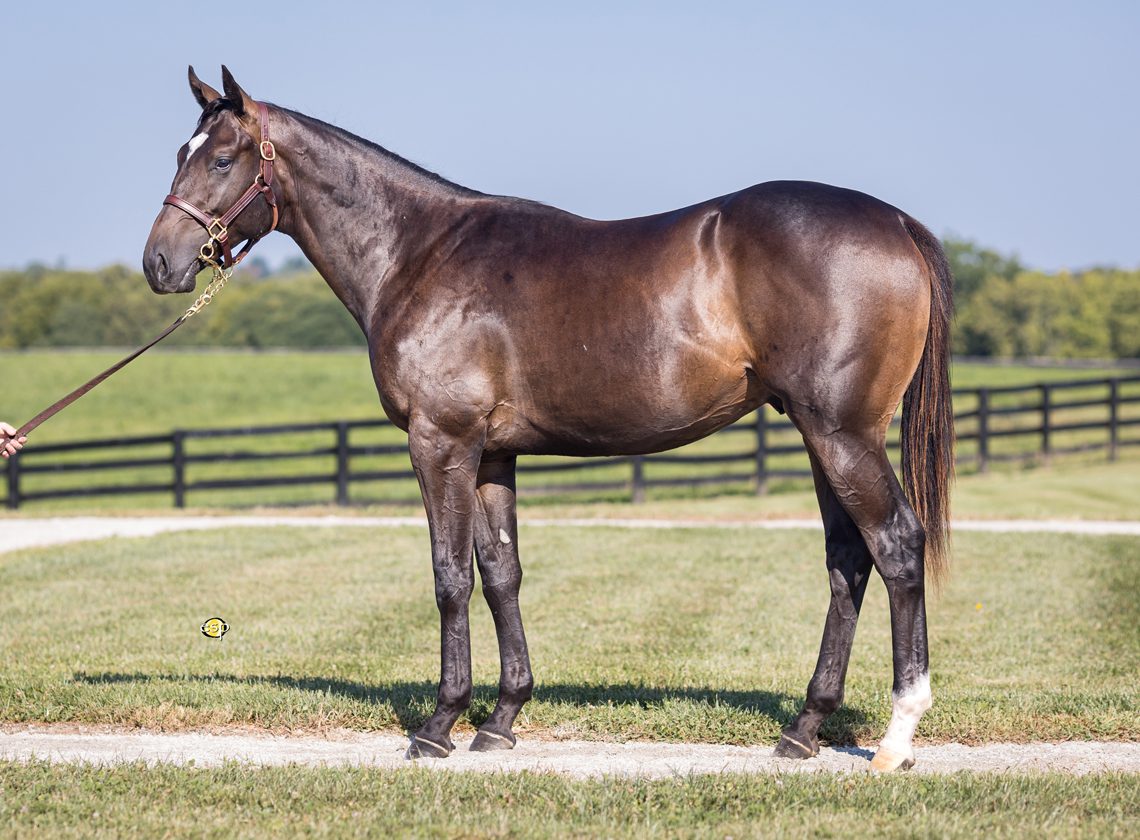
Airdrie will showcase 14 yearlings by the stallion duo at Keeneland, starting with the consignment's first horse to go through the ring in Book 1. Hip 179, a Preservationist colt out of Brereton C. Jones homebred Church By the Sea (Harlan's Holiday), reflects the caliber of broodmare that Airdrie chose to back these young sires.

“This colt is from a family that everyone knows well,” said Airdrie Stud's Director of Sales Jocelyn Brooks. “Not only has Church By the Sea produced multiple graded stakes winners herself, but her family goes back to MGSW Cairo Memories (Cairo Prince) and GI Blue Grass winner Zandon (Upstart). This colt is what you want to see in a Book 1 horse. He's big and strong, beautiful and athletic, and he has a really nice way of going. We're excited about bringing him over to the sale.”

The consignment has eight additional Preservationist yearlings cataloged including Hip 1067, a colt out of Lifetime Memory (Istan) from the family of Grade II winner Speaktomeofsummer (Summer Front).

“He comes from another favorite family here on the farm,” Brooks explained. “He's a stunning physical and is another big, strong colt. He's powerful looking, but is still very fluid moving. We think he'll be very popular with his physical and his really nice family that we've had for all these years.”

A $485,000 yearling himself, Preservationist made six trips to the winner's circle for Centennial Farms and trainer Jimmy Jerkens, with headline victories in the GI Woodward S. and the GII Suburban H. Despite Preservationist's success as an older horse, Brooks said that Airdrie was initially drawn to the bay because of the speed he showed early in his career.

“Our big conversation that we've had with breeders–and actually what we found out when we were looking to bring him to stud–is that he was very precocious,” Brooks noted. “As a 2-year-old, he was the best-training horse in the barn, as they said. When he broke his maiden going six furlongs in 1.09:01 and ran a 3 ½ Ragozin number, you say, 'I'm thinking of the horse that won the Woodward and the Suburban. I didn't realize that he had that speed.' So not only was he a Grade I winner going long, but he also had the speed that everyone is after.”

Preservationist colt out of Church by the Sea selling in Book 1 at Keeneland September | Matt Wooley – EquiSport Photos

A homebred for Emory A. Hamilton, the son of Arch boasts a pedigree that contains a number of influential broodmares like Too Chic and Courtly Dee.

Preservationist's pedigree, top and bottom, is one of the best that you'll find with those Middlebrook Farm and King Ranch families that go back for generations of top-quality horses,” Brooks said. “His pedigree has been a huge draw for breeders.”

Brooks explained that based on the first few Preservationist crops on the ground at Airdrie and the additional yearlings they have had a chance to look at, the stallion is passing on some of his best qualities.

Preservationist is a big, powerful, strong horse, but he's still very athletic,” she said. “We've been really excited about his foals. They are all nice physicals and definitely are very athletic. A lot of them look like him in having that good bone and nice size.”

Preservationist, who has stood for a fee of $10,000 in his first three years at Airdrie, had 26 progeny go through the ring as weanlings including an $85,000 Airdrie-consigned colt out Limitless (Discreet Cat). Brooks said their team was happy with the results from the weanlings that Airdrie sent through the ring.

“They sold very well and went to the right buyers–people who have a wonderful eye and who we respect their opinion,” she said. “We always say that the Airdrie pinhook is the best angle because we brought them over to the sale as weanlings to show off how much we love our Preservationists and hopefully they show up and do even better in September. When [buyers] see the individual physicals, with his pedigree on top of everything, we think that he's going to have a really strong sale.”

Preservationist has 36 progeny cataloged for the Keeneland September Sale while his studmate and fellow first-crop yearling sire Divisidero will be represented by nine yearlings.

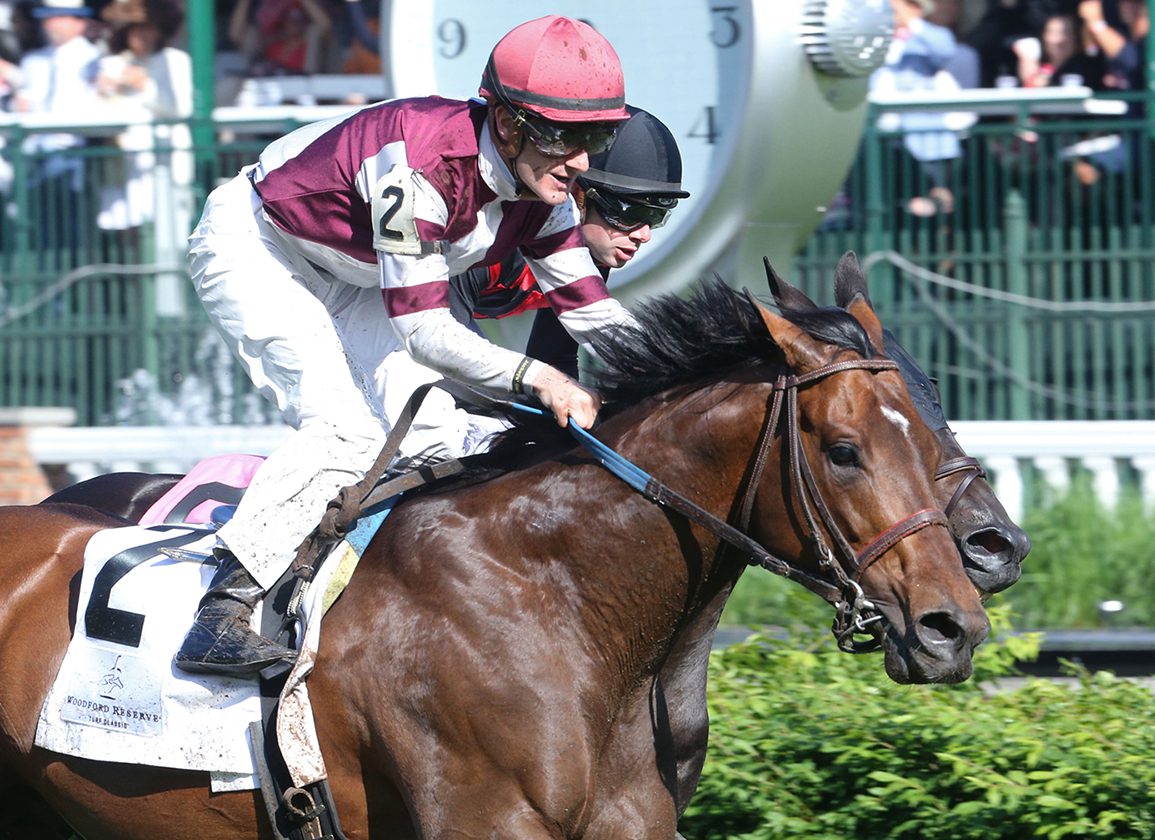
Divisidero gets back-to-back wins in the GI Woodford Reserve Turf Classic S. | Coady

Airdrie's consignment includes Hip 2689, a Divisidero colt out of MSW Keep Crossing (Istan).

“This colt is a good example of a Divisidero because they really do favor him,” Brooks said. “They definitely have his balance, build, and fluid movement and hopefully they have his speed. This colt is just a lovely horse. He's been really easy to be around and he looks like 'Divisidero 2.0.'”

Another Airdrie stallion with an impressive pedigree, Divisidero hails from the family of breed-shaping stallions Northern Dancer, Halo and Danehill.

“He's from a female family that you don't get the chance to breed to very often,” Brooks said. “It's just a fantastic pedigree and we're really lucky to have that here on the farm. He's a beautiful horse. He's very well put together and he definitely looks like a horse that would be a very fast turf horse.”

Campaigned by Gunpowder Farms, the son of Kitten's Joy was a debut winner early in his sophomore year and went on to claim the GII American Turf S. on the Kentucky Derby undercard in his third career start. The turf specialist claimed at least one graded stakes win every year over his five seasons on the track, including back-to-back scores in the 2016 and 2017 editions of the GI Woodford Reserve Turf Classic S.

“We always joke about telling people to go back and watch his race on Derby Day because any one of them would work, either his first stakes win or one of his two Grade I wins,” Brooks said. “He raced against some of the best turf horses that there have been in recent years and he had an incredible turn of foot. People are excited by his explosive speed, for sure. Everyone wants that in their sire.”

To help fight the ongoing battle for a fair shake in the commercial market for young turf sires, Airdrie Stud has thrown whole-hearted support to Divisidero to get his stud career off to a fast start.

“We have bred 15 to 20 mares to Divisidero every year that he has been here,” Brooks shared. “We really believe in this horse. We love his pedigree, we love what he did on the track and we love him physically. His foals have followed in his footsteps in that they're very similar to him. They have his build and they look like very fast horses and very good-moving horses.”

With the recent loss of Kitten's Joy, who passed away in July this year, Divisidero is one of just a handful of young stallions standing in the U.S. with the opportunity to carry on the perennial leading stallion's legacy.

“With the loss of Kitten's Joy, who will never be replaced, it's nice to have such a well-bred son of his that was so accomplished on the racetrack standing here at Airdrie,” Brooks said. “Hopefully he will have an opportunity to fill a tiny bit of the footsteps that Kitten's Joy left behind.”

The post Airdrie Sire Duo Sends First Crop to Keeneland September appeared first on TDN | Thoroughbred Daily News | Horse Racing News, Results and Video | Thoroughbred Breeding and Auctions.

Source of original post

The Week in Review: 32 Years Ago, a Spark of Kismet at Saratoga

It was a relatively quiet Thursday last week when jockey John Velazquez registered his 1,000th victory at Saratoga, extending his record as the winningest jockey in Spa history.

Sifting through the archives to get a feel for what was going on in the sport when Johnny V. won his first career race at Saratoga back on Aug. 5, 1990, yields a heady mix of nostalgia tinged with kismet.

Although not considered a truly “historic” day of racing at the Spa, there are enough intriguing nuggets buried within the charts and news clippings from that day to earn it “historical footnote” status.

The date was a drizzly Sunday on the opening weekend of what would end up being the last four-week race meet at Saratoga. A throng of 51,769 would be announced as the second-largest crowd in Spa history, but that was just the turnstile count. You own a very rare collector's item if you still have the souvenir T-shirt from that afternoon's giveaway.

Velazquez, who had only started riding on the New York circuit earlier that year, was under the tutelage of Hall of Famer Angel Cordero, Jr., who is credited with first recognizing and then helping to develop the talent of the then-18-year-old.

But as fate would have it, Velazquez's first win at Saratoga came in a race in which Cordero got slammed to the grass course back-first when his mount veered in toward the hedge at the three-eighths pole in a turf route.

Velazquez, who was pressing the pace when the spill happened well behind him, ended up winning by a neck at 5-1 odds aboard a filly named Color Blue. The young apprentice's post-race celebration must have been muted, with his 48-year-old mentor prone on the course and being attended to by the ambulance crew.

Cordero ended up walking away from the scary-looking accident even though he was down for a good 12 minutes. Published accounts stated that he flashed the “OK” sign to onlookers, and was seen peering at a program while being assessed for injuries. Perhaps liking the mounts he saw later in the day, the wily veteran missed only the next race on the card before returning to action.

Another item that stands out from that first Spa score for Velazquez is that the race featured no fewer than seven (out of a field of 10) eventual Hall-of-Fame jockeys.

Beyond Velazquez and Cordero, the others in the second race on Aug. 5, 1990, were Craig Perret, Eddie Maple, Chris Antley, Jerry Bailey and Mike Smith.

That's quite a collection of race-riding royalty–all at varying rising and falling points on their career arcs–competing in a $25,000 claimer.

Bug-boy Velazquez, the youngest of that bunch, roared right back in Race 6, pouncing from off the pace to steal a maiden turf route by a nose with Busy as a Bee, igniting the tote board with a $127.60 winner.

Despite a two-win afternoon and the massive mutuel, the rookie rider's first trips to the Saratoga winner's circle (then still a ring of chalk drawn on the main track near the finish) didn't merit a mention in the press.

The racing coverage that day was devoted to the featured GII Jim Dandy S. (in which Johnny V. didn't have a mount), plus sidebars about Cordero's spill.

For anyone believing today that four-horse fields in Saratoga graded stakes are an entirely modern phenomenon, or that slow-paced tactics are frustratingly novel to 21st Century race-riding, we have Steve Crist's New York Times description of a “bizarrely weak” renewal of the Dandy to set us straight:

“Only four starters turned up, and their riders were apparently so worried about their mounts' being able to go the distance–a mile and an eighth–that they virtually walked most of the way,” Crist wrote. “The slow early fractions [:26.22 and :51.73] reduced the race to a three-furlong sprint to the wire.”

Chief Honcho (Smith aboard) was the winner of that dawdling Dandy in a final time 1:51.74.

Jennie Rees of the Louisville Courier-Journal seemed to be the only turf writer who noticed that “the victory was the first in a Saratoga stakesa” for Chief Honcho's trainer, a 37-year-old up-and-comer from the Midwest named Bill Mott.

It's doubtful that anyone in 1990 recognized those same-day accomplishments for Velazquez and Mott as the launch-pad milestones they would prove to be.

Over the next three decades, both jockey and trainer would become well-respected synonyms of Saratoga success, both on and off the track.

So it was fitting that when Velazquez rode Precursory (Kantharos) to victory for his 1,000th Spa win on Aug. 25, 2022, Mott was the trainer.

Travers Takeaways…

The ceremonial maroon and white paint wasn't yet dry on the GI Runhappy Travers S. canoe Saturday when speculation about the next start for Winchell Thoroughbreds colorbearer Epicenter (Not This Time) began to swirl.

With little doubt that the GI Breeders' Cup Classic is the ultimate season-ending goal, the main post-Travers question was whether or not Epicenter (112 Beyer Speed Figure) would have another race in the 10-week interim until the Classic. Trainer Steve Asmussen didn't commit either way in the immediate aftermath of the win, but he did indicate such a layoff wouldn't be considered problematic.

The marquee for the Classic is already being prepared as a highly anticipated Epicenter-vs.-Flightline (Tapit) showdown, but the undefeated 4-year-old 'TDN Rising Star' must first sail through Saturday's GI Pacific Classic at Del Mar before his Breeders' Cup status is confirmed.

Now that Saratoga's so-called Midsummer Derby is in the books, there's not much debate over Epicenter being at the top of the totem pole among sophomores aiming for two-turn glory. He manhandled the GI Kentucky Derby, GI Preakness S., and GI Haskell S. winners in the Travers, meaning the best chances for a late-summer bloom within the 3-year-old division now rest with 'TDN Rising Stars' Charge It (Tapit) and Taiba (Gun Runner).

Charge It ran second in the GI Florida Derby, then was a no-impact 17th when wide in the Kentucky Derby. But the Todd Pletcher trainee rebounded with a gaudy 23-length win in the GIII Dwyer S., and was aiming for the Travers before a foot abscess derailed his training last week. The GI Pennsylvania Derby Sept. 24 could end up being his next start.

Taiba was a surprise nomination for the Pacific Classic, but trainer Bob Baffert said Saturday that the GI Santa Anita Derby winner will probably not go in the race. After eating a ton of dirt and running into a wall of horseflesh on the far turn of the Kentucky Derby, Taiba rallied with interest in the Haskell, coming up just a head short for the win.

“I nominated him just in case,” Baffert said. “Things happen and you never say never, but the complexion of the race would have to change.” (Read: Flightline would have to go missing in action prior to the draw on Tuesday.)

Taiba is also nominated for the ungraded Shared Belief S. on the Pacific Classic undercard.

The post The Week in Review: 32 Years Ago, a Spark of Kismet at Saratoga appeared first on TDN | Thoroughbred Daily News | Horse Racing News, Results and Video | Thoroughbred Breeding and Auctions.

Source of original post

Verified by MonsterInsights