Derby and Oaks Day, Oklahoma Style

Sunday's GIII Oklahoma Derby and GIII Remington Park Oaks give the sophomore set a late-season option at age-restricted competition, with some marquee names making the trek across to Oklahoma City.

Brad Cox has sent out the winners of the last three runnings of the centerpiece of the local racing calendar–Owendale (Into Mischief, 2019); Shared Sense (Street Sense, 2020); and Warrant (Constitution, 2021) and can break the tie with Donnie K. Von Hemel should Gary and Mary West's Best Actor (Flatter) validate his morning-line favoritism. The $330,000 Keeneland September purchase has tasted defeat just once in his four-race career when narrowly runner-up in the GIII Indiana Derby July 9, but he bounced back in no uncertain terms with a 5 3/4-length romp in the GIII Smarty Jones S. at Parx Aug. 23. He swerves that track's million-dollar race and its heavy hitters for the clearly softer competition here. Florent Geroux, in the irons for Owendale's tough win four years ago, takes the call on Best Actor.

Rattle N Roll (Connect) won last year's GI Claiborne Breeders' Futurity and looks for a third Derby this year to go along with the July 2 American Derby at Churchill and the St. Louis Derby at FanDuel Racing Aug. 20. Sandwiched between those is a seventh in the Indiana Derby, a race that is best forgiven after he was hampered badly and clipped heels at the start, then trailed most of the way.

Barring something unforeseen, Juju's Map (Liam's Map) should be able to add her name to the list of Remington Park Oaks winners. Last year's GI Darley Alcibiades S. victress returned with a smashing Oaks day allowance tally May 6, but has since disappointed at odds-on when third in the GII Mother Goose S. and GIII Monmouth Oaks.

Sunday's other graded action includes the GII Gallant Bloom S., featuring 'TDN Rising Star' Kimari (Munnings), at Aqueduct and the GIII Vigil S. at Woodbine.

The post Derby and Oaks Day, Oklahoma Style appeared first on TDN | Thoroughbred Daily News | Horse Racing News, Results and Video | Thoroughbred Breeding and Auctions.

Source of original post

Colin Brennan Gets Fast Start at Keeneland September

Colin Brennan hit a home run with the first horse to represent his consignment during its inaugural appearance at the Keeneland September Sale when he sold a $55,000 pinhook for $100,000 during the eighth session of the sale.

Brennan purchased the Flatter filly out of stakes-placed Summer Reading (Hard Spun) at last year's Keeneland November Sale.

Before the yearling went through the ring on Tuesday, Brennan walked alongside his pinhook prospect for the long trek to the sales pavilion and discussed how he was first drawn to the filly after working with her half-sister at his father Niall's training operation.

“Dad and I pinhooked her sister Very Scary (Connect) last year and she had quite a bit of ability,” Brennan explained. “Then I saw this one at Keeneland November and she fell within our price range. She was a bit immature and narrow at the time, but looked like she had the potential to grow into a pretty filly. She has really blossomed and of course you can't go wrong with Flatter.”

Brennan was greeted by a chorus of well-wishes from fellow horsemen as the filly entered the back walking ring. The consignor has already sold at various auctions in the past two years, but he didn't deny that there is something special about offering his first horse at Keeneland September.

“We're in the big leagues now,” he said with a smile before the filly stepped into the sales ring. “It's always on a young consignor's to-do list to be able to sell at Keeneland, so this is pretty cool”

Hoping to get within a target range of $75,000 to $100,000, Brennan was more than content when the filly hit six figures and sold to Granpollo Stables. Later in the sale, Colin Brennan Bloodstock sent four additional yearlings through the ring including an Audible filly that Brennan pinhooked at Keeneland November for $35,000 and sold during Book 4 for $95,000.

Establishing a consignment of his own has been a dream come true for Brennan, who can pinpoint the exact moment when he decided he wanted to follow in his father's footsteps by making his career in racing.

Three generations of Brennans on the job | photo courtesy Colin Brennan

“I remember working the Miami Calder sale with my dad when I was 13 and I told him that this is what I wanted to do for a living,” Brennan recalled. “Growing up, it has always been a family affair. My mom [Jolane Weeks] was a large Florida breeder and we would foal out 100 to 150 head of mares each year. I grew up working a lot with her, but also at my dad's farm doing the 2-year-old sales. I learned a lot from both of them.”

After graduating from the Godolphin Flying Start program a decade later, Brennan joined Stonestreet Stables as a traveling assistant trainer for several years and then returned home to Ocala to be an assistant trainer at Niall Brennan Stables.

While working for his father, Brennan began pinhooking a few weanlings to yearlings of his own. On top of helping develop the 2-year-olds each day, he would hand walk all of his yearlings himself, often putting in over 30 miles on foot under the Florida sun every day.

“It was exhausting,” he said with an easy laugh. “There weren't enough hours in the day. Eventually when my son was born, that was the ultimate deciding factor. I had started buying more and more weanlings to yearlings and I thought that this was more of a conducive lifestyle to be with my family.”

While focusing on his own operation does allow Brennan a touch more flexibility, he said he has always been drawn to the yearlings in particular.

“I enjoy raising horses and seeing the changes that they go through,” he said. “I like being able to shape them physically and mentally and have an impact on their development. This was always something that I thought I would like to give a try, and I'm still able to go visit at Dad's and have some useful input at the 2-year-old sales.”

Brennan credits his father and Mike Ryan for the eye he has developed for scoping out future stars.

“I think of all the influences I've had, they would be the two biggest in terms of sales and selecting horses,” he explained. “It's about [looking for] an overall quality in their mindset and their demeanor. I look for an active, fluid mover that gives you a good energy. Of course you also have to understand who your end user will be and envision where they would fit in the market, but ultimately I'm looking for a big mover with a real athletic feel to them.”

With his first Keeneland September consignment under his belt, Brennan said he hopes his operation continues to grow from here.

“Long term, I would like to increase the quality,” he said. “I don't ever want to be a very large consignment. I would like to keep my numbers well under control and be able to offer quality over quantity at the major sales. I hope to be able to provide people with confidence that we've raised and prep a good horse.”

The post Colin Brennan Gets Fast Start at Keeneland September appeared first on TDN | Thoroughbred Daily News | Horse Racing News, Results and Video | Thoroughbred Breeding and Auctions.

Source of original post

This Side Up: Striking Gold Never a Formality

In this business, simply “doing the math” would stop us right in our tracks. Luckily, we have algebra on our side. A daunting equation can always be rescued by that helpfully vague variable, 'x', the unquantifiable ardor of wealthy people: their competitive instinct, their sportsmanship, or simply their outsized egos. At the top of the market, after all, the dollars they spend are not the same as the dollars used by the rest of us to buy coffee or gas. It's not like “real” money at all. But that doesn't mean it can't be subject to a scale of values.

So, to give one example, I shouldn't be at all surprised if the most expensive yearling transaction of 2022 has yet to take place, despite that booming market at Keeneland over the past few days. American investment at the Tattersalls October Sale has been soaring in recent years, and the environment this time round could not be more congenial. Even the biggest domestic investors will be bringing a penknife to a gunfight. Sterling has hit a 37-year low against the dollar and, with the fiscal helm in Britain seized by navigators unorthodox to the point of eccentricity, you couldn't rule out outright parity between the two currencies by the time Tattersalls raises a hammer over several yearlings from the penultimate crop of Galileo (Ire).

And here's another calculation for the rich; specifically, for those prosperous partners privileged to share Flightline (Tapit). If all goes well at the Breeders' Cup, somebody in their decision-making huddle will surely point out that nowadays he has the option of banking the equivalent of around 50 covers, even at his likely fee, with a 110-second gallop in Saudi Arabia. (Conceivably it might even be muttered that the race is scheduled just 11 days into the breeding season.)

From the sidelines, we're all fondly anticipating mass public engagement for our sport if Flightline is permitted to extend his career beyond a sixth start. Even if his owners were to give us what we want, however, there's a scenario in which we might seem impossible to satisfy. What if they ask us to settle for a couple of breakfast broadcasts from the desert, before he rests up and takes in maybe a single prep before the Breeders' Cup? I think our gratitude might soon obtain a rather peevish note.

On some level, those imploring his owners to keep him in training are suggesting some implicit duty to the sport. That feels a little unfair. At the same time, if we are asked to believe that their strategy really won't be governed simply by dollars and cents, then it does at least become a question of the kind of legacy they wish to create from a generational opportunity.

Flightline's stud career is emphatically part of that, too, though let's not forget that even an authentic racetrack phenomenon must start over and prove himself in his second career. For now, it's not as though Flightline could be sensibly proposed as an equivalent wager, in terms of what a breeder should be expected to pay, to Into Mischief.

At 126, Flightline has authored one of just eight Beyers ever recorded at 125 or more. The only horse to hit a higher mark, Ghostzapper (128), is also the only one with any pretension to having maintained his elite status at stud. More typical are the fortunes of the horse with the unique distinction of clocking two of those eight Himalayan Beyers.

In his three final starts, Formal Gold ran 126, 124 (smashing a 40-year Monmouth track record) and 125; he was going into the Breeders' Cup on an irresistible roll when derailed by injury. Yet he would prove a thoroughly anonymous stallion, best redeemed by Semaphore Man, who annually contested the GIII Count Fleet H., aged four through seven, for finishes of 3-2-1-1. After failing to get any of three Saskatchewan mares in foal in 2017, Formal Gold was retired into the best of care but nobody noticed when he quietly slipped away two or three years back.

Now obviously Flightline is a radically different proposition. And not just because Formal Gold, expertly handled by the unsung Bill Perry and thriving on the attentions of Skip Away and Will's Way, stood up to 16 starts in 15 months. Formal Gold cost $62,000 as Hip 1657 at the September Sale; Flightline made seven figures at Saratoga. Alongside his freakish performances, then, he evidently has the genetic and physical wherewithal to make a better fist of his next career.

But even Secretariat notoriously failed to find a male heir. All Thoroughbreds tend to keep us guessing, in some respect or other, and that's never going to change. Certainly I can't buy into the notion that Flightline has fueled the market boom by showing that even really big numbers can be made to make sense. The year he was sold was no different from any other, in terms of the spectrum of outcomes.

It was that September, for instance, that the daughter of Leslie's Lady and American Pharoah made $8.2 million, and there's no need to remind anyone of the tragedy that ensued. That kind of thing can happen to any horse, but it's pretty sobering to scroll down the other top prices paid at that auction. They were obviously well assessed, physically, because most have made the racetrack. But while Malathaat (Curlin) has proved a million bucks very well spent, and there have been moments of excitement for the likes of Spielberg (Union Rags) and Overtook (Curlin), suffice to say that there are some pretty expensive geldings pottering around out there.

The late Cezanne in March | Horsephotos

Another of the headline scores of the 2019 bloodstock market was the $3.65-million Curlin colt that topped Fasig-Tipton's 2-year-old sale at Gulfstream. I was extremely sorry, this week, to read that Cezanne's various travails since had reached a fatal nadir in a fungal infection. He will duly remain an unfinished masterpiece, albeit even he managed two more starts than Flightline to this point. Cezanne's whole story has proved a very poignant one: most obviously, as the parting bow of Jimmy Crupi, but also given the premature loss (through colic) of a dam from one of the most brilliantly curated families in the book.

Cezanne had shown sufficient flashes of brilliance to merit a chance at stud and, this business being what it is, he would have started with the same blank slate as will Flightline. So we can never know, from one day to the next, quite when a Thoroughbred has achieved its definitive value.

As such, in enjoying a loaded GI Pennsylvania Derby on Saturday, perhaps we should cast our minds back to the 1996 running when Formal Gold was turned over at short odds. In the event, it proved that he had barely started. Maybe that can still prove true of Zandon (Upstart), in which hope I'm clinging stubbornly to the wreckage after his championship credentials took a battering in the GI Travers.

To me, he looked like a horse in some kind of discomfort that day, the way he carried his head turning in, and I refuse to forget the way he glided into contention on the first Saturday in May. For such a baffling Derby, it is turning out to be a pretty good one, and yet there was a moment when Zandon looked in a class of his own.

His equation still has that 'x' element, and maybe his new jockey will discover its true value. You know, I might even stake a dollar or two out of my grocery budget.

The post This Side Up: Striking Gold Never a Formality appeared first on TDN | Thoroughbred Daily News | Horse Racing News, Results and Video | Thoroughbred Breeding and Auctions.

Source of original post

Racetrack Surfaces: Where HISA’s Rubber Meets the Road

The closer the clock ticks down to Nov. 4, when Turf Paradise's latest 130-day meet is scheduled to launch, the louder will the questions resound about the facility's historically checkered approach to equine welfare and safety.

Near the midway point during last year's Turf Paradise meet, its equine fatality rate was more than 2.8 deaths per 1,000 starts. This compares to the national equine fatality rate of 1.39 per 1,000 starts last year.

Between Oct. 10, 2021, and May 7, 2022, 11 horses were fatally injured during morning training at Turf Paradise and 18 were fatally injured during racing, with another 13 lost to other circumstances.

Anyone with even a glancing understanding of catastrophic injuries knows the complex nature of causality, with the term “multifactorial” much bandied about. One of these important factors, however, is the condition of the racetrack surface–an issue that has bedeviled Turf Paradise in recent years.

To prepare for the upcoming meet–as well as for the Horseracing Integrity and Safety Act (HISA), the racetrack safety portion of which went into effect July 1–Turf Paradise has hired a new track superintendent and has joined forces with the Arizona Horsemen's Benevolent & Protective Association (AZHBPA) to hire noted racetrack expert Steven Wood to oversee these operations.

In many ways, tracks like Turf Paradise–those with more to do to meet HISA's baseline racetrack surface standards–provide something of an inflection point for the federal law, the rubber now meeting the road.

How long do tracks like Turf Paradise have to get up to speed, for example? What are some possible implications for non-compliance?

In the long term, how soon before the data collection components of these federal rules generate the kinds of answers needed to further racetrack surface safety in the U.S.? “Patience,” extolled racetrack surface expert Mick Peterson in answer to the latter. “It's not going to happen overnight.”

HISA Requirements

The racetrack maintenance component of HISA–summarised here–sets out two main areas of compliance.

Before the start of each meet, tracks are required to perform a set of testing protocols for all dirt, synthetic and turf surfaces. These include the examination of dirt or synthetic surface bases either visually or by using ground penetrating radar, as well as measuring the geometry of turf tracks.

Then on an ongoing basis during the meet, HISA requires a set of daily measurements to be made at all quarter-mile markers at distances of five feet and 15 feet from the inside rail. This includes moisture content and, for dirt and synthetic tracks specifically, cushion depth.
Sarah Andrew

Track superintendents are also responsible for keeping a log of what kinds of daily maintenance they perform on the track surfaces and the relevant equipment used, along with the amounts of water put on the tracks.

Though key regional differences mean no two tracks work their surfaces exactly alike, “our end goal is to have every racing surface feel the same to the horses when they run on it,” said Ann McGovern, HISA director of racetrack safety, mirroring comments made about the work done in recent years at Del Mar and Santa Anita to render their main tracks physical twins–work widely regarded as instrumental in making these two tracks among the safest in the country.

That's the goal. To get there, the rollout it is, like much of HISA's broader mandate, piecemeal.

In short, the reporting component of the law is already very much at play, with track superintendents required to keep daily logs either written into notebooks or submitted digitally.

Where HISA currently affords wriggle room is to the typically smaller, less-resourced tracks that might not have all the necessary equipment to meet new demands.

Has HISA identified a specific date by which all tracks need to be up to speed? “We don't have an end date for that,” responded McGovern, adding that “we plan on giving extra help to tracks that need it, and extra guidance.”

Thistledown Racino in Ohio is one of those tracks playing catch up.

“Implementing everything has taken some time, but we're going the right way,” said long-time track superintendent John Banno. “We might be further behind some tracks, but we might be further along than some others.”

As mandated under HISA, the track has established a safety committee that Banno attends with the safety director and director of racing, along with representatives from the horsemen, jockeys and stewards.

“We cover a lot of bases,” Banno said, about these monthly meetings. “It's mostly about keeping the lines of communication open.”
Ryan Thompson

Complying with another new mandate, Banno maintains a written notebook of numbers, details and wrinkles from his workday.

“If I'm putting down 100,000 gallons of water,” Banno said, of the details recorded. “If we use harrows for the first few races and we then switch to floats. If it rains–things like that.”

But as someone “more comfortable with dirt and mud than documentation,” ducks and water would hardly be analogized in the way Banno's taken to the task. “I'm hoping it gets a little more streamlined,” he admitted. Efficiencies can also be made elsewhere.

“I have a wish list every year,” said Banno, pointing out that his crew is working with equipment that is, in some cases, more than 40 years old.

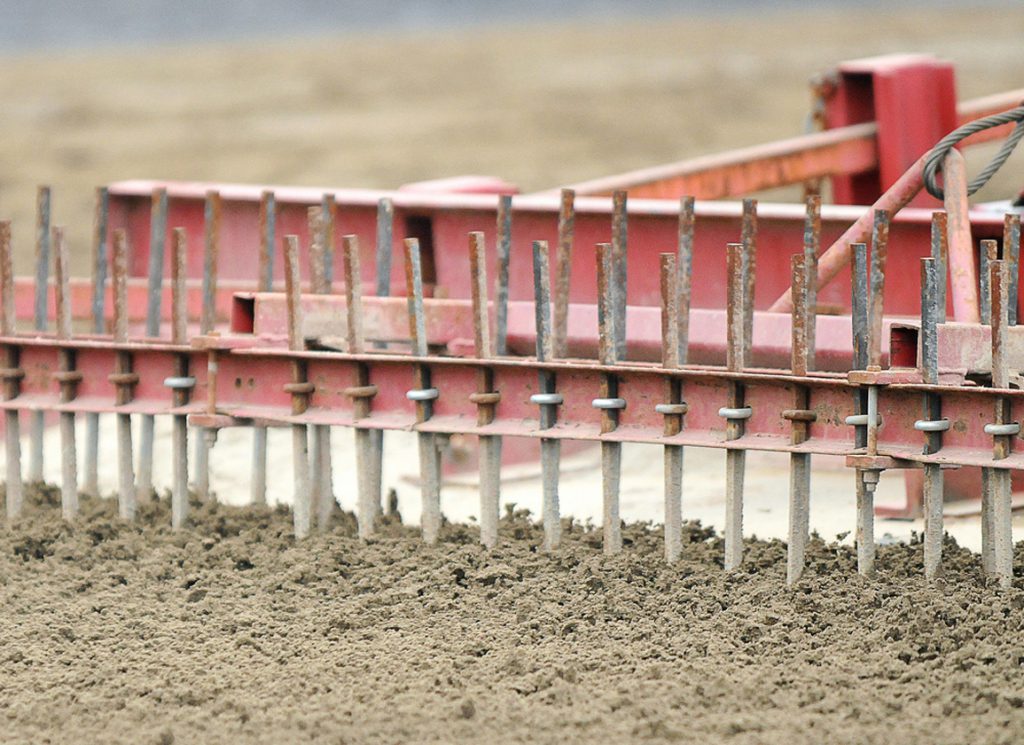
“I'm sure many smaller racetracks have to deal with that, too,” said Banno, pointing out that new equipment is both pricey–new floats or harrows can run up to $25,000 each–and fairly limited in supply.

“As far as I can tell, there's only two vendors that sell this equipment, and one of them doesn't really supply too many things anymore,” he said.

The current Thistledown meet ends Oct. 14 before kick-starting once again next spring.

With more than six months between now and then, Banno has ample time on his hands to prepare for HISA's pre-meet testing requirements. Many other meets are scheduled to launch in the interim.

This is where Peterson, who founded the non-profit Racing Surfaces Testing Laboratory, is expected to step in.

“It doesn't tell you anything”

HISA is in the final stages of reaching an agreement with Peterson for his organization to oversee these pre-meet stipulations.

“Our agreement is to ensure that HISA gets what information it needs when we go to the racetracks to do the testing,” said Peterson. Not that he anticipates the same degree of involvement at all tracks.

Many of the larger, more prestigious tracks already meet and often exceed the baseline track demands under HISA. Take moisture content readings–what should be measured daily–with Fair Grounds “a good example,” said Peterson.

“I can tell you what the moisture content was measured at 24 points [around the track] in 2010 at Fair Grounds, every day of the race meet,” he explained.

But not all U.S. track superintendents currently use the requisite tool to measure moisture content–a funkily called time domain reflectometry device. Those that don't typically gauge it the old-fashioned way, grabbing a clump of dirt and squeezing it with their hand. Or through the feel of the equipment on the track.

The good news is that a time domain reflectometry device will set the buyer back around $1,400–hardly a bank-breaker. Nor do these instruments require a PhD in engineering.

“Incredibly simple,” Peterson said, about the device's ease of use. “You just stick it in, press the button.”
Sarah Andrew

For run-ragged superintendents at under-resourced tracks, arguably the biggest headache under HISA's new regime has proven the time and discipline involved in keeping daily testing and maintenance logs.

Some of the tracks already affiliated with the Racing Surfaces Testing Laboratory use the organization's online portal to record information, though Peterson admits it can still prove laborious, the database something of a Bronze Age relic of the early digital era.

That old software, however, is undergoing a digital facelift. “The new version with The Jockey Club is going to be a lot more user-friendly,” said Peterson. That revamped software will undergo beta-testing at the Keeneland fall meet.

Which leads to the ultimate aim of what Peterson describes as the wholesale collection of “standard data taken in a consistent fashion out of a lot of tracks”: the ability to refine the information to better determine what track surface maintenance practices improve equine safety–and those that don't.

“It doesn't tell you anything,” said Peterson, dismissive of the Clegg hammer–a device measuring hardness and compaction that is still widely used around U.S. racetracks.

Then there's the issue of sealed tracks. In California, for example, horses are not permitted to train on such a surface. According to Peterson, that reticence is probably unfounded.

The “largest study to date from the Equine Injury Database [EID]” found “no significant difference when comparing off dirt versus regular dirt track for risk factors,” Peterson said.

The question then becomes: How soon can we expect the data collected under HISA to bear fruit?

“It's going to take a lot of data,” said Peterson, comparing it to the evolution of the EID.

“The first four or five years, I remember it wasn't clear that the EID was going to contribute any meaningful understanding of catastrophic injuries,” he said. “It took a lot of data, even with full participation.”

Given the steadily shifting sands of public opinion toward horse racing, there's a chance some tracks with dicey safety records might not have that four- or five-year leeway.

“This surface is not right,” warned trainer Kevin Eikleberry during an Arizona racing commission meeting before the 2021-22 Turf Paradise meet when even the commission's head veterinarian bemoaned a lack of thorough and consistent surface maintenance standards.

With a change of crucial track personnel at the Arizona facility in the interim, however, expectations are noticeably higher one year on.
Coady

“HISA would absolutely react”

“We've had to make sure the banking is how we want it,” explained Wood, before ticking off a long grocery list of other preparations already conducted at the track, including removing “a lot” of material from the existing surface, and adding tons of new sand and bark, the latter for cushioning.

“All these things should help,” said Wood, before adding that “you're still going to have to have the other guys, the vets and such, do their job” to meaningfully shift the needle.

According to George Lopez, the newly minted track superintendent at Turf Paradise–himself a former protégé of the Wood academy of track management–the facility has also splashed out on new equipment.

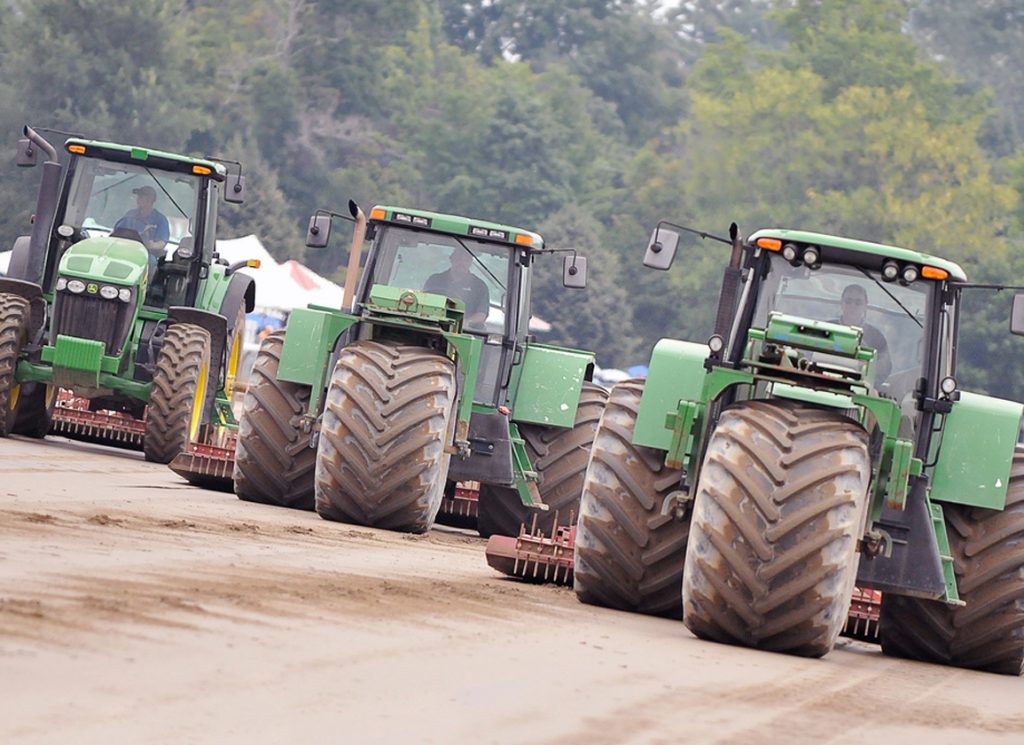
This includes a new grader–used to redistribute surface materials–and two new water trucks. “We also have two good tractors now,” said Lopez, who describes his new job as a “challenge” to relish.

“I'm very confident and I'm very sure we're going to have a really good, safe meet this time,” he said.

But what if the meet resumes this November and safety expectations fall short once more?

Stressing the “multifactorial” nature of equine injury, McGovern said that in such an instance, the new federal authority would “immediately” get involved, though stopped short of outlining a clear set of potential actions.

“Getting involved may mean talking to management, talking to the track superintendent, sending Mick [Peterson] to look at the track surface, looking at necropsies, looking at training methods,” McGovern said. “HISA would absolutely react to any track that had numbers as significant as we have seen at Turf Paradise last year.”

The post Racetrack Surfaces: Where HISA’s Rubber Meets the Road appeared first on TDN | Thoroughbred Daily News | Horse Racing News, Results and Video | Thoroughbred Breeding and Auctions.

Source of original post
Verified by MonsterInsights
