A Shortcut Into Decades of Patience

This is one of those programs, temperate and patient, that nourish the very marrow of our industry. It has never comprised more than around 10 mares, whose foals are brought into the world not just to make a fast buck but actually to go out there and run. Whitham Thoroughbreds is run by an octogenarian widow and her son: they devise matings to draw out speed into a second turn; they're not scared of using a turf stallion from time to time; and they work with horsemen who operate on a correspondingly intimate scale.

In fact, since Janis Whitham and her late husband Frank first dipped their toes into the Thoroughbred world, nearly 40 years ago, the mares and foals have basically been tended by the same hands: first those of Frank Penn at Pennbrook Farm near Lexington and then, when he retired around a decade ago, those of his veterinarian Dr. Steve Conboy at Maple Lane Farm. The racetrack division, albeit launched in California, has reflected similar priorities since it was decided to site the whole herd more accessibly: when Carl Nafzger stepped down, the horses simply stayed with his assistant Ian Wilkes.

“I certainly don't mean to knock those trainers who have huge strings,” stresses Clay Whitham, who assists his mother in running their equine team. “Obviously they get the job done. But I doubt whether they can have enough time to talk with every single one of their clients the way Ian does with Mom. Yes, we have a program-but first and foremost it's something we enjoy. My mother, in particular, really enjoys planning the matings. So it's very good for her to be able to work with a trainer like Ian, who takes his time with the horses, and makes time for visiting with his owners too.”

The dividends have far surpassed those typically achieved by brash ambition in other programs. Admittedly the Whithams were blessed, pretty early on, to import the Hall of Fame impetus of dual GI Breeders' Cup Distaff winner Bayakoa (Arg), but the acorn-to-oaks strategy has since yielded a GI Breeders' Cup Classic from Fort Larned (E Dubai) and a run to the GI Kentucky Derby with McCraken (Ghostzapper). That horse put a remote settlement on the national map, much to the pride of his breeders–who were both raised in the Kansas plains, and in turn made a home for Clay (now a banker in Colorado) and his siblings in the small town of Leoti.

As an unbeaten GII Kentucky Jockey Club S. winner, McCraken was a conspicuously precocious talent by the standards of his sire. The zip in McCraken's genes is attested by the fact that his half-sister Four Graces (Majesticperfection) broke the Keeneland track record over the extended seven furlongs in the GIII Beaumont S., complementing the new mark set by their dam's half-sister Mea Domina (Dance Brightly) in a graded stakes at Del Mar over 1 1/16 miles. That will doubtless seize the attention of commercial breeders when Four Graces comes under the hammer with Denali Stud as Hip 192 at the Keeneland November Sale. But perhaps they should primarily be engaged by the rare opportunity to tap directly into the very fount of this exemplary venture.

Because while there had been one or two Thoroughbred experiments at country tracks, the whole story really began with the weanling Nodouble filly unearthed by Frank Penn for $75,000 in 1983.

“They had quite a bit of Quarter Horse racing out in Kansas back in the day,” recalls Clay. “And my parents, who both came from agricultural areas of the state, had raced a few Quarter Horses. But about this time they decided to transition more into Thoroughbreds. My father was a businessman, I think he could probably just see that the purses were better! And while things have obviously changed quite a bit since, at that time the best purses were in California.”

The filly, named Tuesday Evening, won a Santa Anita maiden on her second start for Ron McAnally and, while unable to race again, duly bred half a dozen winners for the nascent program, including a very fast one in Madame Pandit (Wild Again), who won the GIII Monrovia H. before finishing chasing home Exotic Wood (Rahy) in the GI Santa Monica H.

By the time Madame Pandit came along, however, these horses had acquired a tragic new purpose: as a bond of comfort for a family united by grief. Frank, having built a successful career in livestock, oil and banking, was only 62 when lost in a plane crash in 1993. Through her long widowhood, the patient cycles of breeding-to-race have given Janis much consolation. It was partly to ease that deepening engagement that it was eventually decided to transfer the racetrack division closer to the breeding stock.

Madame Pandit made a great start to her breeding career when Mea Domina, only her second foal, won the GI Gamely Breeders' Cup H. at Hollywood Park. That success actually came just a couple of weeks after Madame Pandit was covered by Seeking The Gold, conceiving a filly that would bear the name Ivory Empress.

“Madame Pandit had been Tuesday Evening's best foal,” Clay reflects. “She was a real speedball, one-turn only, and while I think we breeders tend to get a bit too hung up on size, she really was a very good-sized mare. You know, good barrel, good scope-and every foal she threw was good-looking.

“And we knew that she had that speed back there. We do prefer to breed a two-turn horse, that's our goal, but speed is always a good thing if you can just try to stretch it out. Anyway we were very high on Madame Pandit as a broodmare prospect and, though getting a mare to a stallion like Seeking The Gold was difficult, Mother got that job done! He already had a reputation as a broodmare sire, so we did have our fingers crossed for a filly.”

While Ivory Empress won three times, and also made the podium in a graded stakes, she did not achieve quite as much on the track as Mea Domina. Yet she was the one who has ultimately proved the best conduit for the Tuesday Evening legacy.

“It's a good example of the way things often turn out,” Clay remarks. “You just never know, until you start raising foals. Mea Domina was obviously a very talented horse, but did not turn out to be the broodmare we had hoped. But Ivory Empress took her chances. We bred her first to War Front. Again, my mother got to Seth Hancock! She was the one that could get the mares in there.

“And the result was a very talented colt [early on], second in a couple of graded stakes. One time in particular he looked the clear winner, only for something to fly past in the shadow of the wire. So the mare had landed running-and her second foal was McCraken.”

There was real excitement when McCraken made a seamless resumption in the GIII Sam F. Davis S. and while he was beaten next time, and then suffered a rough trip when midfield at Churchill, he did only go down by a nose in the GI Haskell Invitational S. and has now had his first winners from a small debut book at Airdrie.

“He'll always be special to us,” Clay says. “This whole thing is very much a family activity, and obviously there's nothing quite like having a horse in the Kentucky Derby. That got all the nephews and cousins and everybody involved, it really was quite a ride he took us on.”

It will not be easy, then, to cash out his sister Four Graces. Impressive on debut at Gulfstream, she went through the ranks to win the GIII Dogwood S. before claiming that track record at Keeneland. Restricted to a single start last year, she has had several near-misses this year including when caught late in the GI Derby City Distaff S. But every program, of any size, needs discipline; needs to prune families to keep cultivating them.

“She's the kind we'd love to keep,” Clay says. “She has a great physique, and she has shown a lot of the talent and speed you see in her family. Her dam always has good-looking foals and she was probably top of the list. But as a breed-to-race program, we want to come as close as we can to paying its way. You have two revenue streams available, racing and selling, and it's tough to make it all in purse money. So to have a broodmare prospect that has accomplished everything she has, from a family like that, it's too good an opportunity not to see what we can get done.

“We do have three fillies in the pipeline out of Ivory Empress. Without that, I believe it would be difficult. But we have an Uncle Mo [yearling] down in Florida, just getting started in her training program; we have a Street Sense [weanling] on the farm; and we actually have a 2-year-old full-sister to McCraken who has just been held up by a few little things. And of course we also have Ivory Empress herself. She's 17 and, like all of us, she's getting a little more age on her-but she's doing very well. She was getting late in the foaling [cycle] so we left her open this year and we're working on a mating plan right now.”

The parallel dynasty developed by the Whithams, of course, traces to Bayakoa herself. This really has been a remarkable achievement. The dual champion mare had just two producing daughters. One of these, in turn, herself managed only a single daughter-but that was four-time Grade I winner Affluent (Affirmed). The other daughter, somewhat quixotically, was given the same name as Bayakoa's Argentinian-registered dam, Arlucea. (So good they named her twice!) Having already come up with Fort Larned, another Kansas landmark put on the racing map, she has now produced a fresh maroon-and-silver blossom in Walkathon (Twirling Candy).

Earlier this year Walkathon looked one of the most progressive turf fillies around when winning the GIII Regret S., but has not been seen since.

“She got a knock,” Clay explains. “She was shipped to Saratoga to run in the [Gi Saratoga] Oaks up there but on the morning of race, when they took her out of her stall, she had a bit of a hitch in her giddy-up. So we had her X-rayed and it's a pretty typical deal, no displacement, the kind of thing we've had very good experience recovering from. So we're looking forward to seeing her next spring.”

The emergence of Walkathon is the kind of thing that sustains the passion; and it's the passion that sustains the program. Nobody needs to tell the Whitham clan about the ups and downs of life. They have sampled unspeakable tragedy away from the track and, in the essentially trivial environment of quadrupeds running in circles, they had one of their proudest moments compromised by the disaster that befell their champion's big challenger Go For Wand at the Breeders' Cup. Yet they have found abiding renewal in the patient cycles of raising and racing Thoroughbreds. Whoever is privileged to take this short-cut with Four Graces, then, should also hope to absorb something of the fulfilment the vendors have found in all their years crafting such genetic quality.

“It's all such a great activity for my mother,” Clay says. “She's not able to travel quite so much now, but she's doing great and gets so much enjoyment from the horses. Right now she's running different pedigree programs on the mares, looking at all the different stallions, and still very much engaged.

“We were really tickled to see Walkathon came through for that family. With horses, you always have the ones that carry the load for all the others, and you don't always know which one it will be. Affluent was a disappointing broodmare, but now here's Walkathon from the same family. We've really stuck with these families, tried to develop them. You do have to be careful, not to be too close-bonded on that, but it can work and that's how we got from our foundation mare to Four Graces. Whether we're bull-headed or smart, who knows. But believe me, you have to be lucky too!”

The post A Shortcut Into Decades of Patience appeared first on TDN | Thoroughbred Daily News | Horse Racing News, Results and Video | Thoroughbred Breeding and Auctions.

Source of original post

Nick Luck Joins the TDN Writers’ Room, Talks BC European Contingent

The Green Group Guest of the Week on the latest edition of the TDN Writers' Room podcast presented by Keeneland, commentator Nick Luck, who works both sides of the Atlantic, was asked what are the best storylines out of Europe when it comes to this year's Breeders' Cup. With a deep and talented group of shippers coming to Keeneland, there was no shortage of answers, starting with the story of Highfield Princess (Fr) (Night of Thunder {Ire}).

“I think Highfield Princess is right up there as one of the great storylines,” Luck said of the Europen sprinting star who will contest the GI Breeders' Cup Turf Sprint.  “She's in the Turf Sprint against Golden Pal, so this is one of those races where you can genuinely say the best American in his or her division is facing the best European in his or her division, both with brazen speed. That sets up as a perfect clash. You have the Coolmore ownership on one hand with Golden Pal against the slightly more blue collar origins on the other. It's got everything that a Breeders Cup race should have.”

Then there's jockey Hollie Doyle. She could have two favorites in Nashwa (GB) (Frankel {GB}) in the GI Breeders' Cup Filly & Mare Turf and The Platinum Queen (Ire) (Cotai Glory {GB}) in the GI Breeders' Cup Juvenile Turf Sprint.

“Hollie Doyle is the most successful female jockey that's ever been in Europe,” Luck said. “She's a ground-breaker, someone who's really threatened to shatter the glass ceiling more than any other female rider has before. She's got meaningful chances with The Platinum Queen and Nashwa in the in the Breeders Cup Filly & Mare Turf, and that's a race that will test her a little bit more against some of the best American turf riders. So we'll see what she's made of tactically there.”

Trainer Charlie Appleby will be well represented with a group led by Modern Games (Ire) (Dubawi {Ire}), the likely favorite in the Breeders' Cup Mile. Appleby is 14-for-28 in North America since 2021, including wins with Modern Games, Space Blues (Ire) (Dubawi {Ire}) and Yibir (GB) (Dubawi {Ire}) in last year's Breeders' Cup. He is making it look easy.

“If you have the depth of talent that he has, obviously, that makes it easier,” Luck said. “But there have been plenty of high-profile trainers who've had the patronage of high-profile owners before who haven't done as well as him. Even Aidan O'Brien, who has a great record in the United States, pales by comparison when you look at strike rates. One of the things that motivates Appleby most is finding the right opportunities for his horses. And if he has a whole bunch of Grade I or Grade II horses finding where they fit best. He likes to use the international calendar to exploit that. If he has three dozen beautifully bred horses by Dubawi, he knows he can't target them all at the British classics. They'll find their natural metier running in those turf races in the United States. He's just exploited that to a tee. Then he gets them to get confident, then they get better still.

Elsewhere on the show, panelists Randy Moss, Zoe Cadman and Bill Finley took a look back at the stunning defeat suffered by Baaeed (GB) (Sea The Stars {Ire}) in the GI Champion S. at Ascot and a look ahead at the prospective fields for the GI Breeders' Cup Classic and the GI Breeders' Cup Distaff. The podcast, which is also sponsored by Coolmore, XBTV, The Pennsylvania Horse Breeders Association, Three Chimneys, West Point Thoroughbreds and Legacy Bloodstock, also included a discussion of what's next for Hall of Fame jockey Kent Desormeaux, whose return is unclear after he recently served a 60-day suspension. The writers jumped on the opportunity to implore other states beyond Kentucky to give the bettors a break and revert to penny breakage, but didn't hold out much hope that it would happen. The penny breakage system in Kentucky has meant an additional $1.1 million has been returned to bettors since the system was implemented at the start of the Ellis Park meet.

Click here to watch the podcast and here to listen.

The post Nick Luck Joins the TDN Writers’ Room, Talks BC European Contingent appeared first on TDN | Thoroughbred Daily News | Horse Racing News, Results and Video | Thoroughbred Breeding and Auctions.
Source of original post

The Legacy of Arrogate: Gone Too Soon, Yet Just Getting Started

It was a little over six years ago when Juddmonte Farms' Arrogate (Unbridled's Song), seemingly from out of nowhere, took the racing world by storm. Producing heroics, often in jaw-dropping, record-breaking fashion, in the GI Travers S., GI Breeders' Cup Classic, GI Pegasus World Cup Invitational S. and G1 Dubai World Cup in succession, the imposing gray quickly catapulted himself into the discussion of all-time greats.

Though his racing career fizzled somewhat when he finished off the board in two of his final three starts after returning from Dubai, the enthusiasm was hardly dampened for what he could do as a stallion. As the last great son of generational sire Unbridled's Song and hailing from a deep female family highlighted by champion and six-time Grade I-winning third dam Meadow Star (Meadowlake), the sky was the limit for Arrogate as he took residence at Juddmonte in 2018. Not long after, tragedy struck.

Nearing the end of just his third season at stud, Arrogate collapsed suddenly in his stall and was unable to get back up. After a draining four days of testing at the Hagyard Clinic attempting to diagnose and save him, he was euthanized on June 2, 2020 at only seven years old. The mystery illness was later determined to be a lesion to his spinal cord that rendered him a quadriplegic.

“We were completely gutted by how it happened, and still are scratching our heads a bit,” Juddmonte general manager Garrett O'Rourke said. “For such a young horse, it was totally unexpected. It was extremely gutting for that to happen.”

The legacy of Arrogate, once thought sure to be etched in stone, was entirely up in the air as recently as last year. Seemingly as quickly as he appeared, dazzling the sport with his blinding brilliance, he was gone, with a mere three crops of foals now tasked with ensuring his name would live on beyond the late 2010s.

It frankly didn't look hopeful from the early results that they were up to the challenge. It took until Sept. 6, 2021, roughly five months after 2-year-olds began racing in North America for the year, for Arrogate to record his first winner as a stallion when DJ Stable's Adversity captured a fairly slow New York-bred maiden special weight at Saratoga. Momentum started to build somewhat from there, and he finished 2021 with 13 winners–a respectable number, but not the freshman sire splash Arrogate was expected to make.

Then, on the first day of 2022, a filly named Alittleloveandluck belatedly planted Arrogate's flag in stakes territory, capturing the Ginger Brew S. on the Gulfstream turf. Little did anyone know then, but that victory would be the perfect lid-lifter for what has become a breakout season for Arrogate the stallion at the highest level, with stars Secret Oath, Cave Rock and And Tell Me Nolies giving him three Grade I winners from just 92 total starters. Juddmonte itself has campaigned an additional stakes winner for him in Curlin S. victor Artorius.

“As Bob Baffert says, and I think Cave Rock and Secret Oath are like this: they're cruising along and then you let them down and their head drops down about five or six inches and that's the way they run,” O'Rourke said. “It's a very effective and efficient action. That's all you want out of them. You don't need them to look like their sire as long as they can run like him, and they definitely do run like him.”

As a filly and potential future broodmare, Secret Oath charging to victory in the GI Kentucky Oaks provided hope that Arrogate's longevity in the Thoroughbred breed might yet endure. Same goes for And Tell Me Nolies, who so far has conquered the GI Del Mar Debutante S. and GII Chandelier, and figures to be among the favorites in the GI Breeders' Cup Juvenile Fillies.

But the greatest triumph for Arrogate's legacy from his first two crops is almost certainly the emergence of Cave Rock. The dark bay, bought for $550,000 at Keeneland September–just $10,000 shy of matching Arrogate's selling price at the same auction in 2014–has been devastating in three starts, following up a six-length debut romp with a pair of easy, 5 1/4-length victories in the GI Del Mar Futurity and GI American Pharoah S. He will be heavily favored in the GI Breeders' Cup Juvenile and is already guaranteed to be a sought-after stallion prospect regardless of what he does on the first Friday in November or, for that matter, next year's first Saturday in May.

Quick as this industry is to overreact to slow starts from freshman stallions, many were willing to write off Arrogate as a breeding influence early on. But in under a year, his progeny have completely turned that narrative around, and if you ask O'Rourke, he's not surprised.

“To say there was no doubt would be a little too cocky, but I had expectations of what he could and should be from experience of watching that sire line most especially,” he said. “A lot of people don't realize how slow a start Unbridled got off to with his 2-year-olds, and Unbridled's Song was that type as well. I likened [Arrogate] to a stallion like Curlin; you've got to let them be what they're bred to be and when they do get to that point in time, they're going to be very effective. Impatience just doesn't go hand in hand with those types of horses. Obviously, Unbridled's Song was a champion 2-year-old and maybe that came through with this year's 2-year-olds as well, but I think definitely the Secret Oath, Artorius types are exactly what we expected of Arrogate. It's brash to say that was a lock, but that's what we hoped for him and that's what they're doing.”

The surge in positive results on the racetrack has translated into the sales ring too. After 43 of 61 Arrogate yearlings offered from his first crop in 2020 sold for an average of $227,049, that average dropped precipitously to $142,519 in 2021 from 52 of 68 sold. This year, Arrogate's yearling average has jumped all the way back up to surpass his 2020 output at $241,400, with 56 of 61 changing hands.

“I was just feeling so sorry for the people that bred to him, that were so committed to him, that were left feeling a little bit empty on their investment,” O'Rourke said. “I was delighted to see him get the runners, but I was more delighted for the breeders who supported him to see their Arrogates sell so well at the sales this year, because it could've gone the other way for them. But everything fell into place and it happened at the right time, just before the sales.”

O'Rourke added that he thinks breeders adapting their mares to Arrogate's physical traits after his first season has aided his breakout, creating more harmonious matings for his second and especially third seasons at stud.

“The other thing about him is he probably had his best-looking crop of yearlings this year at the sales,” O'Rourke said. “He was a big horse and I always feel like breeders take a look at the first crop and they go, 'OK, well we bred a really good mare to him in the first year but maybe physically she wasn't the ideal type, so we'll tweak that in year two,' and then they really get it right in year three. I'm going to give the breeders all the credit for picking the right physical types of mares as opposed to pedigree crosses in year three, because you can see it in his sales averages. I saw them individually at the sales; they were a lovely crop of yearlings, and if they run according to their looks, it'll be really ironic that his third crop will quite possibly be the best of all three of his crops.”

If that turns out to be true, let there be no doubt that the legacy of Arrogate–the supernova who appeared in danger of being mostly forgotten just a year ago–will instead be undeniable for decades to come.

The post The Legacy of Arrogate: Gone Too Soon, Yet Just Getting Started appeared first on TDN | Thoroughbred Daily News | Horse Racing News, Results and Video | Thoroughbred Breeding and Auctions.

Source of original post

Bronzes That Breathe

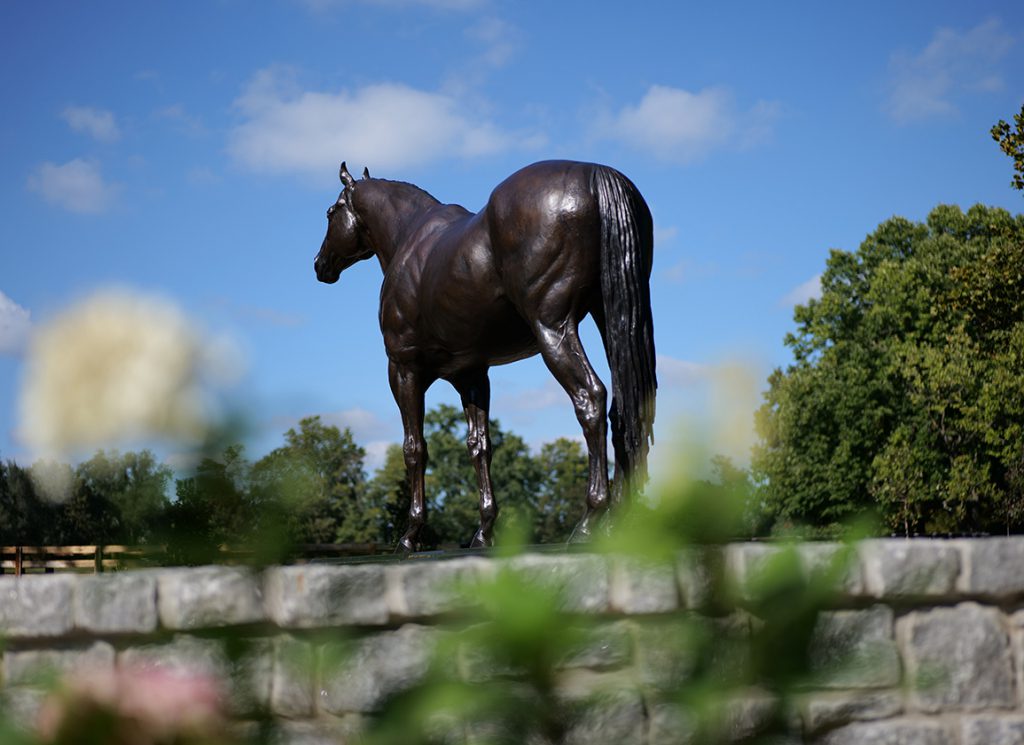
Editor's note: In just under two weeks, Spendthrift Farm will officially open its B. Wayne Hughes Visitors Center in honor of its late founder. The two-story visitors center will offer a trophy room, gift shop, and help to enhance tourists' visits to the farm. A bronze statue of the late Malibu Moon will greet guests as they arrive. The sculptor responsible for the bronze, Douwe Blumberg, gave the TDN a behind-the-scenes look at how the sculpture came together.

My professional sculpting career began over 30 years ago, following an 18-year career as a professional horse trainer in Southern California. While the vast majority of my early works were equine-related, the last decade has seen my career move more towards the large, international public-art scene. `Public art' refers to large pieces that you'd see outside capitols, corporate headquarters, etc., and while I love this type of art, I now rarely have the time to take on an equine commission.

I was therefore tremendously excited when my schedule allowed me to accept the commission from Spendthrift Farm to create a monumentally scaled memorial to Malibu Moon to be placed outside their gorgeous new visitors' center.

Having done sculptures of many different breeds, it is fascinating how important the subtle nuances of each breed are in capturing the real essence of an individual and making it feel right to their people. We were very lucky to have been able to measure him a few months before his passing which always proves exceptionally helpful. I measure on the metric scale so it's easy for me to enlarge them mathematically to whatever scale the client selects. I always encourage people to go larger, and pretty much don't do a true life-size sculpture anymore, because without that spark of life, a true life-sized bronze will always somehow appear too small.

It was a beautiful spring day when I measured him, and even in older age, his tremendous presence and masculinity was most impressive. Not only did this time allow me to gather the factual information of his measurements, but spending time with him also gave me invaluable insights into his attitude and energy, which one can't measure. It definitely informed the sculpting down the road and I believe came through into the finished work. I think that having been a horseman for so long allows me to really hone in on the little things that make each horse an individual, but are often difficult to explain.

My measurements were then used to carve a rough version from a special carving foam and once I was happy with this, we spread a half-inch thick coat of clay over the foam which then becomes my starting point. It takes a lot of heavy clay to cover a piece this large, so an internal steel structure was needed to support this clay and foam structure.

Along with the measurements, I had taken hundreds of photos which now proved their value in capturing not only this individual's musculature, but also his personality to some degree. The first thing is to lay in the basic skeletal points and then the large muscle groups followed by smaller contouring and skin details. This horse had a uniquely imperious eye and as an ex-horseman, I knew that it was vital that the eye be right or the likeness just won't feel right to me or the client.  After the clay sculpt was complete and the people at Spendthrift were happy, it was time to cut him into sections for molds to be made.

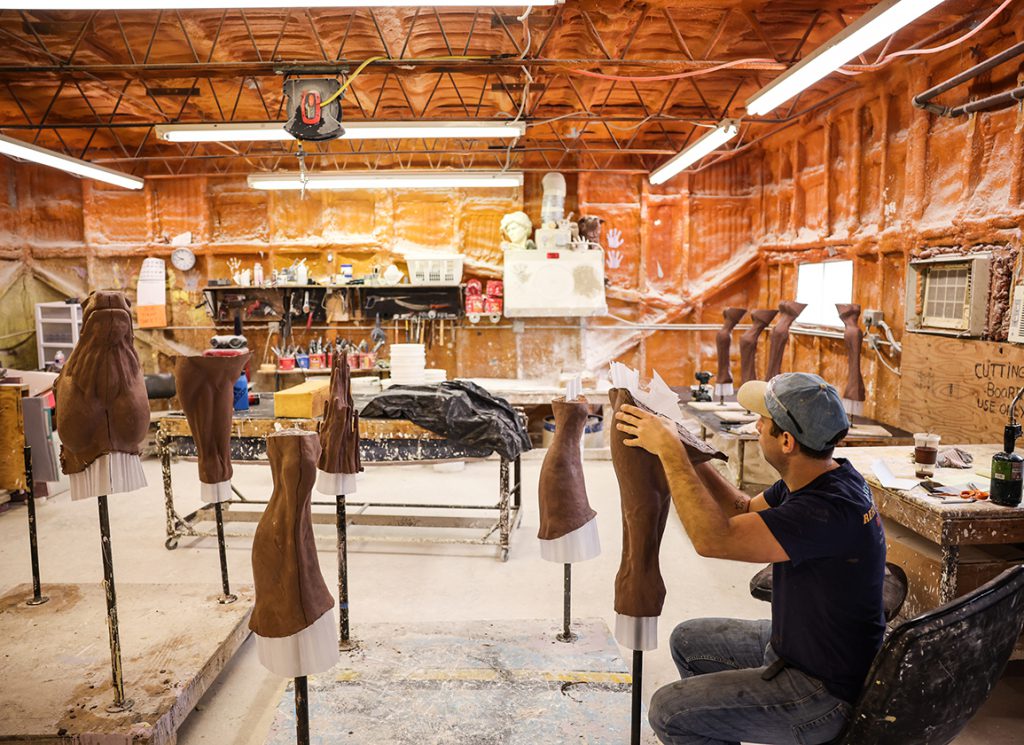
The molds are rubber and plaster assemblies that are used to make hard wax castings, or copies of my clay originals. These hard wax castings are then gone over and any casting flaws are repaired prior to being coated with a hard, heat-resistant, ceramic layer or shell.  Once completed, this ceramic shell is placed in a furnace to melt out the wax, and molten bronze is poured in. After cooling overnight, the shells are broken open and chipped away to reveal the new raw bronze casting inside.  Due to the complexity of shapes, this piece needed to be cast in a dozen sections or so.

Each bronze casting is inspected and any casting flaws are repaired, after which they are painstakingly assembled, like a three-dimensional jigsaw puzzle using a bronze welding rod of the identical alloy as the casting alloy used. Once assembled, he's complete, but looks rather like a Frankenstein creation with all the welded seams. Now comes many weeks of grinding metal to eliminate every seam and seamlessly blend them into the surrounding texture so that they become essentially invisible. I personally dislike too smooth of a surface treatment as I feel it makes the animal look plastic. I like to leave a slight, vibrant texture that captures to some degree the sculptor's spontaneous work, and sometimes even fingerprints. This metal-working is known in the art world as chasing the metal.

Assembling the parts in his studio | courtesy Douwe Blumberg

Once fully assembled and finished, the piece is sandblasted which prepares it for the next and final stage, the color application. A metal coloring is called a patina. There are many methods of applying this color, but the one we use is a very old-school method involving chemicals applied to the metal surface while it is very hot. With torches playing over the bronze, various chemicals are sprayed and brushed on to create depth and then color. These chemicals, unlike paint, actually alter the color of the metal itself so it becomes permanent and long-lasting, as long as it is maintained correctly.

A special wax is applied to the surface while it is still hot so that it melts into the surface of the metal and completely coats it.  Upon cooling, this wax coating is polished to a high sheen and the sculpture is finally finished and ready for installation.

Installation day at Spendthrift was an absolutely perfect early fall day and everything went flawlessly. A waiting crane carefully lifted the piece from the flatbed trailer and lowered it onto the specially prepared base outside the visitors' center.

Douwe Blumberg photo

Malibu Moon stands facing the stallion barn and the pasture he famously ruled during his long stay at Spendthrift. After my team had left and things quieted down, I sat on the grass, relaxed and took it in.   After almost a year of work, it felt wonderful that the piece was successfully installed and worked so perfectly with the site. It is always an honor to help memorialize a life, whether human or animal. This piece proved exceptionally fulfilling because as I sat there, he seemed so lifelike that I half expected him to toss his head, give a snort and step off to go join some friends.

The post Bronzes That Breathe appeared first on TDN | Thoroughbred Daily News | Horse Racing News, Results and Video | Thoroughbred Breeding and Auctions.

Source of original post

Verified by MonsterInsights