Sports Wagering Sunk in California: What’s Next?

After a months-long $400 million plus war of attrition between the two rival California sports wagering measures on this year's ballot, the endgame was a stalemate, both beat down into the muddy trenches–just as the polling had indicated.

The Associated Press made the call that both measures are sunk, though the official tally is far from in. With less than 50% of the ballots counted as of writing, roughly 70% voted against Proposition 26, and some 83% voted against Proposition 27.

“Ugly,” said Pat Cummings, executive director of the Thoroughbred Idea Foundation, calling the voters' rejection of sports wagering a “gag-reflex” to the incendiary nature of the attack-ads from the rival measures, which oftentimes left voters all at sea about exactly what each measure entailed.

Proposition 26 was an initiative called the Tribal Sports Wagering Act spearheaded by a band of extremely powerful Tribal gaming groups which, in short, would have allowed sports wagering at Tribal casinos and at approved racetracks in California. Most crucially, it would have prohibited mobile or on-line wagering on sports events.

Understandably, this Proposition garnered the public support of California racing industry heavy hitters like the Thoroughbred Owners of California (TOC), the Del Mar Thoroughbred Club and the 1/ST Racing and Gaming.

The second, Proposition 27, was the California Solutions to Homelessness and Mental Health Act led by online betting market outfits like FanDuel and Draftkings. This measure would have legalized online or mobile sports betting outside of Native American lands, though still leave legal avenues for Tribes to participate in the market.

As a selling point, the latter Proposition leaned heavily on the massive revenues it would have secured through license fees earmarked for homelessness initiatives, a hot-button topic for California voters. This included adds that often hid or obscured the sports betting component of the ballot measure, however.

Though the state's most powerful gaming Tribes lined up to support Proposition 26, a handful of less lucrative Tribal gaming groups threw their weight behind Proposition 27, including the Middletown Rancheria of Pomo Indians, who argued the FanDuel and Draftkings-backed measure would provide a financial life-line to struggling Tribes “that don't own big casinos.”

Proposition 26 proponents, on the other hand, spent more than $100 million on ads depicting the rival measure as an out-of-state incursion that would ultimately hurt California's Tribes. These conflicting Tribal allegiances only helped fuel voter bewilderment.

And what of the immediate future of sports wagering in California?

“The Tribes have asserted their power,” wrote TOC vice chairman, Bob Liewald, speaking independently of the organization, in an email. “I don't see a compromise that would make [sports wagering] possible without the Tribes having significant say [and] control.”

Liewald wrote it is “unlikely” that measures similar to Proposition 26 and 27 will be on the state-wide ballot in two years time.

Indeed, proponents of Proposition 27 have publicly hinted that the sheer scale of the spending behind both measures would make them think twice about endeavoring down the same path again.

Liewald also doubts state politicians will pass legislation in Sacramento legalizing sports wagering any time soon. “But if they did it would be crafted mainly by the Tribes for the Tribes,” he wrote. As such, he said it is “difficult” to see a viable path forward for sports wagering before 2025.

Scott Daruty, president of Monarch Content Management, the arm of The Stronach Group (TSG) tasked with distributing the company's signal, strikes a more ambivalent tone.

“I think it's too early to even assess that,” Daruty said, about the chances of one or both such measures returning to a state-wide ballot in 2024.

Sports wagering will eventually be legalized in California, he said. “How that happens, what the dynamic is that brings that about, I just think we need a bit more time to figure that out.”

If the Tribal groups behind Proposition 26 reintroduce it at some point, will California racetracks once again be part of the measure?

“I think it's too early to say,” Daruty said. “I think it'll take some time before that dialogue begins.”

As for why Proposition 26 was so comprehensively undone, Daruty points to the lack of resources invested in positive messaging.

“The Tribal interests that were the proponents of 26, I don't want to speak for them, but it appears they were much more worried about 27 passing than 26 failing,” he said. “There was never a positive message about 26 at all.”

A group of Tribes that includes the powerful San Manuel Band of Mission Indians are spearheading an online and in-person sports betting initiative restricted to servers on Tribal land that could run in 2024.

The Washington Post reports that at an October Global Gaming Expo, Tribal heavy hitters suggested that particular initiative could see collaboration with out-of-state entities as platform providers for Tribal mobile sports betting.

“There might be an opportunity for everyone, but they've got to be humble,” Dan Little, San Manuel's chief intergovernmental and tribal affairs officer, is reported to have said about gaming operations like FanDuel.

“That's not particularly favorable to the racing industry,” said Daruty, about the proposed initiative. “But it is something we're aware of.”

If sports wagering remains foreign to California's shores for the foreseeable future, the industry needs to ensure its wagering product is as “competitive as possible,” warned Cummings, pointing to things like eliminating jackpot bets, focused attention on lower takeout, and higher win-probability bets.

“We are already seeing the positive attention around Kentucky shifting to penny breakage. Give horseplayers the equivalent of a tax break and you give them an opportunity to invest that break back through the windows,” Cummings said.

The industry's continued focus on the “Pick X” and super exotic bets “is probably a mistake,” Cummings said. “It's great to have a low takeout pick five, but only if you hit all five winners. And the last I checked, it's still easier to pick one winner than five straight.”

With pari-mutuel betting California's only option, “the greater racing industry should want its customers to win and churn,” Cummings said. “Driving players to multi-race bets that are tough to win is leading them on a path to lower churn.”

As for the industry's long-term future within a sports wagering ecosystem in California, Daruty emphasized the importance of having a “seat at the table” as the lines are drawn.
“If you look at it today, racing is the only legal form of sports betting in California–it's also the only legal form of online betting in California,” he said. “So, we would just like to make sure we're part of whatever the sports betting future brings.”


The post Sports Wagering Sunk in California: What’s Next? appeared first on TDN | Thoroughbred Daily News | Horse Racing News, Results and Video | Thoroughbred Breeding and Auctions.

Source of original post

Taking Stock: Flightline and that Share

About an hour or so after one of 40 shares in Flightline, a son of Tapit and the Indian Charlie mare Feathered, was sold for an unimaginable $4.6 million in an historic special session at Keeneland Monday, Flightline was led out of his stall at Lane's End and posed behind the stallion barn, oblivious to the hubbub on the sales grounds about 10 miles away.

He's a stunning and athletic physical specimen, standing 16.2 hands, with length to go with height and balance. He's so well put together and pleasing to look at that at first glance no one single feature jumps out and grabs the eye, because all of him does at once, flooding the senses. But zoom in here and there and it's evident that the parts that make up the whole are of the finest quality: a well-defined and chiseled masculine shoulder with depth; strong forearms over clean and smooth limbs with short cannons; pasterns at exactly the right angles that are neither too short nor too long; a big hip and butt; and hind legs set perfectly underneath. He'd first caught the eye of Lane's End Bloodstock's David Ingordo as an early and unfinished yearling at breeder Jane Lyon's Summer Wind, and later that year, in August, was purchased by his current ownership group on Ingordo's advice for $1 million at Fasig-Tipton's marquee Saratoga sale.

It's evident that Flightline gets some of his looks from broodmare sire Indian Charlie, who also had size, strength, masculinity, and similar patterns of muscling, except Indian Charlie was slightly back at the knee and had rough ankles, neither of which plagues Flightline.

What stands out the most about Flightline is his mind and presence: he's non-plussed, intelligent, and kind. Here he was, two days after he'd clobbered a high-level field in the GI Breeders' Cup Classic, calmly and confidently surveying his new home, and it's easy to understand how he overcame several mishaps and one major injury along the way and continued to train on with gusto and win at the highest levels.

At the moment, Flightline is being let down cautiously, spending time in a round pen when he's not in his stall. It's expected that by the end of next week he'll be in a paddock like the other studs at the farm, as he's transitioning quickly from a life of hard training at the track to an easier life on the farm for his next career as a stallion.

The Share

Flightline is owned by a 40-share syndicate, with Kosta Hronis and family controlling 15 shares; Lyon's Summer Wind, 10 shares; Terry Finley's West Point, seven shares; Bill Farish and partners' Woodford, four shares; and Anthony Manganaro's Siena Farm, four shares. Lane's End will get breeding rights for standing the horse, and a few others are in the hands of trainer John Sadler and David Ingordo.

The share–a 2.5% fractional interest–that was auctioned came from the West Point group, which is composed of seven individual partners with one share each (2.5% of 40 is one share). Some of them pooled portions of their fractional interests to form one share or 2.5% to offer at auction, and Freddie Seitz, as agent for an undisclosed Seattle-based owner and client with interests in the coffee business, held off underbidder Coolmore to secure the share for the $4.6 million, placing a “value” of $184 million on Flightline's head. In comparison, Triple Crown winner Justify (Scat Daddy) had a book value of $75 million as a new sire just a few years ago.

The big share price is, of course, a trophy prize, and in the strictest sense it will not bear a direct relationship to his stud fee, which is $200,000 live foal–as much as the entering fees of American Pharoah, Ghostzapper, and Devil's Bag. At that fee, based on a four-year return and, say, a 160-mare cap, a traditional market value for a share would likely be about $2.8 to $3 million based on pure back-of-napkin math without expenses: two seasons each year (each shareholder gets two seasons) is $400,000, multiplied by four years, is $1.6 million; and on the back end, a bonus pool of $12 million a year (say 60 mares at $200,000 is $12 million), divided by 40 shares, is $300,000 per share per year, times four years, is $1.2 million. Extending this example over five years, a case could be made for $2 million in stud fee income and $1.5 million in bonus-pool money (assuming the stud fee stays the same), for a value of $3.5 million, plus depreciation. And there's also the possibility of added bonus-pool monies from expanding his book and from breeding Flightline at Lane's End on Southern Hemisphere time.

The Flightline syndicate, of course, is tightly held by the colt's original ownership group, which is to say that not many shares will become available. That scarcity–think of it as an illiquid market–means that the shares that do become available will be snapped up by those few that have the means to pay premium-plus, like the unnamed buyer at $4.6 million and the underbidder, Coolmore, at $4.5 million.

For such owners, that type of money may not be as outlandish as it seems to some. An entity like Coolmore, for example, could breed to Flightline a mare like Gamine, who was purchased for $7 million, and race the offspring, hoping to get a top-class winner. And if Flightline becomes a success at stud like undefeated Frankel, who will stand for about $315,000 in 2023, that would be money well spent in hindsight.

Betting on any unproven stallion is a gamble, but Flightline has the impeccable credentials to succeed as a stallion. Not only is he a son of the elite stallion Tapit, whose son Constitution will stand for $110,000 at WinStar in 2023, he's from a mare, Feathered, who won a Grade 3 race and placed three times in Grade I races, earning $577,474. Moreover, Feathered, who was bred by Teresa Viola, spouse of Vinny Viola (who has a Flightline share under the West Point umbrella), is from the sought-after Phipps family of Blitey/Lady Pitt and was purchased by Lyon in 2016 at Keeneland November for $2,350,000.

In other words, Flightline was bred to be a superstar, and he's that rare example of a horse that realized his lofty potential–and some.

Combine this pedigree with Flightline's exceptional looks, astonishing talent, and undefeated race record, and he is–as the share price reflected–the most desirable new prospect to enter the marketplace in a long time.

   Sid Fernando is president and CEO of Werk Thoroughbred Consultants, Inc., originator of the Werk Nick Rating and eNicks.

The post Taking Stock: Flightline and that Share appeared first on TDN | Thoroughbred Daily News | Horse Racing News, Results and Video | Thoroughbred Breeding and Auctions.

Source of original post

Thursday Insights: Tapit Homebred Stars At Aqueduct

Sponsored by Alex Nichols Agency                          

1st-AQU, $85K, Msw, 2yo, f, 6f, 12:20 p.m.

Owned and bred by Mr. Joseph Alen, BILOXI BLUES (Tapit) makes her first start for trainer Shug McGaughey at the Big A Thursday. Out of the winning Speightstown mare Accepting, herself a half-sister to MGSW Campaign (Curlin), Biloxi Blues hails from the extended female family of GISW Acoma (Empire Maker), GISW and leading sire Arch (Kris S.), dual champion & MGISW Covfefe (Into Mischief), and MGSW & MG1SP Albiano (Harlan's Holiday). Her last work from the gate was a near-bullet four furlongs in :47 (2/167) Oct. 22 and she picks up jockey Dylan Davis for her afternoon debut. TJCIS PPS

The post Thursday Insights: Tapit Homebred Stars At Aqueduct appeared first on TDN | Thoroughbred Daily News | Horse Racing News, Results and Video | Thoroughbred Breeding and Auctions.

Source of original post

Life Is Good, The Newest Addition at WinStar Farm

They could have entered him in the Breeders' Cup Dirt Mile or the Sprint, where he would have been a top choice in either spot, but the connections of Life Is Good (Into Mischief – Beach Walk, by Distorted Humor) opted to send their versatile 4-year-old to the GI Longines Breeders' Cup Classic.

While there was no beating Flightline (Tapit) that day, Life Is Good threw it down with his undefeated competitor, forcing Flightline to chase him through blazing early fractions of :22.55 and :45.47. The Classic marked only his third defeat, but Life Is Good was far better than good in his final career start.

“It was a tough decision to decide which was the right race for Life is Good on Breeders' Cup Day,” said his trainer Todd Pletcher. “We felt like with his body of work and his success leading into it, he deserved a chance for champion older horse and Horse of the Year. We let him do his thing with his running style, which is a high cruising speed, and he took it to Flightline. I think he went out in style.”

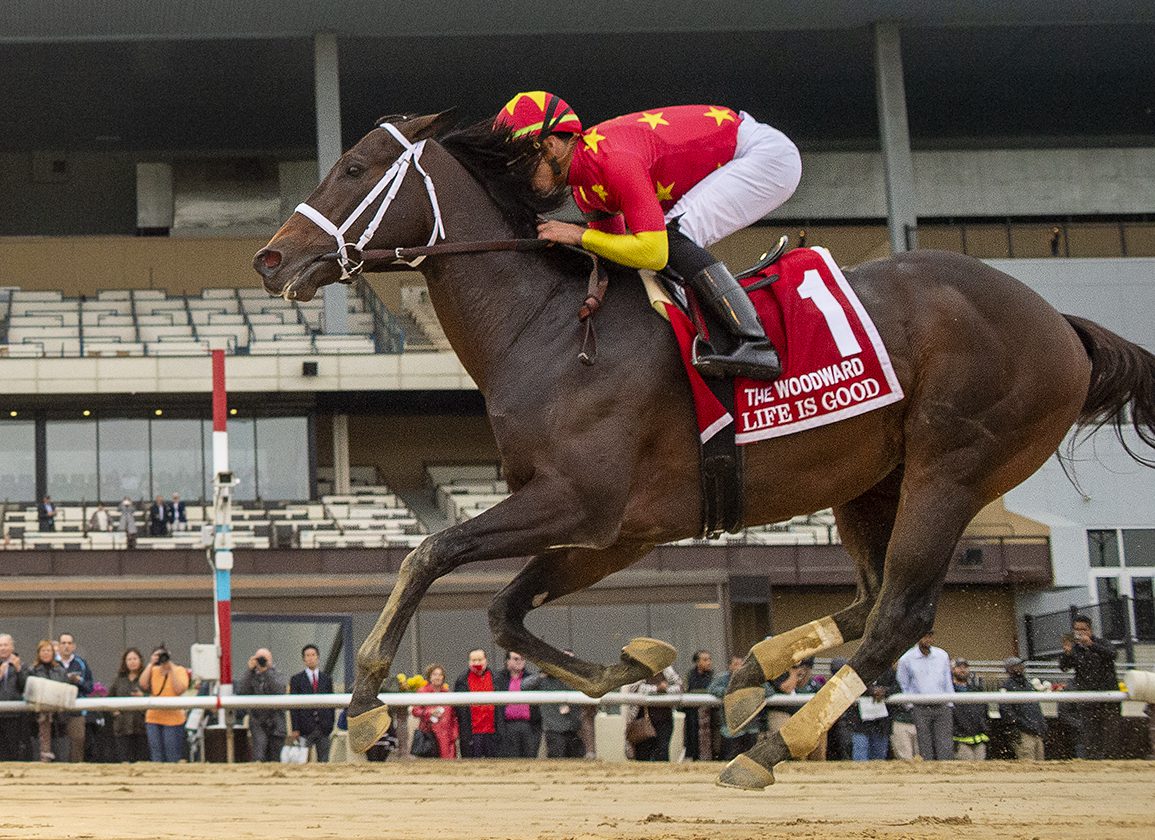
Campaigned by China Horse Club and WinStar Farm, Life Is Good was the winner of nine races from 12 career starts. A 'TDN Rising Star' on debut at two, the eye-catching bay remained in graded stakes company from there, earning eight graded victories over his career. His resume includes four Grade I wins, starting with a definitive score in last year's edition of the Big Ass Fans Breeders' Cup Dirt Mile and then this year adding the Pegasus World Cup Invitational S., Whitney S. and Woodward S.

“What made Life Is Good so special is that he had that unique ability to go fast and carry that speed over a distance of ground,” Pletcher reflected. “From a trainer's perspective, he was very healthy, very sound and just loved his job. Every day he came out, he trained exceptionally and had a great attitude.”

Last year's edition of the GI H. Allen Jerkens Memorial S., where Life Is Good ran second by a neck to the season's eventual Champion Male Sprinter Jackie's Warrior (Maclean's Music), is a race that WinStar's Elliott Walden remembers as one of the colt's most impressive performances.

“That race, to me, was one of his best,” Walden said. “He was just beat coming off a 170-day layoff. I think when people remember Life Is Good as a racehorse, they will remember that he participated in all the big races. We were not afraid to run him at distances that maybe didn't suit him best, whether it was seven furlongs against Jackie's Warrior or a mile and a quarter against Flightline. He's one of the greats that we've had at WinStar.”

Life Is Good arrived at WinStar Farm the morning after the Breeders' Cup and received a warm welcome from his WinStar and China Horse Club connections. Todd Pletcher also stopped by to send off his pupil, who was known as 'Scooter' around the barn.

“He was such a huge part of our stable for almost the last two years that literally our schedule was built around his schedule,” Pletcher explained. “We're going to miss him a lot, but at the same time we're really pleased that he's able to retire to a farm like WinStar and get an opportunity to prove himself as a stallion. We look forward to seeing his babies.”

The son of Into Mischief was bred by Gary and Mary West Stable and sold for $525,000 as a yearling in 2019. His dam Beach Walk (Distorted Humor) is out of the multiple Grade I-placed Mineshaft mare Bonnie Blue Flag, whose family includes multiple Grade I winner Diamondrella (GB) (Rock of Gibraltar {Ire}), Group 3 victor Spectroscope (Medaglia d'Oro) and multiple graded stakes-placed runner Highest Honors (Tapit).

Life Is Good gets his fourth Grade I score in the Woodward S. | Sarah Andrew

“He's about 16'1, so he's a little bigger than Into Mischief,” Walden said. “He has a little bit more scope and range, but all the parts of a fast-looking horse. You can see when he moves how he just springs off with great, quick action that should translate to athletic foals. The Into Mischiefs have a real desire to run and Life Is Good showed that he wanted to compete at every level, every race and every work. Being by Into Mischief and also having Distorted Humor on the bottom, he gets a double dose of that competitiveness.”

Life Is Good's initial stud fee of $100,000 will be among the highest of this year's incoming crop, however Walden said that they have been conservative in their selection process as they begin filling the young sire's first book.

“We plan to breed him to about 160 mares,” Walden said. “We have a lot of requests each week, but we're not taking every mare. We're thinking about where each mare would fit into his whole group. We're making him worthy of a $100,000 stud fee, so we've turned down a lot of mares and are being very critical on that.”

He continued, “I think from a standpoint of what we've had here at Winstar, he would be at the very top as far as the great horses that we've had. Being by Into Mischief and with his physical presence and athleticism, we're super excited about his next career.”

The post Life Is Good, The Newest Addition at WinStar Farm appeared first on TDN | Thoroughbred Daily News | Horse Racing News, Results and Video | Thoroughbred Breeding and Auctions.

Source of original post

Verified by MonsterInsights