Op/Ed: The System Has Failed

“Twelve-thousand dollars going once…twice…SOLD!” It was the Keeneland November Sale and for the second time in a year I had to watch my big beautiful chestnut mare slip out of reach. The former black-type runner was vanned 2,100 miles away to her next venture as a broodmare prospect despite having previously failed to conceive.

Six years later, I would be paying that mare's bail from a Texas livestock yard after she failed to produce but one foal who has yet to race. A graded stakes-placed mare from humble beginnings with six-figure earnings was reduced to a whopping $1,500 valuation of literal horse flesh.

What happened to the funding and the programs designed to prevent this from happening? Where were the aftercare advocates? At the end of the day, I was the only one left–an average racing fan who became her advocate.

Let's start from the beginning.

I first met Ragdoll on the backside of Monmouth Park. She was a big-boned, imposing filly standing at 16.3 with a stellar physical. The kind of filly that makes you do a double-take because surely, she was actually a colt, but her delicate face and doe-eyed expression gave her away every time.

In the barn she was sweet natured and affectionate, willing to hang her head over the stall door eternally if you held it just so. I spent two summers doing just that.

On the track, her heavy legs lumbered beneath her and she lacked the turn of foot of her nimbler, light-boned counterparts. Eager to please, she came down the stretch like a freight train when asked and found herself rising up the ranks, even hitting the board in a pair of graded stakes. That was the end of us.

I knew our racetrack romance would end if she made black-type; she would be more valuable as a broodmare than anything else. My lofty hope of owning her when her racing career ended would never come to fruition. She was privately sold for $70,000 to a breeding farm in Kentucky.

A couple of years would pass and I had the opportunity to visit Ragdoll after reaching out to her new owners. They were kind enough to welcome me to the farm where I was able to soak in the expansive bluegrass hills she now called home. Despite my loss, I was genuinely happy this was her new life.

My visit coincided with the farm veterinarian doing follicle scans on the mares and I watched as the team gave a forlorn sigh after ultra-sounding Ragdoll. I learned she had not been successfully bred, not even a failed embryo. Nothing at all. She simply wouldn't take.

The Falstaff of their Shakespeare, I chimed in, “You know who to call if she needs a home!” but wished them the best as they continued their efforts.

After arriving back home, I followed up with the farm, offered my gratitude for the visit and (more professionally) reiterated my desire to purchase her if things didn't go their way.

As fate would have it, the next year I found myself down a similar path–trying to conceive a child with equally devastating results. I have never been so exhausted in my life; emotionally, physically, psychologically…I was running on empty in absolutely every capacity.
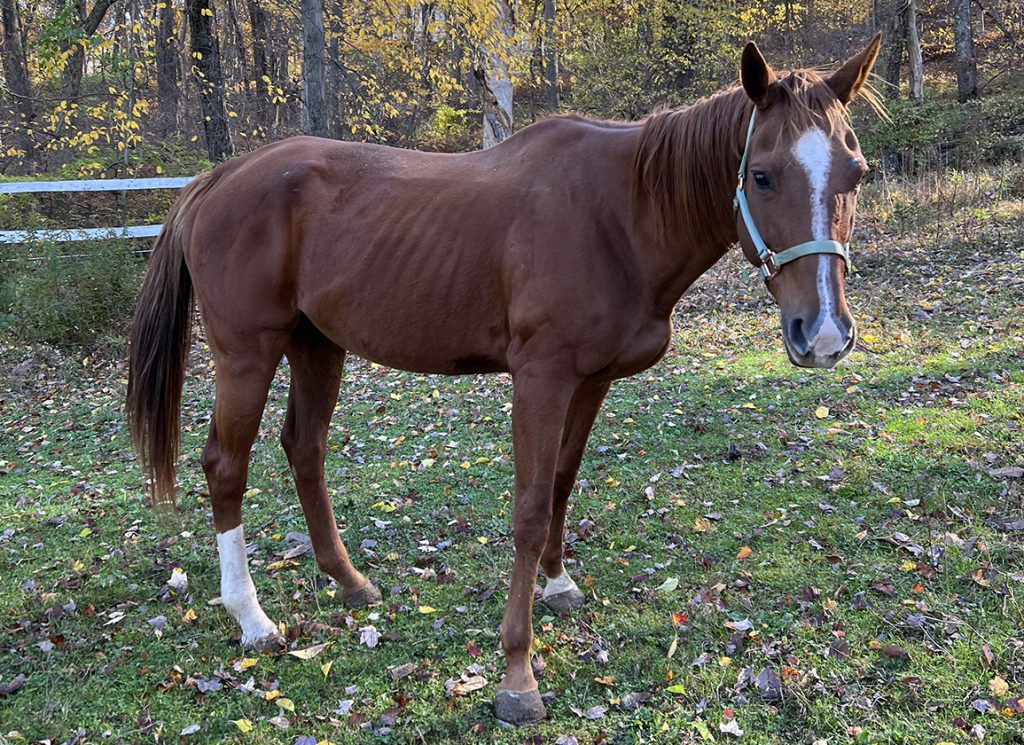
Ragdoll when she first returned home with Forbes in October | Nicole Forbes photo

Eager for a distraction, I decided to lookup Ragdoll on various online information systems and lo and behold, she was listed in the upcoming Keeneland November Breeding Stock Sale.

Shocked, I pulled up her catalog page and saw the big bold letters at the footer “believed to be NOT PREGNANT” after being covered by four different prominent stallions that year. My heart ached for her and the unexpected barren road we both found ourselves on. If this wasn't a sign (albeit a very sad, hormonally surged one) I don't know what is, but this time she was going to be mine.

I immediately applied for credit with Keeneland and was promptly, and rightfully, denied. My meager per-diem racing marketing gig left more of a jingle in my wallet than padding. I turned to my father-in-law, a former trainer and respected horseman who once owned a part of this very mare, and pleaded for guidance.

Wise and soft-spoken, he listened as I cried on the phone for longer than either of us expected before stating, “Well, sounds like this is something you need to do.”

We agreed on a maximum bid of $10,000. Ten thousand dollars that I did not have, but would walk the ends of the earth to repay him for.

“It's only money,” he said and repeated to me again and again as if it were a mantra. I scoffed– only money. But I leaned into like it was a life raft and…swam with it.

The gavel went down and the rest is history. I was outbid by $2,000. I had been so close.

Not shy of persistence, I emailed the purchasing agent within minutes of her sale and disclosed everything I knew of her breeding history; I'd save them the trouble and offered to buy her flat out. The gentleman politely declined and guaranteed me “she'd have a home for life” regardless of the outcome of her broodmare career.

He was right. She would have a home for life. But no thanks to him.

This past September I received a cryptic Facebook message from someone with whom I was unfamiliar. It included a link to a horse's profile from a livestock auction in Texas, a well-known hub of killer buyers, alerting me a former racehorse was in the slaughter pipeline and listed for sale by weight.

It was my chestnut mare. Ragdoll had reached the end of the line.

It took a dozen individuals–a complete stranger from social media, three Thoroughbred aftercare executives, two racing executives, a racing insider, a horse hauler from Oklahoma, two family members and a literal guardian angel to get this mare home.

All because a racing fan was her advocate.

Where were we? The industry that so relied on her to bolster their pocketbooks; the industry that should be behind each and every one of the Thoroughbreds that ends up in this scenario, of which there are plenty.

The system has failed.

We've been playing economic checkers for a century when we should have been playing chess. Excluding the upper echelon of racehorses, each horse is measured as a one-to-four-year commitment and turned over as such. In actuality, every Thoroughbred is a 25-year commitment. At minimum.

How the industry continues to rely on 501(c)(3)'s to pick up our failed promises is astonishing and yet in Atlassian fashion, they continue to hold the burden.
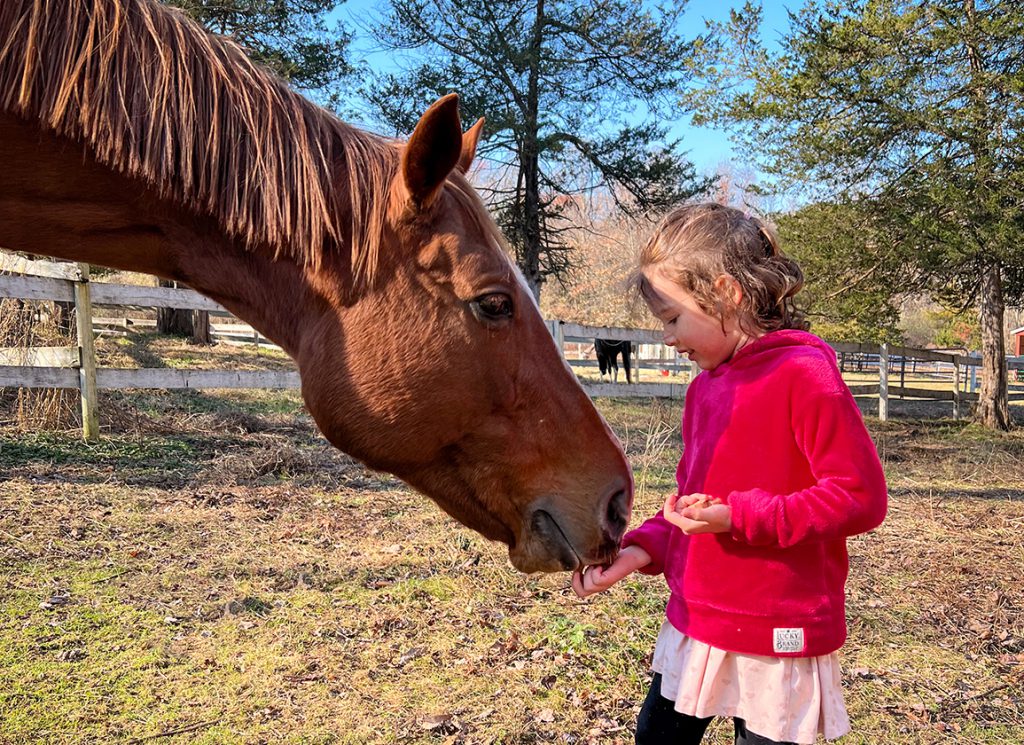
A happier, healthier Ragdoll bonding with Forbes's daughter Avery | Nicole Forbes photo

Grass-roots efforts have provided a lifeline for us (and an innovative one at that–a broodmare division at the Retired Racehorse Project's annual Thoroughbred Makeover, giving these mares the chance at a third career?! *applause*) but the truth of the matter is their efforts are not to scale and may never be. There simply aren't currently enough funds or enough farms to support the number of retired athletes of our sport.

Only very recently has the idea of a “lifetime guarantee” been spreading among noteworthy breeding farms and syndicates who have pledged to care for a horse for its entire life, whether that is by partnering with rehabilitation and retraining facilities or by permanently retiring the horse on their property. Something, I daresay, that strikes me as incandescently sad to be so novel.

As of late, there is also at least one racing entity (1/ST Racing) that has included aftercare liaison managers in their business model, and during our two-day Championship series, thousands is pledged to the flagship of aftercare and retraining that is New Vocations. It's progress.

But what about the other 363 days of the year? The other racing jurisdictions?

Some jurisdictions do give beyond the required race day “aftercare taxes” comprised of per-start fees and a miniscule percentage of handle (of which the legislation varies state to state and is extremely convoluted to say the least) but the fact it is unregulated and voluntary is problematic.

Ultimately though, it starts at the top. The economic model is not viable and is past due for a complete overhaul.

The per-start fees are not enough. The registration fees are not enough. Our big ticket donations made during racing's spotlight moments and fundraising in general are not enough.

I implore The Jockey Club, HISA, NTRA and any jurisdiction that oversees our Thoroughbred athletes to reconsider the fundamental economics of the racing industry and how best to build aftercare into the founding principles of our sport, instead of as an addendum.

Fans cannot be their only advocates.

To be frank, it might be too late. I'm honestly not sure if we can act fast enough on an industry-wide solution to eliminate this crisis. And crisis it is–no matter how neatly swept the room may seem, there's a mortuary under the rug.

For a sport whose marquee race owns the title of the “oldest continuously held sporting event in America,” how are we still in the starting gate when it comes to aftercare?

The post Op/Ed: The System Has Failed appeared first on TDN | Thoroughbred Daily News | Horse Racing News, Results and Video | Thoroughbred Breeding and Auctions.

Source of original post

The Week in Review: Suspension of NYRA Clocker a Disgrace

The New York Gaming Commission has made so many bad decisions of late that it would be laughable if not for the fact they keep going after good people who have done nothing wrong.

The latest chapter is the story of NYRA clocker Richie Gazer.

Back in May, Gazer was handed a 30-day suspension and fined $2,500 “for altering a published work of a horse to make the horse eligible to race.” The horse in question, Papi On Ice (Keen Ice) was originally credited for a five-furlong workout on May 1 in the time of 1:04.60. At the time, the horse was on NYRA's “poor performance” list, the result of his having been eased in a Mar. 19 race and then losing by 26 3/4 lengths in a Apr. 16 race. In order to get off the list and to be able to race again, he needed a published four-furlong workout in:53 or faster. Oddly, the rule, which is a NYRA rule, requires that the work must be at four furlongs and at no other distance. When made aware that the work had to be a half-mile in order for the horse to get off the list, Gazer changed the distance to four furlongs and the time to what was Papi On Ice's split for a half-mile, :51.33. The Gaming Commission then stepped in and cited a rule that prohibits “improper, corrupt or fraudulent acts or practices in relation to racing or conspiring or assisting others in such acts or practices,” pretty harsh language for a case where all the clocker did was shorten the distance of a workout by an eighth of a mile.

Gazer refused to roll over, hired a lawyer and filed an appeal. A seven-hour hearing was held and the hearing officer recommended that the case be thrown out and that Gazer should not be penalized. It appeared that Gazer had won. But the case took a 180-degree turn last week when the Gaming Commission rejected the hearing officer's recommendation and voted 6-0 to uphold the original suspension. Karen Murphy, the lawyer representing Gazer, told the TDN that in the 30 years she has been dealing with New York racing regulators never before had she had a commission reject a decision from a hearing officer. Why even use a hearing officer if you are going to ignore what they have to say?

This all comes down to a matter of common sense. Gazer used his when he approved changing the distance of the workout, which was necessary to allow the horse to race and, otherwise, affected nothing. The rule is in place to keep clockers from playing games, giving a horse a five-furlong workout in 1:03 when they actually went in :58. That's not what happened here.

But common sense is in short supply when it comes to the Gaming Commission. Perhaps by the very letter of the rule, Gazer was guilty of some sort of infraction. The best way to handle this would have been to issue a warning and to tell him not to do it again. Use common sense. Don't fine him, suspend him and try to sully his reputation with outlandish charges of corruption and fraud. Don't go to such great lengths that the commission, by a 6-0 vote, ignored the findings of a hearing officer.

“Everybody is horrified,” Murphy said. “Richard Gazer has been doing this for 40 years and is respected by everyone. You should be pinning a medal on someone like him, not telling the world he is fraudster.”

It's all part of a troubling pattern. Since April, the Gaming Commission and its steward, Braulio Baeza Jr., have sanctioned four NYRA employees a total of five times and levied fines totaling $14,500. In most cases, it was nothing more than a case of the person making an honest mistake.

In June, Frank Gabriel, the New York Racing Association senior vice president of racing operations, was fined $4,000 for “failing to follow proper claiming protocol” resulting in the track stewards voiding the claim of the horse Battalion (Tiznow) on May 28. There was a mixup regarding the claim of the horse. The horse was claimed for $25,000 by trainer Rob Atras, but the claim was not relayed to the clerk of scales, so the horse was not brought to the test barn. That led to the voiding of the claim.

Someone made a mistake. It happens. And never mind that Gabriel had nothing to do with this. Nonetheless, Baeza saw reason to sanction him because, he told the Daily Racing Form, Gabriel was the head of the racing department.

NYRA Racing Secretary Keith Doleshel has been fined twice since April, on one occasion $2,000 for “failing to conduct business in a professional manner.” According to NYRA, here's what happened: “Due to an unintentional administrative error, an unauthorized agent claimed a horse. . . . NYRA subsequently discovered the error and notified the NYSGC of its findings.” A horse was claimed at Saratoga by someone who was not licensed by the Gaming Commission or registered with the Jockey Club. But, again, it was an “unintentional error” committed by someone who has never previously been accused of being unprofessional and the mistake was caught. Doleshel has appealed the ruling through his attorney, Drew Mollica.

As for Gazer, there doesn't appear to be a path whereby the fine and suspension can now be overturned. Murphy says she plans to make the point that the Gaming Commission didn't follow procedure when it comes to transparency. The commissioners did not debate or discuss the details of the case during the open, public meeting, which she says is required.

“The chairman knows nothing about racing and shouldn't have done what he did,” she said of Gaming Commission Chairman Brian O'Dwyer. “We all should be upset about this on legal grounds.”

But that's probably not going to help Gazer. He will have to pay his fine and sit out 30 days, the latest example of an overreach by the New York Gaming Commission and its steward. Someone who has been doing this a long time and has earned a reputation for being a straight shooter, Gazer deserved far better.

The Woodward and Cigar Mile Downgraded

The American Graded Stakes Committee showed some tough love to NYRA last week, downgrading the Woodward S. and the Cigar Mile H., from Grade I races to Grade II's. The move wasn't without controversy. The Woodward is a prestigious race with a long, rich history. Twenty of its winners are in the Hall of Fame. During a seven-year stretch beginning in 1974, the race was won by Forego (four straight), Seattle Slew, Affirmed and Spectacular Bid. This year's Cigar Mile included four Grade I winners, including the winner Mind Control (Stay Thirsty), which made the timing of the downgrade a bit puzzling.

As tough as this may have been for NYRA to swallow, it was the right move. Everyone complains that, considering the declining number in the foal crop and that top horses usually only race four or five times a year, there are too many graded races and too many Grade I's. You can't have it both ways and complain about the Woodward and the Cigar. The committee is to be commended for making some tough decisions. There are still 440 graded races and 97 Grade I's. That's too many.

The post The Week in Review: Suspension of NYRA Clocker a Disgrace appeared first on TDN | Thoroughbred Daily News | Horse Racing News, Results and Video | Thoroughbred Breeding and Auctions.

Source of original post

One-of-a-Kind Maryland Horse Library and Education Center Officially Open to Public

Located in the heart of historic Reisterstown, Md., just down the road from Sagamore Farm, Hall of Fame steeplechase trainer Jack Fisher's Kingfisher Farm, and GreenMount Farm, the birthplace of 2021 Horse of the Year Knicks Go (Paynter), sits the newly opened Maryland Horse Library and Education Center.

The one-of-a-kind facility, honoring the robust history of horses in Maryland and serving as a hub for educating the next generation, is housed in the Maryland Horse Breeders Association (MHBA)'s building. The stately brick structure with large, white columns, was originally built in 1876 as the Grace Methodist Church South, and later housed Reisterstown Federal Savings and Loan, Shaw's Antiques, various realty groups and another Living Faith Chapel, before it was purchased by the MHBA in April of 2020.

It was only fitting that a building with such a storied past would add a new chapter to its legacy as the permanent home of the Maryland Horse Library and Education Center, representing a collective vision and years-long culmination of work by the Maryland Horse Foundation (MHF), the MHBA's staff, boards and committees, and Cricket Goodall, executive director of the MHBA and Maryland Million Ltd.

“We had several different opportunities over the years that didn't work out and I thought, maybe it's just not going to work out, maybe I'm not going to get this done,” said Goodall, who has worked for the MHBA since 1986 and has served as executive director since 2003. “It was certainly a long-term goal of mine, but really it was sort of fate, I guess, that the right spot came along, and that we had the right board of directors that were willing to take the next step to commit and own something. Even the timeframe, [dealing] with COVID, low interest rates and a whole bunch of other things that we couldn't have ever planned for, it all came together at the right time.”

Walking up onto the porch and through the double set of doors, visitors will find themselves stepping into a facility entirely dedicated to Maryland's diverse and expansive horse industry, featuring a 5,000-book reference library covering a wide range of history, breeds, disciplines, genres and collections. The building also boasts a soundproof media room, research room, conference room/meeting area, a children's activity area and a section that's home to a variety of memorabilia.

The center is a dream turned reality for both the MHBA, whose offices have also found a permanent home in the building, and the MHF, which promotes and oversees a variety of equine industry educational programs as well as operates the library and education center.

Though finding an ideal location to display and share the extensive collection of literature, which has only grown throughout the history of the MHBA, was a main priority, the emphasis on education and creating an inviting place to foster learning, collaboration and future growth was inspired by meetings between Goodall and Jordyn Egan, the former director of development for the MHF.

Egan was an integral part of bringing the right people together to help put the vision for the center to paper, in the form of renderings and plans, along with spearheading the collaboration and support necessary to launch and carry out the capital campaign for the project.

“We put together the narrative of what we really believed it would be and the purpose it would serve for the community, and once we took that message and that vision out, it exploded. We thought this would be a much larger process as far as the capital campaign, but our original goal was surpassed in under a year and it just kept going,” said Egan, now the executive director of the Thoroughbred Owners of California (TOC).

Once the initial goal was reached, the plans could be put into action, as renovations began to gut the majority of what existed in the front section of the building and rebuild to fit the vision of the center. A few initial plans changed as more walls and a drop ceiling were stripped away, with quite a few adjustments and tweaks made to preserve the original barrel ceiling of the church, revealed during the demolition process. A cozy reading loft and a spiral staircase to access it, above the media and research rooms, was also added in.

The $1-million capital campaign launched in March of 2021 and by that June, the goal had already been reached, which prompted the team to extend the campaign in an effort to raise $2 million. Currently, they've raised just over $1.7 million.

“Not only did we raise enough money to do the project, but we were able to have some money to endow the project in the future and make sure that the programming happens.”

Goodall extends a lot of credit to Josh Pons, president of the MHF, along with Richard Blue, Jr. and Dr. Michael Harrison, who led the process of reaching out to potential donors and bringing in donations for the capital campaign.

“It feels like we've won some great prize that we can then build on, I think that's one of the biggest things. We packaged this idea of Cricket's vision for what this building could be and people were creative enough and had familiarity with other museums and other libraries that they could say, 'We should have something like that,'” said Pons. “It's difficult to argue with the merits of not just the library, but also the education center component.”

The library aspect of the project was a beast of its own, as the MHBA and later the MHF had developed an extensive collection of literature over many, many decades, which came along for the ride as the MHBA moved office locations throughout its history before eventually, the books were sent out to be housed in storage units. Another dream realized was that of finally having a fully-fledged library, where the books could be organized, shelved and shared.

But before all of that could come to fruition, the collection had to be pulled out of storage, sorted by hand and eventually catalogued. The MHBA's research specialist Cindy Deubler, along with Wesley Wilson, who retired in January after more than 50 years with Enoch Pratt Free Library in downtown Baltimore, and a small but mighty group of volunteers handled the daunting task.

“We tried to come up with an idea of how to organize it, because there are many ways with libraries, but it's so specialized that it was very challenging to break it apart and define it more for some of the collections. I contacted Becky Ryder at Keeneland Library and she was super helpful to give me some basics on what they did, what system they used and how they were displaying them on shelves. We used the Library of Congress method, which is what Keeneland uses, and we're putting the catalog online, on the cloud, at libraryworld.com,” said Deubler.

The bulk of the library was pulled out of storage in April, with the organizing process beginning at the end of that month and continuing until late September. After flooring was installed and the shelving units were all put up in the library, the final collection of books was moved into the building while the rest, another 5,000, returned to storage.

“The material is everything. It's all disciplines, so many different breeds, from veterinary care and stable management, really any kind of horse book you can think of. We have a decent fiction section and a lot of our Dick Francis books are first editions signed by Dick Francis,” said Deubler. “We're just trying to keep it diverse and we'll try to keep it fresh.”

The library collection is also highlighted by many rare, unique finds, thanks to donations through the years including: the Selima Room collection from the Prince George's County Library System's Bowie branch; at least a dozen copies of The History of Thoroughbred Racing in America, by William H.P. Robertson; and complete sets of The Jockey Club Racing In America series (which covers racing history from the 1600s to the 1970s).

“Most research materials are online, so you don't see many volumes of that coming in anymore. But one thing we kept are old stallion registers, we have them going back to the '50s. I look at it as a researcher, a history writer, that it's nice to be able to get your hands on that. The Daily Racing Form chart books are very much that way,” said Deubler. “We're not just Thoroughbred, but obviously the big focus of the library is that because of who our donors have been.”

The dream has always been to create a central location where the horse industry across the state, and those looking to learn more and become a part of it, can come together and collaborate. Based on the turnout of the official grand opening of the library and education center, held Friday, Dec. 16, where the public, politicians, members of the horse industry and supportive donors came together to celebrate, there's no doubt that Goodall's dream has been realized.

She only hopes it will grow from there, as the center will not only host the MHF's various educational programs, but hopes to be the home base for a variety of other programs and events.

“It's an important look in the future, because when you're educating people, you're hoping and planning that they're going to be learning and carrying on the future of the horse industry,” she said. “We hope to have everything from author talks to speaker series, along with hosting local community groups and seminars, because that's a lot of exposure for the industry.”

Other unique features include the outer wall of the building adorned with colorful racing silks, representing prominent Maryland connections in flat racing and steeplechase that donated to the project, along with the walls and doorways, both inside and out, which are graced with the names of supportive donors and treasured members of Maryland's horse industry, such as Robert E. Meyerhoff and Nancy Lee Frenkil.

Topped off with a beautiful, blue-sky mural that spans the ceiling, there is no space that more perfectly emulates the importance of preserving Maryland's horse history while also educating and inspiring the next generation.

“You drive by a horse farm and you can't always come in, but you drive by the Maryland Horse Library and Education Center and you can come in, talk to people and find out how to get involved. It's also bringing the horse community together because it's a central resource for all of the different disciplines. This building signifies the togetherness of the Maryland horse industry as a whole, along with its health, importance and heritage. It is incredibly meaningful,” said Egan.

The Maryland Horse Library and Education Center is open Monday through Friday, from 9 a.m. to 5 p.m. For more information, visit www.marylandhorse.com.

The post One-of-a-Kind Maryland Horse Library and Education Center Officially Open to Public appeared first on TDN | Thoroughbred Daily News | Horse Racing News, Results and Video | Thoroughbred Breeding and Auctions.

Source of original post

Value Sires For 2023 – Part II: First Foals Due

The group we consider today for now retains a convenient gloss, still in the happy position of offering “all talk, no action.” But they will actually have got as far as delivering their first flesh-and-bone foals into the straw by the time they start receiving their second book of mares. And many of the people who exploited their novelty value last year will automatically have moved on to the next intake of rookies, rather than expose themselves to the peril that the market won't like a debut crop. Foals conceived by these stallions in 2023 will go to yearling sales at a time when their first juveniles have begun to dip a toe into the racetrack water, and the “wait-and-see” bubble in a stallion's career nowadays comes earlier than ever.

We know that far too many foals are brought into the world to do no more than stand gleaming on a dais for two minutes. Farms have duly had to devise all manner of incentive schemes to keep their young guns in the game long enough to show what their maturing stock can actually do on a racetrack. Whether through loyalty incentives or the support of a home herd, then, the biggest debut books of 2022 will typically be followed by the biggest second books of 2023.

Independence Hall, Rock Your World, Charlatan and Yaupon respectively covered 202, 219, 222 and a staggering 242 mares this spring, Yaupon busier than any sire in the land bar Gun Runner himself. Everyone who used these stallions will understand that there will be no shortage of competition in the 2023 weanling and 2024 yearling catalogues. But they will be comforted that Mendelssohn and Justify, launched with 252 mares apiece in 2019, both obliged with the necessary commercial performance when their first yearlings reached the ring.

The fact is that ringside investors tend to do much as they are told, in the sense that yearling averages for new sires tend to mirror the sequence of their fees pretty slavishly. When you have such huge samples, admittedly, those averages will inevitably embrace a wide spectrum of triumph and disaster. But that's simply the nature of horse business. I reckon that if you're in for a cent, you might as well stay in for a dollar. If you bred to a new stallion last year because you actually believe in his inherent merit, and not just in the robotic reliability of new sires at the sales ring…  then stick with the program!

On which basis, there are limited grounds for altering the medals we awarded to freshmen last year. Certainly you know to back away with a polite smile if ever somebody starts bragging about covering sire averages, which are almost wholly incidental to the quality of those mares randomly offered for sale. Fees, too, almost invariably remain stable at this point. But there is one new factor in play, and that's the traction or otherwise implied by opening books. And that has caused some revision in our pecking order.

Bubbling Under

Honestly, the horse to stop, once those babies start sending purse money into the freshman's table, probably has to be CHARLATAN. A handsome and brilliant animal with a great shape to his pedigree, he will have matched all that quantity with plenty of quality in his first book–and that is just what you want to hear at $50,000. But we'll try to find him some competition at somewhat lesser cost.

While the size of Yaupon's first book will doubtless divide opinion, you have to respect what the sheer demand says about him, not least as a physical specimen. But if you have to settle for a cheaper son of Uncle Mo, how about one whose debut book of 142 also promises perfectly healthy racetrack opportunity? Because MODERNIST channels a lot of pedigree for $10,000 at Darby Dan. Anything out of a Bernardini mare gives you hope: a Bernardini half-sister to Breeders' Cup winners Sweet Catomine (Storm Cat) and Life Is Sweet (Strom Cat) might give you something nearer confidence. Modernist was obviously a tier below the best of his generation but showed enough to suggest these genes had due functionality, and he has a physique of real charisma.

At the same fee, KNOWN AGENDA was made pick of this intake last year and I do retain every faith in his eligibility. Hopefully others will do the same, because he does require a little imagination: he showed his true caliber only fairly briefly, when transformed by blinkers coming into the GI Florida Derby; and he also has an unfamiliar European family to contend with, though in its detail this should actually be viewed as a major asset by any who actually want to breed a runner.

Known Agenda did muster 166 mares at Spendthrift, albeit that is hardly exceptional at a farm with a portcullis that descends quite slowly! I remain confident that he will produce plenty of winners from what should, in a sane world, be considered lavish numbers. Pending the commercial cycles he must negotiate in the meantime, however, for now he narrowly yields his place on the podium after a couple of rivals, based at farms known for their relative restraint, rather surprisingly shadowed or even exceeded his opening book.

BRONZE:
BEAU LIAM (Liam's Map–Belle of Perintown by Dehere)
$6,000 Airdrie

By the standards of his farm, which prizes old-school virtues, this guy looked a candid commercial play: a bright but brief meteor across the speed-figures firmament. And, lo, they have been knocked over in the rush! So much so, that he was permitted as many as 162 mares, an extravagance that made him the busiest gentleman on their roster.

And, to be fair, at this kind of price he's a bet to virtually nothing for breeders who have seen Maclean's Music build so impressively on a foundation as narrow as a single, clock-melting start. Beau Liam, in comparison, was a grizzled veteran! He twice corroborated his blazing speed after becoming the fastest 6f maiden winner (by seven and a half lengths) recorded at no less a venue than Churchill Downs, by then posting Beyers of 106 and 107 in sprints at Saratoga.

He was then turned over at odds-on for his graded stakes debut and disappeared for good, but there's obviously going to be a sequel judged from the way breeders responded to the rest of the package–which is actually backed up by a highly plausible pedigree.

His dam is an eight-length GII Silverbulletday S. winner by Dehere, who has somewhat emulated his own sire's distaff influence (notably as damsire of City Of Light); and she has additionally produced three stakes and/or graded stakes performers and/or producers. And her own granddam was Grade I winner/Kentucky Oaks runner-up Jeanne Jones (Nijinsky), a half-sister to Avenue Of Flags (Seattle Slew).

With those genes and now those numbers behind him–not just the speed figures, but a book absolutely bursting at the seams–Beau Liam could well have an impact on the freshman table way above his opening fee. Those who get involved now, then, may very well find themselves ahead of the game.

SILVER:
TACITUS (Tapit–Close Hatches by First Defence)
$10,000 Taylor Made

Good things afoot at this farm, with Not This Time leading the way but a well-bred newcomer joining the roster in Idol plus two of the most promising of the previous intake in Knicks Go and Tacitus.

Knicks Go was obviously the more accomplished racehorse of that pair but while a very realistic fee made full allowance for his less glamorous pedigree, it was the royally-bred Tacitus who proved in greater demand when pitched at no less tempting a level. Tacitus covered no fewer than 188 mares, 37 more than Knicks Go, making it clear that breeders were willing to set aside the contrasting curves in their respective racetrack careers.

Tacitus actually won only one of his final dozen starts, when outclassing overmatched rivals in the GII Suburban S., but that did scant justice to the raw ability that had launched him into the GI Kentucky Derby via the GII Tampa Bay Derby (stakes record) and GII Wood Memorial. He had a wide trip in both Triple Crown starts, third (promoted) at Churchill and second at Belmont, but it's not as though he accumulated only excuses thereafter–as a final bank of nearly $3.8 million will attest.

But the key is that his palpable eligibility for the best company, regardless of occasional flaws in execution, was founded in one of the best pedigrees in the book. Curated through its last three generations by Juddmonte, who sent champion Close Hatches to Tapit for her first cover, it traces to the matriarch Best In Show (Traffic Judge) as fifth dam.

An adjacent branch has produced recent Irish Classic winner Siskin, who shares a sire with Close Hatches and is now at stud in Japan. That fortifies the depth we like to see in the third and fourth generations, here saturated with celebrated mares whose genetic potency is corroborated beyond this particular pedigree.

Breeders were invited to roll the dice at this fee and their response gives Tacitus every chance of demonstrating his competence as a conduit for these priceless genes. Grade I ability, Grade I pedigree, at barely a Grade III price.

GOLD:
SILVER STATE (Hard Spun–Supreme by Empire Maker)
$20,000 Claiborne

Woah, what's going on here? A rookie stallion entertaining 171 mares at Claiborne?

We trust that this startling number doesn't mean that the commercial tide is beginning to encroach even this farm, whose clients have long been blessed by that precarious blend: a fair opening fee, without swamping the marketplace. It's always good to have a spectrum of different models to help breeders make their decisions. At the same time, we all trade in a tough environment and everyone must be indulged a degree of pragmatism. After all, we have just elevated a similar outlier, Beau Liam, to this podium for another farm known for its restraint.

Regardless, the one thing we can safely take from this debut–by way of comparison, the previous year War Of Will had been as heavily subscribed as any Claiborne newcomer with a full book of 143–is that there must have been pretty ferocious demand for Silver State. Nor is his book just about quantity. Of 153 mares in foal, Claiborne report 24 to be stakes winners and 30 dams of stakes winners.

And it's not hard to see why this should be. Silver State matured into a very good racehorse, crowning a six-race streak with success in that luminous stallion signpost, the GI Met Mile, but is entitled to do better yet in his second career. That's because his pedigree combines Darby Dan royalty top and bottom, tied together by Roberto as sire of Hard Spun's third dam, a half-sister to Little Current; and also of Silver State's fourth dam, who was out of a half-sister to the dam of Dynaformer. Closer up, Silver State's graded stakes-placed dam is out of a sister to Monarchos.

So there's a ton of wholesome seeding behind this horse, quite apart from his outstanding appeal as a short cut to the attenuating influence of Danzig, who of course stood here himself. Hard Spun, a nugget of value in his own right, is the youngest custodian of his sire's legacy in North America, the line having meanwhile become a breed-changing power in Europe and indeed Australia.

All the Classic branding in Silver State's pedigree, moreover, boiled down into plenty of commercial speed–this is the author of five triple-digit Beyers, remember, who launched his big spree with a seven-length romp in a sprint–and he is a thing of beauty. As a $450,000 yearling, he was the fourth most expensive Hard Spun of his crop but has since matured into his big frame as a real prince. He's 16.3 but so buoyant and smooth that you would barely know it.

The silver medal was too obvious a magnet for a horse bearing this name last year, but in the circumstances it feels imperative to move him up a step. If his first book has a surprisingly modern size, the horse himself is a throwback–from his pedigree, to that invincible sequence wrought from resilience as well as class–and he feels a beautiful fit at his grandsire's home farm.

Here, in short, is a silver mine where breeders can strike gold.

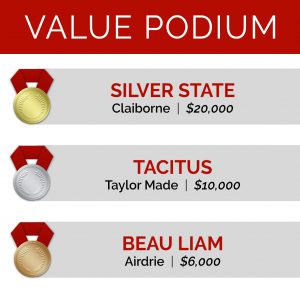
The Value Podium: First Foals Due

Gold: SILVER STATE $20,000 Claiborne
Old-school merit has caused a stampede at his grandsire's farm

Silver: TACITUS $10,000 TaylorMade
Due reward after regal genes were offered at tempting fee

Bronze: BEAU LIAM $6,000 Airdrie
Speedball has been very quick to snowball

The post Value Sires For 2023 – Part II: First Foals Due appeared first on TDN | Thoroughbred Daily News | Horse Racing News, Results and Video | Thoroughbred Breeding and Auctions.

Source of original post

Verified by MonsterInsights