Equine Prosthetics: “There is life after the leg comes off”

There is a theme of reinvention running through Ian Gould's cephalopod-like business ventures.

His UK-based research and development company is looking to revolutionize the way electric vehicle batteries are re-processed, for example, and wants to recycle carbon fiber composite materials otherwise destined for the dump. His latest focus is on animals that suffer catastrophic limb injuries, those with a usually grim prognosis.

“We were looking at greyhounds at first,” said Gould-loquacious and enthusiastic, in the mold of a spirited science professor-over Zoom one recent evening UK-time.

But given the inherent threat of severe injury in racing, “we were thinking, given the advances in digital technologies, in 3D reverse modelling, we realized we could profile equines as well,” Gould added.

In Gould's telling, the idea is broken down into two main buckets. Firstly, a horse's entire physical make-up, inside and out, must be digitally mapped using a 3D laser scan and through bio-engineered x-rays.

“And we can hold that information in a database,” said Gould, pointing to another product in his company library, a digital pet passport accessed through an implanted chip.

In the event a racehorse suffers a catastrophic injury that cannot be saved through conventional surgeries-but which the attending veterinarians believe can be saved though prosthesis-the horse's specifications can be accessed through the chip, then used to print out on a 3D printer an accurate three-dimensional rendering of the required limb part.

“If the vet identified that there is a possibility to save the horse [with prosthetics], that part could be manufactured within hours through 3D printing,” said Gould, of a limb made from hybrid polymer materials strong enough to build jet aircraft.

The technology already exists to bring Gould's idea to life, but practicalities mean it's a long way still, if ever, from being realized in any broad fashion. What it taps into is a niche corner of equine veterinary practice-marginalized for various reasons.

One is the dearth of veterinarians equipped with the training, expertise and inclination to both perform the operation and oversee weeks of post-surgery critical care. Another is cost. Spoiler alert: It ain't cheap.

Another is all wrapped up in ethics: Just because you can do something, does it mean you should?

“Clients often bring friends to see their horse with them standing next to each other watching their horse with a full or half limb prosthesis fly around the paddock with other horses bucking and kicking,” said Lexington-based veterinarian, Ric Redden, who says he has performed more than 50 equine amputation surgeries in his long career. He's an ardent advocate for the surgery but understands how some remain skeptical.

“One says, 'wow, is this not amazing,' with happy tears running down their cheek. The other says 'poor thing, she doesn't have but three legs,' with tears in their eyes. There you go, nothing about horses or horse sports is for everyone,” he added. “But there is life after the leg comes off. That's the story.”


History

“It's been a long slow development on the history of prosthesis,” explained Barrie Grant, a long-time veterinary fixture at Southern California racetracks.

“People have been fashioning sticks and everything else at the end of stumps for years,” said Grant. “I've been over to Egypt. I worked down in Ramses's tomb. I didn't see any hieroglyphic of a horse missing one leg, but that doesn't mean it didn't happen back then.”

Whether or not those ancient Nubians ever fashioned some kind of alternative limb to any accident-prone early ancestor of the horse, a more recent “modern-day” report of equine prosthesis came in the early 1970s, explained Grant, when an appaloosa mare called Robin Dundee was equipped with a prosthetic limb at Washington State University (WSU).

When it comes to overlap with horseracing, Grant was involved in 1985 with one of the most high-profile cases of racehorse prosthesis-Boitron, an ex-European graded stakes winner trained in the U.S. by Wally Dollasse.

Boitron's troubles began at stud, with an abscess in the lining of his right-hind hoof wall. The abscess worsened, ultimately necessitating removal of the whole foot.

Gradually, though, residual problems and infections worked their way up the leg, until eventually Grant and his team at WSU removed the bone to four inches below the hock, wrapping the skin and the superficial flexor tendon around the stump to provide cushioning.

Boitron was fitted with a permanent prosthetic leg, and eventually returned to stud duties at a farm near California's Central Valley coastline. He would end up covering mares until five years later when he died from complications through a stomach abscess that led to peritonitis.

Since the experimental days of Boitron's travails with limb loss, technical advances have been made to the whole procedure. Grant specifically champions the work in this field of veterinarian Donna Harper.

Indeed, Ted Vlahos, a Wyoming-based veterinarian who has performed or overseen virtually over 100 such surgeries, describes a process of refinement to his approach over the past 20 years.

“People always ask, “oh, you'll have to have the horses recover for weeks in a sling,'” said Vlahos, pointing to what he calls a common misconception.

“That is not necessary,” he added. “We don't have a sling in our facility anymore. We stopped using it for amputees and found it completely unnecessary.”

Rather, horses at Vlahos's clinic are expected-like humans with new knees and hips-to move around right away on a temporary prosthetic, and to get up in the recovery room unaided. “We want them as normal as possible,” he said.

So, what does the whole surgical process resemble today?


How it Works

The highest Vlahos has amputated is to the mid-radius of the front leg, and to the upper cannon bone in the hind leg. “But the vast majority of cases-probably 90% of the ones we have done-have been at the fetlock and below,” Vlahos said.

“We will typically in a distal limb case amputate at the fetlock and preserve the sesamoids bones,” said Vlahos, adding that sesamoid bones can still be left in place, even if fractured (a common catastrophic injury in racehorses).
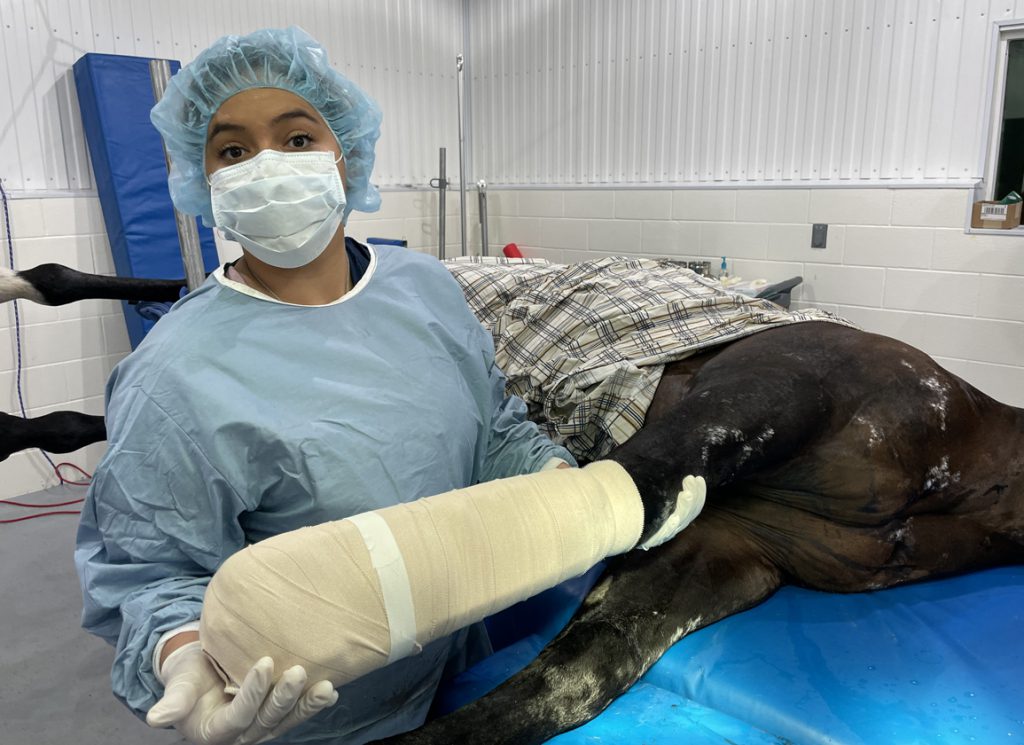
Photo Courtesy Ted Vlahos

“If we can, it's very important to preserve the sesamoid bones when we do our closure as that makes for a bulbous end on the distal limb so the prosthesis won't slip off,” he added.

Blood flow is vital for the tissue and any supporting tendons to be safely closed over the stump, and Vlahos removes sensation of that area by performing an “aggressive neurectomy” so the horses “don't feel their stump,” he said, describing this as a typical process in humans. “We actually take about 3 inches of nerve from the fetlock.”

Surgery will usually range between one and a half to two hours, a difference largely defined by whether or not Vlahos inserts “transfixation pins”-a concoction of metalwork to help alleviate weight-bearing on the stump in the initial post-surgery period.

Unlike humans, whose stumps must heal before a prosthesis is fitted, a horse is put into a temporary prosthetic leg immediately, before transport to the recovery room. “They have to walk on it right away out of recovery,” said Vlahos.

“In most of our cases if the horse is healthy enough to accommodate a transfixation cast, we will place two threaded pins in the bottom third of the horse's cannon bone and incorporate that into a transfixation cast,” said Vlahos. “That is something we've used in fractures and founder cases for many years.”

The thinking behind the transfixation pins and cast boils down to this: When the horse stands upright, the weight in the removed limb is transferred down through the cannon bone to the pins-which stick out each side of the leg about an inch-down through the cast, to which the temporary prosthesis is attached, and then to the ground.

“That allows the horse to fully load on the leg but not put any pressure on the stump,” said Vlahos. “This facilitates stump healing.”

As horses acclimatize to their foreign limb, there of course exists the worry that a horse will injure itself or damage the transfixation cast as it scrambles to its feet.

However, “the risk of limb failure in recovery is no greater than other procedures,” Vlahos said, adding that he has never had a limb fracture in recovery from a transfixation cast in 35 years of surgery.

The temporary prosthesis comes with a bulbous end to negate torque as the horse moves around the recovery room. “We have that fabricated at our welding shop, and it's basically a little round cup with straps that go up the leg,” said Vlahos.

Horses remain in this temporary prosthesis until the stump heals-what generally takes about a month-at which point, the patient will be fitted for the permanent prosthesis, necessitating a mold of the leg. This takes about two weeks to manufacture.

Intriguingly, Vlahos typically halts pain medications after 48 hours, but will keep them on antibiotics or antimicrobial agents for two to three weeks. In all, the horses typically remain at the clinic for about six to eight weeks.


Problems

Given the practicalities of managing lameness, a fair assumption would be that the biggest hurdle to successful post-surgery recovery would be support limb laminitis-lameness transferred to the good leg as the horse shifts its weight away from the problem limb.

Vlahos downplays the threat posed by support limb laminitis, though encourages constant mindfulness of its threat. But in pre-existing chronic cases where support limb laminitis was already at play, “What we found was, by removing the painful limb, the support limb laminitis resolved in most horses,” he said.
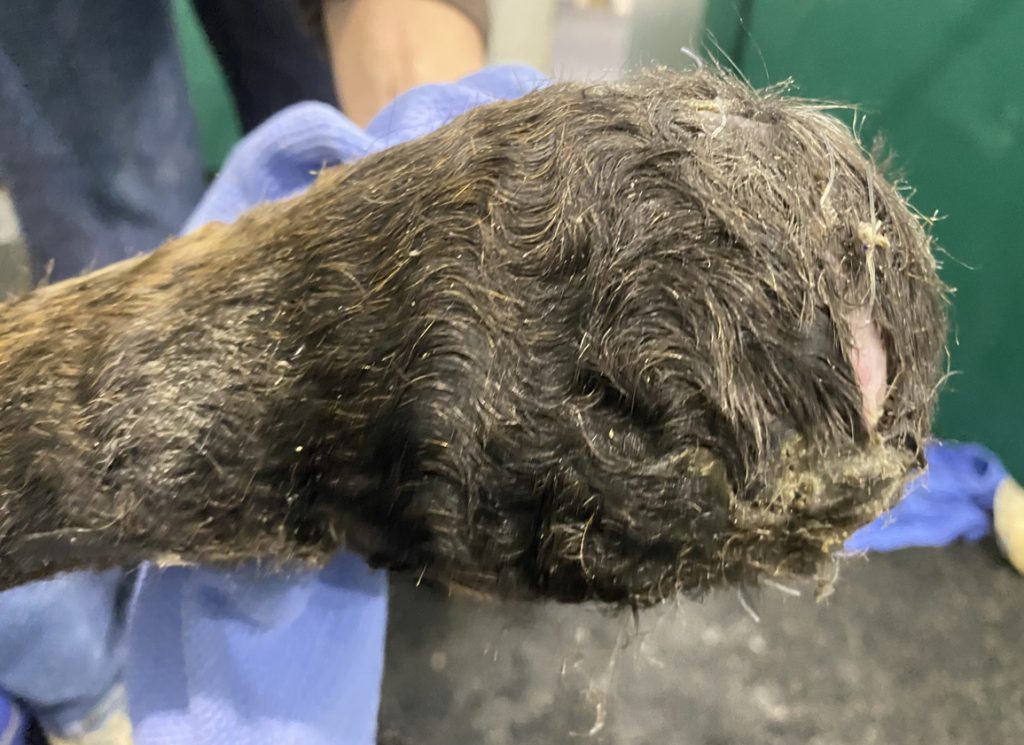
Photo Courtesy Ted Vlahos

Redden, who helped in the initial stages of Boitron's surgical odyssey, similarly emphasizes the need for vigilance in the post-surgery period for support limb problems.

“You can't be looking at them over the stable door waiting for them to tell you if something's wrong,” he warned.

The trick, said Redden, is to support the good leg with devices like a “Mega Ultima“-a high level mechanical aid that can reduce the load on the deep flexor tendon about 60-65%-and to routinely monitor vascular supply to the foot. The mega ultima is technique sensitive, stressed Redden, and requires radiographic control.

Rather, Vlahos and Redden both identify the quality of care horses receive over the long-haul as one of the most instructive factors to post-surgery success and longevity of life.

Once the stump has healed and the permanent prosthetic has been fitted, the new limb still needs to be changed as frequently as every day if the horse is in a hot climate, or every few days somewhere colder. It's a quick process that Vlahos says takes less time than cleaning out all four feet.

Pressure sores at the stump remain a continuous concern, explained Vlahos. The permanent prosthetic will need periodic adjustments and will have to be fully replaced every two to three years. When turned out, the paddock must be essentially child-proofed to ensure the prosthetic won't snag or catch. Steep slopes and muddy patches are discouraged, for example.

“The daily attention you need to give the horse is incredible,” said Redden.


Ethical Considerations

Which partially explains why so few of these operations are conducted. Another is money.

Vlahos breaks the price-tag down this way: Between $8,000 and $10,000 for the surgery, post-surgery aftercare between $200 and $300 a day (for roughly two months), and the permanent prosthesis priced between $2,500 and $3,000.

Gould estimated that 3D rendered limbs-both the temporary and permanent prosthesis-could come with the combined cost of between $12,000 and $25,000.

But perhaps the greatest reason why equine prosthesis remains such a niche veterinary procedure boils down to ethics and optics.

Respected British publication the Horse & Hound has posted various articles in recent years  broadly condemning the procedure, for example, with the publication's resident veterinarian quoted as being “horrified” by a video shared on social media of a horse in Columbia fitted with a prosthetic limb.

“It's hard for me to comment on something that I've never seen done,” said Ryan Carpenter, a Southern-California based veterinarian instrumental over the past few years in a fetlock arthrodesis surgery program-a procedure to stabilize the ankle, preventing joint movement by fusing it into a normal position for the leg-when asked about the procedure.

“But it's the same for any program: What's in the best interest of the horse? We have to be able to look back at these horses after six months or a year and say, 'are we doing the right thing or not?'” he added. “What we've seen with the arthrodesis program is they do remarkably well, and we're actually very happy and proud of our outcomes.”

So, what does Vlahos consider a successful amputation surgery? “Can that horse have a quality of life, maintain their body condition and serve their purpose, whether that be as a pasture animal or a breeding animal?”

In a 2005 study, Redden and Vlahos reported the findings from 26 amputation cases, with 73% surviving the 120 day post-operative period and 65% surviving at least nine months, the latter of which described as “serviceably sound as breeding or companion animals.” Mean overall survival time was 30.6 months.

Over his 100-plus cases to date, Vlahos pins the figure at 90% of horses surviving discharge and comfortable at more than 12 months. Fewer than a handful of horses failed to survive to discharge, he added, tripped up by things like septic limbs and complications during anesthesia.

“Our experience has been they live a normal life, if cared for properly,” said Vlahos, pointing to videos posted on his website. “We have horses that have spent between 15 to 20 years since surgery out running happily in pastures and being serviceable breeding animals.”

As a recent success story from the racehorse world, Vlahos points to the Quarter Horse stallion Triple Vodka, fitted with a prosthetic after a septic coffin joint in his right front necessitated amputation below the fetlock. Triple Vodka returned to full stallion duties, said Vlahos, but passed away last fall through complications from a twisted colon.

In a 1985 article in the Blood Horse on Boitron's surgeries, Grant is quoted as saying that he hoped the horse's exploits would spur copy-cat surgeries. “We were lucky with Boitron,” Grant said at the time. “If he hadn't made it, a lot of skeptics would say don't bother trying anymore.”

Nearly forty years later, however, Grant laments how few believers his proselytizing has converted. “Personally, one of the unfinished things I put in my bucket, I guess, is trying to get more people to think about doing it.”


Future

Which brings us back to the prosthetic limb itself, and its evolution from bygone days of stumps fashioned from wood cuts.

Boitron's foreign limb was ostensibly jimmy-rigged: A steering column from a Volkswagon vehicle mounted along two stainless steel tubes atop on a foot plate and support cup.

Modern iterations used by Vlahos consist of titanium pylons-some with shock-absorbers incorporated-surrounded by graphite laminate or hard plastic and mounted on a stainless-steel foot plate.
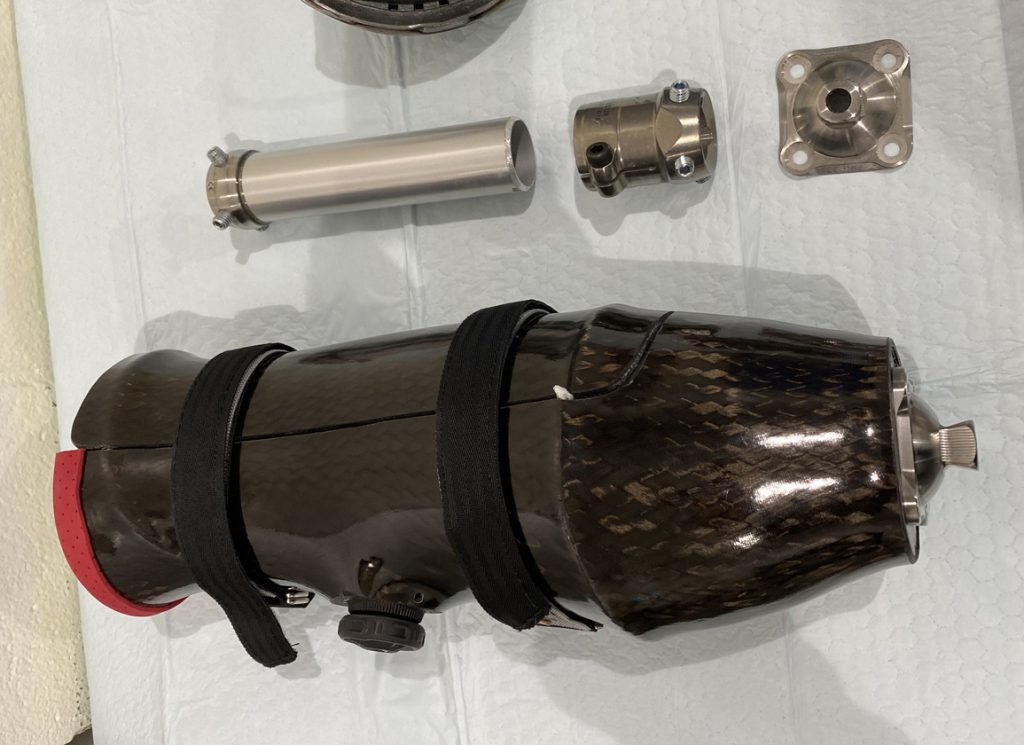
Photo Courtesy Ted Vlahos

To help alleviate pressure sores at the stump, Vlahos inserts a gel cushion into the lining of the prosthesis. With a similar aim, Redden graphs frog tissue to the stump.

And for the past two years, the addition of a Boa cable system to the permanent prosthetic has enabled a more secure fit to the leg, in the style of a ski-boot, allowing for a lighter prosthetic. “This helps prevent the prosthetic from falling off, even at full gallop,” said Vlahos.

The materials used, however, are intended for human use. “So, they're meant for up to a 350lb person per leg,” he said. Which circles back to Gould's vision of the future.

The 3D rendering, he said, could be made accurate in size, weight and proportion to not only the part of the limb removed but to the corresponding leg as well, to act as a necessary “counter balance.” Why is this important?

“Taking the profile of the animal, we can take the dimensions of the other leg that isn't damaged, and say, 'it's got to be within grams of the same weight and the same composition and bone structure as the leg we're already fixing. It has to be. If I was to dissect my legs, they would weigh virtually the same,” said Gould.

“The way the brain operates is that it has already been pre-programmed for the weight of my arms, the weight of my legs, and the pressure I put on each of those things,” he said. “There's a lot of areas that we can tailor to the specific horse.”

Of course, the most accurate rendering of a horse's limb would replicate its full range of motion. Right now, Gould's 3D rendered limb would be a static object.

Eventually, however, “we can, though further engineering, insert into it moving parts and compounds,” he said, pointing to significant advances already made in human prosthetics.

And where does Gould stand on the ethical question: Should veterinary science be pursuing this?

“It's probably only been the last three to five years where analytical data and big data streams have become more prominent,” said Gould, emphasizing how sound evidence-based statistical knowledge can be used to compliment veterinary science, and racehorse health and welfare in general. “Big data is the new frontier.”

The post Equine Prosthetics: “There is life after the leg comes off” appeared first on TDN | Thoroughbred Daily News | Horse Racing News, Results and Video | Thoroughbred Breeding and Auctions.
Source of original post

Value Sires For ’23: Part VI, Earning Their Stripes

And so we come to the abyss: that giddy phase between launching your first juveniles and being able to claim a viable niche in this most unforgiving of marketplaces.

Yes, for those few young stallions that do manage to seize their fleeting opportunity, a narrow path can rise rapidly towards lucrative heights. Most of the others, however, find themselves clinging to a crumbling ledge. Whatever you do, don't look down!

It's easy to disparage the robotic tendencies of the commercial market. Too easy, certainly, for me to have neglected the opportunity to do so quite regularly during this series. On the other hand, however skewed, it's an environment that creates legitimate values of its own. It may seem ludicrous that young stallions should be written off on the basis of a single crop, but the reality is that they will typically have received their biggest and best books in their rookie year. The freshman who lives by hype must also expect to die by hype.

As a result, having hitherto reviewed five intakes individually, today we combine three different classes at various stages of the same process: “earning their stripes”, as we've called it.

In the previous instalment, the first to deal with sires that have actually had some initial racetrack exposure, we felt able to persevere with our high hopes for a horse like Accelerate on the basis that it plainly remains far too soon to reach any conclusions about whether his stock can emulate his own, slow-maturing template. But sires that are only a little farther along the road have, in varying degrees, at least had a more meaningful test of their competence to recycle their prowess.

In each of the three groups combined today, a single horse has broken out immediately before consolidating to become a member of the six-figure club: Gun Runner, Not This Time and Constitution. They have respectively had one, two and three crops show what they can do round a second turn with sophomore maturity. The difficulty is that while few commercial breeders can afford the kind of fees now commanded by these three, even fewer will persevere with those other sires whose fees and reputations have begun to slide. Because everybody knows that those governing ringside investment will be timidly following the herd–and if things are already starting to look ominous for a stallion, then it certainly takes plenty of courage to persevere in the hope of a major turnaround before the 2025 yearling sales.

For the agents and managers, a terrifying risk isn't the unproven new stallion, no matter how flimsy his credentials. It's the horse that everyone else has abandoned, on however cursory a basis. Of course, if you still fervently believe in such a horse, you get the same genetic package for far less money. But that will only represent “value” to the few who remain prepared to play a longer game: either as end users, or as breeders farsighted enough to understand that there should be nothing more commercial than putting a winner under your mare. For everyone else, wanting or needing to trouser a profit as soon as possible, “value” can only be found in anticipating demand.

As I've repeatedly acknowledged in this series, that demand is partly predicated on its self-fulfilling nature. If so many mares are simply moved from one rookie to the next, then it's unsurprising if you get the kind of dividends we saw with the freshmen of 2022–who accounted for seven of the top 14 in the all-comers' juvenile prize money table.

But there's another side to the same coin. There's a stallion out there right now who was launched at a very fair fee by an outstanding farm, and duly filled his first book before looking after commercial breeders beautifully on his sales debut. Everybody, me included, thought he looked a smash. Unfortunately, he had a very quiet time with his first juveniles—and the following spring he covered SEVEN mares. Nobody, it seemed, was prepared to see whether maturity and two turns would vindicate the impression many of us had formed of his prospects. Okay, so that first crop made only mild improvement as sophomores. But who, now, would dare to roll the dice on what is now a giveaway fee? It really does seem that nowadays you get one chance, and only one, or face commercial extinction overnight.

Already, then, many of the horses we consider today look gone beyond recall: either to the rarefied fee levels achieved by Gun Runner, Not This Time and Constitution, or preparing to pack their bags during the next couple of years for overseas or regional programs. That's why we have to combine three different classes for a single podium: once you have lost the freshman limelight, you are in an open market and it's every stallion for himself.

Sometimes even those who survive this brutal process must ride out a small bump in the road. Even our old friend Not This Time–we have been on his side throughout, but can hardly keep him on a value podium at this kind of fee–was quieter with his juveniles in 2022, despite again maintaining his overall stakes action at a terrific rate. That's because they graduate from a crop of 64 live foals, conceived pending his first runners. (His mare upgrade will start to kick in with his 2024 juveniles, conceived at $40,000 from $12,500.)

Gun Runner will endure no such hiatus, albeit his second crop of juveniles understandably couldn't get anywhere near repeating the record-breaking pace set by his first. Perhaps the freshmen of 2022 will prove a stronger group than those he dominated in 2021. That's the kind of calculation required in making our choice for a combined podium, embracing stallions at different phases of consolidation.

It's a tricky undertaking, for sure, but let's see whether we can turn up some residual value somewhere.

BUBBLING UNDER:

Growing momentum for CONNECT did not really reach the sales ring in 2022, but he has some really significant reinforcements on the horizon after a bright start on the track. No fewer than 172 breeders (very much a full book by the restrained standards of his farm) thought him value at $25,000, up from 93 pending his first runners the previous year. That stampede reflects his third place in the freshman table, and growing evidence that he can get you a very good runner for that kind of money.

Connect had two “Derby” winners among his first sophomores, juvenile Grade I winner Rattle N Roll winning the GIII Oklahoma version and High Connection the one at Los Alamitos. Among his daughters, Hidden Connection has more than once flashed elite caliber; while The Alys Look, among the next crop, has already laid down a feasible Oaks marker of her own.

Having been so impressed last year with the ratios achieved by KARAKONTIE (Jpn), I was disappointed that his excellent start on the track earned him no more than 48 mares in 2022, his smallest book in four years. Still, he has a big opportunity now that the enlightened minority prepared to breed to turf stallions in Kentucky has been deprived of both Kitten's Joy and Englis Channel.

Karakontie made his Grade I breakthrough in 2022, through Spendarella in the GI Del Mar Oaks, while his overall stakes/graded stakes action has come at a superior ratio to several more expensive peers. He has also proved more versatile, in terms of surface, than many will have expected–but then he does have a very cosmopolitan pedigree. If his third dam is turf legend Miesque (Nureyev), then his mother was by Sunday Silence while his sire has dirt royalty along his maternal line.

TAPITURE has had to sieve more quantity than quality into his stats, and sure enough only has a solitary graded stakes winner (albeit a good one in millionaire Jesus' Team). Nonetheless he gets black-type action at basically 10% of named foals, no mean effort at just $7,500.

CUPID has had some pretty crazy highs and lows, in his books, but there's no arguing with a fee of $5,000 for a stallion beating 40% winners-to-named foals, including a couple at graded stakes level. Smaller breeders are really being offered quite a lot of horse for their buck here.

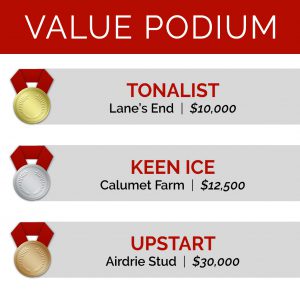
BRONZE: UPSTART (Flatter–Party Silks, by Touch Gold)
$30,000 Airdrie
It's the obvious stuff that has earned this fellow a hike in fee: most obviously of all, one of the most talented sophomores of the crop in Zandon, albeit the GI Blue Grass S. winner repeatedly suggested there was better to come even than third in the Derby and Travers. Among Upstart's 10 other stakes winners to date (20 black-type performers overall, representing 11% of named foals), dual Grade II winner Kathleen O. disappeared after her Oaks bid, only to make a most promising resumption in the fall. But the clincher, for me, are the ratios that most people don't consider enough.

Upstart has got over 80% of his named foals onto the track; and over 60% of them into the winner's circle. Among his most accomplished young peers, that compares to 71 and 53% respectively for Constitution; 71 and 42% for American Pharoah; 69 and 46% for Not This Time; and 64 and 36% for Nyquist. Just what is this creature made of? Tungsten?

Sure enough, in his own track career, Upstart achieved two Grade I placings in each of his three campaigns, finishing up with $1.75 million across 15 starts. (While having been forward enough for a 102 Beyer at two, some achievement for a son of Flatter.)

Upstart is cleverly named, if you look at his parentage (and damsire), but now he is clearly rising in stallion society as well. Admittedly he will do well to maintain quite so steep a climb this year, as his sophomores (including impressive recent Fair Grounds scorer Cagliostro) graduate from a book of just 38 covers. But if that is a pathetic commentary on the neurosis of the commercial market, then remember that the momentum behind this guy began even before he could show his wares on the racetrack. His first yearlings averaged six times his $10,000 starting fee, renewing traffic to 90 mares the next spring; while his first two crops both pinhooked to a six-figure average at the 2-year-old sales.

Having seen his stock on the track—and remember that his stellar 2022 sophomores emerged from no more than 86 covers–breeders were quick to fill his book last spring. His latest yearling returns, with an average soaring back up to $90,900 from $25,115 the previous year, will not discourage them from returning at his revised fee.

A fee hike doesn't automatically put a stop to value, and there's a sense that Upstart is only just getting started. With quantity already on its way, he will now have an upgrade in quality too. So here's a rare chance to enter the elevator just a level up from the lobby. Next stop is the penthouse.

SILVER: KEEN ICE (Curlin–Medomak, by Awesome Again)
$12,500 Calumet
Now this suggestion clearly comes with a few neon caveats. He's had a fairly unorthodox career to date and it tells you plenty about his commercial credibility that his latest yearlings, “boosted” by a GI Kentucky Derby winner at the first attempt, bumped along at No. 199 in the national sales averages! But I would love to have one of his daughters for a breeding program, and Rich Strike has at least made it legitimate to wonder what he might yet achieve with an upgrade in his mares.

Keen Ice always had old school appeal, in constitution and pedigree, right from when he started out.

Arguably he was never really priced to entice commercial breeders, at $20,000, and presumably had to settle primarily for plain weight of numbers from the home herd. Yet he has nonetheless proved a really prolific sire of winners (78 from 136 starters to date)—and, setting aside the ifs and buts of the Derby meltdown, Rich Strike has certainly shown a trademark durability at the top level. With the Gun Runner S. on Boxing Day the effective start of his sophomore campaign, he took in 10 starts in 11 months.

A rise to $12,500 from $7,500 hardly helps Keen Ice, in terms of overcoming commercial doubt, but I'd still say that kind of money is value for access to his sheer teak ($3.4 million across 24 starts). Remember that his maternal line extends to matriarch Too Chic (Blushing Groom {Fr}) while his eligibility as a potential broodmare sire is surely reinforced by replication of Deputy Minister: that iconic distaff influence accounts both for Keen Ice's own damsire, Awesome Again, and for the mother of his sire Curlin.

Maybe he's not the answer to everybody's prayers, but his percentage of named foals to make the starting gate, and then to win, are way ahead of the most glamorous names in his intake (with their far superior books). That shows how he's trading in the kind of stuff that any breeding program should appreciate, and it would be nice if he were granted some overdue respect after all the faint praise for his exotic Derby score.

GOLD: TONALIST (Tapit–Settling Mist, by Pleasant Colony)
Lane's End $10,000
Okay, so I understand that the megabucks earned by a single horse distort his status in the earnings table, and various associated averages. (Not dissimilar, as such, to the horse on the second step of the podium.) But I have been too loyal to Tonalist, for too long, to desert him after the year when he plundered all those desert riches with Country Grammer.

Having a poster boy like that has certainly done Tonalist no harm: he was back up to 87 mares last spring, having the previous year slumped to just 54 from 122; and he elevated his yearling average to $53,413 (for an excellent 29 sold of 31 offered) from $32,505. That's really impressive in any stallion at this awkward stage, never mind one who had been so consistently unfashionable that he had taken a fee cut every single year to 2022. His neglect always seemed mysterious to me: I loved the package at the outset (banked $3.6 million via 11 triple-digit Beyers, just as one would hope from a son of Tapit out of a Pleasant Colony granddaughter of Toll Booth) and I have loved the corresponding dependability of his output since.

He has punched above his fee throughout, especially measured by graded stakes action. In this intake Constitution has been hitting pretty mad numbers, but otherwise Tonalist's 4.5% of graded stakes operators-to-named foals is basically in step with American Pharoah and ahead of everyone else.

His template, for those who want horses that run, and keep running, is just so wholesome. Take the thriving Betsy Blue, just turned five but better than ever. It's a long time now since she broke her maiden under a $25,000 tag: on her 19th, 20th and 21st starts this winter, she placed on her graded stakes debut before winning consecutive black type prizes. Her record now reads 21-10-7-2 for $659,510. Another from the same crop, Who's The Star, took six starts to break his maiden back in 2018 but is similarly on a roll now, running up three consecutive graded stakes on his last three starts. If this guy gets in contention, you're in trouble: the only minor placings in his 17-7-1-2 record trace way back to his first maidens.

This is the kind of stuff we need to be putting into the breed: heart, resilience and “run”. Everything, in other words, we associate with Tonalist's sire and damsire. Imagine what he could do with better mares. Of course, if you happen to own one, you don't have to just imagine. You can find out, and for a near-basement fee. For everyone else trading at this kind of money, however, there aren't many better ways of affordably putting a winner under your mare.

The post Value Sires For ’23: Part VI, Earning Their Stripes appeared first on TDN | Thoroughbred Daily News | Horse Racing News, Results and Video | Thoroughbred Breeding and Auctions.

Source of original post

KTFMC Meeting: Equine Veterinary Changes, Implications for Farm Managers

by Sara Gordon and Katie Petrunyak

LEXINGTON, KY-The Kentucky Thoroughbred Farm Managers Club (KTFMC) held its first meeting of the year on Tuesday at Keeneland. The event was conducted jointly with the Kentucky Association of Equine Practitioners (KAEP) and the over 200 in attendance represented both organizations. Members of the Godolphin Flying Start and Kentucky Equine Management Internship programs were also on hand.

Recent changes and trends in the equine veterinary field were a focal point of the evening, along with topics including equine litigation and liability, navigating equine veterinary practice changes and the equine veterinarian shortage.

KTFMC President Gerry Duffy said their board brought up the issue of the equine veterinary shortage as a potential topic for their monthly meeting and from there, they partnered with the KAEP knowing that the subject would be relevant to both organizations.

“We know that the vet-farm manager relationship is so important and we have been hearing statistics about how they're struggling to get equine practitioners and of the ones they get, there's a high degree of partition,” Duffy explained. “We thought it would be a good topic to discuss at the meeting and when we got talking to the KAEP, they were having a meeting focused on equine veterinary litigation and liability so we thought, why not bring the two together?”

A 'Q and A' session on the Horseracing Integrity and Safety Act (HISA) was also conducted with HISA's Director of Equine Safety and Welfare Dr. Jennifer Durenberger and HISA Representative Marc Guilfoil, bringing forth a host of questions on the new responsibilities that those overseeing horses outside of the racetrack would take on if and when HISA comes into authority.

Evolving Landscape of Equine Insurance Coverage

Equine attorney Mike Casey of Casey Bailey & Maines, PLLC, based in Lexington, was the first speaker to the podium, leading a discussion on the evolving landscape of equine insurance coverage and the particulars of filing a claim under those policies.

Casey emphasized the importance of the relationship between vets and farm managers, particularly when it comes to how the vets document interactions with their patients and handle subsequent care when called out to the farms. This is all information that is not only necessary for those directly connected to the horse, but also required when it comes to instances of filing a claim, such as equine mortality, with an insurance agency.

Common issues that arise involve how often the vet visits the patient, varying whether the visits are routine or for a specific health issue, which correlates with the problematic pressure to prescribe medication without examining the patient first.

“It is critically important to make sure when you're administering medications that you have that temporal visit with the horse,” said Casey.

He also touched on the growing issue of using medication on a horse that it was not originally prescribed to.

“I probably see that more today, in the last two or three years, than the last 10 years before.”

All of these issues were weighed against what the insurance company would be looking for when handling a claim, which always leads back to the importance of maintaining precise, updated documentation. Medical records must include enough detail that anyone checking on the horse should be able to know exactly what their health status is, what treatments they have received in the past and how things should be handled for that particular patient going forward.

“Farm managers need to call the vet and make sure they see the horse the next day. It'll hopefully avoid a catastrophic outcome and it is in compliance with regulations that we know will have heightened scrutiny as we go to HISA, or as KAEP redrafts regulations,” said Casey.

When dealing with mortality insurance claims, farm managers should take the time to read through the entire policy in order to understand what is expected of them when dealing with the insurance company. In that same vein, all communication with the designated representative of the insurance company should also be documented, to avoid any issues when filing a claim down the road.

Casey explained why understanding any negating factors, such as instances of failure to provide improper care, is crucial. His example touched on use of a medication on a horse that it was not prescribed to, which could fall under the realm of an “intentional act” of improper care. In most cases, “proper care” is defined after the fact.

“We want to be able to connect the prescription to the horse, to the vet's visit, to prevent application of the unauthorized medication claim,” he said.

Communication and proper documentation are the key points when it comes to vets and farm managers abiding by regulations, maintaining the proper care for the horses in their charge, and ensuring that in the case of any insurance claims filed, everything is presented properly to guarantee a seamless process.

According to Casey, there is no such thing as too much communication, using the example of emailing the insurance agency a summary of the vet's visit for annual vaccinations to prove his point. Farm managers must also understand that a vet isn't going to report directly to the insurance agency in the case of a claim, so they must maintain their own day-to-day records as well.

“We've got to establish a dialogue for this industry, [when it comes to] what is reasonable, proper and the routine method of doing business. It is important that insurers play a role in this,” said Casey. “It's too easy to use the sins of others in the industry to say, 'That's why we have a heightened medication claim.'”

As he concluded his presentation, Casey reiterated the importance of ensuring all treatment decisions and medications are being administered based on the physical examination of that horse.


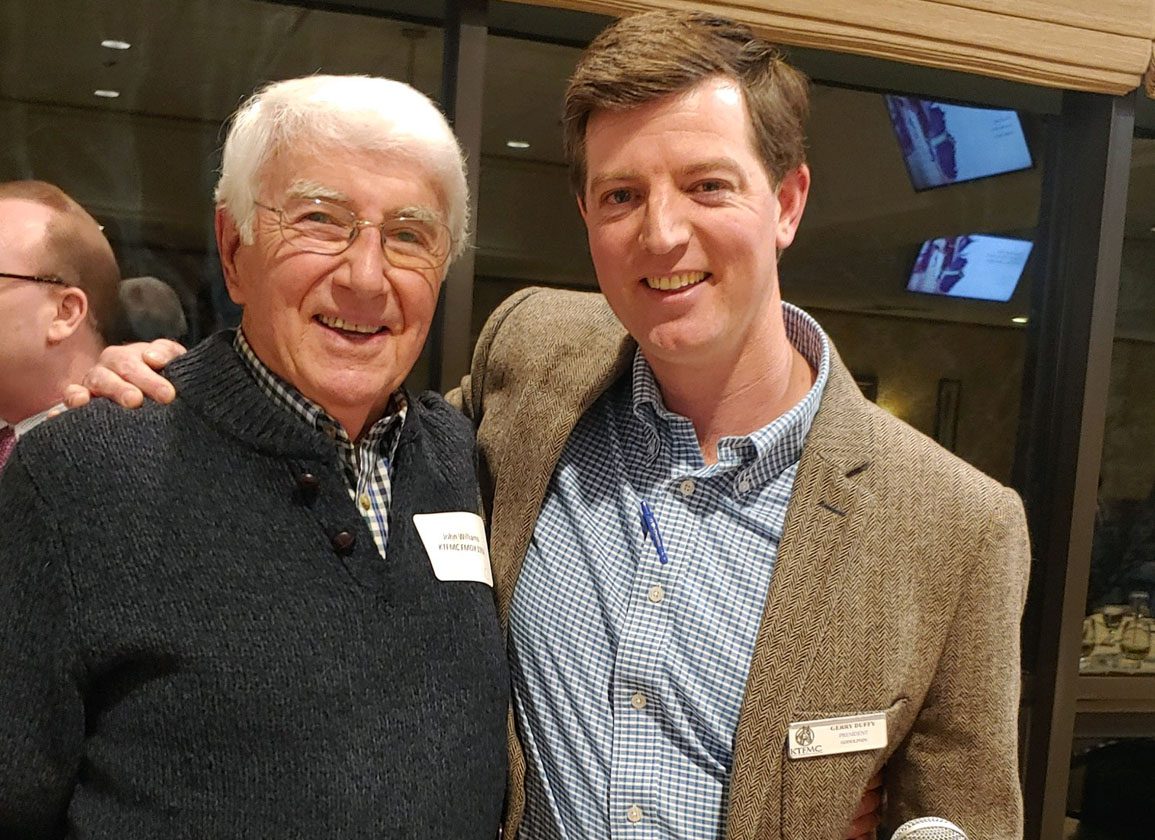
KTFMC President Gerry Duffy with former president John Williams | KTFMC

Equine Practitioners Discuss Vet Shortage

While most meeting attendees were aware of the equine veterinary shortage, the statistics shared by Hagyard's Dr. Luke Fallon were staggering.

Fallon said that according to a recent survey conducted by the American Association of Equine Practitioners, by 2030, equine medicine will need over 5,000 veterinarians to meet the growth in demand. Currently there are approximately 3,650 practicing equine veterinarians in America.

Additionally, of the 3,300 veterinary graduates each year from U.S. schools, only 1.3% will enter the equine profession directly. While 4.5% will enter an internship program, 50% will leave the equine profession within five years.

“If you do the math, the shortage of equine veterinarians is already here,” Fallon said. “Why are equine vets leaving the profession? Burnout is one of the key factors. It is a demanding job with long hours and low starting salaries compared to small animal jobs, which often include a signing bonus as high as $200,000 for new graduates.”

Fallon explained that many young students enter veterinary school with the dream of becoming an equine practitioner, but turn to small animal medicine because it is a more logical step financially. He said that equine veterinarians usually start at between a third and half of the initial salary of a small animal veterinarian.

Fellow Hagyard veterinarian Rhonda Rathgeber joined the conversation to discuss a few of the new initiatives Hagyard is working on to encourage veterinary students to consider a career in the equine industry.

Hagyard has enhanced their recruitment efforts by hosting student weekends to show how their facility operates and share details about their externship program. Although the initiative has been hurt in recent years due to the pandemic, it has led to increased numbers in their externship program.

“We are up to 150 externs this season, so if your veterinarian has an extern or a student with them, please be patient,” Rathgeber advised. “We've done a lot of work to get them to come and see what it's really like.”

Hagyard has also increased their outreach through college visits. Last year, they visited a third of the veterinary colleges in the country. Additional recruitment efforts include a podcast, their participation in the annual Opportunities in Equine Practice Seminar hosted by Rood & Riddle Equine Hospital and also hosting their own undergraduate seminars for pre-vet students.

Jim Heird, PhD, rounded out the session to discuss one promising step toward overcoming the shortage. Heird is a member of the advisory council for Lincoln Memorial University's Equine Veterinary Education Program (EVEP), which provides an accelerated, six-and-a-half year path to a Doctor of Veterinary Medicine degree. Students go through the undergraduate program at LMU and as long as they maintain a 3.35 GPA, they are automatically accepted into the school's veterinary program.

The EVEP places an emphasis on their students developing hands-on horsemanship skills. Students will work on-farm summer internships during their undergraduate years and then will intern at clinics during their summers in the veterinary program.

Heird said that LMU produces more equine veterinarians than any other school in the country.

“When I think about my career, I don't know of anything that I've done that has as much impact on the future of this industry than this program could have,” he said. “That's why I'm so passionate about it.”


HISA's Director of Equine Safety and Welfare Dr. Jennifer Durenberger and HISA Representative Marc Guilfoil

Concerns for Consignors and Managers Brought to Light During HISA Q and A

The evening concluded with a focus on HISA, where attendees were given the opportunity to ask Durenberger and Guilfoil questions. Pertinent to those in attendance, many questions focused on the regulations for those dealing with horses covered under HISA, outside of the track, such as consignors at the sales or farm managers handling lay-ups at the farm.

Though HISA has already released handbooks for racetracks, racetrack maintenance, regulatory veterinarians, attending veterinarians and trainers, Durenberger did say that handbooks for groups such as farm managers, consignors and off-track vets were in the works.

In the meantime, she emphasized that it would be the responsible party's job to update any records related to a “covered horse” in the HISA online portal, as those records would not be required until the horse returned to the racetrack. In those cases, the responsible party would more than likely be the trainer.

Further concern was expressed for clarifying who the responsible party would be, depending on different situations when the horse is not at the track, and specifying the time requirements for submitting any updates to a horse's medical record. Durenberger assured those asking these questions that further details would be provided, in hopes of clearing up any misunderstanding.


For almost 100 years, the KTFMC has helped build community and camaraderie among farm managers while also working to find solutions for challenges that these managers face. Their current officers are President Gerry Duffy (Godolphin), Vice President Adrian Wallace (Coolmore), Treasurer Charles Hynes (Coolmore), Secretary Molly Harris (Shawhan Place) and Sergeant-At-Arms B.G. “Scooter” Hughes (Hughes Racing Stable). The club boasts over 500 members and hosts a number of annual charitable fundraisers including a golf scramble, a trail ride, a 5k run, and more. For more information on the KTFMC or to apply for membership, visit www.ktfmc.org or email info@ktfmc.org

The post KTFMC Meeting: Equine Veterinary Changes, Implications for Farm Managers appeared first on TDN | Thoroughbred Daily News | Horse Racing News, Results and Video | Thoroughbred Breeding and Auctions.

Source of original post

Jan. 25 Insights: TDN Rising Star by Munnings Returns at Gulfstream

8th-GP, $54k, Alw, (S) 3yo, f, 6f, 3:37 p.m. ET

Robert and Lawana Low's MUNNYS GOLD (Munnings) returns to action following an eye-catching 14 1/2-length victory in her career unveiling at Monmouth Park last June. Earning a 101 speed Beyer for the TDN Rising Star-earning performance that day, the Florida-bred counted among her vanquished rivals runner-up Alma Rose (Sharp Azteca), who went on to air next time out at Colonial and subsequently took a stakes race at Delaware. A $300,000 at the Fasig-Tipton July Sale, well above her sire's 2021 yearling average of $131,231 for 81 head sold that year, the filly is trained by Hall of Famer Todd Pletcher, who connects at a 26% clip with horses returning from a 180+ layoff over the past five years. TJCIS PPs.

The post Jan. 25 Insights: TDN Rising Star by Munnings Returns at Gulfstream appeared first on TDN | Thoroughbred Daily News | Horse Racing News, Results and Video | Thoroughbred Breeding and Auctions.

Source of original post

Verified by MonsterInsights