The passing of Burt Bacharach last week evokes a couple of complementary tales that reflect instructively not only on the great man himself, but also on the different ways that different farms go about their business.
Back in the early 1980s Bacharach was staying in downtown Lexington, having been driven down from a concert in Cincinnati the night before so that he could visit his mares and foals before flying on to his next show.
Catherine Parke was still in her twenties, having barely established Valkyre Stud on a parcel of land near Georgetown, maybe 50 acres. She was waiting outside the hotel in her little two-door jeep, in her recollection about seven feet from nose to tail, when a gleaming white stretch limousine pulled up opposite.
Bacharach emerged from the lobby, understated in his blue jeans and gray sweatshirt. He looked at the limo, then at the jeep, walked over and gave Parke a hug. And suddenly here was this guy running up from the limo. Parke recognized the manager of a prominent Bluegrass operation.
“Mr. Bacharach!” he exclaimed. “I'm so-and-so of […?!] Farm. We'd love to take you around today, maybe see some stallions, whatever you'd like to do, sir! We'd love to meet you and talk about handling your business.”
Bacharach turned politely to the manager and his chauffeur. “Thank you, boys,” he said. “But I've already made my plans.”
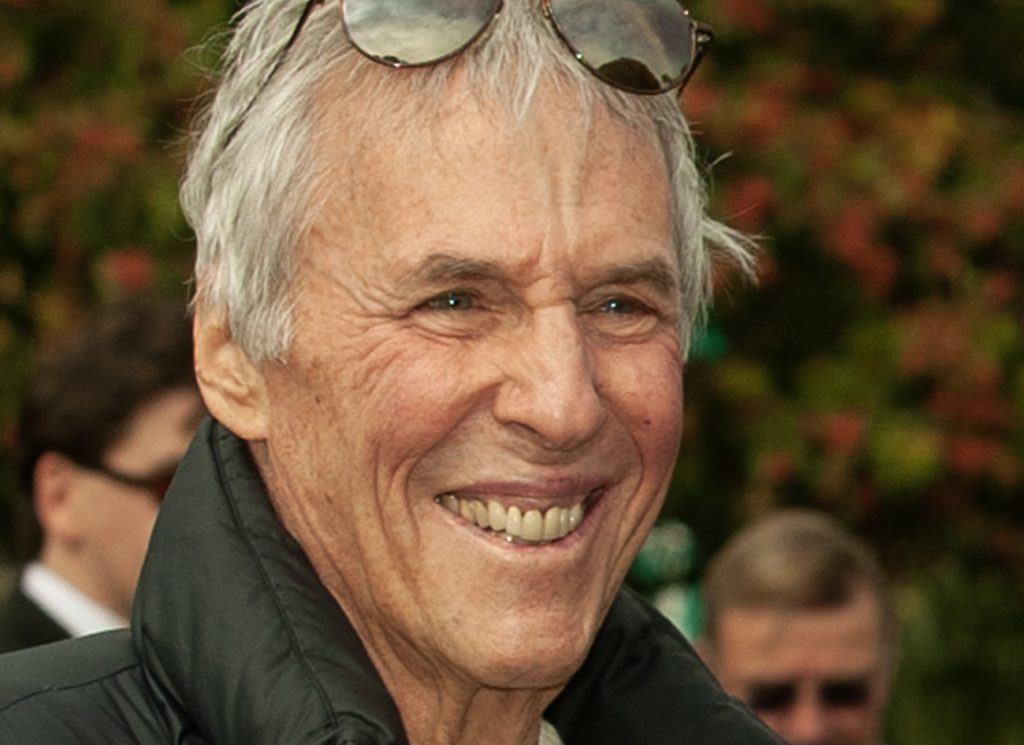
Burt Bacharach | Benoit photo
“And off we went bouncing up to the farm in the old jeep,” Parke recalls. “And he had a peanut butter-and-jelly sandwich, and spent two hours with his horses. I think that farm must have paid the bellhops or somebody to let them know when prominent people were in town, so that they could entertain them.
“But that's exactly why Burt was with me. Same with the Moscarellis, his lifelong managers on the farm in West Virginia: they were hands-on all the time. He wanted to talk to the person that fed his horses that day.”
And, gosh, does the second story show that he got that with Parke! For it was her unstinting devotion to his Heartlight No. One (Rock Talk), champion sophomore filly of 1983, that not only assured Bacharach that his mares in Kentucky were in the right hands, but also convinced Parke herself that she had found her true vocation.
“Heartlight had cracked her pelvis in a workout and colicked literally every week,” Parke explains. “I had to give her timothy hay, and steam-crimped plain oats with just mineral on it. If she had sweet feed, or grass, she'd colic right away. So she had this big dry lot, almost three-quarters of an acre, and Burt built her a great big covered hayrack. And she could go in and out, between there and her stall, any time she wanted, day and night, because the more she moved, the better.
“The problem was that I couldn't afford year-round night watch. So I got this sensor from Australia, a little radio transmitter you hooked to her halter. And if she lay her head down flat for more than three seconds it would send a signal that reached me anywhere on the farm. My bedroom was very close to her paddock and when this beeper went off, I'd run out in the middle of the night and give her a shot of Banamine. And after about 45 minutes she'd shake her head and get up. If ever I couldn't be there for some reason, someone was always in my house with that beeper.”
There were no holidays, anyway: every cent was going into barns and fencing and, a little at a time, mares as well. But the bond she developed with this precious animal was such that she feels as though she got more back than she ever had to give.
“Honestly, she was the smartest, most intelligent horse I've ever been around in my life,” she says. “If she started colicking in her paddock, she'd stand screaming at the gate. I'd run over and her eyes were dilating but when she saw me come running with that shot, she'd hold still and wait. I suppose it was a conditioned response, after a while she realized that when I gave her that poke on her neck she was going to start feeling better. Anyway she would just stand there quietly and as soon as she'd had the shot she'd go back down, because she was in pain. She survived two colic surgeries but not the third, by which time she was 18.”
But then Bacharach knew already that he could trust this novice. Their first dealings had been when he called Dick Broadbent's office, where Parke was working as a bloodstock analyst. She was trying to get started as an agent, too, but charged no commission for securing him a season once she gleaned that he had been offered terms elsewhere that were, shall we say, not quite disinterested.
Again, Parke got far more in return for her probity than she could ever believe she merited. “For me to have a champion filly on the farm, at that age, was surreal,” she says. “Of course I was starstruck, but Burt was always so kind. I'd get to go backstage and meet Dionne Warwick, front row seats, all of that. He let me accept his TOBA award because he was doing a concert. I wouldn't know about his other life, but I know how he loved his horses. He called all the time, wanting to know how Heartlight was doing, how the babies were doing. He was very involved emotionally with them all.”
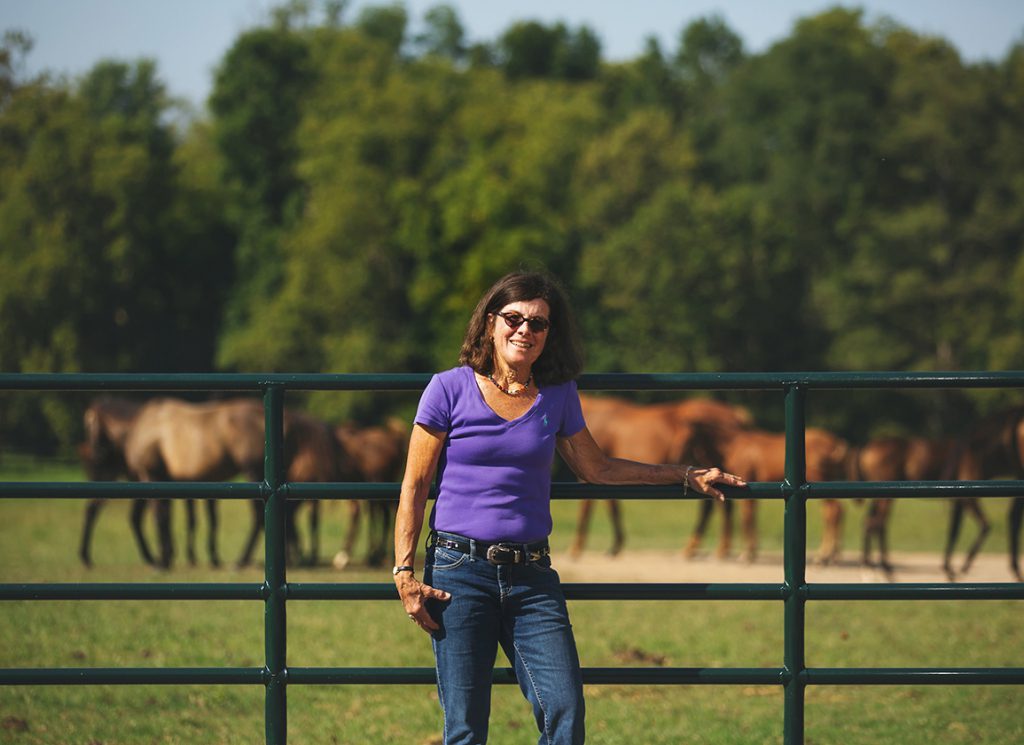
Catherine Parke at Valkyre | Keeneland photo
Having ridden hunters since girlhood in rural Ohio, Parke had come to the University of Kentucky primarily in the hope of galloping racehorses at Keeneland. But the racetrack back then was a hostile environment for a young woman, and she soon gravitated towards farm work. On leaving school, she found cherished mentors in Henry White of Plum Lane Farm and then Broadbent. Usefully, the latter hated flying and Parke gained valuable experience by being dispatched far and wide on his behalf. She started out leasing a barn and run-in shed, with a mare of her own plus a single client.
“Then I had some people come to me from California, and they're like my parents now,” she says gratefully. “Bill and Betty Currin, and Pat and Bill Klussman. They said why don't you get your own place? So I did.”
Parke has lavishly repaid the fidelity of both couples. The Klussmans had Ava Knowsthecode (Cryptoclearance)—graded stakes-placed, albeit “her legs were just a little too short” to go as fast as she wanted—who produced Grade I winners Justin Phillip (First Samurai) and Greenpointcrusader (Bernardini) as well as the latter's brother, GIII Holy Bull S. winner and sire Algorithms. That secured a $1.2 million dividend through her yearling son by Tapit.
The Currins, meanwhile, had Wilshewed (Carson City), who similarly produced Grade I winner Stormello (Stormy Atlantic) and two other graded stakes winners, plus a seven-figure yearling of her own. Then there was Robert Spiegel, who bred dual GI Santa Anita H. winner Milwaukee Brew (Wild Again) from a mare who soon afterwards produced a Cozzene filly to become another million-dollar baby. (Her commission built Parke's office.) Another of the first horses to put the farm on the map was elite turf runner Riskaverse (Dynaformer), raised here for Peter Schiff's Fox Ridge Farm.
In Parke's own cause, meanwhile, the cornerstone was the purchase of the 10-year-old Silk n' Sapphire (Smart Strike) from William A. Carl, for just $40,000 at the Keeneland November Sale of 2008.
“Mr. Carl was an equine insurance executive, and a very nice man,” Parke says. “He only had a small broodmare band but my goodness, he was extremely successful. They started out as very light pedigrees but now you see his bloodlines everywhere.
“Well, when I bought Silky it still looked very light. At the time Smart Strike wasn't yet considered a broodmare sire. But I had a very limited budget. And when I looked at her, I loved her physical: big, strong, very correct.”
And there was a clincher. Just a couple of hours after she was due in the ring, her 2-year-old daughter by Pleasantly Perfect was to debut for Graham Motion at Laurel. Parke had known Motion since raising one of his earliest graded stakes winners, Bursting Forth (Alwasmi), for Sam Huff. So she made a call.
“You know, Cathie, I quite like this filly,” Motion told her. “I think she can run a little bit.”
Knowing his understated style, that was good enough for Parke. Sure enough, Shared Account not only won that same day but went on to become a Breeders' Cup winner, besides since producing another one in Sharing (Speightstown).
“It was just meant to be,” Parke says. “And when I bought her, Silky was carrying a Pleasant Tap filly. We sold her for $475,000 as a yearling and she became [graded stakes winner] Colonial Flag. So that truly was a life-changer for me. I was able to pay some debt down, and buy her half-sister Champagne Sue (Elusive Quality). And then Silky had a $1.2 million yearling.”
But there was more to come. Champagne Sue produced that good 2-year-old of a couple of summers ago, High Oak (Gormley). And Silky's final gift before retirement, a 2019 filly by Hard Spun, has proved beyond price.
“When she had a filly, there was no way I could sell,” Parke avows. “Silky was still very healthy but had this issue retaining fluid. It was very difficult to get her in foal. But Dr. Karen Wolfsdorf, who's just a brilliant reproductive veterinarian, wouldn't give up. We did a lot of procedures and she got in foal fine, carried the foal fine, and foaled easy as could be.”
The Hard Spun filly showed such an immediate and astonishing competitive instinct that Parke had to provide her dam with a raised feed tub.
“She would kick at her mother and run her off the feed tub when she was, oh, 30 days old,” Parke marvels. “Silky's 16.1 and a big strong mare but that baby, she was tough.”
Needless to say, the filly was sent to Motion—via Robbie Harris in Ocala, who Parke salutes for teaching even this feisty youngster to relax. But the filly's ardor remained intact.
“She got turned sideways in a couple of races as a 2-year-old, got slammed really hard, but she got up and came running,” Parke recalls. “She's got no quit in her. It's just the blood, isn't it? She has the ability plus the heart, just pricks her ears and runs.”
Her name is Sparkle Blue, and Motion brought her through the ranks to round off her sophomore campaign on the brink of the elite: winning a graded stakes at the Keeneland fall meet before overcoming a rough trip for third in the GI American Oaks at Santa Anita.
“Graham hopes that she'll be even better at four,” Parke says. “She's changed tremendously since she was young, I don't know if it's the sire, or because she was a May foal. But you keep thinking you're going to wake up and it's all a dream. I've sold plenty of good horses for my clients, and enjoyed watching them run. And I've sold some good ones on my own. But you don't ever expect anything like this, it's just been an unbelievable gift.”
The experience has been “wonderfully” enhanced by George Strawbridge, who doesn't typically engage in partnerships but attests to Parke's standing in our community with his willingness to make an exception this time. Both are thoroughly in tune with Motion's patient style and Sparkle Blue has duly been indulged with a winter break, for a potential resumption at the Keeneland spring meet.
“And I can't say enough about Graham,” Parke emphasizes. “He's a great horseman, genuine and kind, a great communicator: really the kind of person we want to showcase our sport. Which is important, as we try to clean it up. I am an eternal optimist, and really think that we're turning the corner in some very important ways.”
True, she is dismayed by certain trends within bloodstock. When she started out, in 1978, she could sell foals out of ageing stakes producers. But now she finds that an ageing mare is no longer 18, but 13. And she's depressed by the difference in the kind of stallions used by clients who sell their foals, as opposed to those who want to runners to build a family. She misses the days when trainers would scout the sales themselves, and deplores the agents and pinhookers frightened to buy a nice foal by even a second-crop sire.
By this stage, however, she has long established what works for her farm. It has always housed around 30 mares, as a number that permits hands-on management, and doesn't accept the familiar mantra that youngsters need only to be left “to be horses.” Horses leaving her farm should be mentally equal to the regime that awaits them.
“I don't shed raise, I don't hothouse, but I do like to bring everything in once a day,” she explains. “In the afternoon they eat outside, they get to be competitive and bump each other around. But in the morning they come in, they get temped, they eat. Because someday they're going to have to be in a stall, and I don't want them to think of that just as somewhere they get vaccinations and their feet trimmed. I want them to lie down and find their stall's kindness.”
If she's noticed a pattern at all, it's that those whose personalities change after weaning tend not to cope at the racetrack.
“So the mind, to me, is very important,” she reflects. “They can be great-looking athletes, but even from our really good families we've had some that were too nervous and frantic. One of them was really gorgeous, but ended up mean and didn't train. They were all with good trainers, they just couldn't hold up at the track. So, long story short, I think disposition just as important as conformation.”
But she acknowledges that different things work for different people; that some investors, unlike Bacharach, are actually happier getting into that big white limo.
“It's relationships,” she says with a shrug. “Like there are big banks, small banks. I mean, I'm like my little bank in Georgetown. I've lost one client in 40 years—and we actually topped a sale that day! But he just said he needed a big fancy farm, somewhere to take people. I said, 'Well, I have a very pretty farm, but I don't have parties.' But that's okay. That's what suited him. And thank God we have the big corporate farms. We need them, to keep the stallions here. But everyone else I've worked for, from day one, wanted to talk to the person that saw their horse.”
She named it Valkyre “because that was where the maidens waited for the war heroes to come home.” Of course her venerable ladies are still here, too, cherished in retirement: Ava Knowsthecode, Wilshewed, Silky. But last week a fresh cycle began, with an auspiciously smooth foaling: nine o'clock in the evening, no assistance required, a healthy foal. And Parke was as excited as when the whole thing first began.
Back in those early days, she remembers a limousine ride to the Derby with Bacharach. (It wasn't always that jeep, then!) And he fell quiet for 20 minutes, working out a melody that had just come to him. It turned out to be That's What Friends Are For. And the eventual lyrics couldn't be more apt, if you could ask “Heartlight” or any of the other horses blessed by Parke's care over the past 45 years.
Keep smilin', keep shinin'
Knowing you can always count on me.
'Cause I tell you that's what friends are for
For good times and bad times
I'll be on your side forever more.

The post Valkyre Stud: It Starts With the Heart appeared first on TDN | Thoroughbred Daily News | Horse Racing News, Results and Video | Thoroughbred Breeding and Auctions.
Source of original post
昨年のOBSマーチセールで吉田勝己氏(ノーザンファーム代表)が40万ドルで落札
吉田和美氏の勝負服でデビュー予定です【美浦捜査官・T】#GiuocoPiano #HaddieBeGood @OBSSales https://t.co/cAqwZA9cuq pic.twitter.com/6dA8ojIupL
