Having Made A ‘Huge Difference,’ TRF’s John Evans Retires

John Evans didn't know what to expect when he agreed to go to work for the Thoroughbred Retirement Foundation (TRF) as the equine program director at its farm at the Lowell Correctional Institute for Women in Ocala. He had been a steward, a trainer and a farm manager for Bridlewood Farm and Stoneway Farm, so, at the very least, this would be something different. Perhaps, maybe, less interesting, less rewarding.

But a friend, the late Dick Hancock, longtime executive vice president of the Florida Thoroughbred Breeders' and Owners' Association, talked Evans into taking the job, telling him that the program needed help and someone with his myriad skills would be a perfect fit.

“Dick told me he had a job for me at a prison,” Evans said. “He wanted me to come and straighten things out.”

That was in 2005 and 18 years later, Evans retired last week.

“Why did I retire? Because I am 75. That's a good enough reason.”

He left a job that far exceeded his expectations. As soon as he got there, he knew that he had the chance to change the lives for the better for the more than 275 inmates that came through the program while he was there.

“Was this the most gratifying job that I had in racing? It was. There's no question about it,” said Evans, who, in 2016, received the first Thoroughbred Charities of America Award of Merit for his work with the TRF. “To see a lot of these girls go on to be successful, that's the best thing that I accomplished in my life.”

Yes, the TRF, the oldest and largest Thoroughbred rescue in the U.S., is about the horses. It has given a good home to thousands since its founding in 1983. The Lowell herd normally numbered about 50. But it's also about helping people who need help the most. The majority of the TRF's retirees can be found at prison facilities spread across the country, where inmates care for the horses. The interaction between the inmates and the horses has proven to be nothing short of miraculous. The recidivism rate is much lower than it is at non-TRF prisons and most of the inmates turn a corner, leading productive lives after they've been released.

“Hardly any of our inmates come back,” Evans said. “Normally, once they start coming to prison they keep coming back to prison. There were a lot of things I didn't expect when I got there so far as having a positive influence on other people. That was the best thing about this job.”

The Lowell program was the TRF's first at a women's prison and Evans believes that female inmates blossom in the program even more so than the men.

“A lot of them are mothers and this gave them something to nurture,” Evans said. “The horses really benefitted from that and the women really benefitted because they were locked up here without their children. I would say 65% of them had children. That was a big factor right there so far as them moving forward. Because of the horses, they had something to do and an importance in their lives that they hadn't had since got incarcerated. That was a big part of it.

“When I was in the horse business, I worked for a lot of wealthy people and you're just trying to produce for them. It makes a big difference when there isn't the pressure of having to win a race. This is more a matter of motivating people to better their lives. That was the really good part of about it.”

When it became known that Evans was going to retire, tributes came pouring in from some of the inmates who were under his supervision. They all spoke of how much better their lives had become because they had worked with Evans and the horses.

Here is a sampling:

“I don't even know where to begin, but I am going to go ahead and begin with this…Thank You! You and the horses played a HUGE part in me becoming who I am today. I am forever grateful for the time and work you put in teaching me and sharing all of your endless knowledge with me. When I came to prison, I was lost and broken. And having you and the farm and the horses not only healed me, but helped me find my way. The years you have spent at TRF Second Chance farm have made a huge impact on so many broken people's lives…I applaud you, you have done so much good for so many people, it's truly inspiring. So again, thank you…You helped me turn my life around and for that I am eternally grateful.” –Carmen Padilla

“Mr Evans, I never expected to learn so much in such a short amount of time! You are the best teacher and mentor I've ever had. You have taught me life lessons and lessons about how to care for those beautiful horses. You have a beautiful spirit and I wish you the best and hope to see you soon! –Angie Rubiolo

“Thank you to Mr. Evans for believing in me even before I believed in myself. I am so lucky to have known such an amazing man, teacher and mentor. I had zero confidence coming into this program, scared I wasn't good enough. You helped me build that confidence to the point I no longer needed validation for everything I did anymore. Your trust was the most important thing. For example, if I was unsure of a horse's treatment or diagnosis, or the right way to handle it, you would turn to me and say, 'Well, you tell me what do you think should be done.' By giving me this time to talk about the problem, I would have actually solved it. I am so grateful for his teachings not only with the horses but the teaching within ourselves. Definitely the two most important things he gave me back were my confidence and trust. Thank you for giving me my best two years of growing. I wish you the best retirement, relax and enjoy. You definitely have given the tools to so many women to learn and be successful in life. I will never forget you! –Corinda Colins

“A real cowboy knows about pain, love and shame but never cares about being famous…you are an amazing person and famous to anyone who knows you. Thanks for your time and teaching.” –Rebecca Farless

As Evans started to get older, the inmates returned the favor and started to take care of their supervisor.

“These girls, especially after I got older, they wouldn't let me do anything,” he said. “All they wanted to know was what I knew and could teach them.”

He's been off the job about a week, and admits that he misses it.

“I got up this morning wanting to go to work,” he said. “But I didn't have a job. My dogs were the same. They wanted to go to work too.”

His wife Marsha, a retired professor at the University of Central Florida, is certain that Evans will come to miss the job even more.

“What I know that he doesn't know is how much he will miss the interaction with the women and miss how that was his primary focus. We've been getting cards and notes from graduates of the program and they will knock your socks off.”

Another inmate, who gave her name only as J.J., agrees.

“You are one special angel that God placed in my path,” she wrote in her tribute to Evans.

“My husband,” Marsha Evans said, “has made a huge difference in a lot of lives. It's something to be proud of.”

The post Having Made A ‘Huge Difference,’ TRF’s John Evans Retires appeared first on TDN | Thoroughbred Daily News | Horse Racing News, Results and Video | Thoroughbred Breeding and Auctions.
Source of original post

The Racing Manager Garnering Interest in U.S.

Since it was first launched in 2017, The Racing Manager (TRM) has become a valuable tool in many yards across Europe. Today, almost 15% of horses in training in Ireland and the U.K., as well as a growing number in France, are registered on the online platform that is designed to enhance the racehorse ownership experience.

Last fall, TRM expanded to the United States and is already well on its way to having a nationwide influence.

“Without a doubt, our client base is growing and it's growing pretty fast,” said Andy Ash, the founder of TRM. “We've put a lot of effort and a lot of investment into it. We're not coming into the U.S. without some knowledge, but we're also very determined to do what the U.S. needs rather than saying the U.S. needs to be more like Australia or Europe because that will never work. The U.S. is its own unique place, but there are definitely things to be learned from each place.”

Ash was originally inspired to build a platform for improving owner-trainer communication when, as a first-time owner, he quickly became frustrated by the lack of sufficient updates about his horses in training. Upon launching TRM, he learned that he was not alone in this thinking. The company conducted surveys and found that 85% of owners were disappointed with the level or style of communication they received. At the same time, 85% of trainers replied to the survey saying that one of their greatest challenges was being time strapped. The core goal of TRM seeks to improve upon those two issues by helping trainers and racing managers increase the quality and quantity of communication to their owners in an straightforward, streamlined format.

Example of user's profile page | courtesy The Racing Manager

Now six years since its inception, the program has attracted seven of the top trainers in Ireland including Joseph O'Brien and Jessica Harrington.

Ash said that launching the tool has come with its challenges, citing that because many trainers do not have so much as a website to communicate with owners and potential owners, it has been difficult for them to realize the potential benefits of an online communication platform. But he explained that their team has found that the trainers who understand the necessity of good communication are the ones constantly seeking to improve and added that there is strong evidence to suggest that the best communicators are growing in horse and user numbers.

“At the end of the day, it comes down to competitive edge,” he explained. “Communication is not simply saying, 'We need to send a photo or a video.' It's a bit more complicated than that. Racing has to learn to invest in their ownership experience.”

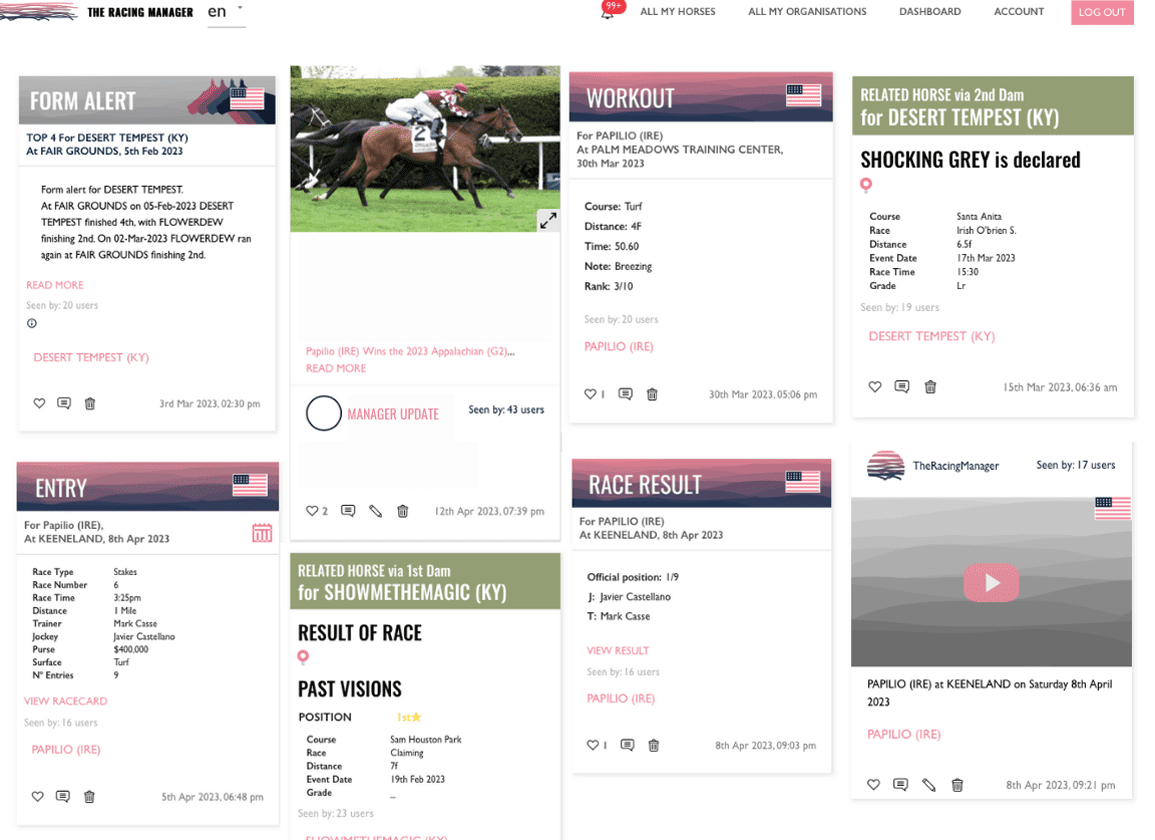
On the Racing Manager platform, owners have an individualized profile feed that is unique to them and their horses. Trainers and racing managers have the ability to send photo and video updates, but they can also conduct polls, create photo galleries that others can add to, send messages to specific owners or syndicate groups and more.

Ash explained that many trainers will send out a weekly yard update and noted that trainers are able to sort their stable's profile to learn which horses have gone the longest without an update.

The Irish National Stud is another prominent TRM client. Ash said that the average Irish National Stud horse receives 175 updates per year.

While some of those updates require trainer engagement, most are produced automatically by TRM. Entries, workouts and race results appear on a user's feed, as do breeding updates (like if a horse's half-sibling is debuting) or a form alert (like if a horse that the user's horse ran second to in its last race won in its next start). All of these notifications are customizable for each user.

“We do all these things that are engaging the owner without the actual manager of the organization having to do anything,” Ash said. “Every user is different and every user can get a different assimilation. Everything the Racing Manager does, it has come from client advice.”

TRM is now working to cater toward an evolving racing landscape worldwide. The success of racing partnerships has grown to where a number of trainers in the U.K. focus exclusively on syndicates. Several of them rely on TRM to communicate with their members. In Australia especially, partnerships are changing the demographics of racing as they have made ownership more accessible to the younger generation.


“The need to encourage younger people into ownership can only be achieved by modern communication methods, especially the professional distribution and presentation of the communication,” said Ash. “If we can change the demographic, we're going to have a better future in ownership and in racing as a whole.”

Even still, Ash said they work to accommodate all demographics and technology skill levels, noting that their customer service department has gone so far as to help set up email accounts for some of their clients.

Just as the demographics of racing may be changing, the sport is becoming increasingly accessible on an international level for the average owner.  Ash said that TRM is becoming an important tool for owners and trainers communicating across oceans.

“We've started to see, out of our user base, that 20% of people are international compared to the country their horse is in,” he shared. “We have had Middle Eastern owners say to us that they would love to have more horses overseas, and specifically in the U.S., if they felt they would be communicated with.”

A growing number of trainers and racing partnerships in the U.S. are becoming interested in TRM. Taylor Made's Medallion Racing, Bradley Thoroughbreds and CJ Thoroughbreds are among the groups that have embraced the tool, while trainers who use the platform for their stable include Doug O'Neill and Norm Casse.

“We have quite a few pending,” Ash added. “We don't intend to rush it too much. We're confident that people will see others using it and realize they can communicate better too.”

The post The Racing Manager Garnering Interest in U.S. appeared first on TDN | Thoroughbred Daily News | Horse Racing News, Results and Video | Thoroughbred Breeding and Auctions.

Source of original post

KTFMC April Meeting Hosts Discussion with Leading Trainers

Attendees of the Kentucky Thoroughbred Farm Managers' Club (KTFMC)'s monthly meeting, held Tuesday evening at Limestone Hall, were treated to “A Discussion with North America's Leading Trainers,” featuring a panel that included Brad Cox, Bill Mott, Todd Pletcher and Brendan Walsh.

FanDuel/TVG host and reporter Scott Hazelton moderated the discussion, as the trainers, who all have GI Kentucky Derby and/or GI Kentucky Oaks contenders in their stables, shared stories about their beginnings and how it all led to where they are today.

“I was born in South Dakota and when I was a little kid, I either wanted to be a cowboy or I thought I'd probably work on a ranch. When I was 14, I wound up getting a job with the Asmussens at their place in South Dakota and it just went from there,” said Mott. “I worked with horses throughout the summers and bought my first horse when I was 15 years old and got lucky, winning the South Dakota Futurity with him. It was $3,800 to the winner and I thought I was the richest guy in South Dakota.”

After spending six years working for trainers Bob Irwin and later Jack Van Berg, Mott opened his public stable in 1978.

“I've had some good clients that have raced in some great places and I've had a lot of help along the way,” said Mott. “It's wonderful to be able to work with really good horses and as you're able to graduate into something that allows you to do that, you meet a lot of great people along the way. It's all the way from the grooms and hotwalkers to some of the most interesting people you meet as owners.”

When asked about how all of his experiences have culminated to where he is now, Mott glanced at the trainers sitting beside him and replied, “I learned a lot from everybody I worked for but I still keep watching. I try to learn from these guys that are sitting beside me. I watch what they do and I try to make myself better. With these guys nipping at my heels every day, I've got to work harder than I've ever worked in my life, but they make me better. The better the competition is, the better you are.”

Pletcher recalled a childhood spent going to the track with his father, longtime trainer Jake Pletcher, and shared the story of his first racehorse, a $700 yearling colt by Bold Cape, who was a spur-of-the-moment acquisition after a fellow trainer offered the horse to his father and an 8-year-old Pletcher offered to take him instead.

“[My dad] said 'Go look at the horse. If the horse is correct, you can have him.' I went back and I looked at him, I mean this horse could barely see over the webbing, but he was correct, so I called him and said, 'He's correct, but he's pretty small.' And he said, 'Alright, go ahead and take him,'” said Pletcher.

After training him with his father for two years, the colt named Rambunctiously won on debut at Oaklawn as a 3-year-old in 1981.

“I ran him back two weeks later and he won, but he got claimed, which I thought was the worst thing that could happen. But as it turned out, financially, it was a good thing,” said Pletcher.

As he grew up, he spent time hot walking and grooming for California trainer Henry Moreno, and later spent a summer working with Charlie Whittingham and eventually found his place with D. Wayne Lukas.

“One thing they had in common was that they were great caretakers. They always paid extra attention to the details of how their horses were taken care of,” said Pletcher.

After working six years as an assistant to Lukas, Pletcher decided to go out on his own in the fall of 1995.

“The guy that encouraged me to do it was Mike Ryan. He had a few clients and he said he could send me some horses if I ever decided to. I started off at Hialeah Park with seven horses and was pretty fortunate. We were able to win a few races and expand from there.”

For Walsh, born in County Cork, Ireland, horses were a passion from the very beginning. After jockey school, college, working on various stud farms and spending a few summers working for different trainers, he ended up working at Sheikh Mohammed's Kildangan Stud. That's where his story began with Godolphin, as he traveled with them to Dubai before coming to the states.

“At one point, actually, I was supposed to come work for Bill. I don't know if Bill ever realized that or not, but it never materialized over a visa or something like that, but that's going back a long time,” said Walsh. “But I loved it over here and I thought it was a place where I'd probably have more opportunity than I would have in Europe.”

When asked if there was one horse in particular that stood out early on in his career, Walsh shared the story of Cary Street (Smarty Jones), who was a 4-year-old when Walsh claimed him for $10,000 out of a race in mid-February of 2013. Though it initially appeared that Cary Street hadn't been worth the investment, he eventually improved under Walsh's training and went on to win the GII Las Vegas Marathon S. at Santa Anita Park and the GIII Greenwood Cup S. at Parx in 2014.

“That was our $10,000 horse. I don't think any horse will ever do what he did for me at the time. He just kind of got us going and that was the best $10,000 I ever spent,” said Walsh.

He also reflected on the climb he's made in career, from working at Kildangan and now training stateside for Godolphin.

“I think it was really pivotal because you got to be around good horses. That's always helped me along the way. From when I was working at Kildangan, you were around these super well-bred yearlings, and when we went to Dubai, it was like a 'who's who' of European breeding,” said Walsh. “I always wanted to be around nice horses and it kind of set the bar to try and progress and be better all the time.”

For Cox, who grew up in South Louisville just blocks away from Churchill Downs, horse racing has been a constant for the entirety of his life.

“I liked two or three things: horse racing, Kentucky basketball and baseball. I wasn't very good at baseball. I thought I was going to be a guard for the University of Kentucky, but based on conformation and talent, that was very short-lived,” said Cox. “I fell in love with horse racing at a very early age. My dad would take me to the track and I'd bring that program home and I'd read everything. It's what I wanted to do and I just worked my way up, starting at the bottom.”

Making his way up through the ranks, from rubbing horses to becoming a foreman and later working as an assistant trainer to Dallas Stewart, Cox went out on his own in 2004.

“It was a long, grilling road but it was well worth it. I'm very proud of what our team has accomplished,” said Cox. “You have to get up and do it every day, you have to continue to work. It's demanding, it's a lot of hours, but it's very rewarding.”

KTFMC President Gerry Duffy with Boyd Browning | Sara Gordon

Hazelton asked the trainers how the sport has evolved in their eyes and if there were any changes they'd like to see in the industry going forward, which led to a discussion about uniformity and the Horseracing Integrity and Safety Act (HISA).

“I think we're going down the right track with a lot of things, in terms of uniform medication rules and anti-doping, so I think those are all positive things. To have everybody on pretty much the same playing field would be great,” said Cox.

“I think the biggest changes we're seeing now are with HISA, the federal intervention. I think the biggest thing I thought it would bring to the table would be uniformity. I was all for uniform medication rules, uniform penalties, so you could go state to state. You don't want to stub your toe and make an honest mistake just because you're not aware of the rules,” said Mott. “I think right now with HISA, it's caused more confusion than uniformity, but hopefully, once things get ironed out maybe we will come to that point where we do have uniform rules from New York to California.”

“One of my biggest issues right now is just the uncertainty [of] where we stand. We're 18 days out from the Kentucky Derby and we don't know if the HISA rules are going to be in effect May 1 or if it's going to be the Kentucky Horse Racing Commission,” said Pletcher. “We saw the implementation of HISA for three or four racing days, then back to each state's rules. I think everybody wants to play by the rules, but even leading up to when HISA went into effect, what seemed to be proper withdrawal times for very standard medications like bute literally changed from 48 hours, from 72 hours to 96 hours.

“Initially it was supposed to have been put together to make everything unified, but now it seems like there's some stuff that is not very agreeable at all. They've gotten rid of a lot of therapeutic stuff, restricted us on a lot of things that are really just for the benefit of the horses. They've kind of restricted us from being horsemen. We're all trying to be horsemen here and do what's beneficial for the horses and it seems like they're wanting to get in our way of that.”

The trainers switched gears, wrapping up the panel with a discussion of their prospects set for the first weekend in May at Churchill Downs, along with new 2-year-olds that have been shipping in to begin their seasons.

“We're looking forward to the Oaks with Pretty Mischievous [Into Mischief], but we've got to try to beat these guys as well,” said Walsh. “We've got a nice team of turf fillies this year, some yet to start this year, but it seems like we have a good team put together.”

Cox spoke about his three colts that are Derby bound, including Hit Show (Candy Ride {Arg}), Verifying (Justify) and Angel of Empire (Classic Empire), along with potential starter Jace's Road (Quality Road), who currently sits in the 21st spot and could make it into the starting gate if any of the top 20 scratch.

“We obviously have a few more works before race day but I'm very happy with all three. We've got a group of fillies as well, The Alys Look [Connect] and Botanical [Medaglia d'Oro]. It's going to be a big week and hopefully a big weekend,” said Cox.

Mott, who trains Derby contender Rocket Can (Into Mischief) admitted he didn't have any surprises yet to be unveiled in his barn, but looking at the stable overall, he was proud of what this group has accomplished so far this year.

“Most of them have run and the good ones have shown up and we've done really well with them. We're hopefully getting a few of those back to the races, including a couple in Derby week,” said Mott. “We're like everybody else, we're already looking at the 2-year-olds. The future is always the excitement in this business.”

Pletcher delved into the remarkable evolution of champion Forte (Violence), who leads his group of Derby contenders.

“It was interesting that he was one of the first 2-year-olds we got in last year, he came in March 25, and he's just a really intelligent colt. He caught onto everything really well, really quickly and he's done everything right,” said Pletcher. “It's great to come here with a group that likes to win. We all know how hard this race is to win.”

The evening was also highlighted by an awards presentation, where Dr. Emma Adam, Shannon Arvin and Boyd Browning were awarded as honorary members, and James Brady became just the fifth person to be honored as a KTFMC Life Member.

The post KTFMC April Meeting Hosts Discussion with Leading Trainers appeared first on TDN | Thoroughbred Daily News | Horse Racing News, Results and Video | Thoroughbred Breeding and Auctions.

Source of original post

Fort Erie Files Trade Grievance Against Woodbine

Ontario's two Thoroughbred tracks are sparring. The Fort Erie Live Racing Consortium (FELRC) announced Tuesday it has filed a grievance with the Canadian Trade Commission over an alleged “impasse in their attempts to resolve ongoing issues” with Woodbine Entertainment Group (WEG), which runs Woodbine Racetrack.

“For the past several race seasons, Woodbine has implemented a horse shipping policy which, in the opinion of the FELRC's board of directors, is designed to starve Fort Erie of its necessary horse supply by restricting the movement of horses between the two tracks,” stated the Fort Erie release. “This amounts to Woodbine abusing its position as the dominant market force, which is hampering Fort Erie's ability to run a business and a fulsome race calendar.”

Fort Erie is also alleging that Woodbine's refusal to return the Canadian Triple Crown dates to their pre-pandemic calendar spots equates to a “refusal to collaborate in the best interest of the horse racing industry” at large.

“By far the largest attraction in Canadian horse racing, the Triple Crown begins with the King's Plate at Woodbine, followed by the Prince of Wales Stakes at Fort Erie, and finally the Breeders' Stakes back at Woodbine,” the Fort Erie release stated.

“Traditionally the three races were held consecutively in June, July, then August,” the Fort Erie release stated. “However, during the COVID crisis, certain restrictions necessitated moving the first jewel of the crown, the King's Plate, to later in the summer. This pushed Fort Erie's signature race, the Prince of Wales Stakes, out of the summer tourism season, and into September.

“With the pandemic over, Woodbine has refused to move the King's Plate back to its regular spring date, or even a mutually planned date, forcing Fort Erie to keep the Prince of Wales Stakes in September,” which does “not allow Fort Erie to meet its maximum potential for such a historic and esteemed event,” Fort Erie claimed.

The Ontario news site NiagaraThisWeek reported Tuesday that a Woodbine spokesperson denied Fort Erie's allegations.

“The assertions made by Fort Erie Race Track are baseless and without merit and we will vigorously and confidently defend ourselves if requested by the Canadian Trade Commission or any other regulatory authority,” Woodbine communications director Jamie Dykstra told NiagaraThisWeek.

Jim Thibert, the chief executive officer of the FELRC, took an opposing view.

“Woodbine holds a near monopoly in our industry,” Thibert said in the Fort Erie statement. “Woodbine's business practices towards Fort Erie are unfair and clearly predatorial. While this situation is particularly harmful for the continued existence of racing at Fort Erie, it is genuinely harmful for the owners, trainers, jockeys and others employed directly in racing and indirectly in services to the thoroughbred racing industry in Ontario.”

The Fort Erie release outlined another allegation: “Further demonstration of Woodbine's hostility is their continued practice of greatly inflating purses in lower level races compared to Fort Erie's, especially claiming races. The use of provincial subsidies for horse racing should not be allowed especially when Woodbine is increasingly running more and more of Fort Erie's race offerings.”

The post Fort Erie Files Trade Grievance Against Woodbine appeared first on TDN | Thoroughbred Daily News | Horse Racing News, Results and Video | Thoroughbred Breeding and Auctions.

Source of original post

Verified by MonsterInsights
