Sudden Equine Deaths: “This is so frustrating for us”

News out of Churchill Downs last week that two of trainer Saffie Joseph Jr's horses had collapsed and died within days of each other has reignited talk around one of the most confounding–and by extension, frustrating–issues in racing: sudden equine death.

More than four years ago in response to the death of GI-placed Bobby Abu Dhabi (Macho Uno)–what was initially suspected a sudden cardiac-related event–the TDN took a lengthy dive into the issue.

In a nutshell, sudden cardiac deaths oftentimes leave no discernable physical sign for pathologists to piece together a clear diagnostic picture–no major lesions, faulty valves, ruptured arteries or damaged heart tissue for them to point to with authority and say this or that caused the heart to stop.

In a well-considered study published in 2011 looking at post-mortem findings from 268 Thoroughbred racehorses that suffered exercise-related sudden deaths, pathologists made a definite diagnosis in only 53% of cases, a presumptive diagnosis in 25% cases, while 22% of cases were left unexplained. In humans, coincidentally, about one-third of sudden deaths are presumed to be cardiovascular-related but don't actually have any concrete diagnosis.

Veterinary experts remain after all these years largely circumspect when pressed as to exactly what causes these events in racehorses, with fingers pointed towards electrical abnormalities like arrhythmias, genetic predispositions, drug use and faulty valves of the heart.

“We're asking better questions and we're asking more questions,” said Dionne Benson, chief veterinary officer for 1/ST Racing, when asked why progress has been slow in better understanding sudden death cases in racehorses. “But we've just started to ask those questions the last few years.”

Causes
Part of the reason is the infrequency with which these events occur. This paper pinned the number at roughly one sudden death per 10,000 individual starts.

Last Friday, the TDN asked the Horseracing Integrity and Safety Act (HISA)–mandated to record and report all equine fatalities at participating jurisdictions–how many sudden deaths have occurred since the law went into effect on July 1 last year. HISA did not provide an answer.

This study from last year found that sudden equine deaths were more likely during training than during racing, and horses with fewer lifetime starts were at higher risk.

“Exercise intensity appears not to be critically important in precipitating sudden cardiac death in horses,” the researchers summarized, before adding that typically, “sudden cardiac death occurred early in the careers of affected horses.”

A pivotal area of research surrounds so-called “electrical irregularities,” like arrhythmias (an irregular heartbeat), and heart murmurs (the presence of irregular heartbeat sounds).

Indeed, some 50% of racehorses experience cardiac arrhythmias when put under some kind of physical duress. That is one main reasons researchers out of the University of Minnesota are in the middle of a study of some 1,200 Thoroughbreds and Standardbreds with normal heart function at rest, but who develop arrhythmia during exercise.

“It's really hard to know for sure because when a horse dies, the electrical conductivity of the heart stops,” said Molly McCue, a professor and the associate dean for research at the University of Minnesota College of Veterinary Medicine, explaining why there still remains no concrete scientific proof that electrical irregularities cause sudden cardiac death, even though most experts agree that these issues are key to getting to the root of the problem.

In this regard, many veterinary experts bemoan the fact that in this scientific arena, horse racing is in some regards the medieval cousin of human athletics, which has already been closely monitoring and studying the heart's electrical capabilities for many decades, meaning so much of the dynamic possibility of a racehorse's heart remains shrouded in mystery.

Back in early 2015, in a study encompassing 30 racehorses in California, none of the horses suffered arrhythmias, but the authors noted a post-exercise increase in what is called valvular regurgitation, which is when heart valves don't close properly, allowing blood to flow backwards in the heart.

About 20% of healthy Thoroughbreds have some degree of valvular regurgitation when examined–but again, any clinical significance is currently unknown.

Despite the vast body of cardiac research in human athletes, the National Institutes of Health has its eye on the Grayson-Jockey Club funded arrhythmia study “as an interesting model for what happens in young human athletes,” McCue said, with the occurrence of sudden death in horses far higher than in humans.

“The frequency in horses, it's about 10 times more common than it is in people,” McCue said.

Another fast-evolving area of interest concerns genetics. Human science has found a genetic connection to a higher risk of heart disease. In racehorses, any potential genetic correlation with a higher likelihood of sudden death is still largely at lift-off.

McCue and her fellow researchers are taking DNA samples from the same 1200 horses in the arrhythmia study to see if any genetic pattern emerges. McCue calls these two studies “a two-pronged effort” to identify early horses at higher risk of experiencing sudden death.

“One is the genetics, figuring out who is high-risk and who we need to screen and look at really critically. And then two, developing tools that can identify the horses this is most likely to happen in,” said McCue.

“Our hope is that if we can develop computer models that can predict if a horse is more likely to experience severe arrhythmias today, we can then pull that horse from racing,” McCue added.

Some heart problems among horses that suffer sudden death are much easier to diagnose–but structural abnormalities are rare. A 2011 paper found that about 1% of horses who die suddenly suffer a ruptured aorta, which is the largest artery in the body.

Which brings the story around to the presumed connection between drugs and sudden cardiac death–the touchpaper of any high-profile sudden death in racing.

Drugs
“Here's the problem,” said Rick Arthur, former CHRB equine medical director. “People watch CSI and they see them taking a fingernail clipping and they can tell you what you had for lunch three days ago. Life doesn't work that way.”

In other words: Unlike an episode of CSI: NY, which typically wraps with a neat conviction, investigations into sudden racehorse death rarely conclude as tidily, even when a link emerges with a suspected substance.

Just take the case of a Standardbred that died suddenly at Cal Expo in early 2014. The horse, Arthur said, was subsequently found to have abnormally high levels of cobalt (a naturally occurring element) in its system.

The trainer faced no punitive actions because the death occurred before the CHRB passed rules instituting cobalt thresholds in test samples, said Arthur, who equivocated on whether the horse's death could have been definitively linked to an administration of cobalt.

“The cobalt was so high that it could have been associated with it,” Arthur said. “But again, that's when we were suspicious of cobalt–we might have over-interpreted it. But it certainly was very high.”

A recent limited study on six Standardbreds found a possible connection between cardiac arrhythmias (including atrial fibrillation) and levothyroxine–a thyroid supplement linked to the sudden deaths of seven Bob Baffert trained horses between 2011 and 2013.

A subsequent CHRB report noted that the horses had been administered thyroxine, and that use of thyroxine is “concerning in horses with suspected cardiac failure.” However, the report also noted that, because the drug had been administered to all horses in Baffert's care, the use of thyroxine “does not explain why all the fatalities occurred.”

Arthur co-authored a paper finding a “very strong” connection between anticoagulant rodenticide exposure and an increased risk of sudden death during exercise from unusual hemorrhaging. Strong suspicions surround the bronchodilator clenbuterol, which has been proven to increase heart muscle. Iodine–commonly found in seaweed-based supplements—has also been linked to arrhythmia.

“Certainly there are other things. Horses can build up levels of selenium [a naturally occurring mineral] which can cause sudden death,” Benson said. “You can also have things in the feed like monensin [a polyether antibiotic toxic to horses].”

In human sports the rise of erythropoietin [EPO]–a synthetic form of a natural metabolic product that thickens the blood–was linked to the deaths of multiple young professional cyclists and other athletes. Has illicit EPO use in horseracing ever been linked to any sudden equine deaths?

“No–at least not in California,” said Arthur, who said that EPO would have the same effect in horses' blood by thickening it though increased blood cell count, a process called polycythemia.

But a diagnostic complication in this issue, Arthur added, is how horses are “natural blood-dopers because of their huge spleens.”

Virus
 Springtime, of course, is equine virus hunting season. And viral infections are known to cause myocarditis, inflammation of the heart muscle.

“It's always a possibility,” said Francisco Uzal, coordinator of the California Animal Health and Food Safety Laboratory post-mortem program for the CHRB, when asked if a viral infection could explain the two recent Joseph-trained sudden deaths.

Uzal added, however, that while he has never seen during any sudden death necropsy instances of severe myocarditis–which would show up under the under the microscope as large lesions–“we've found in a number of sudden-death horses really, really mild and minor myocarditis.”

More tellingly, said Uzal, is how the same minor heart lesions appeared in horses that didn't suffer sudden death events. “You see it in normal horses, too. So, what does it mean? Probably nothing,” he said.

“This is so frustrating for us,” Uzal added. “We go home empty-handed most of the time.”

Which leads to the finer points of the actual necropsy process. Even if a substance suspected of increasing the likelihood of sudden equine death shows up at what are presumed elevated levels during the necropsy process, it doesn't necessarily indicate a smoking gun.

Take thyroxine, an endogenous substance, meaning it's produced naturally inside the body and therefore harder to evaluate than a medication with its own specific pharmacological signature.

“When you do a test, you compare what you find with the normal values in a normal animal in a living horse. There are no normal values for dead horses,” said Uzal, highlighting how difficult it is to determine baseline levels for endogenous substances like thyroxine.

“But having said that, we have compared the thyroxine found in postmortem blood in sudden death horses with the same in normal horses, and we found no difference,” he said.

Helpful to better understanding the underlying causes of sudden cardiac death in racehorses would be if all necropsies were made equal.

Uzal co-authored a 2017 paper highlighting how “autopsy technique” varies depending on personnel and “institutional preferences.”

As Uzal puts it, “pathology is a science as well as an art. You talk to 10 different pathologists, you hear 10 different stories. We have tried very hard to standardize, and we are still fighting for it.” In this regard, could federal intervention be on its way?

HISA's racetrack safety rules require all horses that die or are euthanized on licensed grounds at all participating jurisdictions undergo a necropsy. But the rules appear broad and fail to mandate more specific uniform rules on necropsy protocols.

HISA did not respond to a series of questions on the issue of necropsies. This includes whether every horse that has died during racing and training at jurisdictions under HISA's oversight have undergone necropsy examinations, and whether HISA has indeed instituted uniform protocols or guidelines for the actual necropsy process.

Future
In a bid to fill in some of the glaring blanks surrounding sudden death, UC Davis has begun storing necropsy samples taken from sudden death horses in a large freezer to be retrieved and re-tested in the advent of more sophisticated analytical technologies.

“The other thing we do from each horse, we have multiple different containers. So, the idea is we can provide it to different people,” said Uzal.

More contemporaneously, Uzal and his team are poised to begin studying the training records of horses that suffer sudden cardiac deaths for any possible explanatory patterns.

“We want to see if there's something in the training that could give us a clue of what's happening,” said Uzal. “We want to see if it's possible–and I don't know if that's the right expression–but see if it's possible that some horses are trained to the point of exhaustion.

“I don't know the answer–it's pure speculation,” Uzal added. “It could be nothing, or it could be something.”

The post Sudden Equine Deaths: “This is so frustrating for us” appeared first on TDN | Thoroughbred Daily News | Horse Racing News, Results and Video | Thoroughbred Breeding and Auctions.

Source of original post

Tax Package Including $27.5M in Support of Florida Tbred Industry Passed

Florida lawmakers passed a tax package May 5 that includes significant support for the state's Thoroughbred industry. With the support of Senate President Kathleen Passidomo; Senator Blaise Ingoglia, the Finance and Tax Chair; and Senator Jason Pizzo; House Speaker Paul Renner; Representative Stan McClain, Chair of the House Ways and Means Committee; and Representative Lawrence McClure, chair of the State Affairs Committee; as well as Wilton Simpson, Florida's Commissioner of Agriculture, the package includes $27.5 million annually for two years to bolster purses and racing awards at Gulfstream Park and Tampa Bay Downs. In addition, the two tracks will be provided tax credits to offset the cost of the Horse Racing Integrity and Safety (HISA) Program in Florida; the HISA assessment for Florida for 2023 will be $5.9 million.

Governor Ron DeSantis is expected to sign the bill into law.

“We thank Governor DeSantis and all of our state legislators who recognize the importance of Thoroughbred racing and breeding to the state of Florida,” Florida Thoroughbred Horsemen's Association President Joe Orseno said. “The revenue generated through this bill will help ensure the continued stability and growth of an industry that is so important to so many Floridians.”

The FTHA represents more than 6,000 horse owners and trainers who not only work and race at Gulfstream, but also do business throughout the state. FTHA and 1/ST Racing, which owns and operates Gulfstream, worked in tandem with Tampa Bay Downs to craft the language for the legislation and to get it passed. Although the primary focus of the bill is support for the racing industry, the FTBOA was also at the table so that all stakeholders were represented.

According to a study by the American Horse Council, Florida's Thoroughbred industry has a $2.7 billion economic impact and creates more than 23,000 job opportunities in the state. From the racetracks, to the training centers, to the breeding farms to the horse retirement facilities, there are nearly 100,000 Thoroughbreds stabled in virtually every county in Florida.

“Florida supports hundreds of equine-related businesses–not just the tracks and the racing stables and breeding operations, but the ancillary business as well, such as feed and tack stores, veterinary services, transportation, insurance companies, attorneys, the list goes on and on,” Orseno said. “We are thrilled that our Governor and our legislators have given their support to the thousands in the state who depend upon the Thoroughbred industry.”


The post Tax Package Including $27.5M in Support of Florida Tbred Industry Passed appeared first on TDN | Thoroughbred Daily News | Horse Racing News, Results and Video | Thoroughbred Breeding and Auctions.

Source of original post

Magic Formula for Curlin Succession

With barely a dozen race days to be eked out of its remaining two years, the Steve Pini Memorial S. of September 2017 formed part of a pretty low-key bookend to the history of Suffolk Downs. The Boston track's opening era, after all, had been propped up by Seabiscuit himself. But it turns out that this race, honoring the late track superintendent, deserves a rather lengthier footnote than anyone might have imagined at the time.

Over an extended mile of turf, a 5-year-old daughter of Big Brown overtook Queen Caroline (Blame) in the stretch before going clear by 1 3/4 lengths. On her 16th start, it was an overdue black-type success for Puca, who had in younger days started one of the favorites for the GI Breeders' Cup Juvenile Fillies and also (after running second in the GII Gazelle S.) been deemed worth a crack at the GI Kentucky Oaks.

Having meanwhile added the fourth stakes prize of her own career, Queen Caroline followed Puca to a graded stakes at Belmont the following month. Against this stiffer competition, however, neither was able to land a blow. A few days later Puca was sold at Keeneland, to Thomas Clark for $275,000, and subsequently booked to the rookie Gun Runner; while Queen Caroline, a year her junior, persevered for one more campaign before being retired and sent to Violence.

Puca elevated her value pretty steeply when sold a second time, carrying her Gun Runner foal, to Grandview Equine for $475,000 at the Fasig-Tipton Fall Mixed Sale of 2018. She was a beautiful, black-type mare and her page was decorated by half-brother Finnegans Wake (Powerscourt {GB}) as winner of the GI Woodford Reserve Turf Classic.

Once she had safely delivered a filly, Puca's new owners utilized a share in Good Magic for her next cover, which encounter produced a colt on 18 April 2020. That September, they offered her Gun Runner filly at Keeneland, but she failed to meet her reserve and was retained at $70,000. Sent into training with Kenny McPeek and named Gunning, she has won three of seven starts and earned a second black-type podium just a few days ago.

Queen Caroline's date with Violence had meanwhile resulted in a 3 February colt, sold to Silver Hill Farm at Keeneland that November for $80,000. He proved a pretty marginal pinhook, realizing $110,000 from Repole Stable & St. Elias, deep in the following September Sale.

Puca's Good Magic colt had made $235,000 earlier in the same auction, sold through Runnymede Farm–where he had been foaled and raised–to New Team. He, too, was just a solid pinhook through the next cycle, getting to $290,000 when sold through Sequel Bloodstock to Ogma Investments at Timonium.

As you will doubtless have recognized by now, if you didn't already know, the 1-2 in the Steve Pini Memorial have meanwhile become celebrated as the respective dams of Mage (by Good Magic out of Puca) and Forte (by Violence out of Queen Caroline). The two sons reversed their mothers' Suffolk Downs form in the GI Florida Derby, but a rather wild move on the much less experienced Mage had convinced many that he could progress past the champion juvenile in the GI Kentucky Derby.

That subplot, of course, has been deferred after the 11th hour withdrawal of Forte. But even the first Saturday in May is only one leg of an epic journey. Mike Repole can comfort himself that Uncle Mo, another champion juvenile in his silks scratched late from the Derby, has amply redressed that disappointment in his stud career. And doubtless those associated with Good Magic feel rather less aggrieved about bumping into a Triple Crown winner in his own Derby, now that he has retrieved the top of their class in the sires' table–whether by cumulative earnings, or in the second-crop championship.

Both Good Magic and Justify contested a gripping freshman title last year, every cent counting for much of the campaign, but in the end Bolt d'Oro made his numerical advantage tell, with $2,815,623 banked by 80 starters, over Good Magic ($2,533,414 from 65) and Justify ($2,478,038 from 71). (It is only fair, at this point, to stress again the excellent yield-per-starter achieved from smaller books and fees by the likes of Army Mule, Girvin and Oscar Performance.)

Of the trio, however, it was Good Magic who was first to the Grade I breakthrough with Blazing Sevens in the Champagne S.; and now he has added the Derby itself. In the process, he becomes a poster boy for the commercial inundation of new stallions–albeit their collective books are such that elite success, somewhere among each intake, should really be considered not just imperative, but inevitable. Those that don't take their big chance soon find themselves swirling round the plug-hole, and even coming up with Always Dreaming from his debut crop couldn't prevent the export of Bodemeister to Turkey. As things stand, however, Good Magic appears to be laying down some patently sustainable foundations.

Just getting into contention for the freshman title, after all, had suggested that he is replicating an unusual precocity by the standards of his sire Curlin. Having run second in a Saratoga maiden and again when fast-tracked to the Champagne, Good Magic claimed a unique distinction in breaking his maiden in the GI Breeders' Cup Juvenile. He duly consolidated at three, winning the GII Toyota Blue Grass S. and GI betfair.com Haskell S. besides seeing off all bar Justify at Churchill. Though he backpedalled off the stage in the GI Runhappy Travers S., he had banked just shy of $3 million across nine starts.

Coming under the inspired management of John Sikura and his team at Hill 'n' Dale, at an opening fee of $35,000, Good Magic faced the same challenge/opportunity as the likes of Vino Rosso, Connect, Global Campaign and Known Agenda: namely, to volunteer himself as the premier heir to their sire. Though Curlin has now had consecutive sons produce a Derby winner at the first attempt, that admirable creature Keen Ice has undeniably struggled for commercial recognition. So while Curlin remains lord of the manor at Hill 'n' Dale, he's approaching the evening of a great career at 19 and for now the succession appears wide open. The outlying speed of Cody's Wish will obviously make him an interesting pretender to the crown, as we saw again on the Derby undercard. But Good Magic is positioning himself pretty formidably, his fee having already turned round to $50,000 (from $30,000) after the endeavors of his debut crop.

Besides two elite scorers, that crop has included a second Derby runner in GIII Sham S. scorer Reincarnate; plus winners of the GII Sorrento S, GII Remsen S. and GIII Iroquois S. And while Bolt d'Oro was the only one of three freshman title protagonists actually to elevate the yearling average of his second crop, Good Magic again excelled relative to conception fee. The 94 processed from his first crop (110 offered) had averaged $151,708; while last year 74 yearlings sold (87 offered) at $130,250. If his third book suffered the customary slide, it remained more than respectable at 92 mares and he will now surely be back on the way up.

When retired to stud, Good Magic's racetrack credentials were backed up by a physique that had as a yearling secured a seven-figure Keeneland September docket from E5 Racing. His breeders at Stonestreet then struck a deal to stay aboard. His granddam, after all, had been one of the first building blocks in their program: Magical Flash, a daughter of distaff legend Miswaki purchased for $140,000 at the Keeneland November Sale of 2004. She was rising 15 at the time, but channelled speed, class and also precocity. Her half-sister Magical Maiden (Lord Avie) had won a Grade I at two, as did Magical Maiden's daughter Miss Houdini (Belong To Me). Since then, moreover, Miss Houdini had added fresh luster to the family by producing champion female sprinter Ce Ce (Elusive Quality).

Magical Flash (who ended up producing no fewer than 14 winners, including a graded stakes winner on turf by Chester House) similarly brought to the surface some of the genes that appear to have contributed to the sharpening of Good Magic. For instance, a daughter by Smarty Jones was group-placed in France over just five furlongs; while another, by the sturdy influence Prized, managed to produce an Exchange Rate colt fast enough at two to win the GIII Bashford Manor over six furlongs.

Magical Flash's daughter by Hard Spun, Glinda The Good, won two stakes and was also placed at two in the GIII Pocahontas S. And it was her mating with Stonestreet's dual Horse of the Year that produced Good Magic.

In fairness, Hard Spun has proved a vital late conduit (and remains an outstandingly well-priced one) to the breed-shaping Danzig. So who knows, maybe Good Magic's damsire–himself a Derby runner-up–contributed much to the thwarting of his own son, Two Phil's, last Saturday!

Danzig's presence behind Good Magic's damsire is one of the obvious pegs to the mating that produced Mage, in that he recurs on the bottom half of the pedigree through his grandson Big Brown, the sire of Puca. Danzig's replication in the fourth generation is matched by another ubiquitous modern influence, Mr. Prospector. His grandson Curlin sired Good Magic, while one of his rather less potent sons, Silver Ghost, is responsible for Puca's dam Boat's Ghost. (Mr. P. is further represented by his son Miswaki, don't forget, as sire of Magical Flash.)

The overall seeding of the maternal family is less familiar, admittedly, Big Brown and Silver Ghost being followed by Summer Squall and a forgotten son of Raise A Native, Native Royalty. It's an old American line that eventually takes in some Greentree royalty, notably a 10th dam who was half-sister to 1931 Derby and Belmont winner Twenty Grand.

By now all that stuff is obviously quite attenuated, and Puca's dam–stakes-placed in a light career and dam, as noted, of a Grade I winner on turf–was actually sold (in foal to Raging Bull {Fr}) at Keeneland only this January at the age of 19. I'm pleased, but unsurprised, to see that this indignity was relieved, at just $17,000, by that exemplary farm Nursery Place. If they can just get a filly out of the venerable lady, they'll have a half-sister to the dam of a Derby winner.

As for the people who have Puca herself, well, we visited Robert Clay to hear about Grandview Equine's program just before the Derby. The founder of Three Chimneys candidly acknowledges Mage as rather a windfall. Along with various partners, and with the counsel of Solis/Litt, he bought Puca to support a portfolio that included some Good Magic shares. The principal objective, however, had been to develop yearling colts with stallion potential. They achieved just that with Olympiad, but must now feel very relieved that Puca's date with that horse did not come off, meaning that she instead returned to Good Magic. Moreover the failure to meet her reserve of Mage's half-sister, Gunning, has now turned into another wonderful stroke of luck.

As and when Mage proceeds to stud, incidentally, I think he might repay European attention. We noted how Good Magic's granddam produced some pretty smart turf performers, while his grandsire Smart Strike and damsire Hard Spun have both proved flexible influences. More proximately, however, don't forget Puca's switch to become a stakes scorer on grass; nor that her sire Big Brown started his own career on that surface.

In the meantime, let's hope that Mage's delayed rematch with Forte will eventually put some sunshine back into the headlines. True, it's poignant that the “prequel” takes us to another depressing tale, in the closure of Suffolk Downs. But there are doubtless plenty who, in missing their sport in Massachusetts, in particular miss Stephen J. Pini after his premature loss in 2015. Pini, his father and grandfather had between them worked at Suffolk Downs every day since it opened in 1935. It's nice, then, that a race contested in his memory should now have been rendered so significant by the protagonists' sons.

But then this is a game full of concentric fortunes. Here was Rick Dutrow, for instance, saddling his first starter (and winner) in 10 years on the very day that his own Derby winner, Big Brown, became damsire of another one. (And if we think this was a tough Derby day, just scroll back to that one…)

Puca was co-bred by Paul Pompa, Jr. in support of Big Brown, the horse he had bought and then raced in partnership, as he tried to make his way at stud. Then she, in turn, was deployed by Clay and his partners on their stake in another young stallion. And now the daughter of a Derby winner who confounded nearly all precedent, having made just three starts beforehand, has produced another to do exactly the same.

There's no formula, no wand to be waved. But sometimes things just seem to work as if by “Magic.”

The post Magic Formula for Curlin Succession appeared first on TDN | Thoroughbred Daily News | Horse Racing News, Results and Video | Thoroughbred Breeding and Auctions.

Source of original post

Top to Bottom: Derby Rundown

This week's Triple Crown feature examines the trips of GI Kentucky Derby runners in detail from first to last:

1) Mage (No. 12 in TDN pre-race rankings)
Mage, the little horse who could, was a characteristic beat slow out of the starting gate. Javier Castellano let him roll with the flow as the field sorted itself out through the first furlong, then darted to secure the rail while fourth-last the first time under the wire.

Unhurried through the turn, this son of Good Magic ($235,000 KEESEP; $290,000 EASMAY) raced several paths off the rail down the backstretch. Castellano seemed content knowing a brisk pace was percolating in front of him while aware the two late-running faves were also still parked at the back.

Edging closer, Mage tagged on behind the rapidly advancing Derma Sotogake (Jpn) (Mind Your Biscuits) entering the far turn. Sensing two rivals ranging up from the outside and not wanting to be locked in, Castellano committed his colt to an ever-widening arc to get clear of them. Mage was still 11th while four deep three-eighths out, but he was winding up for a move that would prove to be a better-timed version of the one he uncorked in the GI Florida Derby.

Building momentum, Castellano urged Mage with a more energetic cadence and steered for home in the eight path. He set down Mage as soon as they straightened away, advancing from fifth at the quarter pole to second three-sixteenths out. Zeroing in on a tiring-but not quitting-Two Phil's (Hard Spun), Mage accosted that pacemaker at the eighth pole, with Castellano cracking his colt once right-handed.

Mage didn't exactly blow by the pesky Two Phil's, who lingered a half-length back while Angel of Empire (Classic Empire) emerged as the lone remaining danger. Mage stalled for a stride at the sixteenth pole, but refocused quickly under Castellano's persistent (but never panicked) rousing, driving home with purpose to win by a length (105 Beyer Speed Figure).

2) Two Phil's (No. 11 in TDN pre-race rankings)
Two Phil's ($150,000 RNA KEESEP) broke decently from post three, but an eighth of a mile into the race, Jareth Loveberry wanted no part of being stuck inside, so he guided his colt several paths outward. A trio of speedsters had opened up by three lengths into the first turn, and Two Phil's was in the middle of a second flight of three that crept closer on the back straightaway.

The two waves soon merged, yet even as the pack tightened, Loveberry and Two Phil's appeared relaxed and comfortable. That spot two lanes off the fence proved to be prime positioning into the far turn, because when Verifying (Justify) was first among the duelers to crack, Loveberry shot through to claim the inside passage he vacated, and within three strides Two Phil's had put away Reincarnate (Good Magic) and Kingsbarns (Uncle Mo), who were both being driven while Two Phil's was opening up under hand urging.

At the head of the lane, all the spent horses were bogged down inside, and Two Phil's braced for the wide-and-driving Mage. Two Phil's was understandably fatigued from stalking the fast pace and getting first run at the leaders, and while he was no match for Mage, this colt never packed it in. He stayed on as best he could under Loveberry's urging and held second by a half-length, replicating the 2007 Derby finish of his sire, Hard Spun. He galloped out on even terms with Mage and co-earned a 105 Beyer.

3) Angel of Empire (No. 10 in TDN pre-race rankings)
Angel of Empire ($32,000 RNA KEENOV; $70,000 KEESEP) was sent away from the gate, but not so much to ask him for early speed as to put his head in the game straight from the start. He settled willingly for Flavien Prat third from last the first time through the lane, and seven-eighths out dropped from the three path onto the rail and rode it until the far turn, gradually picking off midpack stragglers as he advanced.

Prat wisely opted off the inside when Verifying began plummeting through the field, and this colt very much looked in it to win it at the top of the stretch. He was eight wide and right behind Mage, but the difference was that Mage kicked into a higher gear while Angel of Empire continued to grind along. This son of Classic Empire was still three lengths in arrears at the eighth pole when Mage made his winning move.

Angel of Empire did find his best stride in that final furlong, but it was too late. Even with an untroubled trip and zesty fractions setting things up for him, this Pennsylvania-bred's usual closing kick wasn't quite good enough to reel in Two Phil's for second-and that's despite upping his best lifetime Beyer by 10 points, from 94 to 104. The top three galloped out more or less together.

4) Disarm (No. 8 in TDN pre-race rankings)
'TDN Rising Star' Disarm (Gun Runner) broke inward from post nine and love-tapped Reincarnate, with neither large-framed colt fazed by the contact. Joel Rosario took every opportunity in the early running to shift this Winchell Thoroughbreds homebred deeper down toward the rail, and he found the fence within the back third of the pack by the time the field crested the clubhouse turn.

Disarm kept bettering his position while eating a fair amount of kickback, but he was never able to cut loose with a sustained run and often appeared “on hold” or on the verge of getting pocketed. He split horses on the far turn, but was walled up near the inside off the final bend, which in this year's Derby was not the place to be because of the cluster of tiring horses taking up residence there.

In upper stretch, Rosario tried to dive outward through a hole that Hit Show (Candy Ride{Arg}) got to first, so Plan B was to slice back inside, which only yielded more tight traffic for a precious half-furlong. Disarm shouldered aside the capitulating Kingsbarns, but when he finally go clear running room inside the final eighth, he had no finishing flourish.

Beaten 4 ½ lengths, Disarm was the final Derby horse in the race to be awarded a triple-digit Beyer, and that 100 represented a respectable 10-point jump off the 90s he paired in his previous two races.

5) Hit Show (No. 9 in TDN pre-race rankings)
Although he never fired despite attaining a no-excuse trip from the difficult one post, this Candy Ride (Arg) homebred for Gary and Mary West ran a commendable race, especially considering he's a May 9 foal.

Hit Show broke fluidly from the inside gate, affording Manny Franco the luxury of positioning him where he wanted in the early part of the race. Initially fifth, Hit Show got geared back to seventh through the turn, then was eased off the fence to the four path so Franco could claim a sweet, uncrowded stalking spot behind the speedsters with no one covering him up and plenty of room to maneuver.

Sixth into the far bend, Hit Show started to pick it up with a four-wide run 3 ½ furlongs out under urging from Franco. He looked poised to pounce from third turning for home, but had no response to three left-handed swats in upper stretch. In the manner of a few strides, Hit Show went from attack mode to being under siege. Mage blew by to his outside, and Hit Show stayed on doggedly, with Franco keeping him to task to get fifth money.

6) Derma Sotogake (Jpn) (No. 14 in TDN pre-race rankings)
Derma Sotogake (Jpn) broke toward the back with his head briefly turned inward. There was no rush by Christophe Lemaire to contest the pace. This ¥18,000,000 JRHJUL son of Mind Your Biscuits seemed okay placed farther back in the pack than expected despite getting pelted with kickback.

Lemaire moved decisively 4 1/2 furlongs out, splitting horses at the entrance to the far turn and initially picking off Disarm toward his inside and targeting the on-the-prowl Hit Show in front of him. Derma Sotogake seemed to be drawing a bead on the top trio off the turn, but he was quickly overtaken by Mage and Angel of Empire, whose full heads of steam stood out in contrast against his one-paced action.

“He didn't break as fast as last time but I was able to put him on the inside and save ground,” Lemaire said. “Gradually, we gained position on the final turn. I was in the best spot to make a move, he stayed on and but didn't have the speed to make it closer late.”

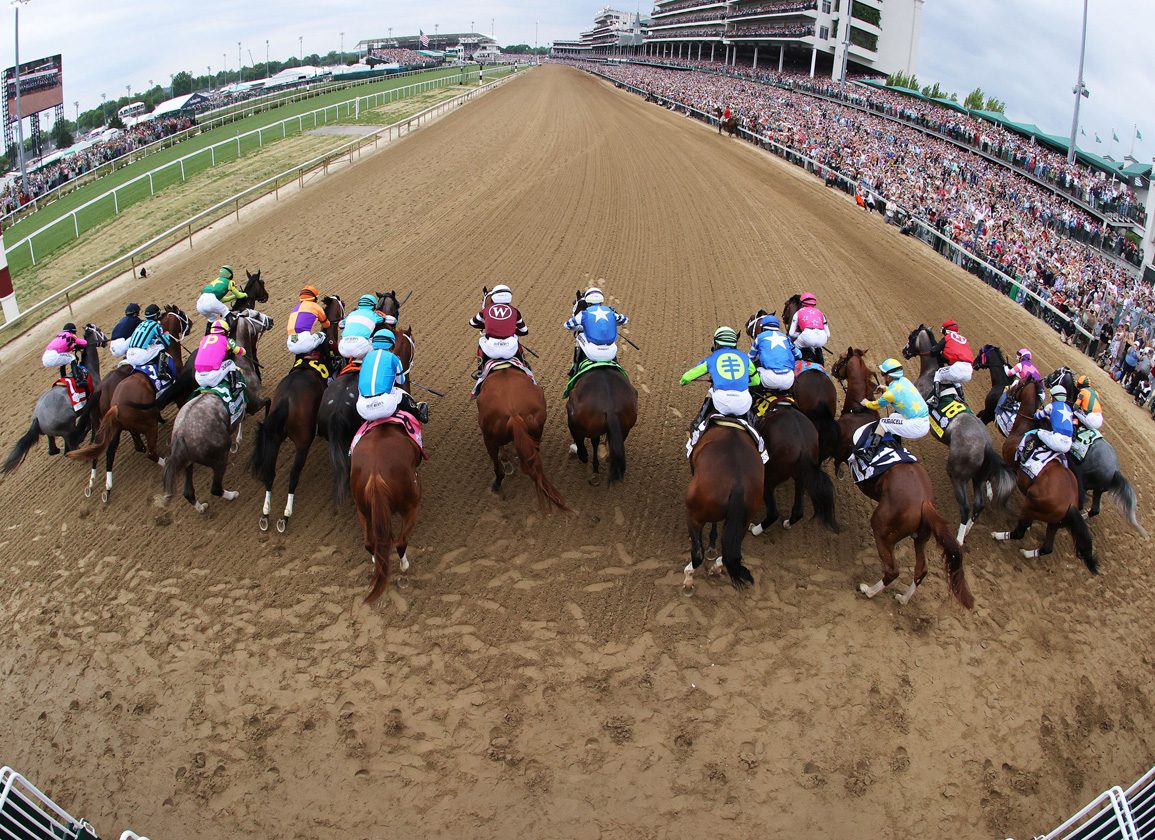
The field leaving the starting gate for the 2023 GI Kentucky Derby | Coady

7) Tapit Trice (No. 5 in TDN pre-race rankings)
You can watch the Derby replay as many times as you want, but trainer Todd Pletcher aptly summed up the trip for this 'TDN Rising Star' in his immediate take right after the race:  “Tapit Trice did what he always does-he broke slow and then he had to check a couple of times heading into the first turn. When it came time he couldn't get going well enough. Farther for him-we're thinking [GI] Belmont [S.].”

Luis Saez had to implore this $1.3 million KEESEP son of Tapit straight out of the starting stall, and he briefly lost momentum when Mage dropped in front of him a furlong into the race. Tapit Trice was last into the turn, but was already on the move six furlongs out, which is how he won the GI Blue Grass S.

He picked off three rivals at the back before another minor stutter-step stall a half mile out; Saez seemed conflicted going into the far turn about whether inside or outside would be best. But it really didn't matter because Tapit Trice had left himself too much work to do.

This colt did respond to far-turn rousing, but it takes Tapit Trice quite a while to fully unwind. He spun nine wide into the lane, and when it was evident he not within realistic striking distance, Saez decided to save Tapit Trice for another day.

8) Raise Cain (No. 19 in TDN pre-race rankings)
This son of Violence ($180,000 KEESEP; $65,000 RNA OBSOPN) ran a sneaky-good eighth. He broke running from post 13 and could have made the front vanguard, but Gerardo Corrales took a firm hold and guided him back, eventually latching on to a midpack spot at the fence through the first turn.

Raise Cain showed a nice ability to pick off selected targets down the backstretch, always bettering his position, and when the far turn arrived, he had achieved a tactically advantageous spot behind the too-fast frontrunners down near the inside.

Corrales pulled off a deft move when shifting outside of the tiring Verifying, then reclaiming his spot at the rail. But when the field straightened, the need to get off the plugged-up inside suddenly became desperate, and Raise Cain had to waste forward momentum by repeatedly shifting laterally through the lane. He only encountered more and more traffic, enduring some bumping that stalled his late run for good. Overall though, the effort rates much better than it looks on paper.

9) Rocket Can (No. 13 in TDN pre-race rankings)
Junior Alvarado said post-race that, “I think I had one of the best trips in the race,” and he's probably right-at least for the first mile of the journey.

Rocket Can, a $245,000 FTSAUG RNA gray, was initially a touch keen while briefly running up on heels in the first few strides, but he settled in seventh, inching closer to the action as the two front packs merged into one. He came out to the four path and enjoyed similar uncovered placement as Hit Show while edging to within four lengths of the leaders into the last turn.

After saving ground, this blinkers-on son of Into Mischief tried to punch through between rivals three-sixteenths out, but he had tiring horses on both sides and it wasn't initially apparent if Two Phil's ahead of him was stopping or staying on. By the time Alvarado called on Rocket Can for another burst, the colt had nothing left to give.

10) Confidence Game (No. 18 in TDN pre-race rankings)
Judging Confidence Game's try based on how close he was to a hot pace and how long he hung in there, his Derby 10th at 21-1 odds comes off as a likeable effort.

This $25,000 KEESEP Candy Ride (Arg) colt threw himself right into the race by breaking with good energy and securing a primo position, fourth at the rail into the turn behind a trio of eager  pacemakers.

He was fifth, then fourth for most of the backstretch run, attending the brisk splits while waiting to see how the duel would come undone. Confidence Game attempted to follow the dive-between move of Two Phil's five-sixteenths out, but Two Phil's was into the bridle with more alacrity, relegating this colt to chase mode turning for home closest to the rail.

At the eighth pole, Confidence Game was still within three of the leaders when Mage powered past Two Phil's. But he had that “spinning his wheels” look to his stride, and couldn't sustain his bid. He wasn't hammered on by James Graham when it became evident he wouldn't attain a placing.

11) Sun Thunder (No. 15 in TDN pre-race rankings)
Even with blinkers added, this late-running Into Mischief colt ($400,000 KEENOV; $495,000 RNA FTSAUG) was unhurried out of the gate, settling into stride second from last the first time past the finish.

Sun Thunder gained a few positions on the far turn and into the stretch, primarily from passing horses who had no forward momentum.

“I think we'll point to the Belmont after this,” trainer Ken McPeek said. “He was a little up against it today, but we'll come back to fight another day.”

12) Mandarin Hero (Jpn) (Unranked also-eligible in TDN pre-race rankings)
Mandarin Hero (Jpn) (Shanghai Bobby) was a hard-charging pace presence out of gate 17 without really being hustled. He suffered only slight momentum loss when Rocket Can knifed in front of him through the stretch.

Midpack and between rivals onto the backstretch, Kazushi Kimura rode him with confidence, then shook the reins at him with a sense of urgency when fellow Japanese invader Derma Sotogake ranged alongside and quickened into the far turn.

Mandarin Hero was asked for run four deep through the bend, and he came in close quarters with the brawny Tapit Trice. But this colt kept getting passed even though he was responding to his rider.

13) Reincarnate (No. 6 in TDN pre-race rankings)
This $775,000 KEESEP son of Good Magic had Disarm bounce off his outside flank a few jumps out of the gate, but Reincarnate's natural speed carried him straight to the front, where he hooked up as the outermost horse in a three-way go.

John Velazquez tacked him back behind Verifying and Kingsbarns down the back straight, and even though this colt was incrementally edging up a half mile out, he couldn't make much of a dent in the margin because the fractions were so demanding.

Reincarnate's best chance came on the far turn when Verifying was the first to crack, but he couldn't muster an authoritative response to put away the ready-to-cave Kingsbarns. Two Phil's slipped through to his inside instead, and Velazquez concentrated on keeping his own regressing mount out of the way of onrushing contenders once he realized no final kick was coming from Reincarnate.

14) Kingsbarns (No. 7 in TDN pre-race rankings)
Kingsbarns, now a 3-for-4 son of Uncle Mo ($250,000 FTSAUG; $800,000 FTFMAR)  won a couple of in-race battles after getting a good jump out of starting stall six.

After establishing a wicked pace, Kingsbarns dueled Verifying into defeat while still in hand entering the far turn under Jose Ortiz, and then kept next-closest pursuer Reincarnate at bay.

But by the midway point on the far bend Kingsbarns had no real response when Two Phil's swallowed him up and a sizable portion of the field careened by. Although out of the race by upper stretch, Kingsbarns managed to contribute to an inside logjam that adversely affected several contenders, although none of them truly had a winning shot.

“I sacrificed going a little bit faster than I wanted to in order to be in a good spot,” Ortiz said. “I wish we could have given him a breather on the backside.”

15) King Russell (Unranked also-eligible in TDN pre-race rankings)
This $60,000 FTKOCT gray by Creative Cause overcame a wide draw from post 18 but could only scrape together a mild mid-race spurt after going four wide on the clubhouse turn.

“He made a nice move from the five-eighths pole to the three-eighths pole, and then after that, he started to get tired and give up,” said jockey Rafael Bejarano.

16) Verifying (No. 4 in TDN pre-race rankings)
Post position two sealed Verifying's fate as a Derby frontrunner, even though he is probably more accomplished and comfortable as a pace-presser.

Tyler Gaffalione let him rumble through torrid opening quarters of :22.35 and :23.38 while forced forward by the speed-centric Kingsbarns and Reincarnate. When Verifying had no more left to give, his rider did a good job wrapping up and letting him coast back through the field along the inside without incident.

The Blue Grass S. and the Derby have now made for two difficult races in a row for this May 11 foal by Justify ($775,000 KEESEP), who still figures to be a fighter at the upper echelon of the division given his underlying talent and the stout seasoning he's gotten over the past six weeks.

17) Jace's Road (No. 17 in TDN pre-race rankings)
'TDN Rising Star' Jace's Road, a $510,000 KEESEP son of Quality Road, was sent away from gate 10 and landed a key stalking spot sixth on the outside heading into the turn. But he couldn't hold his position, and lost touch by the half-mile marker.

“He broke sharp and I tried to hustle him but he could not keep up with the three horses in front,” said Florent Geroux. “He was not trying. Before I knew everyone started passing him.”

18) Cyclone Mischief (Unranked also-eligible in TDN pre-race rankings)
This $450,000 KEESEP son of Into Mischief  broke sluggishly and was widest and last a furlong into the Derby. He zoomed by nine horses before the pack hit the first turn, but got hung out five deep on that bend and soon regressed to the tail of the field.

The post Top to Bottom: Derby Rundown appeared first on TDN | Thoroughbred Daily News | Horse Racing News, Results and Video | Thoroughbred Breeding and Auctions.

Source of original post

Verified by MonsterInsights