The Week In Review: Earle Mack Has The Answer, And We Must Listen To Him

Earle Mack is right. This industry, which is mired in a crisis, can no longer afford to ignore the most obvious solution to its problems, which are synthetic tracks.

Mack wrote just that in an Op/Ed that appeared in this publication last week. If you haven't read it yet, please do so now. It is powerful, articulate and well-reasoned and was written by someone whose credentials demand that we respect his opinion. He is a horse owner, a breeder, a former U.S. Ambassador to Finland and a smart and successful businessman who clearly loves this sport and does not want it to be pushed to the edge of extinction. It may be the most important story you will read all year.

“The responsibility lies with horse racing's governing bodies, influential race track directors, and all key stakeholders to rally behind a transition to synthetic tracks,” he wrote. “Their public endorsement and commitment to safer racing conditions would signal the beginning of the transformative change our industry desperately needs.”

The 12 deaths at Churchill Downs have created a dangerous firestorm unlike anything racing has ever encountered. We only thought the problems at Santa Anita in 2019 were bad. That was an ugly story but it was largely a California story that didn't resonate with the national media. This time, we are talking about the most famous track in the country, the GI Kentucky Derby and two deaths on the Derby undercard.

This is a story that has been widely covered by every major media outlet in the country and has led to a public debate: is our sport inhumane?

How do we answer that? The public no longer wants to hear about how loved these horses are by their owners, trainers, and grooms or that they are pampered and get the very best care possible and that they were born to run. What they want is for the deaths to greatly decrease if not stop all together.

To their credit, Churchill Downs, the Horseracing Integrity and Safety Authority (HISA) and the Kentucky Horse Racing Commission have stepped up and announced that changes are being made. Theirs is a genuine and concerted effort to do the right thing and to get to the bottom of what has been going on at Churchill. Moving the remainder of the Churchill meet to Ellis Park was a drastic step. Considering the widespread opinion that there is nothing wrong with the Churchill track surface, you can argue that it was overkill, but shutting Churchill down was a victory in the public relations battle, and that matters. The days when the sport shrugged this off and we were told “it's part of the game” are, thankfully, over.

But it's not enough. This sport must do absolutely everything it can to alleviate the problem. And it's not. And it won't until synthetic tracks replace dirt tracks throughout the sport.

Yes, deaths happen on synthetic surfaces, too. But they are much safer than dirt tracks. According to the Jockey Club's Equine Injury Database, there were 1.44 deaths per 1,000 starters in dirt races in the U.S. in 2022. On synthetic tracks, the number was 0.41. That means a horse is 3 1/2 times more likely to die in a dirt race that in a synthetic surface race. Dirt tracks are the most dangerous tracks we have and yet they remain the sport's core product.

Noting those figures, Mack wrote, “…the stark and troubling statistics demand a shift in thinking. We must abandon old norms and embrace new practices that prioritize the safety and welfare of our noble equine athletes. The benefits of synthetic tracks are not mere conjecture; they are a proven truth.”

Yet synthetic surface races remain a minor part of racing and Keeneland, Santa Anita and Del Mar gave up on them too quickly, going back to dirt after a short period of time when they were in place at all three tracks.

Mack calls on Churchill Downs to lead the way. Not only does this story center around deaths at that track but the company owns the sport's most important asset, the Kentucky Derby. Mack reasons that if Churchill takes the lead and converts to a synthetic surface, that will create the much-needed domino effect. How about we go a few steps further? The three Triple Crown tracks should make a joint announcement that going forward the Derby, the GI Preakness S. and the GI Belmont S. will be contested on synthetic tracks starting next year. The Breeders' Cup should announce that starting with the 2025 Breeders' Cup only racetracks that have synthetic tracks will be considered as host sites.

It is understood that this would cause a huge change in the economics of the breeding industry, which is a powerful and influential component. There are stallions out there that are worth tens of millions of dollars and that is because they produce top quality dirt horses–ones capable of winning races like the Derby and the GI Breeders' Cup Classic. Should that strength be taken away by ending dirt racing, their value could be greatly compromised. That will never be an easy thing for the top stud farms to accept. But they can adjust. It will take time, but a new set of stallions capable of producing horses that win at the highest levels on synthetic tracks and, for that matter, turf courses, will take over.

And the farms, like every other section of the sport, need to look at what the alternative is.

“If we fail to take decisive action, the Triple Crown and horse racing itself may soon be mourned as relics of the past.,” Mack wrote.  “Animal rights groups, emboldened by each equine death, are gaining traction in their campaign against horse racing. The calls to ban or severely restrict the sport grow louder with each life lost. We cannot afford to lose this race for the soul and survival of our sport.”

Is the sport sure to continue? For maybe the first time in its proud history, we really don't know the answer. Where will racing be in, say, 25 years?  Will it have gone the way of dog racing? It won't if we do the right things now, before it is too late. The sport must become safer and that must happen now. The best way to do that is to end dirt racing.

The post The Week In Review: Earle Mack Has The Answer, And We Must Listen To Him appeared first on TDN | Thoroughbred Daily News | Horse Racing News, Results and Video | Thoroughbred Breeding and Auctions.

Source of original post

Saturday Insights: Matareya Half-Sister Favored on Debut

11th-CD, $120k, Msw, 3yo/up, f/m, 7f, post time: 5:58 p.m. ET
METHODOLOGY (Uncle Mo) is the latest foal to the races out of Grade III winner Innovative Idea (Bernardini), who took her career debut in 2014 who has since gone on to become the dam of Matareya (Pioneerof the Nile), victorious in the GI Acorn S. for the Brad Cox barn last season and a latest upset winner of the GI Derby City Distaff on the Kentucky Derby undercard May 6. Innovative Idea is a daughter of MGSW/GISP Golden Velvet (Seeking the Gold), whose other produce include GSW Lucullan (Hard Spun), MSP Embossed (Medaglia d'Oro) and SP Soft Touch (Uncle Mo). Godolphin acquired MGSW third dam Caress (Storm Cat)–a full-sister to Bernstein–for $3 million at the 2000 Keeneland November Sale. The competition includes Cheyenne Stables' Driana (Kantharos), a $525,000 FTSAUG acquisition who was a big second to Lady Irene (Kantharos–Leslie's Lady) on her 5 1/2-furlong unveiling May 20. TJCIS PPs

2nd-MTH, $57.5k, Msw, 2yo, f, 4 1/2f, post time: 1:07 p.m. ET
OMAHA GIRL (Omaha Beach), a daughter of MSP Anchorage (Tapit), is a half-sister to a pair of 2-year-old debut winners, including the SP Chip Leader (Giant's Causeway), as well as the Grade III winning turf marathoner Abaan (Will Take Charge). A $400,000 KEESEP purchase by Kerri Radcliffe on behalf of Amo Racing/Omni Horse, the Mar. 20 foal hails from the extended female of Broken Vow. TJCIS PPs

The post Saturday Insights: Matareya Half-Sister Favored on Debut appeared first on TDN | Thoroughbred Daily News | Horse Racing News, Results and Video | Thoroughbred Breeding and Auctions.

Source of original post

A Fateful Pair: Chelsie Raabe And Sibelius

Ever since she was a young girl, Chelsie Raabe had dreamed of reaching the pinnacle moment in her career as an equestrian, where she envisioned one day standing atop the Olympic podium or making the victorious walk out following a clear cross-country round at the Land Rover Three-Day event.

But it wasn't until the evening of March 25 at Meydan Racecourse in Dubai, as she looked up at a bustling grandstand that echoed with the crescendo of excited fans awaiting the start of the Group 1 Dubai Golden Shaheen on Dubai World Cup night, that Raabe realized the dream had been achieved.

It was just a new version, with a showjumping stadium swapped out for a racetrack, and instead of her jumping around a course aboard her own off-track Thoroughbred, it was her walking out as the assistant trainer and exercise rider of Sibelius (Not This Time), who would go on to win the Dubai Golden Shaheen and become the first Group 1 winner for his trainer Jerry O'Dwyer.

“I looked up at the grandstand and burst into tears. I couldn't even control it, I literally started sobbing. It was just such a big moment,” said Raabe. “I was always that person that said, 'I'm going to do something really big,' even though I was mostly at a disadvantage. I just had that flashback to me as a little girl daydreaming about standing on an Olympic podium and I'm looking up at these fans and all of these people and these cameramen, and thought 'Wow, this is a dream come true.'”
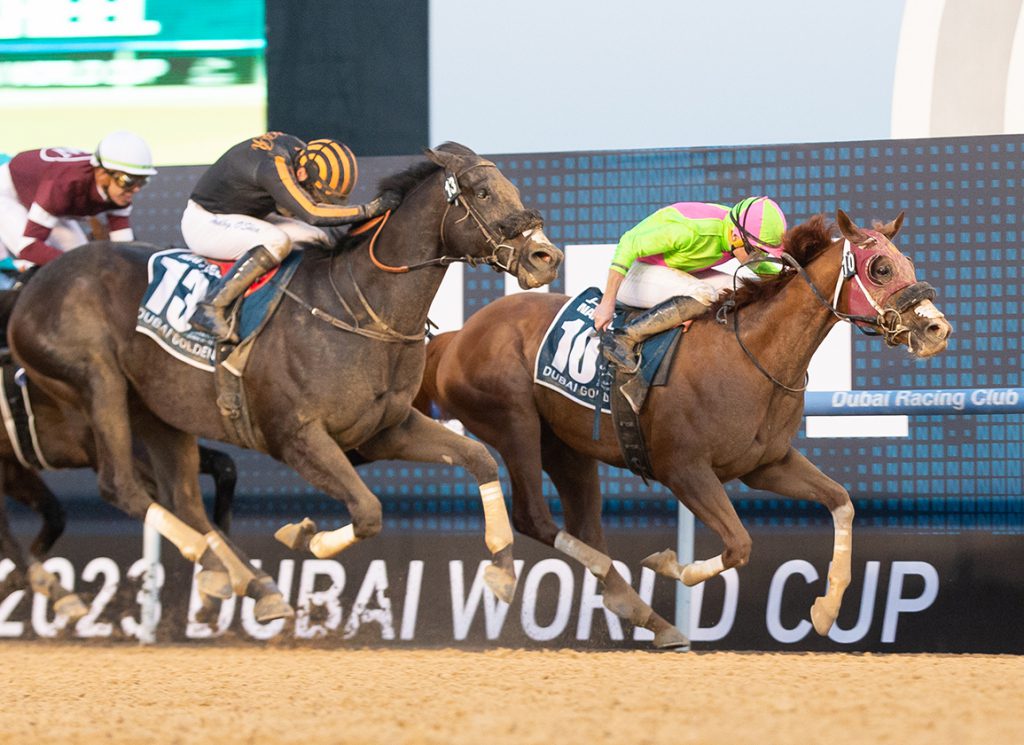
Sibelius wins the G1 Golden Shaheen | Erika Rasmussen

A native of Oxford, Ohio, Raabe grew up on her family's 100-acre farm where ponies and horses were a constant as she participated in 4-H, FFA and rode as a member of the local Pony Club. From there, her passion for the sport of eventing led her to two-time Olympic rider Dorothy Crowell, who Raabe spent the summers with as a working student in Frankfort, Ky.

After graduating from Miami University of Oxford, Ohio, in 2013 with a bachelor's degree in integrative studies, Raabe headed south to Ocala, Fla., working various jobs in the horse industry before landing at Bridlewood Farm. That venture kickstarted her first endeavor into the training and racing side of the Thoroughbred business.

“While I was working at Bridlewood, I absolutely fell in love with racing and that farm. At that time, we had Tapwrit and just so many nice horses. I didn't even realize how nice so many of the horses were that I was around, until much later, because it was so new to me. But I just liked that there were so many different types of races and different types of horses and how new and interesting it was,” she said. “I went from never touching a real racehorse to learning how to gallop and I ended up being one of the traveling assistants, where I was traveling around the country and running horses. I was able to learn a lot quickly and whenever I wanted to learn more, I was always able to do those things there.”

After nearly three years at Bridlewood, Raabe moved on to work for trainers Jonathan Thomas and later Michelle Nihei, before returning to Ocala for a stint at Red Oak Farm.

By the spring of 2022, after working through the brunt of the Covid-19 pandemic in Florida, Maryland and Delaware, Raabe felt she was at a crossroads when it came to her future in the Thoroughbred industry. It was then she decided she'd have one final hurrah as an exercise rider, riding out for Todd Pletcher in Saratoga that summer, while also working for track photographer Adam Coglianese.

“I loved working for Todd. It's definitely what I needed at that point in time. It was a low-stress, good job with good horses,” she said. “But you do get really burnt out. It is a hard life. It's grueling, it really is.”

As summer winded down, Raabe began looking into housing as she planned her return to Florida, until a phone call from longtime friend Alison O'Dwyer, Jerry's wife, changed everything.

“Jerry has this really nice horse; he just won the Lite the Fuse [at Laurel Park] and we're going to run him in a Win and You're In [the Grade II Stoll Keenon Ogden Phoenix] at Keeneland. He's thinking about sending a string but doesn't really have anyone to oversee it, so we're still trying to figure out the details,” Alison O'Dwyer said.

“Ali, if he wants, I would love to go do that for you guys. I would love to go to Keeneland for the fall meet,” Raabe immediately replied.

It was a full circle moment for Raabe, who had met Alison O'Dwyer during her time working for Crowell in Kentucky. The two have been close friends ever since.

“Alison is one of my best friends, so that's actually how I met Jerry. It's always been kind of inevitable as to when I would be working for him. It was never a question, I knew that I'd end up in that barn at some point,” said Raabe. “He would say, 'You always have a job with me.'”

And that 'nice horse' Alison had mentioned? It was none other than Sibelius, a striking chestnut with an enchanting white face and chrome on his legs to match, who had just become a stakes winner with a rousing 7 1/2 length victory over Grade III winner Jaxon Traveler (Munnings) in the Sept. 10 Lite the Fuse.

“My first ride on him in September, I remember getting off of him, looking at my co-worker Ricardo [Barajas], who I had known in Delaware, and saying 'Ricardo, this horse is going to be a freak, but he's not a freak yet,'” she said.

The pair have spent each morning together since. Continuing on with his 4-year-old season, Sibelius wound up fourth in the Stoll Keenon Ogden Phoenix, by two lengths, and second in the Bet on Sunshine Stakes that November at Churchill, before heading back to Jerry O'Dwyer's home base at Palm Meadows Training Center in Boynton Beach, Fla. He closed out the year back in graded stakes company at Gulfstream Park, facing 10 others in the Dec. 31 GIII Mr. Prospector Stakes and prevailing by 2 1/4 lengths with regular jockey Junior Alvarado aboard.

“I really value teaching the horses how to relax while they train. I feel like when a horse is relaxed, a horse can think, and across any sport I've been involved with–I've helped with driving horses, western horses, showjumpers, dressage and eventing horses–the one thing that every horse needs to be successful in any sport is relaxation,” said Raabe. “I have really tried to carry that over in the way I gallop, the way I train horses to gallop. As I've come to know that horse, he really thrives in knowing his people and having a close relationship with them. I've been riding him for months now, and he's one of the easiest horses to ride in the barn now, but in the beginning he wasn't. It just took him time to learn how I wanted him to train and once he started catching on, he was much happier and I'm much happier.”

Following a resilient victory in the Pelican Stakes at Tampa Bay Downs, where he won by 1 ¼ lengths in a final time of 1:08.75 going six furlongs over a fast track on Feb. 11, Sibelius and his team were officially invited to Dubai for the $2-million Dubai Golden Shaheen.

The prep work off the track became just as important as the training on the track, as Raabe took two weeks to prepare the gelding for the long walks they would be making to and from the track when stabled at Meydan.

“Since we have such a small stable, we're able to customize what we do with each horse if we need to, so I just started walking him and getting his body used to carrying weight for that long. By the time I left for Dubai, he was already used to having that 30-minute walk before and after he trained. He really enjoyed it,” said Raabe. “We would march up and down the paths at Palm Meadows and we would have people coming out to visit him, specifically to say 'hi' to him and give him a pet. He loved it because he was getting attention, and of course he's a smart, relaxed horse anyways so he really enjoyed that part of his day.”

The work the O'Dwyer team put in, and the bond Sibelius has with Raabe, were the ideal foundation for a seamless transition to life over in Dubai leading up to the big race. With the pair both making their first trips outside of the United States, Raabe arrived March 12 and Sibelius shipped in the following day.

“As soon as he saw me, he took this deep breath and put his head against my chest. There was all of this madness going on around him, everyone's trying to rip wraps off of the horses and get them walked and get them bathed and in that moment, it was like he said, 'I'm just glad you're here,'” said Raabe. “I quietly took his wraps off, it was just me and him there, and I hung out with him for a few minutes. Once the barn quieted down, I walked him out, gave him a bath and took him for a little walk and let him do his thing. It's little things like that that he really appreciates.”

All eyes were on Sibelius each morning at Meydan, where the gelding established himself as a local celebrity of sorts with his routine of standing in on the rail, taking in his surroundings with ears pricked and head on a swivel. Raabe said his awareness of every situation he is in, regardless of the change in scenery, is a testament to his intelligence and ability to thrive in an ever-changing environment.

“Since everyone around him was relaxed, and the whole situation was relaxed, it was just easy for him. He's a horse that always stands in when he goes on the track. I think he's always done it and he's always been allowed to do it, because he loves just taking in the world. The closer he gets to a race, the longer he wants to stand in. I swear he knows what the routine is the closer he gets to a race and how many times he breezes before he's going to run,” said Raabe. “This was the easiest time I've ever had traveling with a horse, so you just knew something special was going to happen.”

Special indeed. With Ryan Moore aboard, Sibelius ran the race of a lifetime, overcoming a poor start and making up ground as he found a spot on the inside rail and fought until the very end, coming out a nose ahead of defending champion Switzerland (Speightstown). Jerry and Alison O'Dwyer, along with the gelding's owners Jun Park and Delia Nash, were all there to witness the magnificent feat, but it was Raabe who there to collect Sibelius as he came off of the track.

“I had so many people tell me they were going to watch the race and I felt like as many fans as we knew he had, I felt the entire world screaming, propelling him forward. Hundreds of people from my hometown watched that race that have never watched a horse race in their lives. People I didn't even know cared about horse racing tuned into that race. He's made such an impact on people, but maybe it's a little bit of our partnership too. It's a really beautiful bond and I think it's obvious to people, even people that don't know about horse racing, and it's something they can connect with,” said Raabe.
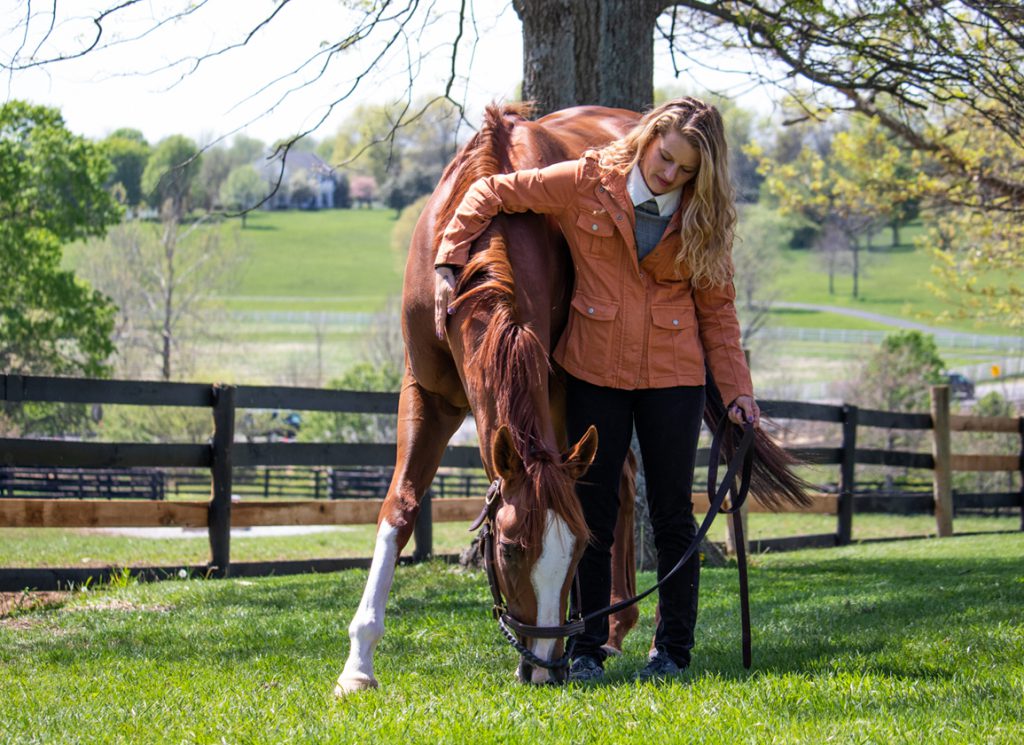
Chelsie Raabe and Sibelius | Sara Gordon

The emotional impact of the moment washed over her again, running through a mix of shock, relief and most importantly, pride, as she watched the culmination of hard work put in by the O'Dwyer team pay off in the most rewarding of successes. Raabe also gave the utmost credit to Alvarado, who had ridden him in his six previous starts, four of which he'd won.

“Junior has done an excellent job riding him. I think with what I do when I gallop in the morning, being really adamant about horses training relaxed, on the bit and using themselves, that's really complimentary to the way Junior rides. Junior has been able to take him from being a horse that was a little nervous and hot in the races to a horse that is very relaxed and really able to think about what's happening. He grew from a horse that wouldn't really pass other horses to a horse that will confidently go by traffic, and he's never had to go by as much traffic as he did in the Golden Shaheen,” said Raabe.

Returning to the states in early April, Sibelius enjoyed a few weeks of downtime on a farm near Lexington, Ky., before shipping to Keeneland to join Jerry O'Dwyer's small string being stabled there, overseen by Raabe. He resumed training April 25.

With three published works at Keeneland under his belt, most recently breezing four furlongs in :50 flat over the main track on May 27, the 5-year-old gelding is set to make his stateside return in Saturday's Aristides Stakes at Churchill Downs. He'll be reunited with Alvarado and once again face off with Gunite (Gun Runner), third in the Golden Shaheen, who is one of four others entered in the six-furlong test.

Despite the added pressure and pressure that tends to comes with being a Group 1 winner that currently holds a three-win streak, it's business as usual for Sibelius and his partner, Raabe, who is just happy to have one of her favorites back in the barn.

“Riding him through the fall and riding him into some of the races, I just fell back in love with the sport. I fell absolutely in love with him and just had so much respect for him as a soul in the world and he really connected with me, and on top of that, I'm working with people who are my family. Jerry has created a healthy space for all of his employees, where it's family-friendly oriented and everyone gets along, everyone is friends,” said Raabe. “All of a sudden, any bit of that sort of resentment or feelings of exhaustion I had melted away. I didn't even realize I had completely fallen back in love with doing what I was doing and it's all because of Sibelius.”

When Sibelius won in Meydan that fateful evening in late March, he did more than win a $2-million Group 1 race. His victory signified the devotion of his trainer and his small crew of staff members, the belief of his owners, and the support of fans, new and returning, that span across the globe. Raabe will never forget her experience with Sibelius in Dubai, but most of all, she'll treasure the precedent they set together.

“I think I've gotten hundreds and hundreds of messages from people, wishing us well, saying they were crying watching us win, or they were screaming, and that part has been really cool. Horse racing needs a horse that the people can relate to and I hope Sibelius can become that horse and our story can to. I think it's really important. We need that, the people need it, racing needs it,” said Raabe. “No matter what happens the rest of the year, or during this horse's career, what matters is that his owners are so nice and kind and just want the best for him, and want the best for Jerry. His story will never become bitter, and the sport really needs that, so that part I take pretty seriously. I hope to keep cultivating his story because we do have a following now.”

Take a bow, Chelsie Raabe.

The post A Fateful Pair: Chelsie Raabe And Sibelius appeared first on TDN | Thoroughbred Daily News | Horse Racing News, Results and Video | Thoroughbred Breeding and Auctions.

Source of original post

This Side Up: Plus Ca Change….

At a time when so many people seem to be allowing a duty of vigilance to crumble into morbid defeatism, it seems a little unfair that our sport should be going through such a hard time even as we approach the 50th anniversary of the most luminous tour de force in the story of the modern breed.

Of course, as some powerful evocations of the time have lately reminded us, Secretariat arrived as a sunbeam into a wider world darkened by Vietnam and civic unrest. And nor should we deceive ourselves that even our own, notoriously insular community was back then immune to some of the things that vex us in 2023.

For instance, without reprising what have doubtless become tiresomely familiar objections to tinkering with the Classic schedule, let's not forget that Secretariat faced down a Triple Crown drought stretching to Citation in 1948. Obviously a still longer wait followed Seattle Slew and Affirmed, but we've found two horses equal to the task in the last eight years. Even so, the trainers are somehow trying to bully us into reconciling the paradox that they want more time between the races and therefore (assuming this indeed renders those races more competitive) to extend the intervals between precisely those Triple Crown winners that supposedly represent our best route to wider engagement.

Well, the world moves on. And it's not as though the Thoroughbred has ever permitted hard and fast rules anyway.

On the one hand, it's pretty unarguable that the old school, by exposing their horses more, helped the public to develop a rooting interest. If Flightline (Tapit) was perhaps as talented as we've seen since Secretariat, in making just six starts he barely scratched the surfaced of national attention.
And I do like to think there were other, incidental gains in the aggressive campaigning of horses, whether in terms of educating the animal or showcasing the type of genes that breeders should wish to replicate. But if Mage (Good Magic) is only the latest proof that modern trainers can prepare a raw horse even for a challenge as notoriously exacting as the Kentucky Derby, then let's roll back to that summer of '73.

Okay, so Secretariat himself had made nine juvenile starts from July 4. But if you would presume experience to be an asset at Churchill on the first Saturday in May, then how much more crucial should it be for the template itself, the most venerable race of all: the Derby at Epsom, that crazy rollercoaster with its twisting hill? Yet half a century ago, in a field of 25, the race was won on only his second career start by Morston (GB).

He was bred for Classic stamina, at any rate: by St Leger winner Ragusa (Ire) out of an Oaks runner-up (herself by a St Leger runner-up) who had already produced the 1969 Derby winner Blakeney (GB). Ragusa, incidentally, was out of a mare imported from a very old American family that had earlier produced Hard Tack, the sire of Seabiscuit. The St Leger, remember, is run over 14 furlongs. As the Japanese have reminded us, the lifeblood of the Thoroughbred is not brute speed but class: the ability not just to go fast, but to keep going fast.

That is certainly the hallmark of Galileo (Ire), whose legacy saturates the 244th running of the Derby on Saturday. With 93 juveniles and just a dozen yearlings still to come, he is represented by a single son, Artistic Star (Ire), unbeaten for one of the outstanding trainers in Europe yet available at tempting odds. Of the remaining 13 starters, eight are by sons of Galileo (including two by principal heir Frankel {GB}); two are out of his daughters; and one is out of a mare by another of his sons. That leaves just two runners to have bobbed to the surface of a European bloodstock industry that squanders mares, by the thousand, on stallions that cannot remotely satisfy the definition of class given above.

But, yes, the world moves on. Sometimes it just moves on in the wrong direction. It's a pretty dismal reflection on where our sport stands today that its greatest race has been shoehorned into the middle of lunch to avoid the F.A. Cup Final. Because what American readers may not realize is that this particular soccer match, in its heyday, also once brought England to a standstill—but has in recent years, even as the game has boomed, also lost much of its popular traction. With many managers resting star players for this tournament, you might even say that the F.A. Cup has shared the same decline in popular culture as the Derby (for which Parliament itself used to take the day off).

Fixed television schedules are also a thing of the past, with the young especially expecting to do most of their viewing “on demand.” That puts live events at a premium. In Britain, however, broadcasting rights for the most prestigious sporting events—including both the F.A. Cup Final and the Derby—are ringfenced for free channels. (Which obviously invites the paradox that the most coveted events, with no competition from channels with subscription revenue, are least likely to achieve their true market value.) Unusually, the F.A. Cup Final is broadcast simultaneously by both the BBC and ITV. And since the latter also has the rights to the Derby, racing has been unceremoniously shown its place.

By an unmissable irony, the match that has elbowed the Derby aside is being contested by Manchester City and Manchester United. As such, it is what the soccer world knows as a “derby” match between local rivals. The origin of this usage is tenuous, but some have ascribed it to the Epsom race. Horseracing, after all, long precedes football (in all its variations) in popular culture.
Yet now we find the Jockey Club taking out injunctions in anticipation of animal rights protests, even for a race in such innocuous contrast to, for instance, the Grand National. And that is without the current traumas of Churchill Downs having remotely penetrated wider consciousness on that side of the pond.

But let's resist adding another “basso profundo” to the prevailing chorus of miserabilism. Let's hope for another infectiously exciting chapter in the Epsom epic: maybe a final Derby for Dettori, who has already won two of three British Classics on his farewell tour; or perhaps one more for another old master, Sir Michael Stoute.

His runner hadn't even seen a racetrack before Apr. 20. Put that in your pipe and smoke it, Mage! Passenger (Ulysses {Ire}) is actually out of a War Front mare. Fifty years on from Morston, then, perhaps Passenger would be an apt reminder that the more the world changes, the more it stays the same.

The post This Side Up: Plus Ca Change…. appeared first on TDN | Thoroughbred Daily News | Horse Racing News, Results and Video | Thoroughbred Breeding and Auctions.

Source of original post

Verified by MonsterInsights