Proposed HISA Rule Change: Emergency Power to Suspend Live Racing?

The opening months of 2019 were still fresh in California lawmakers' minds when they passed a bill that summer giving the California Horse Racing Board (CHRB) emergency authority to suspend racing at a track without the hitherto required 10-day public notice period.

The precipitating event, of course, was the spate of equine fatalities that had covered Santa Anita, and the racing industry in general, under a pall of public condemnation–the exact same kind of scrutiny Churchill Downs has faced these past few weeks, culminating with the announced switch of racing venue to Ellis Park.

As events have unfolded at Churchill Downs, representatives from the Horse Racing Integrity Act (HISA) have made it clear that they could stop the track from exporting their simulcasting signal out of state, if they deemed it necessary.

Here, however, it should also be noted that throughout this period, HISA officials have repeatedly stressed how the agency's actions have been in unison with both Churchill Downs and the Kentucky Horse Racing Commission (KHRC).

But the ability to block the export of a simulcasting signal is not enough, say several non-HBPA affiliated horsemen's groups, including the Thoroughbred Horsemen's Association, the Kentucky Thoroughbred Association (KTA), the Thoroughbred Owners of California, the New York Thoroughbred Horseman's Association, and the Thoroughbred Owners and Breeders Association.

Since the earliest days of the HISA rulemaking process, they have argued for a clear set of rules giving HISA the discretion to completely suspend racing at a facility by removing its accreditation in the event of a safety-related crisis.

“Some of these owner-trainer groups feel so strongly about this issue,” said Chauncey Morris, executive director of the KTA, who stressed that he believes Churchill Downs, the KHRC and HISA have taken the correct steps throughout the past few weeks.

In answer to a series of questions, HISA spokesperson, Mandy Minger, wrote that the federal agency is indeed considering such a rule change.

In background conversations with track officials, however, they've stressed the disruptive nature of such actions, which can have profound economic impacts on a wide swath of stakeholders. Others warn that such powers need clear definition.

Scott Chaney, CHRB executive director, agrees that the threat alone of pulling a track's simulcasting signal “is not a complete solution,” but the key question for him is this: What criteria would HISA use to justify the ability to suspend racing completely at a facility?

“Is it purely fatality based?” he said. “Or is it more response based–like, is the response of the track satisfactory?”

The Proposal

HISA cited Turf Paradise back in January for several safety-related problems like faulty track rails and a subpar racetrack surface maintenance program. Track management ultimately complied, but only after the HISA Authority applied the thumbscrews of a possible simulcasting export block.

In the Turf Paradise situation, therefore, there were clear racetrack safety violations that HISA used as enforcement leverage.

But what happens in a situation where a track experiences a rash of fatalities and there is no clear actionable violation? What if management at that track is not as cooperative with HISA's overtures as Churchill Downs has been? Then add to the mix the growing wingbeat of a national media calling for the sport's swansong.

This is the central conundrum prompting certain horsemen's groups to advocate for HISA to wield such discretionary powers–something the groups did during the first round of the rule-making process, submitting comments calling for the HISA Authority to be given “residual power to suspend accreditation and suspend racing in case of an unusual cluster of fatalities or other safety emergency.”

They added back then that “unambiguous language is necessary to provide that the Authority and its Safety Committee can actively monitor accreditation requirements during live racing, suspend accreditation immediately in order to ensure the safety of horse and rider, and suspend racing until corrective measures are undertaken.”

Those initial proposals were submitted at the start of 2022. According to Morris, the same groups are in the process of resubmitting similar commentary in the latest window to tweak HISA's rule. And HISA, it appears, is listening.

According to Minger, HISA's current rules bar them from prohibiting “Covered Horseraces at a Racetrack” without an accreditation suspension or a finding of a racetrack safety violation.

However, “for circumstances where that is not the case, HISA is closely examining and considering a new safety rule traditionally utilized by State Racing Commissions to summarily suspend Covered Horseraces at a Racetrack when circumstances present an immediate danger to the health, safety, or welfare of Covered Persons, Covered Horses, and Riders, or are not in the best interests of racing,” wrote Minger.

A formal process to remove a track's accreditation, however, still appears to leave a window open for live racing to continue–as in Texas, where the tracks there are not HISA accredited but continue to operate without the ability to export their simulcasting signal out of state.

Uniquely for Texas, the lack of an exported simulcasting signal has not dramatically affected the state's purse fund, buttressed as it is with monies from a sales tax on equine products. Purses in many other states, however, are funded heavily through wagering.

Without the ability to export a signal, the hypothetical question becomes: How long could a track operate without these monies coming in?

Specific Criteria

The CHRB rule giving it emergency discretion to suspend a track's license is prescriptive about the necessary steps the commission must take to execute that power.

The board must give track management at least 24 hours' notice of the hearing on the petition to suspend the license, which can be filed by the executive director or by the equine medical director, for example. The board also has five days following the petition's filing to make a decision on the suspension or license restriction order, among other requirements.

What's missing, however, is a clear set of detailed criteria delineating what set of circumstances warrant the CHRB's petition to be filed in the first place, and that's a big problem, said Chaney.

“From a regulatory standpoint, pressure and notoriety alone should not be the criteria,” warned Chaney.

Which leads to perhaps the thorniest aspect of the proposed rule change–what are the agreed-upon parameters so this regulatory trip wire isn't used capriciously?

The term multifactorial is routinely bandied around to explain fatal musculoskeletal injuries.

In a cluster of deaths, is there commonality in the way the horses were conditioned and medicated, for example? Are there glaring holes in the pre-race veterinary checks? Is the out-of-competition testing program rigorous enough? Has the racing office unduly pressured trainers to enter? Is the track surface at fault? What about their breeding, and the way they were raised?

This Iliad-like search for answers makes transparency of a baseline set of information vital in the quest to identify preventable fatalities, said Chaney.

“But since all reporting is not equal, it's hard to have an open and honest conversation about that,” he added.

Indeed, in recent weeks Churchill Downs has faced criticism over its decision not to publicly share equine fatality data through the Equine Injury Database. And it's unclear when HISA–which is mandated to publicly share this data uniformly–will step up to the task.

“HISA's accreditation team has been working with tracks to help them meet their internal review and reporting obligations. We're also in the process of developing internal systems so that reliable catastrophic injury data can be aggregated and made available to the public on an ongoing basis. Until such time as reporting and tracking systems are in place nationwide, The Jockey Club's Equine Injury Database continues to be the most reliable source for the type of information you requested,” wrote Minger.

But this particular data-set is only one part of the industry's current black-hole riddled nebula of unreported and hidden information. The sooner the industry at large begins sharing relevant data in a timely manner–everything from detailed vet's list info to stewards' reports–the better, said Chaney.

“Regression to the mean is just not good enough,” he said. “When it comes to safety, every track, every regulatory authority, has to do everything they can.”

Cautionary Tales

Attorney Drew Cuoto has long been critical of tracks unilaterally suspending individuals from their facilities, describing instances where he believes the horsemen have not been afforded the necessary due process rights of hearing and appeal.

Couto, it should be noted, has represented Jerry Hollendorfer in ongoing litigation stemming from The Stronach Group's 2019 decision to bar the trainer from the company's facilities.

And so perhaps surprisingly, Couto, one of the founding members of the Thoroughbred Owners of California, agrees with the fundamental premise that HISA is given these additional discretionary powers.

But before actually wielding that cudgel, the Authority should ensure that it has taken reasonable measures to get to the bottom of the problem, he said, mirroring Chaney's comments.

“Every situation is unique,” Couto said. “But in my many years of experience, in the event of these unusual clusters, typically there are issues related with the track itself.”

As such, Couto believes that such a scenario should immediately prompt HISA to bring in outside experts to evaluate the available information, like failure analysts and composite material science experts to evaluate track surface measurements.

Here it should be noted that one of the things HISA has done at Churchill Downs is bring in an equine forensics specialist to conduct an independent review of the necropsies.

This is especially needed at those facilities where track operators might not have the necessary training and experience to understand the complex set of factors behind fatality clusters, said Couto. He points out how–unlike many positions in racing like trainers and veterinarians–individuals filling certain racetrack operational roles aren't tested for proficiency through a formal licensing process.

Right now, “suspensions largely serve PR objectives over reasoned analysis,” he said. “And so, what I hope HISA can do is not take the current scientific consensus as gospel, but to see it as a starting point in the scientific process.”

As Morris sees it, however, HISA is uniquely placed to cut through the red-tape of competing interests to police the “triad” of American racing–the racetracks, the horseman and racing commissions–equally.

“In past situations, it can turn into a blame game between the racetrack, the horsemen and a state racing commission that feels it may or may not have the power or jurisdiction to step in,” said Morris.

“But HISA is an independent regulator,” he added. “That is something that was very, very appealing to our collective group.”

The post Proposed HISA Rule Change: Emergency Power to Suspend Live Racing? appeared first on TDN | Thoroughbred Daily News | Horse Racing News, Results and Video | Thoroughbred Breeding and Auctions.
Source of original post

Could Sunday Silence’s Grandson Close the Circle?

One way or another, plenty of people in our industry seem to think that it has reached a crossroads. But if a shutdown at the home of the Kentucky Derby makes us feel as though we can't get a break in the traffic, maybe we're just looking the wrong way. Because there's a chance that the real game-changing moment was happening 4,000 miles away, where the 244th running of the original Derby was last Saturday won by a horse excitingly equipped to open a new chapter in the story of Coolmore-and, potentially, new horizons for international bloodstock.

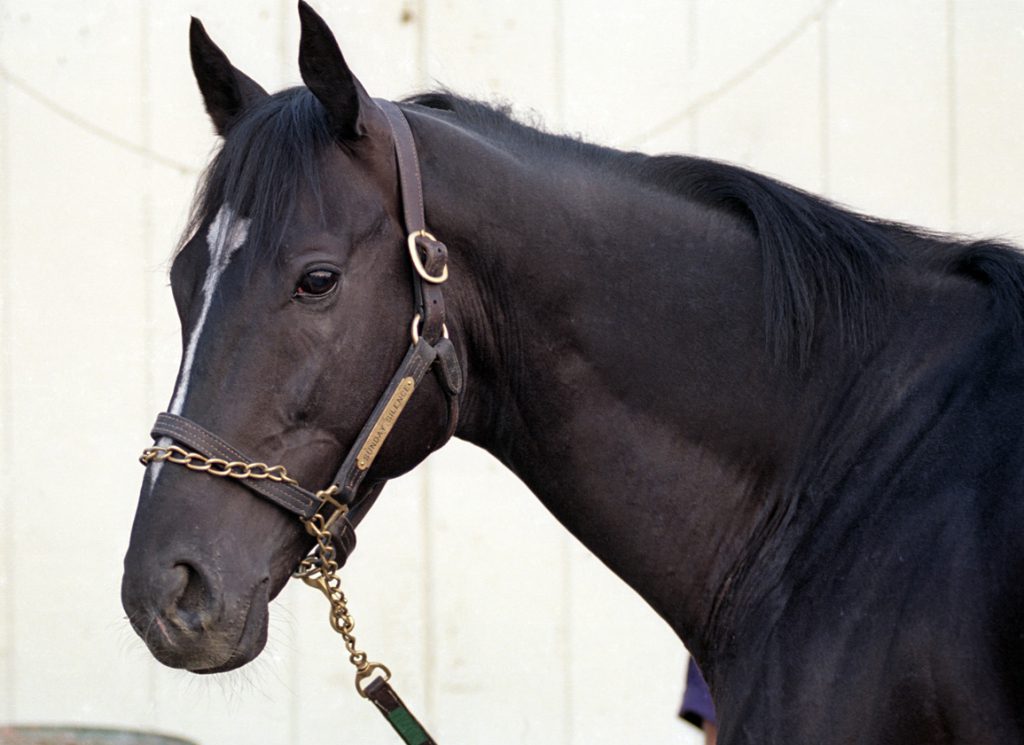
In Auguste Rodin (Ire) (Deep Impact {Jpn}), we have a Derby winner with the wares to help reconcile a debilitating modern division between the gene pools that produced his grandsire Sunday Silence, and his damsire Galileo (Ire).

If Americans have not yet granted this horse adequate attention, then his owner-breeders have an obvious solution later in the year. For if all remains well with Auguste Rodin, then the GI Breeders' Cup Classic would surely be a bet to nothing. Should he handle dirt as befits a grandson of Sunday Silence, then his exceptionally cosmopolitan pedigree really could be said to have brought together the best of all possible worlds. Should he fail to adjust, however, his stud value would barely lose a cent. (In fact, given the current morbidity about the future of dirt racing, the disclosure of an incompetence on dirt might even be said to enhance that value!)

The fact is that a stallion's career never depends purely on the inherent potency of his genes. If it did, true, Auguste Rodin would be in a very strong place, with the diversity of his pedigree standardized only by its seamless quality. But other things need to fall right-in terms of credibility and sheer narrative momentum-to maximize his opportunity. And that is what sets Auguste Rodin apart even from Saxon Warrior (Jpn), a promising stallion already at Coolmore, who shares as many as 13 of the 16 names behind Auguste Rodin in their respective fourth generations.

Because Auguste Rodin, besides being favored by some startling endorsements by his record-breaking trainer, raises an extra frisson of destiny as one of just a dozen sophomores in the final crop of Deep Impact. With even the most parochial and short-sighted breeders elsewhere now obliged to acknowledge Japan's increasing hegemony in the 21st Century Thoroughbred, the transatlantic market should be primed to embrace Auguste Rodin with a grateful fervor.

Deep Impact | J Fukuda

No doubt John Magnier and his partners at Coolmore first and foremost viewed recourse to Deep Impact in practical terms, having required a top-class outcross for all their Galileo mares. But just as when Scat Daddy proved a sire of sires, it also brought a latent opportunity to turn the dial.

While Coolmore has several effective heirs to Galileo, none can quite match the one that got away, Frankel (GB). But that will matter less with each pass of the baton. Say that down the line you sent Auguste Rodin a mare by Frankel's son Cracksman (GB), who had his breakout winner in the G1 Prix du Jockey-Club on Sunday: the resulting foal would be inbred 3 x 4 to Galileo. That's going to be a familiar scenario in Europe. But what compels interest in Auguste Rodin far beyond that theatre is the way such an international pedigree has coalesced to produce such a consummate athlete.

Very often, a horse's ancestors can only be credited with elite stature because of the sons or daughters that tie them into the pedigree in front of us. But just work your way down the fourth-generation mares behind Auguste Rodin, and you'll see that the potency of their genes has been corroborated by collateral distinctions.

Besides producing Halo, for instance, Cosmah was of course half-sister to the most important broodmare of her time, Natalma. Lady Rebecca, dam of Deep Impact's damsire Alzao, was a half-sister to Chieftain and Tom Rolfe. Fairy Bridge, here as dam of Sadler's Wells, was also half-sister to Nureyev. Allegretta (Ger), here as dam of the legendary Urban Sea, was also dam of one Classic winner King's Best and second dam of another in Anabaa Blue (GB). Highclere, herself a Classic winner, features because her daughter became granddam of Deep Impact, but another daughter is one of Europe's great modern broodmares, Height Of Fashion (Fr). And Rahaam also produced the Royal Ascot winner and stallion Verglas (Ire), as well as Auguste Rodin's third dam.

Okay, so a lot of people won't trouble themselves with that kind of underlying structure. They'll reduce a pedigree to blocks behind sire brands, and duly decide that they know what to expect when both Deep Impact and Galileo both displayed abundant stamina. The further seeding of Auguste Rodin's maternal line, meanwhile, may discourage international confidence, with second and third dams by European turf sires Pivotal (GB) and Indian Ridge (Ire).

But everyone should know Pivotal as an outstanding broodmare sire. And Indian Ridge's maternal family channels such old-fashioned, indigenous British sprint speed that you could hardly find a more vivid foil to other European elements in this page: the sturdy German family behind Galileo, for instance; or the profound stamina source Busted (GB), who sired Deep Impact's second dam. Unnerving stuff for American breeders, no doubt, but remember that Busted is by no means the only bottomless turf influence lurking behind sophomore champion Epicenter (Not This Time).

Auguste Rodin's third dam Cassandra Go certainly inherited the dash of Indian Ridge, winning over five furlongs at Royal Ascot, and she has also produced a dual Group-winning sprinter in Tickled Pink (Ire) (Invincible Spirit {Ire})-who came to American attention last autumn through the GI Breeders' Cup Juvenile Turf success of her daughter Victoria Road (Ire), significantly from the first crop of Saxon Warrior.

Another of Cassandra Go's daughters, Theann (GB) (Rock Of Gibraltar {Ire}), was also a Group winner at six furlongs before producing not just Photo Call (Ire) (Galileo {Ire}) to be a dual Grade I scorer on grass in the U.S. (later purchased by Katsumi Yoshida for $2.7 million); but also Land Force (Ire) (No Nay Never) to fly down the Goodwood hill in the G2 Richmond S. as a juvenile.

Cassandra Go's daughter by Pivotal, Halfway To Heaven (Ire), has proved well named as it turns out that her racetrack career only represented a beginning, despite winning three Group 1s. She had stretched her maternal speed to win one of those at 10 furlongs, albeit only just holding out, before then dropping back to a mile.

Certainly she had shown enough speed to remain monogamous with Galileo in her next career. Among their foals was the splendid campaigner Magical (Ire), who won 12 of 28 (seven Group 1s) between 7 and 12 furlongs, often proving too tough for colts; and also Rhododendron (Ire), who proved similarly classy, versatile and hardy, beating males in one of her three Group 1s and dropping back in distance after running second in the G1 Oaks. For her first cover, Rhododendron fortunately ducked under the wire to become one of the final mates of Deep Impact-and Auguste Rodin is the result.

Sunday Silence | Patricia McQueen

Perhaps some American breeders might hesitate about delving through this avowedly turf seam to retrieve the lost genetic gold of Sunday Silence. But it starts with a mare, Cassandra Go's dam Rahaam, who shows us precisely the kind of crossover that has been culpably abandoned since.

She was by an Epsom Derby winner in Secreto, albeit don't forget that he was by Northern Dancer out of a Secretariat mare from the family of Majestic Prince and Real Quiet. Rahaam's dam, meanwhile, was by Mr. Prospector out of a Dr. Fager mare-whose own mother was Kentucky Oaks winner Native Street. The latter, when herself covered by Mr. Prospector, produced the dam of both Dowsing (Riverman), winner of the G1 Haydock Sprint Cup; and Fire The Groom (Blushing Groom {Fr}), a GI Beverly D. winner who herself produced another top-class European sprinter in Stravinsky (Nureyev).

Rahaam had been co-bred by Calumet Farm and Stephen Peskoff before her purchase by Sheikh Mohammed, for whom she won a Newmarket maiden in a light career with Henry Cecil. Both Rahaam and her second foal Verglas (whose subsequent success we noted above) were soon culled from the Sheikh's operation, which did however retain her first foal Persian Secret (Fr) (Persian Heights {GB}) to become the stakes-placed dam of 11 winners. She has also consoled her mother's vendors as third dam of their G1 Melbourne Cup winner Cross Counter (GB) (Teofilo {Ire}).

Nor, equally, will even Japan's stunning recent success on the international stage convince every Bluegrass breeder, based as it is in the patient development of bloodlines discarded by America and Europe alike. We can confidently state that Deep Impact himself would never have received commercial support in those environments, having never raced below 10 furlongs and won over as far as two miles.

By this stage, however, you would like to think that people might not be so obtuse as to deny a stallion's capacity to impart speed simply because of his own ability, in his first career, to keep going. Deep Impact has sired plenty of brilliant milers and we really do need to overcome this childish literalism about “stamina” being the opposite of speed. Very often, it is sooner about having the class to carry it.

Magnier clearly understands that, having shown no compunction about choosing Deep Impact for mares by the undeniably doughty genes of Galileo. Saxon Warrior duly had the pace to win a Classic over a mile, and indeed arguably didn't quite get home at Epsom.
Bearing in mind that Deep Impact only covered a handful of Coolmore mares, for a handful of seasons, the results have been staggering. Just a few days ago Saxon Warrior's brother, again from Deep Impact's final crop, won a Group race on only his third start. Between Saxon Warrior, Snowfall (Jpn) (G1 Oaks winner in 2021, by 16 lengths!) and now Auguste Rodin, from very limited chances the Deep Impact-Galileo cross has given Ballydoyle winners of three of the five British Classics.

Sadly the mysterious misfiring of Auguste Rodin as hot favorite for the G1 2,000 Guineas derailed Coolmore's hopes of winning the first British Triple Crown since 1970. Nowadays there seems to be a depressing reluctance for Guineas winners to try even the Derby and, at 14 furlongs, the St Leger is a commercial bridge too far for nearly everyone. It's a real shame, then, that his connections should have been lucklessly denied the incentive to buck that trend by Auguste Rodin's Guineas flop. Nobody, clearly, would now expect the horse to proceed to the St Leger regardless.

So let's hope that another great sporting adventure might be embraced instead, at Santa Anita this fall. Because it's going to take something that bold, and that special, to persuade modern breeders to renew the kind of transatlantic transfusions that once underpinned Classic pedigrees.

Remember that Deep Impact himself was one such cocktail: by a dirt champion out of an Epsom Oaks runner-up. Remember, also, how Japan has tested the mettle of his stock, with its program predicated on soundness and longevity. For that makes the legacy of Deep Impact still more precious, as we strive ever more conscientiously for a Thoroughbred physically equal to its tasks.

To be fair, he made such remarkable use of limited opportunity with mares from outside Japan that there are already one or two attractive conduits to Deep Impact elsewhere. At Lanwades Stud in Newmarket, Study Of Man (Ire) certainly represents quite a package at just £12,500, as a Classic winner out of a daughter of Storm Cat and Miesque. Only his second starter (out of a Galileo mare, of course!) impressed on debut at Leopardstown a few days ago.

And it's a curious coincidence, given how much genetic material they already share, that the third dams of both Saxon Warrior and Auguste Rodin should have resulted from visits to Indian Ridge in consecutive seasons back in the 1990s. Who knows how their respective futures will play out? But there would be no better way for Auguste Rodin to match his billing, as the anointed final bequest of Deep Impact, than to redeem his stable's agonizing near-misses with Giant's Causeway and Declaration Of War in a race won by his grandsire.

The Thinker, the most celebrated work of the sculptor for whom the Derby winner is named, actually started out as a small figure in another of his masterpieces, The Gates Of Hell. At the moment, everyone seems to think that we are parked right outside the latter. But if we can all be thinkers for a minute, then here's a horse with the potential to help put out the flames.

For it is precisely those virtues now so prized in Japan-an ability to carry speed, and the robustness to keep doing so-that formerly united Classic bloodlines either side of the Atlantic. Auguste Rodin could now just jump through the familiar hoops, banking low-risk dividends through the rest of his track career and equally at stud. Or he could become the horse to close the circle.

The post Could Sunday Silence’s Grandson Close the Circle? appeared first on TDN | Thoroughbred Daily News | Horse Racing News, Results and Video | Thoroughbred Breeding and Auctions.
Source of original post

Dirt, Turf, and Synthetic by the Numbers

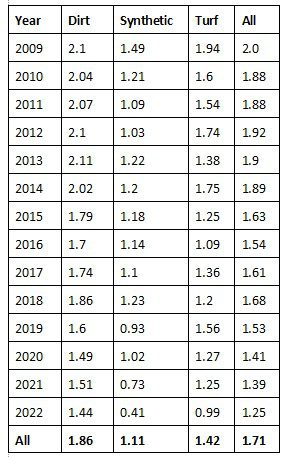
After the TDN published two opinion pieces which recommended a return to synthetic surfaces, one by Earle Mack in the May 31 TDN and one by Bill Finley in this Monday's TDN, we have been inundated by comments, questions, and opinions about the relative safety of one surface versus another. Some of the questions asked for a year-by-year comparison, while other comments cited statistics that were not correct. Courtesy of The Jockey Club's Equine Injury database, here are the figures of racing fatalities per thousand starters, year by year for the past 14 years. These statistics include fatal injuries of Thoroughbreds that occurred during a race as reported by veterinary officials and includes Thoroughbreds that succumbed to a race-related injury within 72 hours after the race day. For a link to the complete table, click here.

The post Dirt, Turf, and Synthetic by the Numbers appeared first on TDN | Thoroughbred Daily News | Horse Racing News, Results and Video | Thoroughbred Breeding and Auctions.

Source of original post

Where Are They Now? When One Grade I Winner Isn’t Enough

For every Off-the-Track Thoroughbred enthusiast, having a sound and healthy former racehorse to partner with for a second career is all they hope for. And while these same people will tell you their horse's racing history doesn't matter much, many of these same OTTB devotees will also admit their immense pride in explaining their companion's racing career, recreating as much of it as possible to anyone who will listen.

Just about everyone in the Thoroughbred industry understands that most OTTBs are runners who served as the backbone of racing, filling the smaller-money races at tracks across the country, so it's rare when a horse who competes at the very top of the game ends up in a second career that doesn't include a breeding shed or broodmare barn. The OTTB graded stakes winner–even a Grade I horse–is like the elusive Big Foot or UFO of racehorse second careers. We know they're out there, yet they're rarely seen.

So imagine, if you will, having not just one or even two, but three Grade I winners in your backyard.

Maggie House-Sauque has spent much of her life competing at the elite level in the hunter/jumper world where highfalutin and expensive Warmbloods have–for the most part–taken the place of solid OTTBs. But that's not to say she hasn't advocated for second careers and hasn't had a good amount of success in the show ring with former runners. Over the past three decades House-Sauque's father, longtime California owner Mike House, has campaigned a number of top horses either alone or in partnership, including 2022 champion 3-year-old filly Nest (Curlin), and House-Sauque has adopted and/or rehomed a handful of them, including Bing Bang (Fr) (Marignan), who more than held his own in the hunter/jumper rings for a number of years and after more than 20 years with House-Sauque died peacefully last month at age 27 due to the infirmities of old age.

At the 2012 Ocala Breeders' Sales Company's April sale of 2-year-olds in training, House plunked down $160,000 for a handsome bay son of Street Hero he would later name Gabriel Charles. At the time, House-Sauque had recently given birth to her son prematurely and the baby, who they named Gabriel Charles, spent the first few weeks of his life in a San Diego NICU. Like every horse who wears the yellow and purple happy face silks widely recognized as House's, hopes and expectations were high for the horse, but maybe more so for this one who carried a very special name.

“We took the baby to all of Gabriel Charles's races as soon as he was able to go,” House-Sauque said. “It was definitely a family tradition. If I couldn't go, my husband Alex would take Gabe with my dad. If my husband couldn't go, I would. My son missing one of Gabriel Charles's races wasn't an option.”

Gabriel Charles won four of 12 starts for earnings of $604,400 and as if it were some kind of kismet, when he crossed the finish line first in the 2015 GI Eddie Read S. he became the House family's first Grade I winner. Unfortunately the Jeff Mullins-trainee battled a series of issues throughout his career, including a tendon injury and a life-threatening bout with colic, and with little fanfare he was retired in 2016 after a runner-up finish in the GIII San Francisco Mile.

A brief stud career at Dave and Sommer Smith's Nextstar Ranch in California followed, but when the handsome bay failed to attract many breeders, the decision was made to geld Gabriel Charles and give him a different kind of second career. House-Sauque is the owner of Lucky Kid Farms at Bella Terra Estates in Jumul, CA, where she lives and trains showjumpers and also gives riding lessons to kids, so she had space.

“We always said we'd do what was best for him,” House-Sauque said. “We tried to get him some good mares and my dad sent a couple to him and Jeff (Mullins) did too, but he couldn't compete with the other stallions and bigger farms so Sommer and I decided that gelding him and bringing him home and giving him a job was the right thing to do. My son was so happy, he is totally bonded with this horse and this horse loves my son.”

Gabriel Charles, now 13 years old, has transitioned into a riding horse like a champ and he is constantly surrounded by action, from his own lessons and schooling to watching other horses' lessons. But by far the most special thing for Gabriel Charles is spending time with his very own now 11-year-old little boy.

“Not too long ago he got loose somehow, as they do, and ran around like a mad man,” House-Sauque remembered. “And after a couple of minutes he saw Gabe and ran right over to him and stopped. That just shows how much they love each other. He would not stop running until he found Gabe.”

Gabriel Charles's status as the only “big horse” at Lucky Kid Farms wouldn't last, however.

In 2015, House-Sauque's father privately purchased a handsome gray 3-year-old Dundalk maiden winner named Hunt (Ire) (Dark Angel {Ire}) and brought him to California for a turf campaign. In the care of trainer Phil D'Amato, for more than a year Hunt raced primarily in allowance company before winning his first stakes, the listed Siren Lure S. at Santa Anita in 2016. And then in 2017, the House family was back in the GII Eddie Read S. winner's circle after Hunt earned his first graded stakes win in the Del Mar turf feature, claiming a second victory in the race for the House family. Wins in the GII Del Mar H., GII Seabiscuit H. and GI Shoemaker Mile followed, making Hunt the official House horse and their most successful runner up to that point.

And all the while the affable gray enjoyed stable visits from his family, especially House-Sauque herself.

“We always visit our horses in the barn area,” she said. “We do it as a family, my husband Alex and my son and my parents and I. Hunt loves people so he loved the visits. And my dad always knew that when Hunt was done he had a home with me, no matter what. And that's exactly what happened.”

In 2019 after suffering a minor injury Hunt was retired with a record of 32-9-5-3 for earnings of $918,156. These days 11-year-old Hunt is now nearly white and spends his time sleeping in the San Diego sun when he's not being ridden or providing entertainment for House-Sauque's camp kids.

“During holidays and school breaks kids come and do camp here,” she explained. “We dress the horses up and paint them and do games and things with them. Hunt loves the kids and he loves the attention. He is the most kind soul and we love having him here and I thank my dad every day for doing the right thing for the Huntster.”

Growing up around the racetrack always creates tight bonds with the families who participate, as everyone knows, and this scenario was no exception for the House and Wellman families. House-Sauque has known Eclipse Thoroughbred Partners' Aron Wellman since he was nine and she was 12. They used to hang out at former trainer Jude Feld's Del Mar barn as kids and have maintained a friendship ever since. And it was Wellman who brought Mike House in as part owner of Nest.

In 2021, Eclipse Thoroughbred Partners' GI Frank E. Kilroe Mile winner Ohio (Brz) (Elusive Quality) had been retired sound at age nine and Wellman was looking for a place for him to be let down and get some training with the idea he'd eventually become a riding horse for his daughter, Sadie. Soon after, Ohio arrived at Lucky Kid Farm, where House-Sauque would develop a plan for his post-racing life.

Trainer Michael McCarthy called House-Sauque at the time as he was preparing GI Preakness S. winner Rombauer for the GI Belmont Stakes to give her more insight into the handsome gelding.

“I couldn't believe he took the time during the most important time in his career after winning the Preakness and while he was getting ready for the Belmont to call me and tell me about Ohio,” House-Sauque remembered. “He told me his quirks, some of the little issues he had, all of it. He didn't want me to have any surprises and he wanted Ohio to have a great retirement. He really went above and beyond.”

It wasn't long before Ohio's retirement plans changed, though only slightly.

“Aron came to visit and saw how happy he was,” House-Sauque said. “I told him Ohio could stay if he wanted him to for as long as he wanted him to. And Aron decided that it would make Ohio most happy to stay and be one of the lesson horses here. And Ohio is so happy doing it, too. He loves the kids and he loves his job. He was made to do this.”

The novelty of caring for three Grade I winners isn't lost on House-Sauque, who has always been a racing fan in addition to advocating for OTTBs. But she says the horses' racing accomplishments don't really have much to do with their lives today and shouldn't define their care, or care for any OTTB for that matter.

“They're the same as all of my horses here,” House-Sauque said. “They eat the same food, they get the same care as all of them. Bing Bang was here almost his whole life and there are other OTTBs here owned by some clients. Yes, it's great to have them here and it's special for us knowing what they did on the track for our family and for Aron's, but it doesn't matter.

“We love them all the same.”

The post Where Are They Now? When One Grade I Winner Isn’t Enough appeared first on TDN | Thoroughbred Daily News | Horse Racing News, Results and Video | Thoroughbred Breeding and Auctions.

Source of original post

Verified by MonsterInsights