Letter to the Editor: Bill Casner

Editor's note: Bill Casner, a long-time participant in many facets of racing, is probably best known for founding WinStar Farm with Kenny Troutt and winning the 2010 GI Kentucky Derby with Super Saver. Among Casner's many roles in the sport have been founding director of the Race for Education and Kentucky Equine Education Program (KEEP). He has sold his interest in WinStar to Troutt and currently operates as Casner Racing.

Horse racing is in a firestorm. We are at survival tipping point. The decisions that are made in the short term will determine whether horseracing can endure as we know it. The American public has no tolerance for what they perceive as a sport that is immersed in carnage. I commend Churchill Downs for suspending racing to take a hard look at their future and to explore solutions that will be significant in mitigating breakdowns and restoring confidence to our fans.

The one decision that would be a major game changer is to convert the racing surface at Churchill Downs to synthetic. In the released 2022 The Jockey Club (TJC) Equine Injury Database (EID) for the year 2021, injuries on dirt were 1.44 per 1,000 horse starts. Turf injuries were 0.99 per 1,000. Injuries on synthetic were vastly diminished with 0.41 per 1,000. This data shows that synthetic surfaces are 3.5 times safer than dirt and 2.2 times safer than turf. These stats are compelling in showing the exponential safety of today's synthetic surfaces over dirt and turf.

The data is compelling but it doesn't tell “WHY” synthetic tracks are safer. Back in 2006, I chaired the shoeing committee for TJC Welfare and Safety Summit. We were tasked to examine the safety of toe grabs which Dr. Sue Stover at UC Davis had shown to significantly contribute to breakdowns. We employed sophisticated high-speed cameras with a closed group of nine horses provided by Chris McCarron's jockey school to understand why toe grabs were contributing to breakdowns. We filmed the hoof's contact with the racing surface using a variety of shoes with varying toe grab lengths on both dirt surfaces and Keeneland's synthetic track.

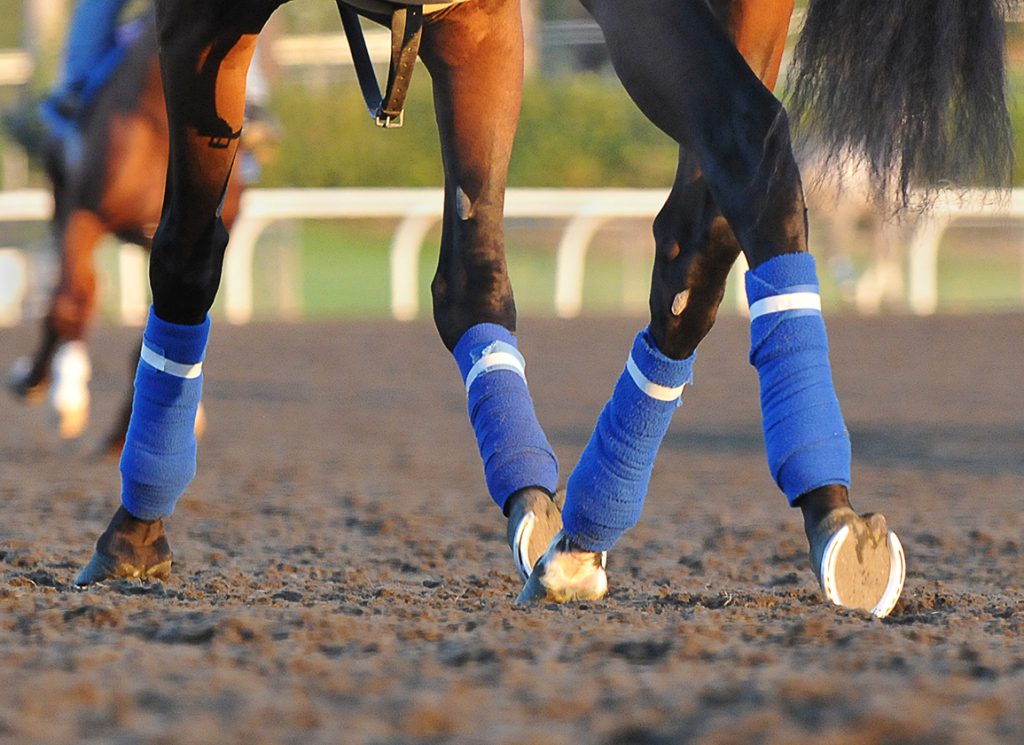
The results were dramatic. What we learned was the effect of “slide” on the lower limb of the horse. With Queen's Plates, the front foot has an average slide on dirt of 3 1/2 to 5 inches. The average slide on synthetic was 1 1/2 inches. Slide is important to understand. It's the “give” in a horse's stride. The increased length of slide on dirt causes two things to happen. First, it magnifies torque on a horse's lower limb. If a horse “toes in” the limb incurs torque medially because of the increased forces on the outside of the hoof. If they toe out, then the torque is lateral with the increased forces on the inside of the foot. And when horses step in holes on a dirt track, the torque can go either way. This doesn't happen on synthetic tracks because of the shorter slide which greatly diminishes torque. Also, a horse's foot is always landing flat on a synthetic surface as opposed to the cuppy holes that cover a dirt track. Synthetic also provides a much higher energy absorption than dirt with a higher energy return.

The second important factor that we were able to measure was the magnified load on the pastern that was presented on dirt. Because of the exaggerated slide and delayed break over on dirt, the pastern continues to load through the stride, increasing its drop by as much as an inch over synthetic. We were also able to see this increased load when horses landed in the “holes” created on dirt tracks.

As you can visualize, the increased load or drop of the pastern creates excessive strains on the suspensory apparatus of the horse's lower limbs magnifying the opportunity for a catastrophic failure. When a horse blows out its suspensory apparatus in a race it leads to a broken leg in the next few strides.

Suspensory and tendon injuries are extremely rare on synthetic but occur way more frequently on dirt because of these magnified strains.

The videos also exposed how lethal toe grabs were on all surfaces. They were especially detrimental on synthetic because they abruptly stopped the foot not allowing any slide. This is why trainers were experiencing rear-end injuries early on because they were continuing to use toe grabs on the rear feet.
Sarah Andrew

Catastrophic break downs are rarely caused by one bad step although this is more likely on dirt. As most orthopedic surgeons will testify, they are the result of cumulative microscopic injuries that accrue with the thousands of steps a horse accumulates in training and racing. It's the laws of physics. Excessive torque and loads on a horse's legs will eventually take its toll. With a synthetic surface these strains are greatly diminished and a horse's natural ability to remodel its bone will repair and strengthen it at a cellular level.

We not only have the irrefutable data over hundreds of thousands of horse starts on synthetic but we have the notable success of several major tracks that have employed them.

The first is Keeneland. The last meet they ran on synthetic in 2014 was the most successful meet in Keeneland's history at that point. All-time attendance and handle records were set. There were record field sizes, minimal scratches with inclement weather when races were taken off turf. And most importantly, there were zero breakdowns!

The second is Santa Anita. The last meet run at Santa Anita in 2009 had an injury rate of 0.57 per 1,000 horse starts compared to their pre-synthetic era on dirt of 2.78 per 1,000. That computes to a 4.8 times higher safety record. This is in spite of a poor-quality installation that would not properly drain, eventually having a subsurface membrane failure allowing aggregate to float to the surface.

Here are some compelling stats from three tracks currently running on synthetic surfaces: Golden Gate, Presque Isle, and Gulfstream.

Golden Gate had an injury rate of .38 per 1,000 with 12,986 horse starts in 2021 and 2022 on their Tapeta surfaces.

Presque Isle race meets in 2021/2022 had 0.24 injuries per 1,000 with 8,178 horse starts.

Gulfstream with its newly installed Tapeta track had the best record of all with only one injury out of 7,085 horse starts with 0.14/1,000. This translates to a 9.7 times safer surface than their dirt track.

Belmont has recognized the advantages of having a synthetic surface with its scheduled completion in the spring of 2024.

Injuries on a national basis have dropped significantly at certain tracks since the implementation of intensified pre-race veterinary examinations of our horses and have the promise of continuing to diminish injuries with mandated requirements by HISA. This high-level scrutiny of starters combined with the safest possible racing surface will dramatically reduce injuries and show the world that we care.

Horseracing is a sport with a rich history of tradition. The thought of changing the racing surface of the Kentucky Derby to a synthetic surface will not appeal to those that value tradition above the safety of our horses and the survival of our beautiful sport. If we do not take drastic proven steps to significantly eliminate breakdowns we are destined for the fate of Greyhound racing.

Today's public has no stomach or tolerance for what they perceive as abuse of our horses. The “writing is on the wall” or in our case the New York Times, CNN and the 6 o'clock news. We either embrace innovative change supported by the data to maximize safety for our horses and riders or we are destined to experience a slow painful death.

The post Letter to the Editor: Bill Casner appeared first on TDN | Thoroughbred Daily News | Horse Racing News, Results and Video | Thoroughbred Breeding and Auctions.


Source of original post

The Week in Review: Triple Crown, Let’s Talk…

Well, Triple Crown, now that the book has been closed on your 2023 campaign, it's time for your annual performance review.

Yes, I realize you're not a tangible, actual entity, and that your entire being is really just a concept based around the sequence of three historic horse races conducted over a five-week span every spring. As such, perhaps you think you're above a little constructive criticism. But we're living in a new era of accountability and I know you want to do your part to remain the focal point on which our sport so vitally depends. So let's begin…

For starters, thanks for saving the best performance for last. We all know you weren't technically “on the clock” this year, because no Triple Crown sweep was on the line this past Saturday.

Sure, there's always tremendous appeal in getting to potentially witness a once-in-a-generation horse run the Grade I table in the Kentucky Derby, Preakness S., and Belmont S. But some of the better overall experiences on Belmont Park's big day have been years in which no Triple Crown sweep was up for grabs. Although a 50,000 attendance cap would have been imposed either way, allowing 48,089 racegoers to enjoy a comparatively uncrowded afternoon of formful stakes action and big-event socialization without having to endure excruciatingly long lines for betting and basic amenities is always a plus.

The Belmont undercard stakes this year touched on just the right mix of intriguing and, at times, inspirational story lines. The distaff division is enjoying a nice run right now, anchored by a reliable cast of well-matched characters, with Clairiere (Curlin) executing an impeccably timed late run to win the GI Ogden Phipps S. for the second consecutive year. Caravel (Mizzen Mast), a Pennsylvania-bred mare with a penchant for unleashing triple-digit Beyer Speed Figures when sprinting on the turf against males, did so again on Saturday, extending her winning spree to five with a speed-centric victory in the GI Jaipur S. And although it hardly seems fair to keep relegating fan-fave Cody's Wish (Curlin) to undercard status when he's an A-list headliner in his own right, this deep closer again uncorked a loop-the-group move that wowed the crowd (112 Beyer!) and left a decent field reeling in the GI Metropolitan H., proving he currently has no peer in the dirt mile division while winning for the sixth straight time.

The crowning achievement, of course, was the gutsy score by 7-1 upsetter Arcangelo (Arrogate) in the Belmont S., propelling his conditioner, Jena Antonucci, into the history books as the first woman trainer of a Triple Crown race winner.

The “Test of a Champion' win by the underdog gray (who cost just $35,000 as a yearling) also capped a nimble feat of Triple Crown jockeying by Javier Castellano, who pulled off the unusual double of winning the Derby with Mage (Good Magic), and then the Belmont with Arcangelo after Mage ran third in the Preakness and bypassed the Belmont.

Despite being elected to the Hall of Fame in 2017, Derby and Belmont wins had eluded Castellano up until this season. We can now look forward to the drama of Castellano possibly having to choose between riding either Mage or Arcangelo should the Derby and Belmont winners cross paths later on this summer, perhaps in the GI Travers S. Regardless of which one he opts for, it's a nice problem to ponder.

But please, Triple Crown, in future years, spare us the “smoke show” that preceded this year's Belmont Stakes Day, forcing the cancellation of Thursday's racing at Belmont Park and almost putting the big day in doubt until the air cleared.

For certain, dangerous air quality because of forest fires hundreds of miles away is out of your direct control. But the unhealthy haze and apocalyptic-looking yellow skies did happen on your watch, Triple Crown, and like it or not, the sport is going to have to reckon with–and have contingency plans for–similar adverse environmental circumstances down the road. Get ready for a summer of becoming just as familiar with the abbreviation AQI (air quality index) as you are with AQU (Aqueduct).

Winding the watch back five weeks, what stands out is how the entire complexion of the Triple Crown pivoted on the morning of the Derby, when morning-line favorite and 'TDN Rising Star' Forte (Violence) was compelled to scratch because of a right front foot bruise. That news overshadowed the defection of not one, but three top California-based contenders–Practical Move (Practical Joke), Geaux Rocket Ride (Candy Ride {Arg}) and Skinner (Curlin)–because they had all spiked fevers earlier in the week.

And although the 15-1 victory by the small-framed Mage had a very likeable “little horse that could” vibe about it, the industry never got to capitalize on that story line because of the sobering and oppressive news of the 12 Thoroughbred deaths at Churchill Downs during the early portion of the Derby meet, a crisis that to this point has not been shown to have any exact or common cause.

Mage managed to win the first leg of the Triple Crown in just lifetime start number four. That's great for the colt and his connections, but not necessarily ideal in terms of adding to the current “less is more” trend of racing top-level sophomores so sparingly. Too many horses are being aimed for the Triple Crown with only two races between the first Saturday in November and the first Saturday in May, diminishing the value of being able to enjoy and assess emerging stars.

Underscoring how the Derby itself is devolving into a be-all/end-all, one-shot endeavor at the expense of the Triple Crown race that follows it, for the first time in 75 years, Mage was the only horse out of the Derby to enter the Preakness. That hadn't happened since 1948, when Citation  scared off a large portion of his competition en route to his Triple Crown sweep. Mage didn't so much “scare off” his rivals this year as the connections of those horses hewed to the increasingly standard script that calls for post-Louisville bubble wrap and rest instead of crab cakes and robust competition in Baltimore.

As a result, the Preakness this year lured only seven to the entry box. Two of them were Maryland-based longshots and two others were taking a shot chiefly because they had earned paid-for starting berths by winning minor prep stakes earlier in the year.

National Treasure (Quality Road) ended up sleep-walking the Preakness field on the front end. His slow-paced victory was not an artistic success, and the lack of depth in the middle jewel did spur the predictable assortment of columns and social media opinionizing advocating for restructuring the Triple Crown series to better align with the realities of race-spacing.

While fiddling with the Triple Crown schedule remains more of a thought experiment than an actual movement that has traction, the sport is most certainly going to have to brace for a near-term tradition jolt in time for the 2025 Belmont S.

After the 2024 edition, Belmont Park will undergo its projected $455-million teardown and rebuild, and the New York Racing Association will have to decide where to stage the concluding jewel of the series in what is expected to be a one-year interim until the reimagined version of Belmont Park opens.

Moving the Belmont S. to Aqueduct–like during 1963 through 1967, when the current version of Belmont was under construction–is an option. But heading upstate to Saratoga Race Course would also be a tantalizing tweak to tradition.

Are you up for it, Triple Crown?

This concludes your annual performance review. We'll score it a C for both the Derby and the Preakness this year. The Belmont rates an A-minus.

In terms of the overall series, we'll call it a “work in progress.” That's because the sport can always benefit by leaving room for–and expecting–Triple Crown improvement.

The post The Week in Review: Triple Crown, Let’s Talk… appeared first on TDN | Thoroughbred Daily News | Horse Racing News, Results and Video | Thoroughbred Breeding and Auctions.

Source of original post

Saturday Insights: Bolt d’Oro Filly Opens Belmont S. Card

1st-BEL, $90K, Msw, 3yo/up, f, 6fT, 11:20 p.m.

A New York-bred daughter of 2022's champion freshman sire Bolt d'Oro, ADVANCE ATTACK makes her afternoon debut to open the card on Belmont S. day. Purchased for $450,000 out of last year's OBS April Sale, she is a half-sister to GI Shoemaker Mile S. winner Bolo (Temple City), SW Build to Suit (Dominus), and GSP Let Me Go First (Paddy O'Prdo). Her dam, unfortunately lost in 2021, was a half to the dam of GI Kentucky Derby upsetter and Canadian champion 2-year-old colt Mine That Bird (Birdstone) and MGISW Dullahan (Even the Score). Racing out of Todd Pletcher's shedrow, Advance Attack gets the services of Manny Franco in the irons. TJCIS PPS


The post Saturday Insights: Bolt d’Oro Filly Opens Belmont S. Card appeared first on TDN | Thoroughbred Daily News | Horse Racing News, Results and Video | Thoroughbred Breeding and Auctions.

Source of original post

Repo Rocks Is Racing’s Most Improved Horse. How Did Jamie Ness Do It?

When Repo Rocks (Tapiture) finished ninth, beaten 16 lengths, in the Oct. 29 GII Bold Ruler S. at Aqueduct it looked like the horse had hit rock bottom. He ran a 62 Beyer, had lost six straight races and his last two starts by a combined 29 1/4 lengths. He had won just three from 29 lifetime starts.

But on Saturday that same horse will be the second choice at 4-1 in the morning line for the Metropolitan H. at Belmont Park. He's won five of his last six starts, all of them in stakes company and has a legitimate shot of winning one of the most prestigious races on the calendar, one with a $1 million purse.

What has changed? The trainer. After the Bold Ruler, his owner, Double B Racing Stables, transferred him from trainer Gregory DiPrima to the barn of Jamie Ness. Some six months later he is the most glaring example yet of Ness's ability to take seemingly ordinary horses and turn them into winning machines.

He says there are no magic formulas, just hard work and good horsemanship. When it comes to Repo Rocks, even he has trouble explaining how he got the horse to where he is.

“I don't really know,” Ness said when asked to explain the gelding's turnaround. “The owner sent him to me maybe six months ago. He had been a pretty good horse, but his form had been tailing off. I had a couple other horses for them that had done good. They said see what you can do. For whatever reason, he just did good in our program. He's a big, strong, sound, good training horse. We're just happy to have him.”

When pressed for more answers, Ness said he believes the work he has done with Repo Rocks in the mornings has paid off.

“When I first got him, I was looking to get his confidence back up,” he said. “I thought maybe I would run him in a two other than allowance or even run him for a tag. That was the route we were thinking about taking. Then he worked really good. He's kind of a hard horse to train. He wants to get out, he kind of wants to run off. I think I got him settled down and training right and that was the key to it. Since he worked so good, we decided to take a shot in a stakes (the Let's Give Thanks S. at Parx). We took a shot and he won. He just got up. I thought then he'd be a bottom level stakes horse around here and we'd be fine. But he just kept getting better and better and better and here we are.”

After the race at Parx, he returned at his home track to win the Blitzen S. and then Ness started aiming higher. Repo Rocks won the GIII Toboggan S. and then the Stymie S. before finishing second in the GI Carter H. He returned to the winner's circle in his most recent start, the GII Westchester S, which he won by 5 1/4 lengths and earned a 109 Beyer.

Repo Rocks started off his career in the barn of Bill Mott, going 0-for-7 for the Hall of Famer. He was claimed for $40,000 by Tom Morley and managed to win a maiden special weight race for that barn. Then, he was claimed by his current owners for $40,000 at the 2021 Saratoga meet and turned over to trainer Juan Vazquez. After making seven starts for that trainer he was sent to DiPrima, who has struggled to make it to the winner's circle over the last two years. His combined record for 2022 and 2023 is 4-for-118.

Jamie Ness | MJC

Those who have closely been following Ness's career couldn't have been that surprised that Repo Rocks had blossomed under his care. Ness, who started training in 1999, is a prolific winner on the Mid-Atlantic circuit. He has 3,947 career wins and is winning at a rate of 25% for his career. He's had three years where his winning percentage has topped 30%. Ness is a regular at Parx, where he's won the last three training titles, Delaware Park and at the Maryland tracks.

When you consistently do that well, win at such a high percentage and improve so many of the horses that come into your barn whispers and innuendo are sure to follow. Ness acknowledges that there are those within the industry who believe that his success is too good to be true and that he must be cheating. He said that's something he has been able to block out.

“There's nothing I can do about that other than bring my horses over,” he said. “We're running under the same protocols that everybody else is. They can say whatever they want. It doesn't bother me.  We'll prove it on the racetrack. I have turned some horses around but I've had a lot of horses that go the other way. They don't talk about those horses. Former stakes horse that become bottom-level claimers. We've been winning at a high percentage for a long time, so I've been dealing with the naysayers for a long time. I've learned to deal with it and at the end of the night I know that I'm doing the right thing That's all that matters.”

He said there was a time when he let the doubters get to him.

“It was a little tough at first,” he said. “I wanted to fight back. Early on when I was winning training titles all over the place I had a little trouble with it.  But now I don't really give a flying you know what about that stuff.  I know, my owners know, my jockeys know the work we put into this. Success doesn't come by accident.”

Ness arrived at Belmont mid-week to prepare Repo Rocks for the most important start of his career. He will also be represented Saturday by Calibrate (Distorted Humor) in the GII Brooklyn S. Calibrate will be making his first start for him after being trained by Coty Rosin. Ness isn't downplaying the moment. Despite having nearly 4,000 wins, he rarely competes at this level. Repo Rocks is just the second horse Ness has started in a Grade I race. The other was Ghost Hunter (Ghostzapper), who finished 11th in the 2017 GI Arlington Million.

“Winning this, It would mean everything to me,” he said. “The other horse we ran in a Grade I, he was just overmatched. This time I'm coming into the race with a shot. It makes those times I was running $5,000 claimers at Beulah Park and all the hard work we've put in worth it. Hopefully, it will pay off on Saturday. It's would be good for people like me who are good trainers, but maybe don't have the top horses or opportunities that other people get. It's kind of for all those guys. We've got this opportunity and we're really going to try to take advantage of it.”

It could happen. Repo Rocks is on a roll and his speed figures suggest he's as good as anyone in the field. And he's got Jamie Ness behind him.

The post Repo Rocks Is Racing’s Most Improved Horse. How Did Jamie Ness Do It? appeared first on TDN | Thoroughbred Daily News | Horse Racing News, Results and Video | Thoroughbred Breeding and Auctions.

Source of original post

Verified by MonsterInsights