The X-Ray Files: David Ingordo

The TDN sat down with bloodstock agent David Ingordo for this second offering in a series presented in cooperation with the Consignors and Breeders Association (CBA). Through conversations with buyers and sellers, the series looks to contribute to the discussion on radiograph findings and their impact on racetrack success.

Bloodstock agent David Ingordo, whose resume includes such superstars as Zenyatta and Flightline, has a stockpile of experience and a team of trusted veterinarians to work with when he travels the sales grounds looking for his next future champion. For Ingordo the all-important vet work is just one part of the puzzle and utilizing it properly helps him to determine when he's getting a bargain and when it's time to walk away.

“The radiographs are one of many tools that we use once we are deciding if we are going to buy a horse or not,” Ingordo said. “Obviously, we inspect them on physical, and then we look at the pedigrees and then we decide if they make the short list. If they make the short list and they jump through a couple other hoops–do they fit whatever trainer or owner I'm working with–then we make that decision to move forward and turn the vetting in to the vet we use.”

Over the years, Ingordo has developed trusting relationships with vets like Dr. Keith Latson, Dr. Nathan Chaney and Dr. Jeff Berk.

“They are all really practical veterinarians,” Ingordo said. “They understand what these horses are going to do. One of the strengths, I feel, with our vets looking at radiographs and interpreting what they tell us is we tend to be forgiving from a practical standpoint. You have to remember, it's a very subjective game. I try to use people that I find their observation and subjectivity is in line with mine and the clientele that I represent and what our goals are.”

At the end of the day, the vet report represents a risk-reward quotient for Ingordo and his clients.

“The X-rays are just part of the puzzle,” he explained. “You have to know how that piece fits when you are buying a horse. If people want a perfectly clean horse, that's fine, that's their prerogative. They're going to pay for that because, if it's a good-looking horse with pedigree and clean X-rays, they top the sales a lot of time. That doesn't mean it's a bad thing, but if you are willing to be a little more forgiving, which we try to be, and you have experience with certain issues–Dr. Latson was great. He would say, 'David, on the racetrack, I've seen this issue 100 times. And my question would be, 'How many times was it limiting in the horse's soundness or their performance?' And he would say, 'Never.' 'Great. I'm in. I'll buy that one.' Or he would say, 'This is one we saw a lot of unsoundness with.' I would ask what is my percentile. He said, '60-40 to be unsound and then once we do the surgery, you have a worse chance of it recurring.' Ok. That's not for me. That's what I need to know.”

Knowing what he can and cannot accept on a vet report has often allowed Ingordo to buy horses at a bargain price.

“We take a lot of chips out,” he said. “At the 2-year-old sales, let's say, they work well and they chip an ankle. It's a garden variety P1 and they are clinical, they have a little pressure in there, and the horse should bring $300,000-$400,000, but because people don't want to give it the time, I can get it for half-price. And the horse is never going to have any residual issue there, best I can tell going into it. For a $2,000 surgery and 60 days stall rest and turn out, which the horse probably needs anyway. What the heck? That's not a bad thing for me.”

On other issues he deals with, Ingordo said, “A lot of sesamoiditis makes me want to scan a horse. If I scan them and that sesamoiditis isn't causing any tears or strain or there are no problems where the ligaments and the suspensory branches attach into the sesamoid, I will probably give that horse 60 or 90 days off and have a perfectly sound horse. And I will probably get a discount. That's ok for me. But if I scan that horse and I find tears, I am out. Because I have had bad luck with that.”

Knowing what issues are acceptable risks with a racehorse prospect should, theoretically, be the same criteria used for pinhooking prospects, right?

“One of my greatest pet peeves in this business is when a vet tells me this horse is OK race, but not to pinhook,” Ingordo said. “I understand what people mean by that, but it isn't a good way to describe it. Every horse is ultimately meant to be a racehorse. I don't care if you buy it for $1,000 or $1 million, the goal is to get these horses to a racetrack, run them around in a circle, bet on them and hopefully get your picture taken because your horse is faster than your competitors. So when I hear that, I understand what they mean and I will call it shorthand. If you are racing this horse and there is no more scrutiny on it from potential future buyers, then these little–I call them jewelry on their X-rays–they have a little old chip that is rounded off, they have some sclerosis here that looks like it's healing, they have an OCD that they didn't take out, but it's not on a weight-bearing part of the joint or doesn't communicate, or they have an OCD somewhere that isn't articular–the horse has a good chance of being racing sound and he's going to be ok. If you have to take this horse and resell it and it performs with a fast time at the 2-year-old sales or grows up to be some Adonis and everybody is going to come vet the horse, people could have differing opinions if this horse is 'clean.' I joke when you pinhook you have to find a horse that the most inexperienced person that has money can approve, so you get the most buyers on that horse.”

He continued, “I love a homebred that is a really good individual that you know he won't pass the commercial market standards on X-rays. What's wrong with him? Little B.S. stuff, but he's never been lame a day in his life, his joints have never blown up. He's been sound, he trains every day, he eats every day, he does everything right. Those horses usually stand up and they would have gotten killed by the scrutiny of the commercial market. Everything needs to be a racehorse and I think we need to remember that, as an industry. That's the ultimate goal.”

For the best way to back up the accumulated experience of what issues hinder performance on the track and the anecdotal evidence of racetrack success stories who had 'failed the vet,' Ingordo envisioned a quixotic research project.

“We have an amazing opportunity to get all this data,” he said. “If you just took the September sale–it's a huge population, it's an annual event–there are 5,000 every year and if you did a 10-year study, just on September yearlings, that's 50,000 horses that go from the most expensive horses sold in the world down to $1,000 or one bid horses and you would see all up and down the ladder. You could rate them, almost say these have a good chance of making the races, these ones we would say have super limiting X-ray findings and then follow those and classify them, these are stifle issues, these are ankle issues, these are hock issues, these are knee issues. I think you could start to draw some really good conclusions. If someone wanted to do that. But that's a massive, massive undertaking.”

Click to read last week's The X-Ray Files with Tom McCrocklin.

The post The X-Ray Files: David Ingordo appeared first on TDN | Thoroughbred Daily News | Horse Racing News, Results and Video | Thoroughbred Breeding and Auctions.
Source of original post

Letters to the Editor: Texas Horse Racing Needs HISA

The horse…inquisitive, sensitive, totally aware, much smarter than you think, fearful, and a creature of habit. When my daughter returns to our family barn after training in Florida for six months, her retired horses greet her with a whinny. An old friend has returned.

The horse is a fabric of historical Texas. The horse represents how we all arrived here, and how we survived in the earliest days. Some horses are bred to run–that's their job. All animals need a job and thrive when working. The thoroughbred's instinct is to run as fast and as far as it can. As long as there are horses, there will be horse races, and men and women will admire the sheer determination, stamina, strength, and speed of the majestic horse.

The tragedy at Churchill Downs this past May, in which twelve horses broke down on the racetrack, fractured their lower legs and needed to be euthanized, should never be repeated. The cause of this rash of sudden breakdowns is uncertain: the current American thoroughbred may be bred too strong up top across the chest with lower legs that are relatively too thin and fragile, or changes in the surface of the track due to humidity and weather variations may increase the risk of a ligamentous injuries which can then predispose to falls and catastrophic fractures. Most horses can survive the surgery, but few can survive the confinement and partial weightbearing needed to allow these fractures to heal.

The Jockey Club, in recognizing this problem, sought relief from Congress and in one of the few truly bipartisan pieces of legislation in the past 10 years, the Horseracing Integrity and Safety Act (HISA) was passed. This lifesaving legislation allows the government to designate a corporate entity to unite the horse industry, to find ways in which horse tragedies can be eliminated, and drug abuse can be regulated at the Federal level.

The model is not a new one. A Federally sponsored corporate entity serves to regulate the Securities and Exchange Commission. The needs are similar. Regulation among multiple states with multiple interests are consolidated under a single governing body with superior resources and a single purpose-driven goal.

In response to the HISA act, most states have supported and endorsed this model, but a few outliers, including the State of Texas represented by the Texas Racing Commission, have sought to preserve the status quo.

The Commission's stated rationale is that only the Texas Racing Commission may regulate parimutuel racing and simulcast wagering in Texas. Although National regulation affects all aspects of our life living in Texas, the Texas Racing Commission, due to this perceived legal technicality, has been unable to find a compromise solution. As a result, the Texas racing industry suffers, the Texas patrons who enjoy horseracing suffer, and our thoroughbred gladiators suffer the most.

A second consequence of this stalemate is that racetracks in Texas can no longer simulcast Texas races to other communities and states and receive wagers allotted for their racing program.  Without the ability to simulcast, the betting handle at Sam Houston Racetrack during the winter meet fell 90% and the handle at the current Lone Star spring and summer racing meet is not significantly better. Tracks survive by taking approximately 15% of the betting handle to support their operations and purses. The current situation is unsustainable.

Having served on the Texas Racing Commission for 10 years, including four years as Chairman, I can attest that the Commission staff, stewards, and the working regulators are superb and unmatched in their quality and dedication. The political appointees of the Commission, however, have lost sight of their designated purpose.

In this one rare instance, Congress has actually provided us–and our horses–a solution. Ultimately, HISA has the resources, the regulatory power, and sophisticated lab testing that can root out illegal drug use, research track surfaces, and analyze breeding patterns. HISA has the potential to improve the sport and create a safe horseracing animal that can thrive in a newer environment.

The Texas Racing Commission needs to recognize its responsibilities and protect our animals in an ever-changing world. The consequences of the Texas Racing Commissioners' opposition to these efforts simultaneously leaves our horses at risk and our tracks on the path to ruin.

Texas deserves better.


Robert Schmidt, MD is a Fort Worth based orthopedic surgeon specializing in joint replacement surgery of the hip and knee. He and his wife had bred and raced thoroughbreds under the colors of Oak Meadow Farm. He was appointed by Govenor Perry to the Texas Racing Commission and served for 10 years, including 4 years as chairman. He currently serves as Mayor of Annetta North, Texas.

The post Letters to the Editor: Texas Horse Racing Needs HISA appeared first on TDN | Thoroughbred Daily News | Horse Racing News, Results and Video | Thoroughbred Breeding and Auctions.

Source of original post

Mage Replica Added to Derby Museum Winner’s Circle Exhibit

The addition of a replica of Mage (Good Magic), the 149th Kentucky Derby champion, is among the features added to the Winner's Circle exhibit at the Kentucky Derby Museum. A local artist, Mike Prather, produced the airbrushed the replica. Also,

exhibit provides the Mage team's story and their journey to the Kentucky Derby stage through the self-guided panels in the exhibit.

The Museum will also feature unique artifacts:

  • Two of Mage's horseshoes worn during the Kentucky Derby
  • A harness worn by Mage
  • A Mage hat signed by the team

The Museum's signature 18-minute movie, The Greatest Race, now also includes Mage's late charge to win in Derby 149.

The Museum also updated its lobby banner with pictures of the Mage team celebrating their win. Matted prints of Mage working out and crossing the finish line, shot by photographer Ted Tarquinio, are also available. Prints are available for purchase at the Kentucky Derby Museum Store or online: DerbyMuseumStore.com

For more info on the museum's latest updates, visit derbymuseum.org/derby149


The post Mage Replica Added to Derby Museum Winner’s Circle Exhibit appeared first on TDN | Thoroughbred Daily News | Horse Racing News, Results and Video | Thoroughbred Breeding and Auctions.

Source of original post

Ramspring Farm Hits the Mark with a Top-Class Turfer

The rest of the Patrick family had all come and gone by the time Belle's Finale (Ghostzapper) was preparing to sell at the 2017 Keeneland November Sale, but Mary Leigh Patrick was there to watch as the pretty bay mare stepped into the ring. Mary Leigh had decided to hold out for the rest of the session, hoping to find one last addition for Ramspring Farm's broodmare band ahead of another breeding season.

The octogenarian knew she had accomplished the mission when she spotted Belle's Finale, an unraced 3-year-old out of GISW Capote Belle (Capote) carrying her first foal by Not This Time, and she secured the winning $70,000 bid.

Mary Leigh's son Clay Patrick, an attorney in their home town of Frankfort who also works alongside his mother to oversee the daily operations of Ramspring, has spent decades observing his mother's knack for scoping out value at the breeding sale.

“She just loves horses, period,” he explained. “She could look at horses all day long, 24/7. She goes into the sales and waits until the last one sells, making sure they don't slip through the cracks. She's very good at spotting a good-looking horse and finding a new mare that might be a good addition for the broodmare band.”

While the acquisition of Belle's Finale exemplifies her purchaser's bargain buying routine, the mare's accomplishments since she arrived at Ramspring have been far from ordinary as her son Up to the Mark (Not This Time) has emerged as one the top turf horses in the country.

When the Patricks were impressed with Belle's Finale's first foal, they sent the mare back to Not This Time and the resulting foal was Up to the Mark. The February-foaled colt was a standout throughout his time at Ramspring.

Clay Patrick recalled how their team, along with Taylor Made advisor Stuart Angus, always thought highly of the youngster.

“Stuart comes out frequently and inspects the horses and the foals and he gives them a grade,” Patrick explained. “I think the colt was one of the few horses that he's ever given an A- grade to on every occasion that he saw him. He was very handsome, a very good-looking young foal from the day he was born until he went to the sales ring.”

While Patrick described sending the colt through the Keeneland September ring to sell for $450,000 as a thrill, he said it has been even more gratifying to watch Up to the Mark's rise to the top of the sport this year.

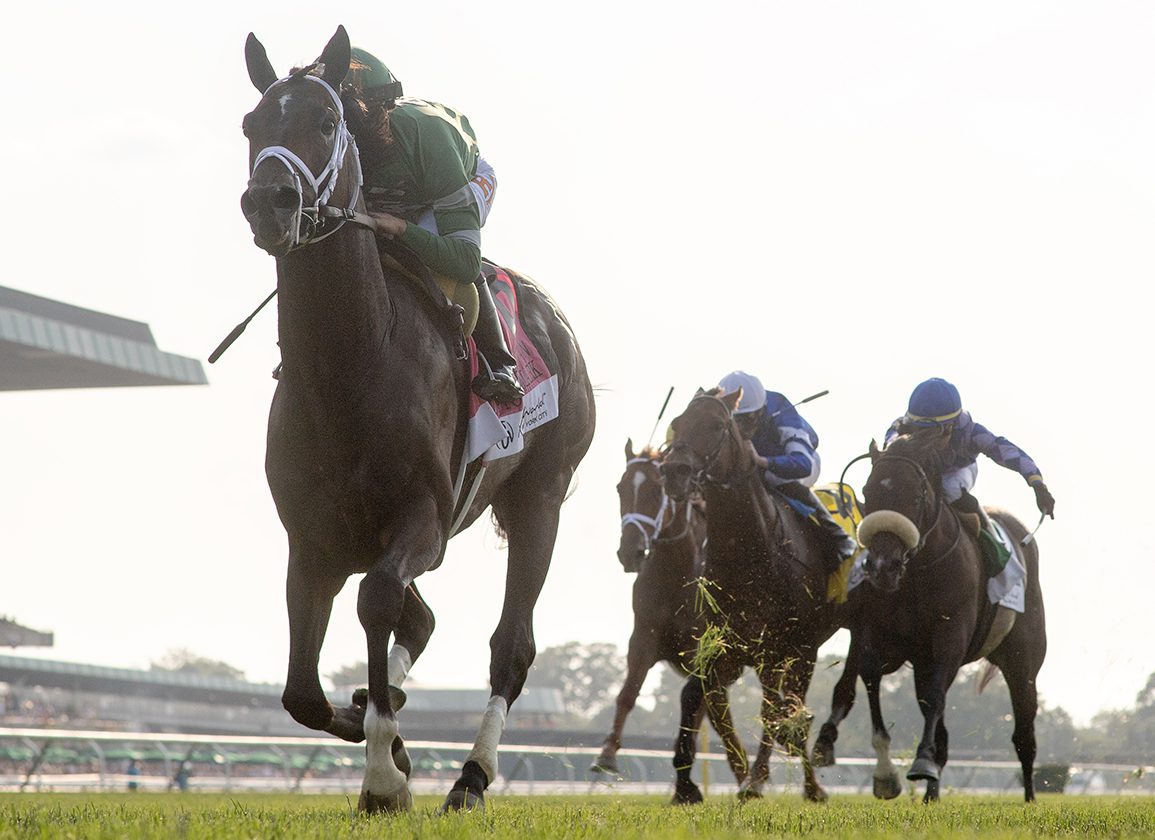
Up to the Mark gets a second Grade I victory in the Manhattan S. | Sarah Andrew

The Todd Pletcher-trained, Repole Stable and St. Elias Stables-campaigned 4-year-old has made a name for himself after switching to the turf, recently reeling off masterful performances in the GI Old Forester Bourbon Turf Classic S. and the GI Resorts World Casino Manhattan S.

“When he turned for home, it was just a thrill,” Patrick said of the recent victory on Belmont weekend. “The hair stood up on the back of my neck when he got loose. Just seeing the horse that you nurtured and took care of from conception to the day he was a mature athlete ready to run was something. Todd Pletcher and the owners have done a super job with him.”

Up to the Mark was one of the 12 to 15 foals Ramspring Farm breeds every year. The breed-to-sell operation focuses on quality over quantity and has been a family business from the beginning.

Mary Leigh and her husband Mac, a surgeon and businessman deeply involved in the Frankfort community, purchased the 200-acre farm in 1976. They named it after the spring located on the property that once had a ram pump system used to send the spring water uphill for livestock.

“I think it was something that they always wanted to do,” Patrick explained about his parents' desire to get involved in the horse business. “They had it in their mind that they wanted to and then once they took the plunge and got into it, it was in their blood.”

Bail Out Becky (Red Ransom) was one of the first horses to gain the Patricks recognition in the Thoroughbred world when she won the 1995 GI Del Mar Oaks and earned over $700,000 for Ken and Sarah Ramsey. Other standouts among the stakes winners to come off the farm over the years include MGSW Lead Story (Editor's Note), 2012 GI Florida Derby runner-up Reveron (Songandaprayer), the MGISP 2017 GIII Turnback the Alarm H. winner Eskenformoney (Eskendereya) and GSP Winning Envelope (More Than Ready).

Ramspring Farm sits alongside the Kentucky River and as the crow flies, is just over a mile from where Dr. James Crow is said to have perfected the sour mash fermentation process used to produce bourbon. Appropriately, the farm is in the early stages of launching their own Ramspring Farm Kentucky Bourbon.

As a teenager growing up at Ramspring, Patrick–who is the youngest of three children–developed his own admiration for the land, the horses and the business.

Unique outbuildings at Ramspring Farm | Katie Petrunyak

“I've always enjoyed being out here and have spent a ton of my time on the farm,” he explained. “The most exciting part for me was to see the foals grow up here and make their way to the sales and hopefully do well on the racetrack. I've moved out here and built a house on the farm.”

Last summer the farm's patriarch, Dr. Patrick, passed away at the age of 87. Mary Leigh continues to oversee the operation from their home that overlooks several of the farm's main pastures, but she now has two more generations of Patricks who have developed their own passion for the land.

“My mother has always taken care of most of the aspects of the farm and is continuing to do so,” Patrick said. “I have three boys and they all enjoy the farm and we combine to take care of it, along with all of the good people that we have working out here. I think the fact that it's a family affair is the most special part of it. We've had a lot of special events and family outings out here. To have the whole family enjoy it is special.”

The farm's star broodmare Belle's Finale has a pipeline of foals that has the Ramspring team excited for the future. While her foal of 2021 died of colic complications, she has two youngsters on the ground and she recently checked in foal to Not This Time.

Her yearling colt by McKinzie is pointing for the Keeneland September Sale.

Belle's Finale and her Maxfield colt | Katie Petrunyak

“He's got a lot of his sire in him and is a big, strong colt,” Patrick shared. “He's got a very powerful motor on him and looks like he's going to be a runner.”

This spring, Belle's Finale foaled a colt from the first crop of Maxfield on April 12.

“The Maxfield is a stoic individual who has a good head on his shoulders and looks great,” said Patrick. “He looks like an A physical to me.”

Until those youngsters hit the sales ring, the Patrick family will await news of Up to the Mark's next challenge as his connections point for a bid in the Breeders' Cup this fall.

“I would say he's definitely the best that we've ever had here,” Patrick said. “That hair-raising experience of seeing him turning for home and giving that final kick, it's something to behold.”

The post Ramspring Farm Hits the Mark with a Top-Class Turfer appeared first on TDN | Thoroughbred Daily News | Horse Racing News, Results and Video | Thoroughbred Breeding and Auctions.

Source of original post

Verified by MonsterInsights