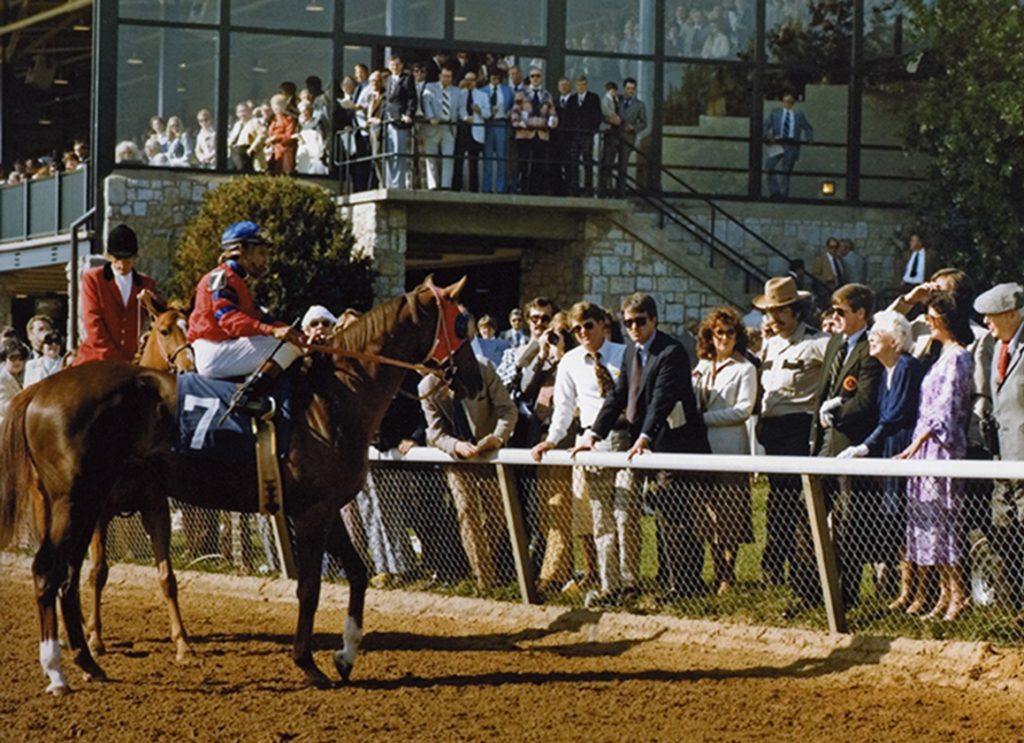
Well, okay, maybe he has retired–but Frank Penn has never quit.
“You know the problem with life?” he asks with a chuckle. “By the time you know everything you need to know, you're too damn old to do anything with it.”
But that won't keep the rest of us from profiting. We're not here to learn about the half-dozen mares Penn still shares with brother John and nephew Alex, over at their place near Paris, nor about the show horses keeping him interested in his own paddocks. Instead we're at chez Penn, on the Mount Horeb Pike outside Lexington, simply because few in our community bring longer experience to the ever-renewing challenges of the Turf. He's served 17 years on the city planning commission, twice as many as trustee of Georgetown College. He was one of the founding fathers of Horse Country, and has been with the KTA/KTOB forever. Nowadays, even at 78, he's helping the Agricultural Finance Board in Frankfort.
Still immersed, then, in the 21st Century Bluegrass. But have any of you, for instance, lately worked a sale the way he did, half a century ago–when Penn Brothers sold 70 yearlings in a single afternoon at Keeneland?
“It was unbelievable,” he recalls. “We had every third horse that went through. Never worked harder in my life. Talk about learning how to do things, how to cut and cover. We couldn't clean stalls. All we'd do is pitch it up in the corner and put more bedding in.
“Now, we didn't prep these horses like you do now. In the wintertime we ran them like cattle, put a halter on literally a month before the sale. We had catch-pens, we'd put a halter on, trim them, worm them, turn them back out. Of course when we got them up there [to Keeneland], you'd have three or four getting loose, running over the hill. But everybody's did that. And everybody sold their whole draft.”
After all, he never saw a horse with bad feet in the Pampas, when he had a chance to see how they did things down there.
“But I guess they were just bred different then,” he says with a shrug.
So, too, were the horsemen. As he puts it himself, Penn “became an economic asset at 14.” Bear in mind that his father and two uncles bought their farm at the end of the 1920s, even as all hope, all belief, was being gnawed out of their generation.
“They paid $350 an acre for 200 acres,” Penn explains. “They put 160 of those acres in tobacco and it brought a dollar a pound. A year later, it brought a quarter a pound. On the other hand, during the Depression they had all the help they could hire. So they just kept expanding. They were three risk-takers, and they knew how to work.”
By the time young Penn was putting his shoulder to the wheel, they had 480 steers–and a couple of hundred Thoroughbreds.
“They'd bought a farm that had horses on it,” he says. “Belonged to an Oklahoma oilman. So they just started boarding them. That's when they learned to be horsemen. And Oscar, the oldest brother, he really got into it. He studied it and decided that we needed two stallions. Well, we needed two stallions like we needed a hole in our head. But we'd set tobacco till noon, go in, eat right quick, go breed two mares, set tobacco till dark, breed two more mares.”
Penn was actually raised downtown. By living there, his family could share the same commute as the labor, day-hires who climbed onto the canopied pick-up at designated street corners every morning. By 14, Penn was leading a tobacco-topping gang. A year later, he was helping to haul lumber out of the mountains to construct huge barns. For years, “tobacco supported our horse habit.”
But so, too, did the steers–in the sense that one kind of husbandry supported another. A man won't panic, foaling, if he's pulled plenty of calves as a boy. Penn learned the hallmarks of good land, too. He knew, for instance, to be wary when cedars thrived in dry weather.
“Cedars only grow on marginal land,” he explains. “I learned all that stuff, growing up. These were three old, cynical men. But they knew land, and knew that's what they needed to produce the animals they wanted, the tobacco they wanted. Same with this land here. The number of good horses raised by the Elkhorn Creek is staggering. Lee Eaton taught me that. I used to think it was crazy. Then I saw Bold Forbes, and all the rest, and started believing it.”
Penn had grown up chain harrowing, soil testing, just doing what farmers did. Nowadays he sees people coming into the Bluegrass and feeding high-protein alfalfa. He can spot those easy enough.
“All you got to do is go around and see which ones have all that mud [i.e poultice] on their legs,” he says. “Pythiosis. Way too much in the feed tub. That grass out there, if it heads out, it's 18% protein. That's why you keep topping your pastures, you don't want it to head out.”
They bought weanlings before the word “pinhook” had entered the bloodstock lexicon, with only Stanley Petter ahead of the curve. Besides foaling out 50 mares, then, they would buy 20-odd weanlings.
“We found out that you could buy a weanling for $300 to $500 and sell it for $2,500 to $5,000,” he says. “You could raise those babies like you raised steers, but the profit per horse was so much better.
“We'd bed those weanlings on tobacco stems. We had a tobacco warehouse, so we could get carloads of that stuff. It was one of the cleanest things you could use at the time, when we didn't have woodchips or shavings. And then you'd take it out and spread it as fertilizer.”
But whatever Penn learned from steers, it was horses that taught him love. He bought his first mare at 16, as soon as he had a driver's license. For a while the Penns had a satellite farm in Ocala, and that was another vital chapter in his adolescence: selling 2-year-olds at Hialeah.
“We'd raise 15 or so down there, broke them, did the whole thing,” he recalls. “So really I got baptized pretty good, pretty young, though it wasn't as speed-crazy as now. Anyway I learned about sand colic, about fire ants, all that kind of stuff. It was all experience, and it served me well.”
Knowing what he wanted to do in life, it was only to please his mother–so that she could say that he'd “attended” college–that he consented to a single semester at Georgetown. But then he got his Vietnam draft number, and it was the kind that made you gulp. Suddenly he had to engage.
“Every hour I wasn't in class, I was in the library catching up,” Penn recalls. “Because if I flunked out, 90 days later I'd be in a rice paddy.”
Whether or not Georgetown College saved his life, it certainly changed it. He has been serving that institution in various roles ever since graduating in 1968. Around that time his father and uncles began to dismantle their partnership, and help the next generation on its way. His parents gave Penn the downpayment on an 87-acre plot, the core of which is where he remains today.
“But I soon found that my tobacco wasn't supporting my horse habit,” he recalls. “And then I got married, had kids, and had to find another way. I started boarding horses, and found out right quick that the only people you board horses for are the ones that can pay you. The economics I'd learned in college taught me that it's all about cashflow. You could be worth $2 million, but if you don't have cashflow, it doesn't matter. All you're doing is borrowing and paying.”
What got the household on an even keel was an unraced Pretense mare Penn bought for $34,000. She turned out to have a son in training with Wayne Lukas. He won the GI Remsen S. and started among the favorites for the Kentucky Derby. Penn rolled the dice, managed to get a season to Seattle Slew, and sold the mare for seven figures to Juddmonte.
He paid his $450,000 covering fee, took the rest to the bank, and discovered the pleasant novelty of solvency.
“My friends and family all said, 'You're stupid to sell that mare,'” he recalls. “But the time to get out of debt is when you can. And a couple of years later I could have bought that mare back for $50,000. She never threw another horse that could run.”
They built their house, and built a client base: a small, loyal group that thought the same way. When Penn packed up, his newest customer had been there 20 years.
“We were lucky enough to board horses for people that wanted to enjoy the life with us,” he reflects. “They became like family, watched your kids grow up.”
These included Janis Whitham, her late husband Frank and their son Clay. The Whithams imported a Hall of Famer-in-the-making in Bayakoa (Arg), but thereafter it has all been acorn-to-oak stuff.
“Jan's a very intelligent lady,” Penn marvels. “She and Frank started out raising pinto beans. There's one stoplight where they live, and it's 25 miles to a grocery store. Jan trained Quarter Horses, raised five kids. And, to this day, she hasn't bought a mare. They had Bayakoa, and the Nodouble filly [Tuesday Evening], and one other, and just built up those families. She'll nick them on the bottom, she'll nick them on the top; and she's still doing it.”
The Whithams were determined to get one of Bayakoa's daughters to Mr. Prospector's last son in Kentucky, the unfashionable E Dubai. And that was how they got GI Breeders' Cup winner Fort Larned. From the Tuesday Evening line, meanwhile, came Four Graces (Majesticperfection), sold at Keeneland last November for $2.3 million.
But if Penn's professional career is rooted in the land, so too is his service to the community. When he bought his farm, straight out of college, he paid $2,000 an acre–“and that was $500 more than it was worth.” The value of land would soar, however, as developers realized they could get 10 perimeter acres for the price of one downtown. All around, the countryside was being cut to ribbons, in tracts too small to farm and too big to make communities.
“We were panicking,” Penn admits. “Go through other counties and you'll see it, all these 10-acre piano keys all down the road. Well, that's a terrible way to use land. We were able to convince the Lexington-Fayette County Urban Government to make the minimum subdivision 40 acres. And we've now preserved 32,000 acres. If you add what the Bluegrass Conservancy has been able to do, we saved 52,000 acres in Fayette County. Out of roughly 250,000. It's been a 22-year fight, but I feel good about where it is now, because I think people now understand the value of living here.”
And not just the economic value of the industry and its ancillaries. It was also about cultural identity and, what then remained latent, the resulting potential for tourism.
“John Gaines had it right,” Penn says. “He used to say that we live in the largest privately owned, privately maintained park system in the world.” He gestures towards the pike. “The city doesn't mow any of this. We mow all the rights of way. And why do we do that? Because our neighbor does. It's pride.”
Penn has stepped back from KEEP because it's time for the next generation to inherit the responsibilities that come with land.
“The average age of the Kentucky farmer is 60-plus,” he remarks. “A lot of land is going to change hands in the next 10 years or so. And how do you keep farmers, if farms are cut up in 10-, five-, even three-acre tracts? You don't produce anything. And who's going to come in and buy those tracts and put them back together, when each has its own house? The houses elevate the price of the land, and that price doesn't justify farming it.”
The Purchase Development Rights program, redressing the difference in value, was key to maintaining those 40-acre tracts.
“We were able to make it look like Holsteins versus Dalmatians,” Penn says. “Instead of a piece here, a piece there.”
Penn was part of the team that presented to the tobacco succession program, coming away with $15 million and then got another $20 million from the city. The tobacco money was an apt dividend for a man who had spent much time on the other side of that particular fence, as president of the Council of Burley Tobacco.
Besides his own crop, Penn had managed tobacco for other horsefarms, including Calumet. He was ringside as multiple attorney generals sued the cigarette manufacturers, even as the state was figuring out that it could no longer support a proven carcinogenic. During the public furor, Penn had found himself sent out to bat for tobacco.
“So over several years I learned how to handle polarization!” he recalls. “Because the medical community came after you hard. And there I was, on every radio show, every debate, defending this stuff. I'd never say that smoking's not harmful to you. But I would say it's a personal choice. I'd say: 'Nobody ever held a gun on somebody and told them to go buy a pack of cigarettes. Look, half the people in this audience are overweight. The other half drink too much.' Now all those things are very harmful to you. But the difference was that the government was supporting tobacco. So you could see that it had to stop.”
His tobacco background, incidentally, prompts a fascinating analogy for the modern bloodstock market. Because in terms of prizing speed, Penn reckons that the 2-year-old sales have changed the game much as the cigarette filter did tobacco.
“Before filters, the Burley is what gave the flavor and aroma,” he explains. “The companies needed that tobacco. But once the filter came, they could buy it cheaper all over the world.”
Penn says that if the market is driven by a bullet work, then all pedigrees become the same–much as Rwandan tobacco would now serve just as well as Kentucky's.
“If we're basing everything on how fast they can work, then nobody is prizing three or four generations of soundness,” he reasons. “And not only do you have weaker bone, now you also have trainers no longer racing a horse fit. They're so concerned about their statistics, they won't run a horse until it's dead fit. But guess who pays for that? The owners.”
But nor does he attribute soundness solely to genes.
“If you only turn a young horse out for a couple of hours when it's a pretty day, he won't run,” he says. “He won't have bone density. He may grow up to be a beautiful horse. But when you put pressure on him, he'll fold up like a marshmallow.”
Obviously producing stock equal to the demands of the racetrack today feels more important than ever. And Penn feels that we can't complain about federal interference, when we either couldn't or wouldn't police the game properly ourselves.
“But I swore I would never be a cynic,” he says. “Because I grew up with three old men that were cynical as can be. I mean, they'd see long-haired hippies and tell you the world's come to an end. But they taught me how to work and to understand that work is not really work at all, if you enjoy what you do.”
When Penn needed bypass surgery, a decade ago, he was told that it was time to move on his handful of faithful clients.
“Done all I can do for you,” the doctor said. “You got to get away from the stress.”
“I don't have any stress!” Penn replied. “My farm's paid for!”
Now he smiles and shakes his head. “Yep, something's there, when [clients] have five mares on your farm worth a million dollars apiece and no insurance on them,” he says. “But I didn't see that as stress. I saw that as an opportunity to raise good horses.”
Now the stakes are lower. True, Penn and his brother have an Empire Maker mare whose son Arklow (Arch) won $3 million. But whenever he needs to, he can just stroll to the creek and soon retrieve perspective.
“I have a deck built down there,” he says. “And I take my Racing Form or Wall Street Journal, and just sit there and hear that water go by, listen to the birds chirping, and life's not too bad.
“The point is that we all try to make a business out of it, but really and truly, it's a sport. It's an advocation. And it's so hard to do that people want to try it. You see them putting millions of dollars into this thing and along comes Rich Strike, Birdstone.
“I've always been in love with the horse. Can't be like that with 400 steers, but go down to the barn and every one of those mares are different. And I've been fortunate to be involved in some really neat things. I'm not saying I started any of them. But for whatever reason I was asked to participate, and I never knew how to quit.”

The post A Penn Full of Think appeared first on TDN | Thoroughbred Daily News | Horse Racing News, Results and Video | Thoroughbred Breeding and Auctions.
Source of original post