How to ride your way into the Hall of Fame? Impossible question. Nobody could reduce such a journey, the decades of endeavor and experience, to a single explanation, a single concept. In the case of Chris McCarron, however, you can actually reduce the answer to a single word, simply by asking a different question.
That question is: why did you make seven trips to Washington to lobby for the HISA bill? And the single word, answering both questions? Cooperation.
That's what he always sought from his mounts; and that's also the premise he commends for all our dealings, as an industry, with the Thoroughbred.
McCarron rode professionally for 28 years. If you combine 34,000 race rides with all those he breezed in the morning, you get past 50,000 mounts.
“And what a learning playground that was!” McCarron exclaims. “If I just showed up every day and my boss says, 'I want you to go five-eighths in a minute…' Well, yeah, that sounds simple enough. But I'd be paying attention to every little thing that horse was telling me. And then I would know what to tell it. And I developed a skill, an ability to communicate with Thoroughbreds, in such a fashion that I would get what I'm looking for. And that was cooperation. The most important thing I ever wanted was cooperation.”
McCarron has welcomed TDN to his Lexington home, the exemplary professionalism of that long riding career (along, no doubt, with all the golf he plays nowadays) plainly legible, at 68, in his spry posture and animated engagement. It was 21 years ago this week that McCarron quit the saddle, aptly concluding at Hollywood Park with Came Home (Gone West), his final Derby horse, as his 7,141st winner. His mounts had earned an unprecedented $264 million. But McCarron didn't just ride off into the sunset.
Rewind to another day at the same track, 12 years previously. McCarron is supposed to ride Sunday Silence on his 4-year-old debut. Earlier on the card, however, there's a pile-up. So while Pat
Valenzuela resumes a partnership sundered by a ban the previous year, McCarron is in hospital with a broken femur, fibula and ulna.
And he gets to asking: “What if this had been worse? What if I broke my back, my neck? I better start laying the groundwork for a second career.”
Having always tried to get inside a horse's head, he was intrigued by the idea of training. Methodical as ever, then, he started studying for a possible next vocation. After breezing, he would stick around the barn and see how things were done.
But then the people he was shadowing all started to say the same thing.
“Chris, I hope you're not thinking about getting your trainer's license?”
Why ever not?
“Well, we don't think you can do to a horse what's necessary to win races.”
“This is way before all our new medication changes,” McCarron emphasizes now. “Every barn has a horse that has a problem. Every barn has horses that turn up lame at any given time. I did it for a week and I couldn't stomach it.”
What he had seen was not his idea of working with the horse, of cooperation. That experience doubtless stayed with him, years later, when joining a team knocking one congressman's door after another. He testified. It took eight years to get the bill signed. But this is a man whose dedication to welfare of horse and rider has been unstinting. Indeed, during a stint as general manager at Santa Anita, he banned shockwave therapy.

McCarron in retirement with his grandson Griffin | Katie Ritz
How did that go down on the backside? “Some of the trainers wanted to hang me.”
And that takes us back to this whole business of co-operation. Because just as a jockey can misuse the whip, the pharmaceutical trainers aren't asking a horse, but forcing it.
“Right,” McCarron says. “But I'm optimistic, I really am. There's a plethora of smart, dedicated, persevering individuals who are going to be enforcing these rules; a great group of people that have gotten together for one cause, for one end, and that's the safety of the horses. Being a jockey, that's paramount for me. Because if the horses are safer, automatically jockeys are safer.”
Significant to hear McCarron still describe himself as a jockey. Evidently the born rider never “stops,” any more than he ever really “starts.” Somewhere along the line, he just discovers what he is. Certainly there was nothing in McCarron's Massachusetts upbringing to explain his intuition for the horse. As a kid, his dream was to play for the Boston Bruins. But then his older brother Gregg, simply because he had a jockey's build, had the fortune to be introduced to Suffolk Downs trainer Odie Clelland.
“Turns out he was like our second dad,” McCarron recalls. “Just a class act. Odie was well known for bringing out young boys and girls to learn how to be jockeys, and he was an outstanding horseman as well. So Gregg started playing hooky from school. And a couple of months later during dinner he said, 'Mom, dad, I think I'm going to quit school and get a job on the racetrack.' Mom slams her fork down and says, 'Over my dead body! No son of mine's ever going to be involved with a bunch of derelicts and gamblers and degenerates.'”
She owed this image of the track to a couple of visits a year with the Knights of Columbus.
“And they'd see what we called the 'stoopers',” McCarron recalls. “These old guys with the stogie in their mouth, the hat, binoculars around their neck and an armful of racing information. And they'd walk around stooping down, 'Is this ticket any good? This ticket?' In the filth.”
Mrs. McCarron's opinion can scarcely have been improved after Gregg was given a leg-up for the first time.
“The colt took one step forward and Gregg landed behind the saddle,” McCarron recalls. “The colt bucked him off and then kicked him right in the face. Shattered the orbital bone, broke his nose, broke some teeth. Mom said, 'I'm praying that this will remove any desire Gregg might have to become a jockey.' But as soon as he was healed, he was back on the track. And he stayed there 25 years.”
If that wasn't enough to stop Gregg, who rode 2,403 winners, it certainly wasn't going to stop his brother. McCarron made his own start in 1971, before his senior year in high school, and was instantly besotted. And, actually, when the rest of the family saw the work ethic instilled by the brothers' hardboot mentor, they understood.
“Even when I was still an exercise boy, Odie taught us to pay really close attention to every horse we threw a leg over,” McCarron says. “Not just once, twice, but every time I scale a horse, I should be learning something. So that evolved into learning what makes a horse tick. The more familiar with a horse's desires and dislikes, the more successful I became-and the more part of that horse's performance I became.”
Hence this vital search for a wavelength, “whether it's a filly bouncing all over the place and I get her to settle down, or a big old lazy gelding that needs to be woken up.”
Obviously across 50,000 horses, there were plenty of recurring responses. But you could never make assumptions.
“John Henry was mean as a horse could be, in the stall,” McCarron recalls. “Even though he was a gelding, even at the ripe old age of nine, if you're not careful he'll hurt you. But in the afternoon, he was as straightforward as he could be. Seventeen different jockeys rode him and just about everybody won on him. So he was a very generous horse with his ability.
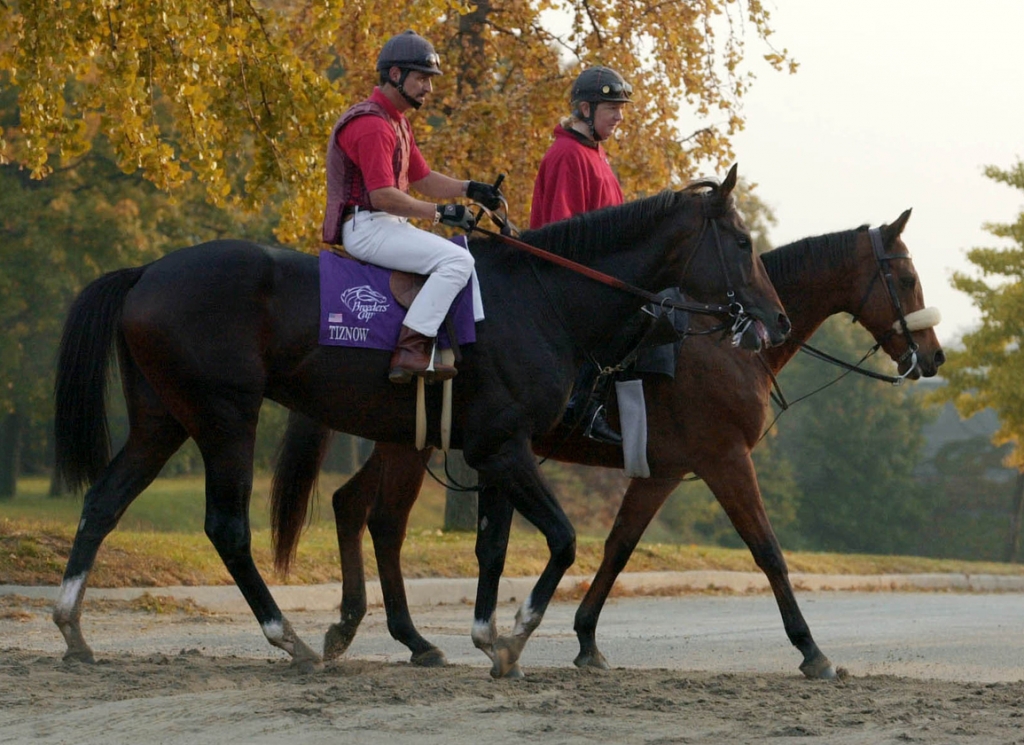
Tiznow training for the Breeders' Cup | Horsephotos
“Tiznow, the opposite. You could put your hand in his mouth, he wouldn't bite down. But you tell him to do something he doesn't want to do, morning or afternoon, he's going to flip you the bird. So I had to be really studious, on his back, to determine what exactly will end up in cooperation.”
Some horses were like bicycles. Alphabet Soup: keep asking, he'd keep giving. Hard work, but for predictable reward. Tiznow, you sense, was more satisfying precisely because more challenging.
McCarron largely resisted using the stick on the big horse.
“I could use it for encouragement,” he recalls. “But if he wasn't ready, he would let me know by pinning his ears. I actually learned that by watching his other riders, Alex Solis and then Victor Espinoza. I watched them and thought, 'I wonder if he's really okay with being hit.'”
Then came a notorious morning, a week before his second Breeders' Cup. The instructions were to backtrack to the half-mile pole, turn with the pony, canter to the wire and breeze a circuit. The first bit goes to plan. Once turned, however, Tiznow plants himself.
“Okay, well, I'll just wait,” McCarron says. “I wait five minutes. Still doesn't want to go. Backtracked some more. Same result. Backtracked again. Now I'm over at the six-and-a-half pole and it's 30 minutes into this exercise.”
With trainer Jay Robbins way off in the grandstand, McCarron calls an audible: he hollers to the starting gate for some blinkers. But no, Tiznow, doesn't take to that suggestion either. Then, suddenly, with McCarron's feet out of the irons, he starts to jog. Quickly McCarron squeezes his toes back in-and Tiznow takes off. And, hell, now he's too strong.
Another audible: he'd break off at the half-mile pole. That's the kind of confidence that comes with the Hall of Fame. But one of the other things that got McCarron there was timing his own works. And, at the quarter pole, he glances at his wrist: 23-and-one. Too fast. But the more he tries restraint, the harder the horse goes. Another glimpse at his watch, passing the wire: 47 flat. Tiznow keeps rolling, works the mile in 1:36 3/5-and gallops out strong, too.
Everyone's asking what can be bugging the horse: he must be sore, in body or mind. But McCarron feels that Tiznow just wanted to show that he wouldn't be rushed. He loved to stand out on the track watching the other horses; and his usual work rider (good as he was) was a freelance with a living to earn, with other horses waiting. Besides, Tiznow actually put in a beautiful breeze.
Come the race, even so, McCarron can't know which Tiznow will come out of the gate.
“He broke running, check that box,” he recalls. “He's got a hold of me, check that box. Going down the backside, he's relaxed, check that box. I told Jay in the paddock, 'Don't be surprised if I don't hit him, because I don't want the Tiznow of today to be the Tiznow of last Saturday.' [But] Sakhee was full of run, and at the 16th pole he's a neck in front. Well, I got nothing to lose at this point. So I tapped him left-handed. Now, when a horse re-breaks at that stage of a mile-and-a-quarter race, it's not like the acceleration you get from a turf horse, when they drop down and come home in 23. But I felt the acceleration. And all of a sudden I was full of hope. And then Tom [Durkin] yelled, 'Tiznow wins it for America.' I was like, wow, this is big.”
Just one snapshot, this, of how a great rider ekes the best from a horse; and, yes, gets them to co-operate.
“I firmly believe that the horses most desirous to win carry that with them all the time,” McCarron says. “They definitely know when they win. I think that the breed has demonstrated a superiority-inferiority segregation, if you will, in the wild. And the Thoroughbred brings that to the table as well. There is a hierarchy. The ones that are followers, they're probably a bunch of losers. And the leaders are those that bring their game every time.”
Who does that remind you of? Because surely that's true of jockeys, too?
“I think so,” McCarron accepts. “No question, most of the jockeys I had the pleasure of riding with and against, they're multi-time champions because of their tremendous desire to do the very best they possibly can. I look back and have to pinch myself: what a classroom I had.”
Through the 1980s, in that Californian colony, he was riding against nine Hall of Famers.
“And I was always seeking answers,” McCarron says. “I see Laffit do something, I'll just watch and figure that out. A lot of times I could ask him. But when you get to the point where you're as competitive as they are, you didn't want to impose. I didn't want to go to Shoe and say, 'How did you get that filly to change leads like that? I couldn't when I rode her.'”
Instead he would listen intently as they all came in and stood watching the replay. Nonetheless McCarron is adamant. “I didn't fear any of them,” he says. “I had to go to work every day with the attitude that I'm better than anybody out there. It's a question of me getting on the right horse.”
He had powerful evidence behind him. “I rode my first race on January 24, 1974,” he recalls. “I broke my maiden on February 9, my 10th ride. By the end of March, riding at Bowie, I'm going to say I had 30 winners. Which is crazy. From April 1 to December 31, I rode another 510.
“How in the world could I have done this? There's only one answer. I am blessed with God-given talent to communicate with Thoroughbreds, bottom line. Then I have to go ahead and take that, capitalize on it, put it to good use every single time I throw my leg over a horse's back.”
After 1,011 winners in his first two years, McCarron was invited to Hollywood Park for an all-star race.
“My agent wouldn't let me go, because he was fearful that if I see those swinging palm trees out there, I may not want to come home,” McCarron says. “He was right!”
McCarron did go when invited again the following year and, forget the palm trees, he knew he had to measure himself against the best. Every now and then, in the Bowie racing office, he had overheard the agents: “Yeah, he might be able to ride around here, but if he thinks he can go out to California and do the same, he's mistaken.”
So that desire, the same desire that set the best horses apart, where had that come from?
“My family,” McCarron says. “My mom and dad were incredibly hard workers. They raised nine of us. My mom had a little one in diapers for 20 years straight, between my eldest brother Joe and my youngest sister Colette. And we were all athletic, all competitive.”
Between nature and nurture, then, he had something special to work with. And he tried to share that by starting the first jockey school in America. Invited to address one in Japan, in 1988, he had been blown away. Why weren't American kids offered that kind of opportunity, when they'd had a school in South Africa as long ago as 1960 and others had meanwhile opened in Latin America, Europe, Australia? Having been dismayed by the way horses were trained, he resolved to train people instead.
To this day, then, he retains a vigilant interest in the role models available to young jockeys.
“The rider of today doesn't look anywhere near as good on a horse as the riders of yesteryear,” he says candidly. “I can't for the life of me figure out why jockeys across the pond, most notably England and Ireland, didn't emulate Frankie. They look terrible on a horse. Frankie learned his trade here. That's why he looks so good. And it's not the American style, it's the Panamanian style.”
He hates to see jockeys standing up down the back stretch, their butts way above the saddle.
“Where the heck's that coming from?” he asks. “Laziness. It's more strenuous to get down and stay down for a long period. Harder on your legs, quads, hamstrings. These guys that get way up off a horse's back have no idea how much drag they're increasing.”
He remembers Joe Allen's wife Rhonda taking a set of aerodynamic silks to NYU, back in the 1980s. The lab computed a gain, over a mile, of around 15 feet.
“Go down the road with the window down, at 40 miles an hour, and then just turn your hand,” he says. “Cyclists, runners, skiers, swimmers shave their bodies because the hair follicles have bubbles. If that creates drag, what is [riding] up here doing?”
His students could never shake McCarron off balance, when he modeled the equicizer for them. But there was always more than one kind of equilibrium involved in the fulfilment of his own talent. Getting onto Sunday Silence, after all, was just the result of one guy being the ultimate professional-and another, well, not so much.
Really all the key ingredients were already in place, the day he rode his first winner: not just the innate connection with the horse, but the seriousness of mind, the diligence of heart.
All that said, is there anything he would tell his younger self, that snowy day at Bowie?
“Boy,” he says, and pauses to think. “I'd say that you're getting ready to jump into a career that can be quite hazardous, and that you must always keep your wits about you.” But it's the next bit that's key. “And that if you learn to love the horse, and you're passionate about what you do, you'll be successful.”

The post McCarron: Connect With The Horse and the Rest Will Follow appeared first on TDN | Thoroughbred Daily News | Horse Racing News, Results and Video | Thoroughbred Breeding and Auctions.
Source of original post