Sunday Insights: Mandella Unveils Bulleting $875k Pharoah Filly at Del Mar

Sponsored by Alex Nichols Agency

9th-DMR, 57K, Msw, 2yo, 5fT, post time: 4:30 p.m. ET

When a pricey yearling works a couple of bullets as a 2-year-old for meticulous preparer and Hall of Famer Richard Mandella, that debut bears watching. Sarah Kelly’s VELVET (American Pharoah) brought $875,000 last year at Keeneland September–fifth-highest of her sire’s yearlings in 2019–and began working in earnest in August, getting three bullets since, including four panels in :47 (1/87) Aug. 30 at Del Mar and five furlongs in 1:00 2/5 (1/21) Oct. 7 at Santa Anita. Out of 2010 GI Mother Goose S. runner-up Connie and Michael (Roman Ruler), Velvet comes from a family with plenty of black-type, none better than her fourth dam’s half-brother, champion and four-time Grade I winner Wajima (Bold Ruler).

The post Sunday Insights: Mandella Unveils Bulleting $875k Pharoah Filly at Del Mar appeared first on TDN | Thoroughbred Daily News | Horse Racing News, Results and Video | Thoroughbred Breeding and Auctions.

Source of original post

From Maine to California, These Tracks Are Gone, But Not Forgotten

Do you remember Bowie? The Marshfield Fair? Or, how about Liberty Bell? I do. I’ve been to them all.

Someone sent me a link the other day to a list of all the defunct racetracks in the country and it got me thinking how sad it was that I had been to so many that have disappeared into the ether. That and whether or not I hold some sort of unofficial record of having attended more former racetracks than anyone else. I have been to 28 North American tracks that no longer operate Thoroughbred racing.

I started compiling the list when I was just a small child and my father would take me to the local tracks near Philadelphia and along on a lot of his business trips so that we could visit a new track in a new town. It grew when I attended college and picked up the Massachusetts fairs, Suffolk Downs and Rockingham, all of them now gone. My early years as a racing writer took me to places like Hialeah and Hollywood Park. One is a casino, the other a football stadium. There are so many that were unable to make it in an era where outside competition for the gambling dollar, real estate values and racing’s struggles to expand its fan base have made staying in business hard to do.

In a few days, I will be able to look back on the 48th anniversary of the first time I saw Secretariat run in person. It was Nov. 18, 1972 and I lived in the Center City section of Philadelphia and, of course, our family was not going to miss the opportunity to see Secretariat run in person in the Garden State Stakes. He was on the verge of superstardom and his appearance at the Cherry Hill, New Jersey, track drew a crowd of 25,175. The great horse did not disappoint, winning by 3 ½ lengths in his final start as a 2-year-old, cementing his first of two Horse of the Year titles.

The track burned to the ground in 1977, but was resurrected in 1985 by Bob Brennan. The new Garden State was supposed to be “the track of the 21st century” but come the early 2000s, its days were numbered. Unable to compete with the Atlantic City casinos and with too many racetracks in the Mid-Atlantic region for horseplayers to choose from, it limped to the finish line and never ran again after a short meet that ended in May of 2001.

Today, over the hallowed ground over which Secretariat, Bold Ruler, Kelso, Dr. Fager, Citation galloped down the stretch you can find a Cheesecake Factory. Very depressing.

Through the seventies and eighties I made many a trip, as well, to Atlantic City Race Course. My brother worked for Philly’s afternoon paper, the Philadelphia Bulletin, and, after his workday was done, we’d make the short trip down the Atlantic City Expressway to catch the last half of the card. Like Suffolk, Atlantic City limped along for years with short meets that allowed them to maintain their license, but ceased racing after 2014. The track still sits there, its owners trying to figure out what to do with the property.

The tracks I really miss are the ones in New England that were such a huge part of my life while I majored in Suffolk Downs and minored in economics while a student at Tufts University. There was a time when there were tracks in Massachusetts, New Hampshire, Vermont, Rhode Island and Maine. They are all gone, leaving an entire region of the country that once embraced racing without a single track.

I made it to the old Rockingham once, early on in my freshman year, before it, too, burned down, in 1980. It was rebuilt and reopened four years later, but the new Rockingham was one of those places where there was no there there. It ran its last Thoroughbred race in 2002.

My favorite track, maybe of all time, was Suffolk Downs. I had an affinity for a hardscrabble, blue-collar, unpretentious track nestled between oil tanks where much of the racing was conducted during the harsh New England winter. For those who prefer Saratoga, Del Mar, Santa Anita, I don’t expect you to understand.

Suffolk Downs held on as long as it could, holding five or six-day meets to keep its license while ownership hoped to be granted a casino license. When Suffolk lost its bid, it was over. The track last raced June 30, 2019, and I was there to say goodbye. The property will soon be developed and include housing, stores, offices, you know, the usual stuff.

The Massachusetts fairs didn’t make it nearly as far. Back in the day, there was nothing like them. With a Ferris wheel, carnival games and 4-H club exhibits as a backdrop, Marshfield, Northampton and Great Barrington were New England institutions. With the legalization of pari-mutuel wagering in Massachusetts in the thirties, a thriving fair circuit got going, a refuge for horses and jockeys that couldn’t win any place else. Everybody who went to the fairs had a story about the fairs, like seeing 17-year-old Golden Arrow win at Great Barrington in 1978 or the time Zippy Chippy finished second at Northampton in his 98th attempt to break his maiden. And who can forget all the races that were fixed? There were hundreds of them over the years.

The fairs were so popular that a crowd of 27,048 once showed up at Great Barrington, which called itself “the Belmont of the Berkshires.” But they were a product of a very different time in racing. Northampton was the last survivor, running its last race in 2005. The fairs at Marshfield and Northampton continue to this day. Great Barrington has completely closed but there was talk before COVID-19 that it would be revived and run some of the dates normally reserved for Suffolk Downs.

I caught Ak-Sar-Ben near the very end. The same racetrack that once regularly drew 25,000 people Saturdays was crippled by competition from casinos in bordering states. It last raced in 1995

and the property has been converted to something called Aksarben Village, a development that includes part of the campus of University Nebraska-Omaha and a Godfather’s Pizza shop. I imagine Ak-Sar-Ben was a great track in its prime.

Bay Meadows is gone. So is Beulah Park, the Woodlands, Bowie, Liberty Bell, Sportsman’s Park, Manor Downs. I have been to them all. Green Mountain, which hadn’t run Thoroughbreds since 1976, burned to the ground in a suspicious fire just this last September. I remember taking the short trip over from Saratoga to catch a card at what was one of the sport’s most remote racetracks.
There was no saving most of these tracks. The exception is Hialeah. When it comes to sheer beauty and class, there was a time when it had no equal. To this day, the track’s website refers to it as “the world’s most beautiful race course.” Losing out on a war for the prime Florida dates, it became less relevant with each passing year until it ran its last Thoroughbred race in 2001. But still it sits there, kept somewhat alive by slot machines and fake quarter horse races. That the sport has never come together and found a way to bring Hialeah back to life is a failure that should have been corrected long ago.

There will be a new member to this list in just a few weeks. Calder/Gulfstream Park West is set to close for good after the Nov. 28 card. That will make my number 29. I’d be fine if it stopped right there.

Editor’s note: Think you can beat Bill’s Finley’s visits for live racing to 28 (soon to be 29) defunct tracks? Email us at suefinley@thetdn.com.

The post From Maine to California, These Tracks Are Gone, But Not Forgotten appeared first on TDN | Thoroughbred Daily News | Horse Racing News, Results and Video | Thoroughbred Breeding and Auctions.

Source of original post

Spielberg Favored to Continue Baffert Streak in Bob Hope

With the ongoing Del Mar meet renamed a few years ago to honor Hollywood icon Bing Crosby, it seems only fitting that a colt named Spielberg (Union Rags) would take his shot in the GIII Bob Hope S., the race formerly known as the Hollywood Prevue S. The $1-millon Keeneland September graduate should jump a warm favorite for the seven-furlong affair, a race won by his trainer Bob Baffert no fewer than six times in its last nine runnings and 10 times dating back to 1996.

Runner-up on debut and in the GI Del Mar Futurity to the talented Dr Schivel (Violence), the chestnut was never truly dangerous when third in the GI American Pharoah S. at Santa Anita Sept. 20. He was more workmanlike than spectacular in graduating by a mile here 13 days ago, but is nevertheless the one they’ll have to beat.

Weston (Hit It a Bomb) is the only member of the Bob Hope sextet with a graded victory to his credit, having earned a neck success in the GII Best Pal S. Aug. 8 prior to a third in the Futurity, where Spielberg was 3 3/4 lengths ahead of him.

Ambivalent (Constitution) enters the Bob Hope a five-time maiden, though he did cross the line third in the Best Pal, only to be disqualified to fourth. A close third in the Del Mar Juvenile Turf S. Sept. 7, he turns back off a distant sixth to Jackie’s Warrior (Maclean’s Music) in the GI Champagne S. over a mile Oct. 10.

The post Spielberg Favored to Continue Baffert Streak in Bob Hope appeared first on TDN | Thoroughbred Daily News | Horse Racing News, Results and Video | Thoroughbred Breeding and Auctions.

Source of original post

This Side Up: Cutting Down Scepticism on Fees

Bought yourself a mare in Lexington this week? Good for you. You have kept the faith. In many cases, that will be because you have seen it all before: you’ve ridden out bumps in the economy, and eked out value from these stoical and enduring creatures by borrowing their impassive engagement with the patient rhythms of Nature. It’s a long game, after all, one that will absorb pandemics and presidential cycles like a passing April shower.

But even the longest journey starts with a single step. And many of you will already have had an assignation in mind for your new mare from the moment you first folded down the catalogue page.

As we know, the stallion farms have done their bit to animate a market stricken by anxiety about the current strain on the global economic system. All the big commercial operations have made headline cuts in fees for 2021, and I’m already salivating over some of the value to be identified in our annual winter appraisal of the stallion market.

Some people, however, have muttered their scepticism as to the substance of these gestures. Has there really been a comprehensive remodelling in the base cost of breeding a Thoroughbred? Or have farms merely camouflaged the decline they had invited in overpricing particular types of stallion?

Well, I thought that might be worth investigating. Intake by intake, I’ve taken a look at the relative decline, between stallions at different stages of their careers, at 12 leading farms in Kentucky. We know, after all, that few sires ever again command a fee as high as their opening one; and that they will generally take repeated trims until either discarded, or achieving something to suggest a long-term viability.

How much deeper than “normal”, then, were the cuts this time round? And where were they concentrated?

This table charts the decline, in each of the past two years, in the aggregate stud fees charged by sires at the same stage of their careers on these 12 farms.
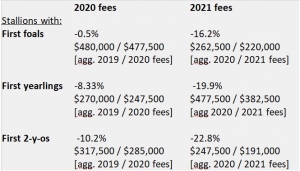
 

It’s a broad-brush exercise, very soon complicated by stallion traffic in and out of the Bluegrass by the likes of California Chrome (out), Laoban (in) and Daredevil (out and in). But my feeling is that when these farm owners talk about us all being in this together, they could also be addressing their stallions. Because they do, in the round, appear to have led sires young and old out onto the high road to meet the breeders halfway.

If there is divergence in the angle of the knife making these cuts, then it’s not so much between stallions at a different stage as between stallions on different farms. And you won’t find it hard to decide which were in deadly earnest, and which were pretty much making standard business decisions about individual stallions who would have been in trouble anyway.
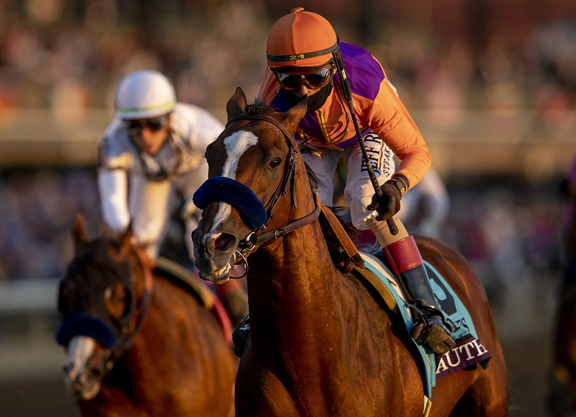
Authentic–priced at $75,000–is the most expensive of the 2021 intake of new stallions to date | Breeders’ Cup/Eclipse Sportswire

New stallions for 2021 vs. in 2020

I suspect that the one and only group of stallions that are being protected, as a class, will turn out to be those making their entrance to the market. These, presumably, are again guaranteed books of grotesque size; certainly a lot of them appear to have been priced that way.

But there’s no point comparing their fees with those who started last spring, as every intake varies in commercial appeal: a $150,000 tag for Justify, for instance, helped to elevate the aggregate fee value of those who started at these 12 farms in 2019 at $480,000, compared with $262,500 for those who began earlier this year. The point here is to compare the relative loss of value suffered, by each intake, at the equivalent point of their careers.

And that’s certainly instructive in the case of those who entered stud in 2020, whose first foals will be delivered in the new year. Collectively, the sampled farms send these stallions back to market in 2021 at an aggregate fee cost of $220,000, down 16.2% from the $262,500 they collectively charged in their debut season.

This is a major departure from the way studs have sought to maintain values at least until a first crop of weanlings has entered the ring. In 2020, by contrast, the same farms were able to charge $477,500 for sires entering a second season, virtually unchanged from an opening $480,000.

This time around, even the stars have been repriced–most strikingly at Spendthrift. A mare apiece to Omaha Beach, Vino Rosso and Mitole would have cost a total of $100,000 last spring; now you can get to them all for $75,000.

Sires with first-crop yearlings in 2021

The next group, meanwhile, is now reaching the stage–with their first yearlings about to go into the ring–when commercial breeders typically abscond to the next round of cadets, and books start to erode. This year, sires who entered stud in 2018 were charging $270,000 from $247,500, down 8.3%, with five of 13 taking cuts. But the group who entered stud in 2019 will be charging $382,500 from $477,500, down no less than 19.9% on their last set of fees. Only four of 19 stallions in this group have managed to hold their 2020 fees.
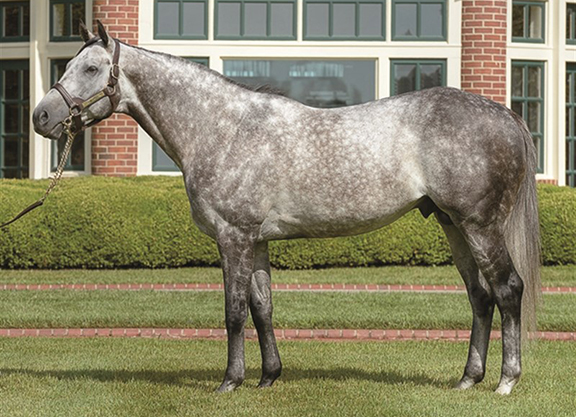
The Factor is an example of a sire whose fee has held | Lee Thomas

Fourth-year (and beyond) stallions

Next we reach a group that tends to cause breeders really to back off, unless their first yearlings have enjoyed a conspicuous market vogue. Because in his fourth year we start to learn whether a stallion’s first juveniles can actually run.

The sires who entered stud in 2017 duly eased their 2020 fees by 10.2%, from $317,500 to $285,000, albeit the majority of farms actually held their nerve and their prices. Those who entered stud in 2018, however, will be taking the equivalent step in the new year at $191,000, down fully 22.8% from $247,500.

Hereafter comparisons become harder. This is the crossroads of every stallion’s career, with the whims of the market now measurable against results on the track. So you’ll have one guy packing his bags for Turkey even as the next turns out to be Constitution, upgraded to $40,000 and now $85,000. In terms of aggregate fees, then, the winners will very often redeem the damage done by the losers. For present purposes, the flux is such that it is more instructive to assess those who come out the other side of this winnowing process.

For instance, the handful still on these farms with three crops of runners (entered stud 2015) are certainly sharing the pain. The bare half-dozen still in business will be charging $67,500 between them in 2021, compared with $85,000 in 2020 and $125,000 the year before.

Consolidation, already so difficult because of the commercial infatuation with unproven sires, is becoming harder and harder. Move on a couple of intakes, to those with a fifth crop of runners (entered stud 2013), and it speaks volumes for The Factor, say, that he can hold even a fee he has already outpunched when a studmate as accomplished as Union Rags must take a cut of no less than 50%.
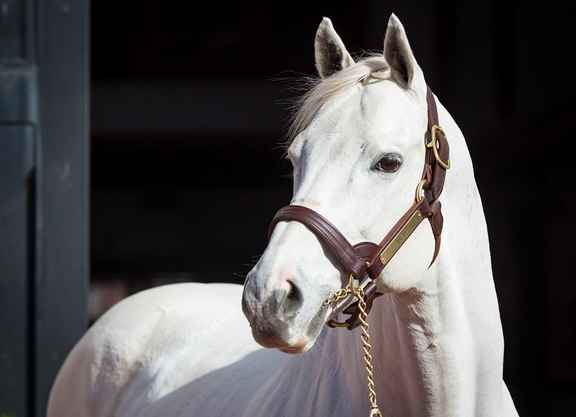
With exceptions, even stalwarts like Tapit have seen cuts going into 2021 | EquiSport Photos

Benchmark sires

And what of those who set the standard; the happy few who, having established their merit and viability, represent the model for those still trying to make a name for themselves? Operating at all levels of the market, from War Front to plucky achievers like Midshipman, they comprise the solid foundation for the whole stallion industry.

Sure enough, after a long bull run in the bloodstock market, these older sires (a total of 35 across our 12 chosen farms) collectively maintained their covering value in 2020 at $2,280,000, up marginally from $2,225,000 the previous year. For 2021, however, despite the odd hike (Into Mischief, Uncle Mo, Speightstown and Munnings) they have slipped 8.2% to $2,041,500.

That’s just about half the percentage loss, then, of those embarking on their second season. Normally, these are the two stable bookends to all the fluctuations in between. But even this lesser erosion implies some exceptional opportunity among the kind of proven sires who can make a mare, who can build a family, pending any return to the mechanical commercial exploitation of unproven sires.

I do see, nowadays, how that kind of thing is primarily driven by breeders; and I no longer blame the farms for loading the books of new stallions when the resulting stock will be given such a brief window of opportunity on the track. At the best of times, farm accountants have a terribly difficult balancing act. And, in reacting to the present crisis, it looks as though that balance extends at least to their collective use of the scythe. Admittedly, you’ll find that the cuts may be a little more jagged on some rosters than others. But the overall result is that there is opportunity across the herd.

So if you do insist on using a newcomer, with such luminous value across the rest of the spectrum, then good luck in your incorrigibility. Because if the overall “supply” did need some kind of correction, then so too, unmistakably, does our demand.

The post This Side Up: Cutting Down Scepticism on Fees appeared first on TDN | Thoroughbred Daily News | Horse Racing News, Results and Video | Thoroughbred Breeding and Auctions.

Source of original post

Verified by MonsterInsights