Second Stab At Synthetics In California? The Trainers’ View

Under the toughest of spotlights, the industry's collective eyes often turn to the stuff under foot. At least, that's what trainer Mark Casse did in a widely-shared TDN Q&A.

“I think we really, seriously, need to look at more synthetic tracks,” Casse said, triggering yet another cavalcade of commentary on the conceived benefits and blights of synthetic surfaces. “I believe in them. I believe they've got plenty of data to back that up.”

Former TDN writer Lucas Marquardt followed it up with an analysis of race-day fatality data through The Jockey Club's Equine Injury database.

Marquardt calculated how from 2009 through 2022, there were 6,036 fatal injuries from 3,242,505 starts on dirt in North America. That's a rate of 1.86 fatalities per 1000 starts.

On synthetics, there were 534 fatal injuries from 482,169 starts, a rate of 1.11. That's a 68% difference.

“Put another way, had dirt tracks matched the safety of synthetic tracks during that stretch, there would have been 2,437 fewer fatalities,” Marquardt wrote.

The state with arguably the deepest-albeit most contentious-relationship with synthetic surfaces is California, which mandated in 2006 the switch from dirt to synthetic surfaces at its four major tracks.

The state reversed course a few years later in the face of broad dissatisfaction with the decision. It's no easy story to tell, riven by tales of cost-cutting and skirted corners, ill-chosen materials and drainage problems.

Some point the finger, at least in part, at the failure of industry leaders to adequately study the efficacy of different materials before putting the new surfaces down.

Since then, California's relationship with synthetic surfaces has grown even more complicated, thanks to Del Mar's dirt track consistently proving among the most statistically safe nationwide-dirt or synthetic. Nevertheless, Del Mar's experiences haven't been replicated state-wide.

In 2021, California's fatality rate on the dirt (1.51) was more than twice the synthetic rate (0.73), according to Marquardt's calculations. In 2022, it was more than three times larger (1.44 vs. 0.41).

This issue promises to remain a prominent one for the near future. The Horseracing Integrity and Safety Authority recently announced that it is establishing a blue-ribbon committee to “work toward the study and ultimate introduction of more synthetic surface options in Thoroughbred racing.”

Among a fleet of promises, The Stronach Group (TSG) announced that it intends to replace the dirt training track at Santa Anita with a synthetic alternative.

Given the state's flip-flopping history with different surfaces, the TDN asked several long-time California-based trainers this question: Given the re-ignited debate on synthetics and all its accompanying arguments, should California mandate once again the replacement of its dirt surfaces with synthetics?

Eoin Harty
“Of course. I don't think they should even have to mandate it. I should think that somebody should show some f*&^ing leadership for a change and do the right thing. Instead of looking down, looking up, looking sideways and dancing around the issue, we need to address the elephant in the room: That we're in a position basically brought on by ourselves.”

“I think the time for hand-wringing and regurgitating old cliches about needing more data, more science, blah, blah, blah-that time has come and gone. No more committees, just do the right thing and put down synthetics. It's time to get on the right side of history. There won't be a Mulligan on this one.”

Note: Harty later explained the curse reflected the gravity of the situation.

John Shirreffs
“I like to tell the story of Tiago, who had won the Santa Anita Derby. In his four-year-old year at Del Mar, I had his exercise rider work him a half [mile]. He breaks off the half mile pole, the horse goes a 16th of a mile and pulls himself up, doesn't want to work.”

Trainer John Shirreffs | Benoit

“I tell the rider, 'don't worry, Mike Smith will be here tomorrow. He gets along with him really well.' Break Tiago off again, goes about a 16th of a mile, pulls himself up and refused to work on that synthetic track.”

“After Zenyatta won the G1 Clement Hearst S., she refused to gallop around the [Del Mar] racetrack. She'd go about two thirds of the way around then just stop and refuse to go. The only thing we could do is walk her to the nearest gap and take her off the track.”

“Zenyatta and Tiago were both big, strong horses that really ran hard. Those type of horses really did not like synthetic tracks. I think that if you just look at how long it takes horses to adjust to the synthetic tracks when they first go in, all you do is find horseshoes on the outside of the track because they're all grabbing themselves. Their feet stop so quickly in it. Synthetic tracks only get bearable as they get older. When they first go in, they're really sticky and tough on horses.”

“As you've seen in the statistics in California, our breakdowns are really reduced. So, I don't think synthetics are the answer. Synthetics are a nice alternative. I mean, it'd be great to have a synthetic track here on the training track because you can't use the main track when it's wet. So, maybe they'd let us use a synthetic track when it was wet.”

Richard Mandella
“I think Santa Anita has the right idea to put it on the training track here to learn more about it, and hopefully it will be waterproof to train through the winter. I would take one step at a time.”

Leonard Powell
“I think the option of having a synthetic track to train on is very good. But to mandate to have all racing on synthetic, I don't think that's a necessity.”

“The notion of a bad step has been proven incorrect. We've found out through a lot of studies, when it comes to injuries, it's not a one-day, one-time thing. It's an accumulation of the pounding from the training, day-in, day-out. So, having the option to have a synthetic to train on would help that, and would lessen the number of catastrophic injuries on dirt on race-day. And it could be very useful on rainy days.”

“However, synthetics are always called all-weather tracks. But they're not really all-weather tracks. They're bad-weather tracks-they're good tracks in bad weather. In Europe, they've had problems with them in the summer months, like we had here. When it's hot and sunny, those tracks are not that good.”

John Sadler
“If you put synthetic tracks back in here, you have to have all the tracks in the country on synthetics. You can't go half and half. That doesn't work. You can't train on synthetic and expect to do well on dirt. You can't train on dirt and expect to do well on synthetic.”
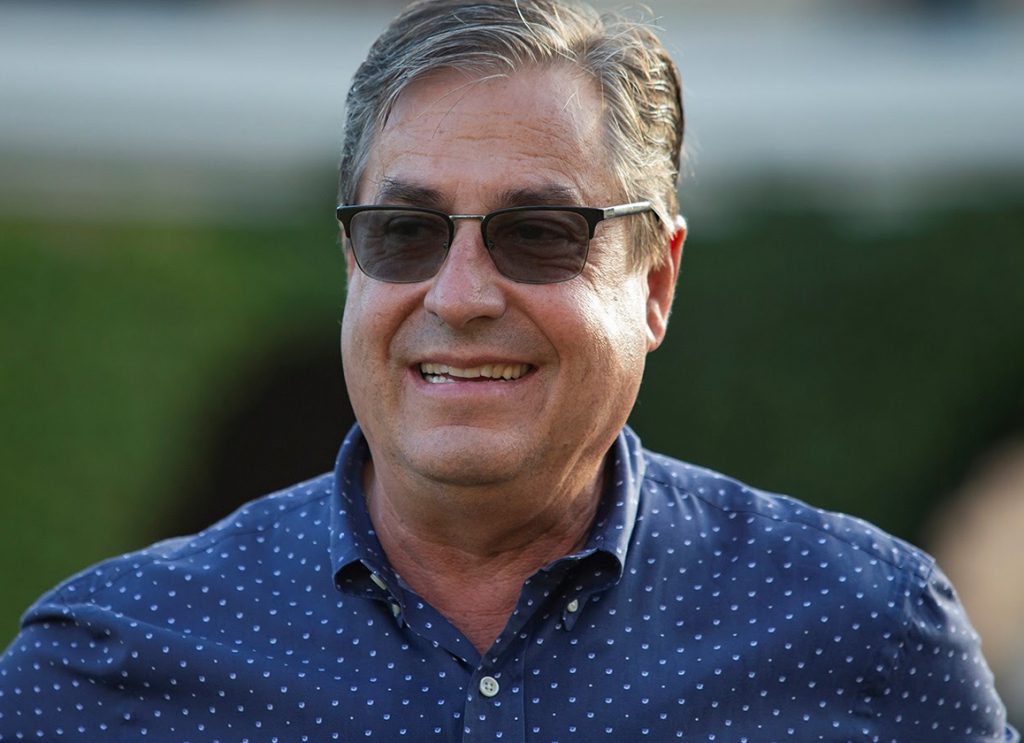
John Sadler | Benoit

“If you go back to when we had synthetics in California, I did very well on it. I could live with one surface nationwide. But because I can train on what you give me, it doesn't mean I prefer that. Not necessarily.”

“I would prefer good dirt. I think it's preferable for these horses. Why? Well, for one, they need a lot of upkeep. They need to be replaced. They need to be refreshed. They're expensive to maintain. And anybody that tells you they're not expensive to maintain is–I don't think they're being truthful.”

“There are other arguments. Are there really fewer fatalities [on synthetics]? Stats probably show that. But is that the real number, if you also look at [career ending] injuries? You don't know, right? It's hard for me to just take one study number and say, 'okay, that's all there is.' It doesn't work like that.”

“What I'm trying to say it's very nuanced. You'd have to give time for the breeders to adjust. You'd have to give time for people to purchase the right horses to adjust. A lot of what we did here wasn't well planned out. We did it and then lived with the consequences.”

Carla Gaines
“Let me start by saying I am not that well-educated on the various types of synthetic tracks.  I know there have been improvements on them since they were mandated here in California in 2006.”

“Santa Anita is installing a synthetic surface here on our training track this fall and with the expected increase in rainfall this winter that would give us an alternative place to train the horses when the main track is sealed.  It would also be a nice option for our grass horses as we do not have grass workouts here.”

“But for racing, I would have no interest in it. We as trainers are held responsible for every single injury. The spotlight is on us-rarely the surfaces we train on and race over. Instead of getting rid of dirt tracks, let's keep a closer eye on them, and try very hard to improve them. As one old timer told me once, 'we can put a man on the moon, why can't we figure out dirt?'” 

Doug O'Neill
“I love the fact they're putting it on the training track. At Santa Anita you'll have all three surfaces. And when we get the rainy weather, you can train on a synthetic. If we had weeks of crazy weather, you could potentially run on synthetic.”

“But to replace the main track dirt for synthetic, I would be anti that. Just wouldn't want to replace the dirt.”

“We've had a pretty good sampling with Hollywood Park and Santa Anita and Del Mar all being synthetic at one time. It had its little perks during rainy season. But all in all, not a good experience for me.”

“They're really good in inclement weather, which a lot of the world has, as opposed to Southern California. So, I just don't think they're good for Southern California tracks.”

The post Second Stab At Synthetics In California? The Trainers’ View appeared first on TDN | Thoroughbred Daily News | Horse Racing News, Results and Video | Thoroughbred Breeding and Auctions.

Source of original post

Friday Insights: Maiden Fillies Kick Off Keeneland Opening Day

2nd-KEE, $100K, Msw, 2yo, f, 6f, 1:32 p.m.

Drawn inside facing a field of 12, ROYAL SLIPPER (Uncle Mo) for Wesley Ward is out of $1.5m Fasig-Tipton Fall Mixed Sale pick up Laffina (Arch), making her a full-sister to MGISW and $4.2m FTKNOV purchase Bast. The dam is a half to GSW/GISP Mananan Mclir (Royal Academy) and to the dam of GISW Fault (Blame), another FTKNOV spotlight at $1.2m.

Lady Chai (Kantharos), a $570,000 Keeneland September buy, is a half-sister to GSW/GISP Shivaji (First Samurai) and to SW/MGISP Tarabi (First Samuari). Cherie Devaux trains for an ownership group that includes CHC INC., Hinkle Farms, David Ingordo and LBD Stable LLC.

Making her second start is $1,000,000 FTSAUG yearling Charlottesapproval (Into Mischief) who needs to improve in this spot after a well-beaten eighth on debut at Ellis Park Aug. 18. TJCIS PPS

7th-BAQ, $90K, Msw, 2yo, 1m, 3:48 p.m.

In a race redrawn from last Friday's rain out, Digital Ops (Nyquist) is the second foal out of MSW/GISP Flora Dora (First Dude). Picked up on a final bid of $600,000 at this Spring's OBS March sale, the colt is a half-brother to 'TDN Rising Star' Spun Intended (Hard Spun).

Drawn outside is fellow first timer and stablemate Unique Insight (Gun Runner). This one, a $360,000 Fasig-Tipton October pickup by Klaravich Stables, is a half to runaway Albany S. winner Drake's Passage (Tonalist).

To graduate, that pair will have to face a trio of salty second-time starters paced by the half-brother to Cody's Wish (Curlin) in Hunt Ball (Into Mischief). The Bill Mott trainee and Godolphin homebred stayed on to be second in his Saratoga debut Aug. 19 behind next-out GIII Iroquois S. runner up Risk It (Gun Runner).

Enlighten (City of Light), a $450,000 yearling, finished the best of the debuting runners in his own Saratoga race Sept. 2 but was ultimately fourth through a speedy seven furlongs.

Arguably the best-bred colt of the bunch, Pentathlon (Speightstown) adds blinkers for his second start after managing sixth behind Just Steel (Justify) and 'TDN Rising Star' Locked (Gun Runner) at the Spa Aug. 5. The Phipps Stable-bred counts MGISW My Flag as his third dam with family members such as champion 2-year-old filly Storm Flag Flying (Storm Cat). TJCIS PPS

The post Friday Insights: Maiden Fillies Kick Off Keeneland Opening Day appeared first on TDN | Thoroughbred Daily News | Horse Racing News, Results and Video | Thoroughbred Breeding and Auctions.

Source of original post

Keeneland’s Cormac Breathnach Joins TDN Writers’ Room Podcast

It's a busy time at Keeneland. The September sale has just ended, the fall race meet is upon us and the November sale is right around the corner. With that in mind, the TDN Writers' Room podcast presented by Keeneland called upon Keeneland Director of Sales Operations Cormac Breathnach to fill us in on the latest from one of America's favorite racetracks. Breathnach was this week's Green Group Guest of the Week.

The foal crop keeps dropping every year, but that doesn't seem to affect the September sale. There were 4,215 horses entered in the sale this year, the second straight year that number had increased. Breathnach was asked how Keeneland has avoided a downturn in the number of horses entered in the sale.

“It's a great question, and I'm not sure there's an easy answer, but there's a lot of things that we look at in there,” Breathnach said. “We're very grateful for the support that we get. Twenty-four percent of the entire North American foal crop goes through the Keeneland  September sale, which is staggering. It's a tribute to the people who came long before Tony (Lacy) and I, people like Rogers Beasley and Geoffrey Russell and everybody else that made this sale what it is today. We're just trying to be stewards to advance that as far as we can. There are a lot of very clever, very experienced, very dedicated commercial breeders. And thankfully for us, they're looking to our September sale as a large outlet for their for their stock every year. That's a privilege for us, but also a huge responsibility that we do the best we can with what they're bringing us.”

The November sale will feature stars like GI Breeders' Cup Turf Sprint winner Caravel (Mizzen Mast), Grade I winner Dalika (GER) (Pastorious {GER}) and Puca (Big Brown). Puca is the dam of GI Kentucky Derby winner Mage (Good Magic) and will also be carrying a foal who is a full sibling to Mage. The sale will also give buyers their first chance to buy mares who are in foal to 2022 Horse of the Year Flightline (Tapit).

“We've had a lot of calls about Flightline already from all over the world about what mares are going to be in the catalog that he was bred to and how many and so on,” Breathnach said. “I think he's going to create the splash that everybody expects. People still remember that last year we sold a 2 1/2 percent share in him that went for $4.6 million. We're excited to continue that story.”

Keeneland opened Oct. 6 with its Fall Stars Weekend. Like everyone else, Breathnach is looking forward to what should be a great weekend of racing.

“It's going to be fantastic,” he said. “We have 11 stakes this weekend. Eight of them are Breeders' Cup 'Win and You're In' races. It's three unparalleled days of action here. One race that I think really jumps out to me is the Darley Alcibiades. I think that race is loaded. Look at the morning line, you've got fillies like Alys Beach at 20-1. It could be one of the best races of the year. The whole weekend, it's going to be action packed, turf and dirt sprints, races going long on the turf and dirt. I can't wait for it.”

Elsewhere on the podcast, which is also sponsored by the Retired Racehorse Project, the Pennsylvania Horse Breeders Association, Kentucky Thoroughbred Owners and Breeders, West Point Thoroughbreds, WinStar Farm, XBTV.com and 1/ST Racing, Lane's End, the team of Zoe Cadman, Bill Finley and Randy Moss discussed a story in the TDN in which John Sikura called for a massive purse increase for the GI Kentucky Derby and the GI Kentucky Oaks. While agreeing with Sikura, Finley pointed out that Churchill Downs has very little incentive to increase the pot. The team reviewed last weekend's big slate of races, which included a win by Cody's Wish (Curlin) in the GII Vosburgh S. Looking ahead, the trio agreed that the GI Coolmore Turf Mile at Keeneland could be the highlight of the weekend as it could be a showdown of the best turf horse in the U.S. in Up to the Mark (Not This Time) and the Charlie Appleby trained star Master of the Seas (Ire) (Dubawi {Ire}).

To watch the Writers' Room, click here. To view the show as a podcast, click here.

The post Keeneland’s Cormac Breathnach Joins TDN Writers’ Room Podcast appeared first on TDN | Thoroughbred Daily News | Horse Racing News, Results and Video | Thoroughbred Breeding and Auctions.

Source of original post

Take Me Out to the Ballgame: Letter to the Editor

If there are two sports whose paths have mirrored each other historically, it would be baseball and horse racing in America.

Both are tradition-driven and both enjoyed prominence for decades. And both recently have dealt with challenges, scandals and declining interest.

One sport though has chosen to embrace innovation.

Baseball has developed multiple changes over several years as they fought to gain fan, media and sponsor revenue. To our credit, racing has innovated in several spaces, specifically health and safety, but not so much in product presentation.

The last major product innovation in racing happened four decades ago with the creation of the Breeders' Cup.

Major League Baseball announced this week that they enjoyed their biggest year-over-year attendance increase since 1993. Because they listened. And they changed.
The energy is back in baseball. Media attention is back. And the fans are back in the ballpark and watching games on a bevy of media options.

Can we say the same of racing? Unfortunately, no.

But fortunately, it is not too late. As long as racing will step up to the plate right now and embrace meaningful innovation.

Need one example? There is a 100% chance that realigning the Triple Crown on a better schedule would result in more media attention, more wagering and a stronger safety message.

Earlier this year, leaders within the sport–Churchill Downs, Stronach, top breeders and others cried out for increased cooperation and collaboration.

There is no question that much of this was due to our safety crisis, but clearly the safety issue is only one of many that should–and must be addressed by a broad coalition of our industry.
That is if we want to remain relevant and follow a proven path, like our friends in baseball just showed us.

It took bold thinking and a never-give-up attitude by John Gaines to create the Breeders' Cup. And equally as important, it took thinking of the greater good by breeders and racetracks.

The evolution of racetrack ownership should make innovation much, much more possible than ever. You can count on one hand the entities that control the sport.

Throw in the Breeders' Cup and The Jockey Club and representatives from those seven could fit around a small dining room table!

There are 30 club owners in MLB involved in the decision-making process. Not to mention the Players' Association and others.

Undoubtedly, a Commissioner-led model greatly facilitates changes to baseball, but with so few involved to create meaningful innovation in racing, we can still change without requiring a Commissioner.

Want to truly pay homage to the 40-year anniversary of the Breeders' Cup? Create a “Gaines Commission” to study and implement strategic changes within racing.
Outside professional support would moderate our “think tank” project, at first with only representatives from the racing entities mentioned above.

As the commission begins to develop and agree on potential action, others (deservedly so) will be brought into the process. But for now, one step at a time.

Just as baseball went to a pitch clock, the Gaines Commission would be on the clock as well, directed to finalize their recommendations long before Breeders' Cup 2024.

Baseball changed and has been rewarded. Racing can do the same. Our changes will be different. Our changes won't be as easy.

But we don't have another 40 years to wait.

Kip Cornett is a Thoroughbred owner, bettor and sports marketer.

The post Take Me Out to the Ballgame: Letter to the Editor appeared first on TDN | Thoroughbred Daily News | Horse Racing News, Results and Video | Thoroughbred Breeding and Auctions.

Source of original post

Verified by MonsterInsights