Juddmonte And Keeneland Continue Their Curragh Race Sponsorship

Juddmonte and Keeneland have renewed their sponsorships of the Curragh's G1 Irish Oaks and G1 Phoenix S., respectively.

The feature race of the two-day Juddmonte Irish Oaks Weekend on Saturday, July 22, the Juddmonte Irish Oaks has been won three times by horses carrying the Juddmonte colours with Enable (GB) (Nathaniel {Ire}) (2017), Bolas (GB) (Unfuwain) (1994) and Wemyss Bight (GB) (Dancing Brave) in 1993. Currently there are 87 first entries for the €500,000 summer Classic, including Juddmonte's debut winner Bluestocking (GB) (Camelot {GB}). Juddmonte started as the sponsor of the G2 Beresford S. in 1988; sponsored the G1 Pretty Polly S. in 2018, and began sponsoring the Irish Oaks in 2020.

Douglas Erskine-Crum, CEO of Juddmonte, said “Juddmonte is delighted to renew our sponsorship of the G1 Juddmonte Irish Oaks. It is extremely important to Juddmonte to support Irish racing and breeding and appreciate its sizeable contribution to the wider industry; we feel the Irish Oaks and Curragh racecourse are perfectly placed to demonstrate this commitment.”

Brian Kavanagh, CEO Curragh Racecourse, Ltd., said “We are delighted to be able to announce the extension of Juddmonte's sponsorship of the Irish Oaks and look forward to a quality renewal as always in July. Juddmonte have been fantastic supporters of the Curragh and of the industry here in Ireland for many years as owners, breeders and sponsors and we greatly look forward to our continued partnership with them in this prestigious race. The Irish Oaks has been won by some wonderful fillies over the years, including the great Enable in 2017.”

Starting their sponsorship of the Phoenix S. in 2010, Keeneland will extend their commitment to the race for another three years. In 2022, Little Big Bear (Ire) (No Nay Never) took the prize and was crowned Europe's Champion 2-Year-old with a mark of 124. Prize-money will increase to €350,000 in 2024 and then €400,000 in 2025.

Shannon Arvin, President and CEO of Keeneland, said, “Keeneland's close connection with the Irish bloodstock and racing industries goes back many decades and we are delighted to celebrate that ongoing bond with the continuation of this longstanding sponsorship.

“We witnessed Little Big Bear win one of the best renewals of the Keeneland Phoenix S. last season, with a performance that this week saw him crowned Europe's champion juvenile, and we look forward to working with the Curragh to continue to grow the race in future years.”

Added Kavanagh, “Keeneland have been a valued partner for the Curragh for many years and we are delighted to be able to announce this extension and enhancement of their sponsorship. They are a pleasure to deal with and the ties between Keeneland and the Irish racing and breeding industries have become stronger in recent years. Their commitment to increasing prize-money for the race over the next three years is most welcome and we greatly look forward to working with Keeneland on this sponsorship.”

The post Juddmonte And Keeneland Continue Their Curragh Race Sponsorship appeared first on TDN | Thoroughbred Daily News | Horse Racing News, Results and Video | Thoroughbred Breeding and Auctions.

Source of original post

Conor Grant Appointed New Chairman Of Racecourse Media Group

Racehorse owner Conor Grant will be the new Chairman of Racecourse Media Group (RMG), replacing Roger Lewis. Grant will initially join as an RMG Non-Executive Director on Apr. 1, and then become Chairman of RMG on Oct. 1.

Grant has 24 years of experience in the UK and Irish gambling sector, including 14 years in senior executive roles. He was most recently CEO of Flutter UK & Ireland, and, prior to that, was Chief Operating Officer of Sky Betting & Gaming.

The umbrella organisation for 35 British racecourses and the parent company of Racing TV, RMG is owned 100% by its racecourse shareholders and pays 100% of operating profit back to racecourses. In 2021, the shareholders were paid £110 million, and that figure will be exceeded for the media and data revenues generated in 2022.

Grant said, “I am delighted to be joining Racecourse Media Group at such an exciting time for the business and the broader racing industry. RMG has delivered outstanding results for its shareholders in recent years, and I would like to pay tribute to Roger who has done a fantastic job, along with CEO Martin Stevenson, in growing and developing the business. I look forward to working with the RMG team and continuing to deliver for all of our racecourses.”

Nevin Truesdale, CEO of The Jockey Club and Non-Executive Director on the RMG Board, said, “I am delighted to welcome Conor to the RMG Board and to be working with him as we further develop the business for the benefit of its shareholder racecourses. Conor brings significant and in-depth expertise to the industry, acquired over a long period of time, and this will help shape our strategies and address the challenges we are facing.”

Originally due to step down in 2022, Lewis was asked by the RMG Board to stay on through the transition. Independent Non-Executive Director Andy Anson will also be stepping down in April.

The post Conor Grant Appointed New Chairman Of Racecourse Media Group appeared first on TDN | Thoroughbred Daily News | Horse Racing News, Results and Video | Thoroughbred Breeding and Auctions.

Source of original post

Edouard Monfort: ‘Willie Mullins Taught Me That Horses Can Take A Lot Of Work’

No trainer in Ireland has farmed France for top-class talent quite like Willie Mullins has in recent times. Superstars Hurricane Fly (Ire), Douvan (Fr), Un De Sceaux (Fr), Vroum Vroum Mag (Fr) and Benie Des Dieux (Fr) are all a product of that hugely successful resource. 

It seems as though not one week goes by where Mullins fails to unleash a leading French prospect, which was evident at Clonmel on Tuesday when Ireland's dominant National Hunt trainer sent out Night And Day (GB) and Gaelic Warrior (Ger) to record emphatic successes and harden their claims for festival honours respectively. 

So where do all these winners come from? Mullins's long-standing and trusty ally Harold Kirk is responsible for a lot of Closutton's jumping stars while Pierre Boulard plays an integral role in France. 

But the tapestry of talent that makes its way to Mullins runs much deeper than Kirk and Boulard alone, with many trainers in France blooding talent in the hope that the major jumps trainers in Britain and Ireland come in with a blank cheque for the next big jumping star the country has to offer. 

“During my experience in Ireland, I made good friends–like Niall Kelly, Sonny Carey and Paddy Mullins,” – Edouard Monfort.

That includes Edouard Monfort, a former employee of Mullins, who now trains a string of 70 horses in his native France and recently sold smart prospects Tekao (Fr) and Parmenion (GB) to the most successful trainer in Cheltenham Festival history. 

Monfort spent the 2015/16 National Hunt season with Mullins, which was the same campaign that Annie Power (Ire) came off the substitutes' bench to land the Champion Hurdle, and he revealed that the relationships forged during his time working for the 16-time Champion National Hunt trainer in Ireland burns bright to this day. 

Monfort explained, “Willie is a really good man. He's very simple and you can talk with him. He's always the same. Of all my experiences in racing, I base my style on Willie.”

He added, “During my experience in Ireland, I made good friends–like Niall Kelly, Sonny Carey and Paddy Mullins. This is why I like coming to the Irish sales. It is easier for me to get information on these horses with all of my contacts. I have lots of clients from England and Ireland. 

“It's important to sell the right horses because it's easy to sell the bad horses. It's important for the future and for business to keep good contacts which is why I was confident to sell Tekao and Parmenion to Willie. I was pretty sure that they would be good jumps horses for him.”
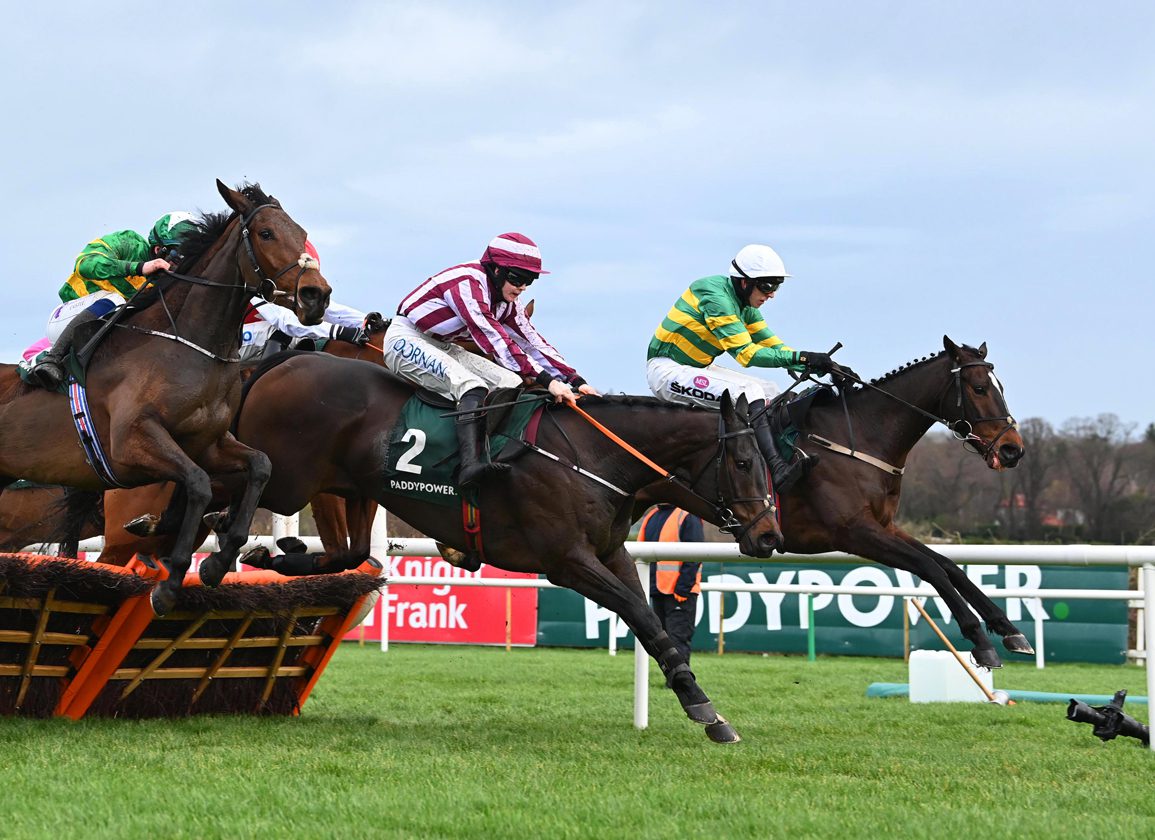
Tekao (right): Monfort's graduate could be a leading Triumph Hurdle contender for Mullins and JP McManus | Racingfotos.com

At 34 years old, Monfort has built up a solid string. Indeed, he was destined to go down this route, being a son of Patrick Monfort, a successful trainer in France. 

But a trip to Mullins's base for that winter in 2015 had the biggest influence on Monfort, according to the man himself, who revealed that he has adopted the many things that he learned from the trainer to his own operation in France. 

Monfort said, “I was born into horses as my father was a trainer. I went to engineers' school during my career as an amateur rider where I rode for 12 years on the Flat and over jumps in France. When I finished my career as an amateur, I targeted becoming a trainer and spent a jumps season with Willie, a year with Andre Fabre and another year with Jean-Claude Rouget. 

“Working with Willie and seeing how he manages all of the horses that he has in his yard was a great experience. I wanted to go to Willie because I really like jumps racing and I wanted to get experience with a top jumps trainer. I learned from Willie that a horse can work a lot. They can work hard before they run. I also learned that you can take your time with some horses. Some of Willie's horses, he takes it step by step with them, and they could be in the yard for a few months without having a race. When they do race, they come back stronger.”

He added, “Sometimes I manage my young horses so that they can work hard for two or three months before getting a rest and after that, they come back and they feel that bit stronger. I was based with Willie when he had that very good mare, Annie Power. I also rode in one race for him. I think it was a gift from Willie to me!”

Now it's Monfort's turn to supply the ammunition to Mullins and the early signs are promising. Tekao won on his hurdling debut at Leopardstown over Christmas for Mullins in the famous green and gold hoops of JP McManus while Parmenion is also held in decent regard.

On the duo, Monfort said, “Tekao was bred by his owner. He has a good pedigree and we took our time with him. He won very well on debut on the Flat but, from the very beginning, he looked more like a jumps horse, which is why he was sold. 

“I hope he is a very good hurdles horse. I saw him winning at Leopardstown and I thought he was a good winner because he was a little bit keen but he kept going all the way from the last to the winning post. I am confident he will be a very good horse for Willie and the team.”

He added, “Parmenion does not have a lot of experience but I really loved this horse when I used to train him. To compare him and Tekao, I would have to say that I would nearly prefer Parmenion from when he was a 3-year-old. I hope that he can be a very good horse. He has a German pedigree and I just think that all he needs is time.”

So why has Mullins returned to France time and time again in search of his next festival star? According to Monfort, one of the key reasons behind the success of the French-breds on racecourses in Britain and Ireland cannot be attributed to the excellent stallions who stand in the country alone, but also the deep pool of quality jumps mares that are available to breeders.

He said, “For a long time, the French breeding for jumps horses has been very good. We've got excellent mares in France for this. I think that is why we are having a lot of success in England and Ireland with our French-bred horses, because our mares here are so good. The breeders have worked very hard in keeping the right stallions in France for jumps racing. We have top jumps stallions in France but we are a little bit light on the Flat. We don't have the same level of stallions standing here compared to the jumps.”

Monfort admits that buying the raw material has become harder but a series of big-money sales, to Flat and National Hunt handlers, has been a huge help.

“It's very important for business to sell some of the horses. We know that the prize-money in France is very good but, if you want to make money, you have to sell these horses. That's why it's important to be able to showcase these horses and be able to sell them. 

“When I think a horse could be a selling prospect, we manage him with a view towards that and we take our time. Most of the time, they don't run until they are three years old if their future lies over jumps.”

He added, “We also sell horses to Australia or America. It just depends on the profile of the horse. The market has been very strong lately which has made it harder for us to buy the right horses. But, you know, when you start selling these good horses it makes it easier to buy the next ones because you've got the wallet!”

The post Edouard Monfort: ‘Willie Mullins Taught Me That Horses Can Take A Lot Of Work’ appeared first on TDN | Thoroughbred Daily News | Horse Racing News, Results and Video | Thoroughbred Breeding and Auctions.

Source of original post

Third Economic Impact Study On UK Breeding Industry Published

The third Economic Impact Study of the British Thoroughbred breeding industry was published on Wednesday. In the report, key opportunities and challenges for the sector were outlined and provide a blueprint for future progress.

Building on reports published in 2014 and 2018, the study was commissioned by the Thoroughbred Breeders' Association (TBA) and conducted by PwC. Both the Racing Foundation and Horseracing Betting Levy Board (HBLB) funded the project.

British breeding was found to have an impact of over £375m of gross value added to the rural economy, as well as being a world-leading producer of top racehorses and the foundation for a world-class racing programme. There was also greater insight gained into the current climate in which Thoroughbred breeders operate through deeper analysis of factors affecting profitability and the overall health of the sector.

Over 7.5 million data points were analysed in the project following the impact of both Brexit and COVID-19. One of the highlights of the report was how the Great British Bonus scheme has narrowed the gap in average sales prices between colts and fillies at British sales. There are ongoing profitability issues, particularly in the middle and lower tiers of the market, where smaller operators continue to exit the industry. Forecasts on foal crops and broodmare numbers in the report also show a steady but continual reduction without intervention.

The report also outlined some recommendations for the industry to pursue, including the consideration of prize-money levels, new targeted industry incentives, creation of accessible ownership models, encouragement and support of the domestic stallion market, and the development of recruitment and retention strategies to meet the industry's talent requirements.

TBA Chairman Julian Richmond-Watson said, “It is timely as it coincides with the racing industry's development of a new long-term strategy, led by the BHA, which is an opportunity to shape racing's future and strengthen our position as a world-leader in thoroughbred racing and breeding.

“The report will be a key evidence bank for this vital work, as industry stakeholders seek to work together to address the challenges for the long-term health of the sport. A high quality and sustainable supply of thoroughbred horses is a specific objective underpinning the whole strategy, and is a requisite for an attractive, competitive and quality racing product.”

TBA Chief Executive Claire Sheppard added, “It is of fundamental importance that as the TBA, and as an industry, we take action based on a sound and robust evidence base and have a real depth of understanding of underlying trends across the whole industry.

“As this is the third study the TBA has commissioned, a comprehensive and longer-term picture of the key trends now exists, and the data have helped PwC to model into the future and map out what could happen if these trends continue and we do not take interventions.

“The long-term declining trend in the key indicators are an ongoing concern, but there are signs of hope for the future in the upturn in the 2022 British-born foal crop numbers and the positive impact of the Great British Bonus on sales prices and owner returns.

“The report demonstrates that incentives and strategic interventions can work. We must learn from this and take forward a plan with the support of breeders in particular and the racing industry in general as part of racing's new strategy.”

The post Third Economic Impact Study On UK Breeding Industry Published appeared first on TDN | Thoroughbred Daily News | Horse Racing News, Results and Video | Thoroughbred Breeding and Auctions.

Source of original post

Verified by MonsterInsights