Moment of 2020: Euchen Glen

While he isn’t one of the very best horses to have raced in Great Britain during 2020, Euchen Glen (GB) (Authorized {Ire}) has to be a contender for any Horse of the Year award. The star of Jim Goldie’s Scottish stable, Euchen Glen put up one of the best handicap performances of 2018 when taking the 19-runner John Smith’s Cup H. at York by two and a quarter lengths from Thundering Blue (Exchange Rate). Thundering Blue was giving Euchen Glen 1lb that day but, while Thundering Blue returned to York to win the G2 Sky Bet York S. on his next start and then to finish third to Roaring Lion (Kitten’s Joy) and Poet’s Word (Ire) (Poet’s Voice {GB}) in the G1 Juddmonte International S. the following month before setting off on some rewarding overseas forays, Euchen Glen didn’t run again for nearly two years as he was found to have sustained a tendon injury in the race.

When Euchen Glen resumed in June this year, exactly 23 months after his John Smith’s Cup triumph, he was had a BHA rating of 107. He finished third to Red Verdon (Lemon Drop Kid) in a listed race at York that day, came home sound and has now raced nine more times. Following wins in the Old Borough Cup H. at Haydock, the G3 Cumberland Lodge S. at York and the G3 St Simon S. at Newbury, he is now rated 109 and, as an improving 7-year-old, he looks like he might be able to give his owner/breeder William Johnstone even more excitement in the years to come.

The discovery of damage to a horse’s tendon always sinks the spirits of owners and trainers. Too many horses never return to racing afterwards. Of those that do, many find that the problem reappears after only a handful of races and/or that they have lost the bulk of their previous ability. It speaks volumes for the skill of Jim Goldie not only that Euchen Glen was back racing merely two years later, but has progressed to become even better than he had been before disaster struck. It is hard to think of a horse in recent years who has made a more successful comeback from tendon trouble than the one which this very popular gelding has enjoyed in 2020.

The post Moment of 2020: Euchen Glen appeared first on TDN | Thoroughbred Daily News | Horse Racing News, Results and Video | Thoroughbred Breeding and Auctions.

Source of original post

Omega Perfume Shoots For Tokyo Daishoten Three-Peat

Omega Perfume (Jpn) (Swept Overboard), arguably the best Japanese dirt horse not named Chrysoberyl (Jpn) (Gold Allure {Jpn}), has drawn nicely in gate seven of 16 as he goes for a third consecutive victory in Tuesday’s G1 Tokyo Daishoten, the final top-level event for 2020 and the lone race at group level held on the National Association of Racing (NAR) circuit.

The 5-year-old gray defeated Nonkono Yume (Jpn) (Twining) by a length in defence of his title 12 months ago and won the G3 Keian Hai at Kyoto first off the layoff this past May. He found Chrysoberyl a touch too strong when second to the champion dirt horse in the June 24 Teio Sho and Nov. 3 JBC Classic, but in that one’s absence, he is hands down the one to beat. Mirco Demuro rides.

Omega Perfume’s first Daishoten came as a 3-year-old and the sophomore set looks well represented here as well. The American-conceived Danon Pharaoh (Jpn) (American Pharoah) won the Japan Dirt Derby over this course and distance in July and bounced back from a fifth in the JBC Classic to take out the Listed Urawa Kinen (2000m) Nov. 25. T O Keynes (Jpn) (Sinister Minister) has won half of his six starts this season and exits a near-miss second in listed company at Hanshin Dec. 20. He should enjoy the run of the race from gate one.

Mutually (Jpn) (Pyro) has missed the top three only once from seven runs at Ohi and came from well back to finish a respectable fourth when last seen in the JBC Classic.

The post Omega Perfume Shoots For Tokyo Daishoten Three-Peat appeared first on TDN | Thoroughbred Daily News | Horse Racing News, Results and Video | Thoroughbred Breeding and Auctions.

Source of original post

Big Books and Breaking Records

The setting of new sire records in the modern era tends more than not to be a direct consequence of ever-greater book sizes. But they must still be acknowledged as legitimate breeding benchmarks as they will inevitably feature some outstanding performances. Just look at Mehmas (Ire)‘s tally of first-crop 2-year-old winners this term. Currently on 56 winners, he is already 17 clear of Iffraaj’s old record and in normal circumstances we might be entitled to expect his record to stand for many years. It may well do, but his strike rate of 53% winners to runners, achieved by quite a few other freshman sires down the years, suggests that the big total of winners is just as much a function of a big crop of runners. So, we cannot rule out another Mehmas-like total in the near future.

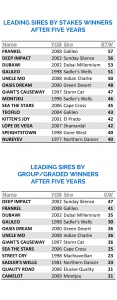
We could say the same about black-type records. Larger numbers of runners tend to be the reason why these records fall, but it’s not always so. Take the case of Frankel (GB), the sire who has posted the highest number of stakes winners (56) and group winners (41) of any European sire in the first five years of his career. Frankel has already eclipsed the previous records set by Dubawi after his first five years, which stood at 53 stakes winners and 35 group winners. Dubawi, in turn, took the record away from Galileo (Ire), who had amassed 51 stakes winners and 30 group winners after his first five years.

No one could accuse Frankel of relying on sheer numbers of runners to outpace Dubawi and Galileo. In fact, he has set the new standards with fewer runners than either of his major rivals. Hence he has posted superior strike rates–14.2% stakes and 10.4% group winners–than Dubawi and Galileo had at the same point in their careers. But Frankel really did get a head start on all his rivals by covering Europe’s best mares from the outset of his career, unlike either Galileo or Dubawi. As many as 62% of the mares that have produced Frankel’s runners so far can be classed as elite, which is in stark contrast to the corresponding percentages for the early runners by Dubawi (30%) and Galileo (35%). What’s certain is that Frankel will need to have very long innings at his current strike rate to overhaul Dubawi’s current mark of 171 stakes winners and, by my calculations, another 20-plus years to reach his sire’s tally of 298. It’s a sure sign of the times that Frankel not only has more group winners than Galileo after five years but also has nearly double the number of his grandsire Sadler’s Wells and has over three times what the great Northern Dancer had in their first five years.

Remarkably, there is yet another sire that can boast an even higher number of group winners in his first five years. Shadai’s Deep Impact (Jpn), the very definition of a big fish in a small pond, sired 47 group winners in his first five years with runners. The lack of serious competition among Japan’s stallion ranks possibly casts a shadow over such an achievement, as does the fact that Deep Impact’s percentage of group winners (7.4%) is not quite as good as the percentages posted by Frankel, Galileo or Dubawi all of whom average above 10% group winners to runners. To counter that argument, though, it must also be recognized that Japan has far fewer group races per head of population than Europe does. So, 47 group winners in five years is still a formidable achievement.

Not surprisingly, North America’s records for stakes winners and graded winners at the end of five years have also fallen quite recently. The phenomenal Uncle Mo set new standards at the end of 2019 with his 48 stakes winners and 26 graded winners. It’s hard to believe that there are now 19 sires with more stakes winners in their first five years than the great Danzig, but none will ever get close to his 21% strike rate.

Among sires who stood exclusively in America, few would have guessed that it wasn’t Speightstown, nor Distorted Humor, nor Scat Daddy that held the record prior to Uncle Mo, but the one and only Kitten’s Joy, a sire that perhaps still struggles for due recognition.

The post Big Books and Breaking Records appeared first on TDN | Thoroughbred Daily News | Horse Racing News, Results and Video | Thoroughbred Breeding and Auctions.

Source of original post

Global Views: Australian Extension

In Global Views, Godolphin Flying Start trainees provide insight into practices experienced and observations taken on their worldwide travels. Second-year trainee Lowri Allen shares the news of the course’s syllabus change that will see them attend the Magic Millions Gold Coast Yearling Sale.

The Godolphin Flying Start Programme offers a unique opportunity to spend time working in and learning about the Thoroughbred industry in five major racing jurisdictions; Ireland, Britain, America, Australia and Dubai. The 2019-2021 class of trainees are now in the fourth phase of the programme, spending time in the capital of Australian Thoroughbred breeding, the Hunter Valley, in New South Wales. Prior to this we spent time in Kildare, Newmarket, and Lexington, learning a tremendous amount about the Irish, British and American Thoroughbred industries.

Spending time shadowing bloodstock agents at the sales forms an integral part of the programme’s syllabus, and consequently we attend many of the major sales internationally. Many of the programme’s graduates have gone on to be highly successful in the bloodstock field.

Ordinarily, trainees would finish the Australian phase of Flying Start in mid-December. But a change resulting from previous year’s feedback, which suggested that the Australian phase should be extended to provide trainees with the opportunity to attend an additional major yearling sale, will see us staying in Australia until the end of February for the Magic Millions Gold Coast Yearling Sale.

The Magic Millions Gold Coast Yearling Sale is one of Australia’s premier yearling sales and this year, a quality line up of 1273 lots has been confirmed by vendors for the seven-day extravaganza. Yearling inspections by trainers and bloodstock agents are currently well underway as they tour the Hunter Valley stud farms looking for the next champion. Legendary trainer Gai Waterhouse places great value in conducting stud farm inspections and is usually one of the earliest visitors on the stud farms. This practice is a noticeable difference between Australia and other jurisdictions, where prospective purchasers might see the yearlings for the first time at the sales complex. From my limited experience, it seems hugely beneficial to see a horse on its home turf and observe how it develops from mid-way through its sales preparation, to the finished product on sales day.

Further to this, the practice of pre-sales inspections was, I think, a major contributor to the success of the 2020 Inglis Easter Yearling Sale. It was the first major sale to take place during the coronavirus pandemic, and it was held at a time when many countries and Australian states were in lockdown. Whilst the sale was conducted with online bidding in a virtual auction format, many prospective buyers had already had the opportunity to view the yearlings through stud farm inspections. Consequently, there was greater buyer confidence and the sales results held up remarkably well considering that the global Covid-19 pandemic drove some challenging economic factors.

Whilst the traditional sales calendar has been kept broadly in line, digital sales continue to gain in popularity. Many in the industry say that the pandemic has pushed forward their usage. Inglis held its first digital sale back in May 2017 and the platform has grown steadily since then. This year was one of exponential growth, with the platform’s gross having doubled that of 2019 by the end of November, being just shy of $50-million.

Across the waters, at Keeneland in Lexington, similar growth was shown at their digital sales. Keeneland debuted its first digital sale in June, offering 31 horses. This number was more than doubled at the December digital sale where 70 horses were offered. The bloodstock industry has been resilient and flexible during 2020, with online bidding and digital sales rapidly establishing themselves alongside those of a traditional format.

The opportunity to learn about and experience sales across all the major racing jurisdictions has been an advantageous aspect of the programme. In Australia, syndicates form a major part of racehorse ownership, with one in every 244 Australians owning a share in a racehorse. In America and Europe, syndication forms a much smaller part of racehorse ownership and syndication groups take up far less of the buying bench at sales in these countries. Another difference is the speed of auctioneering, which is noticeably quicker in Australia and allows the working hours for sales staff to be more favourable than those in Europe, where sales could often go on late into the evening.

The applications for the 2021-2023 intake of Godolphin Flying Start trainees are currently open and close on Monday, Feb. 8, 2021. For more information and to apply, click here.

The post Global Views: Australian Extension appeared first on TDN | Thoroughbred Daily News | Horse Racing News, Results and Video | Thoroughbred Breeding and Auctions.

Source of original post
Verified by MonsterInsights
