DEAUVILLE, France — Everything changes; everything stays the same.
Here's Eric Puerari, rounding off another sales season, his Haras des Capucines consignment an unmissable fixture right next to the parade ring at Arqana. Yet once again, on the eve of the auction, Puerari will on Friday have noticed new faces, making their serious, frowning notes as his mares are led up and down. Will these last any longer than some who surfaced in the previous cycle? Who can say? Plenty of them, Puerari acknowledges, have an authentically competent, dynamic air. Types to keep the old guard on their toes.
“That's the biggest change, the rotation of people that are active,” he says. “When I started, in '95, the newest breeder before me had been Aliette Forien, 10 years previously. Now it feels like we have 10 farms setting up every year. All with quality people, with ambition, putting nice structures in place. And the change among the purchasing entities is just as fast. Sometimes, by the time you get to know someone, they've already disappeared—and yet another has come along in their place. It's impressive, such constant renewal. But it's also the biggest challenge today, to keep pace with so much change.”
Yet whatever people do, in their quest for an edge, one thing abides. Because no software programme, no metric, no business model will remove an 'x' from the equation—and that is the imponderable mystery of the Thoroughbred itself.
“I think the attraction of horses is precisely that technique doesn't actually have much effect,” Puerari says. “People think they can find new ways of doing things, and we have made some progress on a few points. But in the end it always comes down to the same thing: it's always man-and-horse, with a little handling, and the care you take about that. But the main part is intangible.”
That doesn't prevent Puerari and his Capucines partners—co-founder Michel Zerolo, and now an additional investor in Philippe Lazare—from recognising the commercial imperatives arising from this flux of challenge and opportunity. Their own operation is expanding, evolving, adapting to shifts in the marketplace. On the one hand, they have hired Jean-Daniel Manceau to direct a new venture, Capucines Bloodstock; on the other, Puerari himself is devoting himself more than ever to the farm, in order to support increasing volume and welcome new clients.
“Jean-Daniel is a promising young man,” Puerari says. “He can help us propose nominations, find ideas, buy horses privately for clients. Today you have to be wide open, prepared to try different things. Because as I said, this business is moving very fast. There are a lot of creative, enterprising young people, travelling the world over. So we have to renew our concept a little. Our target is not to follow all the trends, but to try and have some foresight, see how things are developing, and give appropriate options to our clients.”
For the core business, meanwhile, Capucines has leased an extra 50 hectares to take the aggregate up to 250—that is, over 600 acres—grazed by 80 mares, some owned by the partners, some with old friends like Dominique Hazan and Ariane Gravereaux, some boarded by the likes of Peter Brant. (These latter, incidentally, include a number in foal to Demarchelier (GB), the son of Dubawi (GB) standing at Claiborne. “We're very impressed by his stock,” Puerari says. “We've raised four of his yearlings, and one has already gone on to be Group-placed, and another looks Group class as well.”)
The Capucines team has also been central to the transfer of Muhaarar (GB) to Haras du Petit Tellier, Shadwell having agreed to sell a 50% stake.
The return is quicker, if you can run early, and the programme especially in England is oriented that way. But you can see that the Classic stables are not that way, nor the Japanese—and the Japanese probably have the best horses in the world now.
“This was Michel's idea, because he was following his results,” Puerari says. “We're grateful to have secured a group of French breeders to support him. He's a very interesting stallion, very like his broodmare sire Linamix (Fr) in that he can throw very different types: horses with speed, horses with stamina, durable horses that run well in America. It's nice for France to have a horse such a versatile influence, and I think €14,000 for a proven stallion like this is very affordable.”
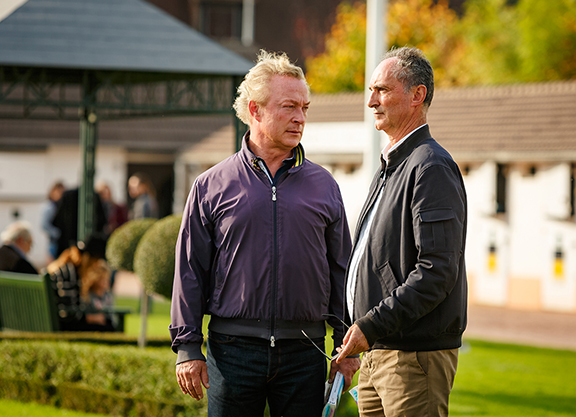
Michael Zerolo and Eric Puerari at Arqana | Zuzanna Lupa
Puerari doesn't rule out standing stallions at Capucines someday. “For just one horse, this was more practical, and Petit Tellier do a very good job,” he says. “But if we grow even more, then who knows? Of course we buy shares in stallions, and I've been managing stallions since I was young. It's a very interesting business; a very risky one, too. But I do think breeders today have to do a little bit of everything. Because sometimes you try stallions and they turn out no good, while the proven ones are becoming extremely expensive. If you look at the sales record of their progeny, there's very little margin. So you have to be creative. You try your luck with stallion shares, you do some consigning, some breaking, just find ways to balance your activity a little.”
Certainly it's a very different environment from the one into which he launched the farm as a young bloodstock agent in 1993. His father, a banker like many of their ancestors (the surname comes from Italy via Switzerland), had introduced Puerari to Thoroughbreds as a small but extremely shrewd breeder whose programme produced the likes of Silver Cloud and Tyrone. (Both won the Grand Criterium, and the latter followed up in the Poulains.) Puerari is also grateful for the racetrack mentoring of Maurice Zilber, whose approach he has memorably compared to the surprise attacks of a military genius.
“My father didn't have a farm, so I think the idea was little bit of a dream,” he recalls. “I realised that being an agent was something fragile, too; that you can lose traction, and I wanted to be on a more solid base. But I had no precise idea, no competence, no experience. No clue at all, really. Probably if I did it again, I would do it quite differently. But you know, I'm not sure I was doing much worse than now!”
Even the name was improvised. He hadn't given it any thought when suddenly the deadline for sale entries was upon him. With a day to decide, a neighbour happened to arrive, saying, “I've just come up the Boulevard des Capucines.” (Nasturtiums, that is, though Capucine also happened to be his sister's name.)
Puerari reckons that three things enabled him to overcome his lack of seasoning. One, he hired good people from the outset. Two, the land was the best in Normandy, as recognised by Louis XIV in choosing an adjacent site for the royal stud. And three, the farm's very first crop included G1 Irish Derby winner Winged Love (Ire).
Luck played its part here, too, as Sheikh Mohammed's team only diverted the horse to the Curragh from the German Derby at the 11th hour, following a setback to their intended runner. Fittingly, Winged Love was out of a mare co-bred by Puerari and his father from one they had bought from the Dupre family. Winged Love was then bought privately as a yearling by Anthony Stroud, with the condition that he was sent to a young trainer named Fabre.
“Winged Love was the turning point,” Puerari says. “That gave me some strength to carry on. To buy a farm and breed, you need funding, and on the eve of the King George—through Michel—I was able to sell the mare to the Yoshida family for a very round price. So that gave me the fuel to develop the farm.”
That, of course, was among many exports then being made by Japanese investors. As a result of those patient endeavours, the Japanese breed is arguably now setting global standards. But few seem to be heeding the implicit rebuke to short-term commercialism, among European breeders. It would be hard work, nowadays, to market a horse like Winged Love's sire, In The Wings (GB), who didn't crack the elite level until running over 12 furlongs at four.
At Tattersalls, where Puerari and Zerolo were as usual presiding over their European Sales Management draft, there was further evidence of fragility in the middle market.
“And the racing is a bit the same now, you have a few powerful organisations at the top and the system is very polarised,” Puerari says. “In that sale a big proportion of the nice, young, Group-winning mares were sprinters, because the Classic stables don't buy those as yearlings. That's where the market lies for ordinary people, they can buy those types for not too much money and hope to make them valuable. The return is quicker, if you can run early, and the programme especially in England is oriented that way. But you can see that the Classic stables are not that way, nor the Japanese—and the Japanese probably have the best horses in the world now.” Puerari smiles wryly, adding: “But the Irish are very creative!”
The business of the breeder is to have a dream, and then to face reality every day. It's about trying to keep that dream alive
Puerari accepts the observation that smaller breeders cannot really pretend that Classic sires are unaffordable, when you consider a horse like Nathaniel (Ire).
“But time is of the essence,” he says. “Everybody wants a quick return, everybody's in a hurry. You don't have many people playing for the long term. Look at the Aga Khan or the Wertheimers, they've been there for a century. How many comparable stables do we have in the world? Not many.”
Yet not all the great breeders have necessarily doubled down on their trademark families.
“For many years I worked for Monsieur Lagardere,” Puerari says. “And he would do the opposite. He'd try to renew at least 20 percent, maybe a quarter, of his bloodlines every single year. He would never 'sleep' on pedigrees, but would blend them, renew them, challenge them. And I do agree that bloodlines have a lifespan. Great female families and great breeding operations are the same: if you don't renew all the time, eventually you're going to lose power.”
Puerari is now curious to see how the overall gene pool addresses its own stagnation.
“We're getting ourselves into a corner, genetically,” he remarks. “The same horses are dominating, so we'll have to see whether we can find some interesting stallions with different blood. If you look at the old pedigrees, you see that in every era there's been dominant blood, with a lot of inbreeding. And then, surprisingly, these lines disappear. Lines that were fashionable quite recently, like the Mill Reef/Shirley Heights one, suddenly just die out.”
One way or another, then, a degree of rotation feels right in the Capucines programme.
“It's true that buyers get fed up with the 'normal,'” Puerari says. “Everybody wants something new all the time, that's why first-year stallions succeed. People always want new blood, a new offer, so we try to do that as well in our operation.”
From a domestic perspective, Puerari admits to disappointment that so many of the best French yearlings are nowadays exported.
“I think we have a lot of talent in France, but we lack a bit of funding,” he says. “It's now very difficult to have a horse for our main sale, here in August: you need a couple of hundred thousand for the mare, and to pay a nomination of €50,000, which means that after two or three years you've spent half a million with no guarantee.
“We do have some foreign investment, Sumbe and Yeguada Centurion are very nice additions, for instance. But we need more of those international breeders, and we need to stay internationally competitive. That's a big fight, here, because a lot of people just see the local scene. We need our leaders not to lose sight of the bigger picture, and to promote the best racing we can.”
At the top level, to be fair, that's an obligation shared internationally. Puerari feels that elite competition has been diluted by insertion of local showcases into the existing programme. The introduction of a Champions' Day at Ascot deliberately confronted both the Arc meeting and the Breeders' Cup, for instance, while enormous prizes offered in the desert have eroded historic races in California.
But then maybe that's another variation on the kind of constant change that Puerari has already discussed. And he's determined that the brand he has built, with the help of three Classic winners and two Breeders' Cup winners off the farm, will remain as relevant and responsive as ever in its 30th year.
He feels fortunate, in this respect, in his partnership with Zerolo. “We met on a plane years ago, going to Newmarket to visit the stable of Olivier Douieb,” Puerari recalls. “We were the same kind of age and just hit it off. Michel wasn't really thinking of having a farm but suggested, really just in a spirit of friendship, that we could do it together. And he has become one of the keys to me having the strength to carry on. I have a lot of admiration for people who do it all themselves, with no help. Both of us have our own relationships, so we remain very independent as well. But it's very important that Michel can offer a different angle. We're a mixture, we have different qualities and probably different defects too, but in the end it works. And that's not just a plus for us but also for clients of the farm.”
Most importantly, however, these are not just matters of structure and execution. Because, as we said at the outset, ultimately everything will stand or fall on that great “intangible,” the empathy between horse and horseman.
“Everybody needs some luck, some results, but there's never any guarantee,” says Puerari. “All we know is that the activity, as a breeder, is very rewarding in terms of human feelings. First because you work as a team, in a beautiful environment, and the team is very dedicated. And then when you see young horses, how they change every week, and you try to make them valuable. The difficult part is putting the mare in foal. Nobody understands why things suddenly go wrong, and the reality is that you have to accept some casualties. After the foal is born, you can control things a bit more. But the business of the breeder is to have a dream, and then to face reality every day. It's about trying to keep that dream alive.”
The post Capucines Adapting to Remain in Full Bloom appeared first on TDN | Thoroughbred Daily News | Horse Racing News, Results and Video | Thoroughbred Breeding and Auctions.
