It has been a big year for Whitsbury Manor Stud. From a landmark result with homebred Chaldean going on to win the 2,000 Guineas for Juddmonte, his half-sister Get Ahead selling for 2.5m gns at public auction and the continued rise of superstar stallion Havana Grey, 2023 has been the gift that keeps on giving for Ed Harper and his team.
There is plenty, still, to look forward to next year, with fellow Whitsbury-based stallion Sergei Prokofiev set to be represented by his first crop of runners and Dragon Symbol taking up his position on the roster.
From all things Whitsbury to reflecting on the breeding stock sales, the ever-engaging Harper makes for required reading in this week's Q&A.
You must look back on 2023 pretty fondly with Whitsbury Manor Stud homebred Chaldean winning the 2,000 Guineas for Juddmonte?
We wouldn't have a lot of runners in Classic races because of the types of stallions we stand but, obviously, we use a few outside stallions every year. When you use the best stallion around [Frankel], you hope to provide yourself with a chance to step up on quality. It couldn't have worked out any better with Chaldean winning the 2,000 Guineas.
Where would that rank?
A great milestone. It ranked very highly but I don't feel as though it was a whole heap of hard work that produced the result. For example, producing a stallion like Showcasing or Havana Grey, that takes five or six years of hard work from every team member pulling in the same direction. A result like Chaldean is a piece of good judgement in the sales ring to buy the mare by Dad, which isn't to be underestimated, but even he would admit that there is a lot of luck involved. So, you get yourself a diamond mare in Suelita, what are you going to do with her? You're going to send her to a diamond stallion. It's brilliant, and it's fantastic, but it's not comparable to the whole Whitsbury machine working together for years to make a stallion. I see the two things very differently.
You must have got a lot of pleasure at seeing Chaldean's half-sister Get Ahead, a talented mare in her own right, selling for 2.5m gns to Ian MacAleavy's First Bloodstock?
I'd have rathered if we didn't have to sell her! We have to remind ourselves that the function of Whitsbury is not to have a small, uber broodmare band sending mares to the best stallions on the planet. Our job is to keep small breeders alive in England because, without them, there is no breeding industry in this country. If we can sell Get Ahead and support the business in areas that help, such as the grassroots by making stallions, then that's our job. Effectively, weighing up the sale of Get Ahead, we can't be everything to everyone. You can't be brilliant at everything. It doesn't work like that for anybody. So weighing it up, we ask ourselves what our priority is. Is it looking out into the paddock and seeing the occasional super mare going to the super stallion or is it making the next stallion? We effectively prioritised the buying of Dragon Symbol over keeping Get Ahead. That's the choice we made.
I'll go on to Dragon Symbol in a second but, when you mentioned Whitsbury supporting the grassroots players in England, I just wonder how you would look back on the breeding stock sales on a personal level taking into consideration how many smaller breeders took a kicking?
The most satisfying thing for us this year was the 20 to 30 smaller breeders who really benefited from Havana Grey. That means that some of those breeders can reinvest and possibly step up the next rung up the ladder, which is great, or, on a slightly scarier level, it means some will survive another two or three years. Without stallions like Havana Grey, that doesn't happen. I'm not pretending to have the answers as to why this is but, culturally, when smaller breeders in England stop, they stop for good. They don't come back. When small breeders in Ireland stop because, say there's a dip in the market or maybe there's overproduction, for whatever reason, they seem to have the ability to come back when times get better. I feel like we have to be the lifeboat throwing the vests out to keep some of the smaller breeders alive and, when you get it right and you help a load of people, it's very satisfying. Obviously, we're trying to run a profitable business as well, we're not a charity, but we need a thriving industry and we have to provide our clients with a chance to make money. It's very satisfying when it happens.
Did you listen to this month's Jamie Railton podcast where Roger O'Callaghan was the guest? Roger singled out Whistbury for high praise. A lot of people would say there are similarities between how Whitsbury and Tally-Ho Stud is run. What would those similarities be?
I listened to it, yes. There's lots of other places in England who had good years, so we don't have a monopoly on that. But what do we do similar? For starters, we don't really worry what other people are doing and Tally-Ho certainly don't worry either. The one thing that we would agree on is that we need to see success scattered around the business from time to time. It can't be for one outfit all the time because that's not how a sport works. I've a few friends and connections who have never been involved in the breeding industry who have started to ask me questions about getting involved for the first time. I've known some of these people for 20 years and they've never asked me that so it's nice to think we have just pricked the interests of a few new players because we can't just have people going out of the market. We need new people as well.
For me, one of the stories from the mares sale was your neighbour Katrina Yarrow getting 52,000gns for Havana Grey foal with the first mare she ever bought.
Exactly. And that was someone who was brave enough to listen to us when we recommended the mare. Fair play to Katrina for giving it a go. You're only ever going to find out by giving it ago and, if you don't risk too much and keep top of what you are prepared to invest, it can be a lot of fun.
Getting back to the Railton podcast, when Roger said that some breeders need to look themselves in the mirror over some of the poor results in the ring, rather than blaming the game, did you think that was fair comment?
Yea, I would agree with Roger completely. We're all good at seeing the difficulties in our game but the skill is figuring out how to combat it. Sending back the same mares, who are a year older, year after year, and then saying, 'oh, it hasn't happened for me,' is not the approach. If you asked that same person what they have done to give themselves a chance, what have they actively gone and done, they often don't have any answer for you. Some will say, 'oh, well I can't go out and buy a new mare, I had to play it safe because the foal sales didn't go well or the yearling sales didn't go well.' Well, the answer to that is no, when the foal or yearling sales don't go well, that's when you have to go out and buy a new mare! You almost have to be more active when things aren't going well. People tend to almost go back into the shell when things aren't working for them. Everyone should be trying to improve all the time. I mean, I read Emma Berry's piece with Peter Kavanagh in the TDN on Tuesday, and he made some excellent points. The bit I would completely agree with is that, part of the puzzle, and the piece of the game that we rarely talk about, is horse husbandry. It's arguably the most important part of the puzzle. From choosing stallions, to buying mares or even sending horses into training, it's all completely irrelevant if the horse husbandry hasn't been good enough. That is the area that is slipping in Britain; the horse husbandry is going the wrong way a lot of the time. Obviously there are plenty of people doing a good job but, in general, the slide is in the quality of husbandry, and that's difficult to get around. When husbandry slides, the rest of it becomes irrelevant.
What are we talking about here? Just poorly presented foals at the sales with regards to lack of bone, poor feet etc?
Everything. The quality of the land, management of the pasture, the attention to detail on the stock, general care of the stock; it's everyday stuff. Thinking that you can just turn out horses and forget about them, be it mares, foals, whatever, horse husbandry is an everyday job. If you are not on it every day, it slips.
I was at the pinhookers panel at Tattersalls on the evening before the foal sales where you came out with a great line when referencing a conversation you had with your accountant. I think he was questioning one of your decisions and you said something along the lines of, 'you don't get to have a say, you just keep the score!' With that in mind, and I know you won't mind me saying this, but I would say there were a few people questioning the decision to stand Dragon Symbol at Whitsbury. Lucky you don't care what other people think!
We had the same reaction with Showcasing and Havana Grey. When we bought Showcasing, I was told that the Gimcrack wasn't a stallion-making race. You had to go back to Mill Reef when a Gimcrack winner became a good stallion. What a load of rubbish that was. With Havana Grey, people were saying, why are we getting excited about a son of a stallion who was standing for eight or 10 grand, or whatever it was at the time. That made no sense to me either because, first of all, Havana Gold had already proved himself as a bloody good stallion and, also, you could give 10 examples in about three seconds of horses who were more successful than their sires. In terms of Dragon Symbol, he's very easy to defend. He was five pounds a better racehorse than Havana Grey ever was and it's about standing a quality racehorse at the end of the day. To be first past the post in a Commonwealth Cup, with himself and Campanelle six lengths clear of the rest, and to then go and be beaten just a neck behind Starman in a July Cup as a three-year-old, those are serious performances. I happened to think Cable Bay was a bloody good stallion as well. He just didn't have the rub of the green in terms of fertility and soundness, in that he had one or two issues that held him back, which was nobody's fault. He got eight black-type two-year-olds in his first crop which is better than ninety per cent of stallions and that allowed them to double his fee to 15 grand, which nobody batted an eye over. He absolutely deserved it.
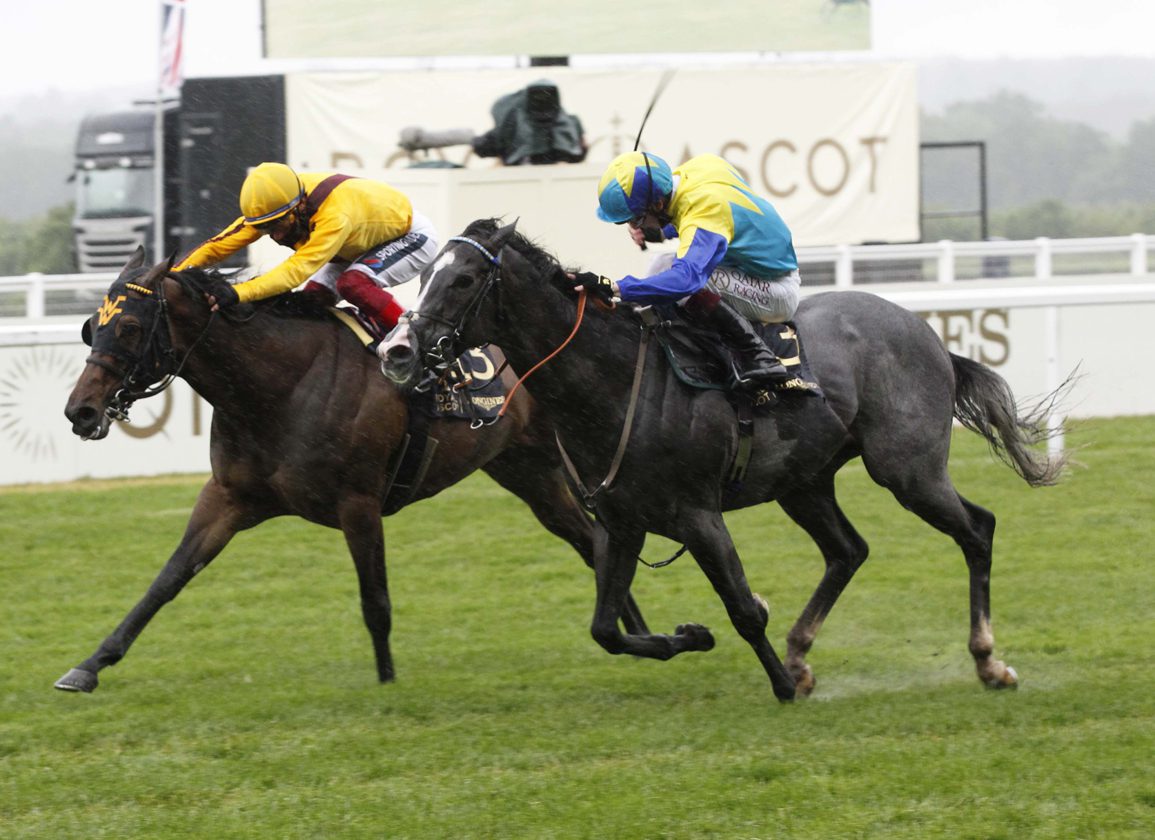
Dragon Symbol (right) | Racingfotos.com
Is it extra special bringing Dragon Symbol back to where he was bred or does it even matter?
The answer to that is I couldn't give a monkeys who bred him! It's a nice thing to talk about but it had zero influence on the decision. In fact, I think it could have the opposite effect as people might get the wrong end of the stick in thinking Dragon Symbol was a vanity project when the reality is that it couldn't be further from the truth. We're far too business-minded and commercial to worry about that sort of thing.
And what's the vibe ahead of Sergei Prokofiev's first runners next year?
I don't even want to hear things from trainers in February, let alone December, but all I would say is that the Sergeis are very easy customers to deal with. They are relaxed and compliant. As we were saying earlier, sadly with the staffing in the industry, we don't have the time to deal with difficult horses compared to back in the day, so having a stallion who produces even-tempered and nice horses is a step in the right direction.
We almost got to the end of the conversation without waxing lyrical about Havana Grey. I know you find it boring to continue to heap praise on him but even you must have been punching yourself over the continued support behind him at the foal sales?
It's fantastic but my pulse doesn't raise much at the sales. When we're selling our own stock for good money, we need to do that to keep the cogs turning in the right direction and to reinvest in the industry, but it's not something I get excited about. What excites me most is watching our horses win on the track. I do get nervous watching a two-year-old we thought a lot of make its debut. Even if it's a Class 5 at Wolverhampton, I'll be far more nervous about that than a horse going through the ring. The other thing that makes us happy is trying our best to help and advise people and, when it works out even better than what we'd hoped it would, that is very satisfying. Celebrating the result of our clients is more satisfying.

The post Ed Harper Q&A: “What Excites Me Most Is Our Horses Winning On The Track” appeared first on TDN | Thoroughbred Daily News | Horse Racing News, Results and Video | Thoroughbred Breeding and Auctions.
Source of original post
