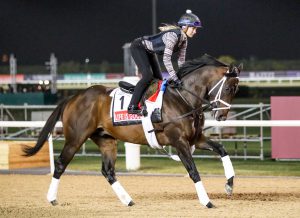
Gary and Mary West have released a statement saying that they will support a redistribution of the purse of the $20 million Saudi Cup. The statement was made via the Twitter account of Werk Thoroughbred Consultants, of which the Wests are longtime clients.
Maximum Security won the $20 million Saudi Cup in 2020, just days before Jason Servis was named in a criminal indictment along with 26 others for a “widespread, corrupt scheme by racehorse trainers, veterinarians, PED distributors and others to manufacture, distribute, and receive adulterated and misbranded PEDs and to secretly administer those PEDs to racehorses under scheme participants' control,” by the U.S. Attorney's Office for the Southern District of New York. Servis pleaded guilty to those charges in court Friday, and is expected to serve four years in prison.
“We believe in the justice system and have patiently waited for the legal prosecution to take its course. Now that Jason Servis has entered a guilty plea, we want to make it clear that if the Saudi Cup decides to redistribute the purse, we would support that decision. Hopefully, that action will prevent future conduct of this nature. We believe the decision to take the Saudi Cup purse from Maximum Security and redistribute it is the correct one. There will be no further statements or comments.” The statement was signed `Gary and Mary West.'
WTC's Sid Fernando posted the statement on @sirewatch, the company's Twitter account, Friday night at 11:46 p.m. with a note that said, “WTC clients Gary and Mary West have asked us to release this statement regarding the guilty plea of Jason Servis, who trained the Wests' homebred Maximum Security.”
The payment, or non-payment, of the 2020 Saudi Cup purse has long been a source of contention, with Maximum Security's owners crying foul that they did not receive the purse money after the allegations against Servis. The rest of the field was paid their share of the purse, but Maximum Security's $10 million payment was withheld. “We are sort of in a hold position now waiting for the U.S. authorities to move forward with that case,” said Prince Bandar on behalf of the Jockey Club of Saudi Arabia at the 2021 Saudi Cup.
Midnight Bisou was the runner-up in the race, with Benbatl third, Mucho Gusto fourth, and Tacitus fifth.
In the end, things work because they work. We try stuff, often if not always with the best intentions, and see whether it gains our trust. Lived experience, among horsemen and fans, will eventually tell us whether an experiment has failed or whether, once every generation or so, we might have struck a game-changing seam of gold. The Breeders' Cup was one such; and, who knows, maybe a similar hostility from vested interests will ultimately prove the furnace in which HISA can be forged into another.
That may seem a long way off, from both sides of the fence. But someday we'll look back and know whether or not this was a moment when enough people, recognizing the steepening gradient of viability, began to embrace the kind of duties that must accompany the privileges of a life with Thoroughbreds in 2022.
Both in terms of the cost of doing something, and the risk in doing nothing, the stakes are pretty enormous. In this era of bitter polemics, it's unsurprising that people are harnessing broader ideologies to their respective positions. As a result, however, there's a tendency to become so consumed by means that we lose sight of the ends. Things work because they work–not because they are assembled by federal factories or state artisans.
One good example is the piecemeal evolution, over the years, of the racing calendar. In my homeland of England, what has come to feel like a sacrosanct cycle actually obeys the social routine of Victorian aristocracy: Royal Ascot dovetailed with the London “season” of debutantes' balls; the imminent garden party of Goodwood is followed, just down the road, by the Cowes sailing regatta; while the Ebor and St Leger meetings at York and Doncaster were sited conveniently for grouse shoots on the northern moors. In the same way, Saratoga only became the addictive ritual it is today because the capitalist barons had found sanctuary, at an upstate spa, from the broiling city summer.
These have become cherished staging posts in our sporting year by achieving an organic connection not just with us, but also with each other. In its understated way, for instance, you could say that last weekend's GIII Ohio Derby embarked us on the second half of the sophomore campaign. Regrouping Classic protagonists like Zandon (Upstart) and latecomers like Jack Christopher (Munnings) will soon be converging along such roads as the one leading through the GII Jim Dandy and GI Travers.
(Click the arrow below to listen to this column as a podcast)
This schedule has matured in the habits of professionals and public alike. And I have yet to hear anything remotely coherent, among those who renewed their tiresome complaints about the Triple Crown schedule because a freak Derby winner did not risk exposure in the Preakness, about how they would avoid instead butting right into races like the GI Haskell. If you stretch out the Triple Crown, you instead create a logjam in these barely less storied races, which allow both precocious and later-developing sophomores to circle back together.
And, actually, what we see this weekend shows us what happens when you start pulling at the ball of wool. Because two of the biggest names around, both sons of Into Mischief, resume Saturday after a prolonged absence occasioned by pursuit of the winter riches nowadays available in faraway deserts.
His disappointing performance in the G1 Saudi Cup leaves Mandaloun still in the curious position of having two Grade I wins on his resumé without ever passing the post first in a Grade I race. It has also required him to take a long break before the GII Stephen Foster S., a likely stepping stone to the GI Whitney–in which race he might well encounter Life Is Good, who has similarly been stuck in the workshop since his derailment in the G1 Dubai World Cup, and now resurfaces in the GII John A. Nerud S.
Now nobody could sensibly object to the growth of international racing, a transparent boon to our sport. But the people putting up these huge prizes halfway round the world, in what always used to be a period of rest and recuperation for elite American horses, plainly have an agenda of their own. And we've seen the dismal consequences for some of those venerable spring races in California, in particular.
Everybody is perfectly within their rights to go after all that eye-watering desert bounty. But let's not lose sight of the connection between the welfare protocols at Santa Anita, which we celebrated last week, and the competence of the breed to service the program. Because we will not be meeting the standards we inherited from our predecessors, if modern champions are either campaigned like Flightline (Tapit), who is being widely credited with “greatness” after racing for an aggregate 5 minutes and 12 seconds; or disappear to the desert in the winter, then needing months to recover before tentatively contesting only a couple of races before the Breeders' Cup. (That's if they recover at all: Arrogate, for instance, plainly reached the bottom of the barrel in Dubai.)
Life Is Good | Dubai Racing Club
Arguably all those dirhams caused Life Is Good to overreach, in terms of his stamina potential, earlier than would have been the case had he stayed home for a campaign that reserved that test for the Breeders' Cup. One way or another, a single performance in Dubai has prompted a pretty abrupt relegation, by most observers, below Flightline. For now, however, I'd resist the idea that Speaker's Corner (Street Sense) will offer Life Is Good a reliable line on the relative merit of Flightline. For Speaker's Corner to be rolling up his sleeves again, just three weeks after meeting that horse in the GI Met Mile, suggests that he can't possibly have left everything out on the track that day.
Two races in three weeks! Whatever next? And both against authentic monsters, in an era where the graded stakes program has become so diluted that you really have to go looking for trouble to find it.
To all the familiar reasons for that syndrome–the foal crop, the super-trainers, the training in cotton wool–we must add the fact that many of our very best horses are taken right out of the game, for several months, by a shattering winter migration.
There's nothing inherently wrong with these desert races. On the contrary, they provide a fascinating melting pot. They're bringing together horses from radically different racing environments, arguably more successfully than the Breeders' Cup or Royal Ascot. Being wholly extraneous, however, they are unraveling a domestic calendar that had over the decades achieved a wonderful national coherence and dynamism from the accretion of local habits and loyalties.
We're seeing now, in a different context, how very hard it is to try and do something like that overnight. We can't turn back the clock on international racing, and nor should we want to–any more than we should stem the tide of progress with HISA. But we should remember that the pageant woven by so many generations past, in the domestic calendar, isn't just a cultural heritage. It is a parallel legacy to that of the breed itself, as a trusted means of testing its physical competence.
We have to retrieve that functionality: streamline racing capacity, in terms of the program; and expand equine capacity, whether as breeders or trainers or both. Otherwise the horses we send out to the desert will bring back with them a drought to wither some of the Turf's most fertile acres.
Although he beat just three home in the G1 Saudi Cup a fortnight ago, trainer Saeed bin Suroor said Real World (Ire) (Dark Angel {Ire}) could still stay on the dirt for the G1 Dubai World Cup on Mar. 26.
Godolphin's 5-year-old came alive in Britain last summer, winning the Royal Hunt Cup at Royal Ascot followed by three straight black-type races culminating in the G2 Prix Daniel Wildenstein in October, and he kicked off his campaign with victory in the G2 Zabeel Mile at Meydan on Jan. 28. Real World ran on the dirt four times during last year's carnival and while he didn't win, he was placed three times, and bin Suroor said his Saudi Cup performance wasn't about an inability to handle dirt.
“He missed the break and from the start it did not look like he was going to win,” the trainer said. “That was clear to me and everyone else who saw it. He has come back after the race very good and he has exercised well. He is happy and healthy.
“He looks good, we will keep options open for him now. He will either go to the Dubai World Cup or the [G1] Dubai Turf, the nine-furlong race. I think we will make that decision a week before the race. I have to talk to Sheikh Mohammed about that.
Bin Suroor's Storm Damage (GB) (Night Of Thunder {Ire}) was the winner of the only non black-type race on Meydan's Super Saturday card last weekend, and the 4-year-old gelding looks ready to step up to pattern level.
“He is a nice horse,” said bin Suroor. “Last time Frankie [Dettori] rode him, he won over seven furlongs at Meydan on Super Saturday. He is a horse who could go over sprint trips or over a mile and could go for the Dubai Turf. The options are open for him.”
The main event on Saudi Cup Day two weeks ago was all about the host nation, with the locally owned and trained Emblem Road (Quality Road) posting a remarkable upset in the world's richest horse race. Saudi Arabia has announced its presence on the global horse racing scene loud and clear, and the country-with its ever-increasing investment in racehorses and breeding stock globally–will continue to be heard from for years to come.
When the layers are peeled back on the third running of the Saudi Cup card, however, it was another nation who made the biggest statement. Japan swept the first four international races on the card and finished second and third in the G3 Saudi Derby. In other words, the only race in which Japan did not hit the board was the Saudi Cup.
While Saudi Cup Day marked a breakout performance for Japan on the world stage, it was far from its first-the dust had still barely settled on Japan's two-win days at both the Breeders' Cup and Hong Kong International Meeting last year-and in fact, the crescendo has been rising for years. Japan's increasing frequency of success on racing's biggest days have gone hand-in-hand with the internationalization of its industry in recent decades, and indeed each of the nation's winners and placegetters on Saudi Cup Day boast pedigrees that have criss-crossed the continents for generations.
Undoubtedly the most major turning point in the history of Japanese breeding came when Zenya Yoshida–the father of current-day Japanese breeding doyens Teruya, Katsumi and Haruya Yoshida-purchased American Classic winner Sunday Silence to stand at stud at Shadai Stallion Station in Hokkaido, reportedly paying $7.5-million for 75% of the horse in 1991 (Yoshida had purchased 25% of Sunday Silence in training so was buying out his partners on the remainder). Sunday Silence, the 10-time champion sire in Japan, had his presence felt on Saudi Cup day not only through his best-known son Deep Impact (Jpn), whose son Kizuna (Jpn) sired the G3 1351 Turf Sprint winner Songline (Jpn), but also through another son, Stay Gold (Jpn), and his own son in turn Orfevre (Jpn).
Stay Gold (Jpn) was a member of Sunday Silence's third crop and was his sire's first major international winner, traveling to take the Dubai Sheema Classic and Hong Kong Vase. Stay Gold has sired 56 stakes winners and 10 Group 1 winners and Stay Foolish (Jpn), a member of Stay Gold's last full crop, joined his sire as an international winner with a victory in the 3000-metre G3 Red Sea Turf H., defeating the G1 Irish St Leger scorer Sonnyboyliston (Ire) (Power {GB}).
Another of Stay Gold's international winners-and, in fact, the second-richest racehorse in history-was Orfevre (Jpn), the Japanese Triple Crown and two-time G1 Arima Kinen scorer who is probably best known internationally for twice finishing second in the G1 Prix de l'Arc de Triomphe, including when he famously snatched defeat from the jaws of victory when hanging badly inside the final furlong while on the lead in 2012, once again dashing Japan's still unfulfilled Arc dreams.
Orfevre's Authority (Jpn) was already a triple group-race winner in Japan but he landed on the public radar in November when finishing second to Contrail (Jpn) (Deep Impact {Jpn}) in the Japan Cup, and he kicked off Japan's four-timer on Saudi Cup Day when justifying favouritism in the 2100-metre G3 Neom Turf Cup. Orfevre is also the sire of last year's GI Breeders' Cup Distaff winner Marche Lorraine (Jpn), who was sixth in her final start in the Saudi Cup.
Authority and Stay Foolish's victories bookended the filly Songline in the 1351 Turf Sprint, and she became the first stakes winner over 1200 metres for her exciting young sire Kizuna, a Japanese Derby-winning son of Deep Impact. Kizuna is another to have represented Japan admirably on the world stage: racing for the Maeda family, which regularly supplements its stock with American bloodlines, Kizuna traveled to France to beat the Derby winner Ruler Of The World (Ire) (Galileo {Ire}) in the G2 Prix Niel and was fourth behind Treve (Fr) and Orfevre (Jpn) in the 2014 Arc.
Another sire story of the day belonged to Symboli Kris S, broodmare sire of both Authority and Songline. Symboli Kris S was bred in Kentucky by Takahiro Wada and like Sunday Silence descends from the Hail To Reason line, he through Roberto and Kris S. Symboli Kris S was exported to Japan for his racing career and was highly successful, winning two renewals each of the G1 Arima Kinen and G1 Tenno Sho Autumn before retiring to Shadai. The best of Symboli Kris S's five Group 1 winners thus far has been the G1 Japan Cup and Classic-winning Epiphaneia (Jpn) and he, incidentally, is a full-brother to Authority's dam Rosalind (Jpn). Epiphaneia and Rosalind are out of Cesario (Jpn) (Special Week {Jpn}) who, like Stay Gold, was a pioneering Japanese shipper, traveling to California to win the GI American Oaks by four lengths in 2005 after taking the Yushun Himba (Japanese Oaks). Cesario has become an excellent producer; in addition to Epiphaneia and Rosalind, she is the dam of the 2015 champion 2-year-old colt Leontes (Jpn) (King Kamehameha {Jpn}); Saturnalia (Jpn) (Lord Kanaloa {Jpn}), a Group 1 winner at two and a Classic winner, and two other Group 2-placed winners. Songline is a descendant of European champion filly Sonic Lady (Nureyev), and it is also the family of Deirdre (Jpn) (Harbinger {GB}), who scored a hugely popular victory when winning the G1 Nassau S. at Glorious Goodwood in 2019 before staying on to train in Newmarket and traveling the world to run in Group 1s.
Dancing Prince (Jpn) (Pas De Trois {Jpn}), Japan's fourth winner on Saudi Cup Day in the G3 Riyadh Dirt Sprint, brings together influences of Mr. Prospector, Halo and Northern Dancer through their Japanese imported sons End Sweep, Sunday Silence and Northern Taste, respectively. The 7-year-old Dancing Prince, who won the G3 Capella S. on Dec. 12, is the most successful horse sired by the multiple Group 3-winning turf sprinter Pas de Trois, whose sire Swept Overboard won the GI Ancient Title S. in 2001 and the GI Met Mile in 2002. Swept Overboard was sold to stand in Japan upon the conclusion of his racing career and his best runner is Omega Perfume (Jpn), who won four straight renewals of the Tokyo Daishoten, a local Group 1, including the most recent renewal in December. Swept Overboard's sire and grandsire, End Sweep and Forty Niner, were both champion first-season sires in America before being sold to stand in Japan.
Dancing Prince is out of a mare by Bubble Gum Fellow (Jpn), a champion 2-year-old from Sunday Silence's first crop. His second dam, Sawayaka Princess (Northern Taste), produced the G1 Mile Championship winner Durandal (Jpn) (Sunday Silence). Japan was also third and fourth in the Dirt Sprint with Chain Of Love (Jpn) (Heart's Cry {Jpn}) and defending winner Copano Kicking (Spring At Last).
When it comes to passion for horse racing, it would be tough to top the Japanese. There is an incredible betting culture and fandom surrounding the sport in Japan, and international success seems to directly fuel not only increased global participation, but also the spend on bloodstock: just days removed from the nation's Breeders' Cup double with Marche Lorraine and Loves Only You (Jpn) (Deep Impact {Jpn}), Japanese breeders headed to the Kentucky breeding stock sales and purchased 13 seven-figure mares, including the Classic-winning filly Swiss Skydiver (Daredevil) for $4.7-million and four additional mares that topped $3-million.
Now, Japan is poised to bring an unprecedented squad to Dubai World Cup night that currently numbers 24. Authority and Stay Foolish are on the lists, respectively, for the G1 Sheema Classic and G2 Gold Cup. Sekifu (Jpn) (Henny Hughes), who was runner-up in the G3 Saudi Derby, is pencilled in for the G2 UAE Derby. Among those set to join Authority in the Sheema Classic are Glory Vase (Jpn) (Deep Impact {Jpn}), the back-to-back winner of the G1 Hong Kong Vase, and last year's G1 Tokyo Yushun and G1 Yushun Himba scorers Shahryar (Jpn) (Deep Impact {Jpn}) and Uberleben (Jpn) (Gold Ship {Jpn}). Schnell Meister (Ger) (Kingman {GB}), who was bred in Germany but is campaigned in Japan by Sunday Racing and beat Songline in last year's G1 NHK Mile Cup, is among those earmarked for the G1 Dubai Turf, while Vin De Garde (Jpn) (Deep Impact {Jpn}), who was runner-up in the 1800 metre event last year, is set to return. Copano Kicking and Chain Of Love lead the Japanese squad for the G1 Dubai Golden Shaheen. Japanese dirt star Chuwa Wizard (Jpn) (King Kamehameha {Jpn}) will line up for the $12-million G1 Dubai World Cup.
Those are just a handful of the runners that could give Japan another night to remember in Dubai later this month. And regardless of the outcomes at Meydan, it is an odds-on bet that the global racing community will continue to see the effects of Japan's incredible investment in and commitment to its racing and breeding programme.