The California Series: John Shirreffs

In a new TDN series, we curry lessons and wise counsel from veteran Californian figures who, like gold nuggets panned from the Tuolomne River in the High Sierras, have unearthed career riches on arguably the toughest circuit in the States. We begin this series with John Shirreffs.

Born at Fort Leavenworth, Kansas, Shirreffs was raised around horses on his family farm, and was deployed to Vietnam with the Marine Corps before embarking on a career in racing, using a 10-year stint at the Loma Rica Horse Ranch in Northern California as a springboard to a training career that would see him sift one of the rarest jewels of all.

Part I

Amid the tall spiking pines and jutting mountain cathedrals of Northern California's Grass Valley back when the sprawling Loma Rica Horse Ranch still hummed with activity and where the transatlantic phenom Noor would later be interred–to haunt the barns, some say–one stubborn son-of-a-gun yearling colt gave a young John Shirreffs an abject lesson in obstinance.

“He's in the stall rearing up and striking and I can't get the bridle on him,” said Shirreffs, remembering the scene from the safe hindsight of some five decades. The memory remains sharp, however.

Rolling up his sleeves, the young Shirreffs sniffed a challenge, which quickly turned from a wily game of wits into a war of muscle. He jumped on the colt bareback. He grabbed his ears. “We're having this Battle Royale.”

After a fashion, though, Shirreffs waved the white flag and with ego deflated turned to Henry Freitas, the farm's storied manager, for pointers on a less adversarial approach.
“Henry said, 'John, just stop all the B.S. Just go down the stall and put the bridle on the horse and quit all that crap you're doing.'”

Shirreffs was unimpressed. “I'm walking down the shedrow thinking to myself, 'what kind of help was that?'” Still, the relationship between pupil and master was one of deference to experience–decades worth, in the case of Freitas–and so, Shirreffs dutifully obliged.

“I went in the stall, put the bridle on the horse–the horse never moved. It was over.”

And what was the main takeaway? “The value of a timeout with horses,” he replied. “When you're caught up in the moment and things aren't working out, the best thing to do is just stop and give yourself and the horse a chance to have a moment of thought to recover.”
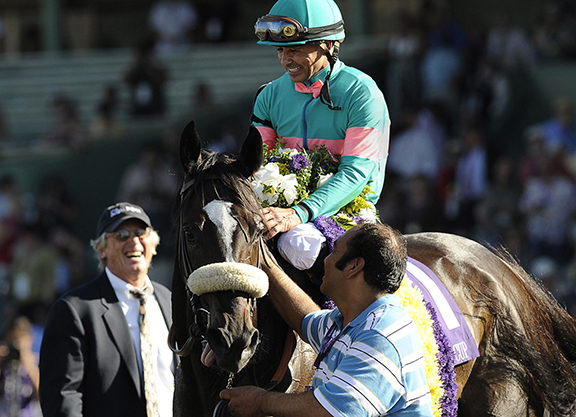
Shirreffs after the Breeders' Cup Distaff with Zenyatta | Sarah Andrew

Shirreffs imparted the story one recent morning in his office at Santa Anita, the nearby San Gabriel Mountains draped in a cold, grey drizzle like a soggy blanket, as the veteran trainer reflected on a 45-year career looped into which is a Kentucky Derby win and multiple Breeders' Cups and the sort of horse in Zenyatta (Street Cry {Ire}) that comes along about as often as Halley's Comet.

This nugget of barn-spun wisdom also provides a useful barometer of the trainer's evolution as a horseman, familiar sounding to anyone long enough in the tooth to know that any career with racehorses is akin to a college course without end.

“When I was younger, I could dominate a horse, right? I could handle them pretty well through strength. But as I got older, horses started getting a lot stronger than I was. Most of them were starting to outsmart me. So, I learned over the years what a mental game it is.”

Indeed, from a world in which the economics of high-level competition has sprouted large military-run outfits–those where routine and repetition are bywords for necessity and thrift–the Shirreffs barn offers a refreshing alternative, where morning training is approached with the same certitude of an explorer setting foot on virgin terrain.

But while Cook and Columbus had in the North Star their guiding light, Shirreffs has for his something altogether more fluid and transactional.

“It's always about building the bond,” said Shirreffs, focusing in on what appears a central conceit of his.

“You have to build a bond between the horse and the person. I have to find a way where that horse has trust in whoever's handling him or doing something with them. So, it's always about the bond, because if that horse trusts the groom or trusts the person with them, then they will behave much better than if all they're thinking about is being nervous, being anxious about what's coming next.”

Big range of emotions

Wander down any shedrow and you'll hear horse behavior equated with everything from wayward teens to recalcitrant spouses to loving sweethearts. This isn't new–the instinct to anthropomorphize is as ancient as civilization itself.

What's unusual is to hear any trainer–especially those operating within the upper echelons of a sport where a business degree can sometimes feel like the most instructive qualification–talk of the complex emotional bandwidth of a racehorse, as Shirreffs does.

The foundations of this clearly stem from those early days under Freitas at Loma Rica Ranch, a 600-acre university for horsemanship, home as it was to stallion and mare, yearling and breaker, lay-up and foal.

“I think somebody should spend an hour in the stall with a stud, just to understand the range of emotion that an animal can have,” he said. “Sometimes, the thing that amazes me about horses is how much they are willing to communicate and how much they're studying us.
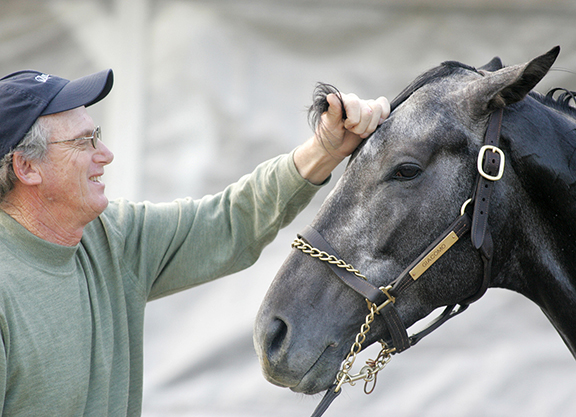
It's a matter of getting to know your horse: Shirreffs with Giacomo | Horsephotos

He added, “You have to realize that they are trying to make their environment as good as they can. And we are the biggest thing in their environment that they have to control. Right?” he added. “We're the ones that could endanger them. So, obviously they're studying what type of a relationship they're going to have with us.”

Like all relationships, the means define the ends. Of course, when it comes to understanding quirks and foibles, there are few substitutes for patience. “It's a matter of getting to know your horse,” he said.

“It's fun to watch the horses to pick up on their habits–I have the time to do that, when the work gets done and everyone's gone to lunch, I have that opportunity, when it's quiet, to watch the horses and see how they're behaving, see what's different about one or the other.”

This, he says, is particularly instructive to the early diagnosis of injury–arguably the biggest culprit of sleepless nights among insomniac license-holders.

“Horses are very stoic, right? You don't have an obvious sense of what's bothering them in the beginning [of injury], before there's any heat or any inflammation or anything like that,” he explained. “But how he eats is a good indication of how he's feeling, not only emotionally but also physically.

“Even then, by the time you notice that something's going on, he's probably been dealing with pain for probably quite some time.”

Such close scrutiny of behavior feeds into what he terms the “bio-rhythm” of a horse–the idea that a racehorse can be brought to peak performance only when, like a maestro vigilant of each section of the orchestra, they're mentally, physically and emotionally in balance.

“You have to figure out how to get things flowing together,” Shirreffs explained. “So, when they're physically at their peak they might not be mentally at their peak because you've trained them really hard, but mentally they're tired or emotionally they're off–you know, upset about being pushed so hard.

He continued, “So, you're going to have to lose a little bit of conditioning maybe to bring them up mentally and emotionally, right? It's always: How close you can get everything?

“That's the one great thing about campaigning a horse, because when they're campaigning they're conditioning–they're physically staying at a pretty high level. And as they campaign, and as they get used to the rigors of racing and training, mentally they're getting stronger, too. And then, if there's some sort of pleasure involved–some sort of reward for the horse–then they're emotionally getting better.

“So, it's all a question of balancing these three different things.”

The real pleasure a trainer gets

In those early days at Loma Rica Horse Ranch, Freitas came down with a nasty bout of flu, giving Shirreffs an early glimpse into the peculiar juggling act that operating a barn necessitates. Though perhaps baptism of fire would be more apropos.

“I knew the routine, right? I knew how everything ran. So, I was fine for about two or three days because I knew exactly what Henry would do.

“But suddenly, after about three or four days, I had to make new decisions based on ones I made a couple of days ago. That's when I got into trouble because I didn't have Henry to ask.”

Now, many an analogy befits a well-run stable, all shaped around a certain triangular hierarchy–an ant colony, for example, of an aforementioned branch of the military.

It's instructive then to hear Shirreffs explain the roles he's carved out for him and staff.

“I don't really need to know veterinary medicine, right? I don't need to know the name of drugs, all that kind of stuff,” he said. “[Veterinarians], they go to school, they know that. But I can learn what the shoer does, right? I can watch what they do.

“I can feel legs, and the difference between one leg and another and study those things. I can watch the horse and see if he's acting colicky or a little upset because of something else going on. So, I thought in the beginning that was where I would best spend my time to become a better trainer.”

Part of that process of self-evaluation has involved holding a mirror to his own failings–his own Achilles heels-as typified, for example, in the way he has, at times, placed individuals in charge of identifying soft tissue injuries.

“As a trainer, you go in and you're checking behind the saddle, but I'm always thinking it doesn't feel too bad because I want to train that horse, right? I have to have somebody put the brakes on. I have to have my own sort of checks and balances.”

At the same time, “You can't put demands on people, right? Because I think a certain way, and I react a certain way, I can't demand that other person be like me and react the way I would react.

“Let's take the exercise rider or jockey or whatever, you have to understand where they are [ability wise], what are their strong points and how you can best use them to accomplish what you need to accomplish with the horse.”

In an industry that often calibrates professional achievement and pleasure through the narrow aperture of race-day honors, it's refreshing, then, to hear someone no stranger to laurel wreath and garland talk of their other important metrics of success.

“It's so difficult to win a race–in California, especially. So somewhere along the way, if you're going to be in this business, you have to derive some pleasure from somewhere else, right?
“So, the real pleasure a trainer gets is seeing the growth in the horse. Or having somebody, like a rider, start to develop and understand his relationship with the horse, see what impact that person can make on how that horse is going to handle the stresses of racing.

“It's really a pleasure when you suddenly see a guy realize that if he didn't pull on this horse so hard and just kind of released the reins a little bit, the horse starts to relax. He realizes, 'Oh, it's not all muscle, it's a little bit of a finesse.'

“I think those are really fun things.”

Part II of this story will run in next week's TDN.

The post The California Series: John Shirreffs appeared first on TDN | Thoroughbred Daily News | Horse Racing News, Results and Video | Thoroughbred Breeding and Auctions.

Source of original post

TVG’s Weekend Broadcast Features Live Coverage Of Louisiana Derby Day

Mandaloun, the winner of the Risen Star Stakes (G2) in February, will continue his road to the Kentucky Derby (G1) and face seven rivals in Saturday's $1 million Louisiana Derby (G2) from Fair Grounds. TVG will be broadcasting live from Louisiana with expanded coverage of the supersized fourteen-race card which features seven stakes races.

TVG's Mike Joyce, Joaquin Jaime and Scott Hazelton will be reporting live from Fair Grounds with exclusive interviews, selections and expert handicapping analysis. The Louisiana Derby is one of four graded stakes races on the card and is a top-tier Kentucky Derby prep race with 100-40-20-10 qualifying points to the top four finishers. The race will feature a rematch of the top three finishers from both the Risen Star Stakes (G2) and the Lecomte Stakes (G3) – Mandaloun for trainer Brad Cox, Proxy for Michael Stidham and the Steve Asmussen-trained Midnight Bourbon.

Saturday's card at Fair Grounds will also feature a prep race for the Kentucky Oaks (G1) – the $400,000 Fair Grounds Oaks (G2). The race has drawn a field of eight sophomore fillies including Clairiere, a homebred daughter of Curlin for Stonestreet Stables. Trained by Steve Asmussen, she was triumphant in her 3-year-old debut in the Rachel Alexandra Stakes (G2) and will have Joe Talamo aboard.

Todd Schrupp, Christina Blacker and Caleb Keller will be live at Santa Anita on Saturday and Simon Bray will be contributing to the from the studio. The featured race on the nine-race card is the $100,000 San Luis Rey Stakes (G3) which will feature the return to action for LNJ Foxwood's multiple graded stakes winner United. Trained by Richard Mandella, Flavien Prat will be aboard as the 6-year-old gelded son of Giant's Causeway tries to notch his eighth career victory.

The stakes action will continue at Gulfstream Park on Saturday and TVG's Gabby Gaudet will be reporting live from the track with insights and interviews throughout the twelve-race card which features the $100,000 Hurricane Bertie Stakes (G3), a sprint for fillies and mares. The race has attracted a contentious field of eight including Slam Dunk, a four-year-old daughter of Into Mischief stepping up to stakes company after an allowance win for Shug McGaughey in February.

In addition to racing from Fair Grounds, Santa Anita and Gulfstream Park, TVG will feature racing from Oaklawn Park, Aqueduct and more. Fans can tune in on TVG, TVG2 and the Watch TVG app which is available on Amazon Fire, Roku and connected Apple TV devices.

The post TVG’s Weekend Broadcast Features Live Coverage Of Louisiana Derby Day appeared first on Horse Racing News | Paulick Report.

Source of original post

Classy United Returns To Action In Saturday’s San Luis Rey Stakes

Richard Mandella's classy multiple stakes winning United, idle since early November, will square off with Richard Baltas' sharp recent winner Masteroffoxhounds, as they head a field of five older horses going a mile and one half on turf in Saturday's Grade 3, $100,000 San Luis Rey Stakes at Santa Anita.

A winner of four out of nine Santa Anita turf starts, United has been idle since running a disappointing eighth in the Grade 1 Breeders' Cup Turf on Nov. 7 at Keeneland—a race in which he finished second, beaten a head at Santa Anita on Nov. 2, 2019.

A 6-year-old gelding by Giant's Causeway, United enjoyed a terrific year in 2020, winning four out of his six starts, all in graded stakes, and finishing a close second in another, the Grade 2 Del Mar Handicap three starts back on Aug. 22.

A gate to wire winner of the Grade 2 John Henry Turf Championship at a mile and one quarter here two starts back on Sept. 26, United's lone “misfire” came in the Breeders' Cup Turf, a race in which he pressed the early pace but tired to be beaten 9 ¾ lengths.

Owned by LNJ Foxwoods, United will be ridden by Flavien Prat, who's been aboard for his last 11 starts, winning five of them. With two second place finishes in three tries at 1 ½ miles on turf, United is easily the leading money earner in the field with $1,453,549 from an overall mark of 17-7-4-1.

A 4-year-old Kentucky-bred colt by War Front, Masteroffoxhounds made his first six starts in Ireland, winning one of them. A non-threatening seventh in his U.S. debut going one mile on turf three starts back on Nov. 7, he's shown rapid improvement going longer distances for Baltas—airing by 4 ¼ lengths in a 1 3/8 mile turf allowance Nov. 28 at Del Mar and most recently, winning the Grade 2, 1 ¼ mile turf San Marcos Stakes here on Feb. 6 by 1 ¼ lengths.

Although ridden by Joel Rosario for the first time in the San Marcos, Masteroffoxhounds will get the first-time services of Umberto Rispoli. With an overall mark of 9-3-1-1, Masteroffoxhounds, who is owned by Rockingham Ranch, has earnings of $172,942 and will be trying a mile and one half for the first time.

As is often the case on grass at Santa Anita, trainer Phil D'Amato will be very well represented, in this case, by a pair of horses, Ontario, Canadian-bred Say the Word and California-bred Acclimate.

In his first start for D'Amato, the current Winter/Spring leader with 10 stakes wins, Say the Word, a dedicated deep closer, finished with a flourish two starts back to be third, beaten one length, in the Grade 2 Hollywood Turf Cup going a mile and one half at Del Mar on Nov. 27. Subsequently 11th going 1 3/16 miles in the Grade 1 Pegasus World Cup Invitational Turf Jan. 23 at Gulfstream Park, he's worked six times since over Santa Anita's inner dirt training track, a regimen that has worked well for D'Amato this winter.

A 6-year-old gelding by More Than Ready that is owned by his breeder, Sam-Son Farm and Agave Racing Stable, Say the Word's chances would be greatly enhanced by a lively pace. A Group 1 winner at a mile and one half on turf at Woodbine Race Course, he's got an overall mark of 27-5-2-5, good for earnings of $469,292.

With leading rider Flavien Prat opting to stick with United, Say the Word will be ridden for the first time by Mike Smith.

D'Amato will hope to “have 'em surrounded” in the San Luis Rey, as his 7-year-old gelding Acclimate, will likely go to the front and try to take the field as far as he can under Tyler Baze. Bet to the 6-5 favorite in the Grade 2 San Marcos on Feb. 6, this California-bred son of Acclamation showed the way until collared by Masteroffoxhounds in a 1 ¼ length defeat—which was his third start off a one year absence.

With four wins, two seconds and as many thirds from 13 tries over the Santa Anita turf, Acclimate's connections will hope a hillside start may bolster their front-running chances on Saturday. Owned by the Ellwood Johnston Trust, Timmy Time Racing, LLC and Ken Tevelde, Acclimate, who was bred in-part by Old English Rancho, has earnings of $439,872.

THE GRADE 3 SAN LUIS REY STAKES WITH JOCKEYS & WEIGHTS IN POST POSITION ORDER

Race 7 of 9 Approximate post time 4:00 p.m. PT

  1. Acclimate—Tyler Baze—120
  2. Masteroffoxhounds—Umberto Rispoli—124
  3. United—Flavien Prat—124
  4. Say the Word—Mike Smith—124
  5. Multiplier—Abel Cedillo—120

First post time for a nine-race card on Saturday is at 1 p.m. All of Santa Anita's races are offered free of charge at santaanita.com/live and fans can wager at 1st.com/bet. For additional information, please visit santaanita.com or call (626) 574-RACE.

The post Classy United Returns To Action In Saturday’s San Luis Rey Stakes appeared first on Horse Racing News | Paulick Report.

Source of original post

Friday’s Stronach 5 Features $154,931 Carryover

With a carryover of $154,931.69 in the Stronach 5, Friday's pool is expected to grow in excess of $500,000 while featuring races from Laurel Park, Gulfstream Park, Santa Anita Park and Golden Gate Fields along with an industry-low 12-percent takeout.

The Stronach 5, which continues to show a strong return on investment, will begin Friday at 4:30 p.m. with Laurel's eighth race.

Fans can wager and watch the Stronach 5 on Xpressbet.com and https://1stbet.com/

Laurel's eighth race, the first leg of Friday's sequence, brings together a competitive field of 3-year-old fillies in a six-furlong allowance optional claimer. Mens Grille Racing's Pretty Lori makes her second start, first against winners, after winning her debut by 7 ½ lengths back in September for trainer Hamilton Smith. Trainer Brittany Russell will send out Little Huntress, who broke her maiden by 14 in December before finishing eighth in her 3-year-old debut Feb. 20 in the Wide Country Stakes. Sonata Stable's Paradise Song, a daughter of Frosted trained by Michael Trombetta, broke her maiden at second asking Jan. 15. She was a game second at Laurel Feb. 12 behind Liv and Let Liv, a winner of four of her six starts.

The Stronach 5 moves to Gulfstream for the second leg and its eighth race, a wide-open mile claiming event for fillies and mares. Assume Control enters off a two-length victory against similar Feb. 25 while Flashing Diamond looks to be on the pace or close to it coming out of sprints. Interest drops in company and moves to the main track for Dan Hurtak.

Older maiden claimers go 5 ½ furlongs in Laurel's ninth race, the third leg of the Stronach 5 sequence. Thunderinthevalley comes into the race off a third-place finish in the slop Feb. 27 and a second-place finish on a fast track Jan. 23.

The Stronach 5 heads west for the final two legs. Santa Anita's third race, a maiden claimer for 3-year-olds going a mile, has Simmer Down, who has placed in three of his six starts, and Royal Orb, who comes in off a pair of third-place finishes. Trainer Sal Gonzalez will send out Hard Metal, second Feb. 21. Sky Navigator moves back to the main track after a fourth-place finish on the turf Jan. 18.

The Stronach 5 concludes with Golden Gate's third race, a maiden claimer for 3-year-old fillies. Owner-trainer Carlo Vaccarezza drops In the Wind into the claiming event after going 1 ¼ mile on the turf against maiden special weight company at Santa Anita March 12. Trainer Jonathan Wong sends out Malibu Jewel, who gets Lasix for the first time. Gary Barber's Made in Karoo drops in company and goes out for the first time for trainer Steve Miyadi.

Friday's races and sequence

  • Leg One – Laurel Park 8th Race: (8 entries – 6 furlongs) 4:30 ET, 1:30 PT
  • Leg Two – Gulfstream Park 8th Race: (8 entries – 1 mile) 4:48 ET, 1:48 PT
  • Leg Three –Laurel Park 9th Race: (13 entries – 5 ½ furlongs) 5:03 ET, 2:03 PT
  • Leg Four –Santa Anita Park 3rd Race: (9 entries – 1 mile) 5:08 ET, 2:08 PT
  • Leg Five –Golden Gate Fields 3rd Race: (8 entries – 1 mile) 5:25 ET, 2:25 PT

Fans can watch and wager on the action at 1/ST.COM/BET as well as stream all the action in English and Spanish at LaurelPark.com, SantaAnita.com, GulfstreamPark.com, and GoldenGateFields.com.

The Stronach 5 In the Money podcast, hosted by Jonathan Kinchen and Peter Thomas Fornatale, will be posted by 2 p.m. Thursday at InTheMoneyPodcast.com and will be available on iTunes and other major podcast distributors

The minimum wager on the multi-race, multi-track Stronach 5 is $1. If there are no tickets with five winners, the entire pool will be carried over to the next Friday.

If a change in racing surface is made after the wagering closes, each selection on any ticket will be considered a winning selection. If a betting interest is scratched, that selection will be substituted with the favorite in the win pool when wagering closes.

The Maryland Jockey Club serves as host of the Stronach 5.

The post Friday’s Stronach 5 Features $154,931 Carryover appeared first on Horse Racing News | Paulick Report.

Source of original post

Verified by MonsterInsights