Apprentice Marquez Out Four Weeks After Fracturing Wrist In Belmont Spill

Apprentice jockey Charlie Marquez will be out four weeks after fracturing his right wrist in the last race of Saturday's card at Belmont Park in Elmont, N.Y.

His agent, Hall of Fame rider Angel Cordero, Jr., said Marquez will return to ride at the fall meet at Aqueduct Racetrack, which runs from November 6 through December 6.

The 17-year-old Marquez won three races during the Belmont fall meet, starting with Wushu Warrior on September 25 and following with Forgotten Hero on October 1 and Noble Thought on October 4. He moved his tack from Maryland to New York at the beginning of the fall meet.

Marquez, aboard Rock N Warrior for Race 11 over Belmont's inner turf on Saturday, was unseated early on the backstretch in Saturday's finale. Rock N Warrior was apprehended and walked off under her own power.

The post Apprentice Marquez Out Four Weeks After Fracturing Wrist In Belmont Spill appeared first on Horse Racing News | Paulick Report.

Source of original post

Breeders’ Cup Presents Connections: Birthday ‘Wishes’ Come True For Meg Levy

Meg Levy can't remember how she heard about the $500 Thoroughbred mare needing a home in February of 2017, but she's incredibly glad she decided to go see “Four Wishes” on the way to the Fasig-Tipton sale that afternoon.

The daughter of More Than Ready had been abandoned by a previous owner after running up a board bill. She had a Revolutionary foal on the ground and was in foal to the same sire, as well, but Four Wishes wasn't likely to be particularly commercial – the mare's catalog page was not inspiring, and she'd raced five times without ever finishing better than sixth.

It was Levy's birthday, though, and something told the founding owner of the Bluewater Sales consignment agency to bring the mare home. Three and a half years later, the $500 rescue mare has turned into a fairy tale success: Four Wishes' Laoban filly, Simply Ravishing, won the Grade 1 Alcibiades at Keeneland on Oct. 2.

“You just can't make it up, truly, we all need a good story right now,” Levy said. “I was lucky enough to be there when she crossed the finish line! Keeneland is kind of strange and spooky without people there, but you can move around so freely and be really close to the racetrack, and we kind of ran with her to the wire.

“Four Wishes really had all the negatives: she couldn't run a jump, and they always say never buy a mare with two blank dams, well, she had them. … It sounds kind of cheesy when I tell the story, but we'd never had anything happen like that for ourselves.”

After purchasing Four Wishes in February of 2017, Levy sent the mare to Stone Gate Farm in New York in the hopes of making her Revolutionary foal somewhat commercially viable. After the mare foaled a colt that April, Levy decided to send her to first-year sire Laoban on her husband's breeding right.

Four Wishes and her colt came home to Kentucky in the summer, and the following April her Laoban filly was born in the New York.

Levy's son, Ryder, saw the filly first. He sent his mother a text message with a photograph of the filly out in the field.

“Looks like a bunch of early breeders awards to me,” he wrote.
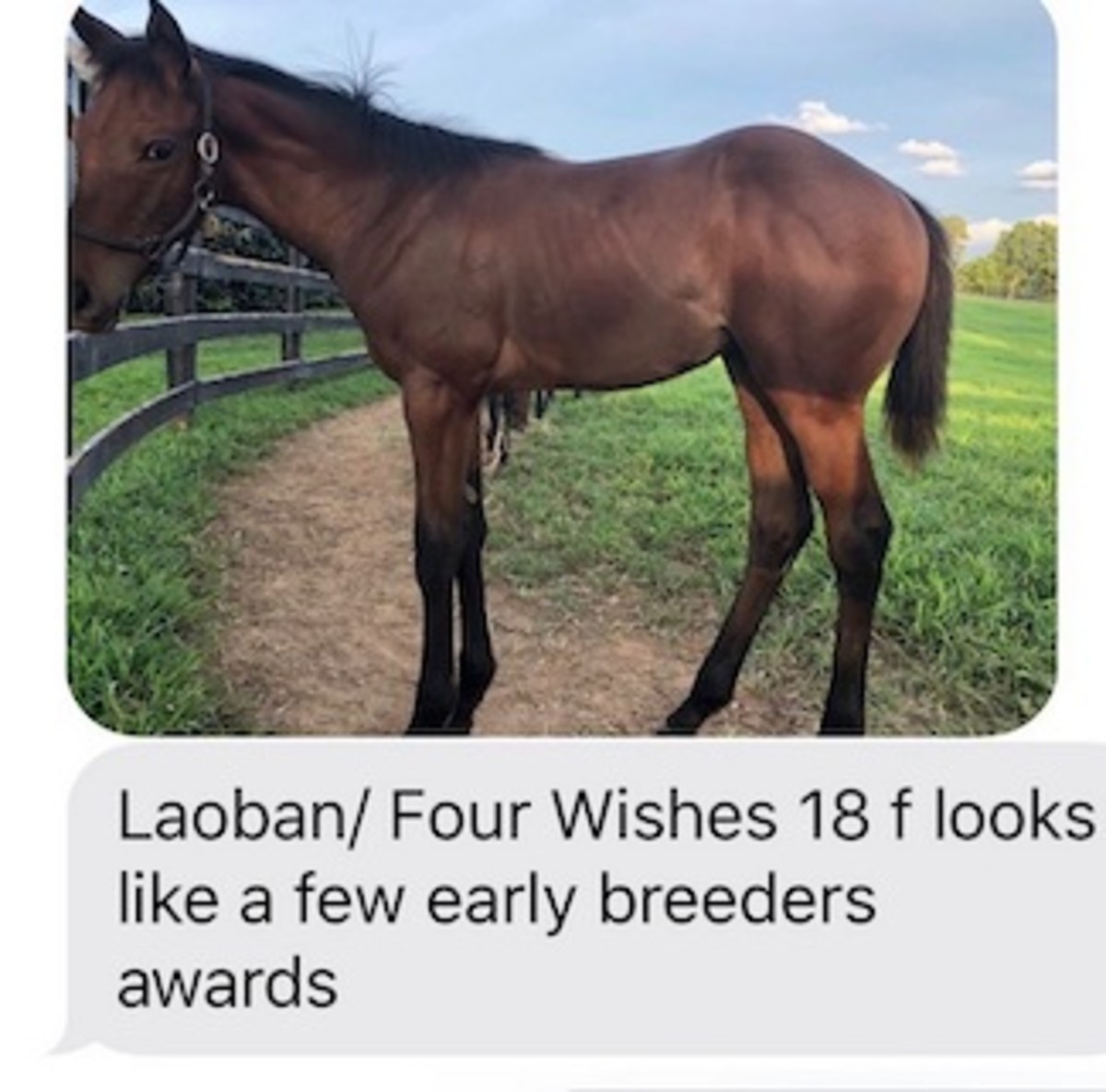
Those words proved prophetic down the road, but there were more bumps in the road before Simply Ravishing's long-predicted success.

Four Wishes' Revolutionary colt was not accepted to the New York-bred sale and brought a final bid of just $8,000 when sold at Fasig-Tipton October in 2018. He wound up headed to Peru, and Levy doesn't know whether the now 3-year-old has yet raced.

Four Wishes was bred to Daaher next, also on a breeding right, but she suffered a dystocia due to the foal's large size, and sadly that foal did not survive. The mare was badly bruised, Levy said, and was given a year off from the breeding shed to recover.

All that happened shortly before Levy was preparing to send Four Wishes' Laoban filly to the 2019 Fasig-Tipton New York-bred sale.

“Laoban foals were really selling well, and they were all pretty athletic looking,” Levy remembered. “I was already at the sale, and the crew at the farm was loading the horses on the trailer to ship them up to me. They sent me a text, as people sending me bad news tend to do, that once she got on the trailer she really wasn't happy and kicked the wall so hard she tore up her hind foot.

“She was going to be just fine, but obviously she had to get off the van and couldn't go to the sale. I was really disappointed and admittedly pretty grumpy about it.”

Levy re-entered the filly in the Fasig-Tipton October sale, and hoped that her impressive physical would be enough to draw the right kind of attention.

“As she was growing up, she just was so simple,” Levy said. “She was always stunning, always in motion, always the right weight, always shiny, always correct. There was none of this messing around business with awkward stages; she just stood out.”

Though she lacked a commercially attractive pedigree, the filly's good looks were enough to draw the attention of trainer Ken McPeek. His final bid of $50,000 was enough to land the filly.

“She was just the kind of filly Kenny likes, real athletic-looking,” Levy said. “He doesn't care about the page so much, and I knew he'd give her every chance.”

Levy had known McPeek since the time she had galloped for John Ward, and then worked with him at 505 Farm. When Levy first opened her consignment business in 1999, McPeek was one of her first successful customers.

Oddly enough, it was with another filly who had two blank dams on her catalog page. This filly had trouble passing the veterinary inspection; of 12 vets who scoped her airway, only McPeek's vet gave the filly a passing grade.

McPeek landed the daughter of Dehere for $175,000 at the 2000 Fasig-Tipton July sale, and the following year Take Charge Lady won Keeneland's Alcibiades.

Take Charge Lady had great success on the track, winning a total of five Grade 1 races and $2.4 million, and she went on to immeasurable success as Broodmare of the Year and dam of two Grade 1 winners, Take Charge Indy and champion Will Take Charge.

The similarities between the two fillies' storylines are the kind of thing that just can't be made up, Levy said, laughing. She remembered attending the 2001 Alcibiades and cheering Take Charge Lady to victory.

“I knew so little [about industry protocols] back then,” said Levy. “I ran across the rail to get to the winner's circle for the photo, and I'm sure everybody in there was like, 'Who is this girl?'”

A more seasoned veteran now, Levy was still emotional after Simply Ravishing's big win in the Alcibiades. Her son Ryder, now 29, had been such a huge fan of the filly's from the very beginning, and he'd surprised his mother by asking the farm manager to name Levy the sole breeder for the first time in her career.

McPeek stayed in touch about the filly through her early training, sending videos of Simply Ravishing's progress ahead of her first start.

“I thought, 'Well, she looks pretty good,'” Levy recalled. “I had taken our farm manager to brunch on that Sunday that she ran for the first time, and I missed her race and then my phone just started blowing up when she broke her maiden at Saratoga.”

After her maiden victory on the turf, McPeek stepped Simply Ravishing up to New York-bred stakes company. The race came off the grass, and the filly won by several lengths.

“I thought, 'Wow, this is pretty crazy,'” Levy said. “When he entered her in the Alcibiades, though, I thought, 'Hmm, could this really happen?'”

Apparently, Wishes do come true.

Simply Ravishing winning the Darley Alcibiades

Simply Ravishing won the Alcibiades by 6 1/4 lengths, completely dominating the competition in an impressive gate-to-wire performance. She's likely to be one of the favorites in the upcoming Breeders' Cup Juvenile Fillies on Nov. 6 at Keeneland.

“After this filly won, I actually ran into the guy who'd had Four Wishes at a reining show,” Levy said. “I tried to ask him about her first filly, by Revolutionary, but I guess he sold her as a riding horse prospect and didn't remember much more than that.”

Levy posted a snapshot of Four Wishes' story on social media following the Alcibiades win, and has enjoyed the excited reaction of so many of her friends. One major Kentucky breeder even told Levy's husband that after learning about the story, he went out and rescued a mare himself.

Four Wishes was bred to Speightster for 2021, and Levy is excited to see what the future will bring with her miracle mare. The entire story reminds Levy of a conversation she had with breeder Helen Alexander when she first got into the business.

“I remember asking her to lunch years ago, because she was someone I've always respected from the very beginning,” Levy said. “I asked if I could pick her brain, said, 'I'm trying to find my way and I really need some advice.' She just kind of said, basically, 'Breed your mares well, take care of them well, and they'll take care of you.' She actually called to congratulate me after Simply Ravishing won!”

The post Breeders’ Cup Presents Connections: Birthday ‘Wishes’ Come True For Meg Levy appeared first on Horse Racing News | Paulick Report.

Source of original post

Right To Ride, Presented By The Kentucky Derby Museum: The Racing World Reacts To Female Jockeys

This is the third in a four-part series examining the arrival of female jockeys in American horse racing – why and how they broke in to the sport when they did, and how racing has reacted. In this third installment, we'll learn about the reaction of the racing world to an influx of female jockeys — and the career path women took in pursuit of race riding.

Find part one here and part two here.

This series is sponsored by the Kentucky Derby Museum, which will open its Right To Ride exhibit on Oct. 16. The exhibit marks the 50th anniversary of Diane Crump's historic ride in the Kentucky Derby in 1970, when she became the first female jockey in the race. You can learn more about the exhibit and access current COVID-19 safety protocols for Museum visitors here.

After Kathy Kusner's success in obtaining a jockey's license, it might have seemed the floodgates should open, and hundreds of women jockeys would appear at the nation's tracks. That isn't what happened, and there are several reasons why. The first, and easiest, is that owners and trainers of the day continued to flout the federal requirements of the Civil Rights Act. Men believed that racing was still such a patriarchy that women could basically be ignored. Perhaps women at that time were so used to being blocked that many of them felt it was fruitless to even try.

Although the Civil Rights Act is a federal law, and a judge had decided that Kusner must be granted a license, she still had to face the members of the male-dominated racing world. As such, the opinions of male jockeys are worth noting.

Nick Jemas, the national manager of the Jockeys' Guild, told The Chicago Sun in 1968, “[The racetrack] is no place for a woman.” An unidentified rider said, “It is a man's game and that's the way it should stay.”

The News Leader reported that several of the Laurel jockeys said it would be a great idea. “It would add some color to racing,” said jockey Bill Passmore. Another rider, Phil Grimm, told the Star, “I've seen a lot of girl exercise riders. They are good and I don't see why Kathy wouldn't be a good jock.”

Unfortunately, the negativity from the male jockey colony sometimes escalated past mere verbal posturing. Jockey Penny Ann Early received a provisional license in 1968, but a jockey boycott over her anticipated ride forced Churchill Downs to cancel racing for two days. It is worth mentioning that many of the fans booed the boycotting male jockeys with taunts of “chicken.” At Diane Crump's first professional race in 1969 she required two armed guards to escort her to the track.

If you have followed the career of Hall of Fame jockey Bill Hartack, you are correct in assuming he would have an opinion on the matter.

“I think women should get a chance to ride,” Hartack wrote in the Dec. 13, 1968 issue of Life magazine. “It's a matter of principle. Women have legal rights, probably too many, but they've got them, and that's all there is to it.

“As a group, I don't think their brains are as capable of making fast decisions. Women are also more likely to panic. It's their nature.”

Hartack's comment harkens back to the late 18th century when progressive scientists embraced phrenology, which included the belief that intelligence could be predicted by head shape and size. Male voters embraced that theory and used in in their crusade to keep women from voting. (History does, in fact, repeat itself.)

If there was so much pressure to keep them out of the sport, why then did women decide to complicate and even risk their lives by going against the odds to ride racehorses? Over the last decades some of the most prominent female jockeys have told their stories. What prompted them to go into racing?

A quick study of the biographies behind the biggest names reveals that almost all female jockeys were introduced to horses (not necessarily horse racing) at an early age.

Although jockey/journalist Donna Barton-Brothers' route should, to the casual observer, seems a fait accompli, Donna resisted the pull of the racetrack. Her mother is famed female jockey Patti Barton, the first woman to win more than 1,000 races. Donna's brother and sister were both jockeys, but Donna only started grooming horses as a way to make money in college. Grooming led to galloping, and galloping to riding.

Julie Krone is America's winningest female jockey, with earnings over $90 million. When Julie was only six years old her mother permitted her to ride her pony several miles away from home. She disliked anything that took her away from horses. When her parents divorced she convinced her mother to spend spring break at Churchill Downs, and Julie convinced Clarence Picou to hire her to do just about anything. Her focus was on becoming “the greatest jockey in the world.”

Rosie Napravnik, winner of over $70 million, was surrounded by horses from birth. Her father is a farrier and her mother trained event horses. By age seven she was riding in pony races, and it was around that time she began dreaming of becoming a jockey.

Sandy Schleiffers (left) and Penny Ann Early (right) at Hollywood Park in 1969

Jockey Diane Nelson pleaded with her parents for a horse or a pony for as long as she could remember. When her mother asked Crump about her college plans, she replied she was only interested in a career that involved horses. Jill Jellison learned to ride when she was three years old and was galloping racehorses by age 14.

Diane Crump, the first woman to ride as a licensed jockey, and the first woman to ride in the Kentucky Derby, was first introduced to horses at age seven, when she rode a pony at a carnival. She began taking riding lessons at age seven, and was licensed to gallop racehorses at age 16.

The above examples reinforce that women generally don't learn about becoming a jockey at the high school career fair; they are exposed to it at a very early age.

Although Kathy Kusner's victory was profound in that it enabled women to ride professionally as jockeys, and Diane Crump's appearance in the Kentucky Derby proved that women jockeys were no fluke, they still had to overcome a public perception that at times tended to ignore their considerable riding abilities. Media depictions of early female jockeys encouraged this, focusing on the riders' emotions somewhat more than they did with men.

Columnist Bill Braucher of The Miami Herald quoted Crump as saying after her first race: “Wasn't that wonderful? Everyone was so nice to me I could almost cry.”

Braucher finished his column with the quote and a comment – “Just like a girl.”

Undated image of jockey Mary Bacon

Braucher was far from alone in his portrayal of the first women jockeys. They were frequently presented more as novelties and not as serious athletes. In 1970 Judy Barrett had become the first British woman to be licensed to ride racehorses in America (women were not permitted to professionally ride in England until 1972). In a British newspaper, the Saturday Titbits (yes, the spelling is correct. Perhaps compare it to a 1970s hypersexed version of the National Enquirer) referred to her blossoming race career in the United States with an accompanying picture of her in a miniskirt, complete with comments about her hair color and the descriptors “lissome,” and “shapely.” There was no mention of her race record, riding ability, or overall horsemanship. That “lissome” individual eventually left racing to become a Thoroughbred breeder, and is one of the most successful breeders in Pennsylvania, twice winning the Pennsylvania Horse Breeder's Association's Breeder of the Year Award.

“Women not only had to work harder to get mounts, they had to fight the conscious efforts of the media to keep gender at the center of the argument,” said Jessica Whitehead, curator of exhibits like Right to Ride at the Kentucky Derby Museum. “No matter the talent, there was an enormous amount of public perception for these women to subvert.”

Our first assumption is that men were the only ones to ignore female riders' capabilities. However, the aforementioned article in the Saturday Titbits was written by Jane Goldstein. Later, she penned an article about female jockeys in Turf and Sport Digest titled “Move Over Billie Jean.” In that article she made a coarse comparison between jockey Julie Krone and Elizabeth Taylor, noting that Crump was “hardly a Liz Taylor type,” noting Taylor's midriff bulge and increasing number of husbands. She also related how “women everywhere were beginning to challenge their prescribed role as the weaker sex.” At the same time, we can look at Goldstein's writing style in much the same way we assess the evolving national attitudes toward racing. Her article went on to quote Lou Cunningham, then publicity director at Atlantic City Race Course. He said, “One of the problems with women jocks, generally, I think, is that a lot of girls ride and are terribly interested at first, but then find out how rough a sport this is and get discouraged by the brutal workload. A lot of them disappear from the scenes.”

One could easily read Cunningham's comment as blatantly sexist. Perhaps it was. However, there is no denying the high attrition rate in the profession of professional jockeys among both men and women.

By the early 1970s the women's movement was at full speed. We began to see women advancing in many different sports. And yet, they continued to struggle with the perception that they were a novelty. Was it only male writers and sportscasters to blame? After her very public thrashing of Bobby Riggs in 1973, tennis superstar Billie Jean King started her own sports magazine titled womenSports. The magazine was intended to be a Sports Illustrated for women. And yet King's new magazine still pandered at times to the prurient interests of men. When jockey Mary Bacon was pictured in her racing jodhpurs and spurs with her polka-dot bikini underwear visible underneath, female readers were irate.

“Now this is exactly the kind of sexist shit that I've always objected to in the likes of Sports Illustrated,” wrote a reader from New Hampshire. “Why does she have to be pictured as a piece of ass on your contents page? Please try to get away from this approach.”

Billie Jean King's magazine is proof that these were transitional times, with both men and women adjusting to women's changing roles.

Not all the female athletes embraced this more radical new brand of outspoken feminism. Said softball player Joan Joyce in 1974: “I've pretty much done what I wanted my whole life, so I don't need feminism.” Or as jockey Robyn Smith said in 1972: “I'm not trying to prove anything as a female jockey. I do it because I enjoy it so much, and I think people should do whatever makes them happy.”

Smith makes a good point, but Kathy Kusner made the same point prior to her trial, and it was Kusner's bold step that enabled Smith to make that choice to do what made her “happy.”

David Beecher has a master's degree from Shippensburg University and a PhD from Penn State, where he is currently a lecturer. Dr. Beecher's research and teaching interests are American history with an emphasis on Early American and Civil War History. His dissertation explained the role of Thoroughbred racing in the Antebellum South.

The post Right To Ride, Presented By The Kentucky Derby Museum: The Racing World Reacts To Female Jockeys appeared first on Horse Racing News | Paulick Report.

Source of original post

‘A Good Heart And A Good Soul’: Trainer Barry Abrams, 61, Dies;

Racing hasn't lost its greatest trainer, but arguably its greatest fan.

Barry Abrams died peacefully Friday night at Huntington Memorial Hospital in Arcadia, Calif., after he was taken off a ventilator following a recent fall at home that injured his back. He was 66. Services are pending.

Abrams had courageously battled throat cancer for 15 years. A bear of a man at 6-4, 315 pounds before he was stricken, Abrams bared his soul in a story I authored about his ordeal that appeared in the October-November 2015 issue of North American Trainer Magazine, excerpts of which follow in this item.

Barry Abrams never smoked. He got cancer anyway. Side effects from the treatment over a 10-year period caused him to lose his taste buds, prevented him from swallowing (he used a feeding tube), he couldn't eat, run, go in the ocean or a swimming pool.

“I'm just functioning and happy to be alive,” he said. “I can eat cookies as long as they're liquified and made pudding-like. I can't swallow anything else because I have no salivary glands that create saliva.”

He lost half his voice box during surgeries, reducing his  speech to a whisper, but he never complained.

“Ordinarily, you talk about things like saving for the future and making plans for this and that, but facing this, you realize that there could be no future,” he said in the 2015 article.

One of Barry's dearest friends was trainer Richard Baltas, who assisted in the barn operation during Abrams' five-month recovery in 2011. “He's very kind with a good heart,” Baltas said. “Years ago, I wanted to leave Louisiana and come home to California, but I needed a job.

“Barry didn't quibble. He simply asked me, 'How much do you want to make?' and that was it. He came to my wedding on Feb. 26, 2011, when he was sick with cancer. He's done many kind and generous things for me.”

Said Abrams' wife, Dyan: “Barry is so kind and helpful. If you needed the shirt off his back, he'd give it to you. … He's one of the good ones. He's got a good heart and a good soul.”

Trainer Peter Miller was looking forward to winning the Breeders' Cup Mile with a horse Abrams owns in part, Mo Forza. “Barry and I have known each other probably 25, 30 years,” Miller said several days ago. “Barry's a great guy. Everyone loves him, and this horse really helped keep him going.”

A highly accomplished conditioner of both Standardbreds and Thoroughbreds, Barry Abrams will forever be associated with Unusual Heat, a horse he claimed for $80,000 on June 10, 1996.  The son of Nureyev would go on to become one of the greatest stallions in California racing history.

With Barry's passing, two questions will forever remain unresolved: did racing love Barry more, or did Barry love racing more?

Call it a dead-heat.

The post ‘A Good Heart And A Good Soul’: Trainer Barry Abrams, 61, Dies; appeared first on Horse Racing News | Paulick Report.

Source of original post

Verified by MonsterInsights