‘A Stupid, Stupid Rule’: New York Restrictions On Married Jockeys Stifling Davis’ Business

“The dumbest rule in racing.”

That's how attorney Bill Gotimer said TVG analysts have described New York's Commission Rule 4040.2 which reads: “No jockey, nor such jockeys' spouse, parent, issue nor member of such jockey's household, shall be the owner of any race horse. All horses trained or ridden by a spouse, parent, issue or member of a jockey's household shall be coupled in the betting with any horse ridden by such jockey.”

The rule has become a topic of discussion in recent weeks as Gotimer said it has recently begun hindering the business of his client, jockey Katie Davis, since her marriage to fellow rider Trevor McCarthy.

Davis married McCarthy in December 2020 and the couple shifted their tack from Maryland to New York. They were later informed that since their marriage, Rule 4040.2 would require the racing office to couple their mounts whenever they rode in the same race, whether or not their horses had the same trainer or owner.

McCarthy has gotten off to a swimming beginning in New York, riding 19 winners from 154 starters this year for mount earnings over $1 million, putting him well on his way to surpassing last year's total earnings. Davis, by contrast, has had just one win from 53 mounts so far, despite coming into the season off two strong years in Maryland. Just before their departure, McCarthy was a leading rider at Laurel Park, while Davis was seventh in the standings there.

Mike Monroe, current agent for Davis, and Gary Contessa, who had her book briefly after her move to New York, both agree that the rule has negatively impacted Davis's ability to get mounts. Both heard from trainers who had named Davis on their horses, only to take her off after they learned about the coupling rule. Media reports have indicated the racing office at Aqueduct has discouraged trainers from using Davis in races where McCarthy is already named, since it would not cause a coupling of what would otherwise be two betting interests in the race. The New York Racing Association has categorically denied that racing office personnel have exerted pressure on trainers not to use Davis.

“It's a stupid, stupid rule,” said Contessa. “It's absolutely ridiculous. When I was booking her, I had a trainer – I'll not say who – who's a bettor. Most trainers are lousy bettors, but they like to bet on their horses and this guy liked to bet. This guy gave me four calls for Katie and two or three days later he told me 'Gary I can't do it because I can't have these horses coupled. I want to get 10-1, I don't want to get 3-1.'

“On the racing office side, they're losing a betting interest and if you really evaluate betting races, losing one betting interest or gaining one betting interest earns or decrease that race by about $100,000 in wagers.”

Monroe said the rule does apply equally to Davis and McCarthy – if McCarthy is named on a mount after Davis, the trainer of McCarthy's horse will be informed that they will be coupled with Davis's mount – but McCarthy is booking mounts so quickly that he's usually named first. Monroe admits the mounts Davis has gotten have not done as well as they would have hoped, but is confident the coupling issue is the primary reason her career has stalled in New York.

“All we're really asking for is a fair shake, a level playing field. It's not a level playing field right now,” said Monroe. “We all know the racing office is having a difficult time with a shortage of entries, but that should not impact Katie Davis' status of being named on a horse. That's what we're trying to bring out here.”

Where did this rule come from?

Although Rule 4040.2 has become a target of complaint for Davis and her supporters recently, the New York State Gaming Commission told Gotimer it has been on the books since at least September 1974.

Though the rule is negatively impacting a female rider in 2021, a letter from New York State Gaming Commission executive director Robert Williams points out the rule is not written to only apply to female riders. It's true however, that the rule (logically) seems to have come about after women became licensed by New York state, which happened in 1969. And Monroe and Gotimer point out that the rule is going to naturally be unevenly impactful towards which ever spouse has less career momentum.

“There's going to be a day when you face this question with same-sex spouses,” said Gotimer.

Part of the reason the rule about married jockeys may have seemed dormant for the past 47 years is that there have been relatively few instances where married jockeys have tried to ride against each other in New York. The closest comparable case in recent memory may be Jose Ortiz and Taylor Rice Ortiz, but Taylor said they never had the opportunity to find out how the rule may have impacted their careers.

Taylor and Jose were engaged for some months before their wedding in December 2016. Taylor said she didn't know about Rule 4040.2 and was planning to continue with her career as a jockey, but found out she was pregnant with the couple's first child shortly before the wedding, prompting her to retire. Taylor, who has many immediate and extended family members in the sport, said she knew that marriage could complicate things.

The Ortiz family as of 2017

“I had heard of my dad's generation had been married and they had conflicts, and I knew that if you're a jockey and you're married to a trainer, you have to ride for your significant other,” said Ortiz. “What Trevor and Katie are going through, I had no idea the extent of it.”


That doesn't mean that she can see the logic in New York's rule. After all, she points out, she rode for her aunt, trainer Linda Rice, on many occasions but also rode for other trainers in races where Rice was saddling an entry and was never coupled in those races. She lived with Ortiz for several months before their marriage – an arrangement that was common knowledge on the backstretch – and that did not result in the racing office coupling their entries.

During the summer, when many riders, trainers, and others descend upon Saratoga Springs from out of town, Taylor Ortiz said it's also common for family members and close friends to share rental houses, as Jose and Irad Ortiz have done in the past, and cohabitation hasn't resulted in entries being coupled.

“What's crazy to me is that the horse racing industry is so intertwined between family and marriage,” said Ortiz. “So we could have stayed engaged forever, but as soon as we sign documents saying we're married it's a problem for one of your rules? It doesn't make sense to me.”

In initial research, Gotimer said he could find no other rule currently on the books in other major American racing jurisdictions that places the same kind of restrictions on riders as the New York State Gaming Commission. Instead, he found that cases where states or tracks had restrictions on married jockeys and had subsequently removed them.

In 1998, married riders Harry Vega and Amy Duross were told by Suffolk Downs stewards they couldn't ride in the same race, but that policy was later overturned by the Massachusetts Racing Commission. When jockeys Angel Serpa and Carol Cedeno were married, they competed against one another on uncoupled horses in Florida.

“[The restriction is] based in two concepts, neither one of which are really acceptable,” said Gotimer. “One is that licensed parties in New York state, and in particular jockeys, can't be trusted. I think that's a wild insult to world-class athletes.

“I think the second point is that it's based on an anachronistic idea that one spouse controls another. I don't see that in racing, and I don't see that in New York.”

Gotimer said he has not been retained for the purpose of bringing any legal action against the commission, but is hopeful the two sides can reach some kind of agreement about improved rule language.

“The Commission has commenced an examination of the rule origin, the harm it sought to prevent, its present applicability, and in what manner the harm – if any – can be addressed by alternative means,” said commission spokesman Brad Maione. “Additionally, we are seeking to place the rule in context, considering how similar situations are governed in other regional racing jurisdictions, in larger U.S. racing states and in major international jurisdictions.

“The rule appears by its plain language to be integrity-based with neutral applicability, but we intend on undertaking a de novo review.”

The rule has impacts on jockey/trainer combinations, too

Though Rule 4040.2 has mostly been discussed in the context of its impacts to two married jockeys, it has also come up for married trainer/jockey duos in New York.

Rachel Sells, who has had her trainer's license since 2017, is married to jockey Jose Soñe and is based at Finger Lakes. When she takes a horse to a race at a New York Racing Association track, Soñe must either sit the race out or ride her horse – he cannot ride for a competing trainer. At Finger Lakes, she said they were initially told that Soñe could ride other trainers' horses running against hers, but his mount would be coupled with her horse if he did so. Sells pushed back.

“We had issues with the racing office a few times,” she said. “I'm not one to sit back and let things happen. I'm a very vocal person. One day I called the racing office after I was informed my husband got taken off a horse because I had a horse in the race and I let them know they were denying him the right to a living and that's illegal. You can't tell somebody not to ride him because it's going to make the body of the race smaller.”

Eventually, Finger Lakes changed its house rules on the issue.
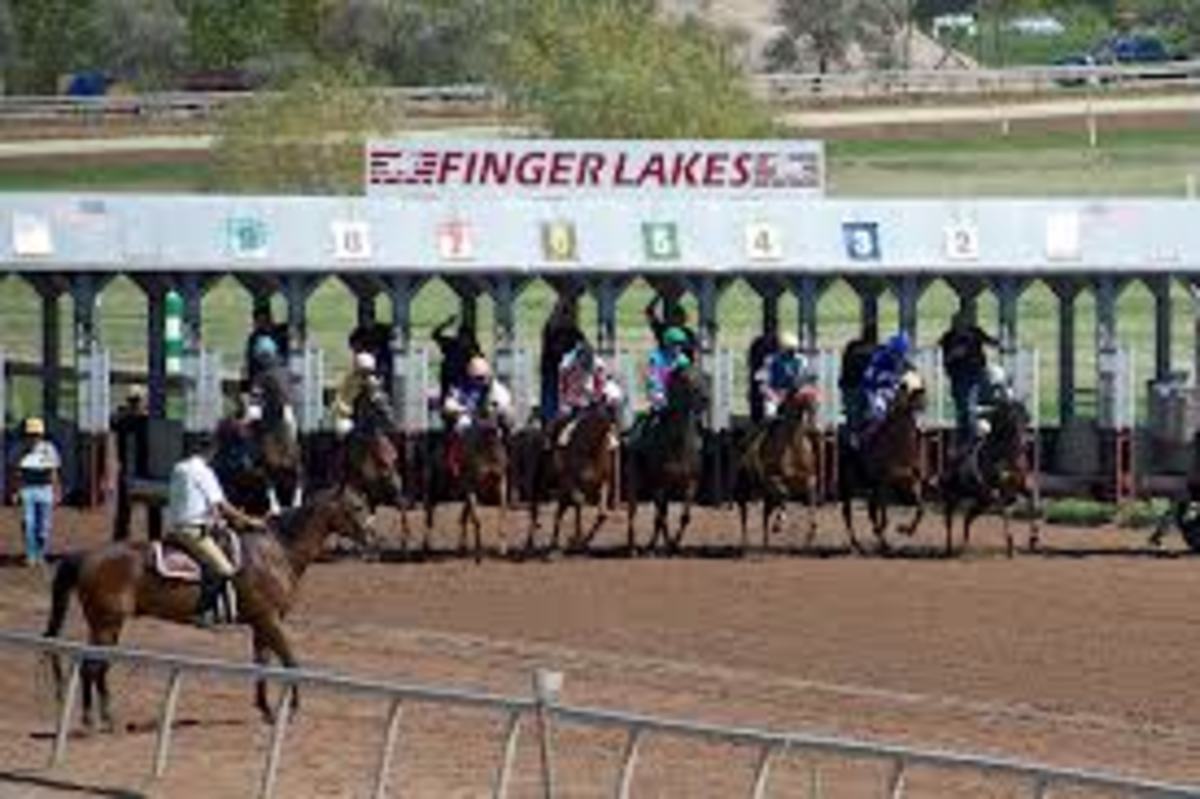
It's not a problem for Soñe to give first preference to Sells' horses, but for a rider with a wide client base, it might be. Taylor Ortiz pointed to the case of Rosie Napravnik, who had long been one of the go-to riders for Mike Maker when her husband, former Maker assistant Joe Sharp, opened his own training barn. Napravnik retired in 2014 upon learning that she was pregnant, not long after Sharp put out his shingle, so they didn't have much chance to find out how much her business may have been limited by the requirement that she give preference to Sharp's horses.

When saddling at her home base of Finger Lakes, Sells is still not permitted to own horses herself because she lives with Soñe, which she said has forced her to pass up great business opportunities. When she travels to a NYRA facility or anywhere out of state however, she encounters no problems running horses as both owner and trainer.

“For me, I could see if I do own a horse and I have a horse in the race, he has to ride that horse; I understand that,” she said. “But it's not even just for me. I have a groom who works for me and she's dating a jockey and wanted to buy a horse last year. I called the stewards and asked them about it and they said no, because she cohabitates with a jockey. It's not even just for trainers.”

Soñe doesn't ride as many races these days, though Sells said that's not because he has to give her first call as a trainer. Soñe has been a licensed rider since 2001 and while Sells said he will decide for himself when to hang his tack up, he isn't taking as many mounts as he once did.

“He's a lot more cautious on who he chooses to ride for,” she said. “At some point I do want him to be able to retire from riding and just come be with me and not have to worry about it.”

After all, being a jockey is a tough gig.

The post ‘A Stupid, Stupid Rule’: New York Restrictions On Married Jockeys Stifling Davis’ Business appeared first on Horse Racing News | Paulick Report.

Source of original post

Kirkpatrick & Co Presents In Their Care: Even When Times Are Tough, Keens Do Right By Their Horses

 Dallas Keen found himself inextricably drawn to a woman riding a dappled gray pony one morning at Lone Star Park in 2004. He had to know her name.

“You don't want to know,” an outrider replied. “She's high maintenance.”

Three years later, Dallas and Donna were married, forming one of racing's most passionate couples when it comes to training Thoroughbreds and providing for their aftercare. As for the high-maintenance tag applied to Donna?

“I found out she's not high maintenance other than she likes to collect horses because she wants to save every horse there is,” Dallas said. “That's her mission.”

That noble mission has led the couple to live life at warp speed since they met. They oversee 12 runners in a racing stable they are working to re-build after they relocated to Texas from California last year. They operate Keen Farms, a 20-acre breeding, breaking and training facility in Burleson, Texas. And they have spared scores of horses from grim ends since founding Remember Me Rescue in 2008.

Remember Me Rescue prepared more than 40 horses for adoption in 2020. It says everything about Donna's hard-driving nature that she is determined to find new homes for more than 50 horses this year.

“This really became a priority for me when I saw these horses with good owners ending up in bad places,” Donna said. “We have the place, we have enough acreage, we have the help that we could re-train these horses for these folks straight from the racetrack.”

The Keens have built professional lives from which there is no real escape, given horses' incessant needs. And that is fine with them.

“We find time for our personal time,” Donna said, “but we still talk about horses because that's our passion.”

They were having lunch some time ago when someone texted Donna a photo of a terribly neglected horse that looked more like a skeleton and asked if anything could be done. They never finished their meal. Donna headed to the site. Dallas picked up a trailer to meet her there. Even then, they did not arrive in time. But the call to help one horse that could not hang on another hour led them to successfully rescue another that was clinging to life.

“When you get those calls, you hate them,” Dallas said. “It gives you a real sick feeling that someone can let a horse get into that situation.”

Dallas on the pony, Donna on the racehorse

It happens, of course, far too often. And there is the reality that only so much can be done. Horses will perish from neglect. Horses will face the terror of the slaughterhouse.

“That is the hardest thing I have to do, decide which horses you can help and which horses you can't,” Donna said. “We try to put a priority on horses we know we can re-home the quickest because we know when those horses get homes, we can go and help more horses.”

The Keens do not have easy lives. Donna had to carry much of the load after Dallas sustained major injuries in a riding accident at Sam Houston Race Park early last year. He was hospitalized for five days while a dangerous buildup of fluid was drained from his lungs. Ten screws and a plate were required to surgically repair a badly-broken ankle.

For all of the work they do, the return on their labor is hardly financially rewarding.

“Half of the time, you're robbing Peter to pay Paul,” Dallas said. “You get into a situation where somebody can't pay a training bill, it's money you've already paid out of your pocket. If I could have all of the money that I've lost over the years from not getting paid, I'd be sitting real good right now. That's part of the business. Some people have bigger ambitions than they've got wallets.”

While the Keens are optimistic about their future in Texas and their ability to attract new owners, their numbers suffered after they decided to relocate there from California. They had conditioned as many as 55 horses and know they must fill more than the 12 stalls they currently have occupied.

According to Equibase, the stable was still looking for its first victory this year after eight starts brought three second-place finishes and one third for earnings of $17,356 in action at Sam Houston and Fair Grounds Race Course & Slots. Their runners made only 56 starts last year but won at an 18 percent clip while finishing in the money 41 percent of the time for $251,672 in purses.

Dallas and Donna Keen

“You've got to watch everything you do,” Dallas said of their spending. “But one thing we've never done is cut our horses short. That's where sometimes you get caught a little upside down because you're spending more money than you're bringing in. But the first priority is the horses got to get the best of everything.”

It helps that Remember Me Rescue is accredited by the Thoroughbred Aftercare Alliance and benefits from TAA grants as well as its own fundraising efforts. The organization also is bolstered by devoted volunteers who follow up on adopted horses to make sure they are in good hands.

The Keens admit there are some horses that become so beloved they cannot possibly part with them. Bee Bop Baby is among those.

“She came from skin and bones and now she's a big, fat, happy mare. She's what we call a lifer,” Dallas said, sounding very much like a man who has everything he needs.

Tom Pedulla wrote for USA Today from 1995-2012 and has been a contributor to the New York Times, Los Angeles Times, Blood-Horse, America's Best Racing and other publications.

If you wish to suggest a backstretch worker as a potential subject for In Their Care, please send an email to info@paulickreport.com that includes the person's name and contact information in addition to a brief description of the employee's background.

The post Kirkpatrick & Co Presents In Their Care: Even When Times Are Tough, Keens Do Right By Their Horses appeared first on Horse Racing News | Paulick Report.

Source of original post

Todd Pletcher, American Pharoah Headline 2021 Hall Of Fame Ballot

Six racehorses, three trainers, and one jockey account for the 10 finalists that will comprise the National Museum of Racing's 2021 Hall of Fame ballot, as chosen by the Museum's Hall of Fame Nominating Committee. The finalists are racehorses American Pharoah (first year of eligibility), Blind Luck, Game On Dude, Havre de Grace, Kona Gold, and Rags to Riches; trainers Christophe Clement, Doug O'Neill, and Todd Pletcher (first year of eligibility); and jockey Corey Nakatani.

Hall of Fame voters may select as many or as few candidates as they believe are worthy of induction to the Hall of Fame. All candidates that receive 50 percent plus one vote (majority approval) from the voting panel will be elected to the Hall of Fame. All of the finalists were required to receive support from two-thirds of the 15-member Nominating Committee to qualify for the ballot.

Ballots will be mailed to the Hall of Fame voting panel the first week in March. The results of the voting on the contemporary candidates will be announced on Wednesday, May 5. That announcement will also include this year's selections by the Museum's Steeplechase Review Committee, which meets once every four years. The Hall of Fame induction ceremony — which will honor both the 2020 and 2021 inductees — is tentatively scheduled for Friday, Aug. 6, at the Fasig-Tipton Sales Pavilion in Saratoga Springs, N.Y., at 10:30 a.m. Because of the ongoing COVID-19 pandemic, many details relating to the induction ceremony are still to be determined.

To be eligible for the Hall of Fame, trainers must be licensed for 25 years, while jockeys must be licensed for 20 years. Thoroughbreds are required to be retired for five calendar years. All candidates must have been active within the past 25 years. The 20- and 25-year requirements for jockeys and trainers, respectively, may be waived at the discretion of the Museum's Executive Committee. Candidates not active within the past 25 years are eligible through the Historic Review process.

A bay colt bred in Kentucky by owner Zayat Stables, American Pharoah (Pioneerof the Nile—Littleprincessemma, by Yankee Gentleman), became racing's first Triple Crown winner in 37 years when he swept the Kentucky Derby, Preakness Stakes, and Belmont Stakes in 2015 en route to Eclipse Awards for Horse of the Year and Champion 3-Year-Old Male. Trained by Hall of Famer Bob Baffert and ridden by Hall of Famer Victor Espinoza, American Pharoah won the Eclipse Award for Champion 2-Year-Old Male in 2014 on the strength of Grade 1 victories in the Del Mar Futurity and FrontRunner Stakes. As a sophomore, American Pharoah won the Rebel Stakes (G2) and Arkansas Derby (G1) prior to the Triple Crown. Following his historic Belmont victory, he won the Haskell Invitational (G1) and Breeders' Cup Classic (G1). Overall, American Pharoah posted a record of 9-1-0 from 11 starts and earned $8,650,300.

A chestnut filly bred in Kentucky by Fairlawn Farm, Blind Luck (Pollard's Vision—Lucky One, by Best of Luck) won the Eclipse Award for Champion 3-Year-Old Filly in 2010. A multiple Grade 1 winner at ages 2 and 3, Blind Luck was also a Grade 1 winner at 4. Trained by Hall of Famer Jerry Hollendorfer and owned by Hollendorfer in partnership with Mark DeDomenico LLC, John Carver, and Peter Abruzzo, Blind Luck posted a career record of 12-7-2 from 22 starts and earnings of $3,279,520 from 2009 through 2011. She won a total of 10 graded stakes in her career, including six Grade 1s: the Kentucky Oaks, Oak Leaf Stakes, Hollywood Starlet Stakes, Las Virgenes Stakes, Alabama Stakes, and Vanity Handicap. Throughout her career, Blind Luck defeated the likes of Havre de Grace (three times), Life At Ten, Unrivaled Belle, Evening Jewel, Devil May Care, and Switch.

A dark bay gelding bred in Kentucky by Adena Springs, Game On Dude (Awesome Again—Worldly Pleasure, by Devil His Due) won 14 graded stakes, including eight Grade 1s. Racing from 2010 through 2014, he compiled a record of 16-7-1 from 34 starts and earnings of $6,498,893. Owned by Joe Torre's Diamond Pride LLC, Lanni Family Trust, Mercedes Stable LLC, and Bernie Schiappa, Game On Dude was trained by Baffert. He is the only horse to win the Santa Anita Handicap (G1) three times (2011, 2013, 2014), setting a stakes record in the 2014 edition by covering 1¼ miles in 1:58.17. Game On Dude also won the Hollywood Gold Cup (G1) and San Antonio Stakes (G2) twice each, as well as single editions of the Pacific Classic (G1), Californian (G2), Charles Town Classic (G2), Lone Star Derby (G3), and Native Diver (G3). He also won the Grade 1 Goodwood in 2011 and won the same race when it was renamed the Awesome Again (G1) in 2012. In 2013, Game On Dude swept the three signature Grade 1 races for older horses in California — the Santa Anita Handicap, Hollywood Gold Cup, and Pacific Classic — becoming only the second horse to win those three events in a single year (Hall of Famer Lava Man was the first).

A bay filly bred in Kentucky by Nancy S. Dillman, Havre de Grace (Saint Liam—Easter Brunette, by Carson City) won the Eclipse Awards for Horse of the Year and Champion Older Mare in 2011. Trained by Anthony Dutrow at ages 2 and 3 and by Larry Jones thereafter, Havre de Grace was campaigned by Rick Porter's Fox Hill Farms throughout her career. After finishing second to champion Blind Luck in thrilling editions of the Delaware Oaks and Alabama in 2010, Havre de Grace earned her first graded stakes victory later that year in the Cotillion (G2). In her 2011 Horse of the Year campaign, she beat Blind Luck in the Azeri (G3) and went on to win Grade 1s in the Apple Blossom, Woodward (defeating males, including Flat Out), and Beldame (defeating Hall of Famer Royal Delta). Havre de Grace made one start as a 5-year-old in 2012, winning the listed New Orleans Ladies' Stakes before being retired with a career record of 9-4-2 from 16 starts and earnings of $2,586,175.

A bay gelding bred in Kentucky by Carlos Perez, Kona Gold (Java Gold—Double Sunrise, by Slew o' Gold) won the Eclipse Award for Champion Sprinter in 2000, when he set a six-furlong track record at Churchill Downs in his Breeders' Cup Sprint (G1) victory. Campaigned by Bruce Headley (who also served as his trainer), Irwin and Andrew Molasky, Michael Singh, et al, Kona Gold raced from 1998 through 2003 with a record of 14-7-2 from 30 starts and earnings of $2,293,384. He set a track record for 5½ furlongs at Santa Anita and won a total of 10 graded stakes, including the Grade 1 San Carlos Handicap, all while ridden by Hall of Famer Alex Solis. Kona Gold won multiple editions of the Bing Crosby Handicap (G2), Potrero Grande Breeders' Cup Handicap (G2), and El Conejo Handicap (once as a G3). He registered Beyer Speed Figures of 110 or higher 17 times. On 10 occasions, his Beyer Figure was 115 or higher, including a career-best of 123. Kona Gold made five consecutive appearances in the Breeders' Cup Sprint.

A chestnut filly bred in Kentucky by Skara Glen Stables, Rags to Riches (A.P. Indy—Better Than Honour, by Deputy Minister) won the Eclipse Award for Champion 3-Year-Old Filly in 2007, a campaign highlighted by an historic victory in the Belmont Stakes. Trained by Pletcher and Michael McCarthy for owners Michael B. Tabor and Derrick Smith, Rags to Riches broke her maiden in her second career start on Jan. 7, 2007, at Santa Anita. That six-length victory was the beginning of a five-race win streak. The next four wins were all Grade 1s: the Las Virgenes Stakes and Santa Anita Oaks (by 5½ lengths) in California, the Kentucky Oaks (by 4¼ lengths), and the Belmont in New York. In the Belmont, Rags to Riches defeated two-time Horse of the Year and Hall of Famer Curlin by a head to become the first filly in 102 years to win the third jewel of the Triple Crown. Rags to Riches remains one of only three fillies to win the Belmont. She finished second in her next race, the Grade 1 Gazelle, and a right front leg injury was discovered after the race. A 4-year-old campaign was being planned for Rags to Riches, but she re-injured her right front pastern and was retired with a record of 5-1-0 from seven starts and earnings of $1,342,528.

Clement, 55, has won 2,094 races to date with purse earnings of more than $139 million (12th all time) in a career that began in 1991. Clement trained three-time Eclipse Award winner Gio Ponti, winner of four straight Grade 1s on the turf in 2009, as well as 2014 Belmont Stakes winner Tonalist, who also won consecutive runnings of the Jockey Club Gold Cup in 2014 and 2015. Clement has won 248 graded stakes, including multiple editions of the Beverly D., Del Mar Oaks, Diana, Manhattan, Man o' War, Shadwell Turf Mile, and Sword Dancer, among others.

A native of Paris, France, Clement began his career in the United States by winning with the first horse he saddled, Spectaculaire, on Oct. 20, 1991, at Belmont. He has since trained 18 horses that have earned $1 million or more. Other Grade 1 winners trained by Clement include Discreet Marq, Forbidden Apple, Mauralanka, Relaxed Gesture, Rutherienne, Voodoo Dancer, and Winchester, among others.

O'Neill, 52, has won 2,552 races to date with purse earnings of more than $138 million (13th all time) in a career that began in 1988. He won the Kentucky Derby and Preakness in 2012 with I'll Have Another and a second Derby in 2016 with Nyquist. O'Neill has trained five Eclipse Award winners — I'll Have Another, Maryfield, Nyquist, Stevie Wonderboy, and Thor's Echo — and has won five Breeders' Cup races.

A native of Dearborn, Mich., O'Neill won nine graded stakes with Hall of Fame member Lava Man, including three editions of the Hollywood Gold Cup and two runnings each of the Santa Anita Handicap, Pacific Classic, and Charles Whittingham Memorial Handicap. O'Neill has won five training titles at Del Mar, where in 2015 he became the first trainer to ever win five races on a card there. He has also won four training titles at Santa Anita, including a record 56-win meet in the winter of 2006-2007, and ranks eighth all time there with 619 wins. He has trained 11 horses that have earned $1 million or more. O'Neill has multiple victories in the Breeders' Cup Juvenile, Alcibiades, FrontRunner, Santa Anita Derby, and Triple Bend, among others. Other major wins include the Breeders' Futurity, Donn Handicap, Florida Derby, Blue Grass, Godolphin Mile, and Japan Cup Dirt. Overall, O'Neill has won 132 graded stakes.

Pletcher, 53, has won 5,072 races (eighth all time) with record North American purse earnings of $400,647,175 in a career that began in 1996. A winner of a record seven Eclipse Awards for Outstanding Trainer, Pletcher has won the Kentucky Derby with Super Saver (2010) and Always Dreaming (2017) and the Belmont Stakes with Rags to Riches (2007), Palace Malice (2013), and Tapwrit (2017). He ranks fourth all time at the Breeders' Cup in earnings ($21,508,030) and fifth in wins (11) and has won 699 graded stakes. Pletcher has also won four or more editions of the Beldame, Champagne, Coaching Club American Oaks, Florida Derby, Mother Goose, Spinaway, Spinster, and Wood Memorial, among others. He has also won the Kentucky Oaks three times and four Canadian Triple Crown races.

A native of Dallas, Pletcher has led all North American trainers in earnings 10 times. He has trained 11 Eclipse Award-winning horses — Hall of Famer Ashado, English Channel, Fleet Indian, Lawyer Ron, Left Bank, Rags to Riches, Shanghai Bobby, Speightstown, Wait a While, Uncle Mo, and Vino Rosso — and 20 horses that have earned more than $1.8 million. On the New York Racing Association circuit, Pletcher has won 16 leading trainer titles at Belmont, 14 at Saratoga, and six at Aqueduct. He has won 16 titles at Gulfstream, five at Keeneland, and two at Monmouth.

Nakatani, 50, won 3,909 races with purse earnings of $234,554,534 million in a career that spanned from 1988 to 2018. He ranks 13th all time in career earnings and won 341 graded stakes. Nakatani won 10 Breeders' Cup races (one of only 10 riders to do so), including four editions of the Sprint. He won three riding titles at Del Mar, two at Santa Anita, and one at Hollywood Park, as well as four Oak Tree meetings. His major victories included multiple editions of the Beverly D., Del Mar Oaks, Eddie Read, Hollywood Derby, Hollywood Gold Cup, Hollywood Starlet, Kentucky Oaks, Santa Anita Oaks, Santa Anita Handicap, and Santa Margarita, among others. He also won the Golden Shaheen in Dubai.

A native of Covina, Calif., Nakatani won five Grade 1 races with Hall of Famer Lava Man. He also won multiple stakes with Hall of Famer Serena's Song, as well as Eclipse Award winners Shared Belief and Sweet Catomine. Nakatani won a record 19 stakes during a single meet at Santa Anita in 2006-2007, breaking the previous record held by Hall of Famer Laffit Pincay, Jr. Nakatani ranks eighth all time in stakes wins at Santa Anita (behind seven Hall of Famers) with 134 and ninth in overall wins at Santa Anita with 1,075. He also stands second all time at Del Mar with 108 stakes wins (behind only Hall of Famer Chris McCarron; the next eight on the list are all in the Hall of Fame) and sixth in overall wins with 705.

Chaired by Edward L. Bowen, the Hall of Fame Nominating Committee is comprised of Bowen, Steven Crist, Tom Durkin, Bob Ehalt, Tracy Gantz, Teresa Genaro, Jane Goldstein, Steve Haskin, Jay Hovdey, Tom Law, Neil Milbert, Jay Privman, John Sparkman, Michael Veitch, and Charlotte Weber.

The post Todd Pletcher, American Pharoah Headline 2021 Hall Of Fame Ballot appeared first on Horse Racing News | Paulick Report.

Source of original post

Big Weekend, Milestone Net Flavien Prat Jockey Of The Week Honors

Jockey Flavien Prat had a very good week. In addition to winning all three stakes races at Santa Anita he also registered his 1,000th North American victory. The accomplishments earned Prat the Jockey of the Week award for Feb. 15 through Feb. 21. The award, which is voted on by a panel of racing experts, is for jockeys who are members of the Jockeys' Guild, the organization which represents more than 950 active riders in the United States as well as retired and permanently disabled jockeys.

Riding for Hall of Fame trainer Richard Mandella in the Wishing Well Stakes, the feature on Presidents' Day, Prat guided Superstition to a 1-1/2 furlong victory in 1:14.22 over 6-1/2 furlongs on the turf.

On Saturday, trainer Phil D'Amato tapped Prat to ride Charmaine's Mia for the first time in the Grade 2 Buena Vista a one mile turf test. Stretching out for the first time, Charmaine's Mia got the distance in 1:33.93.

“She broke sharp,” said Prat. “She's really fast out of the gate and I wanted to be on the lead, but the inside horse (Bohemian Bourbon) was pulling very hard, so we were in second, which was a good place to be. When we made the lead at the quarter pole, she got a good breather and from there, she finished really well.”

Prat was given a leg up on Bella Vita by trainer Simon Callaghan in the Spring Fever Stakes on Sunday. Heavily favored in the field of six, Bella Vita was in control the entire trip making short work of her rivals as she powered to a 4-1/2 length win.

“I thought I was on the best horse and I was,” said Prat. She broke well and we got a good position up close. She was push button and she did it on her own.”

French-born Prat, Santa Anita's reigning Winter/Spring Champion Jockey and current meet leader, registered his 1,000th North American victory on Feb. 19. In a remarkable span of about six years, he has collected 11 Southern California riding titles and is currently tied for 13th with retired Hall of Famer Donald Pierce on Santa Anita's all-time Winter/Spring stakes won list with 99 to date.

“It means a lot, it's a big achievement,” said Prat. “(Looking to the future) I hope to do as good as I have done. I don't want to be satisfied with what I've done, I want to try to improve. I've been lucky to have been on a lot of good horses…They all have a place in my heart.”

Prat's weekly stats included 12 wins from 26 mounts for a win percentage of 46% and 73% in-the-money percentage. He led all jockeys in purses won with $553,440.

He out polled fellow jockeys Eric Cancel with a stakes victory, Isaias Enriquez with two stakes victories, Horacio Karamanos with a graded stakes win and Sheldon Russell with two stakes victories.

The post Big Weekend, Milestone Net Flavien Prat Jockey Of The Week Honors appeared first on Horse Racing News | Paulick Report.

Source of original post

Verified by MonsterInsights