The National Turf Writers And Broadcasters will present lifelong horseman Kiaran McLaughlin, a former leading trainer who has quietly battled multiple sclerosis for more than two decades, with the Bill Mooney Award for displaying courage in the face of tremendous adversity.
Born and raised in Lexington, Ky., McLaughlin was introduced to racing through longtime friend Greg Burchell. He worked for Burchell's father, John, and other trainers before landing a job with Hall of Fame conditioner D. Wayne Lukas in the mid-1980s. McLaughlin left Lukas' operation in 1992 to become a jockey's agent, working with the late Chris Antley for about a year until taking a job as private trainer for the Maktoum family in Dubai.
McLaughlin later split time between Dubai and the United States and his long association with Shadwell Farm, Godolphin Racing, Darley and other Maktoum operations produced dozens of major stakes victories. He won 41 Grade 1 stakes and trained eight millionaires from 1995 into 2020, including Hall of Famer Invasor and $3.8-million earner Frosted. He retired from training in early 2020.
“I'm incredibly honored to receive this award,” said McLaughlin, who currently works as a jockey's agent for Luis Saez.
McLaughlin joins four prior Mooney winners – the award's namesake who died after a long battle with cancer in 2017, retired jockey Joy Scott, retired jockey and owner Rene Douglas and horsewoman Martine Bellocq.
“It's remarkable the way he's handled the adversity of MS all these years; you wouldn't even know it,” said McLaughlin's longtime friend, colleague and former Lukas protégé Todd Pletcher. “He's met it head on, never relinquished his pursuit of excellence, whether it was training and now as an agent for Luis.
“I'm sure it's a lot more difficult than he makes it look. The way he's attacked it and never let him slow him down is admirable. I'm sure there are days that it's not easy but you'd never know it. He always has a smile on his face and is happy to be there. Overall, he's a terrific person, with a great family. And he's been a good friend, a good husband, a good parent to his kids. All the things you would want, and he's a good role model for everyone.”
McLaughlin will be honored along with the NTWAB's other five award winners at the organization's 62nd annual Awards Dinner at Malone's Prime Events in Lexington, Wednesday, Nov. 2.
“Kiaran was always a pleasure to deal with whether interviewing him as a trainer, a jockey agent or just talking about his days working with Wayne Lukas,” said Daily Racing Form's David Grening, winner of the NTWAB's Walter Haight Award for career excellence in Turf writing in 2011. “As dedicated as he was as a horseman, he still had time to be a great family man.”
Other honorees at the NTWAB Annual Awards Dinner will be Jim “Mattress Mack” McIngvale (Mr. Fitz Award); Eclipse Award-winning photographer Barbara Livingston (Joe Palmer Award); Chris Lincoln (Jim McKay Award); and Mike Welsch and Tom Pedulla (Walter Haight Award), along with other writing award winners announced that evening.
The NTWAB Awards Dinner traditionally is held during Breeders' Cup Week and is the organization's only fundraiser. A portion of the proceeds from the event are used toward internships for prospective Thoroughbred racing journalists and to support Thoroughbred industry charities.
Kentucky Derby Museum and the Make-A-Wish Foundation® helped make a young girl's horse dreams come true Monday morning. The experience included a VIP tour at Churchill Downs and a special meet-and-greet with the Museum's miniature horse and Resident Thoroughbred.
Nine-year-old Kori Butts is living with a nervous system disorder that affects her mobility and speech. She has spent many hours of her life at countless doctor's appointments, and the family has never been on a vacation before.
Make-A-Wish planned a days-long vacation for the family of five in the Louisville area, where Kori and her family can relax, have fun, and of course, experience horses!
Monday morning, their Kentucky Derby Museum tour guide lead them out to the famous racetrack at Churchill Downs for a private tour, where Kori said she was “born ready!” to watch the horses run. When asked about her daughter's love for horses, Kori's father, Corey Butts, says, “her eyes glisten, she gets giddy and absolutely lights up. This vacation has allowed her to just be a kid and not think about doctor's visits.”
Next, Kori's guide took her and her mom to the Backside of Churchill Downs for a private tour of the barns. She was full of joy meeting Harley, a famous pony, and she could not stop smiling as she fed him his favorite peppermint treats. She was even gifted a collectible Breyer horse that's a replica of Harley. Then, Kori had an extra special moment back in the barns when she got to meet trainer Michelle Lovell and her horse Elwood, and then trainer Greg Foley showed Kori how to feed carrots to Sconsin, a race horse.
Finally, Kori and her family received a private meet-and-greet with Kentucky Derby Museum's miniature horse and Resident Thoroughbred. Kori got to feed them treats, and perhaps the most adorable moment was when she placed her pink cowgirl hat on Ari's head. When asked why she loves horses so much, Kori exclaimed, “They're magical and special like me!”
The family also experienced live racing on Sunday through the Kentucky Derby Museum's box seats at Churchill Downs.
There are a few more surprises ahead for Kori on her Kentucky vacation before the family heads back to their home state of Florida on Thursday.
Bill Parcells displayed brilliance throughout his 19 seasons as a National Football League head coach to earn enshrinement in the Pro Football Hall of Fame. Now, at 81, he is still making all the right moves as a Thoroughbred owner.
Parcells offered a fitting tribute to the courage and talent of Melanie Giddings, a native of Canada and an assistant to trainer Jeremiah Englehart, when he named a New York-bred he purchased earlier this year after Giddings.
Maple Leaf Mel, a gray daughter of Cross Traffic that the two-time Super Bowl winner bought for $150,000 at Fasig-Tipton's Midlantic 2-Year-Old in Training Sale, is off to an auspicious start in state-bred company. She dominated her Aug. 10 debut by five lengths at Saratoga Race Course, then returned there 16 days later to capture the $200,000 Seeking the Ante Stakes by a comfortable 3 ½ lengths.
If anyone deserved to have a good filly named after her, it is 38-year-old Giddings. She said she endured agonizing, worrisome symptoms for five years before doctors discovered she was suffering from Stage 4 endocervical and ovarian cancer.
“It was a long time getting people to believe what I was telling them,” Giddings said. “My back felt like it was pretty well broken half the time and I was still galloping every day. My stomach started to swell quite a bit and I had a hard time breathing because the tumor on my left ovary was pushing into my lungs and into my ribs.
“I could barely work five hours a day. I'd be exhausted. I could hardly get up the stairs without taking a deep breath. It was rough.”
Everything in Giddings told her something was terribly wrong. But she said that bloodwork, x-rays and scans indicated to doctors she had cysts, not the cancerous cells that were wreaking more havoc every day. She credits Dr. Erica Takimoto, a gynecologic oncologist based in Louisville, for her survival.
“I feel she was the best I could possibly have had,” Giddings said.
She underwent surgery in June 2020 to remove two large tumors, one of which had spread from the uterus to the colon.
“They had to remove everything – my stomach lining, my uterus, everything,” she said.
The agonizing part was to come. She endured six rounds of chemotherapy that finally ended on Dec. 1, 2020. Twenty-eight rounds of radiation were completed on Feb. 12, 2021.
The combination took an extreme toll.
Giddings strikes a pose from atop a pony horse
“Physically, you're just sort of bound to the couch,” she said. “Your job is trying to survive chemotherapy.”
Jockey Shaun Bridgmohan, a close friend, and her wonderful companion, Reese, a mix of Boston Terrier and mini schnauzer, got her through mentally. Bridgmohan was unable to sit with her for any part of her long days of chemotherapy due to the pandemic. He was there whenever possible to drive her to appointments. And he was beside her for many of the hardest times, a tower of strength when chemotherapy's side effects tortured her.
“It kind of breaks your heart,” Bridgmohan said, “because a few days after chemotherapy, she wasn't able to eat. You are throwing up and there is nothing to throw up because you haven't eaten.”
Bridgmohan praised her toughness and said, “She was always a very active person and she was young, so I think that got her through a lot.”
As for Reese's contribution to her recovery, Giddings said, “She makes you get up and get going. It's a good reason to live.”
Giddings remains a valued assistant to Englehart, but her bones have become brittle and she is no longer able to gallop horses.
“I would probably shatter to pieces,” she said, managing a laugh.
She copes with neuropathy in her feet, making it difficult to stand for long periods of time. There is some progress.
“I feel better this year than I did last year. I have a lot more energy,” she said. “My symptoms from all of the treatment I have gotten are slightly better. I still have a lot of hard days.”
Become a Paulick Report Insider!
Want to support our journalism while accessing bonus behind-the-scenes content, Q&As, and more? Subscribe to our Patreon stream.
Every doctor's appointment is hold-your-breath time.
“I'm praying for great results every time she goes back to the doctors,” Bridgmohan said.
So far, his prayers have been answered. Giddings was initially required to undergo a checkup every three months. That was recently extended to six months.
She may never allow herself to think the cancer that became so advanced is behind her.
“It's a little humbling when you sit there and look at the fact that, statistically, it's a 17 percent chance that it doesn't come back,” she said. “But I figure I'm young and keep trucking along and try not to think about it.”
She realizes that every day must be treasured and she has much to look forward to. Maple Leaf Mel's racing career has only just begun.
And if you do notice, there's something wrong, so honestly, they sorta hope you don't notice.
The clerk of the course plays a critical, albeit invisible, role in race meet management, a year-round position that's more avocation than vocation.
Meet Bruce Fenwick, serving the traditionally defined duties of clerk of the Shawan racecourse in Maryland's Hunt Valley north of Baltimore – he's in charge of everything “inside the rail.” Fenwick has helped curate this artfully arranged stage set for Saturday's 22nd annual Legacy Chase at Shawan Downs.
Bruce Fenwick's Saturday had to have been busy. The Maryland native and lifelong steeplechase horseman is responsible for every step made by every one of the 80 horses at the Sept. 24 Legacy Chase at Shawan Downs.
He was on the grounds before sunrise and probably still there after sunset.
But Fenwick's job didn't start this week: planning for the 2022 meet began, literally, the day after the Sept. 25, 2021 races.
And it started with a load of chicken litter.
“It helps that we have a great team (at Shawan),” says Fenwick, as usual trying to spread the credit for what most place squarely on him. “There are so many people that have worked on this. (My brother) Charlie has been on the mower every 10 days all summer.”
It's not an official title at Shawan, but Bruce Fenwick serves the de facto role of clerk of the course, the brains and the brawn, the planner and executor of anything and everything there is to do with the lush turf, festive flags and jumps (two types) dotting the 1 1/8-mile track in Maryland's Hunt Valley north of Baltimore. A former amateur rider and trainer, Fenwick knows all too well the importance of safety and innovations.
“The course is in superb shape,” he says, part of it great growing conditions this spring and summer and part of it the team charged with tending the grounds.
Into the Woods
The backstory of Shawan's turf management reads a bit like a weird marriage of “The Red Violin,” Francois Girard's 1998 drama following a 1681 violin through four centuries and “Chicken Little.”
“Our best piece of equipment has been this batwing mower,” Fenwick maintains. He was the Woods (mower) dealer in Maryland for many years and had sold a trusty and generously proportioned 15-foot Woods 9180 turf batwing to Rufus Williams in the late 1990s.
“Jack (Fisher, Williams' son-in-law) of course decided he needed that batwing more than his father-in-law so he took it. I ended up finding Jack something better – a 22-foot Landpride batwing off of Craigslist.
“So Jack donated the 15-foot mower to Shawan. Somebody else donated a tractor, so that (combo) lives at the racecourse, and anybody that has time can go over and mow for a while any day in the summer without having to move equipment around.
“It's been a really great machine.”
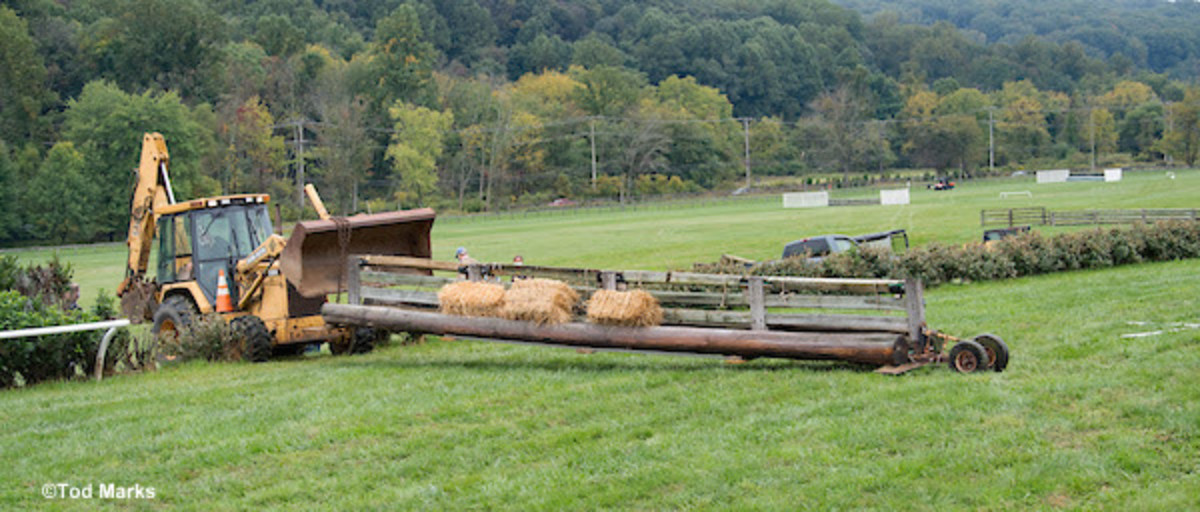
Fenwick (driving the backhoe) wheels a portable timber fence onto the course between races at the 2020 Shawan Downs Point to Point
Great Meadow course manager Bobby Hilton taught them “a lot about turf,” Fenwick adds. “Think about it, he'd say, you're not mowing to make good grass, you're mowing to make good thatch.
“It's the thatch that makes the good cushion.”
Turf management depends, Fenwick says, on what you don't do as much as what you do.
“Three years ago, I stopped fertilizing altogether.” He pauses for dramatic effect. “We traded for poultry litter. One ton per acre, every year in April.
“Game changer.
“My god, it's like putting 120 pounds of nitrogen (fertilizer) on the track,” but without the dreaded negative impacts, he explains.
With the family's Belmont Farm farm equipment sales and consignment, and with generations of experience working the land from a conservation-preservation mindset, Bruce Fenwick knows all too well the dangers of excess nitrogen. Natural fertilizer – chicken litter – breaks down slowly, over time as it rots, releasing nitrogen in bite-sized morsels that the growing grass can access.
It's a win-win for Shawan turf and the environment.
Excess nitrogen from overuse of fertilizer is implicated in acid rain and oxygen-depleted dead zones in water bodies from farm ponds to the Gulf of Mexico. When nitrogen is applied faster than plants' ability to uptake, soil bacteria convert it to nitrate. Water-soluble nitrate is then flushed into the runoff where it pollutes groundwater, streams and coastal pools.
In some farming communities, it's not uncommon for nitrate to render drinking wells unusable.
“Every spring I'd see these giant spinner-spreaders come out and treat all the corn ground around here,” Fenwick traces the natural solution. “There's a big chicken and egg operation in Hampstead, Maryland (a few miles west of the racecourse). We're lucky because the farmer next door does his corn fields every spring and it's easy to get on the same schedule.
“The chicken operations can't spread in winter, so they get these big stockpiles” of already-composting litter.
“We aim for April,” Fenwick says. “Yeah, it's a little stinky and grey for a few days, and has a few feathers in it, but one rainstorm takes care of that.”
Family tradition
Charlie Fenwick Jr., Bruce's brother, serves as race director. He, too, has often thought outside the racecourse rails to make Shawan a success.
One of his most innovative tweaks was something most simple – putting the jocks' room and main scales adjacent to the stable area. It saves time and frustration for riders and working horsemen, and makes the meet run on time, Charlie says. The barn and finish tower are nearly a half-mile apart, which meant a lot of walking – running, between the two until Charlie came up with the new plan.
“There wasn't anything genius about it,” he maintains. “It started with the need to have the races run at (regular) intervals. In our experience, when races get delayed, even a few minutes, people lose interest and by the next-to-last race of the day you're a half-hour behind schedule.
“We started putting the jocks' room down by the stable and van area three years ago. So, instead of a dozen gators ferrying people back and forth and no one ever being where they need to be, the riders have their gear near the barn, and everybody saddles in the stable. When it's paddock time, the horses stage (for the race) and parade up to the tower together.
“They circle under the finish line five or 10 minutes, and all the riders, trainers and horsemen are brought up from the barn to the wire on a farm wagon.”
There's a set of scales for the winner at the tower, and all the others return to the gap by the barn to dismount, untack and weigh-in there.
“It's definitely more fun for the people on the side of the hill.”
Race director Charlie Fenwick says that Wednesday rain showers helped “green up” the racecourse, and five inches of rain a month ago really made a difference.
“I know Bruce doesn't like to be 'called out' and recognized, but he should be. We're both on the race committee and work really hard with a lot of people to make this day a success.”
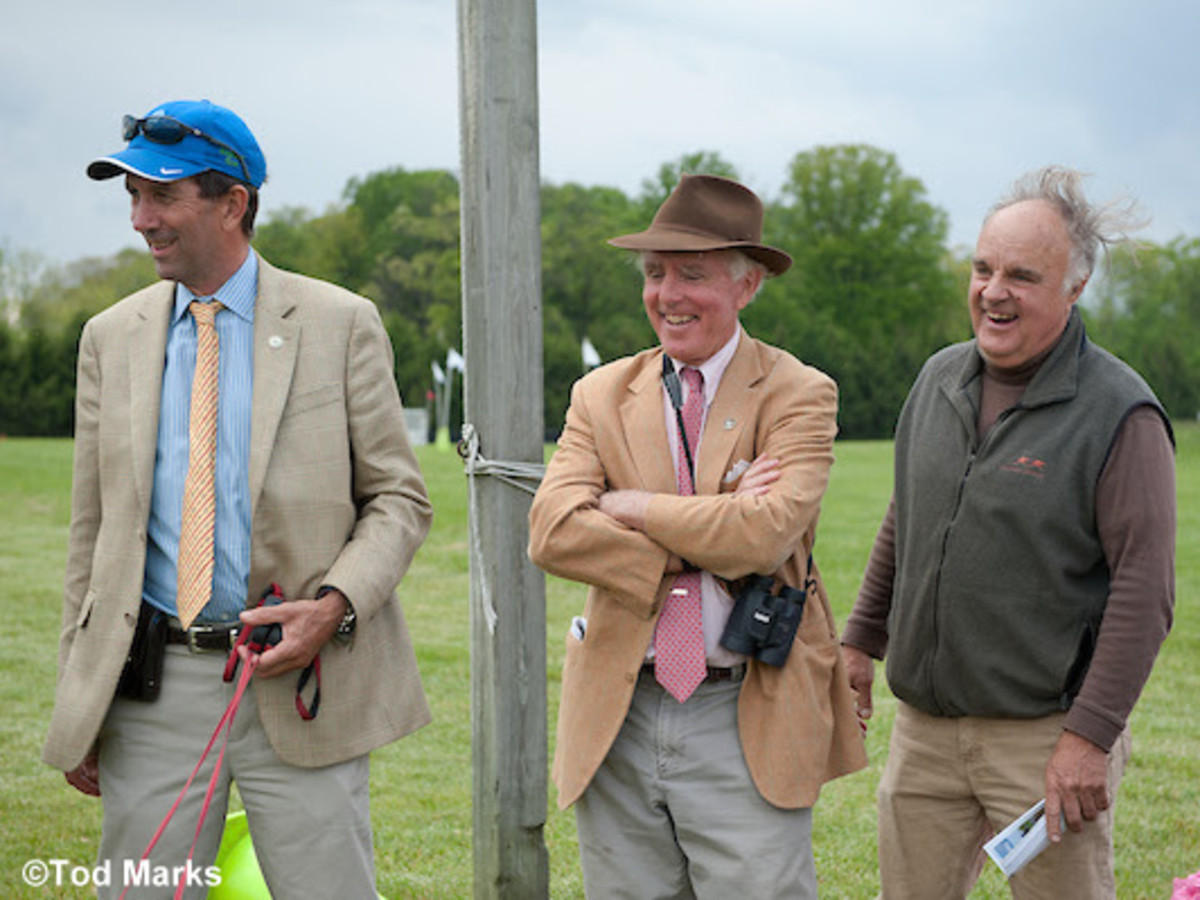
Bruce Fenwick (right) with brother Charlie and neighbor Jack Fisher in 2017.
Jump to it
Shawan modified a timber jump design from New York's Genesee Valley, plus made their fences portable.
Top rails are wedged into firm rubber jump cups, the top rail attached to the upright brace posts with light chains. If a horse hits the top rail hard enough to dislodge it from the jump cup and zip tie, the rail can't go flying and potentially trip up trailing horses. Too, the fence judge or patrol judge can swiftly re-insert the rail in seconds before horses come around the course again.
The portable timber fences can be moved from the course between races, much like the national fence hurdles and the newer EasyFix fences, so the single, irrigated track can accommodate flat, hurdle and timber races.
Timber jumps are 40 feet wide, the base constructed of channel iron and welds with telephone poles lagged onto the takeoff and landing side.
Tail-male pedigree steeped in Maryland timber tradition
Longtime Maryland Hunt Cup race director Charles C. “Cuppy” Fenwick died Dec. 16, 2020.
The retired Baltimore County businessman was born and raised in the Glyndon area.
The youngest of six children, Fenwick's parents were G. Bernard and Margaret G. Fenwick; his great grandfather Arunah Abell created the Baltimore Sun. Fenwick had five children, including National Steeplechase Association horsemen Charlie Fenwick Jr., Bruce Fenwick and NSA board member Peter Fenwick.
A 1942 graduate of Gilman School, Fenwick attended Princeton for a year before enlisting in the infantry for World War II. He was part of the landing force in Normandy in September, 1944. As a member of the 407th infantry's anti-tank company, Fenwick specialized in explosives and took part in the Battle of the Bulge. He laid strategic mines during the Christmas Eve fighting, for which earned a Bronze Star.
Fenwick began his professional career as a clerk with the U.S. Steamship Line for the port of Baltimore. He later co-founded Fenwick, Michaels and Downs, the predecessor of Riggs, Councilman, Michaels and Downs. In 1962, he opened a Volkswagen dealership, Towson Valley Motors. The dealership expanded to include Mercedes-Benz, Audi, Subaru and Porsche. The dealership relocated to Hunt Valley and was renamed Valley Motors.
Fenwick also partnered with William Kidd Sr. to open Bill Kidd's Toyota-Volvo in Cockeysville.
Although he never rode races, Fenwick hunted and served more than 30 years as director of the Maryland Hunt Cup.
Shawan Downs – How'd it happen?
In the early 1800s, Edith and Wilbur Miller's Shawan Farm was filled with horses and dairy cattle, more than 2,500 acres in Maryland's fertile Hunt Valley.
Local foxhunters contested frequent cross-country races and the annual Worthington Valley Horse Show, which benefited the Women's Hospital in Baltimore and was held near Tufton Avenue on Miller land. While the expansive estate has long since been divided, several Miller descendants live on nearby farms.
Shawan Downs was created in 1997 when local conservationists Pedie Killebrew and Charlie Fenwick saw an opportunity to protect the property from development with an open space easement.
They joined with Andre Brewster and the non-profit Land Preservation Trust, buying the property with 19 partners. More than 175 others donated $10,000 or more, each, to share in creating an equestrian venue to remain open in perpetuity.
Today, the 250-acre Shawan Downs hosts the Green Spring Valley Point-to-Point, Shawan sanctioned meet, schooling days, a horse trials, a junior race day and more. Hay is taken from the farm in the late spring and summer.
The 1 1/8th-mile course was designed by former New York Racing Association racetrack superintendent Joe King, noted for its safety and aesthetics. A complete irrigation system enables the course to be maintained at a professional level.
The Land Preservation Trust has worked to protect Baltimore County's agricultural and rural heritage for more than 20 years. LPT is dedicated to the preservation of the region's historic landscape.
To date, property owners have worked with LPT to permanently preserve more than 352 properties protecting almost 13,000 acres.